
Atlantic Canada Opportunities Agency 2026-27 Departmental Plan
© His Majesty the King in Right of Canada, as represented by the Minister of Justice and Attorney General of Canada and Minister responsible for the Atlantic Canada Opportunities Agency, 2026. Catalogue No. AC2-8E-PDF ISSN 2371-719X This departmental plan details the Atlantic Canada Opportunities Agency’s (ACOA) priorities, plans and associated costs for the upcoming three fiscal years. These plans align with the priorities outlined in the Mandate Letter, as well as ACOA’s Vision, mission, raison d’être and operating context. In 2026–27, ACOA will build on Atlantic Canada’s strengths to grow the economy, create wealth and support long-term prosperity while continuing to advance Indigenous economic reconciliation. Our focus for the year includes the following key strategic priorities to enhance productivity and growth, focused on closing the productivity gap of the region: The government is committed to restraining the growth of day-to-day operational spending to make investments that will grow the economy and benefit Canadians. As part of meeting this commitment, ACOA is planning the following spending reductions: It is anticipated that these spending reductions will involve a decrease of approximately 67 full-time equivalents by 2028–29. ACOA will achieve these reductions by finding efficiencies in internal services, programs and service delivery. The figures in this departmental plan reflect these reductions. In 2026–27, total planned spending (including internal services) for ACOA is $389,405,777 and total planned full-time equivalent staff (including internal services) is 534. The following provides a summary of the results the department plans to achieve in 2026–27 under its main areas of activity, called “core responsibilities”. In 2026–27, ACOA will bolster the resilience of Atlantic Canada to promote long-term economic growth in the region. The Agency will provide regionally tailored, client-centric and place-based assistance to SMEs, which accounted for 99.8% of all Atlantic businesses in June 2025Footnote 2 , and to communities in urban and rural areas, the latter of which have accounted for over 40% of ACOA’s projects and expenditures in recent years. ACOA is a key driver of growth and investment built for dynamic times. It was born from a vision of a more productive Atlantic Canada where people get ahead. ACOA’s business clients are 18% more productive than their peers. Workers employed by client firms earn, on average, $36.90 an hour, well above the $28.20 earned by workers at non-client firms in the region. ACOA continues to deliver on the Government of Canada’s priorities, to build One Canadian Economy with strong Atlantic Canadian contributions domestically and globally, to boost business productivity and competitiveness, to diversify local economies, and to leverage regional strengths. This will support many of the Mandate Letter commitments, notably: By prioritizing productivity, competitiveness and diversification, supported by ACOA’s flexible programming and strong client relations, the Agency will help Atlantic Canadian SMEs, sectors and communities navigate economic insecurity, mitigate the impacts trade of disruptions, and secure long-term growth and competitiveness in the region. ACOA will also work with partners to support internal trade and help firms shift to Canadian suppliers, guided by ongoing advocacy and collaboration with other federal agencies and departments, the network of regional development agencies (RDAs) across Canada, the four provincial governments in Atlantic Canada as well as municipalities, Indigenous partners, non-profit organizations, industry associations and other stakeholders such as Community Business Development Corporations. ACOA will also work closely to support the Atlantic Economic Panel on the region’s economy, and will be informed by the panel’s goals for future and sustained economic growth. Finally, ACOA will continue to actively participate in the Organisation for Economic Co-operation and Development’s activities to advance Canadian priorities related to regional development. In support of Canada’s new Climate Competitiveness Strategy, the Agency will explore competitive advantages for growth and position industries for success as they transition to a cleaner economy. In October 2025, the Agency tabled its 2023–2027 Departmental Sustainable Development Strategy – 2024–25 Report, which outlines its contributions to Canada’s sustainable development goals. The Agency’s activities will help drive Atlantic Canada’s economic diversification and low-carbon transition by accelerating the decarbonization of firms and supply chains, advancing clean technology developments in domestic and global markets, mobilizing capital for net-zero transition, and supporting the region’s immense clean energy opportunities. The Agency will continue its strong focus on promoting long-term economic development in the region. Its Regional Economic Growth through Innovation program and Business Development Program will continue to focus on investments that drive economic growth. The Regional Tariff Response Initiative will support SMEs impacted by tariffs, strengthening the competitiveness of Canadian businesses by helping them boost productivity, cut costs, build more resilient supply chains and reach new markets. Other targeted initiatives such as the Regional Defence Investment Initiative and the Regional Artificial Intelligence Initiative will help boost investment in businesses to elevate their products and services and attract greater investments to the Atlantic region in the defence and AI fields. The Agency will remain resolute in its promotion of the Atlantic region across the Government of Canada, including efforts to competitively position Atlantic Canadian firms for defence and Canadian Coast Guard procurement through Canada’s Industrial and Technological Benefits Policy. ACOA will support Indigenous economic reconciliation under its regular programming and delivery of the Northern Isolated Community Initiatives Fund in the Nunatsiavut region of northern Labrador to support food-related initiatives that diversify economic activity. The Agency will improve productivity and efficiency in delivering its programs by integrating new technologies and AI into systems, programs and processes, while staying aligned with government priorities, regional needs and community-focused decision making. More information about Economic development in Atlantic Canada can be found in the full plan. For complete information on ACOA’s total planned spending and human resources, read the Planned spending and human resources section of the full plan. Atlantic Canada: Strengthening Communities, Growing Economies When we think about Canada’s economic future, we often imagine big cities or global hubs. Too often we overlook the opportunities right here in Atlantic Canada. The truth is that the region’s future is being built in our communities, our businesses and our research labs. Across Atlantic Canada, entrepreneurs and innovators are creating new technologies, growing companies and building the skilled workforce that will drive the economy forward. ACOA is helping make that happen. We are supporting small and medium-sized businesses to grow, innovate and compete on the global stage. Investments are helping companies adopt new digital tools, automate processes and prepare people for the jobs of tomorrow. We are working with industry, communities, post-secondary institutions and governments to support clean growth, strengthen supply chains, and position the region to succeed in domestic and international markets. Programming stays flexible and focused on clients. It reflects the strengths and needs of communities. Our commitment to an inclusive economy remains strong. We are advancing Indigenous economic reconciliation, promoting diversity and accessibility, and opening pathways for more people to participate in the economy. These efforts deliver real results: more jobs, growing businesses, thriving communities, and expanded export markets. Small and medium-sized businesses make up almost all firms in the region and drive productivity and higher wages. We are building on this momentum by supporting key sectors such as biosciences, housing manufacturing, cybersecurity, clean technologies, ocean technologies, and aerospace and defence. To ensure Atlantic Canadians benefit from new opportunities, we launched the Atlantic Economic Panel in November 2025. This business-led group is identifying what works, what holds the region back, and how we can grow productivity and competitiveness. At the same time, the federal government is making sure spending is strategic, responsible and effective. ACOA’s services remain open across the region. Investments continue to support growth, innovation and opportunity. Businesses and communities can rely on the supports they need. Now is the time to build on the momentum we have created. Atlantic Canada has the talent, the drive and the innovation to shape the region’s future, and we are making sure the benefits stay here at home. I invite you to explore the 2026–27 Departmental Plan and see how, with federal support and regional leadership, we are creating a stronger, more prosperous future for everyone. The Honourable Sean Fraser, PC, KC, MP Minister of Justice and Attorney General of Canada and Minister responsible for the Atlantic Canada Opportunities Agency Support Atlantic Canada’s economic growth, wealth creation and economic prosperity by building on competitive regional strengths and through inclusive clean growth. Help small and medium-sized enterprise (SME) growth through direct financial assistance, and indirectly through business support organizations. SMEs become more innovative by adopting new technologies and processes, and by pursuing new avenues for expansion and market diversification to compete and succeed in a global market. This core responsibility contributes to the “Prosperity” domain of the Quality of Life Framework for Canada and the indicators of gross domestic product per capita, productivity, investment in in-house research and development (R&D), firm growth and employment. This core responsibility also contributes to the “Environment” domain. This section presents details on the department’s indicators, the actual results from the three most recently reported fiscal years, the targets and target dates for Economic development in Atlantic Canada. Details are presented by departmental result. Table 1 provides a summary of the target and actual results for each indicator associated with the results under Economic development in Atlantic Canada. Table 2 provides a summary of the target and actual results for each indicator associated with the results under Economic development in Atlantic Canada. Percentage of Atlantic Canadian SMEs that are majority owned by women, Indigenous people, youth, visible minorities or persons with disabilities Percentage of professional-, science- and technology-related jobs in Atlantic Canada’s economy Additional information on the detailed results and performance information for ACOA’s program inventory is available on GC InfoBase. The following section describes the planned results for Economic development in Atlantic Canada in 2026–27. In 2026–27, ACOA will remain a reliable source of place-based investments in Atlantic Canada to contribute to a strong Canadian economy. Activities will help Atlantic Canadians, including groups such as Indigenous peoples and rural communities that are under-represented in the economy, to grow the region’s economy. ACOA’s overarching strategic priority will be enhancing productivity and growth. The Agency will emphasize efforts to close the productivity gap of the region, focusing on three areas: The Agency’s focus on productivity, competitiveness and diversification – paired with flexible programming and strong ties to business clients – positions Atlantic Canadian SMEs, sectors and communities to seize new opportunities, strengthen productivity and drive long-term growth. The region’s strong trade relationships, and recent gains in population, employment and investment create ideal conditions to attract capital and become a rising economic force. Through strategic advocacy and pathfinding in national policies and programs, ACOA will help Atlantic Canadian stakeholders navigate disruptions, enhance the region’s value proposition, and ensure it remains a key contributor to Canada’s economic success. The Agency’s delivery will also support the Government of Canada’s Buy Canadian Policy to ensure that public investment supports Canadian-made products and services whenever possible. The Agency will maximize the potential of its suite of programming, including the Regional Economic Growth through Innovation program, one of the Government of Canada’s four flagship platforms for economic development. It will enhance competitiveness and growth through technological development, commercialization, adoption and adaptation, productivity improvements, and market expansion with trusted trading partners. Broad-based support will be complemented by targeted growth-enabling initiatives such as the Regional Tariff Response Initiative, which supports SMEs impacted by tariffs by strengthening the competitiveness of Canadian businesses and helps them boost productivity, cut costs and build more resilient supply chains. This will also help them reach new markets and seize new opportunities, adapt to global trade disruptions, and boost domestic trade. Other targeted initiatives such as the Regional Defence Investment Initiative will accelerate the integration of businesses and regional ecosystems into domestic and international defence supply chains to increase their industrial and innovation capacity. The Regional Artificial Intelligence Initiative will help SMEs adopt and adapt AI solutions by bridging the gap between cutting-edge research and broader marketplace applications, and positioning Atlantic Canadian businesses for future success. ACOA will also support its Indigenous economic reconciliation priority through initiatives under the Agency’s regular programming and the Northern Isolated Community Initiatives Fund in the Nunatsiavut region of Labrador to support food-related initiatives that strengthen and diversify economic activity. ACOA’s key priorities and its Minister’s mandate letter commitments are guiding principles in the achievement of its core responsibilities through the three departmental results below: Results we plan to achieve The Agency will work with SMEs to capitalize on sector strengths and capacities, develop and diversify markets, and scale up by: Results we plan to achieve The Agency will help businesses invest in new technologies to improve their efficiency, productivity, competitiveness and growth, notably by: Results we plan to achieve The Agency will invest in inclusive growth, support the launch and growth of SMEs, and invest in community capacity to plan, attract, hire and retain skilled talent to support a clean and sustainable economy. ACOA will: ACOA programs will be delivered with an inclusion lens to support groups that are under-represented in Atlantic Canada’s economy and among its entrepreneurs and workforce. Capacity-building activities will aim to increase access to opportunities for diverse groups in rural and urban communities. These groups include women, Indigenous people, Black and racialized Atlantic Canadians, persons with disabilities, newcomers, international students, members of the 2SLGBTQIA+ community, youth, older workers, as well as persons living in remote and rural areas, Acadians and francophones. The Agency will include and collaborate with various communities, and actively seek out and incorporate the diverse views of Atlantic Canadian stakeholders on economic development issues. ACOA integrates gender-based considerations for new initiatives, program evaluations, data and reporting mechanisms, including agreements with Statistics Canada for disaggregated data and enhanced administrative data collection with voluntary declarations for under-represented groups and gender and diversity commitments in contribution agreements. ACOA will also foster its internal corporate diversity and inclusiveness with initiatives and the continued implementation of its Employment Equity, Inclusion and Anti-Racism Action Plan. Table 4 provides a summary of the planned spending and full-time equivalents required to achieve results. Complete financial and human resources information for ACOA’s program inventory is available on GC InfoBase. Economic development in Atlantic Canada is supported by the following programs: Additional information related to the program inventory for Economic development in Atlantic Canada is available on the Results page on GC InfoBase. Internal services are the services that are provided within a department so that it can meet its corporate obligations and deliver its programs. There are 10 categories of internal services: This section presents details of the department’s plans to achieve results and meet internal service targets. In 2026–27, internal services will help drive modernization across the Agency, ensuring ACOA continues to uphold its high standard of excellence. To support this work, internal services will: Table 5 provides a summary of the planned spending and full-time equivalents required to achieve results. Complete financial and human resources information for ACOA’s program inventory is available on GC InfoBase. ACOA is resolute in supporting the Government of Canada’s commitment that 5% of the total value of all contracts be awarded to Indigenous businesses. The Agency has surpassed this target every year (2024–25: 12.05%) and plans to continue to meet or surpass the 5% commitment in the future by advocating for the use of Indigenous suppliers. Table 6 presents the current, actual results with forecasted and planned results for the total percentage of contracts the department awarded to Indigenous businesses. ACOA will work to leverage AI in its own operations and ensure that employees are prepared to use artificial intelligence safely and effectively. The Agency plans to: These activities will contribute to the Government of Canada’s objective of increasing productivity and equip employees with the skills needed to leverage new technologies to improve efficiency. ACOA has identified two main risks to fulfilling its mandate. The first is a risk that the Agency’s economic development programming may be affected by external factors that contribute to uncertainties for economic growth in Atlantic Canada, such as potential global trade disruptions. The second is a risk that ACOA’s stakeholders – including other governments, partners, communities and clients – may not have sufficient capacity to identify, develop and successfully implement strategic projects, which could limit the achievement of its program objectives. ACOA will manage these risks by using the flexibility of its programs, including emergency funding, and by drawing on its strong relationships with businesses, clients and communities. The Agency will also use its advocacy role and integrated planning to mitigate potential risks associated with changing economic conditions and the depth of regional stakeholders’ capacity. Finally, ACOA will analyze regional economic issues and collaborate with stakeholders to foster client and community capacity to help achieve targets under key federal priorities. This section provides an overview of ACOA’s planned spending and human resources for the next three fiscal years and of planned spending for 2026–27 with actual spending from previous years. This section presents an overview of the department's planned expenditures from 2023–24 to 2028–29. Table 7 presents ACOA’s spending over the past three years to carry out its core responsibilities and for internal services. Amounts for the 2025–26 fiscal year are forecasted based on spending to date. 390,256,979 29,203,750 The Agency’s 2025-26 forecast spending represents an increase from the 2024–25 actual expenditures, largely due to the addition of temporary funding related to the implementation of the Regional Defence Investment Initiative and Regional Economic Growth through Innovation – Regional Tariff Response Initiative. More financial information from previous years is available on the Finances section of GC Infobase. Table 8 presents ACOA’s planned spending over the next three years by core responsibility and for internal services. 361,832,715 27,573,062 In the 2026–27 Main Estimates, the Agency’s available funding is $389.4 million. This represents a decrease of $30.1 million from the 2025–26 forecast spending of $419.5 million. The variance is explained as follows. In 2027–28, planned spending is $365.5 million, a decrease of $23.9 million from the $389.4 million in the 2026–27 Main Estimates as a result of the following. In 2028–29, planned spending is $309.3 million, a decrease of $56.2 million from the $365.5 million in 2027–28 planned spending as a result of the following. More detailed financial information on planned spending is available on the Finances section of GC Infobase. Information on the alignment of ACOA's spending with Government of Canada’s spending and activities is available on GC Infobase. This section provides an overview of the department's voted and statutory funding for its core responsibilities and for internal services. For further information on funding authorities, consult the Government of Canada budgets and expenditures. Graph 1 summarizes the department’s approved voted and statutory funding from 2023–24 to 2028–29. Actual spending: 2023–24, 2024–25. Planned spending: 2025–26, 2026–27, 2027–28 and 2028–29. Planned spending for 2026–27, 2027–28 and 2028–29 does not include amounts stemming from Budget 2026. For further information on ACOA’s departmental appropriations, consult the 2026–27 Main Estimates. The future-oriented condensed statement of operations provides an overview of ACOA’s operations for 2025–26 and 2026–27. Table 9 summarizes the expenses and revenues that net to the cost of operations before government funding and transfers for 2025–26 and 2026–27. The forecast and planned amounts in this statement of operations were prepared on an accrual basis to strengthen accountability and to improve transparency and financial management. The forecast and planned amounts presented in other sections of the Departmental Plan were prepared on an expenditure basis. Amounts may therefore differ. Planned total expenses for fiscal year 2026–27 are $279.4 million, a decrease of $12.8 million compared to the 2025–26 forecast results. The decrease in planned expenses for fiscal year 2026–27 is due to the sunsetting of several initiatives and the implementation of Refocusing Government Spending and Comprehensive Expenditure Review measures. Total revenues represent the gain on disposal of tangible capital assets. A more detailed Future-Oriented Statement of Operations and associated Notes for 2026–27, including a reconciliation of the net cost of operations with the requested authorities, is available on ACOA’s website This section presents an overview of the department’s actual and planned human resources from 2023–24 to 2028–29. Table 10 shows a summary of human resources, in full-time equivalents, for ACOA’s core responsibilities and internal services for the previous three fiscal years. Human resources for the 2025–26 fiscal year are forecasted based on year to date. Human resource levels at ACOA for 2025–26 are forecasted to be lower than in previous years due to staffing strategies implemented in anticipation of reductions outlined in the Comprehensive Expenditure Review announced in Budget 2025, in addition to cumulative impacts of the Refocusing Government Spending initiative announced in Budget 2023. Table 11 shows information on human resources, in full-time equivalents, for each of ACOA’s core responsibilities and for its internal services planned for the next three years. Human resource levels at ACOA show a decrease to the total full-time equivalents, reflecting the reduction announced in Budget 2025 related to the Comprehensive Expenditure Review, in addition to cumulative impacts of the Refocusing Government Spending initiative announced in Budget 2023. The Agency will continue to achieve its results by allocating its human resources to best support its priorities and programs. The following supplementary information tables are available on ACOA’s website: Information on ACOA’s departmental sustainable development strategy can be found on ACOA’s website. ACOA’s Departmental Plan does not include information on tax expenditures. The tax system can be used to achieve public policy objectives through the application of special measures such as low tax rates, exemptions, deductions, deferrals and credits. The Department of Finance Canada publishes cost estimates and projections for these measures each year in the Report on Federal Tax Expenditures. This report also provides detailed background information on tax expenditures, including descriptions, objectives, historical information and references to related federal spending programs as well as evaluations and GBA Plus of tax expenditures. The Honourable Sean Fraser, PC, KC, MP Laura Lee Langley, President Atlantic Canada Opportunities Agency Part I of the Government Organization Act, Atlantic Canada 1987, R.S.C., 1985, c. 41 (4th Supp.), also known as the Atlantic Canada Opportunities Agency Act. See the Department of Justice Canada website for more information. 1987 Atlantic Canada Opportunities Agency 1-800-561-7862 (toll free in Canada and the United States) 7-1-1 (ask your TTY operator to connect the call to 1-888-576-4444) 506-851-7403On this page
Copyright information
At a glance
Key priorities
Comprehensive Expenditure Review
Highlights for ACOA in 2026–27
Summary of planned results
Core responsibility 1: Economic development in Atlantic Canada
From the Minister

Plans to deliver on core responsibilities and internal services
Core responsibilities and internal services
Core responsibility 1: Economic development in Atlantic Canada
In this section
Description
Quality of life impacts
Indicators, results and targets
Table 1: Departmental result 1 – Businesses are innovative and growing in Atlantic Canada
Departmental Result Indicators
Actual results
Target
Date to achieve target
Number of high-growth firms in Atlantic Canada
880
March 31, 2027
Value of export of goods from Atlantic Canada
$38,000,000,000
March 31, 2027
Value of exports of clean technologies from Atlantic Canada
$800,000,000
March 31, 2027
Revenue growth rate of firms supported by ACOA programs
7%
March 31, 2027
Table 2: Departmental result 2 – Businesses invest in the development and commercialization of innovative technologies in Atlantic Canada
Departmental Result Indicators
Actual results
2026–27 Target
Date to achieve target
Value of business expenditures in R&D by firms receiving ACOA program funding
$125,000,000
March 31, 2027
Percentage of businesses engaged in collaborations with higher-education institutions in Atlantic Canada
15%
March 31, 2027
Table 3: Departmental result 3 – Communities are economically diversified in Atlantic Canada
Departmental Result Indicators
Actual results
2026–27 Target
Date to achieve target
March 31, 2027
33%
March 31, 2027
Amount leveraged per dollar invested by ACOA in community projects
$1.70
March 31, 2027
Plans to achieve results
Departmental result 1 – Businesses are innovative and growing in Atlantic Canada
Departmental result 2 – Businesses invest in the development and commercialization of innovative technologies in Atlantic Canada
Departmental result 3 – Communities are economically diversified in Atlantic Canada
Gender-based Analysis Plus
Planned resources to achieve results
Table 4: Planned resources to achieve results for Economic development in Atlantic Canada
Resource
Planned
Spending
$361,832,715
Full-time equivalents
359
Program inventory
Internal services
In this section
Description
Plans to achieve results
Planned resources to achieve results
Table 5: Planned resources to achieve results for internal services this year
Resource
Planned
Spending
$27,573,062
Full-time equivalents
175
Planning for contracts awarded to Indigenous businesses
Table 6: Percentage of contracts planned and awarded to Indigenous businesses
5% Reporting Field
2024–25 Actual Result
2025–26 Forecasted Result
2026–27 Planned Result
Total percentage of contracts with Indigenous businesses
12.05%
5%
5%
Department-wide considerations
In this section
Related government priorities
Artificial intelligence
Key risks
Planned spending and human resources
Spending
Budgetary performance summary
Table 7: Three-year spending summary for core responsibilities and internal services (dollars)
Core responsibilities and Internal services
2023–24 Actual Expenditures
2024–25 Actual Expenditures
2025–26 Forecast Spending
Economic development in Atlantic Canada
447,178,438
368,846,946
Internal services
31,252,148
31,621,353
Total
478,430,586
400,468,299
419,460,729
Analysis of past three years of spending
Table 8: Planned three-year spending on core responsibilities and internal services (dollars)
Core responsibilities and Internal services
2026–27 Planned Spending
2027–28 Planned Spending
2028–29 Planned Spending
Economic development in Atlantic Canada
338,416,991
283,148,662
Internal services
27,085,860
26,110,987
Total
389,405,777
365,502,851
309,259,649
Analysis of the next three years of spending
Funding
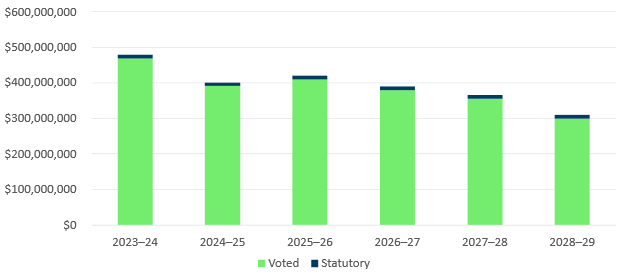
Text description of graph 1
Fiscal year
Total
Voted
Statutory
2023–24
$478,430,586
$468,950,861
$9,479,725
2024–25
$400,468,299
$391,124,459
$9,343,840
2025–26
$419,460,729
$409,887,714
$9,573,015
2026–27
$389,405,777
$379,178,994
$10,226,783
2027–28
$365,502,851
$355,456,429
$10,046,422
2028–29
$309,259,649
$299,631,005
$9,628,644
Analysis of statutory and voted funding over a six-year period
Future-oriented condensed statement of operations
Table 9: Future-oriented condensed statement of operations for the year ended March 31, 2027 (dollars)
Financial information
2025–26 Forecast
results2026–27 Planned results
Difference (Planned results minus forecast)
Total expenses
292,220,998
279,442,146
(12,778,852)
Total revenues
21,857
33,766
11,909
Net cost of operations before government funding and transfers
292,199,141
279,408,380
(12,790,761)
Analysis of forecasted and planned results
Human resources
Table 10: Actual human resources for core responsibilities and internal services
Core responsibilities and internal services
2023–24 Actual full-time equivalents
2024–25 Actual full-time equivalents
2025–26 Forecasted full-time equivalents
Economic development in Atlantic Canada
371
364
341
Internal services
199
205
202
Total
570
569
543
Analysis of human resources over the last three years
Table 11: Human resources planning summary for core responsibilities and internal services
Core responsibilities and internal services
2026–27 Planned full-time equivalents
2027–28 Planned full-time equivalents
2028–29 Planned
full-time equivalentsEconomic development in Atlantic Canada
359
353
338
Internal services
175
170
159
Total
534
523
497
Analysis of human resources for the next three years
Supplementary information tables
Federal tax expenditures
Corporate information
Departmental profile
Appropriate minister:
Institutional head:
Ministerial portfolio:
Enabling instrument:
Year of incorporation / commencement:
Departmental contact information
Mailing address:
P.O. Box 6051
Moncton, New Brunswick
E1C 9J8Telephone:
TTY:
Fax:
Email:
Website:
Definitions
List of terms
Using GBA Plus involves taking a gender- and diversity-sensitive approach to our work. Considering all intersecting identity factors as part of GBA Plus, not only sex and gender, is a Government of Canada commitment.
A department is expected to be aware of the authorities that it has sought and received. The determination of planned spending is a departmental responsibility, and departments must be able to defend the expenditure and accrual numbers presented in their Departmental Plans and Departmental Results Reports.Page details