
HUMA Committee briefing binder: Appearance by the Secretary of State (Seniors), October 28, 2025
Official title: Appearance by: Secretary of State (Seniors), Standing Committee on Human Resources, Skills and Social Development and the Status of Persons with Disabilities (HUMA) Mandate and Priorities Date: October 28, 2025, 11:00 a.m. - 12:00 p.m.
On this page
- Opening Remarks
- Parliamentary Environment
- Seniors
- Seniors Poverty
- Market Basket Measure (MBM)
- Old Age Security (OAS)
- Old Age Security Recovery Tax
- Old Age Security (former Bill C-319)
- Guaranteed Income Supplement Indexation
- Canada Pension Plan
- Third Pillar of the RIS (retirement income system)par
- Housing
- Long Term Care
- New Horizons for Seniors Program
- Age Well at Home Initiatives
- Combatting Fraud for Seniors
- Care Economy
- Potential UN Legally Binding Instrument on the Rights of Older Persons
- OAG Audit on Seniors Program
- Seniors GBA+ (Gender-Based Analysis Plus)
- Service Delivery
- Corporate Issues
- Mandate Priorities
1. Opening remarks
Opening Remarks For the Honourable Stephanie McLean, Secretary of State (Seniors), and Member of Parliament for Esquimalt-Saanich-Sooke, For an Appearance before the Standing Committee on Human Resources, Skills and Social Development and the Status of Persons with Disabilities (HUMA)on Mandate and Priorities - Strengthening CPP, OAS, GIS, dealing with service delays, and improving processing time. House of Commons. October 28, 2025.
Check against delivery.
Mr. Chair, I would like to start by thanking the members of HUMA for their commitment to older Canadians.
The Government of Canada shares this commitment.
And I am honoured, as Secretary of State for Seniors, to talk about the actions we're taking to help older Canadians age with dignity.
I am in awe of the contributions Canadian seniors are making in our communities every day.
And I will continue to uphold the Government of Canada's commitment to providing services that help seniors where they live.
Services that make a positive difference and help give older adults the opportunity to thrive in their communities.
Because everyone deserves to age with dignity.
Mr. Chair, I'd like to start by recognizing the outstanding contribution of older Canadians.
They're an important part of our social fabric, and they contribute to a stronger Canada.
We're unwavering in our mission to support those who built this country through a lifetime of hard work.
And we have an action plan to make sure that all seniors receive their benefits as quickly as possible.
They deserve no less.
Mr. Chair, many of the elements of our previous benefits delivery system were built more than 60 years ago.
So we're modernizing it and are bringing benefits like the Old Age Security program and the Canada Pension Plan onto one user-friendly platform.
We're making sure it's functional, fast, and responsive to Canadians' needs.
It's a massive undertaking, so we're doing it in phases and with the utmost care.
OAS was the first benefit program to migrate to this new platform.
In June 2023, we successfully transferred 600,000 OAS clients onto the new platform.
In March 2025, we added 7.4 million more.
Then, at the end of April, these 7.4 million seniors received their OAS payments through this new platform, accurately and on time.
This was a giant digital leap forward in the way we serve Canadians.
It means that millions of OAS clients now have access to self-serve options like applying for benefits online.
I want to take a moment to thank those who worked hard to make this milestone a reality.
They took the time to get it right, and it wouldn't have been possible without them.
Mr. Chair, filing an income tax return should be easy.
So we're automating the process for the 2026 tax year with a pre-filled tax return for about 1 million lower-income Canadians.
And our goal is to expand this service to 5.5 ;million Canadians for the 2028 tax year.
Simply put, the Government of Canada is making the tax system work for all Canadians, young and old.
And we're helping them build for the future with greater confidence.
Mr. Chair, OAS and CPP are two key pillars in Canada's Retirement Income System.
Together with income from the workplace pension plans and personal savings that form the third pillar, they create a stable base upon which Canadians can build a secure future.
And the OAS program plays a significant role in helping them do so.
In July 2022, the OAS pension was permanently increased by 10% for seniors aged 75 and over.
This provided more than $800 extra for full pensioners over the first year.
The OAS program paid over $76 billion in benefits to 7.4 million beneficiaries in 2023 to 2024, including $18 billion in GIS benefits to 2.5 million low-income beneficiaries.
We understand the importance of ensuring quick, convenient access to these benefits. So far this year, we've improved speed of pay for Old Age Security and the Canada Pension Plan Disability Benefit.
For the GIS, over 96% of our clients were automatically reassessed thanks to the new benefits delivery platform.
OAS benefits are indexed quarterly to the cost of living, meaning that benefits can never go down.
The CPP is also indexed and is one of the top-ranking public retirement plans in the world.
It's both a pension plan and a social insurance program.
And it's also the largest survivor and disability insurance program in Canada.
This gives protection to disabled contributors and their families as well as to the families of deceased contributors.
Mr. Chair, we know these benefits work.
Because the poverty rate among older Canadians has been declining over time.
And this is due in large part to benefits like OAS and the CPP.
Mr. Chair, we're focused on making sure that older Canadians receive every dollar they're entitled to.
Because supporting seniors is not just a policy, it's a promise that we'll always uphold.
Thank you.
2. Parliamentary environment
a. Scenario note
The Standing Committee on Human Resources, Skills and Social Development and the Status of Persons with Disabilities (HUMA) Mandate/Key Priorities October 28, 2025 - 11:00-12:00
Overview
On June 18, 2025, the Standing Committee on Human Resources, Skills and Social Development and the Status of Persons with Disabilities (HUMA) passed a motion to invite "the Minister of Jobs and Families, the Minister of Housing and Infrastructure, the Secretary of State for Seniors, the Secretary of State for Labour, and the Secretary of State for Children and Youth to appear separately before the committee, each accompanied by their officials, for a minimum of one hour, to appear to discuss to the Committee to discuss to discuss their respective mandates and key priorities in their service to Canadians".
Committee proceedings
- During this appearance, will be provided with 5 minutes to deliver your opening remarks. Following that, questioning will begin.
- The first round of questions will give 6 minutes each to the CPC, LPC and BQ, in that order.
- The second (and subsequent rounds) of questions allocate 5 minutes to the CPC and LPC, 2 and a half minutes to the BQ, and then 5 minutes to the CPC and the LPC.
- Senior officials will be in attendance to support you:
- Paul Thompson, Deputy Minister of Employment and Social Development
- There are no outstanding follow up written responses due to the Committee.
Parliamentary environment
- During the previous parliament at HUMA, housing had been a key topic of interest, having occupied 16% of the Committee's time during that previous Parliament, while accessibility and labour, together accounted for 22% of the Committee's time, and nearly 30% on Mandate and Estimates ministerial appearances.
- In relation to the motion on Mandate and Priorities, you will be the first to appear. Your colleagues for Children and Youth is expected to appear on November 18, for Labour on November 20, and Minister Hajdu is scheduled to go for 2 hours on November 25.
- Following the completion of the current Youth Employment in Canada study, HUMA will undertake a study on "the impact of the lack of a definition of the term 'work' in Part III of the Canada Labour .Code and into the Government's routine use of section 107 of the Canada Labour Code to refer labour disputes to the Canada Industrial Relations Board (CIRB) for binding arbitration".
Conservative Party of Canada
- CPC HUMA members have not discussed seniors' issues during Committee meetings so far, focusing rather on youth unemployment.
- Anna Roberts, CPC seniors critic, will likely be present and may ask questions similar to her OPQ Q-436 on department/budget, car/driver, deputy minister/highest level public official, and attendance of Cabinet meetings.
- CPC MPs have often discussed the impact of inflation on seniors.
Bloc Québécois
- The BQ HUMA member has not discussed seniors' issues during Committee meetings.
- Andréanne Larouche, BQ seniors critic, is expected to be present. Recently in the House of Commons, she's raised food insecurity and food bank use among seniors and has called for a review of how pensions are indexed.
- BQ questioning may focus on OAS increase of 10% for those aged 65 to74.
Other topics that could be raised include
- Cúram Social Program Management for Old Age Security.
- HUMA members may discuss the findings of the Auditor General 2024 Report 11-Programs to Assist Seniors.
b. Members biographies
House of Commons Standing Committee on Human Resources, Skills and Social Development and the Status of Persons with Disabilities (HUMA) - Membership
Robert J. Morrissey - Chair
Liberal, Egmont, Prince Edward Island

Brief biography
First elected in 2015, Bobby Morrissey served as a Member on the Standing Committee on Fisheries and Oceans (FOPO), the Liaison Committee as well as the Standing Committee on Human Resources, Skills and Social Development and the Status of Persons with Disabilities (HUMA). He served as Chair of the HUMA during the 44th Parliament and was re-elected as Chair for the 45th Parliament.
Previously, he was elected to the Prince Edward Island Legislative Assembly in 1982 and has dedicated his career and volunteer life to serving the residents of PEI. Having served as MLA for nearly 20 years, Bobby has a deep understanding of his communities' needs. He has held a number of high-profile roles within the Assembly, such as Minister of Transportation and Public Works, Minister of Economic Development and Tourism, and Opposition House Leader. He was also responsible for the redevelopment of the Canadian Forces Base Summerside and the surrounding community following its closure by the federal government in 1989.
Bobby left politics in 2000 to join the private sector as a consultant specializing in government relations, fisheries, and the labour market. Bobby has been a member of the Board of Directors for the Heart & Stroke Foundation of PEI. He was the founding member and former president of the Tignish Seniors Home Care Co-op, and Vice-Chair of Tignish Special Needs Housing.
Caroline Desrochers
Liberal, Trois-Rivières, Quebec

Brief biography
Caroline Desrocher was first elected in the general election of 2025 for the constituency of Trois-Rivières, Quebec. She is Parliamentary Secretary to the Minister of Housing and Infrastructure.
Born in Montreal, Québec, she has a bachelor's degree in economics from Concordia University in 2000, Caroline Desrochers has worked as a diplomat and civil servant before first running for office in 2021, when she was defeated.
Caroline brings a rich background in diplomacy, economics, and public service to her role, one that naturally intersects with issues of language rights and minority communities across Canada. Her affiliation and committee work suggest alignment with federal efforts to Strengthen the Official Languages Act and Support Community Institutions.
Jessica Fancy
Liberal, South Shore—St. Margarets, Nova Scotia

Brief biography
Elected in April 2025, Jessica Fancy is a Member of Parliament for South Shore-St. Margarets, Nova Scotia.
Born and raised on a mushroom farm in Caledonia, Queens County, Jessica has deep roots in the region. She spent more than 20 years as an educator, shaping the lives of countless young people in her community. Along the way, she earned two Master of Education degrees from Memorial University — one in Curriculum and Instruction, and the other in Educational Leadership. She has coached local youth sports, led the Rural Communities Foundation of Nova Scotia, and worked tirelessly to direct millions of dollars in investments toward community initiatives.
Her advocacy has focused on addressing food insecurity, strengthening education, and promoting environmental sustainability. Her key interests involve the concerns and contributions of rural communities in Canada
Natilien Joseph
Liberal, Longueuil—Saint-Hubert, Quebec

Brief biography
Elected in April 2025, Natalien Joseph is a Member of Parliament for Longueuil-Saint-Hubert, Quebec.
Born in Haiti, Natilien Joseph arrived in Quebec nearly 8 years ago. He obtained a Diploma of Vocational Studies (DVS) in refrigeration assembly and repair, a DVS in truck transport at the CFTC in Charlebourg, and a Diploma of College Studies (DCS) in residential real estate brokerage at the Institut Teccart in Brossard in 2021.
He worked as a residential real estate broker on Montreal's South Shore for over a year, before switching to paratransit. His interests include the need of government to address housing concerns among Canadians, including the fight against homelessness and access to affordable housing.
Annie Koutrakis
Liberal, Vimy, Quebec

Brief biography
First elected to the House of Commons in 2019, Annie Koutrakis is the Member of
Parliament for Vimy and the Parliamentary Secretary to the Minister of Jobs and Families. During the 44th Parliament she acted as Parliamentary Secretary to the Minister of Tourism and Minister responsible for the Economic Development Agency of Canada for the Regions of Quebec and Parliamentary Secretary to the Minister of Transport. She was also a member of the Standing Committee on Official Languages (LANG), the Standing Joint Committee on the Library of Parliament (BILI), the Standing Committee on Transport, Infrastructure and Communities (TRAN) and the Special Joint Committee on Medical Assistance in Dying (AMAD).
Prior to becoming a Member of Parliament, Annie Koutrakis worked in full-service investment firms for 30 years, reaching the position of Vice President, Branch Manager, Advisor Services for a major financial services firm. A fervent believer in volunteerism, she has been involved in several community organizations, acting as President, CEO, Chair of the Executive Committee and member of the Board of Directors of the Hellenic Community of Greater Montreal, the Board of CLSC Normand-Bethune (now CLSC du Ruisseau-Papineau), the Board of Directors of Hellenic Social Services of Quebec, the Parents Committee at Ecole Démosthènes, the Alexandria Fundraising Committee in Laval, and the Board of the Hellenic Board of Trade of Montreal. She has also volunteered in municipal, provincial, and federal elections in various roles.
Rosemarie Falk - Vice Chair
Conservative, Battlefords—Lloydminster—Meadow Lake, Saskatchewan

Brief biography
Rosemarie Falk has been the Member for Parliament for Battlefords-Lloydminster since 2017. She served as Vice-Chair for HUMA during the 44th Parliament and was re-elected in that role for the 45th Parliament. During the 44th Parliament, she also served on the Standing Committee on Citizenship and Immigration (CIMM). She has acted as the Official Opposition's Associate Shadow Minister for Labour Since October 2022. She was the sponsor for Bill C-318, An Act to amend the Employment Insurance Act and the Canada Labour Code (adoptive and intended parents), during the 44th Parliament.
Born and raised in Lloydminster, she has always been actively engaged in her community. Rosemarie has previously worked as a registered Social Worker in Saskatchewan and has a Bachelor of Social Work from the University of Calgary. Throughout her social work career and extensive volunteer work she has worked with some of the most vulnerable members of the community. She was previously a legal assistant specializing in family law and as a legislative assistant in federal politics. She is committed to being a strong voice for seniors, families, taxpayers and rural communities.
Garnett Genius
Conservative, Sherwood Park—Fort Saskatchewan, Alberta

Brief biography
Garnett Genius was first elected in 2015. During the 44th Parliament, he was the Vice-Chair and member of Standing Committee on Foreign Affairs and International Development (FAAE), member of the Standing Committee on Government Operations and Estimates (OGGO), the Standing Committee on Public Accounts (PACP), and the Standing Committee on Citizenship and Immigration (CIMM).
Mr. Genuis holds a Bachelor of Public Affairs and Policy Management from Carleton University and master's degree in public policy from the London School of Economics. Prior to running for office, he worked in the Prime Minister's Office under Stephen Harper. Currently the Conservative Shadow Minister for Employment, he was previously Critic for International Development and Human Rights and the Conservative Critic for Canada-China Relations and Multiculturalism.
He is a proponent of freedom of expression and has a strong interest in democracy and the rule of law.
Laila Goodridge
Conservative, Fort McMurray—Cold Lake, Alberta

Brief biography
Laila Goodridge was first elected as the Member of Parliament for Fort McMurray-Cold Lake in September 2021. During the 44th Parliament she served on the Standing Committee on Health (HESA), the Standing Committee on Official Languages (LANG) and the Standing Committee on the Status of Women (FEWO).
She was first elected to the Legislative Assembly of Alberta as the MLA for Fort McMurray-Conklin in a by-election in 2018 and then re-elected in the general election of 2019 as MLA for Fort McMurray-Lac La Biche. Argues for support for minority language groups and support for the natural resources industry, particularly regarding the oil and gas industry. Previously, she was a policy advisor for the oil and sands industry. She was previously the Shadow Minister for Families, Children and Social Development and Addictions and is now the Conservative Shadow Minister for Social Development and Families.
Colin Reynolds
Conservative, Elmwood—Transcona, Manitoba

Brief biography
Elected in April 2025, Colin Reynolds is the new Member of Parliament for Elmwood-Transcona, Manitoba.
A construction electrician and member of IBEW Local 2085, Colin Reynolds grew up in the Valley Gardens neighborhood. He advocates fiscal responsibility, aiming to reduce taxes and government spending to alleviate financial pressures on families and businesses.
Colin Reynolds positions himself as a strong advocate for workers, especially those in skilled trades. He supports policies focused on lowering taxes, improving housing affordability and strengthening public safety.
Marilène Gill - Vice Chair
Bloc Québécois, Côte-Nord—Kawawachikamach—Nitassinan, Quebec

Brief biography
Originally from Sorel, Quebec, Marilène Gill has served as the Bloc Québécois Member of Parliament for the riding of Côte-Nord-Kawawachikamach-Nitassinan (formerly Manicouagan) since 2015. She currently holds the position of Deputy Whip for the Bloc Québécois and serves as the opposition critic for Employment and Social Development Canada (ESDC).
She now holds the role of Vice-Chair on the Standing Committee on Human Resources, Skills Development, Social Development and the Status of Persons with Disabilities. During the 44th Parliament, she served as Vice-Chair of the Standing Committee on Indigegous and Northern Affairs.
Prior to her first election in 2015, Marilène Gill taught at the college level while pursuing doctoral studies in literature. She holds a master's degree in literary studies from the Université du Québec à Trois-Rivières (2004).
3. Seniors
a. Seniors poverty
Issue
How is the Government of Canada helping address poverty and food insecurity among seniors?
Background
- The Government has made significant investments in social programs and income supports to reduce poverty and food insecurity among seniors, including by
- Restoring the age of eligibility from 67 to 65 for both the Old Age Security (OAS) pension and the Guaranteed Income Supplement (GIS), which helped 100,000 seniors aged 65 and 66 to avoid falling into poverty
- Increasing the maximum GIS benefit for single seniors by 10% in 2016, improving the financial security of close to 900,000 seniors who rely almost exclusively on the OAS pension and the GIS. This provided up to $1,150 in additional benefits in 2023, indexed to inflation every quarter
- Raising the OAS pension by 10 per cent for seniors 75 years and older, which provided more than $800 in new support to full pensioners over the first year, and increased benefits for more than 3 million seniors
- Indexing OAS benefits quarterly to keep pace with the rising cost of living
Key facts
- The latest data from the Canadian Income Survey shows that the poverty rate for seniors was 5.0% in 2023 as measured by Canada's Official Poverty Line (the Market Basket Measure), compared to 6.0% in 2022. The 2023 poverty rate for seniors represents a 30% decrease in the poverty rate compared to 2015 (7.1%). There were approximately 21,000 fewer seniors living in poverty in 2023 compared to 2015. The number of seniors living in poverty in 2023 was estimated at 373,000
- In 2023, the poverty rate for senior women (5.2%) was slightly higher than for senior men (4.9%)
- Single seniors continue to have higher poverty rates than those living in families. The poverty rate for single seniors was 11.5% in 2023, while the poverty rate for seniors living in families was 2.7%.
- In 2023, seniors aged 75 and older had a lower poverty rate (3.8%) than those aged 65 to 74 (5.9%). Both rates declined from 2015, when they were 7.6% and 6.8% respectively
- In 2023, seniors from vulnerable groups such as Indigenous seniors living off reserve (7.9%), immigrant seniors (7.0%), seniors with disabilities (6.5%) and visible minority seniors (8.7%) had relatively higher poverty rates than the overall senior population (5.0%)
- According to the 2023 Canadian Income Survey, 9.0% of Canadian seniors experienced food insecurity in 2023 (measured as moderate or severe food insecurity), significantly lower than the national average (19.1%). Yet, this rate was up from 8.0% in 2022 and 6.3% in 2021
- According to Food Banks Canada, a national charitable organization representing the food bank community across Canada, there were over 2 million visits to food banks in March 2024, an all-time high. About 158,600 or 7.7% of food bank visits were by seniors in March 2024, up from about 74,000 or 6.8% in March 2019
Key messages
- Our Government is committed to continuing to build a strong economy that works for everyone by bringing down costs for Canadians - including seniors - and helping them to get ahead
- We understand that food prices and overall cost of living are putting pressure on Canadians, including seniors. We are taking action to help ensure Canadians can meet their basic needs, including being able to afford nutritious food
- To support seniors, the Government has made significant investments, including increasing the maximum GIS for single seniors, and increasing the OAS pension for seniors 75 and older. OAS benefits are also indexed quarterly to help keep up with the rising cost of living
- We are also making historic investments in key initiatives that support seniors' well-being, such as Canada's Housing Plan and the Canadian Dental Care Plan
- Our poverty reduction efforts are working. The poverty rate among seniors stood at 5.0% in 2023, which represents a 30% reduction since 2015
- We will continue to stand with seniors who are feeling the impact of higher costs and ensure they have the support they need to meet their basic needs and live with dignity
b. The Market Basket Measure (MBM) - Canada's Official Poverty Line
Issue
The Poverty Reduction Act (2019) established the Market Basket Measure (MBM) as Canada's Official Poverty Line. The MBM is an absolute measure of income poverty developed in Canada.
Background
- The MBM establishes poverty thresholds based on the cost of a basket of food, clothing, shelter, transportation, and other items representing a modest, basic standard of living. The current MBM methodology establishes thresholds for 53 different geographic regions in the provinces and territories, which can be adjusted to families of different sizes. Regional variation of poverty thresholds allows the MBM to account for differences in the cost of living
- To determine if an individual or family lives in poverty, the MBM compares their disposable income to the regional threshold applicable to their family size. If the disposable income of an individual or family is below such threshold, they are considered to live in poverty
- For the purposes of the MBM, disposable income is defined as total income (including government transfers) after deducting not only income taxes but also several non-discretionary expenditures such as Employment Insurance (EI) and Canada Pension Plan (CPP)/Quebec Pension Plan (QPP) contributions, child care expenses and direct medical expenses. The calculation of disposable income also takes into account the financial impacts of different housing tenure types, such as mortgage-free home ownership and subsidized rental housing.
- Statistics Canada, in collaboration with Employment and Social Development Canada, launched the Third Comprehensive Review of the MBM in June of 2023. The review is expected to end in November of 2025 with the release of an updated MBM methodology known as the 2023-base of the MBM.
Key facts
- In 2023 (latest year for which poverty estimates are available), annual poverty thresholds based on the MBM varied across provinces and territories as follows:
| MBM | 1 person | 2 persons | 4 persons |
|---|---|---|---|
| MBM Lowest Threshold across provinces (Quebec, pop 30,000 to 99,999) | 7. $22,625 | 8. $31,997 | 9. $45,250 |
| MBM Highest Threshold across provinces (Vancouver) | 10. $29,082 | 11. $41,127 | 12. $58,163 |
| MBM Highest Threshold in Yukon (Rural North) | 13. $31,715 | 14. $44,852 | 15. $63,430 |
| MBM Highest Threshold in Northwest Territories (Sahtu) | 16. $42,908 | 17. $60,681 | 18. $85,816 |
| MBM Highest Threshold in Nunavut (Iqaluit) | 19. $54,467 | 20. $77,027 | 21. $108,933 |
- According to the table above, a senior living alone would face a poverty threshold of $22,625 in Quebec regions with a population between 30,000 and 99,999. On the other hand, a senior living alone in Vancouver would face a higher threshold at $29,082
Key messages
- We are committed to improving the quality of life for seniors now and for generations to come
- The Government has made significant investments to reduce poverty among seniors, including improvements to the OAS pension and the GIS, as well as restoring the age of eligibility from 67 to 65 for both benefits, increasing the GIS for the lowest income single seniors, and increasing the OAS pension for seniors 75 years and older
- Our efforts to reduce poverty among seniors are working. According to the latest available data, the poverty rate among seniors decreased from 7.1% in 2015 to 5% in 2023. The poverty rate for seniors in 2023 was less than half the poverty rate among Canada's overall population (10.2%)
c. The Old Age Security (OAS) pension
Issue
How is the Old Age Security (OAS) pension supporting seniors?
Background
- The OAS program plays a significant role in providing income security to Canadians in their senior years. Its objective is to provide a minimum level of income to seniors and contribute to their income replacement in retirement
- The benefits under the OAS program include:
- the quasi-universal OAS pension, which is paid to all seniors aged 65 or over who meet the residence and legal status requirements
- the Guaranteed Income Supplement (GIS) which provides additional support for OAS pensioners who have little or no income other than the OAS pension
- the Allowances for low-income Canadians aged 60 to 64 who are the spouses or common-law partners of GIS recipients, or who are widows or widowers
- To ensure that they retain their value over time, OAS benefits are reviewed 4 times per year (in January, April, July and October) in accordance with changes in the Consumer Price Index (CPI). The CPI measures the price of a collection of foundational goods and services, such as food, shelter, gas and clothing, commonly purchased by Canadian households
- Quarterly indexation ensures that benefits are increased quickly when prices go up. In addition, the Old Age Security Act contains a guarantee ensuring that benefits can never be reduced, even in the event of a decline in the CPI
Key facts
- In 2023 to 2024, $76.1 billion was paid in OAS program benefits (OAS, GIS and Allowance) to 7.3 million beneficiaries this included $57.4 billion in OAS pension benefits
- In October 2025, a senior aged 65 to 74 can receive a maximum monthly OAS pension benefit of $740.09, while a senior aged 75 and over can receive a maximum monthly benefit of $814.10
- For the October to December 2025 quarter, OAS pension benefits increased by 0.7% compared to the July to September 2025 quarter, for a cumulative increase of 1.7% over the past year, from October 2024 to October 2025. In 2024 to 2025, 87.5% of OAS benefits were paid within the first month of entitlement, compared to 86.6% in 2023 to 2024 and 87.6% in 2022 to 2023. The service standard target is 90%
- In March 2025, the OAS program successfully migrated from its 60-year-old system to a new and modern system platform called Cúram
- Service Canada will continue to modernize OAS service delivery through a digital first approach and will continue to expand automation and the use of new and emerging technology such as Artificial Intelligence (AI) to enhance service to Canadians
Key messages
- The Government of Canada is committed to strengthening public pensions and improving the lives of Canada's seniors
- Since 2016, the Government has implemented several enhancements to the OAS pension to improve the financial security of Canadian seniors
- In 2016, the Government restored the age of eligibility for the Old Age Security pension to 65, preventing thousands of future 65- and 66-years olds from falling into poverty
- In July 2022, the Old Age Security pension was increased by 10 per cent for seniors aged 75 and over to provide additional support to seniors as they age
- The Government is also helping low-income OAS pensioners through enhancements to the Guaranteed Income Supplement (GIS). In 2016, the Supplement amount for the lowest income single seniors was increased by 10 per cent, providing up to almost $1,150 in additional benefits in 2023, indexed to inflation every quarter. In 2020, the Guaranteed Income Supplement Earnings Exemption was enhanced to further assist low-income seniors who work
- Since 2025, the Government is focused on bringing down costs, keeping communities safe, diversifying trade, and building one Canadian economy. It has already passed legislation to cut taxes for the middle class and first-time home buyers. The Government will continue to review measures to make life more affordable for Canadians
- With seniors among the fastest-growing segment of the Canadian population, the government is committed to ensuring Seniors receive the level of service they have come to expect while modernizing for the future
- As a Department, ESDC and Service Canada are committed to ensuring continued timely service delivery to seniors by simplifying communications to clients, streamlining processes, enhancing the client experience and increasing efficiencies through its digital first delivery focus and the use of automation and Artificial Intelligence (AI)
Questions and answers
Q1. How is entitlement to the OAS pension determined?
A1. To receive an OAS pension, a person must be at least 65 years of age, meet the residence requirements, and be lawfully in Canada on the day their application is approved.
The amount of a person's OAS pension is determined by how long they have resided in Canada:
- to qualify for a full OAS pension, a person must have lived in Canada for at least 40 years after the age of 18
- a person is eligible for a partial OAS pension if they have lived in Canada between 10 and 39 years after the age of 18. The partial pension is paid at the rate of 1 to 40 of the full amount for each year of residence in Canada after 18 years of age
Prorating the OAS pension based on the number of years of residence in Canada provides a good compromise between a person's contribution to Canadian society, and the right to a lifelong pension.
Q2. Why is the OAS pension higher for seniors aged 75 and over?
A2. In July 2022, the OAS pension was permanently increased by 10% for seniors aged 75 and over.
This measure was designed to help address the increased financial vulnerability that seniors face as they age.
Seniors are living longer than ever before. With increasing age, seniors tend to have lower incomes and often face higher health-related expenses because of the onset of illness or disability.
This financial vulnerability is further compounded by fewer opportunities to supplement income with paid work, and the risk of outliving personal savings.
Q3. The leader of the opposition party, the Honourable Pierre Poilievre, has stated that seniors are being affected by tariffs. What is the Government doing to reduce costs for seniors?
A3. Our Government is committed to strengthening public pensions and improving the lives of Canada's seniors.
To keep pace with the cost of living, OAS benefits are reviewed 4 times per year (in January, April, July and October) in accordance with changes in the CPI. Quarterly indexation allows for faster benefit increases. In the event of a decline in the CPI, the Old Age Security Act guarantees that OAS benefit amounts stay at the same level as during the previous quarter.
Because the OAS pension is indexed quarterly, benefit increases may look small. However, when the change in the inflation rate is taken into consideration over the course of a year, the increase is actually larger. For the October to December 2025 quarter, OAS benefits have increased by 0.7% compared to the July to September 2025 quarter, for a cumulative increase of 1.7% over the past year, from October 2024 to October 2025.
Moreover, since 2016 the Government has undertaken several measures to improve the financial security of low-income seniors.
- In 2016, the Government restored the age of eligibility for the OAS pension and the Guaranteed Income Supplement (GIS) to 65, preventing an estimated 100,000 future 65- and 66-years olds from falling into poverty
- The Government also increased the maximum GIS benefit for single seniors by 10 per cent, providing up to almost $1,150 in additional benefits in 2023, indexed to inflation every quarter, and the Guaranteed Income Supplement Earnings Exemption was enhanced to further assist low-income seniors who work
- In July 2022, the OAS pension was increased by 10 per cent for seniors aged 75 and over to provide additional support to seniors as they age
Since 2025, the Government is focused on bringing down costs, keeping communities safe, diversifying trade, and building one Canadian economy. It has already passed legislation to cut taxes for the middle class and first-time home buyers. The Government will continue to review measures to make life more affordable for Canadians.
Q4. On October 21, 2025, the National Post published an article by Dr. Paul Kershaw, founder of Generation Squeeze, entitled "Liberals urged to cut Old Age Security spending in upcoming budget". As in similar earlier articles, Dr. Kershaw is calling for OAS pension payments to be reduced for retired couples with incomes over $100,000, arguing that this proposal would save Canadians $7 billion per year, which would be enough to lift most of the approximately 400,000 seniors living in poverty to an adequate standard of living. Is the Government considering changes to the phase-out design of the Old Age Security Recovery Tax?
A4. Employment and Social Development Canada (ESDC) is aware of the proposal that has been suggested by Generation Squeeze.
As the OAS Recovery Tax is a measure that is legislated under the Income Tax Act, its design parameters fall within the purview of the Honourable François-Philippe Champagne, Minister of Finance and National Revenue.
See OAS Recovery Tax Issue Note for additional background.
d. Old Age Security recovery tax
Issue
What is the Old Age Security (OAS) Recovery Tax?
Background
- The OAS Recovery Tax was introduced in the Income Tax Act in 1989 as a measure to ensure that the OAS program would remain viable and continue to provide for the financial needs of seniors, particularly those with low and modest incomes
- The OAS Recovery Tax requires all higher-income pensioners to repay their OAS pension at a rate of 15 % of their individual income above a certain threshold
- The OAS Recovery Tax strikes a balance between providing a pension benefit that recognizes a senior's contribution to Canadian society, the economy, and their community while ensuring that seniors with the greatest financial need receive the most OAS benefits
- At its inception in 1989, the minimum income threshold was set at $50,000. Today, the minimum income threshold is $90,997 for 2024 income
- The OAS Recovery Tax threshold is indexed annually by the Department of Finance according to changes in the Consumer Price Index (CPI)
Key facts
- In 2023 to 2024, $76.1 billion was paid in OAS benefits to 7.3 million beneficiaries.
- This included:
- $57.4 billion in OAS pension benefits to 7.3 million recipients
- $18.0 billion in Guaranteed Income Supplement (GIS) benefits to 2.5 million recipients; and
- $609 million in Allowance benefits to 69,600 recipients
- For the 2024 income year, the threshold amount is $90,997 for all seniors, and the OAS pension is completely recovered at an income of $148,451 for seniors aged 65 to 74 and $154,196 for seniors aged 75 and over
- In the 18th Actuarial Report on the Old Age Security Program as at December 31,2021, the Chief Actuary estimated that in 2025:
- approximately $3.0 billion in OAS pensions were repaid under the OAS Recovery Tax; and
- approximately 7.8% of OAS beneficiaries are subject to the recovery tax, with 2.6% subject to full recovery
Key messages
- The Old Age Security program has been supporting Canada's seniors for over 70 years, and will continue to be there for Canadians in the years to come
- Since 1989, higher-income seniors have been required to pay back some, or all, of their Old Age Security pension. This is known as the Old Age Security Recovery Tax. This measure was put in place to help ensure that the OAS program remains viable and continues to provide for the financial needs of seniors, particularly those with low and modest incomes
- The OAS Recovery Tax is a legislated measure under the Income Tax Act, which falls under the purview of the Department of Finance
Generation Squeeze proposal on the OAS Recovery Tax
Q. On October 21, 2025, the National Post published an article by Dr. Paul Kershaw, founder of Generation Squeeze, entitled "Liberals urged to cut Old Age Security spending in upcoming budget". As in similar earlier articles, Dr. Kershaw is calling for OAS pension payments to be reduced for retired couples with incomes over $100,000, arguing that this proposal would save Canadians $7 billion per year, which would be enough to lift most of the approximately 400,000 seniors living in poverty to an adequate standard of living. Is the Government considering changes to the phase-out design of the Old Age Security Recovery Tax?
A. Employment and Social Development Canada (ESDC) is aware of the proposal that has been suggested by Generation Squeeze.
As the OAS Recovery Tax is a measure that is legislated under the Income Tax Act, its design parameters fall within the purview of the Honourable François-Philippe Champagne, Minister of Finance and National Revenue.
e. Old Age Security (former Bill C-319)
Issue
What did Private Member Bill C-319 propose?
Background
- Private Member Bill C-319 was introduced by Ms. Andréanne Larouche (Bloc Québécois, Shefford) in the House of Commons on March 8, 2023. The Bill proposed two sets of amendments to the Old Age Security Act (OAS Act):
- a 10% increase to the full monthly Old Age Security (OAS) pension for seniors aged 65 to 74, effective January 2023 and
- an increase to the amount of the full Guaranteed Income Supplement (GIS) Earnings Exemption from $5,000 to $6,500, and an extension to the partial earnings exemption from the next $10,000 of qualifying work income to the next $13,000 of qualifying work income, effective July 2023
- This Bill expired when the 44th Parliament was dissolved on March 23, 2025, However, it is anticipated that the Bloc Québécois could reintroduce the Bill in the current 45th Parliament
10% increase to the OAS pension for seniors 65 to 74
- In July 2022, the OAS pension was permanently increased by 10% for seniors aged 75 and over. This increase was designed to address the fact that as seniors get older, they tend to have lower incomes and often face higher health-related expenses because of the onset of illness or disability. This increased vulnerability is further compounded by a reduced ability to work, the risk of outliving personal savings and the risk of becoming a widow or widower. This measure was put into place to help make life more affordable for Canadians as they age, and has benefitted over 3 million OAS pensioners aged 75 and over in 2023 to 2024
GIS Earnings Exemption
- The GIS Earnings Exemption is a provision under the OAS Act which allows GIS recipients who wish to remain active in the labour market to exempt a portion of their earnings from the calculation of their GIS benefit, helping them keep more of what they earn. Since July 2020, a GIS recipient can fully exempt up to $5,000 of their annual employment and/or self-employment earnings, as well as a 50% exemption of their next $10,000 of earnings. This provides a total exemption of $10,000 of a person's first $15,000 of employment and self-employment earnings. Bill C-319's proposed amendments to the GIS Earnings Exemption would increase the maximum exemption amounts from $10,000 to $13,000 for single seniors, and from $20,000 to $26,000 for senior couples where both members work
Key facts
- In 2023 to 2024, $76.1 billion was paid in OAS benefits to 7.3 million beneficiaries. This included $57.4 billion in OAS pension benefits to 7.3 million seniors and $18.4 billion in GIS benefits to 2.5 million low-income OAS pensioners
- The Chief Actuary estimated that Bill C-319's proposed increase to the OAS pension would have provided higher benefits for 4.1 million OAS pensioners aged 65 to 74 in 2023-24, the first full year of implementation, at a cost of $3.24 billion. These costs would increase over time with aging demographics and the quarterly indexation of OAS program benefits
- Bill C-319's proposed increase to the GIS Earnings Exemption would have been available to 2.8 million GIS and Allowance beneficiaries (including 53,000 new beneficiaries) in 2024 to 2025, the first full year of implementation, at a cost of $235 million. These costs would increase over time with population aging and benefit indexation
- In total, the Chief Actuary estimated that Bill C-319's amendments to the OAS Act would have increased OAS program costs by $19.76 billion over the first 6 years, from fiscal year 2022 and 2023 to 2027 and 2028. These costs would increase significantly over time
Key messages
- In the previous session of Parliament, the Bloc Québécois put forward Private Member Bill C-319, which primarily proposed to increase the amount of the full monthly OAS pension for seniors aged 65 to 74 by 10%
- Implementing this Bill would have undermined the policy rationale for the targeted 10% increase to the OAS pension introduced in July 2022 for seniors aged 75 and over. These older seniors face greater financial vulnerability as they tend to have lower incomes and higher health-related expenses
- Creating a single OAS pension rate for all pensioners, regardless of age, would mean that the OAS program would no longer reflect the differing needs and economic realities faced by these 2 age groups
f. The Guaranteed Income Supplement
Issue
How is the Guaranteed Income Supplement (GIS) supporting low-income seniors?
Background
- The Old Age Security (OAS) program plays a significant role in providing income security to Canadians in their senior years. Its objective is to provide a minimum level of income to seniors and contribute to their income replacement in retirement
- The benefits under the OAS program include:
- The quasi-universal OAS pension, which is paid to all seniors aged 65 or over who meet the residence and legal status requirements
- The GIS which provides additional support for OAS pensioners who have little or no income other than the OAS pension and
- The Allowances for low-income Canadians aged 60 to 64 who are the spouses or common-law partners of GIS recipients, or who are widows or widowers
- Together with the OAS pension, the GIS provides a minimum level of income to ensure that all low-income pensioners are provided with the same minimum income guarantee
- To ensure that they retain their value over time, OAS benefits are reviewed four times per year (in January, April, July and October) in accordance with changes in the Consumer Price Index (CPI). The CPI measures the price of a collection of foundational goods and services, such as food, shelter, gas and clothing, commonly purchased by Canadian households
- Quarterly indexation ensures that benefits are increased quickly when prices go up. In addition, the Old Age Security Act contains a guarantee ensuring that benefits can never be reduced, even in the event of a decline in the CPI
- The Government's election platform included a commitment to "give a temporary income boost to low‑income seniors by increasing the Guaranteed Income Supplement (GIS) by 5%, providing up to an additional $652 in income per year, tax free"
- Automatic enrollment is beneficial to Canadians as it allows eligible seniors to receive their pensions without needing to apply. This saves time and removes the inconvenience of filling out paper forms and sending them to Service Canada. Additionally, it is a proactive approach in providing seniors the benefits they are entitled to:
- In 2017, the Department implemented auto-enrollment for clients eligible for the Guaranteed Income Supplement (GIS). Each July, entitlement to GIS is automatically assessed and eligible clients are enrolled
- Since implementing GIS automatic enrollment in 2017, there has been a continuous increase in the amount of clients enrolled and this results in more Canadians assessed every year to ensure they receive the benefits they are entitled to
Key facts
- In 2023 to 2024, $76.1 billion was paid in OAS benefits to 7.3 million beneficiaries. This included $18.0 billion in GIS benefits to 2.5 million OAS pensioners, and $609 million in Allowance benefits to 69,600 recipients
- In October 2025, a single GIS recipient can receive a maximum monthly GIS benefit of $1,105.43, while a senior couple can receive a maximum monthly benefit of $665.41 per member (or $1,330.82 for the whole couple)
- For the October to December 2025 quarter, GIS benefits increased by 0.7% compared to the July to September 2025 quarter, for a cumulative increase of 1.7% over the past year, from October 2024 to October 2025
- In 2024 to 2025, 87.5% of OAS benefits were paid within the first month of entitlement, compared to 86.6% in 2023-2024 and 87.6% in 2022 to 2023. The service standard target is 90%
- For July 2025, the number of people auto-enrolled for GIS was approximately 4.8 million clients. The comparable figure for July 2024 was approximately 4.4 million clients, representing an increase of approximately 11%
- In March 2025, the OAS program successfully migrated from its 60-year-old system to a new and modern system platform called Cúram
- Service Canada will continue to modernize OAS service delivery through a digital first approach, and will continue to expand on the use of new and emerging technology such as Artificial Intelligence (AI) to enhance service to Canadians
Key messages
- The Government of Canada is committed to strengthening public pensions and improving the lives of Canada's seniors
- Since 2016, the Government has implemented several enhancements to the Guaranteed Income Supplement to improve the financial security of low-income OAS pensioners
- In 2016, the Government restored the age of eligibility for the Old Age Security pension and the Guaranteed Income Supplement to 65, preventing an estimated 100,000 future 65- and 66-years olds from falling into poverty
- The Government also increased the maximum Guaranteed Income Supplement benefit for single seniors by 10 per cent, providing up to almost $1,150 in additional benefits in 2023, indexed to inflation every quarter, and the Guaranteed Income Supplement Earnings Exemption was enhanced to further assist low-income seniors who work
- Since 2025, the Government is focused on bringing down costs, keeping communities safe, diversifying trade, and building one Canadian economy. It has already passed legislation to cut taxes for the middle class and first-time home buyers. The Government will continue to review measures to make life more affordable for Canadians
- With Seniors among the fastest-growing segment of the Canadian population, the government is committed to ensuring Seniors receive the level of service they have come to expect while modernizing for the future through such things as a digital first delivery focus and the use of Artificial Intelligence (AI) in the pension space
Questions and answers
Q1. How is entitlement to the Guaranteed Income Supplement (GIS) determined?
A1. The GIS provides additional income to seniors who have little or no income other than the Old Age Security (OAS) pension. The benefit is designed to ensure that benefits are provided to those who need them the most, to help them address their immediate needs.
GIS entitlement is based on the applicant's annual income, or in the case of a couple, their combined income. With a few exceptions, any income considered to be net income under the Income Tax Act is used to determine the amount of GIS.
- Exceptions to this general rule are prescribed under the Old Age Security Act
- For example, the OAS pension itself is not included as income for GIS purposes
Seniors with no income other than the OAS pension receive the maximum GIS. Thereafter, the maximum benefit is generally reduced by $1 for every $2 of other income, until the benefit is completely phased out.
An individual's GIS entitlement is re-calculated at the beginning of each July to June payment cycle, based on their net income from the previous year. For example, entitlement to the GIS for the July 2024 to June 2025 payment period is based on 2023 income.
Calculating the GIS based on all sources of income ensures that the benefit is targeted to those most in need. While receiving other income does reduce the amount of GIS payable, seniors with additional income are always better off than those with no income, as the GIS is only partially reduced.
Q2. What is the GIS Earnings Exemption?
A2. To encourage low-income GIS recipients to remain in the labour force, the OAS Act contains an 'Earnings Exemption' which allows low-income seniors to exempt a portion of their earnings from the GIS calculation and keep more of what they earn.
The current Earnings Exemption provides a full exemption on up to $5,000 of annual employment/self-employment earnings, as well as a 50% exemption on the next $10,000 of earnings (for a total exemption of $10,000 on the first $15,000 of earnings).
g. Canada Pension Plan
Issue
What is the Canada Pension Plan? How was it enhanced?
Background
- The Canada Pension Plan (CPP) is a social insurance program that provides partial income replacement for Canadian workers and their families in the event of retirement, disability or death. All monthly CPP benefits are indexed annually. The CPP covers employed and self-employed persons in Canada (outside of Quebec). Quebec has a separate but comparable Québec Pension Plan
- The CPP is self-funded through contributions from employees, employers and self-employed persons, and by the revenue earned on CPP investments. Contributions made to the CPP by workers and their employers are not part of general government tax revenues; rather, they belong to the CPP and are accounted for separately and cannot be used for other purposes
- Originally, the CPP replaced 25 percent of average annual earnings below the Year's Maximum Pensionable Earnings, a threshold which approximates the average full-time wage ($71,300 in 2025). This original part of the Plan is now called the base component
- The CPP enhancement, which began being phased in on January 1, 2019, works as a top-up to the base component of the Plan. The CPP enhancement will gradually increase the CPP's income replacement rate from one-quarter (25.00%) of pensionable earnings to one-third (33.33%). It also increased the limit on pensionable earnings by 14 percent. Together, these 2 changes will increase the maximum retirement pension by more than 50 percent for today's youngest workers
- The CPP enhancement is fully funded, as required by law. As a result, benefits will grow slowly over time as individuals work and contribute. Each year of contributing to the enhancement will allow workers to accrue partial additional benefits, with fully enhanced benefits available in 2065, 40 years after full new contribution rate implementation. Monies cannot be transferred between the base and enhanced components
- The implementation of the CPP enhancement legislative was completed in August 2025
- Contributions which are not immediately required by the Plan to pay current pensions and benefits are invested by CPP Investments (officially, the Canada Pension Plan Investment Board or CPPIB)
- CPP's financial health is sound. This has been confirmed in the Office of the Chief Actuary's most recent actuarial report, which states that given the projected benefit rates, current contribution rates are sufficient to sustain the financial demands on the CPP for at least the next 75 years
- Every 3 years, federal and provincial Ministers of Finance, as stewards of the Plan, review the CPP to ensure its financial health and to ensure that its benefits remain relevant in the face of the evolving needs of Canadians. The next review is set to begin later this Fall
- The delivery of the Canada Pension Plan (CPP) program and its numerous components generally meet or exceed the established service standard targets
Key facts
- Approximately 6.6 million Canada Pension Plan (CPP) beneficiaries were paid a total of $60.8 billion in 2023 to 2024
- The average monthly retirement pension is $848.37
- In January 2025, CPP benefits in pay were indexed by 2.6%
- As of June 30, 2025, the CPP Funds managed by Canada Pension Plan Investment Board have $731.7 billion in net assets, which represents an increase of 13 percent over the previous year ($647 billion as of June 30, 2024)
- Data on the CPP expenditures, revenues, benefits and financial assets for 2024 to 2025 is to be publicly released in the upcoming tabling of the 2025 Public Accounts of Canada
- In 2024 to 2025, 96.8% of CPP retirement benefits were paid in the first month of entitlement, as compared to 95.7% for the same period in 2023-24. The target is 90%
- For 2024 to 2025, the Pensions Call Centre answered 3 million calls with an average wait time of 8.1 minutes
- In 2024 to 2025, 63.8% of calls were answered within 10 minutes, compared to 67.6% for the same period in 2023 to 2024 the target is 80%
- Service Canada is continuing its service delivery modernization agenda through developing a digital first delivery approach to the pension programs that will see Service Canada pursue increased use of automation, while exploring opportunities to utilize new and emerging technology like Artificial Intelligence (AI) to enhance service delivery for Canadians
Key messages
- The Canada Pension Plan provides contributors and their families with partial income replacement in the event of their retirement, disability or death. Its benefits are intended to provide a secure base upon which individuals can add income from other sources, such as Old Age Security benefits, workplace pension plans and personal savings, to address their particular financial circumstances
- The Canada Pension Plan was enhanced to increase the retirement security of today's workers. Once mature, the enhancement will increase the Plan's income replacement from one-quarter to one-third of pensionable earnings and also increase the amount of covered earnings. Benefits under the enhancement will grow slowly over time as individuals work and contribute
- Canada Pension Plan benefits are fully indexed annually to ensure they do not lose spending power, even in the face of a rising cost of living
- With Seniors among the fastest-growing segment of the Canadian population, the government is committed to ensuring Seniors receive the level of service they have come to expect while modernizing for the future
- Service Canada has implemented several measures to improve service to seniors, including simplifying communications to clients, streamlining application processes, and increasing automation through Robotics Process Automation (RPA)
- The Department monitors service standard results to ensure that targets are met and that appropriate actions are taken in a timely manner to address gaps
If pressed regarding criticisms of CPPIB's performance
- The Canada Pension Plan Investment Board is a federal Crown corporation operating at arm's length from the government. It is administered under its own act and, as such, is subject to strict reporting requirements and oversight. The Minister of Finance is responsible for this legislation, and, along with provincial finance ministers, is responsible for the Board's governance
- The true measure of success for Canada Pension Plan Investment Board is its long-term performance. The annualized real return (after inflation) for the base CPP fund was 8.5 percent over the last 10 years, and 5.9 percent for the additional CPP fund since its inception, which is, when aggregated, above the Chief Actuary's assumptions
h. Third pillar of the RIS (Tax-assisted savings vehicles)
Issue
During the last electoral campaign, the Liberal party proposed reducing the minimum amount that must be withdrawn from a Registered Retirement Income Fund (RRIF) by 25% in 2025
Background
- Canada's retirement income system (RIS) consists of 3 pillars, 2 of which are public pensions
- The first pillar is the monthly Old Age Security (OAS) pension and the income-tested Guaranteed Income Supplement (GIS) for low-income seniors
- The second pillar is the Canada Pension Plan (CPP) and Québec Pension Plan (QPP), which provide monthly retirement benefits based on an individual's contributions
- OAS and CPP benefits are not intended to meet all the retirement income needs of seniors to allow them to maintain their quality of life in retirement. Rather, they provide a stable base upon which individuals can add income via third pillar measures
- The Government uses the tax system to support working Canadians in their efforts to build retirement savings in the third pillar. As a result, responsibility for third pillar vehicles falls under the Minister of Finance
- Registered Retirement Savings Plans (RRSPs): Workers can contribute up to 18% of their previous year's work income or the maximum limit (about $27,000), whichever is lower. RRSP contributions are tax-deductible, with that taxation being deferred to when funds are withdrawn, generally when people have a lower tax rate
- Registered Retirement Income Funds (RRIFs): Canadians must convert their RRSP to a RRIF by the end of the year of their 71st birthday, and they must begin drawing down their savings based on a progressive schedule set by the Income Tax Act. No further contributions are allowed after conversion from RRSP to RRIF, and withdrawals are taxed. The decumulation schedule ensures that the savings are used for their intended purpose, which is to provide retirement income
- Tax-free savings accounts (TFSAs): Help Canadians save for any purpose, including retirement. Contributions are made with after-tax dollars, but all earnings and withdrawals are tax-free. The contribution room does not depend on personal income but is defined by the Government annually. In 2025, the contribution limit is $7,000
- Registered pension plans (RPPs), also known as employer-sponsored pension plans, help workers save and grow income for retirement while providing tax benefits. The terms of RPPs vary from company to company and are generally arrived upon by bargaining with the employer who sponsors the plan
- As RPPs are part of employment and labour, they fall under provincial jurisdiction, with the exception of federally-regulated industries
Key facts
- On average, about 35% of seniors' total income comes from public pensions (OAS, GIS and CPP/QPP). This proportion is higher for low-income retirees. The rest comes from a mix of private pensions, savings, and employment
- In 2023, 11.3 million tax filers contributed to either a RRSP or a TFSA. Of these, 3.8 million contributed only to an RRSP, with a median contribution of $3,420
- Another 5.0 million tax filers contributed only to a TFSA, with a median contribution of $6,500 (the annual contribution maximum for 2023).
- The remaining 2.5 million tax filers contributed to both, with median contributions of $5,000 (RRSP) and $6,150 (TFSA)
- RRSPs and RRIFs combined are one of the largest government tax expenditures, representing $25.8 billion in forgone federal revenues in 2023
- In 2019, among 11.4 million individuals ages 55 and over who filed a tax return, 2.6 million (23%) made a RRIF withdrawal and 1.4 million (12%) made only the minimum withdrawal. So, 51% of all RRIF annuitants made the minimum withdrawal only
- For seniors age 71+, the share making minimum withdrawals increases from 62% for those age 72-79, to 82% for those age 90+
- While women represent a higher share of RRIF annuitants (1.4 million women, compared to 1.2 million men in 2019), this largely reflects longer lifespans
- The proportion of workers covered by private pension plans is decreasing over the past decades; 60% of workers in the private sector and 3% of workers in the public sector did not have an RPP in 2019
Key messages
- The Government of Canada supports Canadian workers and their employers in building savings for retirement though third-pillar vehicles. These programs offer tax advantages such as tax-free growth, tax-deductible contributions, or tax-free withdrawals, depending on the vehicle
- Canadians are living longer and work longer in life. Thus, there has been recent advocacy for raising the 71-age threshold for RRSP-to-RRIF conversion, and for reducing the annual minimum RRIF withdrawal rates or even eliminating mandatory minimum RRIF withdrawals altogether out of concern that Canadians may outlive their retirement savings
- During the last electoral campaign, the Liberal party proposed reducing the minimum amounts that must be withdrawn from a RRIF by 25% in 2025, as a result of market downturns. Since the election, no further announcement has been made. Questions about this should be directed to the Minister of Finance, who is responsible for the legislation regarding RRIFs and their tax treatment
i. Seniors housing
Issue
How does the Government of Canada support access to affordable housing for seniors, including supporting seniors to age at home and in their communities
Background
- At the federal level, responsibility for housing policy falls under Housing, Infrastructure and Communities Canada, which includes the Canada Mortgage and Housing Corporation and Build Canada Homes within its portfolio
- With respect to housing for seniors, Finance Canada is responsible for tax credits that can support certain types of alternative housing in specific circumstances (for example, the Home Accessibility Tax Credit, Multigenerational Home Renovation Tax Credit). Health Canada plays a role through supporting provincial and territorial governments' work to improve access to long-term care (long-term care in Canada is organized, managed and delivered by provincial and territorial governments for people living in their jurisdiction)
- Health Canada is providing $5.4 billion over 5 years to the provinces and territories to improve access to long-term care and other continuing care services through the Aging with Dignity bilateral agreements. This investment supports better access to high-quality long-term care and home and palliative care services, allowing individuals to age at home as long as possible
- Affordability and the availability of support systems play an important role in enabling older adults to age at home. Older adults across the country have been experiencing a shortage of appropriate housing for a number of years due to the rising cost of living, shortage of housing that can respond to their needs as they age (for example, dwellings that are affordable and adaptable to all abilities and that can evolve over time) and limited access to home care and community supports
- In July 2024, the National Seniors Council, acting as the Expert Panel on Supporting Canadians Aging at Home, published its final report, which recognized housing challenges for older adults and recommended to "expand, modify eligibility criteria, and promote existing programs that provide housing for older persons" and to "support innovation with affordable housing alternatives for older persons"Footnote i
- Meeting the housing needs of vulnerable Canadians is a priority under the Government of Canada's 10-year $115+ billion National Housing Strategy, which was launched in 2017. Older adults are recognized as one of the strategy's priority populations, alongside others facing housing challenges
- Several National Housing Strategy programs (for example, the Affordable Housing Fund, the Apartment Construction Loan Program, the Federal Lands Initiative) can support the development and/or repair of housing for seniors. In addition, the Apartment Construction Loan Program and the Affordable Housing Fund prioritize projects that put forward accessible housing features which can benefit seniors
- On September 14, 2025, the Government launched Build Canada Homes, a new federal agency within Housing, Infrastructure and Communities Canada that will build and finance affordable housing at scale, and deploy modern methods of construction to catalyze a new Canadian housing industryFootnote ii Build Canada Homes will work primarily with non-market housing providers to deliver affordable housing options that will serve a large segment of the working population, including students and older adults living on fixed income
Key facts
- A 2024 survey by the National Institute on Ageing suggests most (80%) of Canadians aged 50 and older want to remain in their own home for as long as they can.Footnote iii Health and financial circumstances strongly influence this desire with those in better health and with more adequate income being more likely to express a desire to remain at home for as long as they can
- According to the 2021 Census, affordability continues to be the largest issue for older adults with 16.9% of older adults (65+) living in unaffordable housing, followed by 8.9% in core housing needFootnote iv, 4.7% in inadequate housing, and 2.8% in unsuitable housing.Footnote v Older adults aged 65 and older also represented 5% of the shelter user population in 2024 (19% for adults aged 50 to 64).Footnote vi Further, in 2023, among the nearly 1.4 million Canadians who reported using home care services, more than 600,000 people (2% of Canadian adults) reported unmet home care needsFootnote vii
Key messages
- The Government of Canada is committed to making housing more attainable and affordable for Canadians, including seniors
- Since 2017, through the National Housing Strategy, the Government of Canada has supported the creation of over 12,000 new units and the repair of over 42,000 units for seniors
- Key to the government's response to the housing challenges faced across the country is Build Canada Homes, a new federal agency that will build and finance affordable housing at scale, and deploy modern methods of construction to catalyze a new Canadian housing industry
- Build Canada Homes will prioritize housing solutions that meet the needs of a broad range of Canadians, including seniors living on fixed incomes
j. Long-term care
Issue
How the federal government is supporting and investing in long-term care
Background
- Long-term care in Canada is organized, managed and delivered by provincial and territorial governments for people living in their jurisdiction. Because long-term care is provided out of hospital and includes a mix of health and social care, many services are not covered under provincial and territorial health insurance plans. This means that clients may need to pay co-payments for services. For example, there are usually means-tested co-payments to cover for room and board costs
- In recent years the Government of Canada has made significant investments to support provincial and territorial governments' work to improve access to long-term care
- In February 2023, the Government of Canada announced historic federal investments to help provinces and territories improve access to health care with funding of close to $200 billion over 10 years. This includes $5.4 billion over 5 years to provinces and territories to improve access to long-term care and other continuing care services through the Aging with Dignity bilateral agreements
- Federal investments through the Aging with Dignity Agreements are helping to improve the quality of care and workforce stability in long-term care, including through wage top-ups and improvements to workplace conditions
- On January 31, 2023, the Government of Canada welcomed the release of complementary, independent long-term care standards from the Health Standards Organization and Canadian Standards Association Group
- Together, the standards focus on the delivery of safe, reliable, and high-quality long-term care services, safe operating practices and infection prevention and control measures in long-term care homes
- Health Canada provided funding to Canadian Standards Association Group and Health Standards Organization to support enhanced engagement and consultations with Canadians and stakeholders to ensure that diverse perspectives were considered during the development of these standards
Key facts
- A 2024 survey by the National Institute on Ageing suggests most (80%) of Canadians aged 50 and older want to remain in their own home for as long as they canFootnote 1
- Spending on residential care facilities, including nursing homes ("Other Institutions") grew from 9.2% in 1975 to 14.2% in 2024 of total (public sector) health expendituresFootnote 2
- It is estimated that provinces and territories will spend approximately $34 billion on long-term care in Canada in 2024Footnote 3
- Among the 2,076 long-term care homes in Canada, 46% are publicly owned and 54% are privately owned (private-for-profit (29%), private not-for-profit (23%), private no breakdown (2%))Footnote 4
- There are approximately 200,000 long-term care beds in Canada. Canada could need an additional 199,000 long-term care beds by 2035, nearly doubling current capacity, even after accounting for efforts to shift more long-term care into individuals' homesFootnote 5
- Approximately 1 in 11 newly admitted residents in long-term care potentially could have been cared for at home
Key messages
- The Government is taking action to help older persons age with dignity
- The Government of Canada has made significant investments to support provinces and territories in their work to improve access to care, including for continuing and long-term care
- This has included supporting the development of standards for high quality care, stronger infection prevention and control, and better workforce retention
k. New Horizons for Seniors Program
Issue
How does the New Horizons for Seniors Program (NHSP) support Canadian seniors and their communities?
Background
- The NHSP is a Grants and Contributions program created in 2004 to help ensure that seniors can benefit from, and contribute to, the quality of life in their communities. It achieves this goal through program objectives such as promoting volunteerism, engaging seniors as mentors, raising awareness of elder abuse, supporting social inclusion, and providing capital for community projects
- The program has 2 funding streams: Community-based and Pan-Canadian. The community-based stream provides grants up to $25,000 annually for 1-year projects. The most recent call for community-based projects closed in September 2025. The Pan-Canadian stream funds more complex multi-year projects, up to 5 years, through contributions of up to $5 million. The most recent call for this stream closed in November 2023
- NHSP prioritizes projects that support vulnerable seniors including Indigenous Peoples, seniors with disabilities, racialized and newcomer groups, 2SLGBTQI+ communities, low-income seniors, and veterans
- In December 2024, the Office of the Auditor General (OAG) released their Independent Auditor's report evaluating federal support for older Canadians, including the NHSP
Key facts
- With an annual budget of $70 million, the NHSP allocates $50.04 million to community projects, $13.1 million to the pan-Canadian stream, and $6.86 million for program administration
- Since 2004, the community-based stream has funded over 42,000 local projects by and for seniors in hundreds of communities across Canada, with a total investment of just under $800 million
- For the community-based Call for Proposals held in fall 2024, over 5,800 applications were received, with 2,905 projects funded across 411 communities for an investment of $60.32 million. There continues to be high demand for this stream, with the number of successful proposals exceeding available funds
- Project proposals are targeted to vulnerable seniors populations. Of the community-based projects funded as part of the fall 2024 Call for Proposals, 86% of funded projects were intended for vulnerable population groups, with many of these projects serving multiple vulnerable population groups.
- The 2025 to 2026 community-based Call for Proposals was open from August 6 to September 17, 2025, with over 6,300 applications received, representing over $145 million requested funding. Assessment of the applications is ongoing
- The NHSP community-based projects benefit over 900,000 seniors each year
- The Pan-Canadian stream, created in 2007, has supported 168 collective impact projects to increase social inclusion of seniors, representing an investment of more than $161 million. These projects help in addressing serious challenges faced by seniors, such as service delivery in rural areas and ensuring services are culturally friendly in some of Canada's most ethnically diverse communities
- The most recent Call for Concepts for the Pan-Canadian stream was held from October 4 to November 15, 2023, with the theme of increasing the social inclusion of vulnerable populations of seniors. More than 500 applications were received. In March 2025, up to $61.9 million was announced over 5 years for up to 20 collective impact projects
- The OAG audit report had no findings on the Pan-Canadian stream. It focused on the community-based stream and highlighted considerations for increased results reporting and monitoring. As a small grant program stream, the outlined expectations of the OAG exceed those required for grants in the Government of Canada's Policy on Transfer Payments. For example, to assess the impact of these projects, the Department conducts check-in calls with recipients and requires final reports detailing benefits to seniors.
Key messages
- The NHSP supports the Government of Canada's overarching goal to enhance the quality of life and promote the full participation of seniors in all aspects of life. Through both small-scale local projects and larger multi-year initiatives, NHSP creates opportunities for seniors to be socially engaged, connected and active members of their communities and help build the capacity of organizations to address complex issues encountered by seniors and increase their social inclusion
- The Program makes a meaningful difference in the daily lives of hundreds of thousands of seniors every year and helps hundreds of communities benefit from the increased social participation, knowledge, skills and experience of diverse seniors
- Both the community-based and Pan-Canadian streams' recent funding calls received more than twice the numbers of applications that the Department could fund, based on the available budget
- As recommended by the OAG, the Department will continue to work to improve the quality of the information on small grant projects under the NHSP to monitor and measure the impact these projects are having on older Canadians
l. Age Well at Home Initiative
Issue
Why is the Age Well at Home initiative (AWAH) ending?
Background
- AWAH is a federal grants and contributions initiative that assists organizations to provide practical supports to help seniors age in place. The initiative is testing new approaches and supporting existing projects led by seniors-serving organizations through 2 funding streams:
- the In-Home Support Pilot Projects stream funds local projects that are testing the extent to which volunteers can be mobilized to provide in-home practical supports (such as, help with meal preparation, light housekeeping, yard work or transportation) to low-income and otherwise vulnerable seniors and helping seniors navigate and access eligible services provided by other local organizations; and
- the Scaling Up for Seniors stream funds regional or national projects that are expanding services that have already demonstrated results in helping seniors age at home
Key facts
- In Budget 2021, the Government of Canada announced $90 million over 3 years for AWAH. The initiative was extended, with funding until fiscal year 2025 to 2026
- Seniors-serving organizations had the opportunity to apply to 2 competitive funding processes, one for each stream, in June 2022. There was significant interest for the funding processes, with a combined 518 applications received, representing a total funding request of more than $329 million. There were 128 applications received under the Scaling Up for Seniors stream ($114.41 million) and 390 applications received under the In-Home Support Pilot Projects stream ($214.68 million)
- In total, the initiative has supported 117 projects across Canada representing a total investment of $72.98 million, of which 93 were delivered under the In-Home Support Pilot Projects stream ($49 million) and 24 under the Scaling Up for Seniors stream ($23.98 million)
- This includes a total of 25 projects currently underway in Quebec, with $10.69M in total investment. In December 2024, an agreement for the initiative was reached with the Government of Quebec, to move forward with 10 projects that are subject to M-30, which increased the number of projects in the province to 25
- Funding recipients were required to engage, over the course of their projects, with a researcher to support the evaluation of the initiative
Key messages
- Canadian seniors want to stay in their own homes and communities as long as possible, but many do not have all the supports they need to live independently
- AWAH is an initiative gathering lessons learned about mobilizing volunteers and using innovative approaches to help seniors age in place
- The initiative complements provinces and territories' efforts to help seniors by mobilizing seniors-serving organizations and volunteers. Provinces and territories face significant pressures to deliver home and continuing care and access to the kinds of practical supports under the initiative varies across and within jurisdictions
- The Government of Canada has a long history of working in strong collaboration with the Government of Quebec on programming for seniors-serving organizations to help improve seniors' quality of life
- Over 100 organizations serving seniors across Canada have expanded existing services and mobilized volunteers to give practical supports to seniors to help them remain in their homes, like meal preparation and delivery, friendly visiting, and yard work
- The evidence-based insights gathered will help understand how to help seniors age in place, while complementing the existing efforts of provinces and territories in delivering home and continuing care to seniors across Canada
If pressed on the future of the initiative
AWAH is a 3-year initiative announced in 2021 that was extended until 2025 to 2026. The results of the initiative are being carefully evaluated and lessons learned will be shared.
m. Combatting fraud for seniors
Issue
What is the Government of Canada doing to protect older persons in Canada from fraud
Background
- Awareness-raising activities have been a key strategy for preventing financial mistreatment and fraud at the federal level
- Employment and Social Development Canada plays a preventative and an active role regarding financial mistreatment and fraud of older persons through policies and programs, research and engagement, communication initiatives, and in its role as the federal focal point for issues affecting seniors
- In addition to Employment and Social Development Canada, the following federal departments and agencies have a lead role in helping Canadians, including seniors, identify signs of financial mistreatment, fraud, and deceptive sales practices: Finance Canada, the Financial Consumer Agency of Canada, and the Royal Canadian Mounted Police, including the Canadian Anti-Fraud Centre
- Finance is responsible for legislation that governs the market conduct of federally regulated financial institutions, including consumer protection requirements designed to protect all consumers, regardless of age
- The Financial Consumer Agency of Canada is a federal agency that protects financial consumers by supervising federally regulated entities for compliance with legislation, public commitments, and codes of conduct. This includes the implementation of the Financial Consumer Protection Framework in the Bank Act, as well as the Code of Conduct for the Delivery of Banking Services to Seniors
- The Canadian Anti-Fraud Centre is a national policing service that gathers intelligence on fraud across Canada and assists Police of Jurisdiction with enforcement and prevention efforts. The Canadian Anti-Fraud Centre also helps citizens and businesses report fraud, learn about different types of fraud, recognize the warning signs, protect themselves, and provide information to law enforcement and governments in Canada and around the world. The Canadian Anti-Fraud Centre is jointly managed by the Royal Canadian Mounted Police, the Competition Bureau Canada, and the Ontario Provincial Police
Key facts
- According to the overall data compiled by the Canadian Anti-Fraud Centre, under the purview of the Royal Canadian Mounted Police, older adults (60+) are the group most targeted by fraud in Canada, accounting for 23.4% of all fraud victims reported to the Canadian Anti-Fraud Centre in 2024, up from 15.5% in 2021Footnote 6
- Based on fraud reported to the Canadian Anti-Fraud Centre in 2024, older adults (60+) lost at least $179.9 million to fraud in Canada (compared to $89.3 million in 2021), with nearly $111.3 million (61.9%) of that being lost to investment fraud (compared to $41.3 million in 2021)Footnote 7
- The amount lost by older adults reported in 2024 represents 27.9% of the total $643 million lost to fraud in Canada that year, compared to 23% in 2021Footnote 8
Key messages
- Too many Canadians, including seniors, fall victim to fraud, identity theft, and scams each year
- Our government is investing in the well-being of older Canadians, and we are steadfast in our mission to protect the dignity and security of those who built this country through a lifetime of hard work
- We take a whole-of-government approach to protect Canadians by implementing a number of activities to raise awareness among seniors to prevent fraud
- This includes protecting seniors through awareness campaigns such as Fraud Prevention Month, Cyber Security Awareness Month, and Financial Literacy month
- On October 20, the government announced that Budget 2025 will introduce Canada's first-ever whole-of-government National Anti-Fraud Strategy. As a first step, our government will introduce legislative amendments requiring banks to have policies to prevent and address fraud, while giving consumers more control over their bank accounts. All Canadians, especially seniors, would benefit from stronger fraud-related consumer protections
- The government will also establish a new Financial Crimes Agency to lead Canada's efforts in combatting sophisticated financial crimes
- The government will also work with stakeholders and banks to develop a Code of Conduct for the Prevention of Economic Abuse. Economic abuse - such as restricting access to money, sabotaging employment, or forcing debt - is a common yet under-recognised form of gender-based violence and financial harm. Seniors are also particularly vulnerable, especially when financial control or exploitation comes from family members or caregivers
Questions and answers - Federal Anti-Fraud Strategy
Q1: What will be included in the federal strategy to address fraud?
A1: The intent of the strategy will be to establish a multi-sector approach to fighting financial fraud at all stages of its lifecycle - from preventing fraudsters' initial contact with victims, to preventing fraudulent transactions, to mitigating harms to fraud victims. The strategy will be led by Finance Canada, in collaboration with other key federal actors.
Q2. How long will it take to develop the strategy and what will be the next steps?
A2. Announcements about timelines and specific measures included in the strategy will follow.
Questions and answers - Addressing Economic Abuse
Q1. What is a code of conduct? Why is it voluntary?
A1. Voluntary codes of conduct are established instruments in the Canadian financial sector. For example, the Code of Conduct for the Delivery of Banking Services to Seniors addresses specific consumer needs related to seniors. These codes are often developed through consultation with industry, consumer advocacy groups, and affected communities to ensure they reflect real-world challenges and workable solutions.
While it is voluntary for a bank to sign on to voluntary codes, adherence to such codes is monitored by the Financial Consumer Agency of Canada, ensuring transparency and accountability once banks sign on.
Q2. What is the goal of the Code of Conduct for the Prevention of Economic Abuse?
A2. At its foundation, the Code will recognize economic abuse as a serious form of harm that can significantly affect an individual's ability to maintain control over their finances and make independent decisions. The goal would be to ensure that banks can respond to economic abuse in ways that reduce harm and support long-term financial stability.
By adopting the Code, banks will acknowledge the role they plan in helping clients who may be living in, or recovering from, abusive situations. The Code will provide a framework of shared commitments, while allowing flexibility for banks to adapt their approaches to their own operations.
n. Care economy
Issue
How is the Government supporting Canada's care economy, including through advancing a National Caregiving Strategy
Background
- In Canada, the "care economy" is the sector of the broader economy comprising the provision of paid and unpaid care work. This paid and unpaid care work consists of the activities and responsibilities involved in meeting the physical, psychological, and emotional needs of population groups who receive care
- The care economy sectors' activities fall almost entirely under provincial-territorial jurisdiction. Under the Constitution, the roles and responsibilities in health and social programs are primarily within provincial-territorial jurisdiction, and the federal government cannot set standards that amount to regulating a social service under provincial-territorial jurisdiction
- However, the Government has taken concrete actions to support the care economy. For example:
- announced in 2023, the Working Together to Improve Health Care for Canadians Plan provides $200 billion over 10 years, including $25 billion in targeted funding, to support provinces and territories in improving health care for Canadians
- the Government of Canada is working with PTs to reduce fees for regulated child care to an average of $10-a-day and create more than 250,000 new spaces by March 2026
- the Government of Canada provides annual funding for individuals and employers to obtain skills training and employment supports through provincial-territorial employment assistance, leading to increased earnings and quicker returns to employment, including for those in the personal support worker sector and early childhood educator sector
- to support workers who need to temporarily step away from work to care for or support a critically ill or injured person or someone needing end-of-life care, Employment Insurance offers three types of caregiving benefits to eligible claimants: Employment Insurance Compassionate care benefit; Employment Insurance Family caregiver benefit for children; and Employment Insurance Family caregiver benefit for adults
Key facts
- The care economy is an emerging global issue, with the International Labour Organization estimating that globally, 2.3 billion adults and 100 million children will need care as of 2030
- In 2022, one in two Canadians aged 15 or older reported providing either unpaid or paid care in the past 12 months for care-dependent adults or children, with 23% providing care for care-dependent adults and 31% providing care for children under the age of 15 (Statistics Canada). In addition, the majority of paid and unpaid care work is done by women, often migrant and racialized women (International Labour Organization)
- Statistics Canada has also reported that the job vacancy rate in the health care and social assistance sector reached 4.3% (110,745 vacancies) in the first quarter of 2025, compared to a job vacancy rate of 3.0% (64,180 vacancies) in the first quarter of 2019 (Statistics Canada)
- Unpaid caregiving is associated with opportunity costs (loss of potential monetary gain) for caregivers. In 2018, unpaid care for Canadians (excluding minor children) with long-term conditions, disabilities, or problems related to aging was estimated to be valued between at $97.1 and $112.7 billion (Journal of Family and Economic Issues). In addition, in 2015, the value of unpaid child care in Canada was valued at $284 billion, which reflected roughly 15% of Canada's GDP that year (Statistics Canada)
Key messages
- The Government of Canada recognizes that care is a pressing issue within Canada, with significant implications for the economy, societal inequalities, and the well-being of Canadians, including seniors
- As the demand for care services is expected to rise as our population ages, there will be a higher incidence of health issues, functional limitations and disabilities that require caregiving. The Government of Canada is committed to helping Canadians, and the caregivers and care providers that support them
- Although health and social programs mostly fall under provincial-territorial jurisdiction, the federal government provides an array of support for the care economy and to caregivers, including the Canada Health Transfer, Aging with Dignity bilateral agreements, Early Learning and Child Care agreements with provinces and territories, and the Employment Insurance maternity, parental, and caregiving benefits
If pressed on additional efforts the Government of Canada has made recently to support the care economy, including advancing the national caregiving strategy:
- The Government of Canada has made historic investments to strengthen the social infrastructure that is the care economy. These investments have included work to ensure that all families in Canada have access to high-quality, affordable, flexible, and inclusive Early Learning and Child Care, improved tax support for caregivers through the Canada caregiver credit, and improved access to long-term care and other continuing care services through the Aging with Dignity agreements signed with each province and territory
- The Government of Canada has also discussed with experts and stakeholders in the fields of health, labour and childcare on the development of a national caregiving strategy
- The Government will continue to review measures to support caregivers and the broader care economy
o. Potential united nations legally binding instrument on the rights of older persons
Issue
Does the Government support a potential United Nations legally binding instrument on the rights of older persons
Background
- State Party obligations to protect and advance the rights of older persons are implicit in most core human rights treaties such as the International Covenant on Civil and Political Rights, International Covenant on Economic, Social and Cultural Rights, Convention on the Elimination of all Forms of Discrimination against Women, and the Convention on the Rights of Persons with Disabilities. Nevertheless, Canada is open to discussing with United Nations member states the idea of a potential legally binding instrument on the rights of older persons, while not advocating its development
- On April 3, 2025, the United Nations Human Rights Council adopted resolution HRC/RES/58/13 establishing an intergovernmental working group with the mandate to draft an international legally binding instrument on the human rights of older persons. Canada engaged in the negotiations of that resolution and Global Affairs Canada led those negotiations
Key facts
- The intergovernmental working group is scheduled to meet in Geneva in the upcoming months
- As the legally binding instrument would constitute an international treaty, Canada must first obtain a policy mandate to enter into negotiations, which would be led by Global Affairs Canada
- Civil society's opinion is that the current international framework provides fragmented coverage for older person rights
- Multiple stakeholders advocate for the creation of a legally binding instrument on the rights of older persons, including members of the Canadian Coalition Against Ageism, which has broad membership, including the following:
- International Longevity Centre Canada
- HelpAge Canada
- International Federation on Ageing
- Canadian Medical Association
- Council of Senior Citizens' Organizations of British Columbia
- Canadian Network for the Prevention of Elder Abuse
- Elder Abuse Prevention Ontario
- National Association of Federal Retirees
- National Pensioners Federation
- The Retired Teachers of Ontario
- Réseau FADOQ
- SE Health
- United Way British Columbia
Key messages
- Canada strongly supports the promotion and protection of the human rights of older persons, in all their diversity
- Canada actively engaged in negotiations on the United Nations Human Rights Council resolution creating an intergovernmental working group mandated to elaborate a draft LBI on the human rights of older persons. Throughout the process, Canada championed the participation of civil society
- Canada welcomes opportunities to exchange views and share experiences with member states and stakeholders regarding the rights and well-being of older persons
- We are keen to better understand the perspectives of other countries and stakeholders on a potential legally binding instrument, as the new intergovernmental working group begins its work
- Canada is supportive of strengthening the implementation of existing conventions, frameworks and mechanisms to advance the rights of older persons, including the Madrid International Plan of Action on Ageing
Responsive lines
If asked about the co-sponsorship of resolutions at the United Nations Human Rights Council:
- Over the years, Canada has co-sponsored thematic Human Rights Council resolutions on the human rights of older persons, A/HRC/RES/54/13 and A/HRC/RES/48/3
- These resolutions covered crucial elements such as the need to address violence, abuse, and neglect of older persons; combatting ageism; adopting non-discriminatory policies including from an emergency response perspective; and collecting disaggregated data to identify inequalities, among other themes
- Canada continues to engage on the rights of older persons and supports the Independent Expert's mandate
p. Programs to assist seniors - office of the auditor general report
Issue
The Government's response to the Office of the Auditor General's Independent Auditor's report titled Programs to Assist Seniors, which evaluates whether Employment and Social Development Canada has sufficiently supported older Canadians through federal programs, services, and initiatives
Background
- On December 2, 2024, the Office of the Auditor General released their Independent Auditor's report titled Programs to Assist Seniors, which evaluates whether Employment and Social Development Canada has sufficiently supported older Canadians through federal programs, services, and initiatives
- The Office of the Auditor General's report found that Employment and Social Development Canada needs to improve its reporting to better understand how the programs it delivers are meeting seniors' needs as it could not determine whether that was the case
- The audit provided recommendations to Employment and Social Development Canada on how the department should collaborate with other government departments on what programs are in place and identifying the gaps in programs offered, measuring the impact of programs on the population, and allocating resources
- The report also included recommendations on the quality of the information collected on small grants projects under the New Horizons for Seniors Program and how it is used to assess results
Key facts
- Employment and Social Development Canada is the federal focal point for issues affecting seniors
- Given the needs of older Canadians are diverse - age, gender, culture, health and socio-economic status included- responsibility for their care and support spans numerous departments and agencies
- In 2023 to 2024, $76.1 billion was paid in Old Age Security benefits to
- 7.3 million beneficiaries. This includes:
- $57.4 billion in Old Age Security pension benefits to 7.3 million recipients
- $18.0 billion in Guaranteed Income Supplement benefits to 2.5 million recipients, and
- $609 million in Allowance benefits to 69,600 recipients
- Since 2004, Employment and Social Development Canada's New Horizons for Seniors Program has funded about 43,000 local projects and broader-reaching initiatives in hundreds of communities across Canada. The total Government of Canada investment been more than $970 million. Program funding supports community-based projects and Pan-Canadian projects. The Office of the Auditor General's audit report had no findings on the Pan-Canadian stream. It highlighted concerns about the community-based stream in its results reporting and monitoring, yet the outlined expectations exceed those outlined in the Government of Canada's Policy on Transfer Payments. To assess the impact of these projects, the Department conducts check-in calls with recipients and requires final reports detailing benefits to seniors
Key messages
- The Government of Canada is committed to supporting the needs of older Canadians and ensuring that programs and services are developed to respond to Canada's aging population
- In collaboration with other departments and agencies, Employment and Social Development Canada will work to enhance existing tools to ensure a more detailed and broader understanding of seniors' needs in Canada to advance the development of policies and programs across government
- Regarding the findings and recommendations related to the Old Age Security program, Employment and Social Development Canada regularly conducts policy analysis of the program to ensure that it remains responsive to the needs of seniors and government priorities. Employment and Social Development Canada agrees that additional analysis should be conducted on how the program interacts with other pillars of the retirement income system to meet the financial needs of seniors
- As recommended by the Office of the Auditor General, Employment and Social Development Canada will also improve the quality of the information on the small grant projects under the New Horizons for Seniors Program to monitor and measure the impact that these projects are having on older Canadians
- In-depth policy analysis has always been and will remain a core practice of Employment and Social Development Canada
Employment and Social Development Canada role in the governance of the Seniors' Portfolio
Q1. What is Employment and Social Development Canada's authority over programs and initiatives related to seniors?
A1. Employment and Social Development Canada's is responsible for supporting the Minister of Jobs and Families to work with partners to develop policy, manage and deliver Canada's public pension programs, namely the Old Age Security program and the Canada Pension Plan.
Employment and Social Development Canada's is also responsible for several key programs and initiatives that support seniors such as the New Horizons for Seniors Program and the Age-Well at Home Initiative.
However, Employment and Social Development Canada's does not have the authority to assess the performance or direct the actions of programs under the authority of other ministers and departments. Individual departments and agencies are ultimately responsible to measure the outcomes achieved through their programs and services.
Q2. What is Employment and Social Development Canada's role in the assessment of programs under other departments and agencies?
A2. Employment and Social Development Canada does not have the mandate or authority to assess the performance of programs under the authority of other ministers and departments.
Individual departments and agencies are responsible for measuring the outcomes achieved through their programs and services.
In light of the comments made by the Auditor General, Employment and Social Development Canada will, however, put in place tools for systematic information sharing and collaboration with partners, to further build an understanding of federal programs for seniors.
This will further help to ensure that seniors are considered as programs are developed across the Government of Canada.
Q3. How does Employment and Social Development Canada work horizontally with other departments?
A3. While Employment and Social Development Canada does not have oversight over other federal departments and organizations, it does serve as the federal focal point on seniors' issues across the Government of Canada.
Employment and Social Development Canada also works closely with other departments/agencies on mandate and Budget commitments.
- For example, Employment and Social Development Canada worked closely with Health Canada on the commitment to increase the wages of personal support workers.
- Employment and Social Development Canada also worked closely with the Department of Justice to strengthen Canada's approach to the mistreatment of older persons.
In light of the comments made by the Auditor General in its 2024 Report 11 - Programs to Assist Seniors, Employment and Social Development Canada will continue to strengthen its collaboration with other federal departments and agencies to understand the impact their policies and programs are having on older Canadians.
Q4. Is Employment and Social Development Canada the sole lead responsible for informing government on all seniors' portfolios?
A4. Since a number of other federal organizations have programs and policies supporting seniors, Employment and Social Development Canada coordinates and collaborates with other departments such as Health Canada, the Public Health Agency of Canada, and Housing, Infrastructure and Communities Canada on issues led by these departments, including for example health care, healthy aging, and accessible and affordable housing.
Employment and Social Development Canada is responsible for informing the government about seniors' programs and initiatives it leads. Other departments and agencies are responsible for informing the government about the programs and policies they lead.
As needed, Employment and Social Development Canada seeks information from other departments/agencies to inform the Minister of Jobs and Families and Secretary of State Seniors on the various programs and policies led by other departments/agencies.
Employment and Social Development Canada Methods for Assessing Seniors Needs
Q5. How does Employment and Social Development Canada assess the needs of seniors?
A5. Employment and Social Development Canada's policy analysis include the assessment of economic and social needs of seniors through various mechanisms. These include:
- Research & Analysis: Analyzing data on recipients of Old Age Security program benefits and Canada Pension Plan benefits, conducting internal research or collaborating with external research partners based on selected program priorities, and monitoring stakeholder input and public consultations
- Policy Development & Evaluation: Conducting issue-specific policy analysis to identify gaps and challenges and provide options on mandate commitments and key seniors issues as well as reviewing governments programs based on audits and periodic evaluation reports and recommendations
- Collaboration & Engagement: Engaging with national and international forums (for example, United Nations, International Social Security Association) to exchange insights and promote international cooperation and policy discussions
q. Gender-Based Analysis Plus and seniors-related programs
Issue
How does the Gender-Based Analysis Plus (GBA Plus) support inclusivity of seniors related programs?
Background
- GBA Plus is an analytical tool to support development of responsive and inclusive policies, programs and initiatives. It is an analytical process to assess the potential impacts of policies, programs, services, and other initiatives on diverse groups of individuals
- GBA Plus is used to understand how demographic factors interact with each other to influence how individuals experience policies, programs, and services. Factors include, but are not limited to gender, race, disability, age, economic class, region and sexual orientation
- GBA Plus implementation supports Employment and Social Development Canada (ESDC)'s mandate to build a stronger and more inclusive Canada
Key facts
- The Department made significant progress in applying GBA Plus by introducing new tools, training, and engagement opportunities to better integrate inclusive perspectives into policies, programs, and services
- Key initiatives include the update of the Black-Centric Lens (BCL) offering guiding principles to consider Black experiences in the Department activities, the development of new GBA Plus and BCL checklists to provide simplified guidance for integrating inclusive analysis at all stages of policies, programs, and services
- The National Seniors Council (NSC) who advises the Government of Canada on seniors-related matters developed a healthy aging lens policy analysis tool. The Age-Friendly and Healthy Aging Lens can assist policy makers and stakeholders in developing and implementing inclusive policies, programs and initiatives for seniors. The tool also enables to challenge assumptions about aging, and help identify potential impacts of current policies, initiatives, and programs on healthy aging
- The New Horizons for Seniors Program (NHSP) is responsive to the diverse needs of seniors, including vulnerable populations. Of the community-based projects funded in 2024 to 2025, 54% intended to serve low-income seniors, 41% newcomer seniors, 37% seniors with disabilities, 29% seniors in rural and remote communities, 17% Indigenous seniors, and 12% 2SLGBTQI+ seniors. ESDC collects data, including GBA Plus data, from funded organizations on their projects' impact. The Department continues to adjust reporting tools to improve response rates and augment information collected related to funding impacts
Key messages
- The Government of Canada integrates GBA Plus from policy and program design to implementation and service delivery to ensure inclusive programs, including to seniors who have been historically left out
- ESDC uses disaggregated data and intersectional analysis for seniors-related programs to identity challenges for specific demographic groups within seniors and develop mitigating strategies to target their specific needs
- Under the New Horizons for Seniors Program, the Department will be collecting data, including GBA Plus data, from new multi-year Pan-Canadian collective impact projects funded to measurably increase the social inclusion of vulnerable seniors within a targeted geographic area. This data will be used in future years to evaluate the program's impact on seniors, including through a GBA Plus lens
- The Department is taking the concrete steps to break down barriers and build a country where every senior has the fair chance to thrive
4. Service Delivery
a. OAS on BDM (Benefits Deivery Modernization)
Issue
What is the status of OAS on BDM?
Background
- The Government of Canada (GC) needs technology that can respond to the changing everyday needs of Canadians, ensuring that our high-quality services continue to be delivered
- The Benefits Delivery Modernization (BDM) Programme is a long-term, strategic undertaking to modernize the delivery of Old Age Security (OAS), Employment Insurance (EI) and Canada Pension Plan (CPP) benefits, providing a single point of access for Canadians and ensuring reliable, accurate payments
- BDM is on track to modernize OAS, EI, and CPP over three phases, with an expected completion date of 2030 to 2031. OAS is the first benefit to onboard the new, modern BDM Common Benefits Delivery platform
- In March 2025, BDM moved all 7.4M OAS clients from legacy systems to the new benefits delivery system, a change which impacted more than 6,600 Service Canada employees. The new system has been delivering OAS benefit payments since its implementation
- In parallel to the project, an OAS Benefits Estimator was launched online in June 2023 and has had, to date, over 1.2 million visits
Key facts
- The BDM Programme supports the Minister's mandate to develop and implement modern, resilient, secure, and reliable services and benefit delivery systems for Canadian citizens
- In March 2025, BDM successfully migrated 7.4M OAS clients from the OAS legacy system to the new benefits delivery system. OAS clients are now being served via the Common Benefit Delivery (CBD) platform, which introduced a redesigned OAS/GIS application, the ability to upload supporting documents directly, the ability to update life events (for example, marital and legal status changes), and other self-service features (for example, requests for reconsideration and voluntary tax deduction) for our OAS benefit recipients
- The project is currently in the stabilization phase. Additional system releases were scheduled during this nine-month period to enhance user experience and resolve issues as needed. Release 3.1 occurred in June 2025, and Releases 3.2 and 3.3 are scheduled for October and December 2025, respectively
- Following completion of the OAS on BDM project in December 2025, OAS will transition to ongoing operational maintenance effective January 2026, with minor enhancements also planned throughout 2026 to ensure continued improvements to the new system
- The OAS on BDM project has successfully adhered to 3 guiding principles:
- the product delivered all Legacy system functionalities and met or exceeded the Legacy service standards on Day 1
- accurate and timely payments to seniors have been prioritized and have not been put at risk
- timing of the initial and subsequent releases are scheduled to minimize business impact
Key messages
- The GC needs technology that can respond to the changing everyday needs of Canadians, ensuring that our high-quality services continue to be delivered. Putting vulnerable seniors' payments at risk is not an option
- Canadians are already benefitting from this modern, stable OAS system deployed on current technology that can adapt quickly to changes in policy or legislation. It features new self-serve options, remains safe and secure, and ensures that benefits will be paid accurately and on time for years to come
- The new benefits delivery platform boosts processing speed and reduces errors; staff productivity continues to rise with the automation of manual processes (such as, GIS calculations)
- AI tools are also boosting productivity. For example, Assist-Me (ESDC's first generative AI-powered chatbot) provides accurate, real-time answers to over 90% of staff enquiries, helping agents deliver services effectively and focus on meaningful support. Assist-Me continuously improves learning from interactions and feedback, enabling it to deliver increasingly accurate and relevant support that evolves with staff needs and priorities
- ESDC acknowledges that the implementation of the new system marked a significant change for employees. Training was provided before implementation to ensure a foundational understanding of the new system. To produce the best user-adoption results, this training has been coupled with continuous support, including work-integrated learning, a robust support model, and real-world experience with the system
- Original and additional training remains available to all employees, and the support model in place helps ensure successful and sustainable user adoption
- Productivity measures were adjusted for the transition period, allowing users to learn through hands-on experience without the pressure of unrealistic productivity standards. Employees are consistently meeting these adjusted targets, though not actively being measured against them - this underscores the department's commitment to a sustainable transition
- Beyond its initial scope, BDM's core capabilities could scale to support the delivery of other programs and services across the Government of Canada in the future. Looking ahead, Service Canada will be better positioned to introduce new benefits and respond to policy changes more quickly and effectively
5. Corporate issues
a. Q&As for FTEs published in ESDC's 2025 to 2026 Departmental Plan
| Core Responsibilities and Internal Services | Actuals 2022 to 2023 | Actuals 2023 2024 | Forecast 2024 to 2025 | Planned 2025 to 2026 | Planned 2026 to 2027 | Planned 2027 to 2028 |
|---|---|---|---|---|---|---|
| Core Responsibility 1: Social Development | 638 | 562 | 572 | 507 | 442 | 440 |
| Core Responsibility 2: Pensions and Benefits | 7,276 | 7,608 | 7,682 | 7,517 | 6,488 | 6,549 |
| Core Responsibility 3: Learning, Skills Development and Employment | 17,216 | 16,529 | 16,185 | 15,610 | 14,179 | 13,820 |
| Core Responsibility 4: Working Conditions and Workplace Relations | 872 | 807 | 857 | 839 | 831 | 831 |
| Core Responsibility 5: Information Delivery and Services for Other Departments | 4,382 | 4,748 | 4,932 | 4,045 | 3,370 | 2,319 |
| Internal Services | 6,575 | 6,361 | 5,713 | 5,806 | 5,346 | 5,275 |
| Total | 36,959 | 36,615 | 35,941 | 34,324 | 30,656 | 29,234 |
Q: What are Planned FTEs?
A: Planned FTEs are a measure of the extent to which an employee represents a full person-year charge against the departmental budget for future spending years. Full-time equivalents are calculated as a ratio of assigned hours of work to scheduled hours of work. Scheduled hours of work are set out in collective agreements.
FTEs are not the same as Headcount.
Q: What are FTE forecasts based on?
A: The FTE forecasts for fiscal year 2024 to 2025 are based on the confirmed salary spending authority, as approved by the Treasury Board at the time of the departmental plan's development.
Q: What are actual FTEs based on?
A: The actual FTEs are derived from the final salary spending at the end of the fiscal year and are reported in the Departmental Result Reports.
Q: How are Planned FTEs calculated in the Department Plan?
A: They are based on funding in the Department's reference levels, as per approved Treasury Board submissions and the 2025 to 2026 Main Estimates.
Generally, when salary operating budget is added to the Department's reference levels it will increase Planned FTEs. An increase to the reference levels would require a new funding decision, a Treasury Board submission, and when necessary, inclusion in an Estimates.
Q: Why is there a reduction of 1,617 between the Planned FTEs in fiscal year 2025 to 2026 compared to the forecasted FTEs in fiscal year 2024 to 2025?
A: The reduction in planned FTEs is mainly attributable to:
- a reduction in planned FTEs for the delivery of Passport services and other service delivery partnerships on behalf of other government departments, such as the Canadian Dental Care Plan, impacting the planned FTEs in future years
- lower FTEs for specific measures including the processing and payments of Employment Insurance and Old Age Security benefits
Q: Why is there a reduction of 5,090 Planned FTEs between fiscal years 2025 to 2026 and 2027 to 2028 in ESDC's 202 to 2026 Departmental Plan?
A: The decrease of 5,090 planned full-time equivalents (FTEs) from fiscal year 2025 to 2026 to fiscal year 2027 to 2028 is mainly explained by:
- a reduction in temporary resources provided for the delivery of various departmental programs and initiatives such as Employment Insurance, Old Age Security and CPP processing and payments, as well as the Temporary Foreign Worker Program and Canada Summer Jobs
- modernization efforts and other efficiencies aimed at delivering Passport services and the Canadian Dental Care Plan, as well as partnership agreements to be renewed
- a decrease of FTEs for internal services, mainly explained by reductions in permanent funding and the sunsetting of funding for the corporate costs associated with various initiatives
The variance in Planned FTEs will diminish when additional budget is added to the Department's reference levels after the 2025 to 2026 Main Estimates, as a result of new funding decisions and the renewal of partnership agreements.
The final item approved for inclusion in ESDC's 2025 to 2026 reference levels received Treasury Board decision on February 18, 2025.
b. ESDC 2025 to 2026 Main Estimates Overview
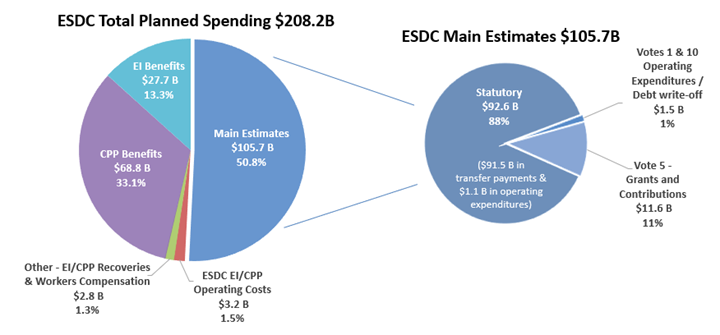
Descriptive text:
Figure on the left: ESDC total planned spending is $208.2 billion
- EI Benefits planned spending is $27.7 billion or 13.3% of total planned spending
- CPP Benefits planned spending is $68.8 billion or 33.1% of total planned spending
- Other EI and CPP Recoveries and Workers Compensation planned spending is $2.8 billion or 1.3% of total planned spending
- EI and CPP Operating Costs planned spending is $3.2 billion or 1.5% of total planned spending
- Main Estimates represents $105.7 billion or 50.8% of total planned spending
Figure on the right: ESDC Main Estimates is $105.7 billion
- Statutory planned spending is $92.6 billion or 88% of total Main Estimates
- Vote 1 - Operating Expenditures planned spending and Vote 10 - Debt Write-off are $1.5 billion or 1% of total Main Estimates
- Vote 5 - Grants and Contributions planned spending is $11.6 billion or 11% of total Main Estimates
Of the $105.7 billion in planned budgetary expenditures included in ESDC's 2025 to 2026 Main Estimates, $103.1 billion (98%) directly benefits Canadians through statutory and voted transfer payment programs:
- Old Age Security Program = $85.5 billion
- Canada Student Financial Assistance Program and Canada Apprentice Loans = $3.2 billion
- Canada Education Savings Program = $1.3 billion
- Canada Disability Benefit= $0.8 billion
- Canada Disability Savings Program = $0.7 billion
- Main programs included in the $11.6 billion in voted grants and contributions in ESDC's 2025 to 2026 Main Estimates:
- Early Learning and Child Care = $8,521.5 million
- Workforce Development Agreements = $722.0 million
- Youth Employment and Skills Strategy = $412.5 million
- Indigenous ELCC Transformation Initiative= $311.1 million
- Indigenous Skills and Employment Training Program = $236.7 million
- Canadian Apprenticeship Strategy = $227.5 million
- Student Work Placement Program = $202.1 million
- National School Food Program = $142.2 million
- Opportunities Fund for Persons with Disabilities = $100.7 million
- Canada Service Corps = $82.9 million
- New Horizons for Seniors Program = $76.7 million
- Social Development Partnerships Program = $77.7 million
- Future Skills = $72.7 million
- Foreign Credential Recognition Program = $70.4 million
- Enabling Fund for Official Language Minority Communities = $67.7 million
- Social Innovation and Social Finance Strategy = $60.0 million
- Skills and Partnership Fund = $50.0 million
c. Comprehensive Expenditure Review
Issue
The Government has launched a Comprehensive Expenditure Review (CER) to ensure spending is responsible, cost-effective and delivers results for Canadians.
Background
- Departments were asked to bring forward ambitious savings to support a phased approach to achieving potential savings of 15 percent by fiscal year 2028 to 2029, based on planned spending in the 2025 to 2026 Main Estimates
- This target is ambitious and represents an 'up to' amount, providing the government with flexibility to select proposals that best align with its focus on balancing fiscal discipline, quality service delivery for Canadians, and economic growth
Key facts
ESDC, savings targets have been assigned as follows, based on 2025 to 2026 Main Estimates levels:
- 7.5% in 2026 to 2027
- 10% in 2027 to 2028
- 15% in 2028 to 2029
Key messages
- The Comprehensive Expenditure Review is about ensuring that government spending is responsible, cost-effective and delivers results for Canadians
- Deliberations on the Comprehensive Expenditure Review are ongoing and results will be announced in due course. No decisions have been taken yet
- As Secretary of State (Seniors), I am cognisant of the important role that Government programs and services play in the lives of seniors. Any decisions taken as part of the Comprehensive Expenditure Review will be in the best interest of Canadians, including seniors
6. Mandate priorities
a. Mandate priorities for Secretary of State (Seniors)
Issue
What is your mandate and how are you supporting the Government's priorities?
Background
- The Prime Minister's May 21, 2025, mandate letter asked Ministers and Secretaries of State to "meet a series of unprecedented challenges with both a disciplined focus on core priorities and new approaches to governing."
- The letter outlined 7 specific missions
- Establishing a new economic and security relationship with the United States and strengthening our collaboration with reliable trading partners and allies around the world
- Building one Canadian economy by removing barriers to interprovincial trade and identifying and expediting nation-building projects that will connect and transform our country
- Bringing down costs for Canadians and helping them to get ahead
- Making housing more affordable by unleashing the power of public-private cooperation, catalysing a modern housing industry, and creating new careers in the skilled trades
- Protecting Canadian sovereignty and keeping Canadians safe by strengthening the Canadian Armed Forces, securing our borders, and reinforcing law enforcement
- Attracting the best talent in the world to help build our economy, while returning our overall immigration rates to sustainable levels
- Spending less on government operations so that Canadians can invest more in the people and businesses that will build the strongest economy in the G7
Points to register
1. Overview of mandate and priorities
- As Secretary of State (Seniors) I lead and coordinate federal efforts that support seniors across Canada
- In this role, I oversee programs and initiatives that promote aging with dignity, financial security, and the social inclusion of seniors-all measures that are central to the Government's mission of bringing down costs for Canadians and helping them to get ahead
- I play a leadership role on program design elements of Canada's income support programs for seniors including Old Age Security (OAS), Canada Pension Plan (CPP), and Canada Pension Plan Disability
- My role also includes helping seniors age with dignity with responsibility for programs such as the New Horizons for Seniors Program and the Age Well at Home Initiative
- Underscoring the key role that provinces and territories play in the lives of seniors, I also co-chair the Federal/Provincial/Territorial Ministers Responsible for Seniors Forum
- This forum provides an opportunity for all governments to discuss solutions that support older Canadians in living dignified and affordable lives at home and in their communities
- Beyond seniors' issues, Minister Hajdu has also asked me to take a leadership role on the Sustainable Development Goals (SDGs) Program that increases public awareness of the SDGs, supports new partnerships to advance action, and identifies and implements innovative initiatives to drive progress on the SDGs
2. Collaboration with Minister of Jobs and Families
- In my role as Secretary of State (Seniors), I work closely with the Minister of Jobs and Families, the Honourable Patty Hajdu, to provide advice on a range of economic and social development issues related to seniors
- I also support the Minister in exercising her oversight and accountability for OAS, CPP, and CPP Disability, including helping to inform policy decisions and on reporting to Parliament
3. Collaboration with other Cabinet Ministers
- Issues that seniors face are complex and solutions require collaboration across government. As Secretary of State (Seniors), I bring issues affecting seniors to other portfolios' attention and help them anticipate where their policies and programs need to consider seniors' priorities
- I am working with the Minister of Finance and National Revenue to implement Canada's first ever whole-of-government National Anti-Fraud Strategy to help protect Canadians, including seniors, from financial crimes, fraud, and scams
- This strategy, which will be introduced in Budget 2025, will include a new Financial Crimes Agency, a voluntary Code of Conduct for the Prevention of Economic Abuse for financial institutions along with other measures to maintain confidence in our financial system, and keeping people, and their money, safe
- I am also supporting the Minister of Housing and Infrastructure as he sets up the new Build Canada Homes agency, which will prioritize housing solutions that includes the needs of seniors living on fixed incomes so that all Canadians have a place to call home