
Chapter 1: Labour market context
Official title: Employment Insurance Monitoring and Assessment Report for the fiscal year beginning April 1, 2024, and ending March 31, 2025: Chapter 1: Labour market context
On this page
List of abbreviations
This is the complete list of abbreviations for the Employment Insurance Monitoring and Assessment Report for the fiscal year beginning April 1, 2024 and ending March 31, 2025.
- ACG
- Apprenticeship Completion Grants
- ADR
- Alternative Dispute Resolution
- AI
- Artificial Intelligence
- AIG
- Apprenticeship Incentive Grants
- B/C
- Benefits-to-Contributions
- B/U
- Beneficiary-to-Unemployed (rate)
- B/UC
- Beneficiary-to-Unemployed Contributor (rate)
- BDM
- Benefits Delivery Modernization
- CAL
- Canada Apprenticeship Loans
- CEEDD
- Canadian Employer-Employee Dynamics Database
- CCB
- Compassionate Care Benefits
- CCDA
- Canadian Council of Directors of Apprenticeship
- CEIC
- Canada Employment Insurance Commission
- CEIFB
- Canada Employment Insurance Financing Board
- CFP
- Call for Proposals
- CIRNAC
- Crown-Indigenous Relations and Northern Affairs Canada
- COLS
- Community Outreach and Liaison Service
- CPI
- Consumer Price Index
- CPP
- Canada Pension Plan
- CRA
- Canada Revenue Agency
- CRF
- Consolidated Revenue Fund
- CSO
- Citizen Service Officers
- CWDP
- Community Workforce Development Program
- CX
- Client Experience
- EAS
- Employment Assistance Services
- EB
- Employment Benefits
- EBSM
- Employment Benefits and Support Measures
- ECC
- Employer Contact Centre
- EDI
- Equity, Diversity and Inclusion
- EI
- Employment Insurance
- EI-A
- Employment Insurance Regular Benefits - Apprentices
- EIACC
- Employment Insurance Appeals Consultative Committee
- EICS
- Employment Insurance Coverage Survey
- ELMLP
- Education and Labour Market Longitudinal Platform
- eROE
- Electronic Record of Employment
- ES
- Employment Services
- ESDC
- Employment and Social Development Canada
- FS
- Family Supplement
- FTE
- Full-Time Equivalent
- FY
- Fiscal Year
- G7
- Group of 7
- GC
- Government of Canada
- GDP
- Gross Domestic Product
- HCCS
- Hosted Contact Centre Solution
- HR
- Human Resources
- IBD
- Integrity-by-Design
- IC
- Individual Counselling
- IQF
- Individual Quality Feedback
- ISET
- Indigenous Skills and Employment Training
- IVR
- Interactive Voice Response
- IWW
- Integrated Workload and Workforce
- JCP
- Job Creation Partnership
- KPI
- Key Performance Indicators
- LFS
- Labour Force Survey
- LMDA
- Labour Market Development Agreements
- LMI
- Labour Market Information
- LMIA
- Labour Market Impact Assessment
- LMP
- Labour Market Partnerships
- LTU
- Long-Term Unemployed
- MIE
- Maximum Insurable Earnings
- MSCA
- My Service Canada Account
- MUS
- Monetary Unit Sampling
- NEET
- Not in Employment, Education or Training
- NERE
- New Entrant and Re-Entrant
- NESI
- National Essential Skills Initiative
- NHQ
- National Headquarters
- NIS
- National Investigative Services
- NOC
- National Occupation Classification
- OAS
- Old Age Security
- OASIS
- Occupational and Skills Information System
- OECD
- Organisation for Economic Co-operation and Development
- p.p.
- Percentage point
- PAAR
- Payment Accuracy Review
- PCIC
- Parents of Critically Ill Children
- PCS
- Post Call Survey
- PEAQ
- Processing, Excellence, Accuracy and Quality
- PPE
- Premiums-paid Eligible Individuals
- PRAR
- Processing Accuracy Review
- PRP
- Premium Reduction Program
- PSPC
- Public Services and Procurement Canada
- PT
- Provinces and Territories
- QPIP
- Quebec Parental Insurance Plan
- R&I
- Research and Innovation
- RAIS
- Registered Apprenticeship Information System
- RN
- Registered Nurse
- ROE
- Record of Employment
- RPA
- Robotics Processing Automation
- SCC
- Service Canada Centre
- SCT
- Skills and Competency Taxonomy
- SD
- Skills Development
- SD-A
- Skills Development - Apprentices
- SD-R
- Skills Development - Regular
- SE
- Self-Employment
- SEAQ
- Service, Excellence, Accuracy and Quality
- SEPH
- Survey of Employment, Payrolls and Hours
- SFS
- Skills for Success
- SIN
- Social Insurance Number
- SIP
- Sectoral Initiatives Program
- SIR
- Social Insurance Register
- SM
- Support Measures
- SME
- Small and medium enterprise
- SRI
- Service Referral Initiative
- SRS
- Simple Random Sampling
- SST
- Social Security Tribunal
- STDP
- Short-Term Disability Plan
- SUB
- Supplemental Unemployment Benefit
- SWSP
- Sectoral Workforce Solutions Program
- TES
- Targeted Earning Supplements
- TFW
- Temporary Foreign Worker
- TIS
- Telephone Interpretation Service
- TRF
- Targeting, Referral and Feedback
- TTY
- Teletypewriter
- TWS
- Targeted Wage Subsidies
- UTIP
- Union Training and Innovation Program
- VBW
- Variable Best Weeks
- VER
- Variable Entrance Requirement
- VET
- Vocational Education and Training
- VRI
- Video Remote Interpretation
- VRS
- Video Relay Service
- WCAG
- Web Content Accessibility Guidelines
- WISE
- Work Integration Social Enterprises
- WWC
- Working While on Claim
List of figures
- Chart 1: Quarterly real gross domestic product, Canada, 2022-23 to 2024-25
- Chart 2: Change in real gross domestic product by industry, Canada, 2023-24 to 2024-25
- Chart 3: Year-over-year change in the Consumer Price Index (CPI), Canada, January 2012 to March 2025, not seasonally adjusted
- Chart 4: Components of quarterly population growth in Canada, Q2 2023 to Q1 2025
- Chart 5: Change in employment by industry, Canada, 2023-24 to 2024-25
- Chart 6: Unemployment rate, Canada, April 2019 to March 2025
- Chart 7: Average duration of unemployment (in weeks) and share of long-term unemployment (% unemployed for 52 weeks or more), Canada, April 2019 to March 2025
- Chart 8: Share of unemployment by reason for unemployment, Canada, 2019-20 to 2024-25
- Chart 9: Job vacancies and job vacancy rates, Canada, third quarter of 2022-23 to fourth quarter of 2024-25
- Chart 10: Unemployment-to-vacancy ratio, Canada, 2023-24 to 2024-25
- Chart 11: Unemployment-to-vacancy ratio, by industry, Canada, 2023-24 to 2024-25
- Chart 12: Year-over-year nominal and real hourly wage growth and CPI inflation, April 2023 to March 2025
- Chart 13: Business sector real compensation per hour worked, labour productivity and labour productivity growth, Q2 2019 to Q1 2025
- Chart 14: Unemployment-to-vacancy ratio by province, last quarter of 2023-24, and last quarter of 2024-25
List of tables
- Table 1: Share of unemployment by reason for unemployment and gender, Canada, 2019-20 to 2024-25
- Table 2: Share of unemployment by reason for unemployment and age, Canada, 2019-20 to 2024-25
- Table 3: Job vacancies and job vacancy rates, by industry, Canada, fourth quarter of 2023-24 and 2024-25
- Table 4: Change in labour force and labour force participation rate, by province or territory, Canada, 2023-24 to 2024-25
- Table 5: Change in employment and employment rate, by province or territory, Canada, 2023-24 to 2024-25
- Table 6: Change in unemployment and unemployment rate, by province or territory, Canada, 2023-24 to 2024-25
- Table 7: Average weeks of unemployment, by province, Canada, 2023-24 to 2024-25
- Table 8: Nominal weekly earnings, weekly hours worked and consumer price index by province or territory, Canada, 2023-24 to 2024-25
- Table 9: Change in job vacancies, job vacancy rates and unemployment-to-vacancy ratio, by province and territory, Canada, 2024-25
Introduction
This chapter provides an overview of the economic situation and key labour market developments in Canada during the fiscal year beginning on April 1, 2024, and ending on March 31, 2025 (2024-25).Footnote 1 This is the same period for which this Report assesses the Employment Insurance (EI) program.
Section 1.1 provides a general overview and context of the economic situation for 2024-25. Section 1.2 summarizes key labour market developments in the Canadian economy during the reporting period.Footnote 2 Section 1.3 concentrates on the evolution of regional labour market conditions. Definitions and more detailed statistical tables related to key labour market concepts discussed in the chapter can be found in Annex 1.
1.1 Economic overviewFootnote 3
Global economic context in 2024-25
In 2024-25, the global economic outlook was marked by resilient growth and decreasing inflation across most advanced economies.Footnote 4 The global economy grew at an average annual rate of 3.3% during 2024-25, compared to 3.5% in 2023-24, despite tighter financial conditions, heightened trade policy uncertainty, and elevated geopolitical tensions in the Middle East as well as the ongoing war in Ukraine (consult Chart 1, for Canada).
During 2024-25, most central banks in advanced economies lowered interest rates in response to declining inflation, primarily driven by decreases in food, energy and goods prices.Footnote 5 The global Consumer Price Index (CPI), or CPI inflation, in the average advanced economy fell from 4.4% in 2023-24 to 2.5% in 2024-25, approaching the 2% target set by central banks in most advanced economies, including Canada and other G7 countries.Footnote 6 In 2024-25, Canada recorded an inflation rate of 2.0%, which was below the average among G7 countries.Footnote 7
Canadian economic context in 2024-25
Canada experienced an increase in economic growth in 2024-25. The real Gross Domestic Product (GDP) grew by 2.5% compared to 2023-24, while it increased by 1.4% in 2023-24 compared to 2022-23.Footnote 8
When examining quarterly movements, the Canadian economy showed robust annualized growth rates in the first and second quarters of 2024-25, driven by previous interest rate cuts that boosted household spending and residential investment.Footnote 9 Economic growth slowed in the last 2 quarters of 2024-25 but was stronger than expected in the fourth quarter (2.2%) due to a temporary surge in exports in anticipation of US tariffs (consult Chart 1).Footnote 10 Overall, in 2024-25, the slowdown in population growth, combined with high trade tensions and the continual decline in economic growth during this period, have led the Canadian economy in a state of excess supply.

Text description
| Quarter | Real GDP at market prices ($ trillion, chained 2017 dollars) (left scale) | Change in real GDP at market prices, chained 2017 dollars (annualized quarterly percentage change) (right scale) |
|---|---|---|
| Q1 2022-23 | 2.36 | 4.6% |
| Q2 2022-23 | 2.38 | 3.3% |
| Q3 2022-23 | 2.38 | 0.3% |
| Q4 2022-23 | 2.40 | 4.3% |
| Q1 2023-24 | 2.41 | 0.6% |
| Q2 2023-24 | 2.41 | 0.2% |
| Q3 2023-24 | 2.41 | 0.2% |
| Q4 2023-24 | 2.43 | 2.9% |
| Q1 2024-25 | 2.45 | 3.3% |
| Q2 2024-25 | 2.47 | 3.3% |
| Q3 2024-25 | 2.48 | 2.8% |
| Q4 2024-25 | 2.50 | 2.2% |
- Source: Statistics Canada, Table 36-10-0104-01.
Internationally, Canada ranked second among G7 countries in real GDP growth rate for 2024-25, an improvement from its third position in 2023-24.Footnote 11 Nonetheless, Canada ranked sixth in terms of real GDP per capita (using Purchasing Power Parity) among G7 countries, averaging US$ 51,967 per capita in 2024-25.Footnote 12 In fact, real GDP per capita, the most widely used measure of a country's standard of living, has softened in the previous 2 fiscal years in Canada and remained below pre-pandemic levels.Footnote 13 This softness is primarily attributed to the unprecedented strong population growth and the time required for newcomers to fully integrate into the economy.Footnote 14
As in previous fiscal years, a closer look at quarterly movements by industry (consult Chart 2) showed that economic growth in the Canadian economy during 2024-25 was unequally distributed across sectors. While most industries expanded compared to the previous fiscal year, only 4 sectors contracted. More than half of the industries grew faster than the national average of 1.9% across all sectors. Among them, Agriculture, forestry, fishing and hunting; Mining, quarrying, and oil and gas extraction; and Education services had the highest growth in 2024-25. Sectors that experienced contractions were Manufacturing; Business, building and other support services; Wholesale and retail trade; and Other services (except Public administration).
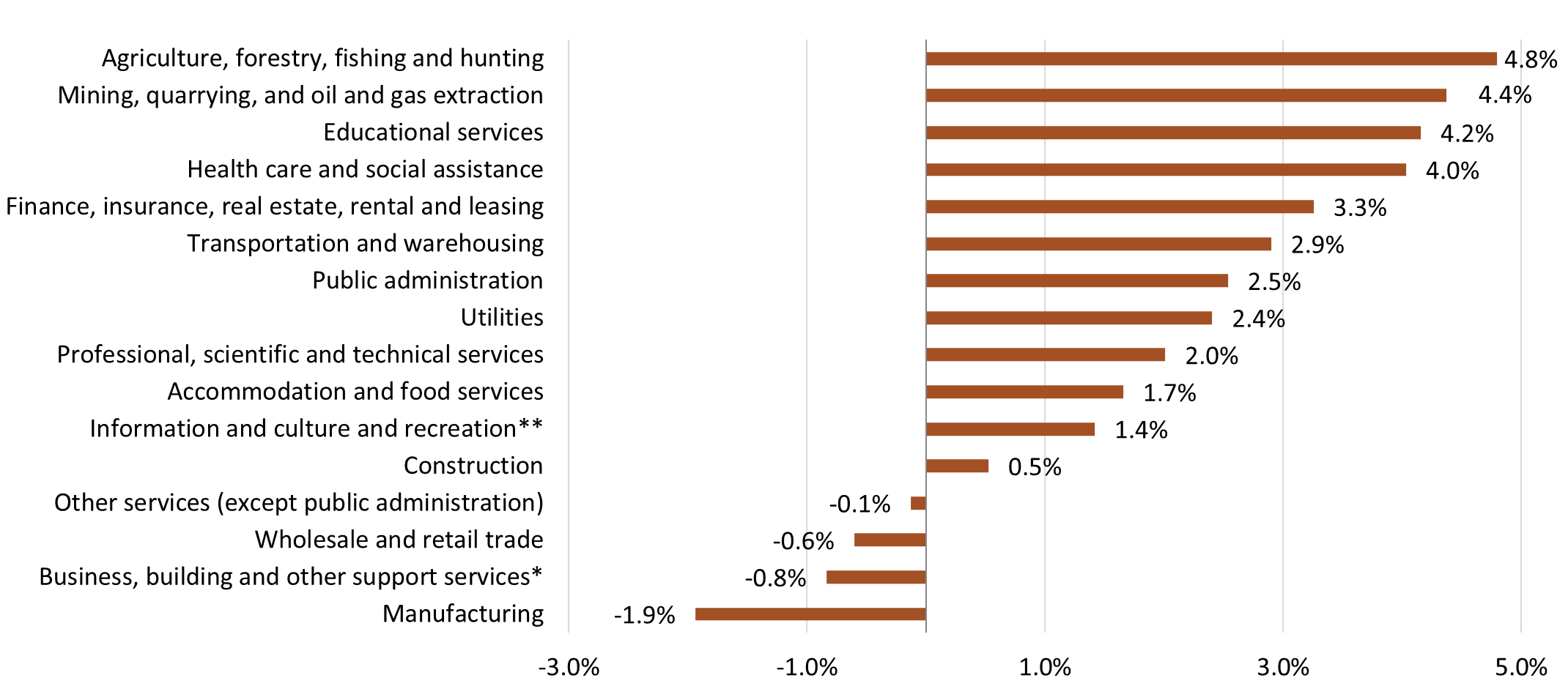
Text description
| Industry | Change in real GDP 2023-24 to 2024-25 |
|---|---|
| Accommodation and food services | 1.7% |
| Transportation and warehousing | 2.9% |
| Agriculture, forestry, fishing and hunting | 4.8% |
| Other services (except public administration) | -0.1% |
| Professional, scientific and technical services | 2.0% |
| Information and culture and recreation** | 1.4% |
| Mining, quarrying, and oil and gas extraction | 4.4% |
| Public administration | 2.5% |
| Business, building and other support services* | -0.8% |
| Educational services | 4.2% |
| Manufacturing | -1.9% |
| Health care and social assistance | 4.0% |
| Utilities | 2.4% |
| Construction | 0.5% |
| Finance, insurance, real estate, rental and leasing | 3.3% |
| Wholesale and retail trade | -0.6% |
- * Includes management of companies and enterprises and administrative and support, waste management and remediation services.
- ** Includes information and cultural industries and arts, entertainment, and recreation industries.
- Source: Statistics Canada, Table 36-10-0434-01.
The inflation rate in Canada fell during the 2024-25 period, reaching the Bank of Canada's target level of 2%. The year-over-year change in Canada's CPI inflation, decreased from 2.5% in April 2024 to 1.9% in March 2025 (consult Chart 3). This decline was mainly attributed to lower year-over-year gasoline prices as a result of the removal of the federal consumer carbon price and easing in shelter services prices.Footnote 15

Text description
| Month | 12-month CPI change rate |
|---|---|
| Jan-12 | 2.0% |
| Feb-12 | 1.2% |
| Mar-12 | 1.5% |
| Apr-12 | 1.3% |
| May-12 | 1.2% |
| Jun-12 | 1.2% |
| Jul-12 | 1.2% |
| Aug-12 | 0.8% |
| Sep-12 | 0.8% |
| Oct-12 | 0.5% |
| Nov-12 | 1.2% |
| Dec-12 | 1.0% |
| Jan-13 | 0.4% |
| Feb-13 | 0.7% |
| Mar-13 | 1.2% |
| Apr-13 | 1.3% |
| May-13 | 1.1% |
| Jun-13 | 1.1% |
| Jul-13 | 0.7% |
| Aug-13 | 0.9% |
| Sep-13 | 1.2% |
| Oct-13 | 1.5% |
| Nov-13 | 1.1% |
| Dec-13 | 1.5% |
| Jan-14 | 2.0% |
| Feb-14 | 2.3% |
| Mar-14 | 2.4% |
| Apr-14 | 2.1% |
| May-14 | 2.1% |
| Jun-14 | 2.0% |
| Jul-14 | 2.4% |
| Aug-14 | 2.0% |
| Sep-14 | 1.5% |
| Oct-14 | 1.0% |
| Nov-14 | 1.0% |
| Dec-14 | 1.2% |
| Jan-15 | 0.8% |
| Feb-15 | 0.9% |
| Mar-15 | 1.0% |
| Apr-15 | 1.3% |
| May-15 | 1.3% |
| Jun-15 | 1.0% |
| Jul-15 | 1.0% |
| Aug-15 | 1.4% |
| Sep-15 | 1.6% |
| Oct-15 | 2.0% |
| Nov-15 | 1.4% |
| Dec-15 | 1.3% |
| Jan-16 | 1.7% |
| Feb-16 | 1.5% |
| Mar-16 | 1.5% |
| Apr-16 | 1.3% |
| May-16 | 1.1% |
| Jun-16 | 1.3% |
| Jul-16 | 1.5% |
| Aug-16 | 1.2% |
| Sep-16 | 1.5% |
| Oct-16 | 2.1% |
| Nov-16 | 2.0% |
| Dec-16 | 1.6% |
| Jan-17 | 1.6% |
| Feb-17 | 1.3% |
| Mar-17 | 1.0% |
| Apr-17 | 1.2% |
| May-17 | 1.4% |
| Jun-17 | 1.6% |
| Jul-17 | 1.4% |
| Aug-17 | 2.1% |
| Sep-17 | 1.9% |
| Oct-17 | 1.7% |
| Nov-17 | 2.2% |
| Dec-17 | 2.3% |
| Jan-18 | 2.2% |
| Feb-18 | 2.2% |
| Mar-18 | 2.5% |
| Apr-18 | 3.0% |
| May-18 | 2.8% |
| Jun-18 | 2.2% |
| Jul-18 | 2.4% |
| Aug-18 | 1.7% |
| Sep-18 | 2.0% |
| Oct-18 | 1.4% |
| Nov-18 | 1.5% |
| Dec-18 | 1.9% |
| Jan-19 | 2.0% |
| Feb-19 | 2.4% |
| Mar-19 | 2.0% |
| Apr-19 | 2.0% |
| May-19 | 1.9% |
| Jun-19 | 1.9% |
| Jul-19 | 1.9% |
| Aug-19 | 2.2% |
| Sep-19 | 2.2% |
| Oct-19 | 2.4% |
| Nov-19 | 2.2% |
| Dec-19 | 0.9% |
| Jan-20 | -0.2% |
| Feb-20 | -0.4% |
| Mar-20 | 0.7% |
| Apr-20 | 0.1% |
| May-20 | 0.1% |
| Jun-20 | 0.5% |
| Jul-20 | 0.7% |
| Aug-20 | 1.0% |
| Sep-20 | 0.7% |
| Oct-20 | 1.0% |
| Nov-20 | 1.1% |
| Dec-20 | 2.2% |
| Jan-21 | 3.4% |
| Feb-21 | 3.6% |
| Mar-21 | 3.1% |
| Apr-21 | 3.7% |
| May-21 | 4.1% |
| Jun-21 | 4.4% |
| Jul-21 | 4.7% |
| Aug-21 | 4.7% |
| Sep-21 | 4.8% |
| Oct-21 | 5.1% |
| Nov-21 | 5.7% |
| Dec-21 | 6.7% |
| Jan-22 | 6.8% |
| Feb-22 | 7.7% |
| Mar-22 | 8.1% |
| Apr-22 | 7.6% |
| May-22 | 7.0% |
| Jun-22 | 6.9% |
| Jul-22 | 6.9% |
| Aug-22 | 6.8% |
| Sep-22 | 6.3% |
| Oct-22 | 5.9% |
| Nov-22 | 5.2% |
| Dec-22 | 4.3% |
| Jan-23 | 4.4% |
| Feb-23 | 3.4% |
| Mar-23 | 2.8% |
| Apr-23 | 3.3% |
| May-23 | 4.0% |
| Jun-23 | 3.8% |
| Jul-23 | 3.1% |
| Aug-23 | 3.1% |
| Sep-23 | 3.4% |
| Oct-23 | 2.9% |
| Nov-23 | 2.8% |
| Dec-23 | 2.9% |
| Jan-24 | 2.7% |
| Feb-24 | 2.9% |
| Mar-24 | 2.7% |
| Apr-24 | 2.5% |
| May-24 | 2.0% |
| Jun-24 | 1.6% |
| Jul-24 | 2.0% |
| Aug-24 | 1.9% |
| Sep-24 | 1.8% |
| Oct-24 | 1.9% |
| Nov-24 | 2.6% |
| Dec-24 | 2.3% |
| Jan-25 | 1.7% |
| Feb-25 | 1.7% |
| Mar-25 | 1.9% |
- Note: The dotted lines indicate Bank of Canada's 1-3% control range for the inflation target with inflation measured as the 12-month rate of change in the consumer price index (CPI), Bank of Canada, Monetary Policy Report, April 2024.
- Source: Statistics Canada, Table 18-10-0004-01.
The Bank of Canada began to reduce its policy interest rate in June 2024, implementing 7 consecutive cuts totalling 2.25 percentage points (p.p.), bringing the rate down from 5.0% in April 2024 to 2.75% in March 2025.Footnote 16 In general, cutting policy interest rates in response to easing inflationary pressures aims to stimulate economic activity and aggregate demand, which can impact unemployment levels and job creation.
Considering real GDP growth and CPI inflation developments in 2024-25, aggregate demand for goods and services (demand), supported by accommodative monetary policy (interest rate cuts), was strong and contributed to robust GDP growth in the first 2 quarters of this fiscal period. Despite increased trade policy uncertainty due to US tariffs, demand continued to grow in the last 2 quarters of 2024-25 but at a slower pace than in the first 2 quarters of 2024-25.
1.2 The Canadian labour market
This section highlights key labour market developments in Canada during 2024-25, including several elements related to the administration of the EI program.Footnote 17 Overall, the Canadian labour market during this period was characterised by a slowdown in population growth, moderate employment growth, a rise in the national unemployment rate, and looser labour market conditions.Footnote 18,Footnote 19
Labour force and participation rate
Canada's population growth slowed from over 1.2 million individuals in 2023-24 to approximately 614,000 individuals in 2024-25, resulting in a 1.7 p.p. decline in the annual population growth rate, from 3.2% to 1.5% over the same period. This slowdown was primarily due to a reduction in non-permanent immigration following the implementation of new federal immigration policies.Footnote 20 In 2024-25, the proportion of non-permanent immigrants decreased by 38 p.p., falling from 851,000 individuals who represented 67% of population growth in 2023-24 to 180,000, accounting for 29% of the population growth in 2024-25.
Conversely, the share of permanent immigrants increased by 40 p.p., rising from 448,000 individuals, (accounting for 35% of the population growth) to 466,000, representing 76% of the population growth in the reporting period. Overall, due to low levels of natural increase (around 5% of the population growth in 2024-25), international migration (both permanent and non-permanent immigration) remained the main driver of Canada's population growth in 2024-25, accounting for 95.0% of total population growth (consult Chart 4).Footnote 21

Text description
| Quarter | Immigrants | Net non-permanents residents | Natural increase | Population growth |
|---|---|---|---|---|
| Q2 2023 | 117,927 | 205,191 | 10,508 | 225,968 |
| Q3 2023 | 107,988 | 314,059 | 15,873 | 321,791 |
| Q4 2023 | 100,406 | 169,369 | 1,060 | 418,634 |
| Q1 2024 | 121,778 | 161,892 | 1,469 | 256,804 |
| Q2 2024 | 134,172 | 135,755 | 12,872 | 265,771 |
| Q3 2024 | 124,266 | 109,961 | 17,445 | 272,032 |
| Q4 2024 | 103,438 | -11,002 | 2,397 | 231,803 |
| Q1 2025 | 104,210 | -55,194 | 983 | 80,385 |
- Source: Statistics Canada, Table 17-10-0040-01, Table 17-10-0059-01 and Table: 17-10-0009-01. Population is the estimated number of Canadians whose usual place of residence is within Canada. Population growth is the change in population between 2 successive quarters. Natural increase is the difference between the numbers of births and deaths. Net non-permanent residents represent the difference between the inflows and outflows of non-permanent residents to Canada between 2 dates. Immigrant refers to a person who is a permanent resident or a landed immigrant.
The significant decline in population growth contributed to a 0.4 p.p. slowdown in Canada's labour force growth, which increased by 2.9% (+619,000, from 21.7 million to 22.3 million) in 2024-25 compared to 3.3% in 2023-24.Footnote 22 Likewise, there was a 0.4 p.p. decline in the national participation rate, from 65.8% to 65.4% over the same period as the working-age population grew at a faster rate (3.4% in 2024-25 compared to 3.0% in the previous fiscal) than the labour force.Footnote 23
The decline in the national participation rate masks significant variations among age groups. The participation rate for older (55 years and over) and core-aged people (25 to 54 years) decreased by 0.6 p.p. and 0.3 p.p., respectively, while it dropped by 1.4 p.p. for youth (15 to 24 years). Participation in the labour market is driven by 2 factors (changes in labour force and working-age population). In 2024-25, the population for core-aged people (+3.9%) and their labour force (+3.5%) almost grew at a similar pace; hence their participation rate had the smallest decrease (-0.3 p.p.) compared to other groups. The population for older people (+1.8%) increased faster than their labour force (+0.2%), resulting in a decrease in their participation rate (-0.6 p.p.) that was greater than that of the core-aged group (-0.3 p.p.). In contrast, the youth recorded an increase in their population (+6.2%) that was greater than their labour force (+3.9%), leading to the largest decrease in participation rate among all age groups (-1.4 p.p.).
Employment and employment rate
Compared to the previous fiscal period, total employment grew by 1.8%, up from 20.5 million in 2023-24 to 20.8 million in 2024-25. However, this expansion was insufficient to fully absorb the increase in labour force (2.9%), resulting in an increase in the national unemployment rate.
Over the same period, employment trends varied widely depending on the type of workers, the size of firms, the age and gender of individuals. The average number of part-time workers increased by 112,800 (+3.1%), while full-time workers expanded by 255,000 (+1.5%) between the 2 fiscal years.Footnote 24
Employment growth was much higher for employees in the public sector (+3.1%) than for private sector employees (+1.4%) and self-employed individuals (+1.5%).Footnote 25 Similar to the previous fiscal period, in 2024-25, self-employment has not exceeded its pre-pandemic level as of February 2020, indicating that workers are becoming more likely to be paid employees and less likely to be self-employed. Employment increased significantly only in large enterprises (500 employees and over) by 140,000 and in small enterprises (0 to 19 employees) by 22,000.Footnote 26 Approximately half of all employees (47.0%) worked in large enterprises in 2024-25.Footnote 27
Between the 2 fiscal periods, most sectors recorded employment growth and only 3 sectors had declines. The 3 sectors with the largest employment growth in 2024-25 were Health care and social assistance; followed by Finance, insurance, real estate, rental and leasing; and Business, building, and other support services. In contrast, Agriculture; Utilities; and wholesale and retail trade were the 3 sectors that registered contractions in employment (consult Chart 5). Information, culture and recreation; Manufacturing; and Other services (except Public administration) were the only sectors where employment remained virtually unchanged compared to 2023-24.

Text description
| Industry | Change (%) in employment by industry 2023-24 to 2024-25 |
|---|---|
| Transportation and warehousing | 1.2% |
| Forestry, fishing, mining, quarrying, oil and gas | 2.9% |
| Educational services | 2.8% |
| Wholesale and retail trade | -1.4% |
| Other services (except public administration) | 0.3% |
| Manufacturing | 0.2% |
| Business, building and other support services | 3.6% |
| Agriculture | -5.3% |
| Health care and social assistance | 4.4% |
| Finance, insurance, real estate, rental and leasing | 3.8% |
| Total employed, all industries | 1.7% |
| Public administration | 2.8% |
| Construction | 1.0% |
| Professional, scientific and technical services | 3.4% |
| Utilities | -4.5% |
| Information, culture and recreation | 0.1% |
| Accommodation and food services | 2.4% |
- Source: Statistics Canada, Labour Force Survey, Table 14-10-0355-01.
When examining employment changes by age group, core-aged individuals had the largest increase in employment (+2.6%) in 2024-25, followed by youth (+1.1%). In contrast, older people experienced a 0.4% decrease in employment during the reporting period.
In 2024-25, men represented 56.2% of full-time workers whereas women accounted for 43.8%. Conversely, women represented 62.5% of part-time workers, while men accounted for 37.5%. These proportions remained relatively unchanged compared to the previous fiscal year. However, between the 2 fiscal years, full-time employment rose by 1.9% for men and 1.0% for women, while part-time employment increased by 2.2% for men and 3.6% for women.
The evolution of total employment does not account for changes in the working-age population. Conversely, the employment rate, which measures the proportion of people aged 15 years and over who were employed during a given period, takes changes in the working-age population into account. The employment rate fell by 1.0 p.p., from 62.1% in 2023-24 to 61.1% in 2024-25, as the working-age population (3.4%) grew faster than total employment (1.8%) due to the significant increase in international migration in the previous fiscal year. On the global scene, Canada had the second highest employment rate among G7 countries during the reporting period.Footnote 28
Looking at employment rate trends across gender groups, the employment rate for men decreased by 1.1 p.p., from 65.9% in 2023-24 to 64.8% in 2024-25, while it dropped by 0.9 p.p. for women, from 58.3% to 57.4% over the same period. Among age groups, youth had the largest decline, dropping by 2.8 p.p., from 57.2% to 54.4%, followed by a 1.0 p.p. drop for core-aged individuals, and a 0.8 p.p. decrease for older people, who also had the lowest employment rate (34.4%) among all age groups in 2024-25.
Unemployment and unemployment rate
Unemployment rate is a key factor in determining a claimant's eligibility for EI regular benefits. A lower unemployment rate in an EI region translates into a higher number of hours of insurable employment required within the qualifying period for a claimant that resides in that region to be eligible for EI regular benefits.Footnote 29 Additionally, the unemployment rate in an EI region also plays a role in determining the duration of EI regular benefits that a claimant can receive and the number of weeks of insurable earnings (known as the divisor) used to calculate their weekly benefit rate. Regional variations in the unemployment rates are discussed in subsection 1.3.
The number of unemployed individuals increased from 1.2 million in 2023-24 to about 1.5 million in 2024-2025, representing a 20.8% rise during this period. Along with a 2.9% expansion in labour force during the reporting period, the unemployment rate rose by 1.0 p.p., from 5.6% in 2023-24 to 6.6% in 2024-25. There are significant variations in unemployment rates by age and gender. Among gender groups, in 2024-25 women had a lower unemployment rate than men (6.2% vs 6.9%), and men had the highest increase in unemployment rate (1.1 p.p.) than women (0.8 p.p.). Youth had the highest unemployment rate at 13.5% in 2024-25 compared to 5.5% for core-aged individuals and 5.1% for older people.
Youth unemployment rate has been trending upward since early 2023 and was 0.8 p.p. above its pre-pandemic average of 12.7% over the period 2010-2019. Between the 2 fiscal periods, youth recorded a 2.4 p.p. rise in their unemployment rate (from 11.1% in 2023-24 to 13.5% in 2024-25), compared to 0.8 p.p. for core-aged individuals and 0.5 p.p. for older people The continued rise in youth unemployment can be attributed to strong population growth in recent years, a loosening of labour market conditions, and a slowdown in job vacancies in the main industries where youth typically find employment such as Accommodation and food services, and Wholesale and retail trade (consult Table 3).Footnote 30
In general, youth experience 2 times higher unemployment rates than core-aged and older people for 2 main reasons. First, youth tend to move in and out of the labour force throughout the school year, periodically joining the unemployment pool as they search for work.Footnote 31 Second, being at the beginning of their careers, youth often have little work experience, making the search for positions that match their skills more time-consuming and challenging.Footnote 32 Additionally, youth are often the first to be laid off during economic downturns when employers face uncertainty and need to reduce their workforce.
In 2024-25, the monthly unemployment rate rose from 6.2% in April 2024 to 6.7% in March 2025, representing a 0.5 p.p. increase during this period (consult Chart 6). The unemployment rate in March 2025 rose from the record low level of 4.8% reached in June 2022.

Text description
| Month | Unemployment rate (%) |
|---|---|
| Apr-19 | 5.7% |
| May-19 | 5.5% |
| Jun-19 | 5.6% |
| Jul-19 | 5.7% |
| Aug-19 | 5.7% |
| Sep-19 | 5.6% |
| Oct-19 | 5.6% |
| Nov-19 | 5.9% |
| Dec-19 | 5.6% |
| Jan-20 | 5.5% |
| Feb-20 | 5.8% |
| Mar-20 | 8.5% |
| Apr-20 | 13.7% |
| May-20 | 14.2% |
| Jun-20 | 12.6% |
| Jul-20 | 10.9% |
| Aug-20 | 10.1% |
| Sep-20 | 9.1% |
| Oct-20 | 9.0% |
| Nov-20 | 8.6% |
| Dec-20 | 8.9% |
| Jan-21 | 9.2% |
| Feb-21 | 8.5% |
| Mar-21 | 7.7% |
| Apr-21 | 8.2% |
| May-21 | 8.3% |
| Jun-21 | 7.9% |
| Jul-21 | 7.4% |
| Aug-21 | 7.1% |
| Sep-21 | 7.0% |
| Oct-21 | 6.5% |
| Nov-21 | 6.1% |
| Dec-21 | 5.9% |
| Jan-22 | 6.4% |
| Feb-22 | 5.5% |
| Mar-22 | 5.4% |
| Apr-22 | 5.4% |
| May-22 | 5.2% |
| Jun-22 | 4.9% |
| Jul-22 | 4.8% |
| Aug-22 | 5.2% |
| Sep-22 | 5.1% |
| Oct-22 | 5.1% |
| Nov-22 | 5.0% |
| Dec-22 | 5.0% |
| Jan-23 | 5.1% |
| Feb-23 | 5.1% |
| Mar-23 | 5.0% |
| Apr-23 | 5.1% |
| May-23 | 5.2% |
| Jun-23 | 5.4% |
| Jul-23 | 5.5% |
| Aug-23 | 5.5% |
| Sep-23 | 5.5% |
| Oct-23 | 5.7% |
| Nov-23 | 5.7% |
| Dec-23 | 5.8% |
| Jan-24 | 5.7% |
| Feb-24 | 5.9% |
| Mar-24 | 6.1% |
| Apr-24 | 6.2% |
| May-24 | 6.3% |
| Jun-24 | 6.4% |
| Jul-24 | 6.4% |
| Aug-24 | 6.7% |
| Sep-24 | 6.6% |
| Oct-24 | 6.6% |
| Nov-24 | 6.9% |
| Dec-24 | 6.7% |
| Jan-25 | 6.6% |
| Feb-25 | 6.6% |
| Mar-25 | 6.7% |
- Source: Statistics Canada, Labour Force Survey, Table 14-10-0287-01.
Duration of unemploymentFootnote 33
Along with the increase in the national unemployment rate in 2024-25 compared to 2023-24, 2 indicators measuring the duration of unemployment also showed upward trends.
First, the average duration of unemployment spells (the number of continuous weeks of unemployment where an individual is looking for work or is on temporary layoff) increased from 17.5 weeks in 2023-24 to 20.3 weeks in 2024-25, representing an additional 2.8 weeks (consult Chart 7).
Second, the share of long-term unemployment (those looking for work for 52 weeks or moreFootnote 34) increased from 8.0% in 2023-24 to 10.9% in 2024-25, representing a rise of 2.9 p.p. However, in absolute terms, the number of long-term unemployed individuals increased from an average of 97,000 to 159,000 over the same period, representing an increase of 65%. Canada had the lowest share of long-term unemployed people among G7 countries in 2024.Footnote 35 This upward trend in long-term unemployment is likely to affect EI access indicators (that is the Beneficiary-to-Unemployed rate, or simply the B/U rate) and the overall coverage of the EI program presented in subsection 2.2.2.

Text description
| Month | Average weeks of unemployment spells (left scale) | Share of long-term unemployment (%) (right scale) |
|---|---|---|
| Apr-19 | 17.2 | 8.1% |
| May-19 | 16.4 | 8.0% |
| Jun-19 | 16.9 | 7.2% |
| Jul-19 | 17.2 | 8.1% |
| Aug-19 | 16.2 | 7.4% |
| Sep-19 | 15.0 | 6.6% |
| Oct-19 | 16.6 | 7.8% |
| Nov-19 | 16.1 | 7.4% |
| Dec-19 | 16.6 | 7.8% |
| Jan-20 | 17.3 | 8.5% |
| Feb-20 | 16.2 | 8.3% |
| Mar-20 | 11.9 | 5.3% |
| Apr-20 | 8.9 | 2.8% |
| May-20 | 11.2 | 2.9% |
| Jun-20 | 12.6 | 3.7% |
| Jul-20 | 16.6 | 4.4% |
| Aug-20 | 17.5 | 4.8% |
| Sep-20 | 19.4 | 5.6% |
| Oct-20 | 18.2 | 6.2% |
| Nov-20 | 18.6 | 5.9% |
| Dec-20 | 20.5 | 7.4% |
| Jan-21 | 21.0 | 8.8% |
| Feb-21 | 21.8 | 10.0% |
| Mar-21 | 22.6 | 16.2% |
| Apr-21 | 21.9 | 18.9% |
| May-21 | 22.3 | 18.0% |
| Jun-21 | 24.2 | 18.5% |
| Jul-21 | 24.0 | 18.2% |
| Aug-21 | 23.8 | 16.9% |
| Sep-21 | 23.5 | 16.7% |
| Oct-21 | 24.6 | 17.3% |
| Nov-21 | 21.9 | 13.9% |
| Dec-21 | 21.3 | 13.2% |
| Jan-22 | 20.5 | 12.5% |
| Feb-22 | 19.7 | 11.6% |
| Mar-22 | 19.7 | 11.6% |
| Apr-22 | 20.9 | 12.8% |
| May-22 | 20.0 | 10.5% |
| Jun-22 | 19.3 | 10.8% |
| Jul-22 | 19.4 | 9.5% |
| Aug-22 | 19.4 | 9.0% |
| Sep-22 | 17.5 | 8.9% |
| Oct-22 | 16.9 | 8.7% |
| Nov-22 | 18.0 | 8.8% |
| Dec-22 | 18.1 | 7.9% |
| Jan-23 | 17.5 | 9.9% |
| Feb-23 | 18.0 | 8.6% |
| Mar-23 | 17.5 | 9.1% |
| Apr-23 | 16.9 | 7.9% |
| May-23 | 17.5 | 7.5% |
| Jun-23 | 15.9 | 5.9% |
| Jul-23 | 16.5 | 7.2% |
| Aug-23 | 16.1 | 7.6% |
| Sep-23 | 17.3 | 7.1% |
| Oct-23 | 19.0 | 8.4% |
| Nov-23 | 18.4 | 7.9% |
| Dec-23 | 17.6 | 8.3% |
| Jan-24 | 18.2 | 8.3% |
| Feb-24 | 18.4 | 9.7% |
| Mar-24 | 18.5 | 9.5% |
| Apr-24 | 18.1 | 8.6% |
| May-24 | 18.4 | 8.3% |
| Jun-24 | 18.7 | 7.9% |
| Jul-24 | 19.2 | 8.7% |
| Aug-24 | 19.9 | 10.1% |
| Sep-24 | 20.4 | 9.6% |
| Oct-24 | 21.5 | 11.9% |
| Nov-24 | 20.7 | 12.2% |
| Dec-24 | 22.3 | 11.8% |
| Jan-25 | 22.3 | 13.8% |
| Feb-25 | 21.2 | 13.0% |
| Mar-25 | 21.0 | 14.2% |
- Source: Statistics Canada, Labour Force Survey, Table 14-10-0342-01.
Unemployment duration also varied substantially by age and gender. Among age groups, older people generally experience longer durations of unemployment compared to youth because, as workers age, their chances of finding a job decrease, making it more difficult for them to re-enter the labour market.Footnote 36 In 2024-25, the average duration of unemployment was 25.9 weeks for older people, compared to 21.5 weeks for core-aged people and 14.8 weeks for youth.
Compared to 2023-24, this represented increases of 3.2 weeks for youth, 3.1 weeks for core-aged people, and 1.3 weeks for older people. The rise in unemployment duration for youth can be explained by the strong population growth in recent years, leading to strong competition in the labour market with other age groups, and a softening of labour market conditions. Over the same period, the proportion of long-term unemployed was highest among older people (14.3%), followed by core-aged workers (11.5%) and youth (7.7%). Compared to the previous fiscal year, this represented a rise of 3.8 p.p. for older people, 3.7 p.p. for youth, and 2.8 p.p. for core-aged people.
Among gender groups, the average duration of unemployment in 2024-25 was 21.0 weeks for men and 19.4 weeks for women. Compared to 2023-24, this represented increases of 3.1 weeks for men and 2.1 weeks for women. In 2024-25, the proportion of long-term unemployment was 11.5% for men and 10.3% for women, representing increases of 3.2 p.p. for men and 2.7 p.p. for women, compared to the previous fiscal year.
Reason for unemploymentFootnote 37
In general, workers can become unemployed for various reasons, and the cause of unemployment is a key factor in determining if an individual is eligible for EI benefits. EI regular benefits are available only to unemployed people with a valid reason for job separation according to the Employment Insurance Act.
The Labour Force Survey reports 5 categories of reasons for unemployment: job leavers, permanent layoff, temporary layoff, not worked in last year, and never worked.Footnote 38 Of these, permanent and temporary layoff are most relevant to the administration of the EI program. Between the 2 fiscal years, unemployment due to permanent layoffs accounted for the largest share of all unemployment, declining from an average of 39.3% in 2023-24 to 37.8% in 2024-25 but still exceeding its pre-pandemic level of 37.1% in 2019-20. Similarly, the share of temporary layoffs decreased from 3.4% to 2.8% over the same period and was below its pre-pandemic level of 7.2%. The share of job leavers also fell from 18.9% to 16.8%, far below its pre-pandemic level of 20.6%. Conversely, the share of unemployed individuals who did not work in the last year rose from 24.3% to 26.1% and remained above its pre-pandemic level of 23.3%. Lastly, the share of individuals who never worked also increased from 14.0% to 16.4%, surpassing its pre-pandemic level of 11.8% (consult Chart 8). An increase in the share of the latter 2 categories will likely affect access to EI regular benefits as measured by the B/U rate (consult subsection 2.2.2).

Text description
| Reasons | 2019-20 | 2023-24 | 2024-25 |
|---|---|---|---|
| Job leavers | 20.6% | 18.9% | 16.8% |
| Permanent layoff | 37.1% | 39.3% | 37.8% |
| Temporary layoff | 7.2% | 3.4% | 2.8% |
| Have not worked in last year | 23.3% | 24.3% | 26.1% |
| Never worked | 11.8% | 14.0% | 16.4% |
- Source: Statistics Canada, Labour Force Survey, Table 14-10-0125-01, seasonally unadjusted.
When examining the reasons for unemployment across gender and age groups, substantial differences emerged. Among gender groups, permanent layoffs were the main reason for unemployment for both men and women. Between the 2 fiscal periods, their proportions fell for men (43.0% to 41.0%) and for women (34.5% to 33.8%) although both remained above pre-pandemic levels (40.8% and 32.4%, respectively). The proportion of temporary layoffs also dropped to 3.6% for men and 1.8% for women and stayed below their pre-pandemic levels (7.7% and 6.3%). The share of job leavers likewise declined for both men (18.5% to 15.8%) and women (19.6% to 18.1%), remaining below pre-pandemic levels (19.5% and 22.0%).
In contrast, the share of individuals who had not worked in the previous year increased, rising for men ( 22.2% to 24.2%) and women (27.1% to 28.6%), and exceeding pre-pandemic levels (21.6% and 25.6%). Similarly, the share of those who never worked rose among men (12.2% to 15.4%) and women (16.3% to 17.7%), surpassing their respective pre-pandemic levels (10.0% and 13.7%). Overall, men had higher proportions of unemployment due to permanent and temporary layoffs, whereas women had higher proportions of individuals who had not worked in the previous year or who never worked.
Permanent layoffs also remained the largest category of unemployment across all age groups. Between the 2 fiscal years, their share decreased for youth (29.2% to 27.2%), core-aged people (41.8% to 41.7%), and older people (47.6% to 44.2%). These shares were above pre-pandemic levels for youth (26.6%) and core-aged individuals (41.7%), while for older people the share remained nearly unchanged relative to its pre-pandemic level (44.5%). The share of temporary layoffs also declined across all age groups, youth (1.9% to 1.1%), core-aged individuals (3.6% to 3.1%), and older people (5.3% to 5.0%) and remained below their respective pre-pandemic levels (5.2% , 7.3% and 9.6%).
Similarly, the share of job leavers declined for all age groups, falling to 20.6% for youth, 16.2% for core-aged people and 11.8% for older people, and staying below pre-pandemic levels (28.2%, 19.5%, and 12.8% respectively). Conversely, the proportion of individuals who had not worked in the previous year increased across all age groups, youth (14.1% to 16.9%), core-aged people (27.6% to 28.8%), and older people (30.2% to 33.7%), exceeding their pre-pandemic levels (13.8%, 25.9%, and 29.6%).
The proportions of individuals who never worked also rose across age groups, increasing for youth (30.6% to 34.1%), core-aged individuals (8.5% to 10.3%), and older people (4.7% to 5.3%), all above pre-pandemic levels (26.1%, 8.5%, and 3.5%). Overall, older people had the highest proportions of unemployment due to permanent and temporary layoffs as well as of individuals who had not worked in the previous. Youth had the highest shares of job leavers and individuals who had never worked, followed by core-aged people, and then older people.
| Category | 2019-20 | 2023-24 | 2024-25 |
|---|---|---|---|
| Men: Job leavers | 19.5% | 18.5% | 15.8% |
| Men: Permanent layoff | 40.8% | 43.0% | 41.0% |
| Men: Temporary layoff | 7.7% | 4.1% | 3.6% |
| Men: Have not worked in last year | 21.6% | 22.2% | 24.2% |
| Men: Never worked | 10.4% | 12.2% | 15.4% |
| Women: Job leavers | 22.0% | 19.6% | 18.1% |
| Women: Permanent layoff | 32.4% | 34.5% | 33.8% |
| Women: Temporary layoff | 6.3% | 2.5% | 1.8% |
| Women: Have not worked in last year | 25.6% | 27.1% | 28.6% |
| Women: Never worked | 13.7% | 16.3% | 17.7% |
- Source: Statistics Canada, Labour Force Survey, Table 14-10-0125-01, seasonally unadjusted.
| Category | 2019-20 | 2023-24 | 2024-25 |
|---|---|---|---|
| Youth: Job leavers | 28.2% | 24.2% | 20.6% |
| Youth: Permanent layoff | 26.6% | 29.2% | 27.2% |
| Youth: Temporary layoff | 5.2% | 1.9% | 1.1% |
| Youth: Have not worked in last year | 13.8% | 14.1% | 16.9% |
| Youth: Never worked | 26.1% | 30.6% | 34.1% |
| Core-aged: Job leavers | 19.5% | 18.4% | 16.2% |
| Core-aged: Permanent layoff | 40.0% | 41.8% | 41.7% |
| Core-aged: Temporary layoff | 7.3% | 3.6% | 3.1% |
| Core-aged: Have not worked in last year | 25.9% | 27.6% | 28.8% |
| Core-aged: Never worked | 7.3% | 8.5% | 10.3% |
| Older people: Job leavers | 12.8% | 12.2% | 11.8% |
| Older people: Permanent layoff | 44.5% | 47.6% | 44.2% |
| Older people: Temporary layoff | 9.6% | 5.3% | 5.0% |
| Older people: Have not worked in last year | 29.6% | 30.2% | 33.7% |
| Older people: Never worked | 3.5% | 4.7% | 5.3% |
- Source: Statistics Canada, Labour Force Survey, Table 14-10-0125-01, seasonally unadjusted.
Hours of workFootnote 39
Hours of work are closely related to the administration of the EI program. In fact, the number of hours of insurable employment is a key eligibility criterion of the EI program, as claimants must have worked a minimum number of insurable hours during the qualifying period to be eligible to receive EI benefits. The number of hours of insurable employment also determines, along with the regional unemployment rate, the maximum number of weeks of EI regular benefits that a claimant is entitled to receive.
Average usual hours refer to the number of hours a worker typically works according to their employment contract, while average actual hours indicate the true number of hours a worker spent working, accounting for hours variations due to factors such as illness, vacation, or overtime. In 2024-25, the average number of hours Canadians usually worked per week across all jobs was 36.4, virtually unchanged from 36.5 in 2023-24. Similarly, the average number of hours Canadians actually worked per week across all jobs was 32.8, which was also unchanged from the previous fiscal year (32.9).
Job vacanciesFootnote 40 and labour market conditions
Job vacancies are the number of unoccupied positions for which employers are actively seeking workers, whereas the job vacancy rate is number of job vacancies expressed as a proportion of total labour demand (both occupied and vacant jobs).
In 2024-25, both job vacancies and job vacancy rates continued to decline. Job vacancies fell from 635,000 in the last quarter of 2023-24 to 524,000 in the same quarter of 2024-25, below the historical average of 535,000 in 2018-19. This represented a 17.6% year-over-year decrease. Similarly, the job vacancy rate decreased from 3.6% to 2.9% over the same period, above its historical level of 2.2% in 2018-19, representing a 0.7 p.p. year-over-year decline (consult Chart 9).

Text description
| Quarter | Job vacancies (in thousands) (left scale) | Job vacancy rate (%) (right scale) |
|---|---|---|
| Q3 2022-23 | 868 | 4.9% |
| Q4 2022-23 | 819 | 4.6% |
| Q1 2023-24 | 765 | 4.3% |
| Q2 2023-24 | 699 | 3.9% |
| Q3 2023-24 | 663 | 3.7% |
| Q4 2023-24 | 635 | 3.6% |
| Q1 2024-25 | 571 | 3.2% |
| Q2 2024-25 | 542 | 3.0% |
| Q3 2024-25 | 536 | 3.0% |
| Q4 2024-25 | 524 | 2.9% |
- Source: Statistics Canada, Job vacancies, payroll employees and job vacancy rate by provinces and territories, monthly Table 14-10-0432-01, seasonally adjusted.
An indicator of labour market tightness is the unemployment-to-vacancy (UV) ratio. This ratio measures the potential number of available unemployed people for each vacant position. A lower UV ratio indicates a tightening of labour market conditions, characterized by more job vacancies and fewer unemployed persons available to fill up vacant positions, which may lead to longer vacancy durations. Conversely, a higher UV ratio corresponds to an easing of labour market conditions, resulting in more unemployed persons and fewer job vacancies, making it easier for firms to fill up vacant positions. A comparison of the UV ratio between 2 points in time indicates how labour market conditions evolve over the period.
During the 2024-25 period, the UV ratio trended upward, rising from 2.0 in the last quarter of 2023-24 to 2.9 in the same quarter of 2024-25 (consult Chart 10). The UV ratio was higher in all 4 quarters of 2024-25 compared to the same quarters in 2023-24, indicating continued easing of labour market conditions. The average UV ratio in 2024-25 was 2.7, above the historical average of 2.2 observed in 2018-19. Labour market conditions continued to ease as unemployment grew faster than job vacancies, reflecting the labour market 's inability to fully absorb the 2.9% growth in labour force during the current fiscal year. The latter was driven by strong population growth in the previous fiscal year as discussed earlier.

Text description
| Quarter | Unemployment-to-vacancy ratio |
|---|---|
| Q1 2023-24 | 1.5 |
| Q2 2023-24 | 1.7 |
| Q3 2023-24 | 1.9 |
| Q4 2023-24 | 2.0 |
| Q1 2024-25 | 2.4 |
| Q2 2024-25 | 2.7 |
| Q3 2024-25 | 2.8 |
| Q4 2024-25 | 2.9 |
- Sources: Statistics Canada, Job Vacancies, payroll employees and job vacancy rate by provinces and territories, monthly Table 14-10-0432-01, seasonally adjusted (for job vacancies) and Labour Force Survey, Table 14-10-0287-01 seasonally adjusted (for unemployment). Data on job vacancies and unemployment for Canada exclude territories.
Job vacancies and job vacancy rates also trended downward across industries between the last quarter of 2023-24 and the last quarter of 2024-25, although there were substantial variations among them (consult Table 1). Transportation and warehousing; Utilities, and Business, building and other support services recorded the most significant declines in job vacancies. In contrast, Public administration; Agriculture, forestry, fishing and hunting; and Manufacturing experienced the smallest reductions in job vacancies among all industries.
When it comes to job vacancy rates, Business, building and other support services; Transportation and warehousing; as well as Health care and social assistance experienced the largest decreases, whereas Public administration; Information, culture and recreation; Educational services; and Manufacturing recorded the smallest decreases among all industries (consult Table 3).
Between the 2 fiscal years, the Canadian labour market was characterised by a loosening of overall labour market conditions, as the UV ratio increased from 2.0 to 2.9. However, notable differences were observed across industries (consult chart 11). Overall, out of 15 industries, only 9 industries experienced an easing of labour market conditions, while 4 (Public Administration; Accommodation and food services; Information, culture, and recreation; and Educational services) had a tightening of conditions. Labour market conditions remained virtually unchanged in 2 Health care and social assistance; and Other services (except public administration) over this period.
| Industry | Job vacancies Q4 2023-24 |
Job vacancies Q4 2024-25 | Job vacancies change (%) Q4 2023-24 to Q4 2024-25 |
Job vacancy rate Q4 2023-24 (%) | Job vacancy rate Q4 2024-25 (%) |
Job vacancy rate change (% points) Q4 2023-24 to Q4 2024-25 |
|---|---|---|---|---|---|---|
| Agriculture, forestry, fishing, and hunting | 9,330 | 8,015 | -14.1% | 3.7 | 3.2 | -0.5 |
| Mining, quarrying, and oil and gas extraction | 5,925 | 5,055 | -14.7% | 2.7 | 2.3 | -0.4 |
| Utilities | 2,920 | 2,195 | -24.8% | 2.1 | 1.6 | -0.5 |
| Construction | 51,965 | 41,685 | -19.8% | 4.2 | 3.4 | -0.8 |
| Manufacturing | 41,975 | 35,945 | -14.4% | 2.6 | 2.3 | -0.3 |
| Wholesale and retail trade | 84,035 | 68,965 | -17.9% | 2.9 | 2.4 | -0.5 |
| Transportation and warehousing | 36,380 | 25,655 | -29.5% | 4.2 | 2.9 | -1.3 |
| Information, culture, and recreation | 18,595 | 15,180 | -18.4% | 1.6 | 1.3 | -0.3 |
| Finance, insurance, real estate, rental and leasing | 30,650 | 26,125 | -14.8% | 2.6 | 2.2 | -0.4 |
| Professional, scientific and technical services | 43,695 | 37,255 | -14.7% | 3.4 | 2.9 | -0.5 |
| Business, building and other support services | 39,825 | 30,045 | -24.6% | 6.7 | 5.2 | -1.5 |
| Educational services | 23,055 | 19,395 | -15.9% | 1.6 | 1.3 | -0.3 |
| Health care and social assistance | 135,890 | 110,575 | -18.6% | 5.5 | 4.3 | -1.2 |
| Accommodation and food services | 71,795 | 60,445 | -15.8% | 5.2 | 4.4 | -0.8 |
| Other services (except public administration) | 29,730 | 24,100 | -18.9% | 4.9 | 4.0 | -0.9 |
| Public administration | 14,555 | 14,105 | -3.1% | 2.5 | 2.4 | -0.1 |
| All industries | 640,320 | 524,755 | -18.0% | 3.6 | 2.9 | -0.7 |
- Source: Statistics Canada, Job vacancies, payroll employees, and job vacancy rate by industry sector, quarterly, Table 14-10-0400-01, adjusted for seasonality

Text description
| Industry | Unemployment-to-vacancy ratio, last quarter of 2023-24 | Unemployment-to-vacancy ratio, last quarter of 2024-25 |
|---|---|---|
| Agriculture, forestry, fishing, mining, quarrying and gas | 1.9 | 2.2 |
| Utilities | 0.8 | 0.9 |
| Construction | 1.5 | 1.7 |
| Manufacturing | 1.4 | 1.6 |
| Wholesale and retail trade | 1.1 | 1.5 |
| Transportation and warehousing | 0.9 | 1.1 |
| Information, culture, and recreation | 3.1 | 2.6 |
| Finance, insurance, real estate, rental and leasing | 0.6 | 0.7 |
| Professional, scientific and technical services | 0.6 | 0.9 |
| Business, building and other support services | 1.1 | 1.2 |
| Educational services | 3.0 | 2.5 |
| Health care and social assistance | 0.4 | 0.4 |
| Accommodation and food services | 1.1 | 0.8 |
| Other services (except public administration) | 0.7 | 0.7 |
| Public administration | 1.6 | 1.4 |
| Total, all industries | 2.0 | 2.9 |
- Sources: Statistics Canada, Job Vacancies, payroll employees and job vacancy rate by industry, monthly Table 14-10-0400-01, seasonally adjusted (for job vacancies) and Labour Force Survey, Table 14-10-0291-01 seasonally adjusted (for unemployment).
WagesFootnote 41
Employment earnings are another important factor for the administration of the EI program. They determine the EI premiums paid by both employers and employees, as well as the level of benefits claimants are eligible to receive. Employment earnings can be a combination of hourly wages and hours worked, a fixed amount paid for a specific period (a week, for example) or in the form of commissions, tips, or bonuses. To better understand the evolution of earnings in Canada, we analyzed the evolution of some key indicators such as average hourly nominal wages, compensation per hour worked and average weekly earnings.
The evolution of wages can be influenced by several factors including labour productivity, labour market conditions, inflation, demographic shifts, structural changes in the labour market, such as minimum wage increases, and the influence of workers' bargaining power, resulting in further adjustments in wages negotiated in collective agreements. For example, a rise in inflation, labour productivity and tighter labour market conditions are more likely to result in an increase in nominal wages, holding other factors unchanged.
Compared to 2023-24, year-over-year growth (12-month rate of change) in nominal wages continued to outpace year-over-year CPI inflation in 2024-25, resulting in year-over-year growth in real wages. On average, nominal wages grew by 4.5% year-over-year, while CPI inflation rose by 2.0%, resulting in a 2.5% year-over-year increase in real wages in 2024-25 (consult Chart 12). In 2024-25, easing of labour market conditions had a moderating effect on real wages, while increases in minimum wages and real wages negotiated in collective agreements exerted upward pressure on real wages.Footnote 42

Text description
| Month | Average nominal hourly wage growth | Average real hourly wage rate growth | CPI inflation |
|---|---|---|---|
| Apr-23 | 5.1% | 1.9% | 3.3% |
| May-23 | 5.1% | 1.1% | 4.0% |
| Jun-23 | 4.2% | 0.4% | 3.8% |
| Jul-23 | 5.0% | 1.9% | 3.1% |
| Aug-23 | 4.9% | 1.8% | 3.1% |
| Sep-23 | 5.1% | 1.7% | 3.4% |
| Oct-23 | 4.8% | 2.0% | 2.9% |
| Nov-23 | 4.8% | 2.0% | 2.8% |
| Dec-23 | 5.4% | 2.5% | 2.9% |
| Jan-24 | 5.2% | 2.6% | 2.7% |
| Feb-24 | 5.0% | 2.1% | 2.9% |
| Mar-24 | 5.1% | 2.4% | 2.7% |
| Apr-24 | 4.7% | 2.1% | 2.5% |
| May-24 | 5.1% | 3.1% | 2.0% |
| Jun-24 | 5.4% | 3.7% | 1.6% |
| Jul-24 | 5.2% | 3.2% | 2.0% |
| Aug-24 | 5.0% | 3.2% | 1.9% |
| Sep-24 | 4.6% | 2.8% | 1.8% |
| Oct-24 | 5.0% | 3.1% | 1.9% |
| Nov-24 | 4.2% | 1.6% | 2.6% |
| Dec-24 | 4.0% | 1.7% | 2.3% |
| Jan-25 | 3.5% | 1.8% | 1.7% |
| Feb-25 | 3.8% | 2.1% | 1.7% |
| Mar-25 | 3.6% | 1.7% | 1.9% |
- Sources: Statistics Canada, Consumer Price Index Measures, Table 18-10-0004-01 (for CPI) and Labour Force Survey, Table 14-10-0063-01 (for nominal hourly wage). Real hourly wage is the difference between nominal hourly wage and CPI inflation.
Factors that influence wage expectations
A recent departmental study* examines the factors that influence wage expectations and income trajectories of unemployed individuals who received EI regular benefits in Canada. The goal of this study is to assess whether the EI program is fulfilling its role of mitigating the effects of unemployment by supporting unemployed workers in finding appropriate job matches at income levels similar to their pre-unemployment earnings.
This study has 2 components. First, it analyzes the characteristics of unemployed individuals based on their expectations of future income. This includes comparing recipients and non-recipients, considering their socio-economic environment, and assessing how these factors relate to their wage expectations. Second, it tracks trends in employment earnings and household income before and after an unemployment spell and compares actual post-unemployment earnings with the expectations individuals had while unemployed.
Using data from the Employment Insurance Coverage Survey (EICS), the Canadian Employer-Employee Dynamics Database (CEEDD) and the Labour Force Surveys, the study shows that between 2001 and 2019:
- unemployed recipients faced more pressure to accept lower wages. Among a population of 7.0 million unemployed recipients and 13.9 million unemployed non-recipients, 51.7% of recipients were willing to accept a job paying 75% of their previous wage, compared to 41.8% of non-recipients. Conversely, 16.4% of recipients sought jobs matching or exceeding their last wage, compared to 24.7% of non-recipients
- recipients living in provinces with higher unemployment rates, higher amounts, or longer durations of EI benefits were more willing to accept a job offering 75% of their previous wage
- there is a stronger positive correlation between wage expectations of recipients and the national unemployment rate. As labour market conditions loosened, recipients tended to lower their wage expectations. In contrast, non-recipients were more likely to wait for better job offers, which contributed to better earnings outcomes after unemployment
- only 0.1% of former recipients earned 75% of their previous earnings in the year following unemployment, while 57.4% earned at least as much as before. Among the non-recipients, the corresponding figures were 0.1%, and 62.2%
- non-recipients generally had higher household incomes than recipients before their unemployment spells. After following unemployment spells, income growth for recipients was greater than that of non-recipients, which helped narrowed the gap between the 2 groups
* ESDC, Factors that influence wage expectations. (Ottawa: Labour Market Information Directorate, 2026)
Labour productivity
As discussed in the previous subsection, labour productivity (productivity), defined as real GDP (output) per hour worked, is another key factor of wage development, as gains in productivity may result in higher wages, holding other factors unchanged.
Productivity growth also directly affects jobs and the economy, as productivity gains allows competitive firms to expand production and potentially increase employment. However, it may also reduce the number of workers needed to produce output, possibly lowering the demand for workers. Additionally, while new technologies such as generative artificial intelligence (AI), automation and robotics may enhance worker productivity, they can either displace jobs by replacing tasks previously performed by workers or stimulate job creation by introducing new, complementary tasks that require human involvement.Footnote 43
Like other developed countries, Canada's population is aging, which may lead to labour shortages in the Canadian labour market. In the context of an aging population, Canada's employment and participation rates are projected to decline in the absence of immigration. Therefore, productivity is expected to be the main long-term driver of economic growth and prosperity in Canada.
Productivity in Canada and other G7 countries has been on a declining trend for decades, and the gap between Canada and US productivity growth has widened in the last 2 decades.Footnote 44 Canada's productivity for the business sector and its growth were relatively low before the pandemic (Q2 2019 to Q4 2019).Footnote 45 At the beginning of the pandemic, they rose substantially from the fourth quarter of 2019 to the second quarter of 2020 due to severe disruptions in economic activity, resulting in hours worked decreasing at a higher rate than output (consult chart 12). Since the third quarter of 2020, both productivity and its growth have trended downward.
Total compensation per hour worked (hourly compensation) in the business sector, defined as the average cost of labour per hour paid by employers, is another measure of earnings.Footnote 46 Real hourly compensation (real compensation) adjusts hourly compensation for inflation (GDP deflator). Over time, real compensation has generally aligned with productivity trends (consult chart 13). Before the pandemic, real compensation was relatively lower than productivity. However, between the second quarter of 2020 and the second quarter of 2021, real compensation grew more rapidly than productivity, largely due to significant gains in productivity recorded from the second quarter of 2019 to the third quarter of 2020 (consult chart 13). Both real compensation and productivity stagnated during the last 2 quarters of 2021. From the first quarter of 2022 to the first quarter of 2023, real compensation remained below both productivity and its pre-pandemic level.Footnote 47 Since 2023-24, real compensation has continued to increase at a rate marginally higher than productivity.
A country's productivity depends on 3 main factors: capital intensity (driven by the accumulation of machinery and equipment, investment in research and development (R&D), and technological advancements); labour composition (driven by the accumulation of human capital and structural changes in the labour market); and multifactor productivity, which refers to the overall efficiency with which capital and labour are used in the production process (influenced by competition in the goods markets, the economies of scale, management practices).Footnote 48 Research showed that 80% of the Canada-US productivity gap is attributed to differences in machinery and equipment investment, capital-labour ratio, trade openness and capital utilization.Footnote 49

Text description
| Quarter | Labour Productivity growth (%) | Real compensation per hour worked | Labor productivity |
|---|---|---|---|
| Q2 2019 | -0.1% | 102.8 | 100.3 |
| Q3 2019 | 0.0% | 101.8 | 100.4 |
| Q4 2019 | 0.6% | 102.9 | 101.0 |
| Q1 2020 | 4.8% | 103.4 | 105.8 |
| Q2 2020 | 12.5% | 110.0 | 119.0 |
| Q3 2020 | -9.6% | 131.3 | 107.6 |
| Q4 2020 | -1.9% | 112.8 | 105.5 |
| Q1 2021 | -0.5% | 109.2 | 105.0 |
| Q2 2021 | -0.9% | 105.6 | 104.0 |
| Q3 2021 | -0.2% | 103.8 | 103.8 |
| Q4 2021 | -0.3% | 103.8 | 103.5 |
| Q1 2022 | 0.7% | 101.4 | 104.2 |
| Q2 2022 | -0.3% | 99.7 | 104.0 |
| Q3 2022 | -0.4% | 97.0 | 104.3 |
| Q4 2022 | -1.1% | 99.2 | 104.1 |
| Q1 2023 | -0.8% | 101.5 | 103.5 |
| Q2 2023 | -0.3% | 103.0 | 102.7 |
| Q3 2023 | -0.4% | 104.6 | 102.2 |
| Q4 2023 | 0.8% | 102.9 | 102.3 |
| Q1 2024 | -0.3% | 103.6 | 102.5 |
| Q2 2024 | -0.2% | 104.9 | 103.0 |
| Q3 2024 | -0.2% | 104.9 | 103.5 |
| Q4 2024 | 1.2% | 105.4 | 104.6 |
| Q1 2025 | -0.1% | 106.1 | 104.6 |
- Sources: Statistics Canada, Table 36-10-0206-01 indexes of business sector labour productivity, unit labour cost and related measures, seasonally adjusted. Labour productivity growth is the quarter-on-quarter change in labour productivity.
Average nominal weekly earnings are another key indicator of earnings and are a combination of the number of hours worked by an employee (including overtime) in a week and their hourly wages. While average weekly hours worked by employees remained relatively unchanged compared to the previous fiscal year, average nominal weekly earnings increased by 4.8%, rising by $59 from $1,217 in 2023-24 to $1,276 in 2024-25.Footnote 50
1.3 Canada's regional labour market
Labour market developments at the national level may not be consistently observed across regions. This subsection examines the evolution of some key labour market indicators at the provincial and territorial levels in Canada.Footnote 51
Labour force and participation rate
In 2024-25, all provinces and Yukon expanded their labour forces compared to 2023-24. Yukon recorded the largest growth in labour force followed by Alberta and Manitoba during this period (consult Table 4). In contrast, and similar to the previous fiscal year, the Northwest Territories and Nunavut experienced significant declines in labour force growth during the reporting period (consult Table 4).
While the national participation rate in Canada declined in 2024-25 compared to the previous fiscal year, significant variations were observed at the provincial and territorial levels. Among all regions, Yukon was the only region to experience a significant increase in participation rate, while the Northwest Territories and Nunavut had the largest decreases over the 2 fiscal periods (consult Table 4).
| Province or territory | Change in labour force 2023-24 to 2024-25 | Participation rate 2023-24 | Participation rate 2024-25 | Change in participation rate (% points) 2023-24 to 2024-25 |
|---|---|---|---|---|
| Newfoundland and Labrador | +1.8% | 57.8% | 58.0% | +0.2 |
| Prince Edward Island | +3.0% | 66.8% | 66.5% | -0.3 |
| Nova Scotia | +2.0% | 61.9% | 61.5% | -0.4 |
| New Brunswick | +2.9% | 60.4% | 60.5% | 0.0 |
| Quebec | +2.1% | 65.2% | 64.9% | -0.3 |
| Ontario | +3.1% | 65.6% | 65.2% | -0.3 |
| Manitoba | +3.4% | 66.9% | 66.8% | -0.1 |
| Saskatchewan | +3.2% | 67.2% | 67.3% | +0.1 |
| Alberta | +4.0% | 69.5% | 69.0% | -0.5 |
| British Columbia | +2.3% | 65.8% | 65.0% | -0.8 |
| Yukon | +6.9% | 74.5% | 76.8% | +2.2 |
| Northwest Territories | -2.0% | 73.4% | 70.9% | -2.5 |
| Nunavut | -2.6% | 61.6% | 59.0% | -2.6 |
| Canada* | +2.9% | 65.8% | 65.4% | -0.4 |
- * Figures for Canada’s labour force and participation rate exclude the territories. Percentage change is based on unrounded numbers.
- Sources: Statistics Canada; Labour Force Survey, Table 14-10-0287-01 and 14-10-0292-01, seasonally adjusted data.
Employment and employment rate
During the reporting period, all regions, except the Northwest Territories, registered employment growth compared to 2023-24. Among all regions, Yukon, New Brunswick, and Alberta had the highest employment growth during this period (consult Table 5).
Although the national employment rate decreased by 1 p.p. over the 2 fiscal years, significant regional differences were noted. Overall, out of 13 regions, Yukon and Nunavut were the only regions to register increases in employment rates. The Northwest Territories, Alberta, and Ontario recorded the most significant declines in employment rates compared to the previous fiscal year.
| Province or territory | Change in employment 2023-24 to 2024-25 | Employment rate 2023-24 | Employment rate 2024-25 | Change in employment rate (% points) 2023-24 to 2024-25 |
|---|---|---|---|---|
| Newfoundland and Labrador | +1.4% | 52.2% | 52.2% | 0.0 |
| Prince Edward Island | +2.4% | 61.9% | 61.3% | -0.6 |
| Nova Scotia | +2.2% | 57.8% | 57.6% | -0.2 |
| New Brunswick | +2.7% | 56.3% | 56.2% | -0.1 |
| Quebec | +1.1% | 62.2% | 61.3% | -0.9 |
| Ontario | +1.8% | 61.7% | 60.5% | -1.1 |
| Manitoba | +2.4% | 63.6% | 63.0% | -0.7 |
| Saskatchewan | +2.5% | 63.9% | 63.6% | -0.3 |
| Alberta | +2.6% | 65.3% | 64.0% | -1.3 |
| British Columbia | +1.8% | 62.3% | 61.3% | -1.0 |
| Yukon | +6.3% | 71.6% | 73.4% | +1.7 |
| Northwest Territories | -1.5% | 69.0% | 67.1% | -2.0 |
| Nunavut | +2.2% | 53.8% | 54.1% | +0.3 |
| Canada* | +1.8% | 62.1% | 61.1% | -1.0 |
- * Figures for Canada’s employment and employment rate exclude the territories. Percentage change is based on unrounded numbers.
- Sources: Statistics Canada; Labour Force Survey, Table 14-10-0287-01 and 14-10-0292-01, seasonally adjusted data.
Unemployment and unemployment rate
In 2024-25, all regions except Nova Scotia, the Northwest Territories and Nunavut, experienced increases in unemployment levels compared to 2023-24. Overall, 7 out of 13 regions had increases in unemployment levels exceeding 10%. Among them, Yukon, Alberta, and Ontario recorded the largest increases in unemployment (consult Table 6).
During the same period, unemployment rates increased across all regions except in Nunavut and the Northwest Territories, where significant declines were recorded. In these 2 regions, the growth in the labour force outpaced the growth in unemployment, resulting in lower unemployment rates. Nova Scotia and New Brunswick were the only provinces where the unemployment rate was virtually unchanged compared to the previous year. In 2024-25, the Northwest Territories, Yukon, and 5 provinces (Nova Scotia, Quebec, Manitoba, Saskatchewan, and British Columbia) had lower unemployment rates than the national unemployment rate of 6.6%.
| Province or territory | Change in unemployment 2023-24 to 2024-25 | Unemployment rate 2023-24 | Unemployment rate 2024-25 | Change in unemployment rate (% points) 2023-24 to 2024-25 |
|---|---|---|---|---|
| Newfoundland and Labrador | +6.0% | 9.7% | 10.1% | +0.4 |
| Prince Edward Island | +10.8% | 7.4% | 7.9% | +0.6 |
| Nova Scotia | -1.3% | 6.6% | 6.4% | -0.2 |
| New Brunswick | +5.4% | 6.8% | 7.0% | +0.2 |
| Quebec | +23.5% | 4.6% | 5.5% | +1.0 |
| Ontario | +25.0% | 5.9% | 7.2% | +1.3 |
| Manitoba | +21.8% | 4.9% | 5.8% | +0.9 |
| Saskatchewan | +16.9% | 4.9% | 5.5% | +0.6 |
| Alberta | +25.8% | 6.0% | 7.2% | +1.2 |
| British Columbia | +10.0% | 5.3% | 5.7% | +0.4 |
| Yukon | +29.1% | 3.7% | 4.5% | +0.8 |
| Northwest Territories | -11.2% | 6.0% | 5.4% | -0.6 |
| Nunavut | -36.5% | 12.7% | 8.3% | -4.4 |
| Canada* | +20.8% | 5.6% | 6.6% | +1.0 |
- * Figures for Canada’s unemployment and unemployment rate exclude the territories. Percentage change is based on unrounded numbers.
- Sources: Statistics Canada; Labour Force Survey, Table 14-10-0287-01 and 14-10-0292-01, seasonally adjusted data.
Duration of unemployment
As discussed previously, the average duration of unemployment in Canada increased by 2.8 weeks in 2024-25, representing a 15.9% increase compared to 2023-24. However, substantial provincial variations were observed. Compared to the previous fiscal year, all provinces had increases in average unemployment duration in 2024-25, except Nova Scotia, where it decreased by almost 2 weeks (consult Table 7).
Saskatchewan, Ontario, Quebec, and Newfoundland and Labrador recorded the largest rises in average unemployment duration, but only Saskatchewan and Ontario exceeded the national average of 2.8 weeks over the 2 fiscal periods. In contrast, Prince Edward Island and Manitoba were the only provinces where the average unemployment duration remained relatively unchanged compared to the previous fiscal year.
| Province | Average weeks of unemployment 2023-24 | Average weeks of unemployment 2024-25 | Difference in average weeks of unemployment 2023-24 to 2024-25 | Change (%) in average weeks of unemployment 2023-24 to 2024-25 |
|---|---|---|---|---|
| Newfoundland and Labrador | 17.7 | 19.7 | +2.0 | +11.3% |
| Prince Edward Island | 14.1 | 14.1 | 0.0 | -0.1% |
| Nova Scotia | 19.8 | 18.2 | -1.6 | -8.2% |
| New Brunswick | 15.4 | 16.7 | +1.3 | +8.4% |
| Quebec | 14.5 | 16.6 | +2.1 | +14.6% |
| Ontario | 18.2 | 21.9 | +3.7 | +20.0% |
| Manitoba | 19.0 | 19.1 | +0.1 | +0.4% |
| Saskatchewan | 16.5 | 24.2 | +7.7 | +46.4% |
| Alberta | 20.5 | 21.6 | +1.1 | +5.4% |
| British Columbia | 17.7 | 18.9 | +1.3 | +7.3% |
| Canada* | 17.5 | 20.3 | +2.8 | +15.9% |
- * Excludes the territories. Percentage change is based on unrounded numbers.
- Sources: Statistics Canada; Labour Force Survey, Table 14-10-0342-01.
Weekly hours and earnings
In 2024-25, the average weekly hours actually worked in Canada remained almost unchanged compared to 2023-24. However, significant regional variations were noted. Compared to the previous fiscal year, the average weekly hours actually worked decreased significantly in 4 provinces (Prince Edward Island, New Brunswick, Ontario, and Manitoba) and increased in 2 provinces (Quebec and British Columbia) (consult Table 8). Newfoundland and Labrador, Nova Scotia, Saskatchewan and Alberta were the only provinces where the average weekly hours actually worked remained almost unchanged compared to the previous fiscal year.
During the same period, average nominal weekly earnings and inflation increased across Canada and its regions compared to 2023-24, although notable regional differences were observed between these 2 indicators. In all regions, average nominal weekly earnings outpaced CPI inflation, resulting in an increase in the purchasing power of the average worker in these regions in 2024-25. Moreover, growth in average nominal weekly earnings was below the national average in 7 regions (Newfoundland and Labrador, Nova Scotia, New Brunswick, Manitoba, Alberta, British Columbia and Yukon) while it exceeded the national average in 5 regions (Prince Edward Island, Ontario, Saskatchewan, Nunavut, and the Northwest Territories). Quebec was the only province to record growth in average nominal weekly earnings at the same rate as the national average. CPI inflation in most provinces was lower than the national inflation rate, except in Alberta and British Columbia, where it was higher (consult Table 8).
| Province or territory | Average weekly hours worked* 2024-25 | Change in average weekly hours worked (%) 2023-24 to 2024-25 | Average nominal weekly earnings** 2024-25 | Change in average nominal weekly earnings (%) 2023-24 to 2024-25 | Change in consumer price index (%) 2023-24 to 2024-25 |
|---|---|---|---|---|---|
| Newfoundland and Labrador | 34.1 | -0.1% | $1,255 | 3.7% | 1.4% |
| Prince Edward Island | 34.1 | -1.1% | $1,082 | 5.1% | 1.8% |
| Nova Scotia | 32.8 | 0.0% | $1,132 | 4.7% | 2.0% |
| New Brunswick | 33.4 | -1.4% | $1,154 | 3.5% | 2.0% |
| Quebec | 31.7 | +0.4% | $1,222 | 4.8% | 2.0% |
| Ontario | 32.9 | -0.8% | $1,311 | 5.5% | 2.3% |
| Manitoba | 33.1 | -1.3% | $1,150 | 3.2% | 1.6% |
| Saskatchewan | 33.8 | +0.1% | $1,233 | 5.1% | 1.7% |
| Alberta | 34.1 | -0.2% | $1,342 | 3.9% | 2.7% |
| British Columbia | 32.4 | +0.6% | $1,285 | 4.5% | 2.6% |
| Yukon | n.a. | n.a. | $1,461 | 4.6% | 2.2% |
| Northwest Territories | n.a. | n.a. | $1,745 | 8.5% | 1.9% |
| Nunavut | n.a. | n.a. | $1,722 | 5.4% | 1.0% |
| Canada*** | 32.8 | -0.2% | $1,276 | 4.8% | 2.2% |
- * Weekly hours worked reflect the number of hours actually worked in the reference week of the Labour Force Survey from all jobs, including overtime.
- ** Earnings data are based on gross payroll before source deductions; this includes earnings for overtime.
- *** Excludes the territories. Percentage change is based on unrounded numbers.
- Sources: Statistics Canada, Labour Force Survey, Table 14-10-0042-01, unadjusted for seasonally (for hours worked), Survey of Employment, Payrolls and Hours, Table 14-10-0203-01, unadjusted for seasonality (for nominal weekly earnings) and Consumer Price Index Measures, Table 18-10-0004-01, unadjusted for seasonality (for CPI).
Job vacancies and labour market conditions
Job vacancies declined in Canada and across all regions in the last quarter of 2024-25 compared to the same quarter in 2023-24 (consult Table 9). Canada recorded a 17.6% decrease in job vacancies during this period, but significant variations were observed at the regional level. The Northwest Territories, Yukon, Saskatchewan, and Newfoundland and Labrador experienced the largest declines, each surpassing the national average (-17.6%).
Similarly, the job vacancy rate decreased in Canada and across all regions over the 2 fiscal years, although substantial regional variations were noted. Saskatchewan was the only province that had a larger decline in job vacancy rate than the national average (-0.7 p.p.). Lastly, job vacancy rates remained above the national average of 2.9% in most regions during this period, while they were below the national average in Newfoundland and Labrador, New Brunswick, and Ontario (consult Table 9).
With the number of unemployed people rising and job vacancies declining in all regions, the UV ratio remained relatively high in the last quarter of 2023-24 and continued to increase in the last quarter of 2024-25, showing further easing of labour market conditions across regional labour markets over the 2 fiscal years (consult Chart 14).
| Province and territory | Change in number of job vacancies (%) Q4 of 2023-24 to Q4 of 2024-25 | Job vacancy rate (%) 2024-25 | Change in job vacancy rate (% points) 2023-24 to 2024-25 | Unemployment-to-vacancy ratio 2024-25 |
|---|---|---|---|---|
| Newfoundland and Labrador | -19.7% | 2.4% | -0.6 | 5.4 |
| Prince Edward Island | -12.2% | 3.0% | -0.4 | 3.5 |
| Nova Scotia | -12.1% | 3.0% | -0.5 | 2.5 |
| New Brunswick | -14.6% | 2.7% | -0.6 | 3.3 |
| Quebec | -18.7% | 3.0% | -0.7 | 2.2 |
| Ontario | -17.2% | 2.6% | -0.6 | 3.4 |
| Manitoba | -13.5% | 3.1% | -0.5 | 2.2 |
| Saskatchewan | -18.8% | 3.3% | -0.9 | 2.0 |
| Alberta | -17.5% | 3.1% | -0.6 | 2.9 |
| British Columbia | -18.4% | 3.5% | -0.7 | 1.9 |
| Yukon | -23.6% | 3.7% | -1.3 | 1.5 |
| Northwest Territories | -38.1% | 4.2% | -1.2 | 1.2 |
| Nunavut | -1.4% | 3.7% | -0.3 | 2.0 |
| Canada | -17.6% | 2.9% | -0.7 | 2.7 |
- Sources: Statistics Canada, Table 14-10-0432-01, Job vacancies, payroll employees, and job vacancy rate by provinces and territories, monthly, adjusted for seasonally (for job vacancies) and Labour Force Survey, Table 14-10-0287-01, and Table 14-10-0292-01, adjusted for seasonality (for unemployment).

Text description
| Region | Unemployment-to-vacancy ratio, last quarter of 2023-24 | Unemployment-to-vacancy ratio, last quarter of 2024-25 |
|---|---|---|
| Canada | 2.0 | 2.9 |
| Newfoundland and Labrador | 4.2 | 5.4 |
| Prince Edward Island | 2.8 | 3.4 |
| Nova Scotia | 2.4 | 2.6 |
| New Brunswick | 2.9 | 3.3 |
| Quebec | 1.5 | 2.2 |
| Ontario | 2.5 | 3.6 |
| Manitoba | 1.6 | 2.4 |
| Saskatchewan | 1.5 | 2.0 |
| Alberta | 2.2 | 2.9 |
| British Columbia | 1.5 | 2.2 |
- Sources: Statistics Canada, Table 14-10-0432-01, Job vacancies, payroll employees, and job vacancy rate by provinces and territories, monthly, adjusted for seasonality, (for job vacancies) and Labour Force Survey, Table 14-10-0287-01, adjusted for seasonality (for unemployment).
1.4 Summary
In 2024-25, the global economy outlook was characterised by resilient growth, decreasing inflation, high trade policy uncertainty and elevated geopolitical tensions. The Canadian economy recorded a 2.5% increase in annualized real GDP and a significant decline in inflation over the same period. CPI inflation fell from 2.5% in April 2024 to 1.9% in March 2025, reaching the Bank of Canada's target of 2%. Easing inflationary pressures pushed the Bank of Canada to cut its policy interest rate by 2.25 p.p. in 2024-25, from 5.0% in April 2024 to 2.75% in March 2025. The significant decline in population growth, combined with heightened trade policy uncertainty and the continual decline in economic growth in the last 2 quarters of this period, led the Canadian economy in a state of excess supply.
In fact, Canada's population growth decreased as a result of the implementation of new federal immigration policies and had a notable impact on the labour market. Despite slower population growth, the working-age population increased at a faster pace than total employment, resulting in a decline in the employment rate in 2024-25. Furthermore, the employment growth was insufficient to fully absorb the labour force expansion, resulting in a 0.5 p.p. rise in the national unemployment rate, from 6.2% in April 2024 to 6.7% in March 2025. The average duration of unemployment increased by almost 3 weeks, from 17.5 weeks in 2023-24 to 20.3 weeks in 2024-25. At the same time, both job vacancies and job vacancy rates continued to decline, while unemployment-vacancy (UV) ratio rose further, signaling continued easing of labour market conditions compared to 2023-24.
At the regional level, all provinces and territories except the Northwest Territories recorded employment growth in 2024-25 compared to 2023-24, with the largest gains in Yukon, New Brunswick, and Alberta. All regions had rises in unemployment rates except Nunavut and the Northwest Territories, where decreases occurred because growth in their labour forces outpaced growth in their unemployment levels. This, combined with falling job vacancies and rising UV ratios across all regions, signaled a loosening of labour market conditions at regional levels in 2024-25 compared to 2023-24. In 2024-25, Saskatchewan, British Columbia and all territories (Yukon, Northwest Territories, Nunavut) had the tightest labour markets, while Newfoundland and Labrador, Prince Edward Island, Ontario, and New Brunswick had the loosest.
The impact of these recent labour market developments on the EI program is discussed in the following sections of this report.