
National School Food Program – 2025 to 2027 Action Plan – British Columbia
Note: This action plan has been re-formatted to meet accessibility requirements of Government of Canada webpages.
On this page
- List of Abbreviations
- Section 1 - Introduction/overview
- Section 2 - Implementation plan
- Section 3 - Indicators, targets and expected results
- Section 4 - Expenditures
- Section 5 - Indigenous collaboration
- Section 6 - Official language minority communities (OLMCs)
- Section 7 - Reporting
- Appendix A 2025 to 2026 operating grant allocation formula
- Appendix B - 2025 to 2026 Feeding Futures Allocations
- Appendix C - Feeding Futures & National School Food Program funding – Instructions to school districts
List of abbreviations
- AF
- Minister of Agriculture and Food
- B.C.
- British Columbia
- CSF
- Conseil scolaire francophone
- ECC
- Minister of Education and Child Care
- EOS
- Equity of Opportunity Supplement
- FFAC
- Feeding Futures Advisory Committee
- FIP
- Food Infrastructure Program
- FNESC
- First Nations Education Steering Committee
- FY
- Fiscal year
- HLTH
- Ministry of Health
- IEC
- Indigenous Education Council
- INF
- Ministry of Infrastructure
- ISC
- Indigenous Services Canada
- MNBC
- Métis Nation BC
- NSFP
- National School Food Program
Section 1 - Introduction/overview
Current school food landscape in British Columbia (B.C).
British Columbia's Minister of Education and Child Care (ECC) received a mandate letter commitment in December 2022 to make sure students are properly fed for learning, work with school districts to develop school food programs, and work with the Minister of Agriculture and Food (AF) to integrate Feed BC for districts to include local food in school food programs. In Budget 2023, the B.C. government announced $214 million over three years for the Feeding Futures fund. Feeding Futures is dedicated, predictable funding allocated by ECC to school districts to create and expand school food programs while addressing the immediate need of feeding hungry students in a stigma and barrier-free manner, with the intention that funding covers food at school (breakfast, lunch, and/or snacks) for the 20% of students in each school district who need it most.
The current landscape of school food programs in B.C. is diverse, with some schools and districts expanding or enhancing existing programs, and others building capacity and creating new school food programs through Feeding Futures. Program enhancements may include improvements to existing programs such as increasing the number of students served, providing new program infrastructure, expanding offerings from only breakfast to include lunch, increasing nutrition of food, increasing local food purchasing, and increasing menu options and inclusivity. In the 2024 to 2025 school year, approximately 88% of B.C. public schools reported operating a school food program. It is estimated that 40% of enrolled students in B.C. public schools, or approximately 236,000 students, are currently receiving breakfast, lunch, and/or snacks through these programs.Footnote 1 Programs vary in the type and frequency of meals offered, with approximately 75% of schools offering breakfast, 85% offering lunch, and 88% offering snacks.Footnote 2 Data from the 2025 School Food SurveyFootnote 3 also indicates that most programs offered in the 2024 to 2025 school year (including breakfast, lunch, and snacks) were universally accessible to all students, with most (96%) offering free meals to students in need. Additionally, some schools use pay-what-you-can models or subsidize meal prices to offset costs for students and families. There are also a variety of models used across B.C. for food procurement, preparation, and delivery, including but not limited to cooking meals in-house, preparing meals at a central location such as a secondary school or a commissary kitchen, hiring third party caterers, or partnering with local non-profits to deliver meals. Of the $22.4M in Feeding Futures funding that school districts reported providing to third party service providers in 2024 to 2025, approximately $10M (45%) was spent on non-profit providers, approximately $11.9M (53%) was spent on for-profit restaurants/caterers, and the remaining $500K (2%) was spent on a combination of non-profit/for-profit providers with a breakdown unknown. School districts generally partner with for-profits if there are no existing not-for-profits within the community and/or if they provide better value for money. Current barriers to program operations as noted by B.C. school food program staff include inadequate staffing to operate programs, lack of kitchen space and infrastructure for food storage, preparation, and delivery, and challenges with serving all students in need with current funding levels.
ECC distributes Feeding Futures funding to school districts in B.C. and engages regularly with district-level School Food Coordinators to understand challenges and opportunities for program delivery. Through these engagements, ECC develops various resources and sector supports to guide school food program delivery in B.C. ECC also works closely with AF to fulfill the 2022 joint mandate letter commitment to integrate B.C. foods into school food programs through Feed BC, the Ministry of Health (HLTH) to develop guidance for nutrition and food safety in school food programs, the Ministry of Infrastructure (INF) to coordinate on school food program infrastructure, and the Ministry of Social Development and Poverty Reduction (SDPR) to align Feeding Futures with broader food security and poverty reduction work across B.C. In addition, ECC engages with the First Nations Education Steering Committee (FNESC) on an ongoing basis to uphold the rights and meet the needs of First Nations students in B.C. To inform the development of the Feeding Futures Framework over the 2023 to 2024 school year, ECC also established the Feeding Futures Advisory Committee (FFAC), which was comprised of school food experts, non-profits and community partners, FNESC, and other Indigenous partners. The Ministry also engages regularly with community partners and non-profit organizations that support schools and districts to deliver school food programs, such as the Breakfast Club of Canada, Food Banks BC, the BC Chapter of the Coalition for Healthy School Foods, among others.
Provincial school food funding allocations
In the 2023 to 2024 fiscal year (FY) and 2024 to 2025 FY, pre-federal funding, ECC allocated $71.5M for public school districts, and $4.5M for independent schools who met a need threshold, through Feeding Futures for targeted food funding and district school food coordinators. Additionally, $5M for minor capital enhancements required for school food programs was allocated by ECC through the Food Infrastructure Program (FIP). The same provincial funding amounts are allocated for FY 2025 to 2026 and 2026 to 2027, including $71.5M for public schools and $4.5M for independent schools through Feeding Futures funding per year. Additionally, the FIP program will continue to be funded at $5M per year for capital enhancements, however, administration of the program has since transferred from ECC to INF.
For public schools, Feeding Futures funding is allocated proportionately to the school district operating grant allocation formula using a $350,000 funding floor. For example, if a school district receives 5% of total provincial operating funding in 2025 to 2026, they also receive 5% of the total Feeding Futures envelope for public schools ($71.5M) in 2025 to 2026. The 2025 to 2026 operating grant allocation formula includes a basic FTE allocation, a unique student allocation to support unique student needs such as Indigenous education targeted funding, a unique district allocation to address unique district factors such as the rural factor, and funding protection/enrolment decline funding. School district 93, the Conseil Scolaire Francophone, receives a 15% funding premium on allocated funding to account for it being a province-wide district and to support language and culture. The full 2025 to 2026 operating grant allocation formula is attached (Appendix A). The 2025 to 2026 Feeding Futures funding allocations by school district are attached (Appendix B), and the 2026 to 2027 Feeding Futures funding allocations will be released in Spring 2026.
As Feeding Futures is now in ECC's base budget, total annual Feeding Futures funding amounts are expected to be ongoing in future years. The Ministry provides spending criteria (Appendix C) that school districts must follow when allocating Feeding Futures funding and requires school districts to report back bi-annually on how funding is spent. Starting in the 2024 to 2025 school year, spending criteria also includes guidance for districts to spend NSFP funding. As school districts know their school communities best, Feeding Futures and NSFP spending criteria is intentionally flexible to allow districts to deliver school food programs in a way that best meets local needs. In addition to spending criteria, ECC has developed a set of Feeding Futures Guiding Principles Feeding Futures Guiding Principles to guide program creation and delivery in B.C.
NSFP priority areas for investment - Fiscal years 2025 to 2026 and 2026 to 2027
For FY 2025 to 2026 and 2026 to 2027, NSFP funding will be distributed directly to school districts with similar spending criteria as NSFP funds in FY 2024 to 2025. Districts will continue to have the flexibility to spend funding where it is needed most to expand and enhance school food programs, including the ability to spend NSFP funds on capital infrastructure needs to continue setting districts up for long-term success and program sustainability. ECC will provide spending criteria and guidance to school districts for spending NSFP funding in FY 2025 to 2026 and 2026 to 2027. Adjustments to NSFP spending criteria and guidance may be made over time as ECC evaluates the implementation of the program and identifies areas for clarification or changes.
Section 2 - Implementation plan
To implement years 2 and 3 of National School Food Program funding, ECC plans to allocate funds to school districts using the school district operating grant formula, with additional weighting added to rural factors and the Equity of Opportunity Supplement (EOS), which factors in unique student needs and low-income families. Additional weighting to rural factors and the EOS enables targeting funds where need is likely to be greater in the province. Additionally, for years 2 and 3, ECC will ensure that school districts receive at least 1.5 times their year 1 allocation. Given that the school districts in B.C. receiving federal funds already offer school food programs, the focus of federal funding will be to expand and enhance existing programs.
Districts will continue to have the flexibility to spend funding for year 2 and 3 where it is needed most to expand and enhance programs, such as purchasing food, offsetting staffing costs, or purchasing equipment for school food program operations. ECC will also continue to enable school districts to spend federal funding on capital infrastructure needs, as schools have indicated that lack of kitchen infrastructure is one of the top three challenges to serving students in need and current Feeding Futures spending criteria does not enable school districts to spend Feeding Futures funding on major infrastructure. Supporting districts to spend funding on capital needs will set districts up for long-term success by providing the infrastructure necessary for programs to grow. This will also enable districts to spend more funding on food in future years. National School Food Program funding will therefore contribute to the sustainability of school food programs that support students in need. School food program enhancements over FY 2025 to 2026 and FY 2026 to 2027 with NSFP funding may include improvements to existing programs such as increasing the number of students served, providing new program infrastructure, expanding offerings from only breakfast to include lunch, increasing the nutrition of food, increasing local food purchasing, or increasing menu options and inclusivity.
ECC will require school districts to track and report back on program data and expenditures. This will include, but not be limited to, staffing and capital infrastructure expenditures, the total number of students and schools reached, the number of programs by program type, and progress towards Feed B.C.'s goal of 30% of total food expenditures spent on B.C. food over time.
National School Food Policy alignment
| National School Food Policy principle | Anticipated activities or existing resources (Fiscal year 2025 to 2026 and Fiscal year 2026 to 2027) |
|---|---|
| Accessibility Definition: Children and youth can participate in school food programs without stigma or barriers |
|
| Health Promoting Definition: Food served is consistent with healthy eating recommendations in Canada's Food Guide, and children and youth are supported in developing healthful food-related behaviours and attitudes, as well as food and nutrition knowledge and skills |
|
| Inclusive Definition: Children and youth have access to culturally appropriate, relevant, and inclusive school food programs that engage students and the broader community, with specific engagement and consultation with Indigenous peoples and Official Language Minority Communities |
|
| Flexible Definition: Food is locally sourced where possible and reflective of local and regional circumstances |
|
| Accountable Definition: Consistent and transparent monitoring and evaluation to ensure the programs are achieving policy objectives |
|
| Sustainable Definition: Programs are designed to be environmentally sustainable and adequately resourced |
|
Section 3 - Indicators, targets and expected results
Note: This section and its table have been modified for accessibility reasons.
| Indicator | School year 2024 to 2025 (no NSFP funding) | School year 2024 to 2025 (with NSFP funding) | School year 2025 to 2026 projection | School year 2026 to 2027 projection |
|---|---|---|---|---|
| Number of B.C. public schools as per district reporting | 1,488 | 1,488 | 1,488 | 1,488 |
| Number of public-school students in B.C. | 589,378 | 589,378 | 584,107 | 575,107 |
| Approximate number of B.C. public schools operating school food programs | 1,304 (88%) * | 1,304 (88%) * | 1,304 (88%) * | 1,304 (88%) * |
| Approximate number of schools offering breakfast programs | 1,112 (75%) * | 1,112 (75%) * | 1,112 (75%) * | 1,112 (75%) * |
| Approximate Number of schools offering lunch programs | 1,260 (85%) * | 1,260 (85%) * | 1,260 (85%) * | 1,260 (85%) * |
| Approximate number of schools offering snack programs | 1,304 (88%) * | 1,304 (88%) * | 1,304 (88%) * | 1,304 (88%) * |
| Approximate total number of students accessing breakfast, lunch, or snacks through all school food programs** | 236,000 (40% of 2024 to 2025 enrolled public students)** | 236,000 (40% of 2024 to 2025 enrolled public students) ** | 234,000 (40% of projected 2025 to 2026 enrolled public students) ** | 230,000 (40% of projected 2026 to 2027 enrolled public students) ** |
| Approximate number of schools with enhanced SFPs, including enhanced infrastructure | 0 | 326*** | 1,000 *** | 1,000 *** |
| Approximate total number of students reached by enhanced SFPs, including enhanced infrastructure | 0 | 49,000**** | 130,000 **** | 130,000 **** |
- *2024 to 2025 indicators and 2025 to 2026 & 2026 to 2027 projections are derived from year-end school district financial reporting received in July 2025 and includes the number of students reached and number of schools offering breakfast, lunch, and snacks in each school district. School district financial reporting will continue to collect this data annually in July.
- **Districts were asked to report on the approximate percentage of students accessing SFPs in 2024 to 2025. As several districts reported all students accessing snacks at some point in the school year, several districts reported 100% of students accessing SFPs, significantly increasing the provincial total. 40% is the median percentage reported by districts and was multiplied by total enrolment to determine the approximate number of students reached. In 2025 to 2026, B.C. will work towards collecting the approximate number of students accessing school food programs by program type including breakfast, lunch, and snacks to include this indicator in future year-end NSFP reports.
- ***The Year 2 and 3 projections for the number of enhanced/expanded school food programs with NSFP funding are an estimate derived from the schools in B.C. anticipated to receive/benefit from Year 1 of NSFP funding. 2024 to 2025 figures reflect that 2024 to 2025 funding was distributed to school districts in April 2025 and many districts will be spending these funds in the 2025 to 2026 school year.
- ****The number of students reached by enhanced SFPs with NSFP funding is an estimate derived by multiplying the total enrollment numbers for schools in B.C. that have received/benefited from Year 1 NSFP funding by the proportion of enrolled public students served by school food programs in B.C. in the 2024 to 2025 school year (40%). Given that NSFP funding may be allocated to program enhancements (for example, infrastructure improvements, increasing nutrition or diversity of food served, etc.), the projected number of students served may not increase with NSFP funding.
Section 4 - Expenditures
Note: The following tables were modified for accessibility reasons.
| Fiscal year | Amount |
|---|---|
| 2025 to 2026 | $15,947,488 |
| 2026 to 2027 | $15,947,488 |
| Investment category | Fiscal year 2025 to 2026 planned expenditure | Fiscal year 2026 to 2027 planned expenditure | Description |
|---|---|---|---|
| ECC Administration | $1,594,749 (10%) | $1,594,749 (10%) | ECC will take a 10% administration fee for both fiscal year 2025 to 2026 and fiscal year 2026 to 2027, as authorized by the federal government. |
- Total to ECC FY 2025 to 2026: $1,594,749
- Total to ECC FY 2026 to 2027: $1,594,749
| Investment category | Fiscal year 2025 to 2026 planned expenditure | Fiscal year 2026 to 2027 planned expenditure | Description |
|---|---|---|---|
| School District Food Program Funding | $14,352,739 | $14,352,739 | Year 2 and 3 funds for fiscal year 2025 to 2026 & fiscal year 2026 to 2027 will be allocated directly to school districts. Districts would have the flexibility to spend funding where it is needed most but would be enabled to use funding to address infrastructure needs. |
- Total to School districts fiscal year 2025 to 2026: $14,352,739
- Total to School districts fiscal year 2026 to 2027: $14,352,739
| Investment Category | Projected Allocation of Fiscal year 2025 to 2026 Funding | Projected Allocation of Fiscal year 2026 to 2027 Funding | Description |
|---|---|---|---|
| Food | $8,898,698 | $8,898,698 | 62% of NSFP expenditures in 2024 to 2025 were on food (including direct food purchases and funding to third party providers) |
| Capital / Infrastructure | $4,162,294 | $4,162,294 | 29% of NSFP expenditures in 2024 to 2025 were on equipment and infrastructure. |
| Staffing | $430,582 | $430,582 | 3% of NSFP expenditures in 2024 to 2025 were on staffing. Note: 2024 to 2025 NSFP funds were distributed in April 2025, which may have impacted district ability to spend NSFP funds on staffing in 2024 to 2025. Districts may allocate a larger percentage of funds to staffing in 2025 to 2026 and 2026 to 2027. |
| Administration | $861,164 | $861,164 | 6% of NSFP expenditures in 2024 to 2025 were on other costs, such as administration. |
Section 5 - Indigenous collaboration
Ensuring that students have access to culturally preferred foods and that school food programs centre and include students, families, local First Nations, Rightsholders, Indigenous partners, and community members in decision-making are guiding principles for Feeding Futures. Districts and schools have the flexibility to implement school food programs that reflect their distinct cultures, communities, and student populations. Resources are available for incorporating traditional foods in school food programs, such as the Cooking in Two Worlds resource released by AF in consultation with Elders and Knowledge Holders from across B.C., which can be used as a guide for incorporating Indigenous foods into school food programs.
In addition, Bill 40 in B.C. requires each Board of Education to establish and maintain an Indigenous Education Council for the purposes of advising the board respecting any matter related to providing comprehensive and equitable educational programs and services for Indigenous students (First Nations, Métis, and Inuit) and improving Indigenous student achievement. The IEC consists of members from each local First Nation in whose traditional territory the board operates as well as each non-local First Nation with students enrolled in an educational program within the district. Using their student data, and with the advice of local First Nations, the board will invite additional persons to the IEC that bring perspectives relevant to the Indigenous student population served by the Board. Such individuals may bring the perspectives of local First Nation students, First Nation students from other parts of B.C. or outside of B.C., Métis students, or Inuit students. Bill 40 and the IEC Ministerial Order requires the IEC to advise on the Board's planning, spending, and reporting on school food program funds in relation to Indigenous students. School districts are required to report back to ECC on how they engaged with their IEC and/or local First Nations regarding school food program planning and spending.
With respect to First Nation schools, Indigenous Services Canada (ISC) matches funding that is provided to B.C. public schools for First Nation schools on-reserve in the province through the BC Tripartite Education Agreement. In September 2023 and 2024, ISC distributed an adapted amount of funding to First Nation schools in B.C. for school food programs.
ECC also prioritizes distinctions-based collaboration with FNESC, Métis Nation BC (MNBC), and other Indigenous partners in the development of the Feeding Futures framework in B.C. ECC regularly collaborates with FNESC in an ongoing nature to ensure that school food programs are upholding the rights and meeting the needs of First Nation students, regardless of where they live or attend school. The Ministry also works with FNESC to address specific questions and concerns relating to First Nation students' access to school food programs. Examples of engagement activities between ECC and FNESC on school food programs include ongoing School Food Working Group meetings, ad hoc participation in the ECC-FNESC Policy and Legislation Table, and involvement of FNESC at school food events, such as FNESC co-presenting with ECC to build capacity on IECs at the 2025 Feeding Futures Spring Gathering for School Food Coordinators. ECC also engages separately with MNBC to provide information about Feeding Futures and learn about additional opportunities to support Métis students and families. Additionally, FNESC, MNBC, the First Nations Health Authority, and the BC Association of Aboriginal Friendship Centres participated in the FFAC over the 2023 to 2024 school year to inform consistent and equitable school food program delivery in B.C. and discuss topics such as incorporating traditional foods into programs and the barriers to program access for Indigenous students.
Section 6 - Official language minority communities (OLMCs)
In B.C., School District 93 - Conseil scolaire francophone (CSF) is one of the 60 public Boards of Education with a specific mandate to provide K-12 public education in French throughout the province. The CSF is B.C.'s only francophone education authority and oversees 47 schools across the province. As the CSF is one of B.C.'s public Boards of Education, they receive funding, including Feeding Futures funding, through the operating grant formula used for all Boards of Education in B.C., which allocates operating grants using individual district enrolments and specific factors that apply to each school district. The operating grant allocated to CSF takes into consideration its unique geographic factors as a province-wide district with dispersed schools. Additionally, the CSF receives a 15% supplement to account for geographic as well as cultural and linguistic factors on top of their operating grant. The CSF is receiving $1,060,021 in Feeding Futures funding for the 2025 to 2026 school year. Under the NSFP implementation plan, the CSF would receive approximately $148,230 in additional school food program funding in Year 2 and Year 3.
The CSF is included in all ongoing ECC engagement activities with school districts and has a representative School Food Coordinator to whom ECC communicates school food updates and resources on an ongoing basis. The CSF's School Food Coordinator attends the in-person Feeding Futures Fall and Spring Gatherings to network with other coordinators across the province and is invited to participate in the Feeding Futures Community of Practice sessions occurring monthly in the 2024 to 2025 school year to learn and work through challenges with coordinators across the province. The ECC team also provides support to the CSF to complete required Feeding Futures interim and end-of-year financial reports and answers school food related inquiries via email correspondence. Additionally, ECC's updated Feeding Futures website is available in French.
Section 7 - Reporting
B.C. commits to share an annual report and audited financial statement with Canada for each of the two fiscal years no later than October 1, 2026 and October 1, 2027, outlining the investments and results of the previous fiscal year.
The annual report will show the results attributable to the funding provided by Canada under the Agreement, including:
- results for common indicators as set out in Section 3 of the Action Plan, for each year
- narrative description of the activities, expenditures and results, as set out in Section 2 of the Action Plan, for each fiscal year
- narrative description of consultation processes with Indigenous peoples, official language minority communities as well as parents, students and stakeholders
B.C. also commits to continue to work together with Canada to improve data collection and dissemination on key school food indicators to measure the broader impact of school food programming on areas such as academic performance, attendance rates, mental or physical wellbeing, etc.
Appendix A - 2025 to 2026 operating grant allocation formula
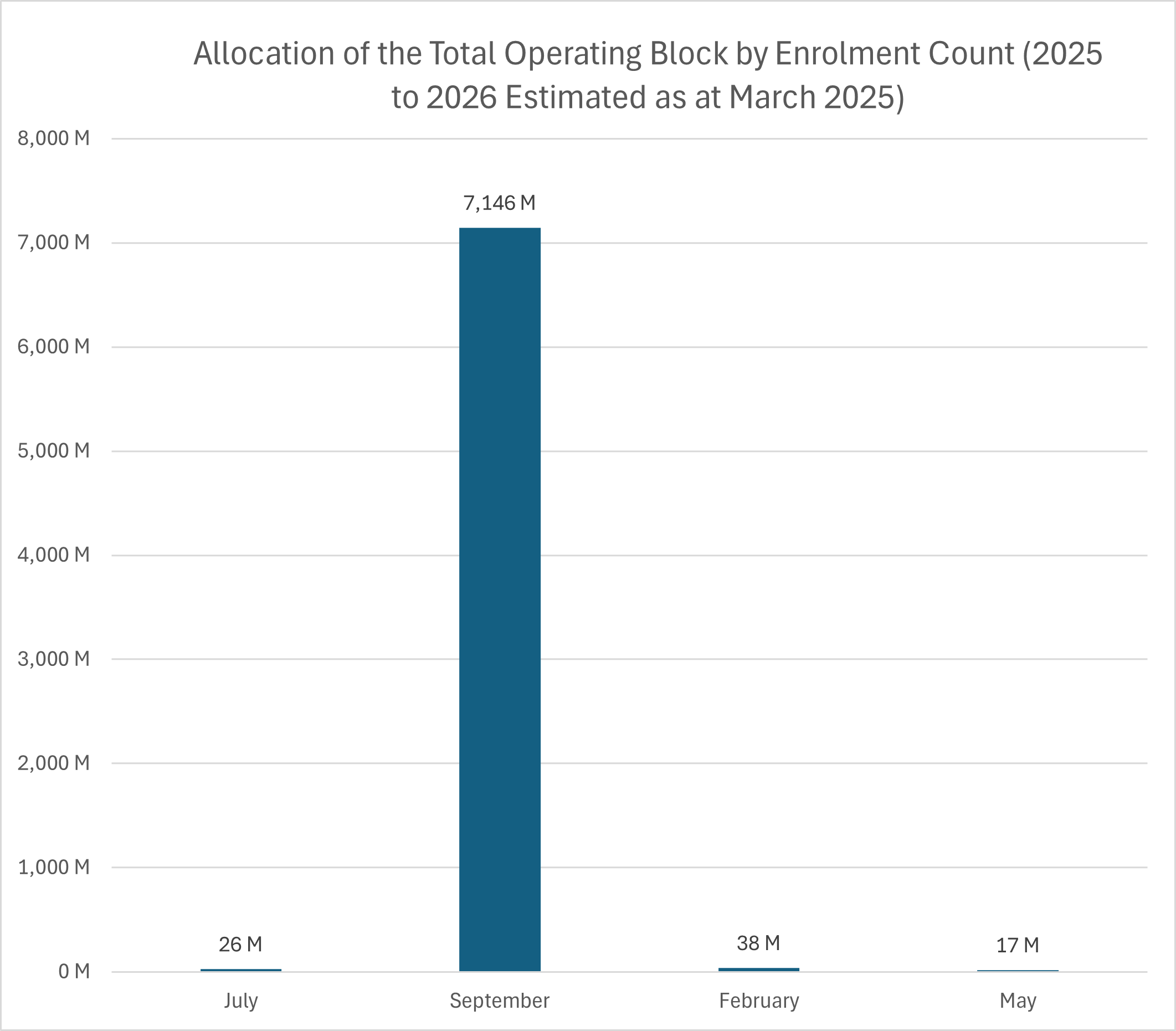
Text description
Title: Allocation of the Total Operating Block by Enrolment Count (2025 to 2026 Estimated as at March 2025)
Value column: 8,000 M (M for millions), 7,000M, 6,000M, 5,000M, 4,000M, 3,000M, 2,000M, 1,000M, 0M
Bars:
July 26M
September 7,146M
February 38M
May 17M
Note: The following tables were modified for accessibility reasons.
| Standard School | $ 9,015 per school age FTE |
|---|---|
| Alternate School | $ 9,015 per school age FTE |
| Continuing Education | $ 9,015 per school age FTE |
| Online Learning | $ 7,280 per school age FTE |
- *Common per student amount for every FTE student enrolled by school type
74% allocated through the Basic Allocation
| Level 1 Inclusive Education | $51,300 per student |
|---|---|
| Level 2 Inclusive Education | $24,340 per student |
| Level 3 Inclusive Education | $12,300 per student |
| English/French Language Learning | $1,815 per student |
| Indigenous Education | $1,790 per student |
| Adult Education | $5,755 per FTE |
- *Additional per student funding to address uniqueness of district enrolment and support additional programming. Includes Equity of Opportunity Supplement for children and youth in care and students with mental health challenges.
18% allocated to recognize unique student
| Small Community | For small schools located a distance away from the next nearest school |
|---|---|
| Low Enrolment | For districts with low total enrolment |
| Rural Factor | Located some distance from Vancouver and the nearest large regional population centre |
| Climate Factor | Operate schools in colder/warmer climates; additional heating or cooling requirements |
| Sparseness Factor | Operate schools that are spread over a wide geographic area |
| Student Location Factor | Based on population density of school communities |
| Supplemental Student Location Factor | Level 1 and 2 inclusive education enrolment |
| Salary Differential | Funding to districts that have higher average educator salaries |
- * Additional funding to address uniqueness of district factors.
7% allocated to recognize unique district factors
| Funding Protection | Funding to ensure that no district experiences a decline in operating grants greater than 1.5% when compared to the previous September |
|---|---|
| Enrolment Decline | Funding to districts experiencing enrolment decline of at least 1% when compared to the previous year |
0.2% allocated to buffer the effects of declining enrolment
CSF Supplement
District receives a 15% funding premium on allocated funding
Note: All funding information estimated for the 2025 to 2026 School Year
Appendix B - 2025 to 2026 Feeding Futures Allocations
| School District | Feeding Futures Allocation |
|---|---|
| 5 - Southeast Kootenay | $770,348 |
| 6 - Rocky Mountain | $461,311 |
| 8 - Kootenay Lake | $597,706 |
| 10 - Arrow Lakes | $350,000 |
| 19 - Revelstoke | $350,000 |
| 20 - Kootenay-Columbia | $505,141 |
| 22 - Vernon | $1,058,137 |
| 23 - Central Okanagan | $2,806,448 |
| 27 - Cariboo-Chilcotin | $596,893 |
| 28 - Quesnel | $402,072 |
| 33 - Chilliwack | $1,816,425 |
| 34 - Abbotsford | $2,248,258 |
| 35 - Langley | $2,793,495 |
| 36 - Surrey | $8,831,277 |
| 37 - Delta | $1,695,059 |
| 38 - Richmond | $2,442,836 |
| 39 - Vancouver | $5,548,306 |
| 40 - New Westminster | $868,914 |
| 41 - Burnaby | $2,980,197 |
| 42 - Maple Ridge-Pitt Meadows | $1,882,964 |
| 43 - Coquitlam | $3,533,144 |
| 44 - North Vancouver | $1,746,166 |
| 45 - West Vancouver | $745,220 |
| 46 - Sunshine Coast | $488,121 |
| 47 - qathet | $397,844 |
| 48 - Sea to Sky | $622,386 |
| 49 - Central Coast | $350,000 |
| 50 - Haida Gwaii | $350,000 |
| 51 - Boundary | $350,000 |
| 52 - Prince Rupert | $350,000 |
| 53 - Okanagan Similkameen | $350,000 |
| 54 - Bulkley Valley | $350,000 |
| 57 - Prince George | $1,680,154 |
| 58 - Nicola-Similkameen | $350,000 |
| 59 - Peace River South | $509,026 |
| 60 - Peace River North | $780,684 |
| 61 - Greater Victoria | $2,277,123 |
| 62 - Sooke | $1,661,694 |
| 63 - Saanich | $854,935 |
| 64 - Gulf Islands | $350,000 |
| 67 - Okanagan Skaha | $710,635 |
| 68 - Nanaimo-Ladysmith | $1,682,926 |
| 69 - Qualicum | $498,142 |
| 70 - Pacific Rim | $462,743 |
| 71 - Comox Valley | $1,159,491 |
| 72 - Campbell River | $694,235 |
| 73 - Kamloops-Thompson | $1,924,536 |
| 74 - Gold Trail | $350,000 |
| 75 - Mission | $805,803 |
| 78 - Fraser-Cascade | $350,000 |
| 79 - Cowichan Valley | $967,092 |
| 81 - Fort Nelson | $350,000 |
| 82 - Coast Mountains | $560,797 |
| 83 - North Okanagan-Shuswap | $848,097 |
| 84 - Vancouver Island West | $350,000 |
| 85 - Vancouver Island North | $350,000 |
| 87 - Stikine | $350,000 |
| 91 - Nechako Lakes | $573,198 |
| 92 - Nisga'a | $350,000 |
| 93 - Conseil scolaire francophone | $1,060,021 |
| Provincial Total | $71,500,000 |
Appendix C - Feeding Futures & National School Food Program funding – Instructions to school districts
Through Feeding Futures, the Ministry allocates $71.5 million per year in dedicated, multi-year funding to school districts to create and expand school food programs. For the 2025 to 2026 school year, Feeding Futures spending criteria will remain flexible so districts can allocate funds to best meet local needs.
In addition, the B.C. Government entered into an agreement with the Government of Canada through the National School Food Program (NSFP), providing approximately $39 million over three years in additional school food program funding to complement Feeding Futures. Guided by the National School Food Policy, NSFP spending criteria will be flexible to enable districts to spend funding where it is needed most. NSFP funding for the 2024 to 2025 school year will be allocated to districts in April 2025.
District by district allocations and a description of the funding allocation methodology for federal funds are available on the Summary of Grants to Date table for 2025 to 2026 Feeding Futures funding and 2024 to 2025 NSFP funding. This funding is being disbursed under section 115(1)(a) of the School Act and should be treated as separate Special Purpose Funds on school district financial statements. All 2024 to 2025 NSFP funds should be spent by March 31, 2026, and 2025 to 2026 Feeding Futures funding should be fully spent by June 30, 2026.
Feeding Futures 2025 to 2026 spending criteria
- Food:
- Must be towards the delivery of food programs to feed students who need it most (for example, maintain current programs, increase number of students served, increase nutrition of food).
- Spending may support food for Culinary Arts programs if the food produced by the program is provided to students in need.
- Program delivery may include the procurement of third-party food service providers and/or expansion of existing contracts.
- Districts are encouraged to make best efforts to align school food programs with the Feeding Futures Guiding Principles.
- Staffing:
- Within reason, districts have the flexibility to hire up to one School Food Coordinator FTE if needed or offset existing costs to a School Food Coordinator. School Food Coordinator responsibilities may include coordination and/or delivery of programs (for example, prepare food, build community connections, seek local partnerships and procurement opportunities, work with local First Nations and Indigenous partners).
- Within reason, districts may use a portion of Feeding Futures funding to offset staffing costs for staff directly involved in the delivery of school food programs. For example, this could include offsetting staffing costs for support workers or school administrators when they are directly involved in the delivery of food programs.
- Infrastructure and equipment:
- Small appliances or equipment to prepare, store, cook, and transport food from a school with a kitchen to another school (for example, kitchen utensils, insulated containers, microwaves).
- To inquire about the use of Feeding Futures funding on infrastructure projects not specified above, please contact ECC.schoolfood@gov.bc.ca
- Other:
- Within reason, districts may use discretion to allocate a small portion of Feeding Futures funding towards home food security supports (for example, grocery store gift cards, food hampers).
- Within reason, districts may use discretion to allocate some Feeding Futures funding towards supporting the provision of snacks for children in StrongStart BC programs, if necessary.
National School Food Program 2024 to 2025 spending criteria
- Spending criteria for NSFP funding is the same as the above Feeding Futures spending criteria, apart from the following:
- Districts may use funds towards major and minor food infrastructure, appliances, or equipment needed to prepare, store, cook, or transport food for programs. Food infrastructure improvements made with NSFP funding must not add square footage to an existing school facility or convert educational classroom space to a kitchen.
- Districts are encouraged to consider that, when using third parties to deliver school food programs and services, NSFP funding supports programs and services that are delivered predominantly by not for-profit entities.
- Federal funding cannot be used to provide school food programs during school holidays, however funding may be spent in advance of the school year if it supports the delivery of school food programs during the school year. For example, districts may use NSFP funding for infrastructure or equipment upgrades during the summer, if the upgrades support the delivery of a food program during the school year. However, districts may not use NSFP funding to provide meals or snacks to students during school holidays such as summer, spring break, or winter holidays.
Reporting
- Year-end financial reporting for 2024 to 2025 Feeding Futures and 2024 to 2025 NSFP funding will be required by July 31, 2025. Unused 2024 to 2025 NSFP funding can be spent in the 2025 to 2026 school year but should be fully spent by March 31, 2026.
- School districts will also be required to return a completed report outlining how 2025 to 2026 Feeding Futures and 2025 to 2026 NSFP funds (to be distributed September 2025) were spent to the ministry by July 31, 2026.
- A reporting template will be distributed and will ask for information related to spending of Feeding Futures and NSFP funding, including:
- Number of schools offering school food programs (breakfast, lunch, snacks) and the percentage of students served.
- A list of schools that received NSFP funding.
- Utilization of third-party food service providers. Food purchased and provided using district staff.
- Other goods, services and/or programs to feed students that are within the policy direction.
- Spending on infrastructure, equipment, or supplies for programs. o Spending to provide home food security supports.
- Staffing costs to directly support the provision of food programs.
- Engagement and decision-making processes regarding Feeding Futures funding, including engagement with Indigenous Education Councils (IEC or local equivalent) and how Indigenous students are supported.
- Reporting will be required at the end of the school year, in addition to the reporting in the Annual Budget and audited Financial Statements.
| Date | Description |
|---|---|
| Mid-April, 2025 | Feeding Futures 2024 to 2025 District Payments (2 of 2) National School Food Program 2024 to 2025 District Payments (1 of 1) |
| July 31, 2025 | Year-end financial reporting for 2024 to 2025 Feeding Futures and National School Food Program funding |
| Mid-September 2025 | Feeding Futures 2025 to 2026 District Payments (1 of 2) National School Food Program 2025 to 2026 District Payments (1 of 1) |
| Mid-April 2026 | Feeding Futures 2025 to 2026 District Payments (2 of 2) National School Food Program 2026 to 2027 District Payments (1 of 1)* |
| July 31, 2026 | Year-end financial reporting for spending of 2025 to 2026 Feeding Futures and National School Food Program funding |
- *2026 to 2027 NSFP funding will be distributed prior to the start of the 2026 to 2027 school year to provide districts the flexibility to utilize funds in advance of the school year for expenditures that support the delivery of school food programs in the 2026 to 2027 school year. NSFP funding may not, however, be used to provide school food programs during the summer holidays.