

Volume 9 | Issue 2
Operations update
HMCS Charlottetown transits to Op HORIZON

Caption
Member of the ship's force protection team conducts overwatch onboard HMCS Charlottetown while approaching the Panama Canal while sailing on Operation HORIZON.
His Majesty’s Canadian Ship (HMCS) Charlottetown departed February 1 for a six-month deployment to the Indo-Pacific region in support of Operations HORIZON and NEON.
On February 16, Charlottetown completed an early milestone of the deployment by transiting the Panama Canal. The transit required coordinated efforts to safely navigate the canal’s lock system, which raises vessels approximately 26 metres.
The ship will participate in multinational exercises and cooperative engagements with allies and partners, reinforcing regional security and advancing Canada’s Indo-Pacific Strategy. The operations demonstrate Canada’s ongoing defence commitment to the region and its role as a reliable international partner.
Map of RCN Operations and Exercises (Click to expand)

Caption
- OP HORIZON
- OP NEON
- OP LATITUDE
- OP LENTUS
- OP NANOOK
- OP CARIBBE
- OP PROJECTION
- OP REASSURANCE
- OP AMARNA
- EX BALAKATAN
- EX VALIANT SHIELD
- EX KEEN SWORD
- EX TALISMAN SABRE
- EX RIMPAC
- EX ARCTIC EDGE
- EX TRIDENT FURY
- EX FORMIDABLE SHIELD
- EX TRADEWINDS
- EX CUTLASS FURY
- EX JOINT WARRIOR
- EX STEADFAST DEFENDER
HMCS Ottawa completes readiness training with Sea Training Pacific

Caption
A sailor stands watch on the flight deck of HMCS Ottawa during readiness training with Sea Training Pacific off the coast of British Columbia.
HMCS Ottawa conducted training with Sea Training Pacific from January 19 to February 6, operating along the coast of British Columbia and through Barkley Sound, with a port visit in Port Alberni.
During the period at sea, the ship completed Basic Single Ship Readiness Training (BSSRT) and Intermediate Air Sea Readiness Training (IASRT), while conducting sea trials on upgraded sensors.
The training forms part of the ship’s progression toward full operational capability. BSSRT confirms the ship and crew can safely operate at sea, while IASRT builds on these fundamentals to enhance mission readiness.
The sea trials represent an initial step in validating upgraded systems and ensuring HMCS Ottawa is prepared to deploy and conduct assigned tasks.
HMCS Yellowknife patrols Caribbean Sea

Caption
A boatswain from HMCS Yellowknife and members of the United States Coast Guard Tactical Law Enforcement Team return to the ship after investigating an object spotted on the water during Operation CARIBBE on 15 February 2026
HMCS Yellowknife departed January 21 for a seven-week deployment on Operation CARIBBE in the Caribbean Sea. Operation CARIBBE is Canada’s contribution to multinational efforts to counter illicit narcotics trafficking in the Caribbean Sea and eastern Pacific Ocean. Yellowknife is operating alongside the United States Coast Guard to lawfully detect, monitor and interdict suspect trafficking vessels.
As part of the operation, Canadian Armed Forces (CAF) members are conducting Rigid Hull Inflatable Boat drills and maintaining interdiction readiness while at sea. Operation CARIBBE strengthens partnerships across the western hemisphere and supports international efforts to prevent illicit narcotics from reaching North American communities.
Yellowknife is expected to return to its homeport on March 12.
HMC Ships Frédérick Rolette and Robert Hampton Gray strengthen Arctic readiness
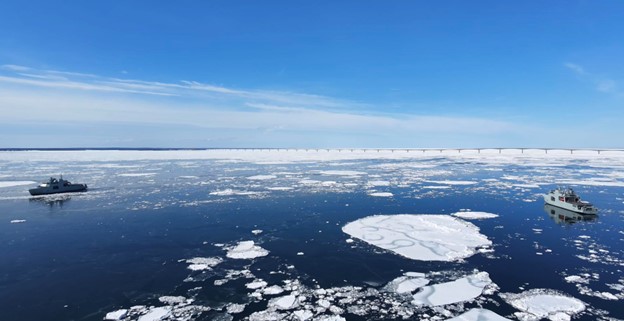
Caption
HMC Ships Frédérick Rolette and Robert Hampton Gray sail in the Northumberland Strait during cold weather trials, navigating through seasonal ice beneath Confederation Bridge.
HMC Ships Frédérick Rolette and Robert Hampton Gray are conducting cold weather trials and ice operations training in the Northumberland Strait between Prince Edward Island and New Brunswick. Operating in seasonal ice and low temperatures, the ships are validating equipment performance, ship handling and overall operational readiness in winter conditions, including a transit beneath Confederation Bridge in ice-infested waters.
As part of ongoing Arctic capability development, HMCS Robert Hampton Gray conducted icebreaker familiarization training with Canadian Coast Guard Ship (CCGS) Jean Goodwill in Chaleur Bay. Coast Guard personnel demonstrated backing and looping techniques used to free vessels beset in ice and reduce ice pressure.
Meanwhile, HMCS Frédérick Rolette continued ice navigation trials, with embarked scientific personnel measuring ice thickness and environmental conditions while underway. The activities support the refinement of procedures for safe and effective operations in ice-covered waters.
Top Stories
HMCS Regina Conducts First-of-Class Mk 54 Torpedo Firings
Caption
A Mark 54 lightweight torpedo is launched from HMCS Regina during live-fire trials at the Canadian Forces Maritime Experimental and Test Ranges off the coast of Vancouver Island, February 2026.
HMCS Regina has become the first ship in the Royal Canadian Navy (RCN) to conduct firings of the Mark 54 lightweight torpedo, marking a milestone in the modernization of Canada’s Halifax-class frigates and enhancing the navy’s anti-submarine warfare capability.
The firings took place from February 2 to 4 at the Canadian Forces Maritime Experimental and Test Ranges off the eastern coast of Vancouver Island, north of Nanaimo, as part of the Lightweight Torpedo Upgrade project.
During the exercise, Regina engaged a stationary underwater test target to evaluate system integration, target detection, weapon preparation and launch procedures under live firing conditions. The trials also assessed new data collection and analysis tools to support fleetwide implementation.
The Mk 54 torpedo will strengthen the RCN’s ability to counter modern undersea threats as it is introduced into operational service across the Halifax class.
S2 Marco Petrucci: Trust at every level
Transcript
My great, great grandfather served in World War I and World War II in Italy. He was actually captured. Few German soldiers were actually found killed in the area of Pianosinatico, where my family comes from. And because of that, they actually lined up 25 Sisis and 25 Petruccis, the Sisis are the Petrucci counterpart, and they all shot them. So we have a gravestone in Pianosinatico, with 50 names. And we've all gone and visited that grave.
You know, you come out of high school thinking, oh, the world, the world is going to be your oyster. You know, everything's going to be easy. But it is absolutely not. I was a server at Boston Pizza, I did lifeguarding, I was a substitute teacher at one point, but in the end they didn't give me enough purpose. So when I started looking for a good path in my life, I talked through with my father and we found that, you know, MARTECH in the Navy, really looked like a good option.
Having no background in the trades, I was a little nervous. Job number one: Make sure that the ship moves.
Now is my first sail not having training, I'm responsible for everything I do. I want a naval experience, I want the trades experience. I've gotten the opportunity to work mechanical, to work electrical, work hull tech. And I'll be sent out to transfer, you know, oil for our MLO systems. And that's like our gearbox. That's the most important part of the ship for us. If anything goes wrong, that can cause the ship to stop. That causes delays. And now I'm responsible for all that. We’re the guys getting in the bunker here.
Fights. Fires. Floods. Damages. Helo crashes. All the above, right? Yeah. There has to be trust at every level because we know if anything happens, you know, we're looking at each other. And so we build this really strong camaraderie. We've seen the best andthe worst of all of us, and that's one reason that we can honestly call ourselves family.
We'll do a load between the boards.
We're getting new guys on, new recruits, and now I'm one of the guys they look towards. To carry on, you know, what my family stood for, really means a lot to me. So my job will always be down in the machine spaces, you know, turning wrenches.
In Pianosinatico, we paid our respects, and it is very solemn. But at the same time, you know, I'm just kind of proud to be part of that lineage, part of that history that kind of stood up for themselves and made sacrifices. And in the end succeeded.
Recently promoted Sailor 2nd Class (S2) Marco Petrucci serves as a Marine Technician (MARTECH) in the RCN, where he is responsible for maintaining and repairing the mechanical and electrical systems that keep a warship operational.
For S2 Petrucci, service is also shaped by family history, with ancestors who experienced the impacts of war in Italy during the Second World War. That legacy informs his commitment to teamwork and accountability. “There has to be trust at every level,” he said, reflecting on the reliance sailors place on one another at sea. Now mentoring junior personnel, S2 Petrucci supports the development of future technicians while contributing to the RCN’s continued operational readiness. Watch the video of his full story.
Defence Minister visits CFB Esquimalt

Captions
The Honourable David McGuinty, Minister of National Defence (Left); Vice-Admiral Angus Topshee, Commander of the Royal Canadian Navy (Middle); Rear-Admiral David Patchell, Commander of Maritime Forces Pacific (Right) sail on Patrol Craft Training (PCT) Ship Grizzly as part of a visit to CFB Esquimalt at Esquimalt Harbour on February 19.
Defence Minister David McGuinty visited Canadian Forces Base (CFB) Esquimalt on February 19, 2026, to meet with naval leaders, sailors and support staff. Discussions focused on operational readiness, personnel well-being and ongoing fleet modernization efforts.
During the visit, the Minister met with military families and discussed initiatives aimed at improving quality of life for sailors and their families, including work underway with the Province of British Columbia to enhance access to child care and health care services.
The Minister toured Fleet Diving Unit (Pacific), Esquimalt Harbour and Fleet Maintenance Facility Cape Breton to learn about current and future projects supporting fleet sustainment. He also went aboard His Majesty’s Canadian Ship (HMCS) Vancouver to meet with the crew and observe ongoing operations.
Future naval occupations set to ensure readiness
The Royal Canadian Navy (RCN) has completed an Occupation Analysis to update its occupational structure and align skills, training and career pathways with the requirements of the future fleet. The analysis recommended transitioning nine existing RCN-managed occupations into thirteen occupations to reflect evolving technologies, advanced combat systems and increasingly complex operating environments. The changes are intended to support workforce resilience and ensure sailors are prepared to operate and sustain new classes of ships and emerging capabilities.
With the new occupation structure endorsed, the RCN is now moving into implementation planning. This phase focuses on developing a deliberate transition plan that balances personnel management, training, fleet readiness and career progression. No individual changes are being made at this stage. Over the coming months, the RCN will continue engagement across formations to refine the plan and provide additional information as implementation details are confirmed.
Navy accepts Naval Large Tug Canso

Caption
The Canadian Forces Auxiliary Vessel (CFAV) Canso sailing under a bridge in Halifax.
On February 27, 2026, representatives from the Department of National Defence highlighted the arrival of Canadian Forces Auxiliary Vessel (CFAV) Canso at Canadian Forces Base Halifax, N.S. CFAV Canso is the third Naval Large Tug delivered under the fleet recapitalization project and the first assigned to the East Coast. The vessel completed its transit from Ocean Industries Inc., Île-aux-Coudres, Que., in late 2025 and was accepted in January 2026. Ownership will transfer to the Royal Canadian Navy (RCN) following completion of crew training.
Naval Large Tugs provide essential harbour and coastal support, including berthing, coastal towing and firefighting. As our fleet size grows over the coming years with the arrival of the Harry DeWolf-class Arctic and Offshore Patrol Ships, Protecteur-class Auxiliary Oiler Replenishment vessels and River-class destroyers, demand for harbour support services will increase.
In December 2025, the contract was amended to include two additional tugs, CFAV Sansum and CFAV Belle Isle, bringing the total to six vessels. Once delivered, three tugs will operate on each coast, strengthening redundancy and sustaining fleet readiness.
PO1 Evans: Finding purpose beneath the surface

Caption
PO1 Evans in HMC Submarine Corner Brook's control room.
Petty Officer 1st Class (PO1) Yevrag Evans joined the Canadian Armed Forces in 2005, continuing a family legacy of military service. In search of greater permanence and shared responsibility he earned his dolphins and became a qualified submariner in 2009.
Submarine service demands a deep understanding of interconnected systems and trust within a small crew. Over more than 21 years, PO1 Evans has served in roles including anti-submarine plotting, electronic warfare, submarine fire control and intelligence. Now progressing toward senior operational positions, he mentors prospective submariners and emphasizes accountability, patience and teamwork.
Exercise ROGUISH BUOY 2026 reinforces combat diver readiness on Vancouver Island

Caption
Divers prepare at Whirl Bay underwater demolition range during Exercise ROGUISH BUOY.
Combat divers trained at Albert Head and the Whirl Bay Underwater Demolition Range from January 21 to February 12 as part of Exercise ROGUISH BUOY. ROGUISH BUOY is Canada’s only dedicated collective combat diver exercise, focused on maintaining operational readiness, recertification and advanced underwater capabilities, including demolition, reconnaissance, navigation, and insertion and extraction techniques. Helocasting operations were conducted in partnership with 443 Maritime Helicopter Squadron.
Hosted on Vancouver Island for the third consecutive year, the exercise also included participation from the United Kingdom, Latvia, Germany and the Netherlands. Training alongside allied partners in a realistic maritime environment strengthened interoperability and ensured Canada’s dive teams remain prepared to support complex operations at home and abroad.
New in defence
Defence Industrial Strategy strengthens sovereign capability

Caption
HMCS Protecteur alongside a shipyard in Vancouver, British Columbia.
On February 17, 2026, the Government of Canada released Canada’s Defence Industrial Strategy, outlining a long-term plan to strengthen the country’s defence industrial base and support the operational readiness of the CAF. Backed by $6.6 billion in dedicated funding and aligned with an $81.8 billion reinvestment in defence, the strategy establishes a new Defence Investment Agency (DIA) and introduces a “BUILD-PARTNER-BUY” framework to guide future procurements, prioritizing domestic production in key sovereign capability areas and increasing the share of defence acquisitions awarded to Canadian firms to 70 per cent.
Structured around five pillars, the strategy focuses on renewing relationships with industry, accelerating procurement, investing in research and development, securing critical supply chains, and working with partners, including in Canada’s North and Arctic.
It sets a target to raise maritime fleet serviceability to 75 per cent, while boosting defence-related research and development investment by 85 per cent, increasing exports by 50 per cent, and supporting the creation of up to 125,000 new jobs. The strategy aims to strengthen shipbuilding, aerospace, digital systems, munitions and uncrewed systems to enhance defence readiness and long-term national security.
Prime Minister Mark Carney secures Canada’s participation in European Union SAFE initiative

Caption
Prime Minister Mark Carney meets with European Commission President Ursula von der Leyen and European Council President António Costa in Ottawa on December 1, 2025, during a Canada–European Union meeting.
On December 1, 2025, in Ottawa, Prime Minister Mark Carney announced the conclusion of negotiations enabling Canada’s participation in the European Union’s Security Action for Europe (SAFE) initiative. SAFE is a financial instrument under the European Union’s Readiness 2030 plan that provides up to $244 billion in loans to member states to support large-scale defence procurement, including ammunition, missiles, drones, artillery systems and other critical capabilities. Canada will become the first non-European country to participate in the instrument following the adoption of a Council decision authorizing the bilateral agreement.
Canada’s participation in SAFE is expected to expand market access for Canadian defence manufacturers, strengthen industrial cooperation with European allies and support capability development for the CAF. As European Union member states increase defence investment, collaboration through common procurement is intended to accelerate readiness, reinforce transatlantic security partnerships and contribute to closing existing capability gaps.