
Esquimalt Harbour Projects
Background
CFB Esquimalt leadership is fully committed to its role as environmental stewards of Esquimalt Harbour. We acknowledge “es- whoy-malth,” or “the place of gradually shoaling waters” is a culturally significant area located within the Traditional Territories of the lək̓ʷəŋən (Lekwungen) Esquimalt and Songhees Nations. We thank them for sharing their traditional knowledge of the environment and their consultations with the Department of National Defence (DND) in the management of Esquimalt Harbour Projects past, present and future.
Esquimalt Harbour has been inhabited by people longer than recorded history. However, it is only since the arrival of European nations in the late 1700’s that negative environmental impacts from human activity began to accrue. The establishment of HMC Dockyard by the British in 1865 is an important date in the history of the region. Not only did it establish an enduring naval presence in the harbour, but it was also a harbinger for the environmental pressures to follow.
The past 200 years have witnessed increased industrial activity around the harbour including civilian and military shipbuilding and repair, commercial and military ship operations, and sawmilling. As population centres around the harbour grew, releases from storm sewers, surface runoff and other sources have added to contaminant levels in the marine environment.
The modern-day environmental movement began to take shape in North America in the early 1960’s. Since then, our knowledge and attitudes about the environment have steadily improved.
When DND assumed management authority for the designated federal harbour in 2005, environmental remediation was already a top priority for the government. Supported by a dedicated team of full-time environmental scientists, researchers and managers, DND has made steady progress over the past 20 years.
We are proud of what we have accomplished through reducing or eliminating harmful practices, creating favourable habitat for the revitalization of native species and remediating legacy contamination through stand-alone projects in conjunction with infrastructure upgrades.
At Canadian Forces Base (CFB) Esquimalt, care for the environment isn’t merely an afterthought: it’s integrated into everything we do.
Projects
In order to meet its Defence commitments to the Government of Canada, the Royal Canadian Navy requires a range of infrastructure (buildings, roads, jetties etc.) suitable to support its sailors and the vessels they operate.
Given that some structures in HMC Dockyard date back 175 years, infrastructure recapitalization is an ongoing effort. However, each new upgrade project is also an opportunity to invest in the environment. By introducing green technologies, sustainable practices and concurrently remediating legacy contamination, each project advances our goal of fostering a vibrant, more diverse marine ecosystem and a healthier harbour for the surrounding residents.
Remediation projects require careful investigation, analysis, and planning to ensure that contaminants are safely removed and disposed of. First, environmental investigations are done to identify contaminated areas and how deep they are embedded into the seabed. This information is then used to determine the best course of action for removal. Next, dredging is done to remove as much of the contaminated sediments as possible. This is done by using a clamshell bucket attached to a crane or excavator. The removed sediments are then processed and transported by a barge or truck to a facility for disposal or treatment. In most cases, areas that are dredged are then backfilled with a clean sand cover to enhance the natural recovery process. In areas near the shore where dredging cannot be done, contaminated sediments are “capped” with engineered layers of sand, gravel, and armoured rock to cover the contamination and limit its exposure to humans and marine life.
At the same time, DND continues to rebuild and upgrade infrastructure at CFB Esquimalt to meet operational, maintenance, environmental, and technological advances. In 2013, DND announced plans to replace the existing “A” and “B” jetties at CFB Esquimalt’s dockyard to synchronize with Canada’s National Shipbuilding Strategy, which will deliver modern ships to the Royal Canadian Navy over the next 30 years. CFB Esquimalt’s upgraded A/B Jetties will be home to several of these Canadian-built vessels.
DND will continue to share updates about harbour remediation and infrastructure projects as they progress.
Esquimalt Harbour Projects Overview
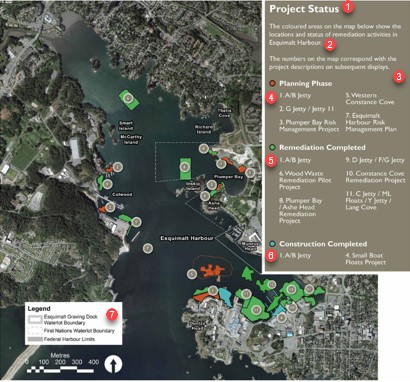
The following map identifies locations of DND Esquimalt Harbour projects that have been recently completed, are currently underway, or are being planned for the future. These projects include remediation and risk management activities to address areas of contamination and monitor long-term effects, as well as infrastructure improvements to modernize DND's facilities in Esquimalt Harbour. Each number on the map below corresponds to a project description.
Click on the map to see in full screen.
Caption
The Esquimalt Harbour Map figure includes coloured areas on the map below to show locations and status of remediation activities in Esquimalt Harbour. The numbers on the map correspond with project descriptions on subsequent displays. Red colour areas on the map refer to projects in the planning phase. Green areas on the map refer to projects that have completed remediation. Blue areas on the map refer to projects that have completed construction.
Past projects
Central Constance Cove Remediation Project
Learn more about DND’s Central Constance Cove Remediation Project including a project overview, current status, anticipated timeline, and related figures and images.
Colwood Jetties Remediation Project
Learn more about DND’s Colwood Jetties Remediation Project including a project overview, current status, anticipated timeline, and related figures and images.
Constance Cove Remediation Project
Learn more about DND’s Constance Cove Remediation Project including a project overview, current status, anticipated timeline, and related figures and images.
Esquimalt Harbour Remediation Project
Learn more about DND’s Esquimalt Harbour Remediation Project including a project overview, current status, anticipated timeline, and related figures and images.
G Jetty / Jetty 11 Project
Learn more about DND’s G Jetty / Jetty 11 Project including a project overview, current status, anticipated timeline, and related figures and images.
Plumper Bay/Ashe Head Remediation Project
Learn more about DND’s Plumper Bay/Ashe Head Remediation Project including a project overview, current status, anticipated timeline, and related figures and images.
Small Boat Floats Project
Learn more about DND’s Small Boat Floats Project including a project overview, current status, anticipated timeline, and related figures and images.
Western Constance Cove Remediation Project
Learn more about DND’s Western Constance Cove Remediation Project including a project overview, current status, anticipated timeline, and related figures and images.
Current projects
A/B Jetty Recapitalization Project
Learn more about DND’s A/B Jetty Recapitalization Project including a project overview, current status, anticipated timeline, and related figures and images.
Esquimalt Harbour Risk Management Plan
Learn more about DND’s Esquimalt Harbour Risk Management Plan including a project overview, current status, anticipated timeline, and related figures and images.
Plumper Bay Revitalization Project
Learn more about DND’s Plumper Bay Revitalization Plan including a project overview, current status, anticipated timeline, and related figures and images.
Wood Waste Remediation Project
Learn more about DND’s Wood Waste Remediation Project including a project overview, current status, anticipated timeline, and related figures and images.
Upcoming projects
Lang Cove/Eastern Constance Cove Remediation Project
Learn more about DND’s Lang Cove/Eastern Constance Cove Remediation Project including a project overview, current status, anticipated timeline, and related figures and images.
Project communication
First Nations Engagement
Learn more about First Nations involvement in DND’s Esquimalt Harbour Projects.
Public engagement
Learn more about public involvement in DND’s Esquimalt Harbour Projects including how to stay updated and share feedback on these projects.
Environment
Remediation in Esquimalt Harbour
Learn more about DND’s remediation work in Esquimalt Harbour including the remediation process, types of contaminants in Esquimalt Harbour, environmental investigations, construction, and disposal.
Monitoring in Esquimalt Harbour
Learn more about DND’s environmental monitoring efforts in Esquimalt Harbour including environmental practices and types of environmental monitoring used for the Esquimalt Harbour Projects.
Habitat in Esquimalt Harbour
Learn more about DND’s habitat protection and enhancement efforts in Esquimalt Harbour including different initiatives and reef imagery.
Contact us
E-mail: cfbesquimalt@outlook.com
Fax: 250-363-2124
Telephone numbers
Base Public Affairs: 250-363-4006
King's Harbour Master: 250-363-2165
Harbour Official / Assistant to King's Harbour Master: 250-363-7584
Emergency Line 24/7: 250-363-2160 / 250-363-5848
Harbour Control Officer: 250-363-2162
Harbour Operations Officer: 250-363-2160
Mailing Address
Base Public Affairs
Canadian Forces Base Esquimalt
PO Box 17000 Stn Forces
Victoria, BC V9A 7N2