
Remediation in Esquimalt Harbour
Remediation Overview
Remediation projects require careful investigation, analysis, and planning to ensure that contaminants are safely removed and disposed of. The types of contaminants vary by site, and may include metals, organometals, petroleum hydrocarbons, polycyclic aromatic hydrocarbons, phenols, polychlorinated biphenyls, dioxins and furans, and organochlorine pesticides.
Esquimalt Harbour has been the location of naval operations and an active industrial harbour for over 150 years. During this time, previous industrial practices have contributed to harbour contamination due to various organic and inorganic chemicals being deposited in the marine seabed. Industrial activity and releases from storm sewers, surface runoff, and groundwater discharges have impacted harbour sediments. While environmental practices and procedures have been established to help prevent further contamination from occurring, historical contamination is an ongoing problem that needs to be addressed.
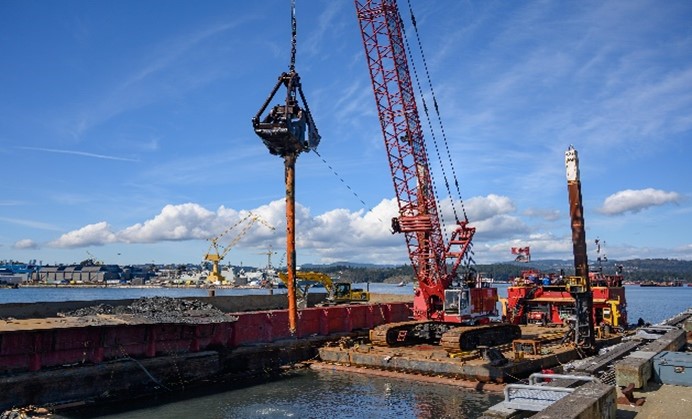
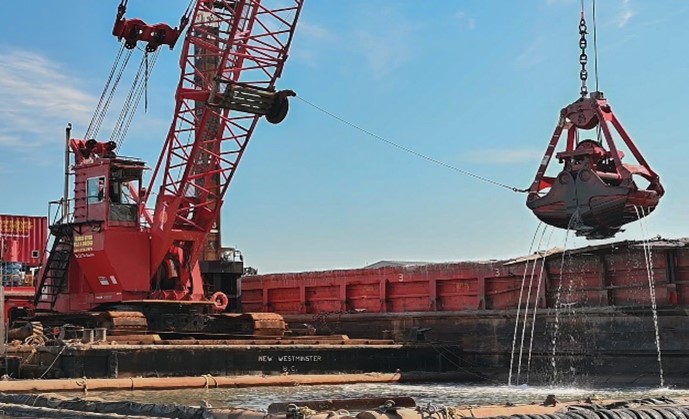
First, environmental investigations are done to identify contaminated areas and how deep they are embedded into the seabed. This information is then used to determine the best course of action for removal. Next, dredging is done to remove as much of the contaminated sediments as possible. This is done by using a clamshell bucket attached to a crane or excavator. The removed sediments are then processed and transported by a barge or truck to a licensed facility for disposal or treatment.
In most cases, areas that are dredged are backfilled with a clean sand cover to enhance the natural recovery process. In areas near the shore where dredging cannot be done, contaminated sediments are “capped” with engineered layers of sand, gravel, armoured rock and remedial amendments such as granulated activated carbon to cover the contamination and limit its exposure to humans and marine life.
Construction
Work planning will consider health, safety, and noise in accordance with environmental assessments completed by the Department of National Defence (DND) for each project. DND will carefully monitor contractor activities and will make every effort to minimize any disruption to their neighbours.
There are various reasons why construction activities may occur outside of regular work hours. For example:
- Environmental mitigation may require in-water activities to be undertaken only during specific windows of the year, to minimize potential impact on fish or other species. Work may need to occur around the clock to meet the window requirements.
- Some work needs to be completed at a specific tide (high or low). As some of these tides occur at night, work may need to be completed outside of regular working hours.
- It is important that projects remain on schedule to manage cost and limit project delays. Although DND endeavours to minimize these scenarios, at times, work hours may need to be extended to maintain project schedules.
To the extent possible, work that generates noise and/or light will be undertaken during normal work hours. Where this is not possible, mitigation will be used to minimize potential impact to nearby residents.
Caption
The Y Jetty Dredging photo shows dredging activities at Y Jetty in Esquimalt Harbour.
Caption
The C Jetty Dredging photo shows dredging activities at C Jetty in Esquimalt Harbour.
Disposal
To ensure the safety of the surrounding environment, all contaminated sediments removed from Esquimalt Harbour during remediation work will be safely transported to facilities that are licensed to accept contaminated sediments.