
Help guide for the Regional Defence Investment Initiative (RDII) expression of interest form
This help guide is a companion for the Prairies Economic Development Canada (PrairiesCan) Regional Defence Investment Initiative.
Preparation
- Before beginning your expression of interest (EOI), carefully review the guidelines on the website for this initiative, to ensure your organization is eligible to apply for funding and your proposed activities meet the objective and criteria of the initiative.
- Review this help guide carefully as it contains details on how to answer specific fields exclusively for this initiative.
- This expression of interest will be used to determine whether you will be invited by PrairiesCan to submit a full Regional Defence Investment Initiative (RDII) application.
- Fields marked with an asterisk (*) are mandatory and you will be unable to submit your EOI if such fields are left incomplete.
- Incomplete EOIs cannot be assessed and may be deemed ineligible.
- Contact PrairiesCan should you have any questions or wish to discuss your proposed project or other relevant government programs that may be applicable your project.
- For information about the program, application and assessment process, please see: Regional Defence Investment Initiative (RDII)
Completing the form
Refer to the guidance below for explanations of how to complete the expression of interest form.
Organization information
- Legal name of applicant organization *
- The legal name as shown on the certificate of incorporation or registration.
- Operating name (if different than legal name)
- Provide the name you are operating under if different from the full legal name.
- Mailing address (Including suite, unit, apt #)
- The mailing address of the applicant organization.
- Mailing address line 2:
-
Additional mailing address information.
- City: *
-
The city in which your organization resides.
- Province/Territory:
-
The province in which your organization resides.
- Country: *
-
The country in which your organization resides.
- Mailing postal code: *
-
The mailing postal code of your organization.
- Telephone country code: *
-
The telephone country code of your organization.
- Telephone: *
-
The telephone number of your organization.
- Facsimile country code:
-
The facsimile country code of your organization.
- Facsimile:
-
The facsimile number of your organization.
- Website:
-
Your applicant organization’s website address (if available).
- Email address
- Include the general email address of your organization.
- Are you an Indigenous (First Nation, Métis or Inuit) majority owned or led organization or government? *
-
Select yes or no.
Definition: majority owned or led is defined as individuals with long-term control and management of the organization and an active role in both strategic and day-to-day decision making.
- Website
- Your organization’s website address (if available).
- Corporate Status *
- Indicate if your organization is a for-profit or not-for-profit.
- Organization Type (select best fit) *
- Select from the drop down menu what most accurately reflects your organization type.
- I have a Canada Revenue Agency (CRA) Business Number: *
- Select yes or no.
- Provide your Canada Revenue Agency (CRA) Business number or Goods and Services Tax (GST) number (first 9 digits only)
- The unique business number or GST number assigned to the applicant organization by the CRA. A business number or GST number must be obtained through the CRA. For information on obtaining a business number visit the CRA’s Business Number Registration page.
- Jurisdiction of Incorporation *
- Select from the drop down menu your organization’s jurisdiction of incorporation.
- Incorporation Number
- As shown on your Certification of Incorporation.
- In the province of
- Indicate in which province the organization was incorporated.
- Date of incorporation
- Indicate the date the organization was incorporated.
- Alternative number and Alternative number type
- Please enter if you do not have a CRA Business Number or Incorporation Number, so your organization can be identified (e.g. Band number, education number).
- Number of employees working for your organization (full-time equivalents)
- Indicate the number of Full-Time Equivalent employees (FTEs) working for your organization (and if applicable, any affiliated companies). Part-time employees should be calculated based on their equivalent to an FTE (i.e., 1 part-time employee working approx. 20 hours/week should be represented as 0.5 FTEs).
- Provide a brief description and summary of your organization (Maximum of 500 characters)
-
Provide an overview of your organization. Include:
- the date it was established in Canada
- mandate and key priorities of your organization
- how it meets the RDII eligibility criteria on eligible recipients
- whether it is Canadian owned
- whether it is a subsidiary of another company
Eligible recipients
Eligible for-profit businesses:
To be eligible for this program, for-profit businesses must meet all of the following criteria:
- be incorporated to conduct business in the Prairies
- be a business, within or positioning themselves in, the defence supply chain
- have been in operation for at least 2 years
- have staffed operating facilities in the Prairie provinces
- have confirmed, at the time of application submission, funding from all other sources, including government and non-government
- are capable of entering into legally binding agreements
Eligible not-for-profit organizations:
To be eligible for this program, not-for-profit organizations must meet all of the following criteria:
- are a not-for-profit organization including post-secondary educational institutions, research centres, business accelerators and incubators, industry associations and consortia, and provincial and municipal authorities
- are capable of entering into legally binding agreements
- have an operating presence in the Prairies
Eligible Indigenous Organizations:
Eligible Indigenous organizations include Indigenous-led not-for-profits and organizations which include but are not limited to First Nations as represented by their Chief and Council, Métis Settlements, Tribal Councils, Indigenous Representative Organizations, Métis and Inuit organizations, as well as Indigenous/First Nation/Métis Settlement owned businesses.
Indigenous-led organizations and businesses are strongly encouraged to apply. For assistance with the application process, call one of our regional offices or 1-888-338-9378.
Project primary and secondary contacts
- Project Primary Contact *
- This person will be contacted for any follow-up on this application. Enter primary contact person information in the sub-sections (first name, last name, title, email address, cellular phone country code, cellular phone, telephone country code, telephone).
- Project Secondary Contact
- This person will be contacted if the primary contact is unavailable. Enter secondary contact person information in the sub-sections (first name, last name, title, email address, secondary cellular phone country code, secondary cellular phone, secondary telephone country code, secondary telephone).
Project information
- Project title (maximum of 90 characters) *
-
Provide a project title beginning with "RDII-" that accurately reflects the activities and results of the project. The project title:
- must start with the acronym "RDII-" to be identified as an application to the Regional Defence Investment Initiative
- can be a maximum of 90 characters including spaces
- will be disclosed on the Open Government Portal website as part of its proactive disclosure guidelines if your project is approved
- Project address is the same as mailing address?
-
Select “Yes” if the address at which the project will be undertaken is the same as the organization’s mailing address. If checked, the mailing address will be automatically entered.
- Project address / location (Including suite, unit, apt #): *
- If the project address is different from the mailing address, enter the location at which the project will take place.
- Project address line 2:
- If you would like to provide additional project address information, please fill out this section.
- Project city, province/territory, and postal code. *
- The project location address.
- Briefly describe your project in plain language. This is important as this section will be used in summary documents to describe your project at various review stages. (Maximum of 1,000 characters including spaces) *
-
The description should:
- provide a high-level overview of the project and its objective
- if you are a for-profit business, describe how the project will integrate you into the defence supply chain, , enhance your ability to integrate into the defence supply chain, or increase your capacity to meet Canada’s defence needs through one or more of the eligible activities.
- if you are a not-for-profit organization, describe how the project will support businesses that respond, or could respond, to a military need. Alternatively, outline how the project will conduct industrial research related to strengthening Canada’s defence capabilities. Explain how the project aligns to one or more of the eligible activities.
- outline the main elements of the proposed project, including what the key activities are, what the funds will be spent on, and how the activities will achieve the intended objectives of the project.
- describe how the proposed project responds to a military need, referencing specific defence procurement projects, fleets, or other defined military requirements, as applicable. Moreover, in the case of projects involving dual-use* technologies (i.e., both civilian and military applications), the military component must be demonstrated.
* Dual-use technologies, products, or services: Technologies, products, or services that may have both military and civilian applications. For projects involving dual use technologies, products or services, the military component will need to be demonstrated by referencing specific military use cases or applications.
Eligible activities
Eligible activities include the following:
Technology adoption
- Includes digitization, automation, or technology integration investments to enhance productivity and competitiveness
Capacity building
- Eligible activities for Businesses include:
- commercialization strategies including active participation in technology showcases (e.g., demonstrations, booths)
- certification required to integrate into defence supply chains for specialized applications
- Eligible activities for Not-for-Profits include:
- business services providing market diagnostics, development and expansion activities
- business and structural ecosystem support, market development, and guidance to support businesses
- assisting in the development of commercialization strategies including participation in technology showcases
- assisting in acquiring the certification required to integrate into defence supply chains for specialized applications
Productivity improvement
- includes acquisition of equipment as well as expansion and modernization of facilities, including manufacturing facilities
- includes acquisition of equipment to enhance the productivity of a strategic infrastructure used for defence purposes.
Technology commercialization
- includes adaptation, adoption, development or improvement of dual-use technologies with both civilian and military applications
- includes research and development (R&D)
- includes establishment of research centres and centres of expertise
PrairiesCan may give preference to activities that:
- target sectors that reflect Canadian military needs or defense priority areas (e.g., artificial intelligence, cybersecurity, quantum technologies, space, sensors, aerospace, uncrewed/autonomous technologies, etc.)
- enhance productivity, production capacity and competitiveness
- demonstrate strong regional economic benefits
- advance Indigenous economic inclusion
- strengthen Canadian supply chains, e.g. where possible buying from Canadian suppliers, using Canadian materials, etc.
- provide a high-level overview of the project and its objective
- Briefly describe the economic benefits directly associated with this project. (1,000 characters including spaces) *
-
Provide an explanation on what economic outcomes your project will achieve. Identify and detail all assumptions to support the reasonableness of your economic outcomes. All projects will be screened for significance of outcomes and the likelihood of achieving them.
Describe the economic benefits associated with your project, and impacts and benefits associated with the defence industry.
Provide numerical values measured year over year from the project start date typically to 1 year following the project completion date. Anticipated outcomes include:
- number of highly qualified personnel (HQP), including science, technology, engineering, and mathematics (STEM), jobs created in Canada
- number of non-HQP jobs created in Canada
- number of jobs maintained in Canada
- revenue growth ($)
- export sales growth ($)
- number of technologies to market – where applicable
- value of business expenditures in research and development ($) – where applicable
- number of SMEs assisted (for not-for-profit projects only)
- business sales growth resulting from commercialization ($) – where applicable
If your project supports the Government of Canada’s commitment to inclusive growth (under-represented groups), you may include this in your explanation. Note: recipients will be encouraged to track inclusiveness indicators (i.e., women, Indigenous Peoples, and youth).
You will be provided another opportunity to explain in the Benefits section. Refer to the expected results for more details.
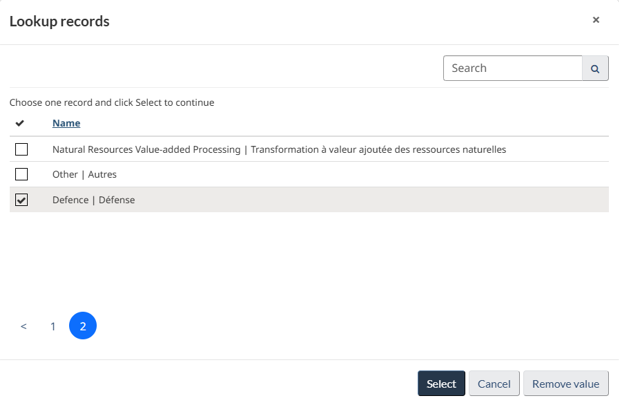
- Which regional development agency (RDA) Priority does this project best support?
-
The RDII is open to all businesses that are within or positioning themselves in the defence supply chains and not-for-profit organizations that are helping those businesses.
If you are in the defence sector or trying to integrate into the defence supply chain, choose "Defence".

- Explain how this project supports the indicated priority. (Maximum of 2,000 characters).
-
Explain in detail how the project’s objectives, activities and outcomes align with the selected priority as well as other PrairiesCan key priorities where applicable.
If your project involves a dual-use technology, product, or service*, clearly describe the civilian component, including the sector(s) or industry(ies) that benefits from the dual-use application.
* Dual-use technologies, products, or services: Technologies, products, or services that may have both military and civilian applications. For projects involving dual use technologies, products or services, the military component will need to be demonstrated by referencing specific military use cases or applications.
Project timelines
- Proposed project start date *
-
This is the proposed date the agreement between the Recipient and PrairiesCan could come into effect.
- The start date must be on or after April 1, 2025.
- Costs may be eligible on a retroactive basis for a 12-month period prior to receipt of a funding request, but no earlier than April 1, 2025.
- If the application is approved, eligible project costs incurred on or after this date may be reimbursed with proper documentation.
- Any costs incurred prior to the project start date would not be eligible for reimbursement under the terms of the agreement and are outside of the scope of the project.
- The start date must be on or after April 1, 2025.
- Proposed project end date *
-
This is the anticipated date the project activity will cease.
- Project end date must be on or before the program end date of March 31, 2028
- This does not include the repayment period when applicable.
- Any costs incurred after this date are not eligible for reimbursement under RDII.
- Project end date must be on or before the program end date of March 31, 2028
Project costs
Interested applicants are encouraged to submit an expression of interest with their estimated project costs. Project funding may be limited by available budget.
- Description of types of costs (not activities) *
-
List the various cost items you anticipate incurring in the implementation of the project. Each cost item should have its own line (see instructions below).
Recipients must ensure all project cost items are clearly verifiable.
Project costs incurred by the applicant in the absence of a signed funding agreement with PrairiesCan are incurred at the sole risk of the applicant.
If your project involves a dual-use technology, product, or service, outline all costs and indicate which cost items are aligned to military use.
Eligible costs
Eligible costs under the program are incremental, reasonable and essential to carrying out the eligible project activities. Examples of eligible costs include:
- Cost of labour (e.g., wages and benefits) and of material used.
- Capital costs: purchase of machinery, equipment and infrastructure.
- Consultancy fees (e.g. professional, and technical services).
- Costs related to preproduction activities (e.g., technological development and commercial demonstration)
- Costs related to commercializing products, expanding or maintaining markets.
- Costs related to specialized services such as, testing services, research and development services, technical or innovation services.
- Costs related to meeting military certifications and/or standards (e.g., Cybersecurity Maturity Model Certification, Controlled Goods Program Certification, International Organization for Standardization, technical and engineering standards).
- Costs related to development capacity to enable businesses to bid on defence projects.
Costs may be eligible on a retroactive basis up to a 12-month period prior to the receipt of a signed funding request, but no earlier than April 1, 2025.
Ineligible costs
Costs that are deemed not reasonable, non-incremental, and/or not directly related to the project are ineligible for funding. These can include, but are not limited to:
- costs of amortization, land acquisition and goodwill
- salary bonuses and dividend payments
- entertainment and hospitality expenses
- refinancing of existing debts
- amortization or depreciation of assets
- purchase of any assets for more than their fair market value
- lobbying activities
- donations, dues, and membership fees
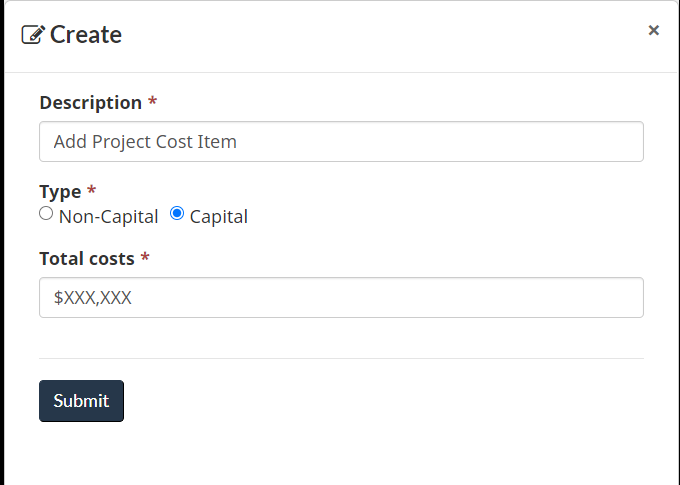
- Type *
- Indicate if the cost is capital (e.g. purchase of equipment and associated costs, such as installation) or non-capital (e.g. salaries, professional fees).
- Amount *
- The anticipated amount of the cost item.
- Total Project Costs
-
Automatically sums the cost items listed above.
Note: This total must equal the Total expenditures from the Cash Flows section below.
To add a project cost item, click on the  button and the following window will appear for you to provide the information. Click the Submit button once completed. You will still have the ability to edit the project cost item after hitting this Submit button.
Cash flows
Financial assistance information
- PrairiesCan will take into consideration all other sources of funding available to the applicant and may give preference to projects that demonstrate greater leverage of funding from non-PrairiesCan sources.
- Government funding (federal, provincial, and municipal) can cover up to 100% of eligible project costs.
- Funding is normally repayable for eligible business applicants. Funding can cover up to 75% of eligible project costs.
- The remaining 25% of eligible costs must be supported from a non-PrairiesCan source and must be confirmed at time of application and again prior to project approval
- Not-for-profit applicants can apply for non-repayable contribution funding of up to 90% of eligible project costs
- The remaining 10% of eligible costs must be supported from a non-PrairiesCan source and must be confirmed at time of application and again prior to project approval
- Indigenous applicants may receive funding for up to 100% of eligible project costs.
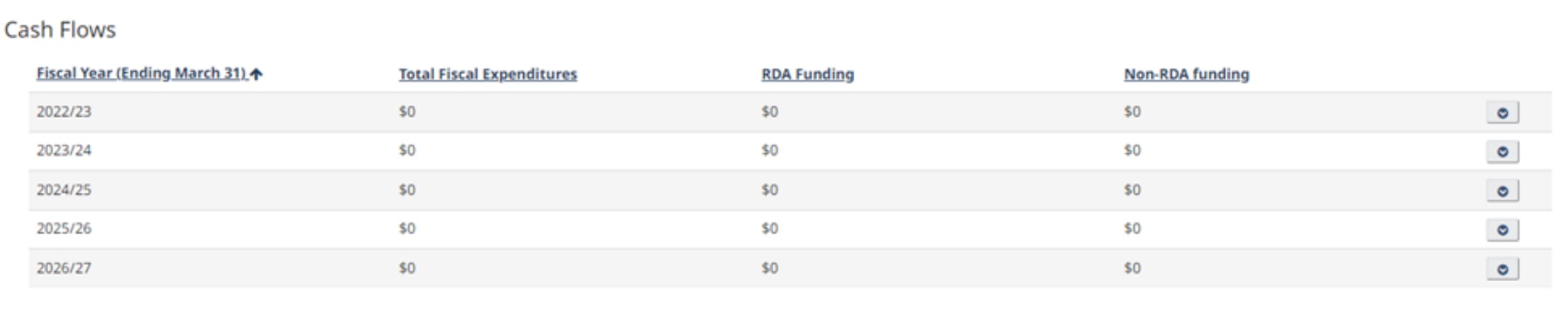
Fiscal Year (Ending March 31): Year 1
- Total Fiscal Expenditures
- Anticipated total project costs incurred in Year 1.
- RDA Funding
- The amount of PrairiesCan funding being requested to support Year 1 expenses.
- Non-RDA Funding
- Automatically generated: the expenditures not covered by PrairiesCan funding.
Fiscal Year (Ending March 31): Year 2
- Total Fiscal Expenditures
- Anticipated total project costs incurred in Year 2.
- RDA Funding
- The amount of PrairiesCan funding being requested to support Year 2 expenses.
- Non-RDA Funding
- Automatically generated: the expenditures not covered by PrairiesCan funding.
Fiscal Year (Ending March 31): Year 3
- Total Fiscal Expenditures
- Anticipated total project costs incurred in Year 3.
- RDA Funding
- The amount of PrairiesCan funding being requested to support Year 3 expenses.
- Non-RDA Funding
- Automatically generated: the expenditures not covered by PrairiesCan funding.
- To enter cash flow information, click the down arrow on the far right for the fiscal year you are interested in. Click the Edit option that appears. Note: the fiscal years shown below are for illustrative purposes only.
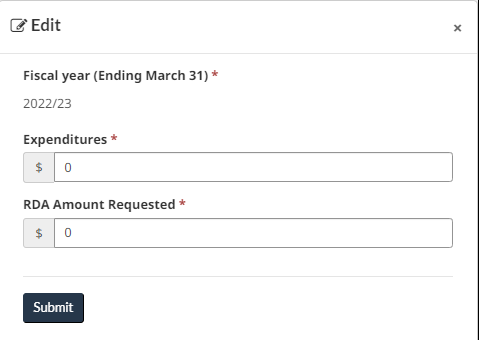
- Enter the “Expenditures” and “RDA Amount Requested” information and then hit Submit. You will still have the ability to edit the project cost item after hitting this Submit button. Note: the fiscal year shown below is for illustrative purposes only.
- RDA funding requested *
- This is the sum of the RDA Funding column in the Cash Flows section. It is automatically calculated.
- Total expenditures *
- This is the sum of the Total Fiscal Expenditures column in the Cash Flows section. It is automatically calculated.
Note: This total must equal the Total project costs from the Project Costs section above. - Total non-RDA funding *
- This is the sum of the Non-RDA Funding column in the Cash Flows section. It is automatically calculated.
Note: This total must equal the Amount provided by funding partners from the Funding Partners section below.
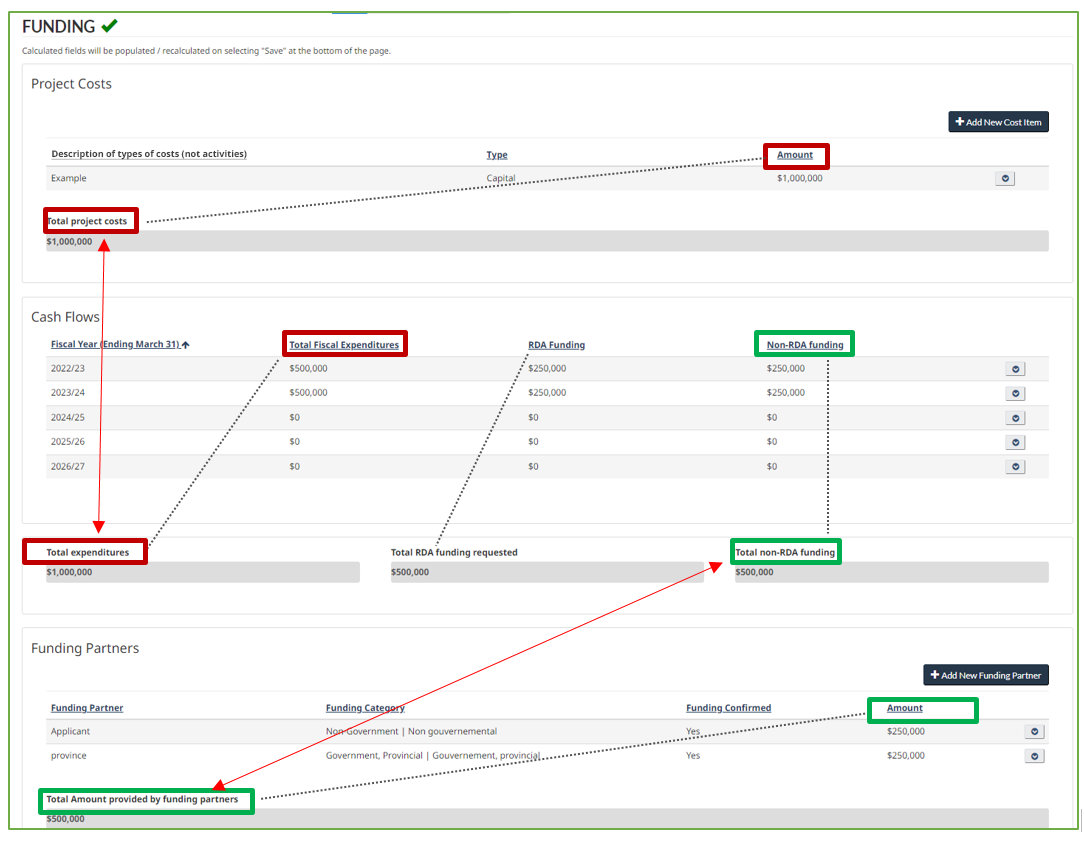
The solid arrows point to the fields that must balance and the dotted lines indicate what column is being summed to produce those totals. Note: the fiscal years shown above are for illustrative purposes only.
Funding partners *
- Funding Partner
The first entry in the list of funding partners is reserved for your own organization (the “Applicant”). Add other funding partners or contributors, if any, in subsequent rows.
Identify all potential project partners that will provide monetary or in-kind contributions.
Guidelines for in-kind costs/contributions
Only project costs incurred and directly paid by the applicant can be reimbursed by PrairiesCan.
An in-kind contribution is a project cost that does not involve an expense incurred and paid for by the project applicant. Typically, these expenses are borne by third parties for items or services that are in turn provided to the applicant at no cost or at a reduced cost (e.g., a deep discount not typically offered to others).
In-kind costs:
- are used to demonstrate a more accurate picture of the project scope, including:
- project funding
- project leveraging
- demonstration of participant and/or private sector contributions to a project.
- must be for an item considered by PrairiesCan to be essential to a project’s success, eligible under the programming, and would otherwise be purchased and paid for by the applicant.
- may only be included in the project when there is a clear plan and commitment from the applicant on how the costs can be verified.
Example: An industry partner will provide trucks to a college for use in a project to train truck drivers.
- The college did not incur or pay any incremental costs but the project could not reasonably go forward without the trucks, so this would be an in-kind contribution to project costs.
- The value of the trucks to the project can be quantified via sales records.
Note: applicants must ensure all contributions (including in-kind contributions) are clearly verifiable.Other government assistance, SR&ED and other tax credits
PrairiesCan considers tax credits received for activities undertaken between the project start and end date as a source of government assistance. Such credits are included when calculating the total amount of government funding that has been provided to a project.
Successful applicants who are in receipt of Scientific Research & Experimental Development (SR&ED) tax credits and other similar federal or provincial tax credits for activities defined in the project are required to inform PrairiesCan.
The Canada Revenue Agency (CRA) may consider funding received from RDII to be government assistance, even though it will eventually be repaid.
Applicants are strongly advised to seek independent professional advice to determine the potential effect of RDII funding on project activities for which SR&ED tax credits, or other federal and provincial tax credits or funding, are likely to be sought.
- are used to demonstrate a more accurate picture of the project scope, including:
- Funding Category
-
Select from the drop down menu the description that best reflects the funding source.
- Funding Confirmed
- Indicate if the funding has been confirmed.
In the case where your organization (Applicant) is a source of funding, indicate yes if you have cash on hand. - Amount
- The anticipated amount of funding this partner will provide.
- Amount provided by funding partners
- Automatically sums the funding amounts listed above.
Note: This total must equal the Total non-RDA funding from the Cash Flows section above.
- To add a funding partner, click on the
 button and the following window will appear for you to input the information. Click the Submit button once completed. You will still have the ability to edit the project cost item after hitting this Submit button.
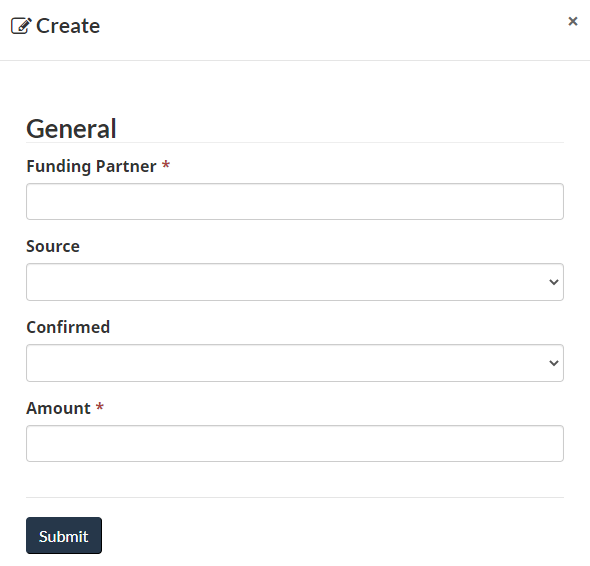
- To edit what your organization will be contributing towards this project, click the down arrow on the far right for the fiscal year you are interested in. Click the Edit option that appears and a similar pop-up window as shown above will appear.

- Briefly describe any project partnerships (non-financial and financial), including any costs covered (maximum of 1200 characters including spaces): *
- Describe partnerships that would be important to the success of the proposed project, with a focus on partnerships within the defence industry. Include any costs covered by the partnerships.
Documents
Upload the following required documents to be provided with your EOI:
- supporting documents
- a Regional Defence Investment Initiative supplemental form must be completed, and submitted with your EOI; download the fillable PDF form here
- incorporation documents for your organization and proof of signing authority (e.g. bylaws, articles of incorporation, board minutes or record of decision)
- a business plan or pitch deck providing details about your organization (including management team, board of directors) and details about the proposed project
- other supporting documentation
- financial statements
- for the past 2 years
- interim financial statements for at least the last 6 months
- confirmed funding
- confirmation of non-PrairiesCan project funding* (e.g. bank statements, unused portion of lines of credit, official letters of intent, funding agreements, signed term sheets)
Signing authority
Indicate here the individual within your organization who has signing power / the authority to enter into an agreement. This person may be different from the contact person.
- First name: *
- Provide the first name of the member of the organization with signing power/the authority to enter into an agreement. This person should be either the primary or the secondary contact.
- Last name:
- Provide the family name of the contact.
- Title *
- Provide the contact person’s job title (e.g., President, Executive Director).
- Email address *
- The email at which the primary contact may be reached.
- Telephone country code:
- The telephone country code of where the contact person can be reached.
- Telephone:
- Provide a phone number where the contact person can be reached.
- Cellular country code:
- The cellular country code of your organization.
- Cellular phone:
- The cellular number of your organization.
Diversity and inclusion
The Government of Canada is committed to diversity and inclusion so that all Canadians have the opportunity to participate in and contribute to the growth of the economy. Gender and diversity data collected may be used for research, statistics, program and policy evaluation, risk management, strategy development, reporting, and gender-based analysis (including GBA+ ). This information can help the Government of Canada monitor progress on inclusive access to federal support programs and services; to identify and remove barriers; and, to make changes to improve inclusive access. The Government of Canada understands that participation of underrepresented groups is an integral part of building strong and inclusive communities and economy.
No personal identifying information will be shared. Aggregate and anonymous data may be shared with other federal organizations and/or published for reporting and monitoring purposes.
Unless otherwise directed by the program, the following gender and diversity data will not be used to assess the application. It is being collected for statistical purposes and may feed into future programming.
- Is your organization majority (i.e. over 50%) owned or led by individuals who self identify as:
- Definition: majority owned or led is defined as individuals with long-term control and management of the organization and an active role in both strategic and day-to-day decision making.
If applicable, please indicate whether your organization is led or majority-owned by one or more of the listed groups. Note that this information may be used in the assessment process. Aggregate and anonymous data may be shared with other federal organizations, and/or published for reporting and monitoring purposes. If you do not know if a particular group is involved in the management team, or prefer not to answer, please select ‘prefer not to answer/do not know’ from the drop down box. - Will your project directly support any of the following diverse groups?
- This question is regarding the people that will benefit from this project. Will your project directly support any of the groups listed? If so, please answer ‘yes’. If you do not know if your project will directly support a particular group, or prefer not to answer, just leave the field blank.
- If yes is selected for any of the diverse groups, then specify (maximum of 1,500 characters)
- Provide an explanation.
Validation
For this step, any errors or omissions in the form will be brought to your attention, and you will be given the opportunity to review them, and make necessary corrections.
Attestation
Before you can complete and submit your expression of interest, it is necessary in this final step for you to affirm that you are aware of certain statutory obligations, and that your organization meets the eligibility requirements for the Regional Defence Investment Initiative. The attestation must be completed by a member of your organization with signing power/authority to enter into a legal agreement. For your reference, the complete text of this attestation is given below.
Please select “I agree” to affirm, and then submit using the “Submit” button.
On behalf of the Applicant Organization, I hereby acknowledge and agree that:
- This expression of interest does not constitute a commitment from Prairies Economic Development Canada (PrairiesCan) for financial assistance.
- Any person who has been lobbying on behalf of the Applicant Organization to obtain a contribution as a result of this expression of interest is registered pursuant to the Lobbying Act and was registered pursuant to that Act at the time the lobbying occurred.
- The Applicant Organization is under no obligation or prohibition, nor is it subject to, or threatened by any actions, suits or proceedings, which could or would affect its ability to implement this proposed project.
- The Applicant Organization has not, nor has any other person, corporation or organization, directly or indirectly paid or agreed to pay any person to solicit a contribution arising as a result of this expression of interest for a commission, contingency fee or any other consideration dependent on the execution of an Agreement or the payment of any contribution arising as a result of this expression of interest.
- Prairies Economic Development Canada (PrairiesCan) and Pacific Economic Development Canada (PacifiCan) are government institutions as defined under the Access to Information (ATI) Act. Records in the custody and care of the institution are subject to disclosures under Part 1 and Part 2 of the ATI Act with limited exceptions and exclusions.
- Personal information collected by PrairiesCan is collected in accordance with section 4 of the Privacy Act (R.S.C., 1985, c. P-21). This information will be used to determine eligibility, administer grants and contributions, and evaluate program effectiveness. Personal information collected is described in the Personal Information Bank entitled “Grants and Contributions”, number PrairiesCan-PPU-055. Questions regarding the collection and use of your personal information may be directed to the ATIP Coordinator, PrairiesCan, Canada Place, 1500-9700 Jasper Avenue NW, Edmonton, Alberta T5J 4H7, by telephone at 780-495-4164, or by email to atip-aiprp@prairiescan.gc.ca.
If you choose not to provide the personal information, your application may not be processed.
You have a right under section 12 of the Privacy Act to access to your personal information under the control of PrairiesCan as well as a right to request correction of personal information where there is an error or omission. You have the right to make a complaint to the Office of the Privacy Commissioner under section 29(1) of the Privacy Act regarding PrairiesCan’s collection, use, and disclosure of your personal information, processing of your request for correction of personal information or processing of your access to personal information request.
I authorize PrairiesCan, its officials, employees, agents and contractors to make credit checks and enquiries of such persons, firms, corporations, federal, provincial and municipal government departments/ agencies, and non-profit, economic development or other organizations as may be appropriate, and to collect and share information with them, as PrairiesCan deems necessary in order to assess this expression of interest, to administer and monitor the implementation of the subject project, and to evaluate the results of the project and related programs.