
A study for the development of a laboratory-based surveillance system for vector-borne diseases

 Download this article as a PDF (94 KB)
 Published by: The Public Health Agency of Canada
Issue: Volume 51-5, May 2025: Travel Health
Date published: May 2025
ISSN: 1481-8531
Submit a manuscript
About CCDR
Browse
Volume 51-5, May 2025: Travel Health
Infographic
Retro 3: A feasibility pilot study for the development of a laboratory-based surveillance system for vector-borne diseases
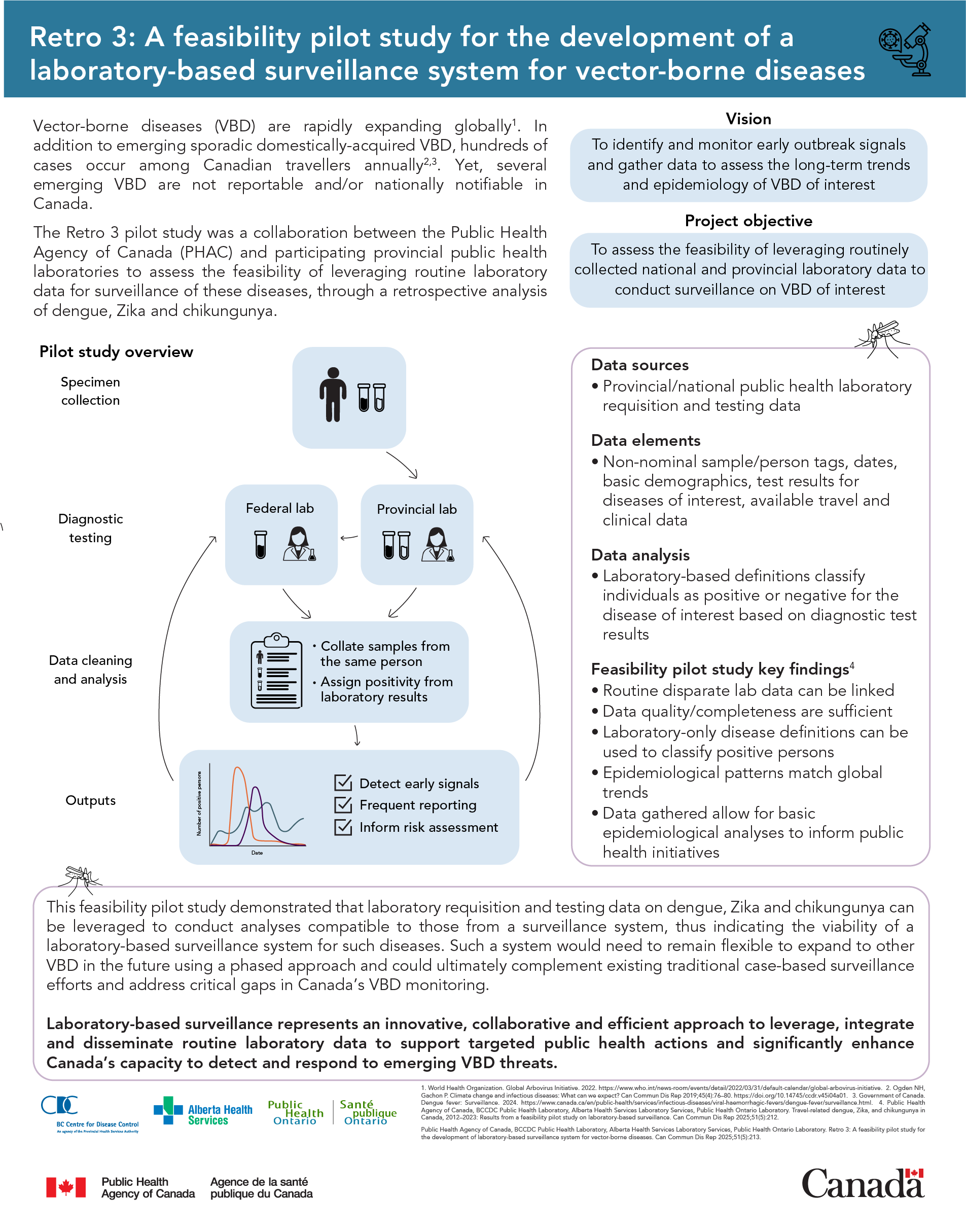
Text description: Infographic
Vector-borne diseases (VBD) are rapidly expanding globally Footnote 1. In addition to emerging sporadic domestically-acquired VBD, hundreds of cases occur among Canadian travellers annually Footnote 2Footnote 3. Yet, several emerging VBD are not reportable and/or nationally notifiable in Canada.
In 2017, the Public Health Agency of Canada (PHAC) initiated a pilot project titled Retro 3, aimed at assessing the feasibility and utility of laboratory-based surveillance for VBD in Canada. The Retro 3 pilot study was a collaboration between PHAC and participating provincial public health laboratories to assess the feasibility of leveraging routine laboratory data for surveillance of these diseases, through a retrospective analysis of dengue, Zika and chikungunya. These diseases were selected due to the chikungunya and Zika outbreaks between 2014 and 2016 in the Americas, and the cross reactivity between Zika and dengue viruses.
Vision for the laboratory-based surveillance system for vector-borne diseases
Ultimately, a pan-Canadian laboratory-based VBD surveillance system would have the purpose of identifying and monitoring early outbreak signals and gathering data to assess long-term trends and the epidemiology of VBD of interest in Canada.
Project objective
To assess the feasibility of leveraging routinely collected national and provincial laboratory data to conduct surveillance on VBD of interest.
Pilot study overview
Diagnostic testing for VBD in Canada is distributed between the National Microbiology Laboratory (NML) and provincial public health laboratories. Typically, for pathogens that are novel, rare or for which requests are infrequent, samples are collected at the provincial level and sent to NML for both initial and confirmatory testing. Over time, and where capacity exists, provincial laboratories may conduct initial testing, only forwarding samples to NML for confirmation, as appropriate.
The data flow begins with the collection of specimens from individuals meeting standard testing requirements for one or more VBD. These specimens are forwarded to the provincial laboratory and/or NML, where they undergo testing and results are generated. Laboratory-based surveillance compiles sample-level data from all specimens tested for diseases of interest. Data is received as de-identified disparate extracts from each laboratory, securely shared with PHAC epidemiologists via a secure online data-sharing platform.
Next, anonymous, non-identifiable dummy tags are used to collate specimen data from provincial and national laboratories. These tags also facilitate the linkage of all specimens belonging to the same person while ensuring no personal information is included. Following data cleaning, laboratory-based case definitions Footnote a are used at the data analysis stage to classify each tested person as positive or negative for the disease of interest, based on results from laboratory diagnostic testing. The dataset is then prepared for further exploration through basic descriptive epidemiological analyses, including subgroup analyses by gender, age group and pregnancy status, as well as travel history. Ultimately, the envisioned laboratory-based surveillance system for VBD would allow detection of early outbreak signals, frequent reporting, informing risk assessment and numerous other outputs that can be shared with laboratory partners.
Data sources
Provincial and federal public health laboratories requisition and testing data extracts containing anonymous information on all samples tested for the diseases of interest.
Data elements
| Category | Data elements |
|---|---|
| Primary | Non-nominal specimen tag Non-nominal person tag Specimen collection date Date of specimen laboratory receipt Age Gender All available results for the diseases of interest |
| Supplemental | Reasons for testing/pregnancy status Clinical information/symptoms Disease/symptoms onset date Recent travel history (destination and dates) |
Feasibility pilot study key findings
The Retro 3 pilot consisted of a retrospective study analyzing over 56,000 specimens tested for dengue, Zika and chikungunya between 2012 and 2017 at the NML, BCCDC Public Health Laboratory, Alberta Health Services Laboratory Services and Public Health Ontario Laboratory. In its final phase, Retro 3 is currently capturing retrospective laboratory data on specimens tested for the three diseases to date, to update analyses Footnote 4.
This pilot study has demonstrated that:
- Feasibility of laboratory-based surveillance: It is feasible to compile and harmonize data from multiple public health laboratories across Canada, providing a unified framework for early signal detection and monitoring of VBD.
- Data quality and completeness: The quality and completeness of laboratory data support basic descriptive epidemiological analyses, enabling meaningful insights into the occurrence and patterns of VBD.
- Laboratory-only disease definitions: Flexible laboratory-based disease definitions can be developed and applied effectively to classify positive laboratory diagnoses, providing a standardized approach to signal monitoring and surveillance.
- Patterns of travel-related diseases: Laboratory diagnoses reflect global trends and match disease activity in destination countries.
- Utility of laboratory data: Laboratory data have the potential to detect early disease signals, monitor trends, and inform public health initiatives, including risk communication, travel health advice, and outbreak preparedness, through basic epidemiological analyses.
The Retro 3 pilot has provided a strong, data-informed foundation for the development of a pan-Canadian laboratory-based surveillance system for VBD in Canada, demonstrating the feasibility and utility of laboratory-based surveillance for addressing emerging VBD public health needs within a globalized and climate-sensitive context.
Conclusion
This feasibility pilot study demonstrated that laboratory requisition and testing data on dengue, Zika and chikungunya can be leveraged to conduct analyses compatible to those from a surveillance system, thus indicating the viability of a pan-Canadian laboratory-based surveillance system for such diseases. The envisioned system would need to remain flexible to expand to other VBD in the future using a phased approach and could ultimately complement existing traditional case-based surveillance efforts and address critical gaps in Canada’s VBD monitoring.
Laboratory-based surveillance represents an innovative, collaborative and efficient approach to leverage, integrate and disseminate routine laboratory data to support targeted public health actions and significantly enhance Canada’s capacity to detect and respond to emerging VBD threats.
Public Health Agency of Canada, BCCDC Public Health Laboratory, Alberta Health Services Laboratory Services, Public Health Ontario Laboratory. Retro 3: A feasibility pilot study for the development of a laboratory-based surveillance system for vector-borne diseases. Can Commun Dis Rep 2025;51(5):213.
