
Meeting between Patrick Borbey, PSC President, and Doug Chorney, Chief Commissioner, Canadian Grain Commission
*Information valid as of February 2021
Introduction
Deputy Head
Initially appointed as the Interim Chief Commissioner in June 2020, Doug Chorney was appointed as the Chief Commissioner, Canadian Grain Commission (CGC) on December 21, 2020, to a term lasting three years.
Doug Chorney is exercising the Public Service Commission’s (PSC) authority for the first time as Deputy Head (DH). A copy of the New Direction in Staffing (NDS) highlights for DHs is attached as Annex A.
Organizational Context
Mandate
The CGC regulates grain handling in Canada and establishes and maintains science-based standards of quality for Canadian grain. Its research, programs and services help support Canada’s reputation as a consistent and reliable source of high-quality grain.
The CGC works to:
- deliver grain quality and quantity assurance programs for exports of Canadian grain;
- carry out scientific research to understand all aspects of grain quality and grain safety;
- establish and maintain Canada’s science-based grain grading system; and
- ensure farmers receive fair compensation for their grain.
Challenges
To support the recruitment of employees in the Technical Services group, specifically the Primary Product Inspection (PI) occupational group, the CGC has implemented a four-year PI Professional Development and Apprenticeship Program (PDAP) for Grain Inspectors. However, once employees are hired into the program, retention issues have been observed due to the operational demands of this role that include the need to travel and the requirement to work on evenings and weekends.
Another ongoing recruitment challenge for the CGC is hiring bilingual employees at its headquarters in Winnipeg. While this presents an issue for recruitment activities throughout the organization, it is most acute for senior level positions, as well as communications and human resources staff. The competition between various federal public service employers located in the Winnipeg area for the recruitment of experienced human resources advisors, especially those who specialize in labour relations and classification is also a challenge. The CGC is also seeing a high turnover in its entry-level positions, specifically those in the program and administrative services group.
Experimentation
The CGC is exploring the use of social media to extend the reach of its job advertisements by using Linked In, Facebook and Twitter. It is also considering the possibility of leveraging the PSC’s GC Jobs social media accounts to increase its social media presence.
Due to Covid-19, the CGC is using the MS Teams and Webex video platforms to conduct candidate assessments in appointment processes. In addition, it is using fillable PDF documents when it conducts unsupervised internet written testing.
The CGC has collaborated with the Atlantic Canada Opportunities Agency to learn about the use of the VidCruiter suite of online assessment tools to manage interviews at a distance in appointment processes. The CGC expects to have its own VidCruiter access available shortly.
The CGC is investigating the use of a recruitment video to provide Grain Inspector PDAP candidates with a realistic job preview. This video would provide candidates with a sense of the day to day job functions and work environment. One of the principal objectives would be to address issues related to retention, for example by giving candidates sufficient information about the operational demands of the position prior to applying. The CGC’s Staffing team plans to work in collaboration with its counterparts in Communications and Training on this initiative. They have also consulted the PSC's new toolkit on video interviews.
Other initiatives at the CGC include having a continuous commitment to streamline its staffing documentation and processes and to keep an ongoing inventory of previous Federal Student Work Experience Program (FSWEP) participants to facilitate re-hiring through FSWEP or appointments to term or indeterminate positions after graduation. These strategies support the CGC’s goals of increasing staffing efficiency and reducing its time to staff.
Population and Staffing Activities
Population
The CGC is a small organization that has a population of 429 employees (as of March 31, 2020). The organization is headquartered in Winnipeg, Manitoba. It operates two regional offices in Montreal and Vancouver and has ten smaller service centres across Canada.
Staffing Activities
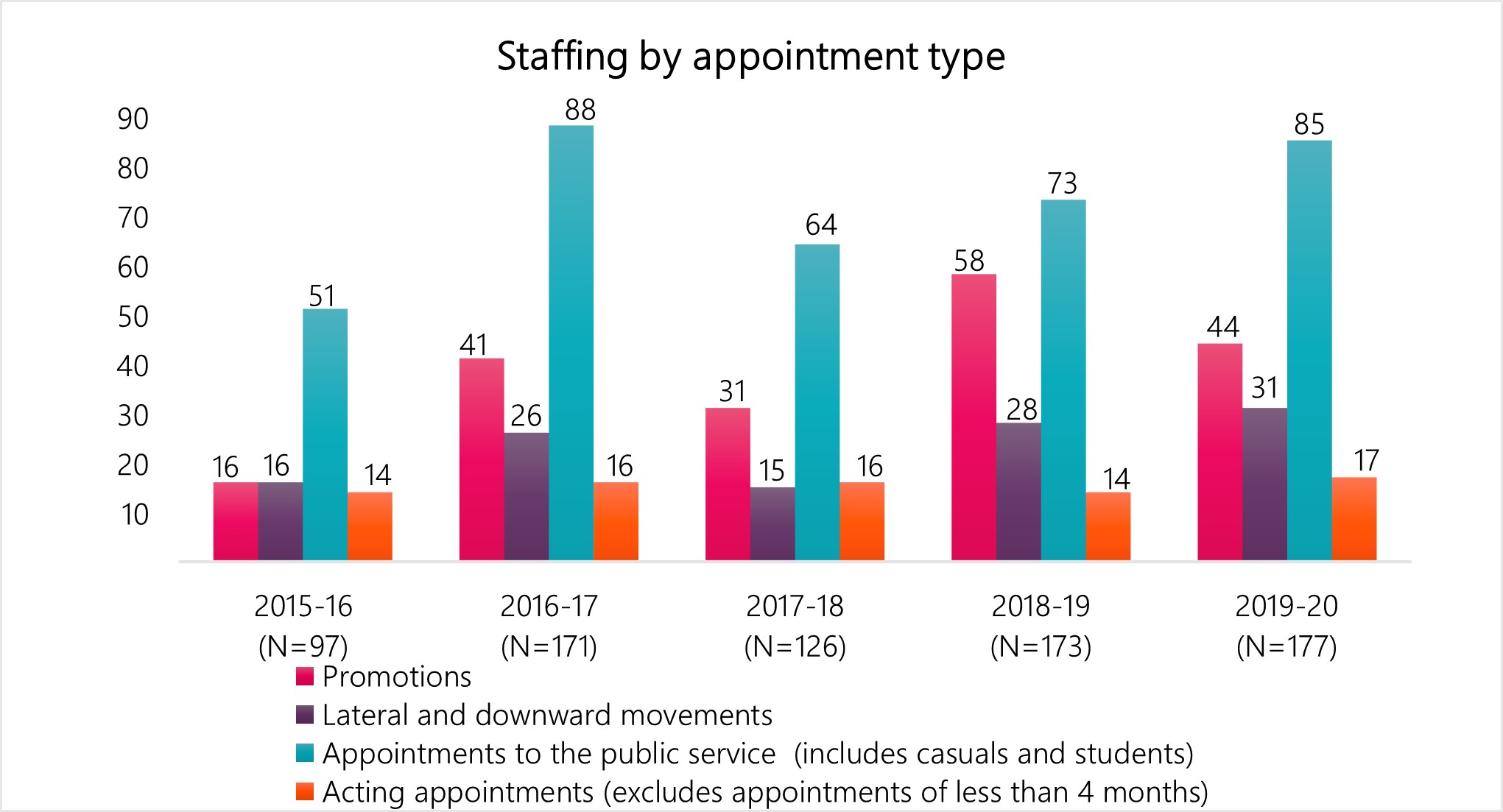
In the 2019-2020 fiscal year, the CGC completed a total of 177 staffing activities:
- 85 appointments to the public service (including casual workers and students)
- 6 casual workers
- 20 students
- 44 promotions
- 17 acting appointments
- 31 lateral and downward movements
Please refer to Annex B for additional details on staffing activities.
Time to Staff
There is insufficient data to provide time to staff results for internal or external staffing processes at the CGC.
Staffing Framework
New Direction in Staffing Implementation
The CGC has shared its appointment framework and delegation instrument with the PSC.
Policy
The CGC updated its Appointment Policy in 2016 to align with NDS. It contains the policy on area of selection, direction on the use of advertised and non-advertised processes, and expectations for the articulation of selection decision.
Recently, the CGC completed a review of its Appointment Policy. The proposed updates are currently in the approvals process.
Delegation
As part of the transition to the NDS, the Human Resources Branch reviewed its organizational approval process for staffing. To correct delays, it has implemented a streamlined electronic approvals process with its hiring managers.
The CGC is currently in the process of reviewing and updating its human resources sub-delegation instrument. Once this exercise has been completed, it will be sent to the DH through the approvals process.
Monitoring
The CGC’s Appointment Policy includes staffing monitoring guidelines. The organization worked with its Staffing Support Advisor (SSA) in 2017 and 2019 to update its monitoring framework. This exercise was recently completed.
Organizational Engagement
During the SSA’s visit to the CGC headquarters in Winnipeg in May 2019, sessions were delivered to the CGC’s human resources team on diverse topics. These included NDS staffing scenarios, effective merit criteria, leveraging staffing options related to employment equity (EE), staffing experimentation taking place in the public service, and PSC and NDS updates.
In 2020, the SSA used virtual means to engage with the CGC. In June 2020, the SSA attended the CGC’s staffing team meeting to provide various PSC and NDS updates and answer questions. In November 2020, the SSA led an NDS scenario session for 75 managers during the CGC's Managers Forum.
The SSA is currently in discussions with the organization about possible topics of interest for future virtual sessions, such as additional NDS scenario sessions with managers, and ways to improve the establishment of merit criteria, candidate assessments and job posters. Recently, the SSA has started having monthly video meetings with the organizational contact and plans to hold a virtual organizational visit with the human resources team in 2021.
Appointment Delegation and Accountability Instrument Annex D Reporting
Use of the Public Service Official Languages Exclusion Approval Order (PSOLEAO) and the Public Service Official Languages Appointment Regulations (PSOLAR)
The CGC reported that the organization made no use of the PSOLEAO and the PSOLAR during the period of April 1, 2019 to March 31, 2020.
Approved Deputy Head Exceptions to the National Area of Selection (NAOS) Requirements for an External Advertised Appointment Process
The CGC reported that the DH did not approve any exceptions to the NAOS during the period of April 1, 2019 to March 31, 2020.
Results of Organizational Cyclical Assessment
The CGC intends to complete its first cyclical assessment by the end of the 2020-2021 fiscal year. The Human Resources Branch is collaborating with the CGC’s internal audit team on aspects relating to compliance. The SSA also continues to provide support to the organization throughout this project.
Inquiries and Trends
The CGC is in regular contact with the SSA on a variety of topics with most questions related to assessments. Other inquiries included:
- student hiring;
- priority entitlements;
- PSC’s new unsupervised second language evaluations and temporary measures to provide flexibility in assessing second language qualifications;
- PSC's new toolkit on video interviews;
- exemptions to meeting official languages for acting appointments;
- direction on the use of advertised and non-advertised appointment processes; and
- use of telework on GC Jobs advertisements.
Oversight
Audits
The CGC was among the 30 organizations that participated in the PSC’s Audit of Employment Equity Representation in Recruitment recently completed and one of the 14 organizations selected for the horizontal Audit of FSWEP that is currently underway.
The objective of the Audit of EE Representation in Recruitment was to determine whether the four designated EE groups are proportionately represented in recruitment processes and to identify key factors that influence representation in the appointment system among the four designated EE groups. The audit report was published in January 2021.
The FSWEP audit objectives are to determine if student appointments under the FSWEP are compliant with key legislative, policy and regulatory requirements and to determine the extent to which organizational roles, responsibilities and practices influence the use of FSWEP. The audit report is expected to be published in spring 2021.
Investigations
Between January 8, 2020 and January 8, 2021, one allegation relating to the CGC was received by the PSC under s.66 External Appointments (i.e. merit, error, omission, improper conduct) of the Public Service Employment Act (PSEA). However, it was closed by the PSC upon receipt.
Staffing and Non-Partisanship Survey Results
Overall, the CGC’s Staffing and Non-Partisanship Survey (SNPS) results are positive when compared to similar sized organizations and the public service, specifically pertaining to employee perceptions of transparency and fairness in staffing processes. Employees were also more likely than those in similar sized organizations and the public service as a whole to indicate that staffing is less dependent on who you know and that the people hired can do the job. The remainder of the results are relatively consistent with similar sized organizations and the public service as a whole.
Below are key findings from the CGC’s 2018 SNPS results:
- 61.6% of employees indicated that staffing was carried out in a transparent way, as compared to 51.3% in similar size organizations and 44.3% across all organizations in the federal public service.
- 34.6% of employees indicated that appointments depend on who you know, as compared to 45.5% in similar size organizations and 54% across all organizations in the federal public service.
- 74.6% of employees indicated that people hired in their work unit can do the job, as compared to 67.1% in similar size organizations and 53.8% across all organizations in the federal public service.
- 69.4% of employees indicated that the process of selecting a person for a position is fairly done, as compared to 56.9% in similar size organizations and 46.4% across all organizations in the federal public service.
- 82.6% of managers feel staffing is burdensome, as compared to 79.3% in similar size organizations and 87.9% across all organizations in the federal public service.
- 67.7% of managers agreed that NDS has improved the way they hire and appoint persons to and within their organization, compared to 69.7% in organizations of similar size, and 56.1% in the federal public service.
Diversity Profile
The CGC is doing well in its EE representation of Aboriginal Peoples and members of visible minorities. However, the organization is below workforce availability for persons with disabilities and women, who represent only 4.3% and 48.3% of its workforce, respectively. This is compared to an overall workforce availability of 7.8% for persons with disabilities and 52.7% for women. The CGC had the same two EE gaps in 2017-2018 and 2018-2019. However, the organization’s representation gaps in 2018-2019 increased for persons with disabilities and decreased for women.
| Designated Group | Public Service Work Force Availability (WFA) |
Canadian Grain Commission (2018-2019) |
Canadian Grain Commission (2017-2018) |
Representation across the Public Service of Canada |
|---|---|---|---|---|
| Women | 52.7% | 48.3% | 47.7% | 54.8% |
| Aboriginal Peoples | 4.0% | 6.0% | 5.8% | 5.1% |
| Persons with Disabilities | 7.8%* | 4.3% | 5.8% | 5.2% |
| Members of Visible Minorities | 15.3% | 24.2% | 22.9% | 16.7% |
Source: Treasury Board of Canada Secretariat
*Based on Census 2016 and the 2017 Survey on Disability
The Clerk of the Privy Council asked senior leaders to commit to making measurable change to the diversity and inclusiveness of the public service which includes the creation of staffing plans to close representation gaps for employment equity groups. The below data highlights the current gap in representation of persons with disabilities (PWD) at the CGC and the estimated level of recruitment required to close this gap within the next five years, taking into consideration factors such as attrition.
- Representation of PWD: 4.3%
- Workforce availability (WFA) for PWD: 7.8%
- Gap between WFA and representation: 3.5%
- Closing the gap: PWD population increase required to reach WFA over 5 years: 15
- Closing the gap: Recruitment of PWD required to achieve population increase over 5 years (estimate): 27
Priority Entitlements and Veterans
Appointments of Persons with a Priority Entitlement
From April 1, 2019 to January 7, 2021, the CGC has not appointed any persons with a priority entitlement (PPE).
Appointments of Persons with a Canadian Armed Forces (CAF) Priority Entitlement
Since the coming into force of the Veterans Hiring Act (VHA) on July 1, 2015 until January 7, 2021, the CGC has not appointed any persons with a CAF Priority Entitlement.
Priority Clearance Requests
From April 1, 2019 to January 7, 2021, the CGC has submitted 138 priority clearance requests.
| Priority Clearance Type | Amount | Percentage |
|---|---|---|
Internal advertised processes
|
34 | 25% |
External advertised processes
|
90 | 65% |
| Internal non-advertised processes | 8 | 6% |
| External non-advertised processes | 6 | 4% |
| Total | 138 | 100% |
Source: Priority Information Management System
COVID-19 Related Priority Clearance Requests
Since March 13, 2020, the CGC has not submitted any priority clearance requests related to COVID-19 positions.
Persons with a Priority Entitlement
As of January 11, 2021, the CGC had three PPEs in the Priority Information Management System:
- One employee with a surplus entitlement (Guarantee of a reasonable job offer);
- One with a leave of absence entitlement; and
- One with a lay-off entitlement.
Non-Partisanship in the Public Service
Since the 2006-2007 fiscal year, no CGC employee has requested PSC permission to be a candidate in a federal, provincial, territorial or municipal election.
In the 2018 SNPS:
- 4.0% of the CGC respondents indicated that they engaged in political activities (other than voting or seeking political candidacy) between January 1 and December 31, 2017, which is higher than the average of 2.4% for the Public Service in general.
- 91.8% of the CGC respondents indicated that they are aware of their rights and obligations for engaging in political activities to a moderate and great extent, which is greater than 80.1% for the Public Service in general.
The CGC’s Designated Political Activities Representative (DPAR) is Patti Charach, Acting Director, Human Resources Branch. The DPAR acts as a liaison with the PSC on matters related to political activities and non-partisanship. General awareness sessions on political activities and non-partisanship for employees can be delivered upon request.
Recruitment Programs
Federal Internship Program for Canadians with Disabilities (FIPCD)
Although the CGC is currently not participating in the FIPCD Program, it is an excellent initiative to contribute to the Government of Canada’s Accessibility Strategy by having an intern and support their organization while the intern develops their skills to increase their employability. The program also offers for a 50% salary reimbursement to hiring departments for the duration of the internship period.
In addition, the program provides managers and interns with career coaching services and tools to support the interns’ development such as recommended training offered by the Canada School of Public Service (CSPS).
Should the CGC wish to hire interns, they may contact the PSC to explore this option at: cfp.diversitedetalent-talentdiversity.psc@canada.ca
Employment Opportunity for Students with Disabilities (EOSD) / Indigenous Student Employment Opportunity (ISEO)
Since January 1, 2020, the CGC has not submitted any requests referrals for the EOSD or ISEO through FSWEP.
The EOSD and ISEO initiatives are excellent support initiatives available to students through FSWEP and to increase workplace diversity by facilitating the hiring of students living with disabilities and Indigenous students. Managers and students are provided with resources such as onboarding tools, training and networking events, such as mentoring and meet and greets. Candidates from both of these initiatives are available to hiring organizations year-round through the FSWEP ongoing inventory.
- The number of available students in EOSD is 4,424Footnote 1.
- The number of available students in ISEO is 2,511Footnote 2.
Federal Student Work Experience Program (FSWEP)
The CGC has submitted 5 requests for referrals through FSWEP since January 1, 2020. This program remains an excellent way an organization to renew its workforce and bring in new energy, ideas and approaches to its workplace. The number of available students in this program is 84,744Footnote 3.
Post-Secondary Recruitment (PSR)
The CGC has not submitted any requests for referrals from existing PSR inventories in 2020. A number of candidates remain available.
- Careers in Policy, Economics and Social Sciences;
- Careers in Project Management, Procurement and Contracting; and
- Careers in Administrative Services.
Participation in new PSC initiatives
The CGC posted 4 external appointment processes using the PSC’s new unsupervised second language test (SLE-UIT) for reading and writing to fill bilingual imperative BBB/BBB positions (all in the Quebec Region). In total, there were 710 applicants for these four appointment processes and 14 SLE-UITs were administered:
- 1 appointment process for a CR-05 Administration Assistant – general services;
- 2 appointment processes for EG-03, Equipment and Standards Technicians; and
- 1 appointment process for a PI-CGC-01, Grain Inspector Trainee as part of the four-year Grain Inspector PDAP.
Participation in Initiatives Related to the Hiring of Indigenous Peoples
Although the CGC has not yet participated in this initiative, the PSC’s Aboriginal Centre of Expertise and the Treasury Board Secretariat’s Office of the Chief Human Resources Officer (OCHRO) have developed Indigenous Career Pathways (ICP) that may be of interest to the CGC.
The ICP provides managers and human resources specialists with expertise and support in the area of Aboriginal recruitment and combines two tools:
- The Inventory of Indigenous Applicants facilitates the matching between hiring managers and candidates by sourcing indigenous talent from existing PSC inventories and proactively promoting their profiles to federal organizations.
- 12 students currently availableFootnote 4
- 8 graduates currently availableFootnote 5
- The Indigenous Recruitment Toolkit provides tools, resources and advice on indigenous recruitment and outreach, and shares initiatives that PSC and other departments offer.
More information about the Indigenous recruitment programs is available on the Indigenous recruitment – Information for hiring managers website.
Staffing Support
Public Service of Commission Representatives and Organizational Contacts
The SSA assigned to the CGC is Steven Davidson and the primary organizational contacts are Danielle Dupasquier, Human Resources Advisor and Rosana Leung Shing, Senior Human Resources Consultant. The CGC’s head of human resources is Patti Charach, Acting Director, Human Resources Branch. There is a high level of collaboration between the organization and the SSA.
PREPARED BY:
Steven Davidson
Staffing Support Advisor
APPROVED BY:
Lynn Brault
Director General, Staffing Support,
Priorities and Political Activities Directorate
Michael Morin
Acting Vice-President, Policy and Communications Sector
Annexes:
- Annex A – A New Direction in Staffing, highlights for deputy heads
- Annex B – Data on Population and Staffing Activities
Annex A
Highlights for deputy heads
A New Direction in Staffing – A Merit-Based System That is Effective, Efficient and Fair
Appointment Policy
New focus on core requirements to provide sub-delegated persons with greater discretion in making an appointment
- One Appointment Policy, no duplication of legal requirements
- Broader focus on values-based system, away from rules-based system
- Appointment Policy supported by streamlined guidance:
- A roadmap to the legislative, regulatory and policy requirements
- Options and considerations for decision making where there is discretion
- Clear expectations for priority entitlements
- No restrictions on assessment methods for EX appointments
- Exceptions to National Area of Selection approved by deputy head
Delegation
- New ability to customize organizational staffing system based on unique context and evolving business needs
- Deputy heads establish a direction on the use of advertised and non-advertised appointment processes
- Deputy heads to establish requirement(s) for sub-delegated persons to articulate, in writing, their selection decision
- Clarity on requirements related to investigations
- Attestation form to reinforce the accountabilities of sub-delegated persons
All PSC monitoring and reporting requirements now found in the Appointment Delegation and Accountability Instrument
Monitoring and Reporting
Monitoring built by organizations, targeted to their needs
- Annual Departmental Staffing Accountability Report no longer required
- Annual reporting to the PSC limited to:
- Use of Public Service Official Language Exclusion Approval Order
- Exceptions to the National Area of Selection approved by the deputy head
- Results of any internal investigations
- Actions taken following any PSC investigations or audits.
- Deputy head responsible for ongoing monitoring of organizational staffing system based on the organization’s unique context
- Assessment of adherence to requirements, based on organization’s own risks, every five years, at a minimum.
PSC Oversight
System-wide focus
- Government-wide compliance audit every two years
- Renewed Survey of Staffing administered in alternating years with government-wide audit
- System-wide effectiveness and efficiency reviews to support continuous improvement
- Targeted PSC audits as a result of identified system-wide or organizational risks or at the request of deputy head
- Investigations conducted when there is reason to believe there was political influence, fraud or improper conduct in an appointment process
This document should be read in conjunction with the Public Service Employment Act, the Public Service Employment Regulations, the PSC Appointment Policyand the PSC Appointment Delegation and Accountability Instrument.
Annex B
Population by tenure as of March 31, 2020
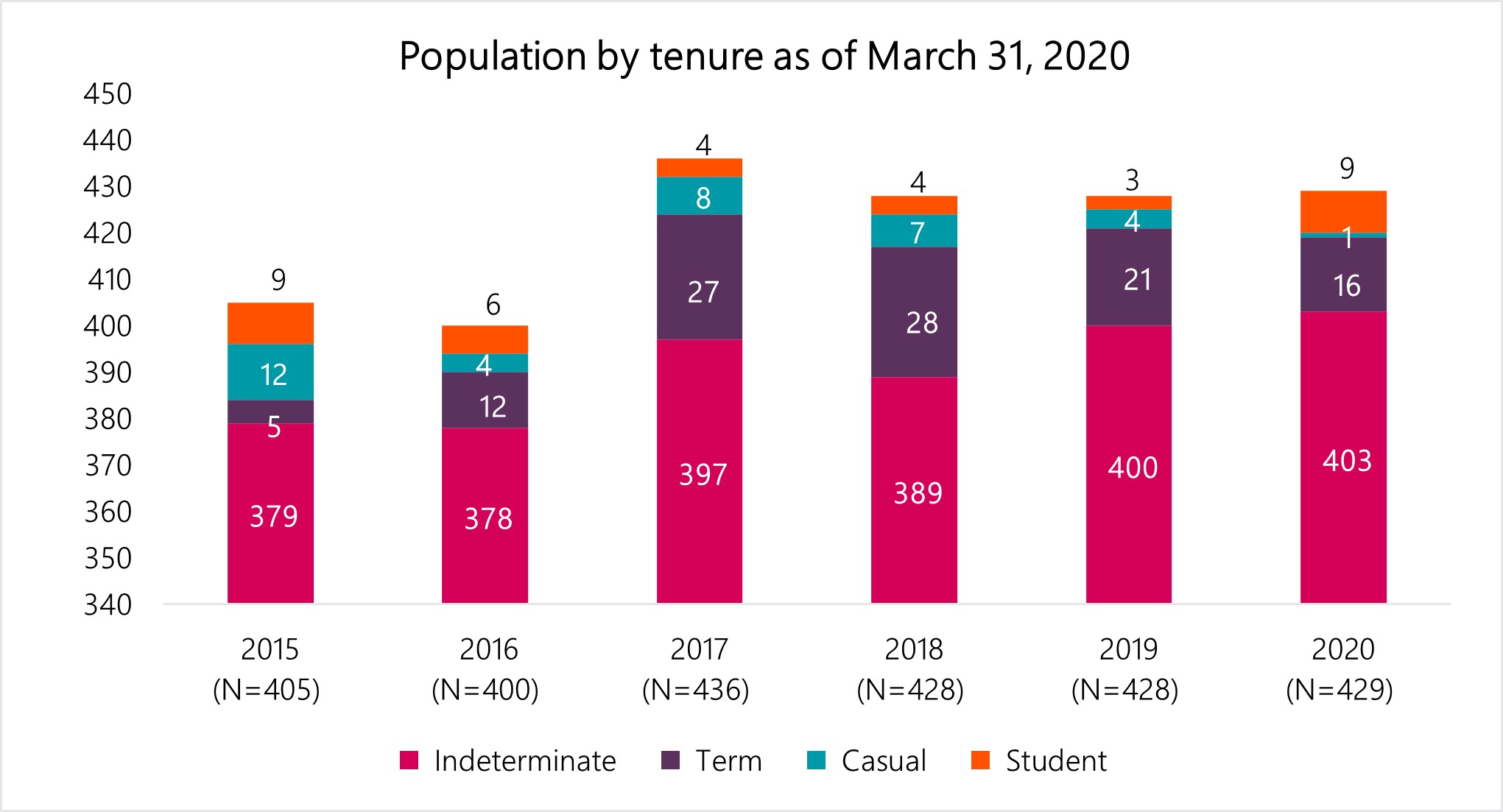
Text version
| Year | Indeterminate population | Term population | Casual population | Student population | Total population |
|---|---|---|---|---|---|
| As of March 31, 2015 | 379 | 5 | 12 | 9 | 405 |
| As of March 31, 2016 | 378 | 12 | 4 | 6 | 400 |
| As of March 31, 2017 | 397 | 27 | 8 | 4 | 436 |
| As of March 31, 2018 | 389 | 28 | 7 | 4 | 428 |
| As of March 31, 2019 | 400 | 21 | 4 | 3 | 428 |
| As of March 31, 2020 | 403 | 16 | 1 | 9 | 429 |
Population by language requirements as of March 31, 2020
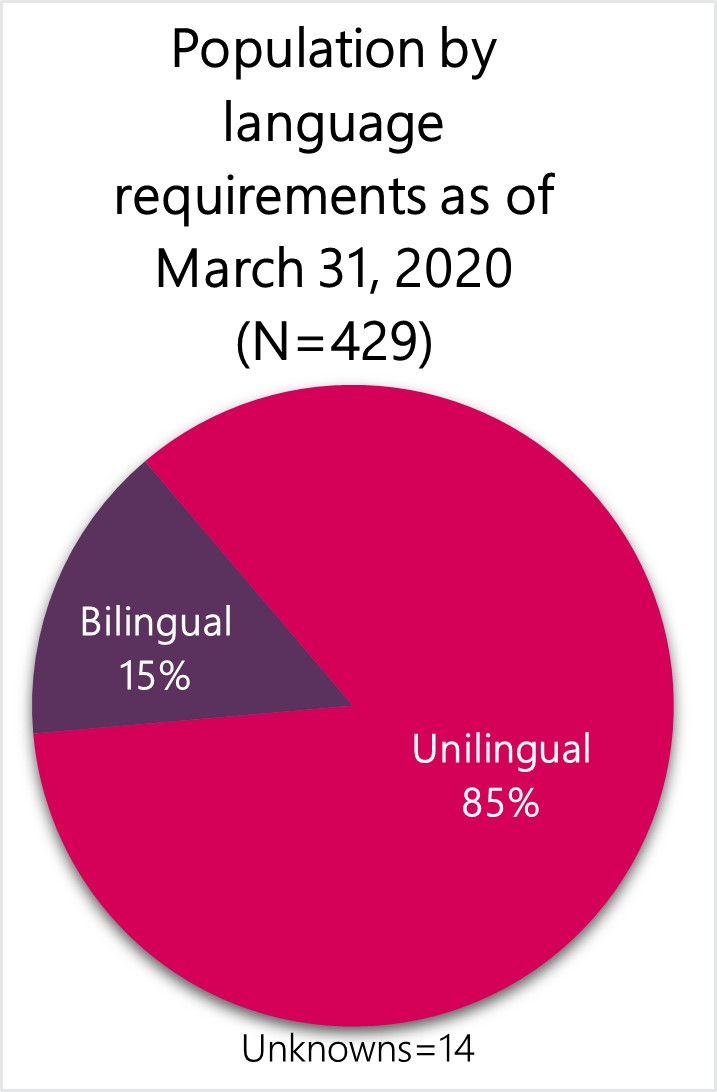
Text version
| Linguistic requirements of the position | Population as of March 31, 2020 | Percentage of population as of March 31, 2020 |
|---|---|---|
| Bilingual | 63 | 15% |
| Unilingual | 352 | 85% |
| Unknowns | 14 | 0% |
Population by occupational group as of March 31, 2020
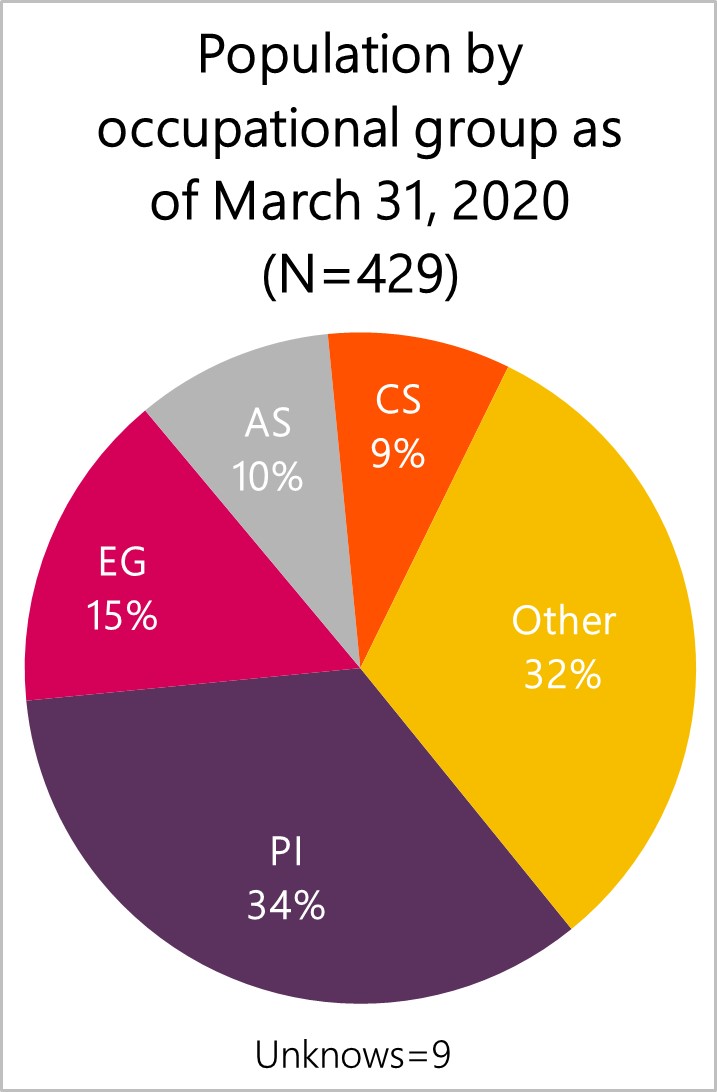
Text version
| Occupational group | Population as of March 31, 2020 | Percentage of population as of March 31, 2020 |
|---|---|---|
| PI – Primary Products Inspection | 144 | 34% |
| EG – Engineering and Scientific Support | 65 | 15% |
| AS – Administrative Services | 40 | 10% |
| CS – Computer Systems | 37 | 9% |
| Other | 134 | 32% |
| Unknowns | 9 | 0% |
Population by region as of March 31, 2020
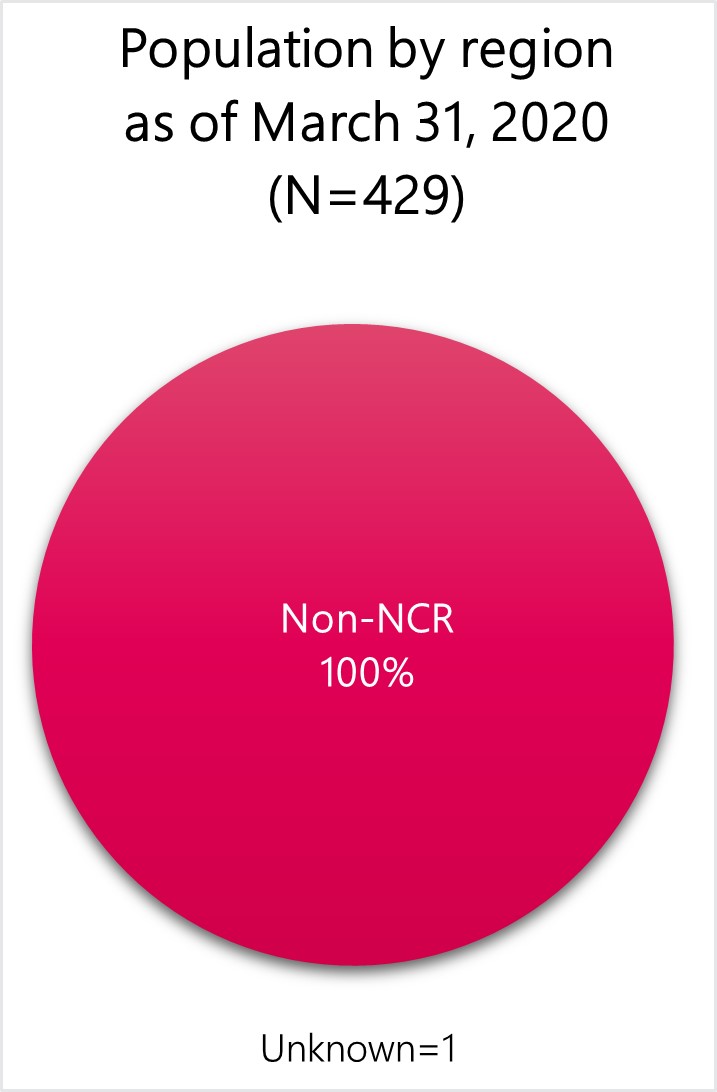
Text version
| Region | Population as of March 31, 2020 | Percentage of population as of March 31, 2020 |
|---|---|---|
| National Capital Region (NCR) | 0 | 0% |
| Non-NCR | 428 | 100% |
| Unknown | 1 | 0% |
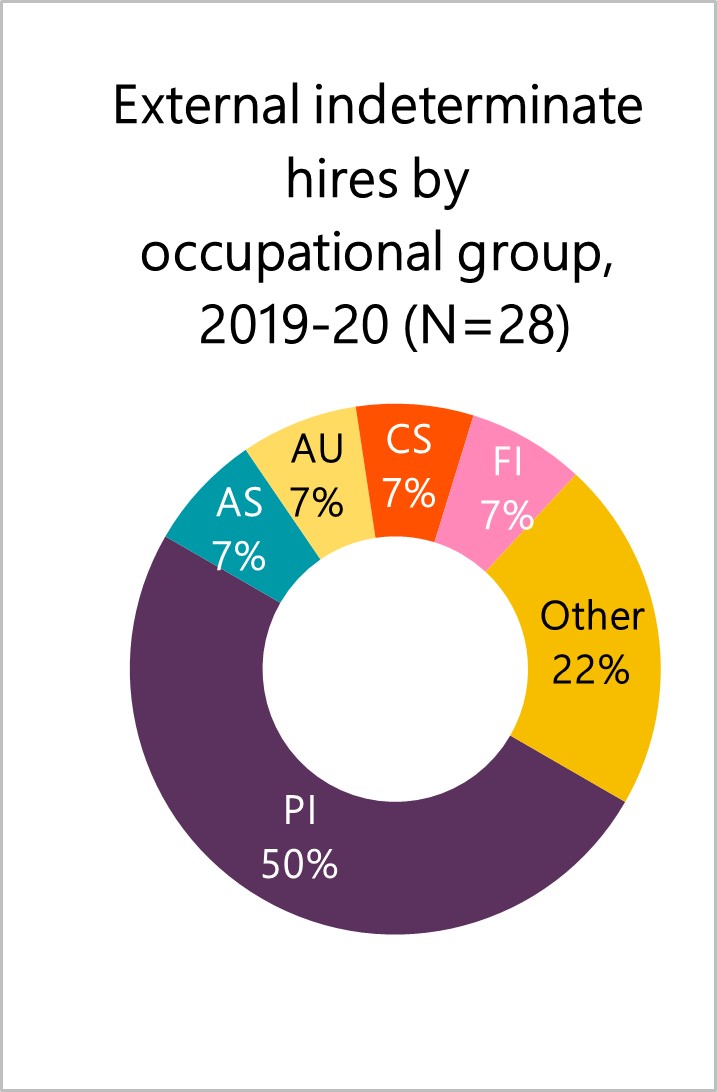
External indeterminate hires by occupational group, 2019-2020
Text version
| Occupational group | Number of indeterminate hiring activities | Percentage of all indeterminate hiring activities |
|---|---|---|
| PI – Primary Products Inspection | 14 | 50% |
| AS – Administrative Services | 2 | 7% |
| AU – Auditing | 2 | 7% |
| CS – Computer Systems | 2 | 7% |
| FI – Financial Management | 2 | 7% |
| Other | 6 | 21% |
| Total | 28 | 100% |
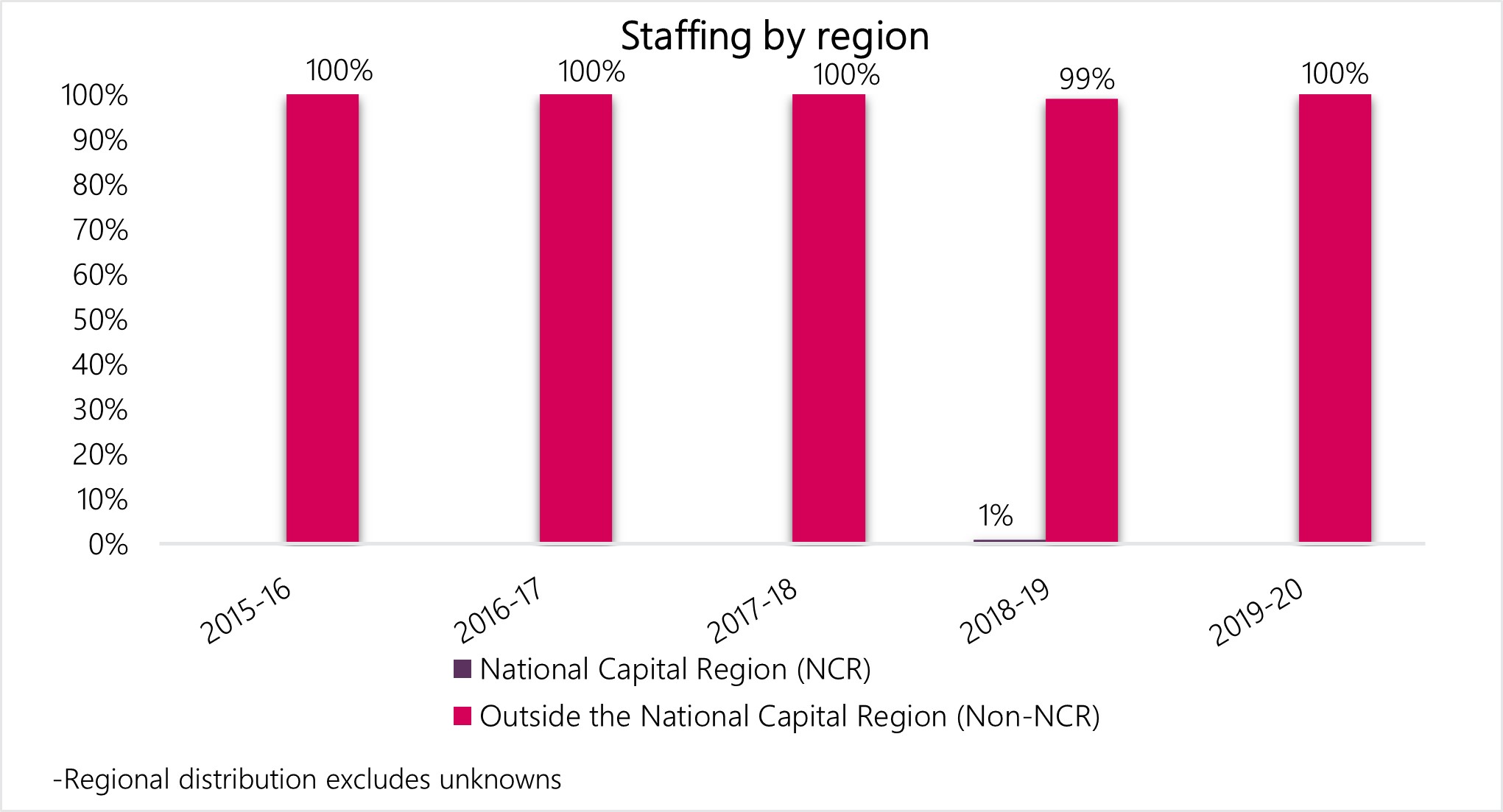
Staffing by region
Text version
| Fiscal year | Percentage of staffing activities in the National Capital Region (NCR) | Percentage of staffing activities in all other regions (Non-NCR) |
|---|---|---|
| 2015 to 2016 | 0% | 100% |
| 2016 to 2017 | 0% | 100% |
| 2017 to 2018 | 0% | 100% |
| 2018 to 2019 | 1% | 99% |
| 2019 to 2020 | 0% | 100% |
- Regional distribution excludes unknowns
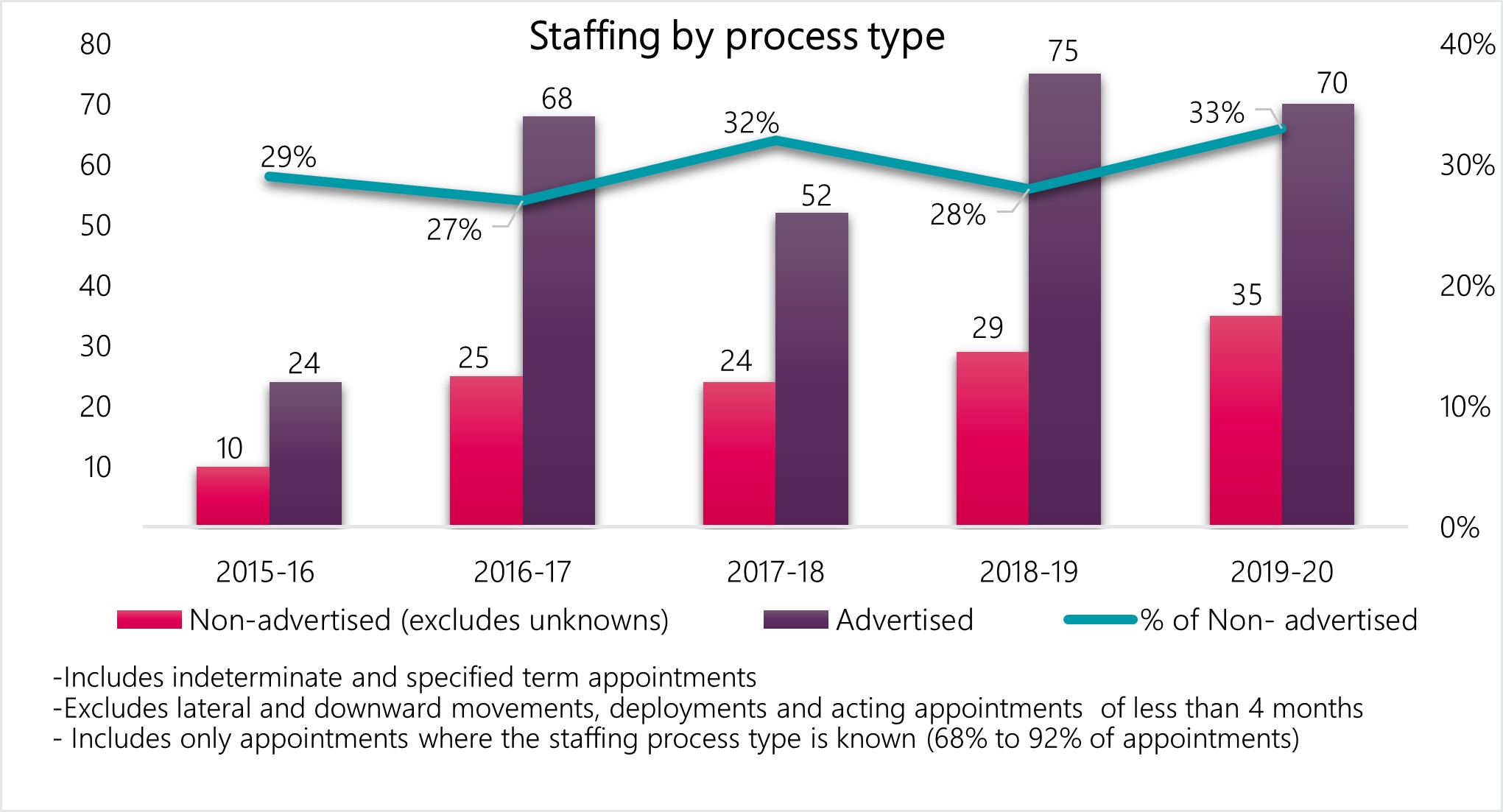
Staffing by process type
Text version
| Fiscal year | Non-advertised processes (excludes unknowns) | Advertised processes | % of Non- advertised processes |
|---|---|---|---|
| 2015 to 2016 | 10 | 24 | 29% |
| 2016 to 2017 | 25 | 68 | 27% |
| 2017 to 2018 | 24 | 52 | 32% |
| 2018 to 2019 | 29 | 75 | 28% |
| 2019 to 2020 | 35 | 70 | 33% |
- Includes indeterminate and specified term appointments
- Excludes lateral and downward movements, deployments and acting appointments of less than 4 months
- Includes only appointments where the staffing process type is known (68% to 92% of appointments)
Staffing by appointment type
Text version
| Fiscal year | Promotions | Lateral and downward movements | Appointments to the public service (includes casuals and students) | Acting appointments (excludes appointments of less than 4 months) | Total |
|---|---|---|---|---|---|
| 2015 to 2016 | 16 | 16 | 51 | 14 | 97 |
| 2016 to 2017 | 41 | 26 | 88 | 16 | 171 |
| 2017 to 2018 | 31 | 15 | 64 | 16 | 126 |
| 2018 to 2019 | 58 | 28 | 73 | 14 | 173 |
| 2019 to 2020 | 44 | 31 | 85 | 17 | 177 |
Staffing by tenure
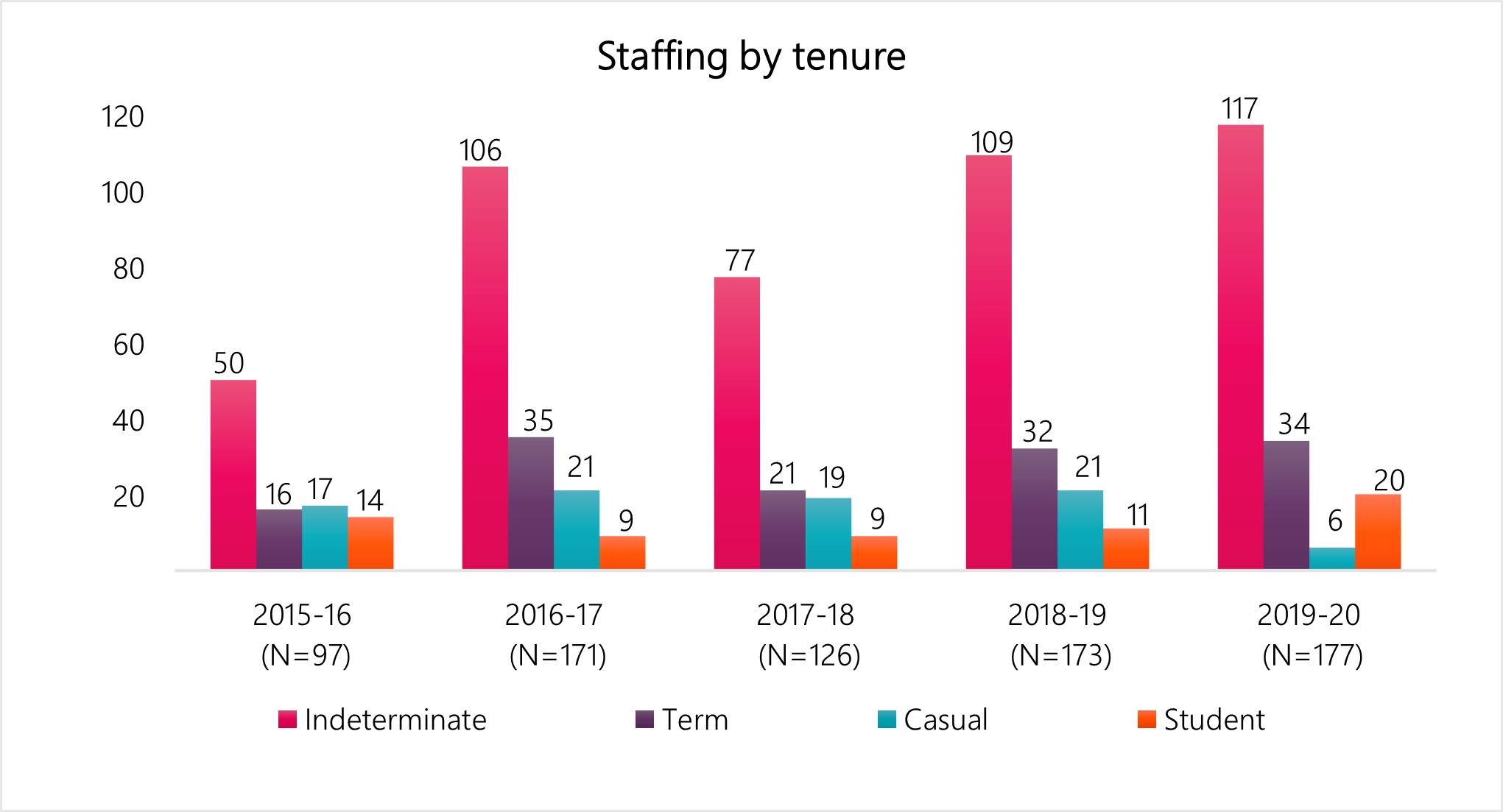
Text version
| Fiscal year | Indeterminate staffing activities | Term staffing activities | Casual staffing activities | Student staffing activities | Total staffing activities |
|---|---|---|---|---|---|
| 2015 to 2016 | 50 | 16 | 17 | 14 | 97 |
| 2016 to 2017 | 106 | 35 | 21 | 9 | 171 |
| 2017 to 2018 | 77 | 21 | 19 | 9 | 126 |
| 2018 to 2019 | 109 | 32 | 21 | 11 | 173 |
| 2019 to 2020 | 117 | 34 | 6 | 20 | 177 |
Key findings - Staffing and non-partisanship survey (2018)
- 74.6% of employees agreed that people hired can do the job, compared to 67.1% in organizations of similar size, and 53.8% in the federal public service
- 67.7% of managers agreed that the New Direction in Staffing has improved the way they hire and appoint persons to and within their organization, compared to 69.7% in organizations of similar size, and 56.1% in the federal public service
- 82.6% of managers agreed that within their organization, the administrative to staff a position is burdensome, compared to 79.3% in organizations of similar size, and 87.9% in the federal public service
Student program hires
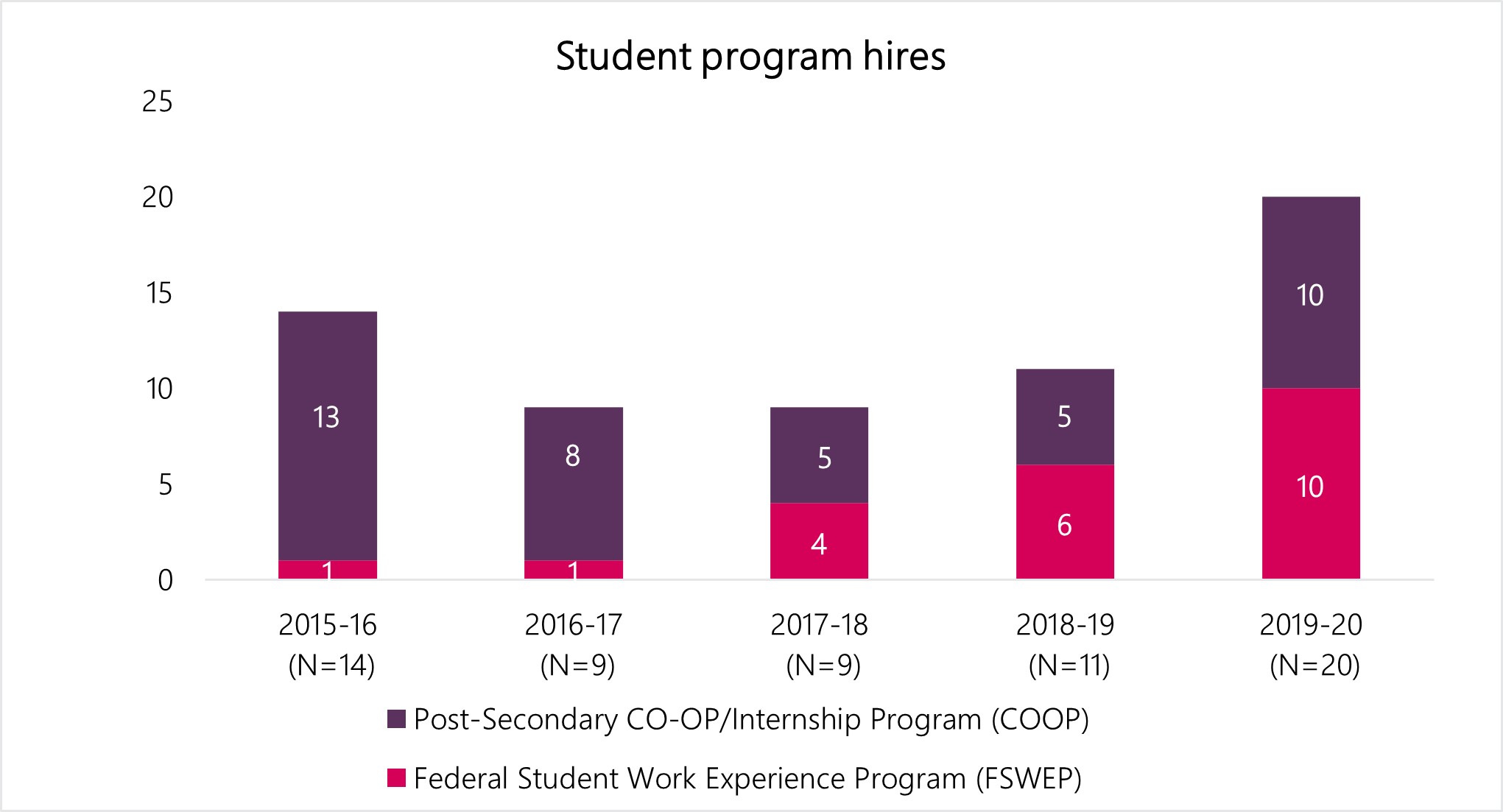
Text version
| Fiscal year | Federal Student Work Experience Program | Post-Secondary Co-op/Internship Program | Research Affiliate Program | Total |
|---|---|---|---|---|
| 2015 to 2016 | 1 | 13 | 0 | 14 |
| 2016 to 2017 | 1 | 8 | 0 | 9 |
| 2017 to 2018 | 4 | 5 | 0 | 9 |
| 2018 to 2019 | 6 | 5 | 0 | 11 |
| 2019 to 2020 | 10 | 10 | 0 | 20 |
External indeterminate and term hiring activities: Post-Secondary Recruitment Program and former student hires
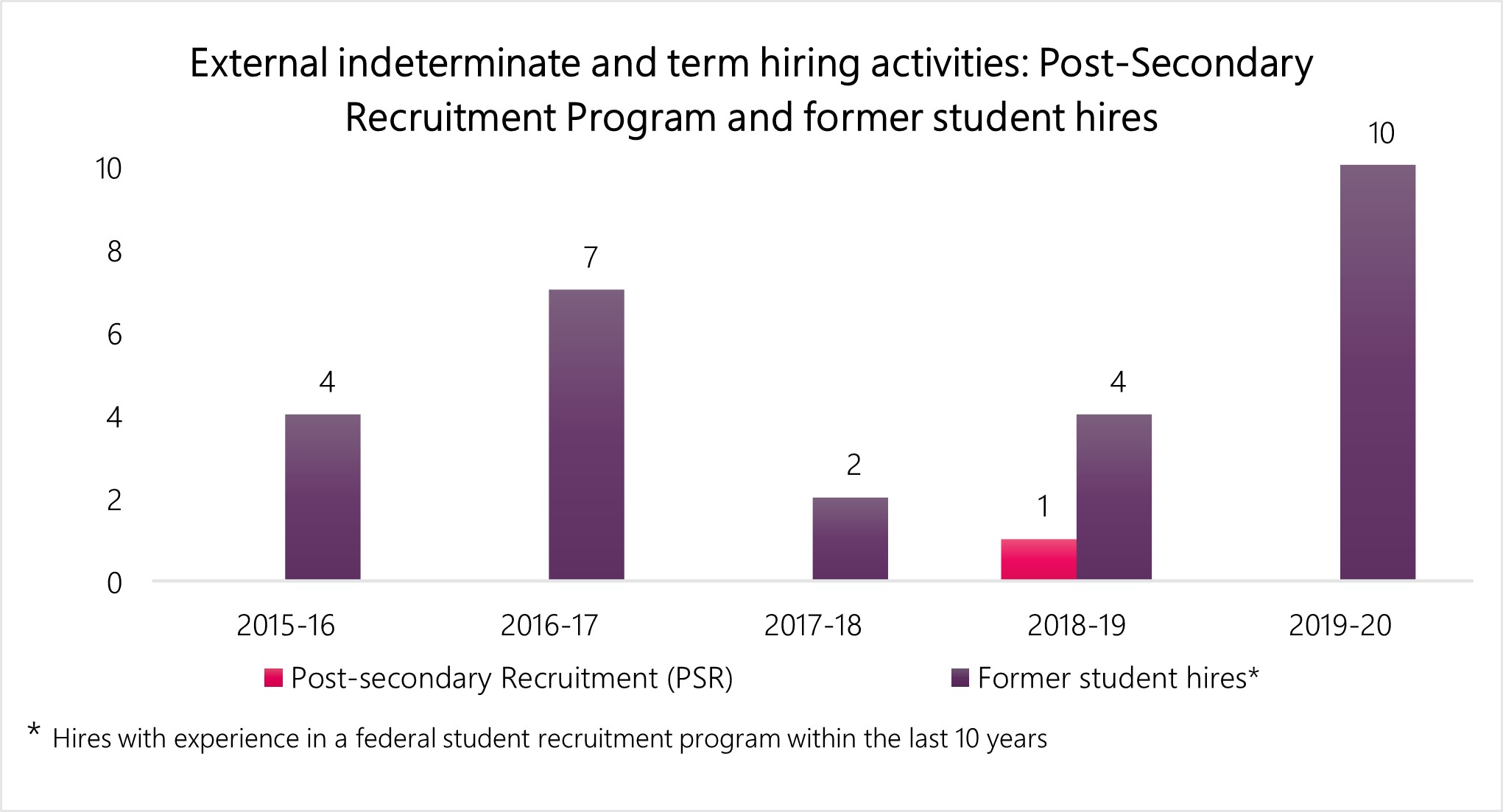
Text version
| Fiscal year | Post-Secondary Recruitment Program hires | Hiring of former students |
|---|---|---|
| 2015 to 2016 | 0 | 4 |
| 2016 to 2017 | 0 | 7 |
| 2017 to 2018 | 0 | 2 |
| 2018 to 2019 | 1 | 4 |
| 2019 to 2020 | 0 | 10 |
Hiring of former students includes indeterminate and term hires with experience in a federal student recruitment program within the last 10 years.
Internal time to staff
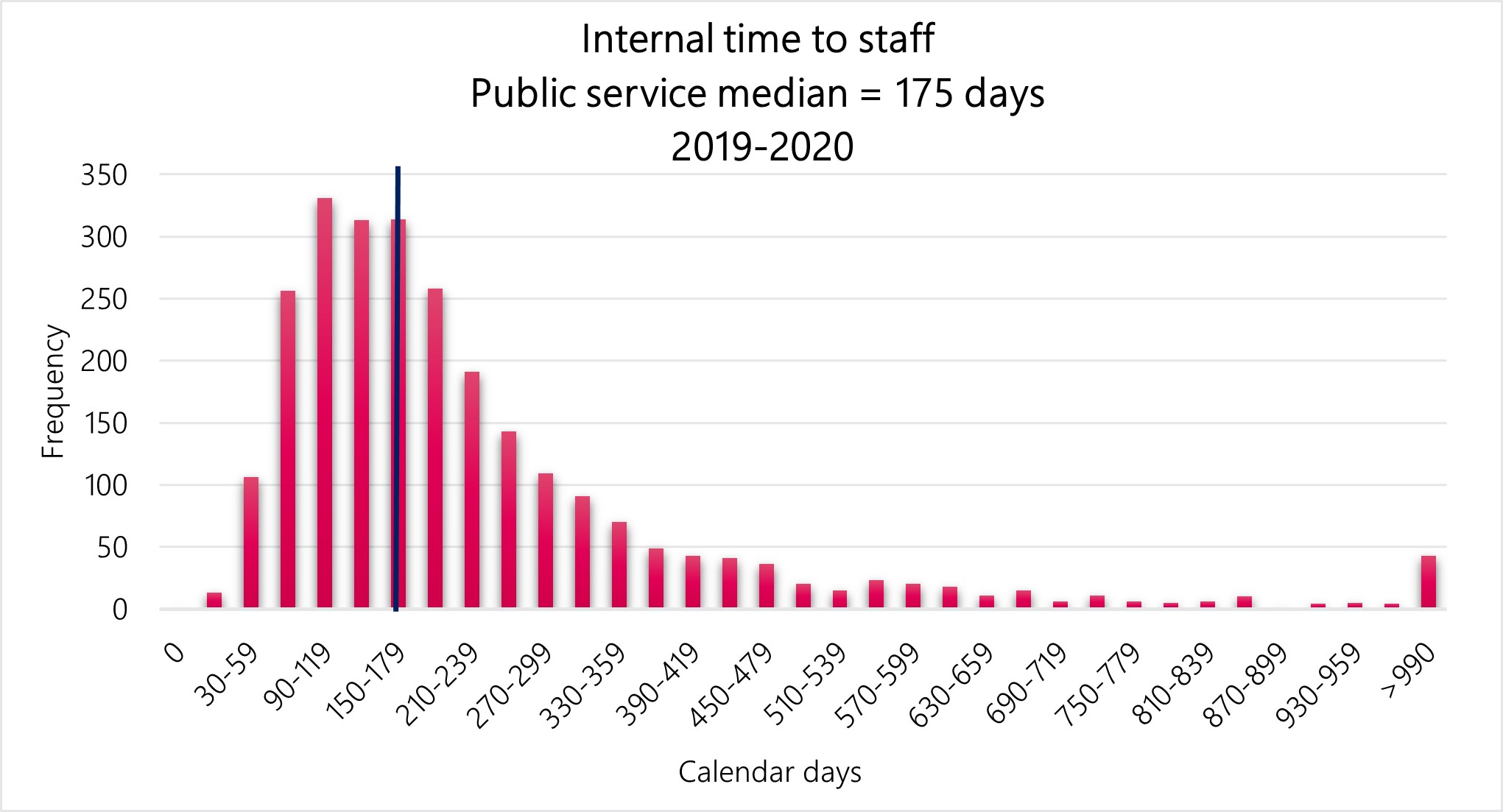
Text version
| Number of calendar days | The number of internal appointments for which the TTS-IA was within the specified number of calendar days for organizations subject to the Public Service Employment Act |
|---|---|
| 0 calendar days | 0 |
| 0 to 29 calendar days | 13 |
| 30 to 59 calendar days | 106 |
| 60 to 89 calendar days | 256 |
| 90 to 119 calendar days | 331 |
| 120 to 149 calendar days | 313 |
| 150 to 179 calendar days | 314 |
| 180 to 209 calendar days | 258 |
| 210 to 239 calendar days | 191 |
| 240 to 269 calendar days | 143 |
| 270 to 299 calendar days | 109 |
| 300 to 329 calendar days | 91 |
| 330 to 359 calendar days | 70 |
| 360 to 389 calendar days | 49 |
| 390 to 419 calendar days | 43 |
| 420 to 449 calendar days | 41 |
| 450 to 479 calendar days | 36 |
| 480 to 509 calendar days | 20 |
| 510 to 539 calendar days | 15 |
| 540 to 569 calendar days | 23 |
| 570 to 599 calendar days | 20 |
| 600 to 629 calendar days | 18 |
| 630 to 659 calendar days | 11 |
| 660 to 689 calendar days | 15 |
| 690 to 719 calendar days | 6 |
| 720 to 749 calendar days | 11 |
| 750 to 779 calendar days | 6 |
| 780 to 809 calendar days | 5 |
| 810 to 839 calendar days | 6 |
| 840 to 869 calendar days | 10 |
| 870 to 899 calendar days | 1 |
| 900 to 929 calendar days | 4 |
| 930 to 959 calendar days | 5 |
| 960 to 989 calendar days | 4 |
| More than 990 calendar days | 43 |
Internal time to staff is calculated as the number of calendar days between the opening date of the advertisement and the date of the first notification
The median internal time to staff for the public service (organizations subject to the Public Service Employment Act) for fiscal year 2019 to 2020 is 175 days
Internal Time to Staff
The data is insufficient for providing results on internal process times for the Canadian Grain Commission.
Internal time to staff for fiscal year 2019 to 2020
The data is insufficient for providing results on internal process times for the Canadian Grain Commission.
External time to staff
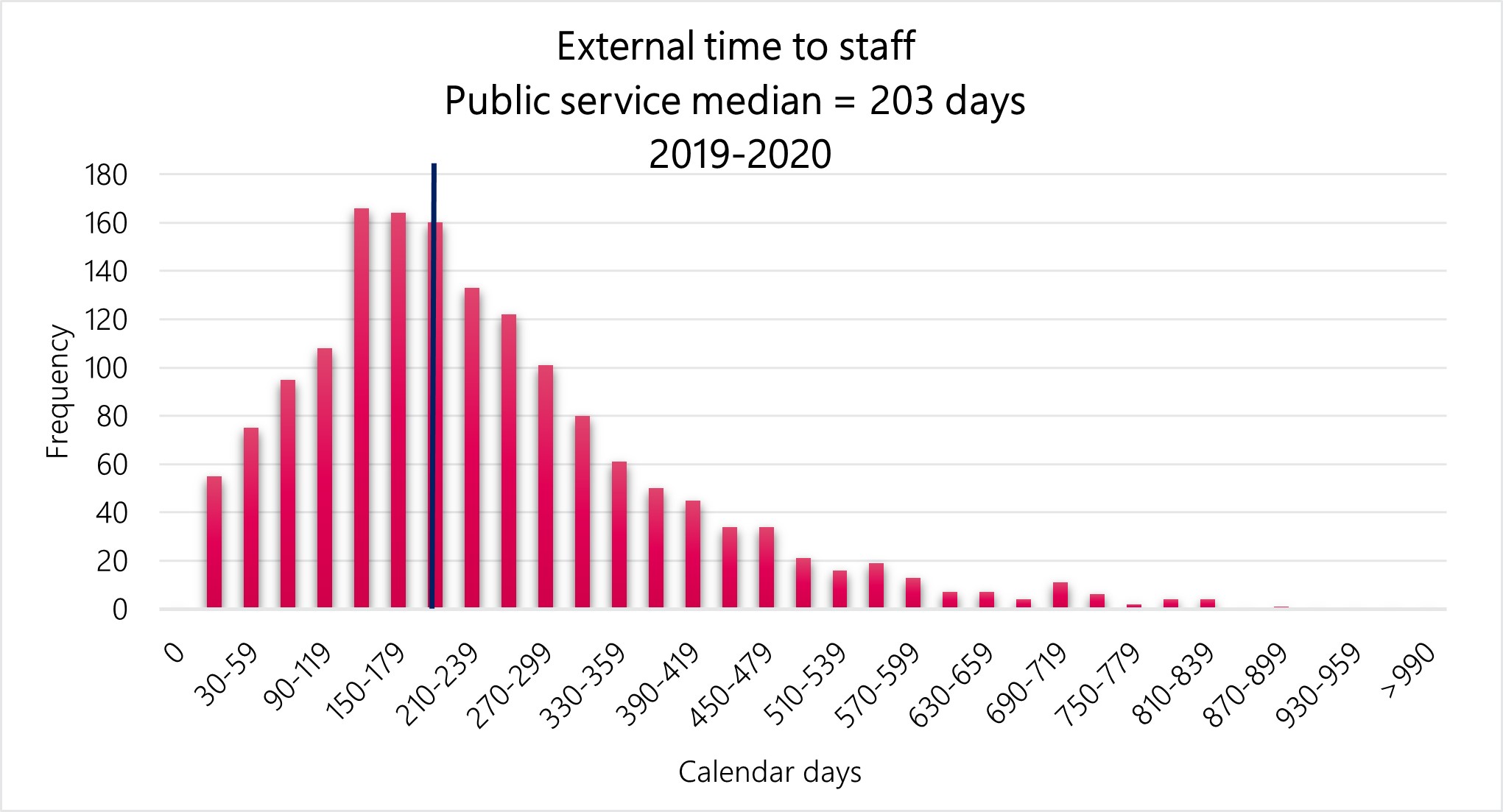
Text version
| Number of calendar days | The number of external appointment processes for which the TTS-EA was within the specified number of calendar days for organizations subject to the Public Service Employment Act |
|---|---|
| 0 calendar days | 0 |
| 0 to 29 calendar days | 55 |
| 30 to 59 calendar days | 75 |
| 60 to 89 calendar days | 95 |
| 90 to 119 calendar days | 108 |
| 120 to 149 calendar days | 166 |
| 150 to 179 calendar days | 164 |
| 180 to 209 calendar days | 160 |
| 210 to 239 calendar days | 133 |
| 240 to 269 calendar days | 122 |
| 270 to 299 calendar days | 101 |
| 300 to 329 calendar days | 80 |
| 330 to 359 calendar days | 61 |
| 360 to 389 calendar days | 50 |
| 390 to 419 calendar days | 45 |
| 420 to 449 calendar days | 34 |
| 450 to 479 calendar days | 34 |
| 480 to 509 calendar days | 21 |
| 510 to 539 calendar days | 16 |
| 540 to 569 calendar days | 19 |
| 570 to 599 calendar days | 13 |
| 600 to 629 calendar days | 7 |
| 630 to 659 calendar days | 7 |
| 660 to 689 calendar days | 4 |
| 690 to 719 calendar days | 11 |
| 720 to 749 calendar days | 6 |
| 750 to 779 calendar days | 2 |
| 780 to 809 calendar days | 4 |
| 810 to 839 calendar days | 4 |
| 840 to 869 calendar days | 0 |
| 870 to 899 calendar days | 1 |
| 900 to 929 calendar days | 0 |
| 930 to 959 calendar days | 0 |
| 960 to 989 calendar days | 0 |
| More than 990 calendar days | 0 |
External time to staff is calculated as the number of calendar days between the opening date of the advertisement and the date of the first estimated external hire
The median external time to staff for the public service (organizations subject to the Public Service Employment Act) for fiscal year 2019 to 2020 is 203 days
External Time to Staff
The data is insufficient for providing results on external process times for the Canadian Grain Commission.
External time to staff for fiscal year 2019 to 2020
The data is insufficient for providing results on external process times for the Canadian Grain Commission.
Technical notes:
- The Time to Staff - Internal Appointments (TTS-IA) is the median number of calendar days between the opening date of an internal advertisement and the date of the first Notice of Appointment or Proposal of Appointment (NAPA) from the Public Service Resourcing System for internal term and indeterminate positions. As NAPAs are not required for all internal staffing actions, this measure is limited to reporting on internal promotional appointments.
- The Time to Staff - External Appointments (TTS-EA) is the median number of calendar days between the opening date of an external advertisement and the date of the first estimated appointment of an individual from outside an organization subject to the Public Service Employment Act for term and indeterminate positions. Because data between systems is linked using a probabilistic match, errors in data linkage are a potential source of measurement error.
- Only estimated term and indeterminate appointments/notifications are included (deployments, casual and acting appointments are excluded).
Sources:
- Hiring and staffing activities data are derived from information received from the Treasury Board of Canada Secretariat Incumbent File. The Incumbent File is extracted from the Public Services and Procurement Canada’s pay system. The data constitutes an estimate of hiring and staffing activities to and within organizations.
- Information from the Priority Information Management System and the Public Services Resourcing System is also used to determine if staffing actions are advertised or non-advertised as well as for calculating time to staff.
- The data are not expected to match an organization’s human resources data, due to methodology and timing differences
- The Time to Staff - Internal Appointments (TTS-IA) is the median number of calendar days between the opening date of an internal advertisement and the date of the first Notice of Appointment or Proposal of Appointment (NAPA) from the Public Service Resourcing System for internal term and indeterminate positions. As NAPAs are not required for all internal staffing actions, this measure is limited to reporting on internal promotional appointments
- Only estimated term and indeterminate appointments/notifications are included (deployments, casual and acting appointments are excluded)
- The Time to Staff - External Appointments (TTS-EA) is the median number of calendar days between the opening date of an external advertisement and the date of the first estimated appointment of an individual from outside an organization subject to the Public Service Employment Act for term and indeterminate positions. Only estimated term and indeterminate appointments/notifications are included (deployments, casual and acting appointments are excluded)
- Because data between systems is linked using a probabilistic match, errors in data linkage are a potential source of measurement error
- Hiring and staffing activities data are derived from information received from the Treasury Board of Canada Secretariat Incumbent File. The Incumbent File is extracted from the Public Services and Procurement Canada’s pay system. The data constitutes an estimate of hiring and staffing activities to and within organizations.
- Information from the Priority Information Management System and the Public Services Resourcing System is also used to determine if staffing actions are advertised or non-advertised as well as for calculating time to staff.
- The data are not expected to match an organization’s human resources data, due to methodology and timing differences.