
Meeting between Patrick Borbey, PSC President, and Isabelle Mondou, Deputy Minister, Canadian Heritage
*Information valid as at July 2021
Introduction
Deputy Head
Isabelle Mondou was appointed Deputy Minister, Canadian Heritage (PCH) on May 3, 2021.
Ms. Mondou is exercising the Public Service Commission’s (PSC) authority for the first time as Deputy Head (DH). A copy of the New Direction in Staffing (NDS) Highlights for DHs is attached as Annex A.
Deputy Ministers and University Champions and/or Programs and Communities Champions
As Deputy Minister and Official Languages Champion, Isabelle Mondou plays a key role in championing numerous government-wide initiatives, programs and functional communities related to official languages across the public service.
In addition, as Deputy Minister and University Relations Champion, Ms. Mondou plays a key role in public service renewal by building relations between the Public Service Commission, the Ontario College of Arts and Design University (OCADU) and Ryerson University.
For OCADU
- February 2017 – Collaborated with the Deputy Ministers and University Relations Champions to discuss summer internships at PCH targeting master’s students (strategic foresight and innovation); 45-minute presentation followed by individual meetings with students interested in summer internships (14).
- March 2018 – Partnership with the career fair to promote summer internships and PSC recruitment programs.
For Ryerson University
- No partnership with PCH for events at Ryerson University. However, the PSC has developed good relations with the university career centre. The PSC has participated in the following events:
- September 2018 – Ryerson University job fair – 315 participants;
- November 2019 – Public servants panel (federal, provincial and municipal) –120 participants;
- January 2020 – Panel Discussion at Ryerson University – 250 participants;
- March 2020 – Virtual information session – 80 participants;
- November 2020 – Ryerson Public Sector Careers Day – Information sessions and Q&A – 150 participants.
Isabelle Mondou is also Communications Community Co-Champion with Valerie Gideon, Associate Deputy Minister, Indigenous Services Canada. As Programs and Communications Community Co-Champion, Ms. Mondou plays a key role in championing numerous government-wide initiatives, programs and functional communities across the public service.
Organizational Context
Mandate
Canadian Heritage is represented by three Ministers: the Minister of Canadian Heritage, the Minister of Diversity and Inclusion and Youth, and the Minister of Economic Development and Official Languages. The Canadian Heritage Portfolio is one of the most varied portfolios in the Government of Canada. In addition to the Department of Canadian Heritage, which is charged with the development of laws and policies, the Canadian Heritage portfolio comprises an important number of organizations active in the fields of arts, culture, heritage preservation and conservation, as well as human rights.
Canadian Heritage and its portfolio organizations play a vital role in the cultural, civic and economic life of Canadians. They work together to support culture, arts, heritage, official languages, citizen participation and initiatives for youth, sports and Indigenous languages and cultures.
Challenges
There are numerous challenges and PCH and its portfolio organizations will continue to work together and focus on various departmental programs to mitigate the effects of the pandemic in their sectors of activity. The 2020 Fall Economic Statement includes funding and robust measures to support, in 2021–2022, the cultural, heritage and sports sectors, which are among the most affected and will probably be among the last to recover completely.
PCH foresees an increase in its workforce in the next few years to meet the initiatives surrounding the resumption of activities in the arts and culture sector, major celebrations at the national level, the development of the first federal LGBTQ2 action plan, a government-wide approach to fighting racism and discrimination, and the implementation of the Canada Youth Policy.
In addition, PCH will support the sports community for a safe return to its activities following the health crisis. The Department will continue to implement the Indigenous Languages Act by supporting, among other things, the establishment of the Office of the Commissioner of Indigenous Languages, an independent entity.
PCH is committed to the promotion of both official languages across the country. It will therefore prioritize the modernization and strengthening of the Official Languages Act, taking into account the particular reality of French in Canada, including Quebec.
Given PCH’s broad mandate and the large-scale projects that fall under its responsibility, the Department has recruitment needs in a wide variety of fields that often do not overlap. In conversation with the Staffing Support Advisor (SSA), PCH has indicated that it will be looking to the PSC for assistance and guidance in recruitment activities, with the goal of attracting a skilled, diverse workforce that is representative of the Canadian population.
Experimentation
In September 2018, the Public Service Commission (PSC) implemented a national area of selection (NAoS) for all indeterminate positions in the National Capital Region (NCR) whose duties could be performed virtually through remote work. With the introduction of this measure, employees located in the regional offices are now able to apply for indeterminate employment opportunities in PCH positions in the NCR. This was intended to allow for smoother workforce management and to retain expertise within the organization by providing a greater variety of employment opportunities for staff in the regions for whom career progression becomes limited to certain groups and levels. However, this experimentation has involved only a few cases here and there. PCH is reviewing its practices in the context of its reflections in the context of the future of work. The organization believes that remote work will be less of an issue in the future.
Population and Staffing Activities
Population
PCH is a medium organization that has a population of 1,926 employees (as at March 31, 2021). During fiscal year 2020–2021, it carried out 937 staffing actions.
Staffing Activities
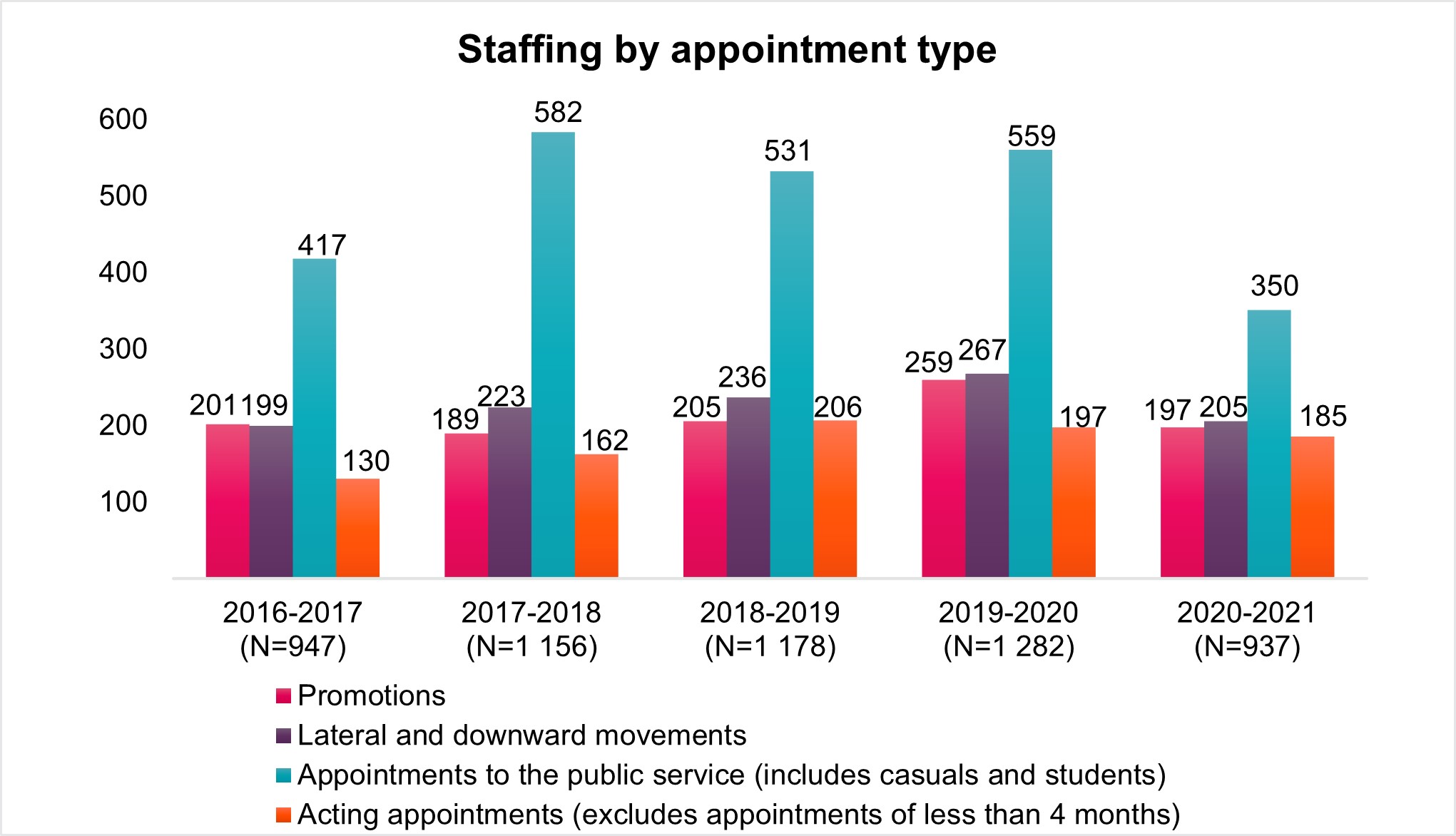
In 2020–2021, PCH processed a total of 937 staffing activities:
- 350 appointments to the public service (including casual employees and students)
- 158 casual workers
- 46 students
- 146 term and indeterminate workers
- 197 promotions
- 185 acting appointments
- 205 lateral and downward movements
Please refer to Annex B for additional details on staffing activities.
Time to Staff
There are insufficient data to provide time to staff for PCH’s internal and external staffing processes.
PCH is currently developing the Staffing Tracking System, which would allow the application of service standards, performance measurement and the monitoring of staffing requests at all steps of a process. This system will therefore allow us to measure the time required for each appointment. Its launch is expected in 2022.
Staffing Framework
New Direction in Staffing implementation
Since 2016, PCH has experienced some resistance to the changes made by the NDS at various levels, such as the acceptance of non‑advertised appointments by managers, employees and HR specialists.
Since 2018, the organization has expressed renewed interest in improving the understanding of the flexibilities offered by the NDS. This has led the Department to request that the staffing support advisor (SSA) give, together with the Department’s Corporate Staffing Services, a number of information sessions about the various flexibilities offered by the NDS to a variety of audiences, including sub‑delegated managers, HR specialists and employees.
In 2018, PCH consulted the SSA regarding its staffing policies. Since they were already aligned with the NDS, the SSA made some minor suggestions to improve the guidelines governing the choice of appointment process and the selection decision, as well as the area of selection policy. The Department incorporated these changes in fiscal year 2019–2020.
From 2018 to 2020, PCH worked in consultation with the PSC delegation expert and the SSA to adjust the Department’s Corporate Staffing sub-delegation instrument to comply with the requirements of the Public Service Employment Act (PSEA) and the Appointment Delegation and Accountability Instrument. The final changes were implemented in February 2020.
Departmental staffing is now implementing the NDS philosophy and, since 2020, it has taken over the delivery of information sessions for hiring managers and for employees to ensure that everyone receives the information necessary to experiment with the flexibilities offered by the NDS.
Collaboration between the SSA and Corporate Staffing has continued to address topics such as rethinking staffing, promotion rates for employment equity designated groups and others to address staffing in a more modern way.
Appointment Delegation and Accountability Instrument Annex D Reporting
Use of the Public Service Official Languages Exclusion Approval Order (PSOLEAO) and the Public Service Official Languages Appointment Regulations (PSOLAR)
PCH has stated that the organization used the Public Service Official Languages Exclusion Approval Order (PSOLEAO) 24 times and the Public Service Official Languages Appointment Regulations (PSOLAR) 4 times during the period from April 1, 2020, to March 31, 2021.
Deputy Head-approved exceptions to the National Area of Selection requirements for an external advertised appointment process
PCH has stated that the DH has not approved any exceptions to the national area of selection.
Results of organizational cyclical assessment
PCH has not reported on the cyclical assessment for the period from April 1, 2016, to March 31, 2021. The organization should submit its report by October 1, 2021.
Inquiries and trends
Between April 1, 2020, and May 31, 2021, PCH made 78 inquiries, of which 27 were about staffing actions related to the response to COVID-19 and 10 were about actions to support and enhance diversity and inclusion in the public service.
The following is a breakdown of the requests by topic:
- 28 requests regarding the assessment of candidates;
- 9 requests related to delegated staffing authorities;
- 8 requests related to the PSC website and systems;
- 7 requests related to employment equity;
- 6 requests related to staffing legislation (PSEA, OLA, PSOLEAO);
- 6 requests related to matters outside the PSC’s mandate, including 5 requests related to the Office of the Chief Human Resources Officer’s directive and policies;
- 4 requests related to area of selection;
- 4 requests related to monitoring and reporting;
- 2 requests related to priority persons and their entitlements;
- 2 requests related to documentation for the staffing file;
- 2 requests related to student hiring.
Oversight
Audits
PCH was one of 30 organizations that participated in the Audit of Employment Equity Representation in Recruitment, which was reported in January 2021. Of the 181 appointment files reviewed as part of the audit, 8 were from PCH. PCH’s participation in the audit was greatly appreciated.
PCH is not included in any PSC audits in progress.
Investigations
The following table outlines the different investigations by the PSC for PCH between May 2018 and May 2021. None of these investigations was founded. Moreover, no investigation was conducted by the PSC on behalf of the PCH Deputy Head during this period.
| Nature of Issue | Cases Received | Cases Referred by Organization | Closed – Not Accepted | Completed Unfounded | Completed Founded | Ongoing |
|---|---|---|---|---|---|---|
| s. 66 External Appointments (Merit, Error, Omission, Improper Conduct) | 3 | 0 | 3 | 0 | 0 | 0 |
| s. 69 Fraud | 1 | 0 | 1 | 0 | 0 | 0 |
| s. 118 Improper Political Activities – Employees | 0 | 0 | 0 | 0 | 0 | 0 |
| Total | 4 | 0 | 4 | 0 | 0 | 0 |
Note: The number of received cases may not add up to the number of completed/closed cases as completed/closed cases are not necessarily cases that were received in the same period. Some cases can also be discontinued or resolved via early intervention.
Staffing and Non-Partisanship Survey results
Overall, PCH’s Staffing and Non-Partisanship Survey (SNPS) results are slighter lower than the results of other medium organizations and higher than the overall public service results.
Below are key findings from PCH’s 2018 SNPS results:
- 69.8% of employees felt that the people hired can do the job, compared with 67.6% in departments and organizations of similar size and 53.8% in the federal public service overall.
- 91.3% of managers felt that the administrative process involved to staff a position in their organization was burdensome, compared with 84.0% in departments and organizations of the same size and 87.9% in the federal public service.
- 61.8% of managers indicated that the NDS has improved the way they hire and appoint persons within their organization to a moderate or great extent, compared with 69.4% in medium organizations and 56.1% in the federal public service.
- 75.1% of managers understand the provisions that help veterans gain employment in the federal service to a moderate or great extent, compared with 67.4% in medium organizations and 64.8% in the federal public service.
- 49.9% of managers said that staffing options available to them within their organization allow them to address their staffing needs as quickly as required to a moderate or great extent, compared with 54.6% in medium organizations and 37.6% in the federal public service.
- 71.4% of managers agreed that their organization’s staffing advisors provided them with useful staffing advice to a moderate or great extent, compared with 77.7% in medium organizations and 72.7% in the federal public service.
- 57.6% of managers agreed that, overall, they were satisfied to a moderate or great extent with the staffing services they received from their organization, compared with 67.6% in medium organizations and 59.4% in the federal public service.
- 57.3% of employees agreed that staffing activities in their work unit were carried out in a transparent way to a moderate or great extent, compared with 54.6% in medium organizations and 44.3% in the federal public service.
- 67.1% of managers agreed that appointees meet the performance expectations of the positions for which they were hired to a great extent, compared with 69.2% in medium organizations and 63.7% in the federal public service.
Diversity Profile
PCH is over-represented for women at 68.1%, Indigenous peoples at 4.6% and members of visible minorities at 15.8%. It is under-represented for persons with disabilities at 5.1% of the workforce, while the workforce availability rate for this group is 9.0%.
| Designated Group | Public Service Work Force Availability (WFA) |
PCH | PCH EE Data from Previous Year |
Representation Across the Public Service of Canada |
|---|---|---|---|---|
| Women | 52.7% | 68.1% | 66.9% | 55.0% |
| Indigenous peoples | 4.0% | 4.6% | 4.6% | 5.1% |
| Persons with disabilities | 9.0% | 5.1% | 5.2% | 5.2% |
| Members of visible minorities | 15.3% | 15.8% | 14.2% | 17.8% |
Source: Employment Equity in the Public Service of Canada 2018–2019 Treasury Board of Canada Secretariat
PCH should take measures to close the representation gap for persons with disabilities and continue to appoint members of designated groups based on merit, if applicable, to ensure the representativeness of its workforce.
The Clerk of the Privy Council has asked senior leaders to commit to making measurable changes to the diversity and inclusiveness of the public service; these include developing staffing plans to close representation gaps for employment equity designated groups. The below-noted data highlight the current gap in representation of persons with disabilities (PWD) at PCH and the estimated level of recruitment required to close this gap within the next five years, taking into consideration factors such as attrition.
- Representation of PWD: 5.1%;
- Workforce availability (WFA) for PWD: 9.0%;
- Gap between WFA and representation: 3.9%;
- Closing the gap: PWD population increase required to reach WFA over 5 years: 68;
- Closing the gap: Recruitment of PWD required to achieve population increase over 5 years (estimate): 123.
Priority Entitlements and Veterans
From April 1, 2021, to May 31, 2021, approximately 70% of PCH’s priority clearance requests affect non-advertised processes: 41% internal and 29% external.
| Fiscal Year | Attributable to Service (Statutory) | Not Attributable to Service (Regulatory) | Total |
|---|---|---|---|
| 2015 (July 1)–2016 | 0 | 1 | 1 |
| 2016–2017 | 0 | 0 | 0 |
| 2017–2018 | 1 | 0 | 1 |
| 2018–2019 | 0 | 0 | 0 |
| 2019–2020 | 0 | 0 | 0 |
| Total | 1 | 1 | 2 |
Source: Priority Information Management System
Appointments of persons with a priority entitlement
From April 1, 2019, to May 31, 2021, no one with a priority entitlement was appointed by PCH (the last appointment of a person with a priority entitlement dates back to 2018).
Appointments of persons with a Canadian Armed Forces Priority Entitlement
Between the coming into force of the Veterans Hiring Act on July 1, 2015, and May 31, 2021, PCH appointed one person with a CAF Priority Entitlement (in fiscal year 2017–2018).
Priority clearance requests
From April 1, 2019, to May 31, 2021, PCH submitted 882 priority clearance requests.
| Priority Clearance Type | Number | Percentage |
|---|---|---|
Internal advertised processes
|
140 | 15.87% |
| Internal non-advertised processes | 342 | 38.78% |
External advertised processes
|
91 | 10.32% |
| External non-advertised processes | 230 | 26.08% |
| Appointment of persons with a priority entitlement (includes term and indeterminate appointments) | 2 | 0.23% |
| Student bridging | 67 | 7.59% |
| Section 43 | 10 | 1.13% |
| Total | 882 | 100% |
Source: Priority Information Management System
COVID-19 related priority clearance requests
Since the Priority Entitlements Policy Division has been monitoring priority entitlement clearances related to COVID-19, PCH has submitted two requests to the PSC, one for a term period and the other for an indeterminate period.
Persons with a priority entitlement
At the end of fiscal year 2020–2021, 13 PCH employees, plus one from April 1 to May 31, 2021, had a priority entitlement under paragraph 41(1)(a) of the Public Service Employment Act, which is a priority entitlement granted to a public servant on leave and the following year.
As at May 31, 2021, of the 14 persons with a priority entitlement at PCH, three had been appointed to a position and the priority period of one person had expired. This leaves 10 PCH public servants with priority entitlements in the PSC’s Priority Information Management System.
Non-Partisanship in the Public Service
Since April 1, 2016 (past five years), the PSC has received two applications from the same PCH employee to run as a candidate at the municipal level:
- In 2017–2018, permission was granted for the employee to run as a candidate in a municipal election. She was not elected.
- In 2019–2020, permission was granted for the employee to run as a candidate in a municipal by-election. She was not elected.
According to the 2018 Staffing and Non-Partisanship Survey (SNPS) results, PCH scores higher than all public service respondents in all aspects related to understanding the rights and responsibilities of political activities and the responsibility to remain impartial in performing duties as a public servant.
- 88.5% of respondents indicated that they were aware of their rights and obligations for engaging in political activities to a moderate or great extent, compared with the overall public service score of 80.1%.
- 74.2% of respondents indicated that PCH keeps them informed of their rights to engage in political activities to a moderate or great extent, compared with an overall public service result of 63.6%.
- 97.8% of respondents indicated that they understand the importance to be perceived as being politically impartial in carrying out their duties to a moderate or great extent, compared with an overall result of 94.2% for all public service respondents.
- Only 2.3% of PCH employees reported engaging in political activities between January 1 and December 31, 2017, which is about the same rate as in the overall public service (2.4%).
PCH’s designated political activities representative (DPAR) is Lise Laneville, Director and Ombudsman, Office of Values and Ethics. The DPAR acts as a liaison with the PSC on matters related to political activities and non-partisanship.
Recruitment Programs
Federal Internship Program for Canadians with Disabilities
PCH hired an intern from the second cohort of the Federal Internship Program for Canadians with Disabilities (FIPCD). This FIPCD is an excellent initiative to contribute to the Government of Canada’s Accessibility Strategy by having interns and supporting them in skill development to increase their employability. The program also offers a 50% salary reimbursement to hiring organizations during the internship period. In addition, the program provides managers and interns with career coaching services and tools to support the interns’ development, such as recommended training offered by the Canada School of Public Service.
Should PCH wish to hire other interns, it may contact the PSC to explore this option at: cfp.diversitedetalent-talentdiversity.psc@canada.ca
Employment Opportunity for Students with Disabilities / Indigenous Student Employment Opportunity
PCH submitted eight requests for referrals for students with disabilities and nine requests for Indigenous students through the Federal Student Work Experience Program (FSWEP) between May 31, 2020, and May 31, 2021.
Unfortunately, with regard to students with disabilities, PCH was entitled to only one candidate for the salary subsidy. Despite its enthusiasm, if the Department had hired more than one participant, the salaries of the additional participants would have had to be fully assumed by the Department. Consequently, PCH hired only one participant.
The Employment Opportunity for Students with Disabilities (EOSD) and the Indigenous Student Employment Opportunity (ISEO) are excellent recruitment options to increase diversity in the workplace by hiring students with disabilities or Indigenous students. Managers and students are provided with resources, such as onboarding tools, training and networking events. Candidates from both these initiatives are available year-round in the FSWEP ongoing inventory.
- Number of available students in EOSD: 4,222Footnote 1
- Number of available students in ISEO: 2,022Footnote 2
Federal Student Work Experience Program
PCH submitted 50 requests for referrals to FSWEP between May 31, 2020, and May 31, 2021. In addition, PCH hired 361 students under FSWEP over the previous 4 years. This program remains an excellent way for an organization to renew its workforce and bring new energy, ideas and approaches to its workplace. The number of available students in this program is 68,918.Footnote 3
Post-Secondary Recruitment
PCH submitted 34 requests for referrals from existing Post-Secondary Recruitment inventories to staff a total of 53 positions in the AS (mainly), CS, EC, IS and PM classifications.
Participation in initiatives related to the hiring of Indigenous People
In partnership with the PSC’s Aboriginal Centre of Expertise, the Personnel Psychology Centre provided PCH with detailed information on developmental assessments and Executive Counselling Services to support the career advancement of Indigenous employees at all levels, including the EX cadre. This information was coordinated in consultation with a representative of the Knowledge Circle for Indigenous Inclusion, working through the Office of the DM Champion for Indigenous Employees in the federal public service at PCH. The assessment information contributed by the Psychology Centre has been incorporated into a comprehensive Indigenous Employee Learning and Career Development Roadmap. It is anticipated that this Roadmap will be published shortly on the GCpedia page of the Knowledge Circle and accessible through the Indigenous Employee Career Pathway portal on GCintranet.
While we have not worked with PCH on specific initiatives, the Indigenous Career Pathway is an initiative that may be of interest to it in hiring Indigenous people. PCH can contact the Aboriginal Centre of Expertise for more information.
The PSC’s Aboriginal Centre of Expertise and the Treasury Board Secretariat’s Office of the Chief Human Resources Officer have developed an Indigenous Career Pathway (ICP) that may be of interest to PCH. It provides information on Indigenous recruitment, career progression, as well as development and retention:
- The Indigenous Career Pathways – Inventory of Indigenous Applicants in GCpedia facilitates the matching between hiring managers and candidates by sourcing Indigenous talent from existing inventories of the PSC and proactively promoting their profiles to federal organizations. Ten students are currently available in the inventory.
- The Indigenous Recruitment Toolbox is a repository of tools, resources and advice on Indigenous recruitment, outreach and initiatives that the PSC and other departments offer.
More information about Indigenous recruitment programs is available on the Indigenous recruitment – Information for hiring managers website.
Staffing Support
Public Service Commission representatives and organizational contacts
The Staffing Support Advisor (SSA) assigned to this organization is Yannick Fortin, the primary organizational contacts are Caroline Bernier, Director, Resourcing; and Sylvain Aubé, Manager, Human Resources Policies and Programs; and the Head of HR is France Guèvremont, Director General, Human Resources and Workplace Management.
PREPARED BY:
Yannick Fortin
Staffing Support Advisor
APPROVED BY:
Lynn Brault
Director General, Staffing Support, Priorities and Political Activities Directorate
Policy and Communications
Gaveen Cadotte
Vice-President, Policy and Communications
Annexes
Annex A – The New Direction in Staffing (NDS) highlights for DHs
Annex B – Data on Population and Staffing Activities
Annex A
A New Direction in Staffing – A Merit-Based System That is Effective, Efficient and Fair
Appointment Policy
New focus on core requirements to provide sub-delegated persons with greater discretion in making an appointment
- One Appointment Policy, no duplication of legal requirements
- Broader focus on values-based system, away from rules-based system
- Appointment Policy supported by streamlined guidance:
- A roadmap to the legislative, regulatory and policy requirements
- Options and considerations for decision making where there is discretion
- Clear expectations for priority entitlements
- No restrictions on assessment methods for EX appointments
- Exceptions to National Area of Selection approved by deputy head
Delegation
- New ability to customize organizational staffing system based on unique context and evolving business needs
- Deputy heads establish a direction on the use of advertised and non-advertised appointment processes
- Deputy heads to establish requirement(s) for sub-delegated persons to articulate, in writing, their selection decision
- Clarity on requirements related to investigations
- Attestation form to reinforce the accountabilities of sub-delegated persons
All PSC monitoring and reporting requirements now found in the Appointment Delegation and Accountability Instrument
Monitoring and Reporting
Monitoring built by organizations, targeted to their needs
- Annual Departmental Staffing Accountability Report no longer required
- Annual reporting to the PSC limited to:
- Use of Public Service Official Language Exclusion Approval Order
- Exceptions to the National Area of Selection approved by the deputy head
- Results of any internal investigations
- Actions taken following any PSC investigations or audits.
- Deputy head responsible for ongoing monitoring of organizational staffing system based on the organization’s unique context
- Assessment of adherence to requirements, based on organization’s own risks, every five years, at a minimum.
PSC Oversight
System-wide focus
- Government-wide compliance audit every two years
- Renewed Survey of Staffing administered in alternating years with government-wide audit
- System-wide effectiveness and efficiency reviews to support continuous improvement
- Targeted PSC audits as a result of identified system-wide or organizational risks or at the request of deputy head
- Investigations conducted when there is reason to believe there was political influence, fraud or improper conduct in an appointment process
This document should be read in conjunction with the Public Service Employment Act, the Public Service Employment Regulations, the PSC Appointment Policyand the PSC Appointment Delegation and Accountability Instrument.
Annex B
Population by tenure as of March 31
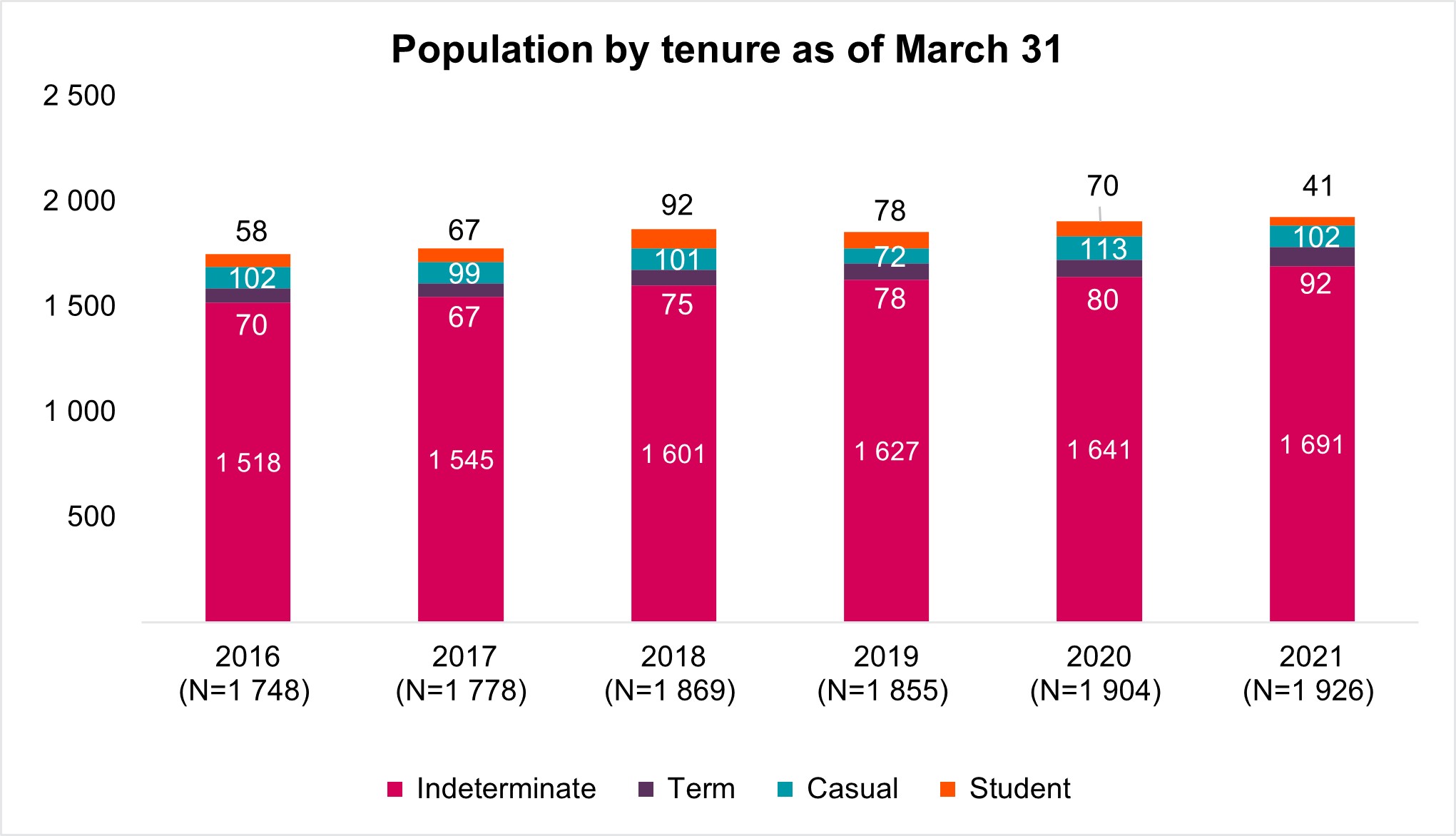
Text version
| Year | Indeterminate population | Term population | Casual population | Student population | Total population |
|---|---|---|---|---|---|
| As of March 31, 2016 | 1 518 | 70 | 102 | 58 | 1 748 |
| As of March 31, 2017 | 1 545 | 67 | 99 | 67 | 1 778 |
| As of March 31, 2018 | 1 601 | 75 | 101 | 92 | 1 869 |
| As of March 31, 2019 | 1 627 | 78 | 72 | 78 | 1 855 |
| As of March 31, 2020 | 1 641 | 80 | 113 | 70 | 1 904 |
| As of March 31, 2021 | 1 691 | 92 | 102 | 41 | 1 926 |
Population by language requirements as of March 31, 2021
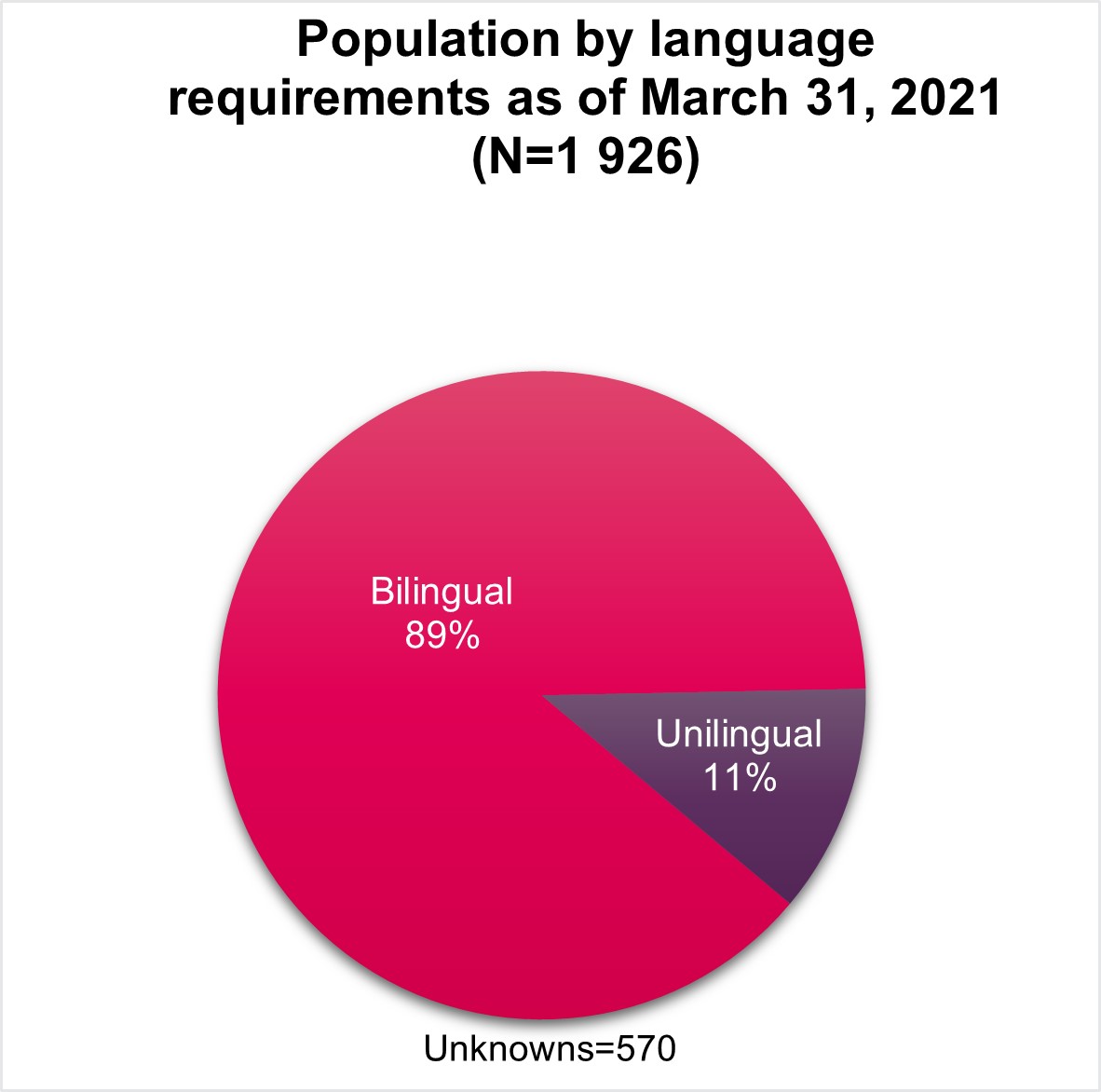
Text version
| Linguistic requirements of the position | Population as of March 31, 2021 | Percentage of population as of March 31, 2021 |
|---|---|---|
| Bilingual | 1201 | 89% |
| Unilingual | 155 | 11% |
| Unknowns | 570 | Not Applicable |
Population by occupational group as of March 31, 2021
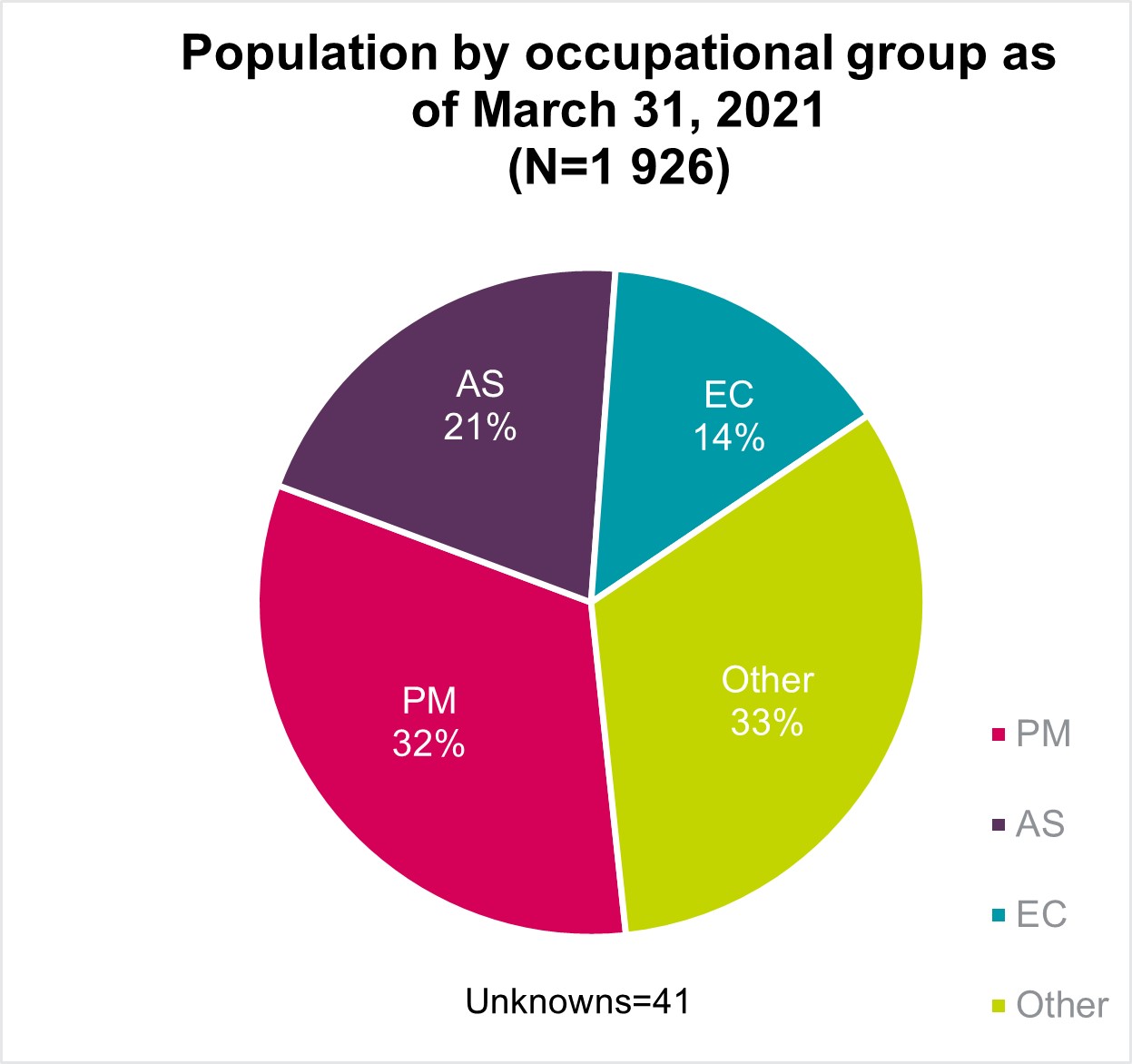
Text version
| Occupational group | Population as of March 31, 2021 | Percentage of population as of March 31, 2021 |
|---|---|---|
| PM – Programme Administration | 610 | 32% |
| AS – Administrative Services | 386 | 20% |
| EC – Economics and Social Science Services | 271 | 14% |
| Other | 618 | 33% |
| Unknowns | 41 | Not Applicable |
Population by region as of March 31, 2021
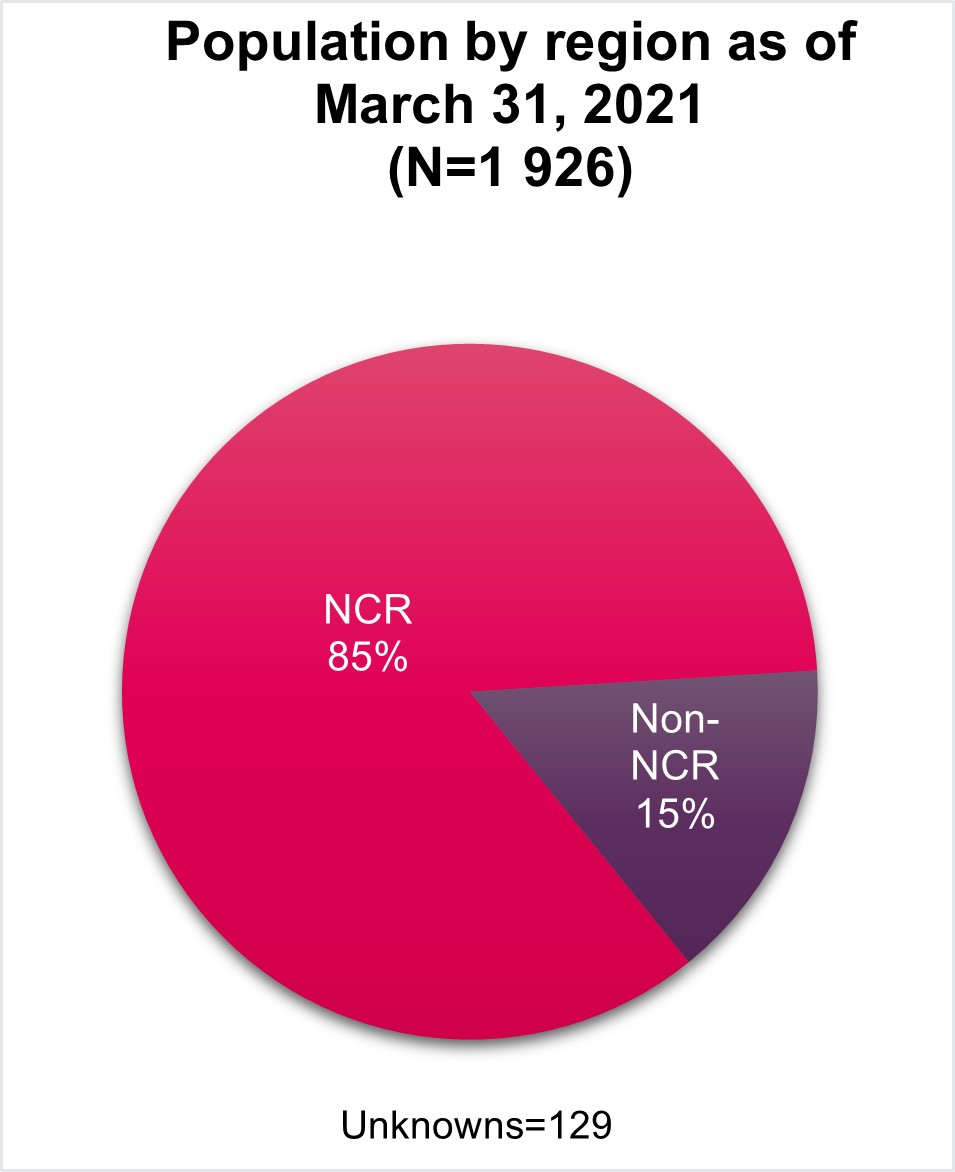
Text version
| Region | Population as of March 31, 2021 | Percentage of population as of March 31, 2021 |
|---|---|---|
| National Capital Region (NCR) | 1 525 | 85% |
| Non-NCR | 272 | 15% |
| Unknowns | 129 | Not Applicable |
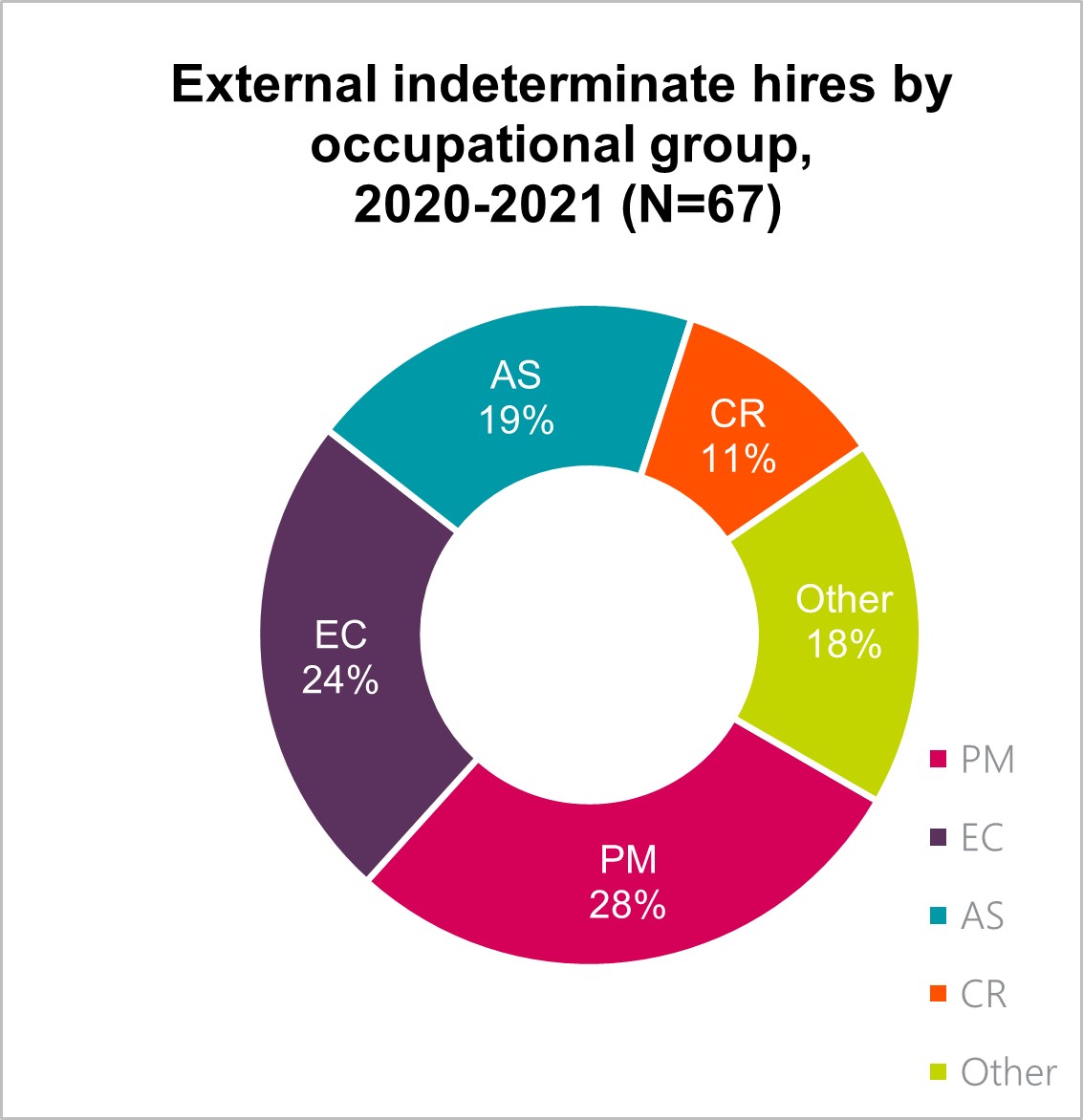
External indeterminate hires by occupational group, 2020-2021
Text version
| Occupational group | Number of indeterminate hiring activities | Percentage of all indeterminate hiring activities |
|---|---|---|
| PM – Programme Administration | 19 | 28% |
| EC – Economics and Social Science Services | 16 | 24% |
| AS – Administrative Services | 13 | 19% |
| CR – Clerical and Regulatory | 7 | 10% |
| Other | 12 | 18% |
| Total | 67 | 100% |
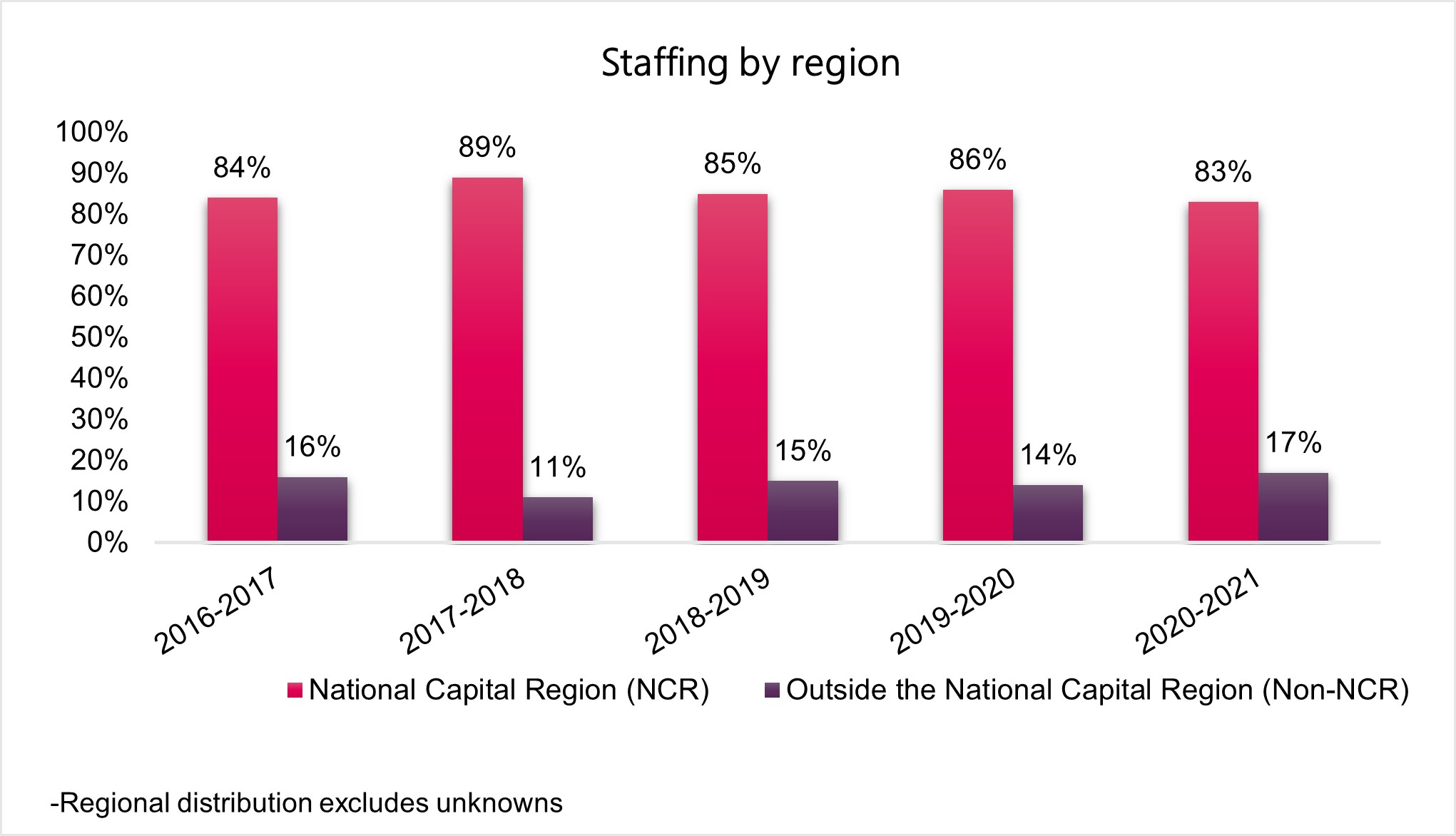
Staffing by region
Text version
| Fiscal year | Percentage of staffing activities in the National Capital Region (NCR) * | Percentage of staffing activities in all other regions (Non-NCR) * |
|---|---|---|
| 2016-2017 | 84% | 16% |
| 2017-2018 | 89% | 11% |
| 2018-2019 | 85% | 15% |
| 2019-2020 | 86% | 14% |
| 2020-2021 | 83% | 17% |
* Regional distribution excludes unknowns
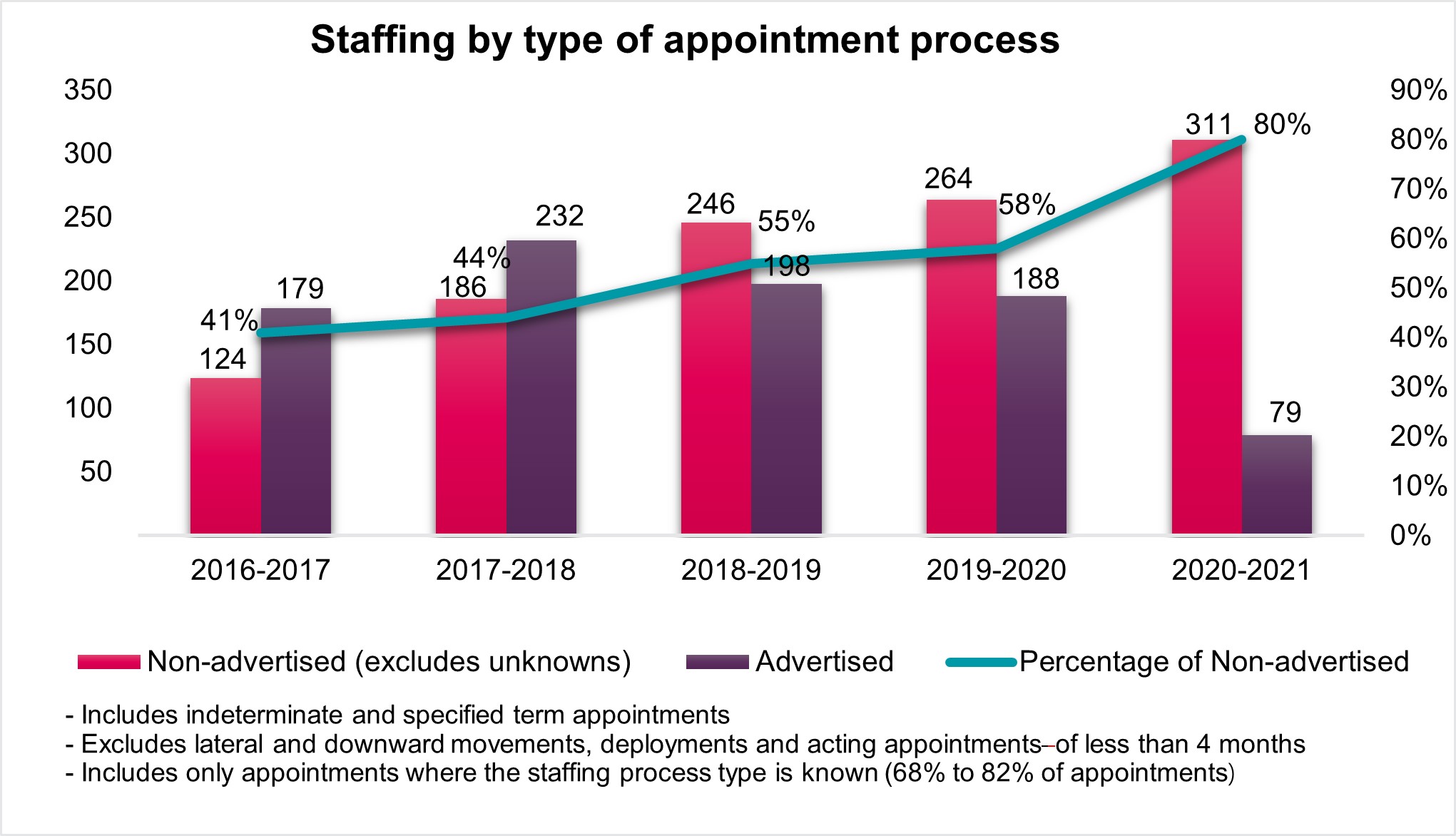
Staffing by appointment process type
Text version
| Fiscal year | Non-advertised appointments (excludes unknowns) | Advertised appointments | Percentage of Non-advertised appointments |
|---|---|---|---|
| 2016-2017 | 124 | 179 | 41% |
| 2017-2018 | 186 | 232 | 44% |
| 2018-2019 | 246 | 198 | 55% |
| 2019-2020 | 264 | 188 | 58% |
| 2020-2021 | 311 | 79 | 80% |
- Includes indeterminate and specified term appointments
- Excludes lateral and downward movements, deployments and acting appointments of less than 4 months
- Includes only appointments where the staffing process type is known (68% to 82% of appointments)
Staffing by appointment type
Text version
| Fiscal year | Promotions | Lateral and downward movements | Appointments to the public service (includes casuals and students) | Acting appointments (excludes appointments of less than 4 months) | Total |
|---|---|---|---|---|---|
| 2016-2017 | 201 | 199 | 417 | 130 | 947 |
| 2017-2018 | 189 | 223 | 582 | 162 | 1 156 |
| 2018-2019 | 205 | 236 | 531 | 206 | 1 178 |
| 2019-2020 | 259 | 267 | 559 | 197 | 1 282 |
| 2020-2021 | 197 | 205 | 350 | 185 | 937 |
Staffing by tenure
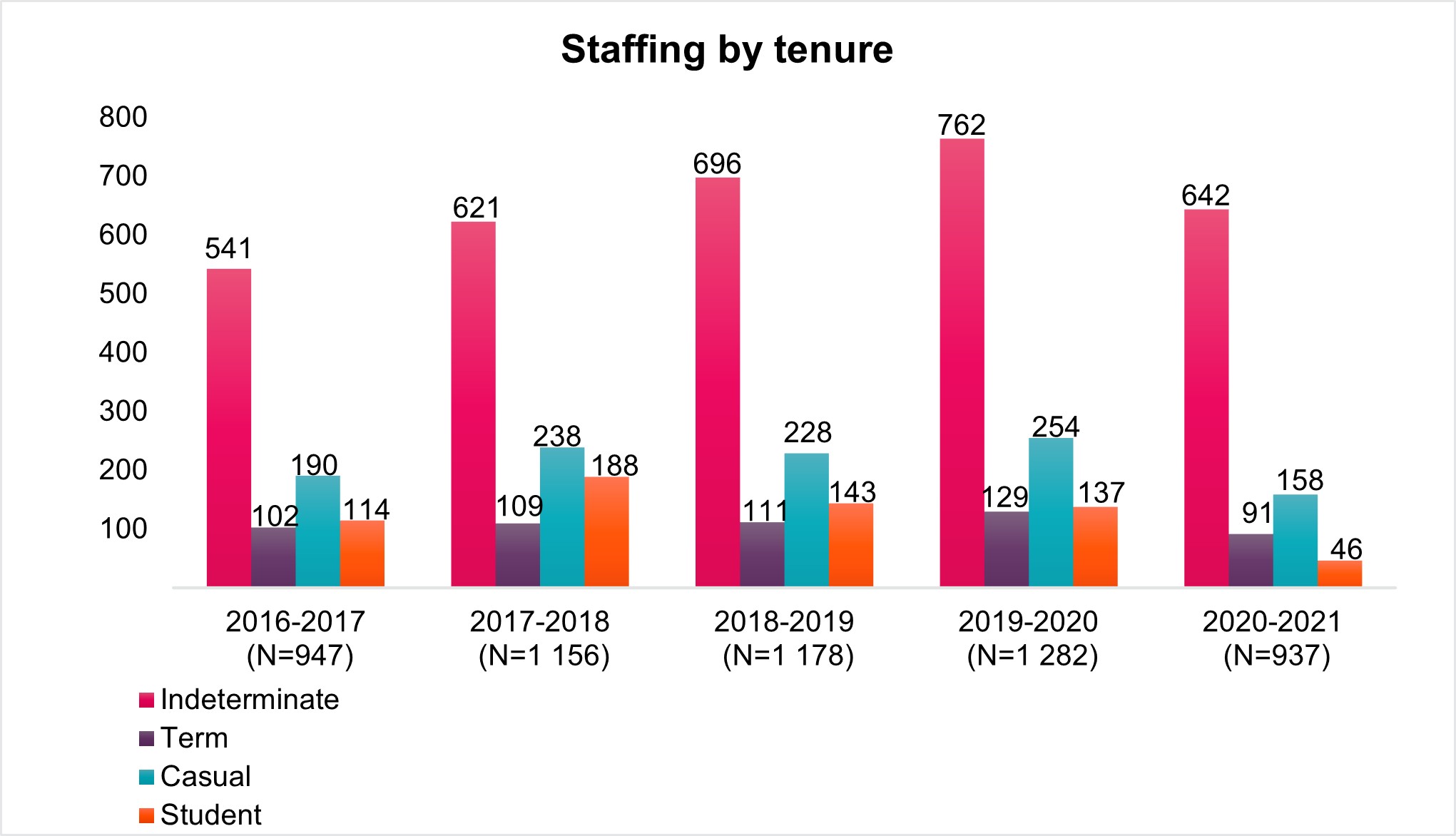
Text version
| Fiscal year | Indeterminate staffing activities | Term staffing activities | Casual staffing activities | Student staffing activities | Total staffing activities |
|---|---|---|---|---|---|
| 2016-2017 | 541 | 102 | 190 | 114 | 947 |
| 2017-2018 | 621 | 109 | 238 | 188 | 1 156 |
| 2018-2019 | 696 | 111 | 228 | 143 | 1 178 |
| 2019-2020 | 762 | 129 | 254 | 137 | 1 282 |
Key findings - Staffing and non-partisanship survey (2018)
- 69.8% of employees agreed that people hired can do the job, compared to 67.6% in organizations of similar size, and 53.8% in the federal public service
- 61.8% of managers agreed that the New Direction in Staffing has improved the way they hire and appoint persons to and within their organization, compared to 69.4% in organizations of similar size, and 56.1% in the federal public service
- 91.3% of managers agreed that within their organization, the administrative to staff a position is burdensome, compared to 84.0% in organizations of similar size, and 87.9% in the federal public service.
Student program hires
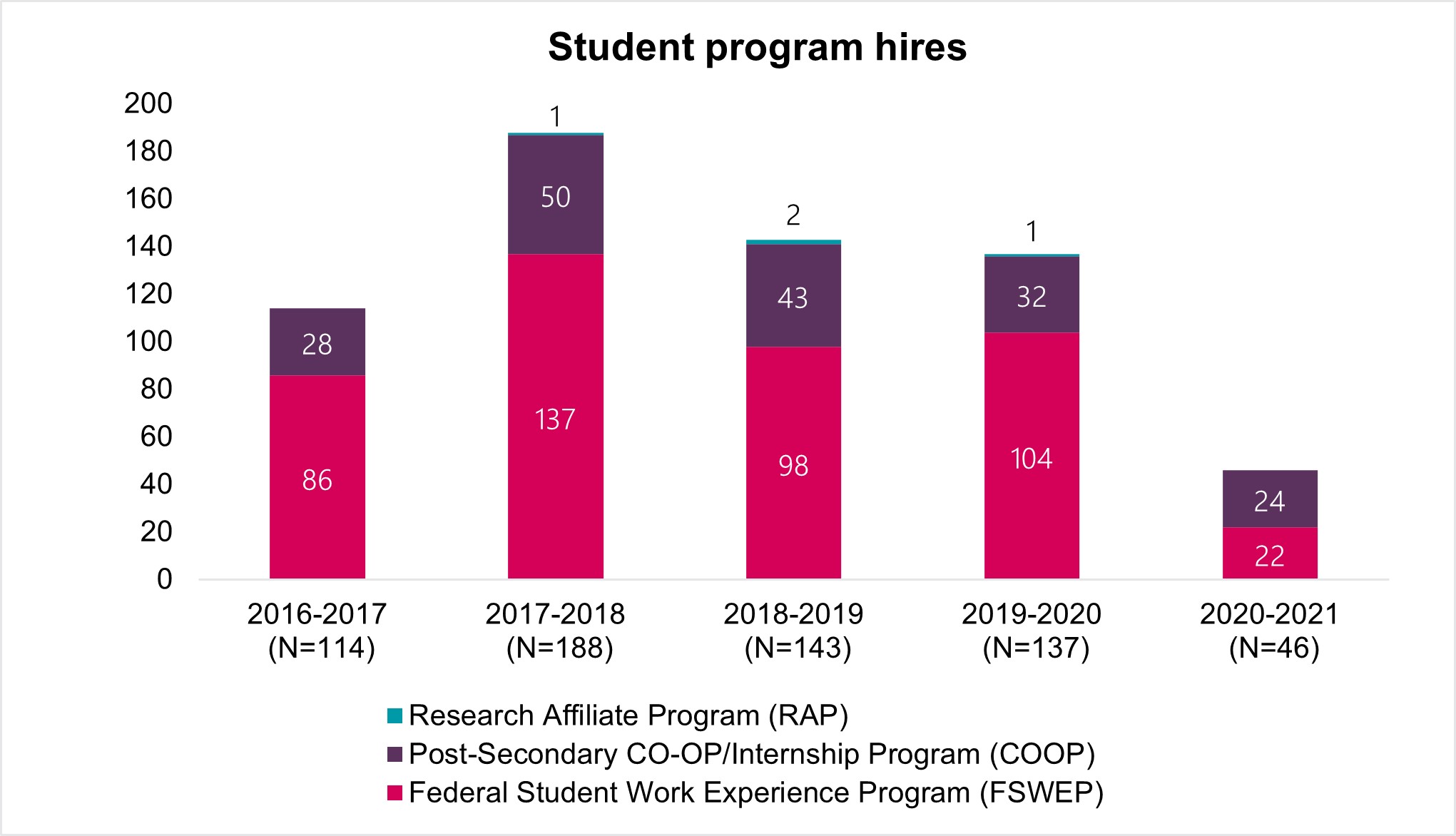
Text version
| Fiscal year | Federal Student Work Experience Program | Post-Secondary Co-op/Internship Program | Research Affiliate Program | Total |
|---|---|---|---|---|
| 2016-2017 | 86 | 28 | 0 | 114 |
| 2017-2018 | 137 | 50 | 1 | 188 |
| 2018-2019 | 98 | 43 | 2 | 143 |
| 2019-2020 | 104 | 32 | 1 | 137 |
| 2020-2021 | 22 | 24 | 0 | 46 |
Post-Secondary Recruitment Program and former student hires
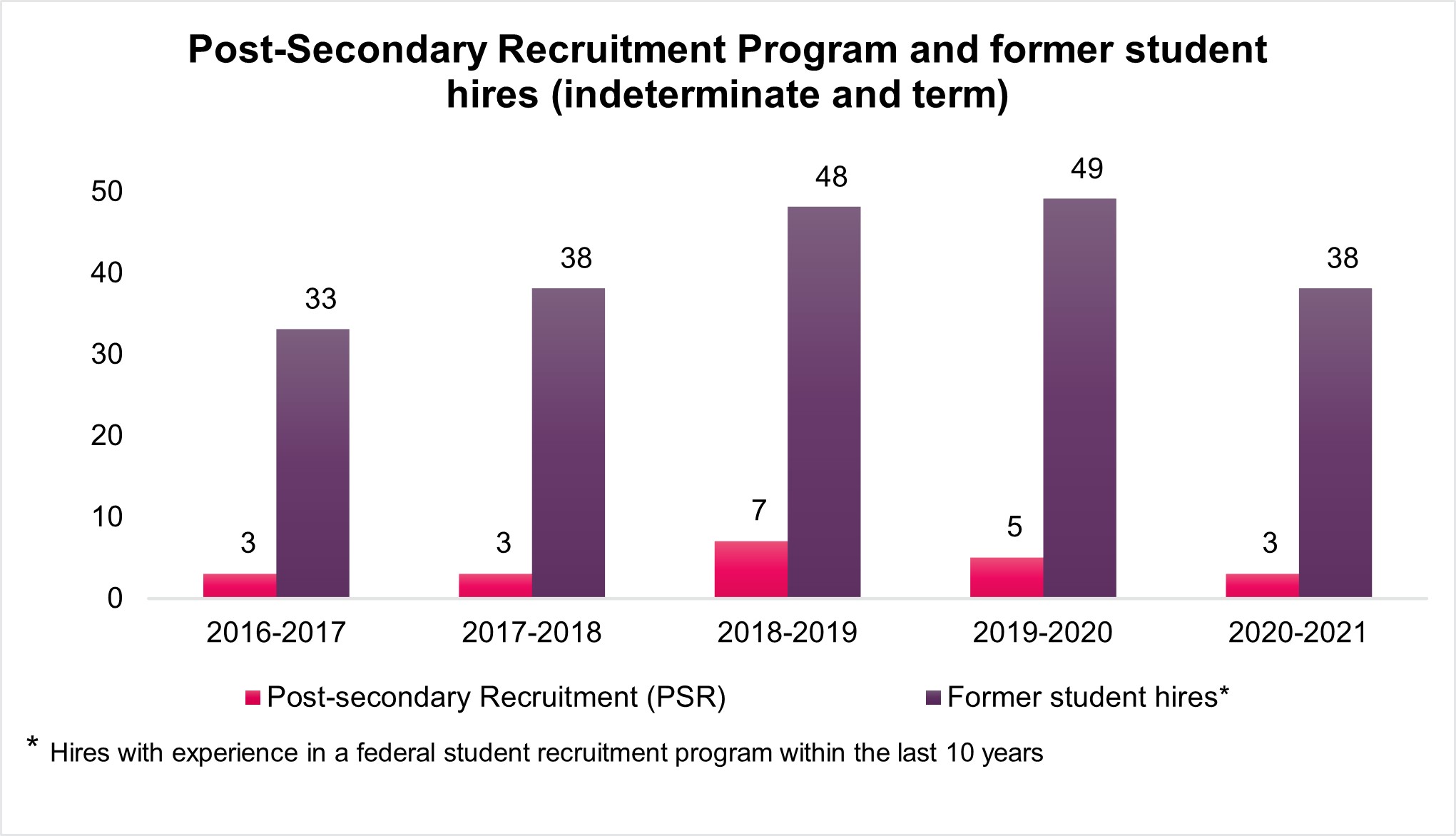
Text version
| Fiscal year | Post-secondary Recruitment (PSR) | Former student hires* |
|---|---|---|
| 2016-2017 | 3 | 33 |
| 2017-2018 | 3 | 38 |
| 2018-2019 | 7 | 48 |
| 2019-2020 | 5 | 49 |
| 2020-2021 | 3 | 38 |
*Hiring of former students includes indeterminate and term hires with experience in a federal student recruitment program within the last 10 years.
Internal time to staff
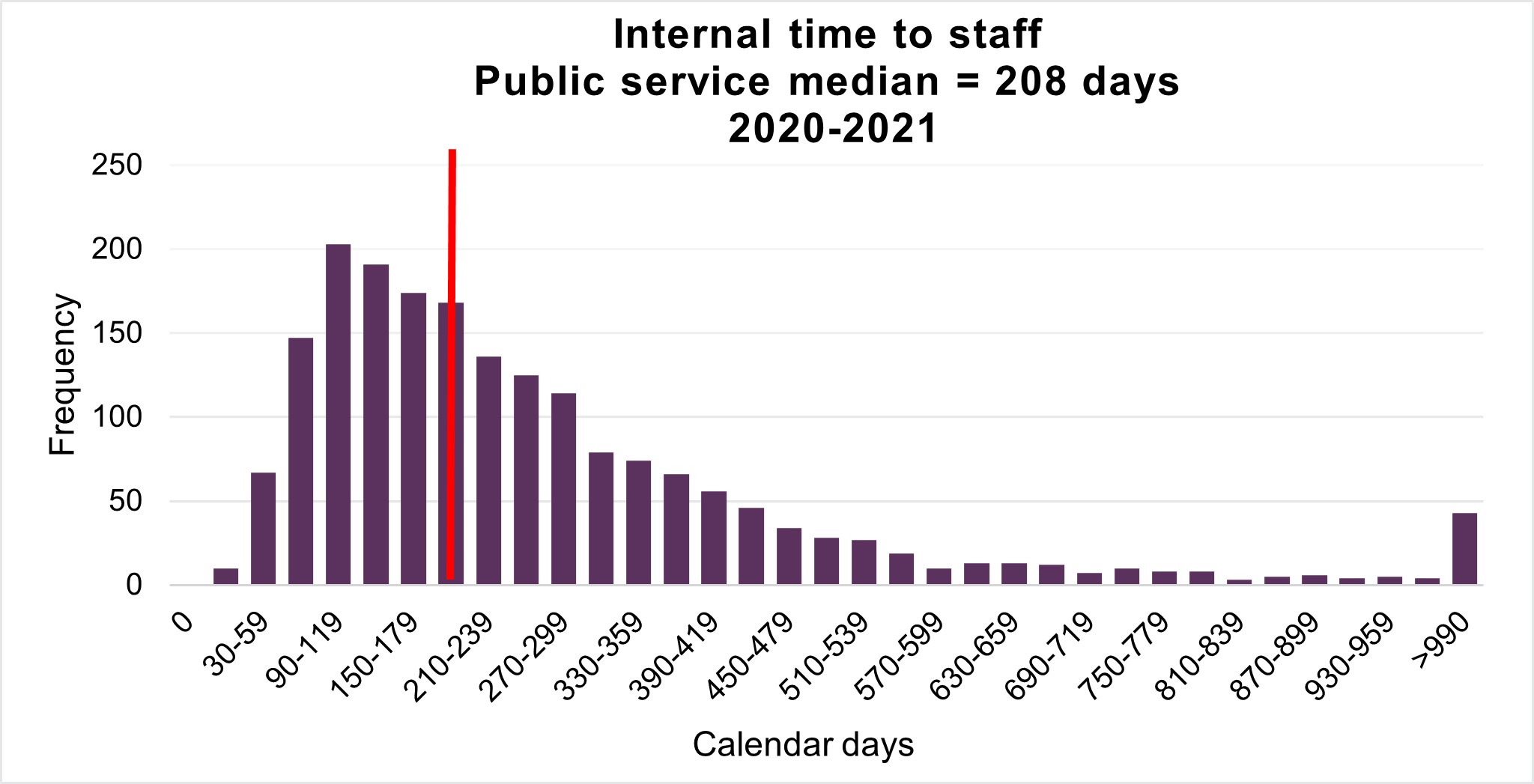
Text version
| Number of calendar days | The number of internal appointments for which the internal time to staff was within the specified number of calendar days for organizations subject to the Public Service Employment Act |
|---|---|
| 0 calendar days | 0 |
| 0 to 29 calendar days | 10 |
| 30 to 59 calendar days | 67 |
| 60 to 89 calendar days | 147 |
| 90 to 119 calendar days | 203 |
| 120 to 149 calendar days | 191 |
| 150 to 179 calendar days | 174 |
| 180 to 209 calendar days | 168 |
| 210 to 239 calendar days | 136 |
| 240 to 269 calendar days | 125 |
| 270 to 299 calendar days | 114 |
| 300 to 329 calendar days | 79 |
| 330 to 359 calendar days | 74 |
| 360 to 389 calendar days | 66 |
| 390 to 419 calendar days | 56 |
| 420 to 449 calendar days | 46 |
| 450 to 479 calendar days | 34 |
| 480 to 509 calendar days | 28 |
| 510 to 539 calendar days | 27 |
| 540 to 569 calendar days | 19 |
| 570 to 599 calendar days | 10 |
| 600 to 629 calendar days | 13 |
| 630 to 659 calendar days | 13 |
| 660 to 689 calendar days | 12 |
| 690 to 719 calendar days | 7 |
| 720 to 749 calendar days | 10 |
| 750 to 779 calendar days | 8 |
| 780 to 809 calendar days | 8 |
| 810 to 839 calendar days | 3 |
| 840 to 869 calendar days | 5 |
| 870 to 899 calendar days | 6 |
| 900 to 929 calendar days | 3 |
| 930 to 959 calendar days | 2 |
| 960 to 989 calendar days | 2 |
| More than 990 calendar days | 36 |
Internal time to staff is calculated as the number of calendar days between the opening date of the advertisement and the date of the first notification.
Internal time to staff for fiscal year 2020-2021
The median internal time to staff for the public service (organizations subject to the Public Service Employment Act) for fiscal year 2020-2021 is 208 days. The data is insufficient for providing results on internal process times for Canadian Heritage.
External time to staff
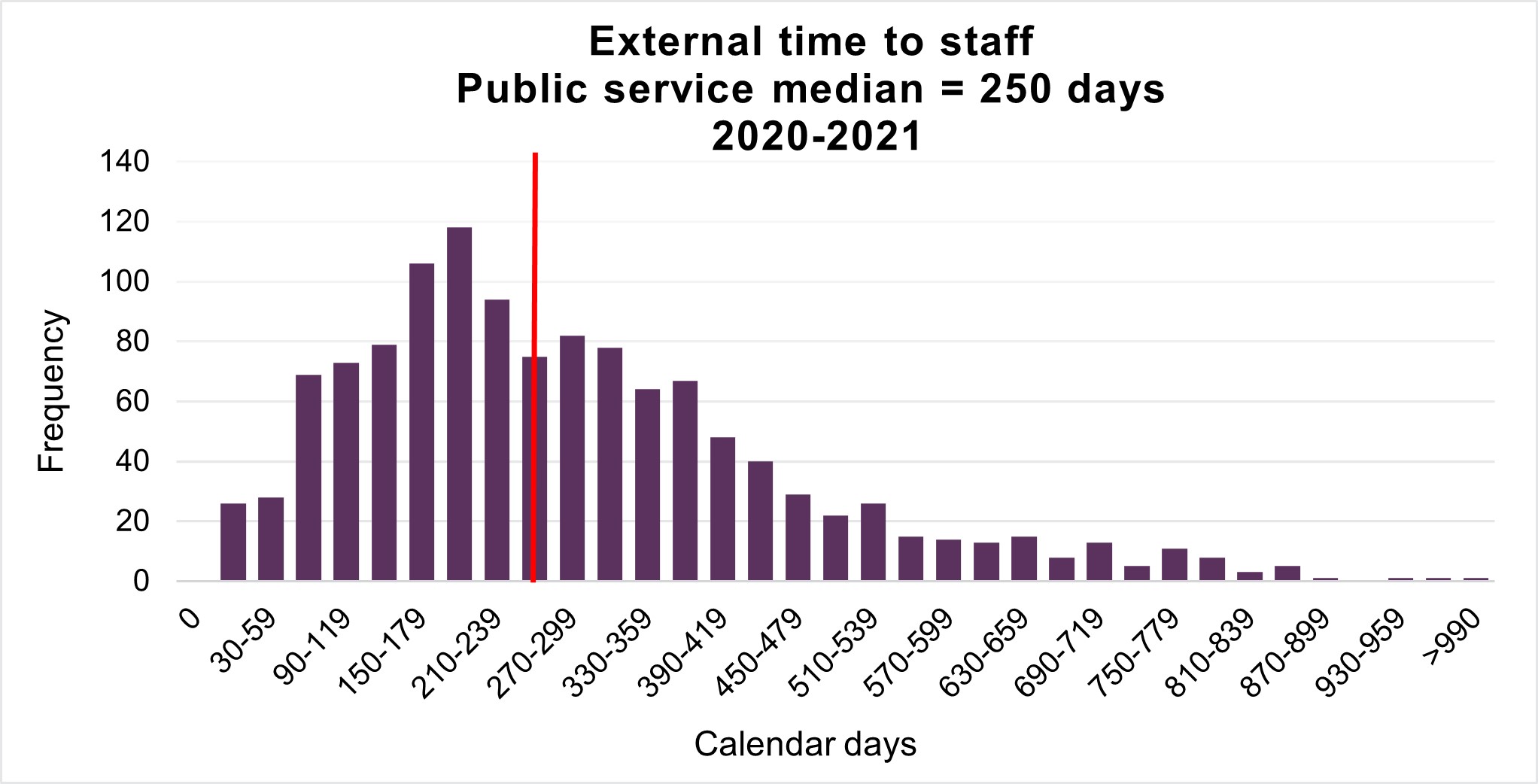
Text version
| Number of calendar days | The number of external appointment processes for which the external time to staff was within the specified number of calendar days for organizations subject to the Public Service Employment Act |
|---|---|
| 0 calendar days | 0 |
| 0 to 29 calendar days | 26 |
| 30 to 59 calendar days | 28 |
| 60 to 89 calendar days | 69 |
| 90 to 119 calendar days | 73 |
| 120 to 149 calendar days | 79 |
| 150 to 179 calendar days | 106 |
| 180 to 209 calendar days | 118 |
| 210 to 239 calendar days | 94 |
| 240 to 269 calendar days | 75 |
| 270 to 299 calendar days | 82 |
| 300 to 329 calendar days | 78 |
| 330 to 359 calendar days | 64 |
| 360 to 389 calendar days | 67 |
| 390 to 419 calendar days | 48 |
| 420 to 449 calendar days | 40 |
| 450 to 479 calendar days | 29 |
| 480 to 509 calendar days | 22 |
| 510 to 539 calendar days | 26 |
| 540 to 569 calendar days | 15 |
| 570 to 599 calendar days | 14 |
| 600 to 629 calendar days | 13 |
| 630 to 659 calendar days | 15 |
| 660 to 689 calendar days | 8 |
| 690 to 719 calendar days | 13 |
| 720 to 749 calendar days | 5 |
| 750 to 779 calendar days | 11 |
| 780 to 809 calendar days | 8 |
| 810 to 839 calendar days | 3 |
| 840 to 869 calendar days | 5 |
| 870 to 899 calendar days | 1 |
| 900 to 929 calendar days | 0 |
| 930 to 959 calendar days | 1 |
| 960 to 989 calendar days | 1 |
| More than 990 calendar days | 1 |
External time to staff is calculated as the number of calendar days between the opening date of the advertisement and the date of the first estimated external hire.
External time to staff for fiscal year 2020-2021
The median external time to staff for the public service (organizations subject to the Public Service Employment Act) for fiscal year 2020-2021 is 250 days. The data is insufficient for providing results on external process times for Canadian Heritage.
Technical Notes:
- The Time to Staff for internal appointments is the median number of calendar days between the opening date of an internal advertisement and the date of the first Notice of Appointment or Proposal of Appointment (NAPA) from the Public Service Resourcing System for internal term and indeterminate positions. As NAPAs are not required for all internal staffing actions, this measure is limited to reporting on internal promotional appointments
- Only estimated term and indeterminate appointments/notifications are included (deployments, casual and acting appointments are excluded)
- The Time to Staff for external appointments is the median number of calendar days between the opening date of an external advertisement and the date of the first estimated appointment of an individual from outside an organization subject to the Public Service Employment Act for term and indeterminate positions. Only estimated term and indeterminate appointments/notifications are included (deployments, casual and acting appointments are excluded)
- Because data between systems is linked using a deterministic match, errors in data linkage are a potential source of measurement error
Sources:
- Hiring and staffing activities data are derived from information received from the Treasury Board of Canada Secretariat Incumbent File. The Incumbent File is extracted from the Public Services and Procurement Canada’s pay system. The data constitutes an estimate of hiring and staffing activities to and within organizations
- Information from the Priority Information Management System and the Public Services Resourcing System is also used to determine if staffing actions are advertised or non-advertised as well as for calculating time to staff
- The data are not expected to match an organization’s human resources data, due to methodology and timing differences