
Canada Revenue Agency Quarterly Financial Report For the quarter ended September 30, 2025
© His Majesty the King in Right of Canada, represented by the Minister of Finance and National Revenue, 2025
Catalogue No. Rv2-4E-PDF
ISSN 2819-4543
Statement outlining results, risks and significant changes in operations, personnel and program
Introduction
This quarterly financial report has been prepared by management as required by section 65.1 of the Financial Administration Act in the form and manner prescribed by the Treasury Board. This report should be read in conjunction with the Main Estimates.
Further details on the Canada Revenue Agency’s (CRA) program activities can be found in the Departmental Plan.
Basis of Presentation
This quarterly report has been prepared by management using an expenditure basis of accounting. The accompanying Statement of Authorities includes the CRA's spending authorities granted by Parliament and those used by the CRA consistent with the Main Estimates for the 2025-2026 fiscal year. This quarterly report has been prepared using a special purpose financial reporting framework designed to meet financial information needs with respect to the use of spending authorities.
The authority of Parliament is required before moneys can be spent by the government. Approvals are given in the form of annually approved limits through appropriation acts or through legislation of statutory spending authority for specific purposes.
The CRA uses the full accrual method of accounting to prepare and present its annual departmental financial statements that are part of the departmental performance reporting process. However, the spending authorities voted by Parliament remain on an expenditure basis.
This quarterly report has not been subject to an external audit or review.
Highlights of the fiscal year-to-date (YTD) results
Figure 1 below reflects the CRA's annual net authorities available for use, as well as the CRA’s YTD expenditures as at September 30, 2025.
The CRA’s annual net authorities have decreased significantly, primarily in statutory authorities, due to the removal of the funding for the distribution of the federal fuel charge effective April 1, 2025. YTD expenditures have also decreased, due to both statutory payments and operating costs. Further analysis of authorities and expenditures is presented below.
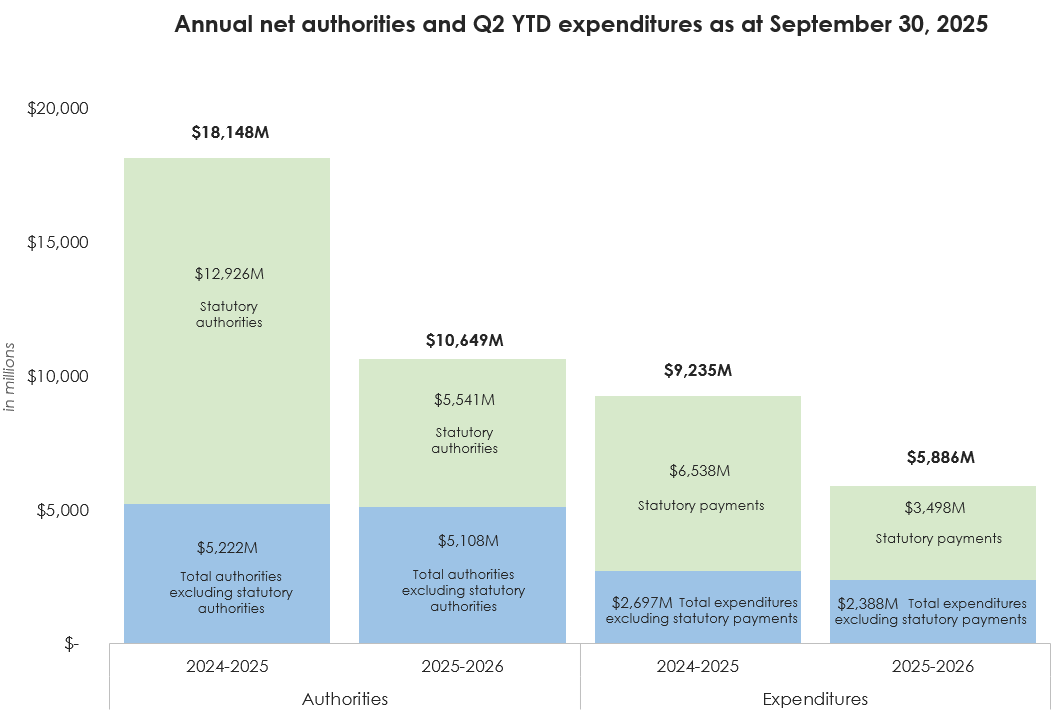
The Agency’s annual authorities available for use as of September 30 and cumulative expenditures for 2024-2025 and 2025-2026
Figure 1 – details
| Year | Authority/Expenditure | Total Authorities Excluding Statutory Items |
Statutory | Total |
|---|---|---|---|---|
| 2024-2025 | Authorities | $5,222 million | $12,926 million | $18,148 million |
| Expenditures | $2,697 million | $6,538 million | $9,235 million | |
| 2025-2026 | Authorities | $5,108 million | $5,541 million | $10,649 million |
| Expenditures | $2,388 million | $3,498 million | $5,886 million |
Note: Refer to the Statement of Authorities, at the end of the report, for details of the specific items included in the statutory authorities.
Year-over-year (YOY) analysis of authorities
This report reflects the results for the current fiscal year in relation to the Main Estimates and authorities available for use from the prior fiscal year. The current year authorities do not include the funding from the recently tabled Supplementary Estimates (B) or the funding decisions from the 2025 federal budget. As shown in the summarized table below, the CRA’s total Budgetary Authorities have decreased by $7,499M ($7.5B) since the second quarter of 2024-2025, from $18,148M ($18.1B) in 2024-2025, to $10,649M ($10.6B) in 2025-2026.
| (in millions of dollars) | Total available for use for the year ending March 31, 2026 |
Total available for use for the year ending March 31, 2025 |
Variance in budgetary authorities |
|---|---|---|---|
Budgetary Statutory Authorities |
$5,541M |
$12,926M |
($7,385M) |
The decrease in Budgetary Statutory Authorities is largely due to the removal of the funding for the distribution of the federal fuel charge effective April 1, 2025. One final fuel charge payment was issued. ($7,460M) |
|||
Gross Vote 1 – Operating Authorities |
$5,462M |
$5,565M |
($103M) |
The decrease in Gross Vote 1 Operating Authorities is primarily related to the following:
|
|||
Vote 5 – Capital Authorities |
$136M |
$143M |
($7M) |
The decrease in Vote 5 Capital Authorities is primarily related to the following:
|
|||
Revenue Credited to the Vote (RCV) |
($490M) |
($486M) |
($4M) |
The increase in RCV is primarily related to the current year increments associated with the latest collective agreements and the Canada Pension Plan Enhancement |
|||
Total Budgetary Authorities |
$10,649M ($10.6B) |
$18,148M ($18.1B) |
($7,499M) ($7.5B) |
YOY analysis of expenditures
The YTD second quarter expenditures as at September 30, 2025 have decreased by $3,349M ($3.3B), from $9,235M ($9.2B) in 2024-2025 to $5,886M ($5.9B) in 2025-2026, as displayed in the Statement of Authorities. The material components of this YOY change are explained below by vote and standard object.
| (in millions of dollars) | YTD expenditures at September 30, 2025 | YTD expenditures at September 30, 2024 | Variance in YTD expenditures |
|---|---|---|---|
Budgetary Statutory Authorities |
$3,498M |
$6,538M |
($3,040M) |
The majority of the decrease in Budgetary Statutory Authorities is primarily related to reductions in fuel charge payments issued, as a result of the funding for the distribution of the federal fuel charge effective April 1, 2025. ($3,128M) |
|||
Net Vote 1 – Operating Expenditures |
$2,361M |
$2,661M |
($300M) |
The decrease in Net Vote 1 Operating Expenditures is primarily related to variances in the following standard objects. The Personnel standard object:
The Professional and special services standard object:
The Acquisition of machinery and equipment standard object:
The Rentals standard object:
The Purchased Repair and Maintenance standard object:
|
|||
Vote 5 – Capital Expenditures |
$27M |
$36M |
($9M) |
The decrease in Vote 5 Capital Expenditures is primarily related to the completion of major project investments. |
|||
Total Budgetary Authorities |
$5,886M ($5.9B) |
$9,235M ($9.2B) |
$3,349M ($3.3B) |
Risks and uncertainties
The CRA is a world-class tax and benefits administration that is trusted, fair, and helpful by putting people first. As such, the CRA continually monitors its internal and external environments for events that could affect whether it achieves its strategic priorities and objectives. The Audit, Finance and Risk Committee of the CRA’s Board of Management and CRA senior management receive quarterly updates on the CRA’s Corporate Risk Profile (CRP), which contains information of the changing risk landscape of the entire risk portfolio. Given the observed shifts in the financial environment, the Financial Management risk has been elevated to an enterprise-level risk. A discussion on CRA’s key risks and mitigation strategies are outlined in the 2025-2026 Departmental Plan.
The CRA recognizes that all of the key risks identified in the Departmental Plan could have financial impacts should they materialize. The key risks and associated mitigation strategies outlined in the Departmental Plan relate to the CRA’s 2025-2026 strategic priorities, which include the following:
- Deliver high quality services
- Ensure the fairness of the tax system
- Transform digitally
- Nurture a high-performing and diverse workforce in a modern, flexible, inclusive, and accessible workplace
Significant changes in relation to operations, personnel, and programs
Since the first quarter, the CRA has launched a 100-day Service Improvement Plan, which is focused on four principal areas:
- Increasing contact centre capacity
- Expanding digital self-service options
- Addressing the root causes of service issues
- Accelerating service modernization
The 100-day Service Improvement Plan has resulted in significant changes to operations, personnel, and programs, as it has necessitated additional investment for the renewal and rehiring of contact centre agents to increase capacity as well as internal reallocations of resources to work on the above-mentioned priorities.
The CRA has faced many uncertainties this fiscal year, as it navigates a period of increased demands and fiscal constraint. Spending reductions and the emphasis on fiscal prudence continue to be central themes this year. The winding down of funding associated with post-pandemic support, the ending of select funding and the government-wide savings initiatives have contributed to reducing the CRA’s authorities.
The CRA continues to contribute to the government’s priority of Responsible Government Spending by reducing discretionary spending on travel, professional services, and other operating expenditures. The CRA has been proactive in advancing its financial plans, while ensuring its long-term financial viability. These plans have necessitated the commencement of workforce adjustment actions as well as a recalibration of the temporary workforce.
The CRA’s goal, throughout the financial planning process, has been to minimize the impact on employees, core business, and service to Canadians, while ensuring the ability to operate within its allotted authorities is assured.
Approval by Senior Officials
Approved by:
[original signed by]
________________________
Bob Hamilton, Commissioner
[original signed by]
_____________________________
Hugo Pagé, Chief Financial Officer
Ottawa, Canada
Date:
| (in thousands of dollars) | Total available for use for the year ending March 31, 2026table 4 note 1 | Used during the quarter ended September 30, 2025 |
Year-to-date used at quarter-end |
|---|---|---|---|
|
Vote 1 - Operating expenditures |
|
|
|
|
Gross Operating expenditures |
$5,462,166 |
$1,255,123 |
$2,603,620 |
|
Revenues netted against expenditures |
($489,859) |
($121,425) |
($242,850) |
|
Net Vote 1 - Operating expenditures |
$4,972,307 |
$1,133,698 |
$2,360,770 |
|
Vote 5 - Capital expenditures |
$135,712 |
$15,283 |
$27,429 |
|
Budgetary Statutory Authorities |
|||
|
Contributions to employee benefit plans |
$661,636 |
$165,409 |
$330,818 |
|
Children's Special Allowance payments (Children's Special Allowances Act) |
$423,000 |
$112,456 |
$221,304 |
|
Canada Carbon Rebate payments |
$3,522,000 |
$221,497 |
$2,540,853 |
|
Spending of revenues received through the conduct of its operations pursuant to section 60 of the Canada Revenue Agency Act |
$293,913 |
$125,389 |
$138,234 |
|
Distribution of Fuel Charges - Provinces and Territories |
$17,000 |
$1,219 |
$22,042 |
|
Distribution of Fuel Charges - Farming Businesses |
- |
$37,295 |
$131,645 |
|
Distribution of Fuel Charges - Small and Medium-sized business |
$623,000 |
$12,344 |
$111,547 |
|
Minister's salary and motor car allowance |
$102 |
$26 |
$41 |
|
Court awards - Tax Court of Canada |
- |
$1,040 |
$1,118 |
|
Spending proceeds from the disposal of surplus Crown Assets |
- |
$24 |
$36 |
|
Energy Cost Benefit |
- |
- |
($1) |
|
Total Budgetary Statutory Authorities |
$5,540,651 |
$676,699 |
$3,497,637 |
|
Total Budgetary Authorities |
$10,648,670 |
$1,825,680 |
$5,885,836 |
Note: Statutory authorithies will be adjusted at year-end to reflect actual expenditures. Any incongruences between statutory authorities and spending will be resolved at year-end.
This financial table compares the Agency’s total available authorities available as of March 31, expenditures used during the quarter and year-to-date expenditures for fiscal years 2024-2025 and 2025-2026 by voted authority. This table uses parentheses to show negative numbers.
| (in thousands of dollars) | Total available for use for the year ending March 31, 2025table 4 note 1 | Used during the quarter ended September 30, 2024 |
Year-to-date used at quarter-end |
|---|---|---|---|
Vote 1 - Operating expenditures |
|
|
|
Gross Operating expenditures |
$5,565,191 |
$1,374,623 |
$2,906,851 |
Revenues netted against expenditures |
($485,700) |
($122,991) |
($245,982) |
Net Vote 1 - Operating expenditures |
$5,079,491 |
$1,251,632 |
$2,660,869 |
Vote 5 - Capital expenditures |
$143,423 |
$21,645 |
$36,295 |
Budgetary Statutory Authorities |
|||
Contributions to employee benefit plans |
$569,177 |
$142,136 |
$284,273 |
Children's Special Allowance payments (Children's Special Allowances Act) |
$396,000 |
$110,037 |
$212,224 |
Canada Carbon Rebate payments |
$11,358,000 |
$3,099,186 |
$5,799,953 |
Spending of revenues received through the conduct of its operations pursuant to section 60 of the Canada Revenue Agency Act |
$338,773 |
$87,672 |
$107,191 |
Distribution of Fuel Charges - Provinces and Territories |
$60,000 |
$10,425 |
$18,074 |
Distribution of Fuel Charges - Farming Businesses |
$203,500 |
$30,176 |
$115,743 |
Distribution of Fuel Charges - Small and Medium-sized businesses |
- |
- |
- |
Minister's salary and motor car allowance |
$99 |
$24 |
$49 |
Court awards - Tax Court of Canada |
- |
$103 |
$269 |
Spending proceeds from the disposal of surplus Crown Assets |
- |
$68 |
$87 |
Energy Cost Benefit |
- |
- |
($1) |
Total Budgetary Statutory Authorities |
$12,925,549 |
$3,479,827 |
$6,537,862 |
Total Budgetary Authorities |
$18,148,463 |
$4,753,104 |
$9,235,026 |
This financial table compares the Agency’s total available authorities available as of September 30, expenditures used during the quarter and year-to-date expenditures for fiscal years 2023-2024 and 2024-2025 by voted authority. This table uses parentheses to show negative numbers.
| (in thousands of dollars) | Planned expenditures for the year ending March 31, 2026 | Expended during the quarter ended September 30, 2025 | Year-to-date used at quarter-end |
|---|---|---|---|
Expenditures: |
|||
Personnel |
$5,186,615 |
$1,285,127 |
$2,607,197 |
Transportation and communications |
$184,773 |
$23,438 |
$56,255 |
Information |
$33,785 |
$2,600 |
$4,763 |
Professional and special services |
$743,699 |
$163,721 |
$267,278 |
Rentals |
$278,653 |
$69,252 |
$132,061 |
Purchased repair and maintenance |
$47,209 |
$8,881 |
$16,757 |
Utilities, materials, and supplies |
$32,214 |
$1,800 |
$3,973 |
Acquisition of machinery and equipment |
$41,865 |
$4,972 |
$8,829 |
Transfer payments |
$4,589,454 |
$384,811 |
$3,027,390 |
Other subsidies and payments |
$262 |
$2,503 |
$4,183 |
Total Gross Budgetary Expenditures |
$11,138,529 |
$1,947,105 |
$6,128,686 |
Less: Revenues netted against expenditures |
$489,859 |
$121,425 |
$242,850 |
Total Net Budgetary Expenditures |
$10,648,670 |
$1,825,680 |
$5,885,836 |
This financial table compares the Agency’s planned expenditures available as of September 30, expenditures used during the quarter and year-to-date expenditures for fiscal years 2023-2024 and 2024-2025 by standard object. This table uses parentheses to show negative numbers.
| (in thousands of dollars) | Planned expenditures for the year ending March 31, 2025 | Expended during the quarter ended September 30, 2024 | Year-to-date used at quarter-end |
|---|---|---|---|
Expenditures: |
|||
Personnel |
$4,934,687 |
$1,384,205 |
$2,778,421 |
Transportation and communications |
$242,138 |
$24,656 |
$59,134 |
Information |
$43,488 |
$3,035 |
$8,870 |
Professional and special services |
$908,742 |
$115,095 |
$286,326 |
Rentals |
$309,773 |
$75,054 |
$143,907 |
Purchased repair and maintenance |
$69,172 |
$13,320 |
$24,211 |
Utilities, materials, and supplies |
$43,130 |
$2,695 |
$6,070 |
Acquisition of machinery and equipment |
$59,131 |
$6,115 |
$23,613 |
Transfer payments |
$12,023,544 |
$3,250,628 |
$6,146,798 |
Other subsidies and payments |
$358 |
$1,292 |
$3,658 |
Total Gross Budgetary Expenditures |
$18,634,163 |
$4,876,095 |
$9,481,008 |
Less: Revenues netted against expenditures |
$485,700 |
$122,991 |
$245,982 |
Total Net Budgetary Expenditures |
$18,148,463 |
$4,753,104 |
$9,235,026 |
This financial table compares the Agency’s planned expenditures available as of September 30, expenditures used during the quarter and year-to-date expenditures for fiscal years 2023-2024 and 2024-2025 by standard object. This table uses parentheses to show negative numbers.