
Parliamentary committee appearance binder for the Comptroller General of Canada before the Standing Committee on Public Accounts (PACP) on November 18 and 22nd, 2022 regarding the Public Accounts of Canada 2022
Notice to readers
This report contains either personal or confidential information, or information related to security, which has been redacted in accordance with the Access to Information Act.
On this page
Meeting Agenda and PAC Membership
A. Summary on Public Accounts 2022
Public Accounts 2022
Issue / Question:
The Public Accounts of Canada for fiscal year 2021-2022 were tabled in Parliament by the President of the Treasury Board in October 2022.
Suggested Response:
- The Government of Canada is committed to responsible financial management and oversight.
- The Public Accounts include the audited consolidated financial statements of the Government.
- For the 24th year in a row, the Government of Canada received a clean audit opinion on its consolidated financial statements.
- This demonstrates the high quality of Canada's financial reporting.
Background:
- Production and finalization of the Public Accounts of Canada is a joint responsibility between the Receiver General, the Office of the Comptroller General and the Department of Finance.
- The Public Accounts reflect the Government’s audited consolidated financial statements and other detailed financial information for the fiscal year 2021-2022 that ended March 31, 2022.
- Volume I – includes the audited consolidated financial statements of the Government; the unmodified audit report from the Auditor General; a financial statements discussion and analysis, which presents 10-year comparative financial information; as well as details on certain financial statement components.
- Volume II – includes financial operations of the departments, including the reconciliations of authorities granted and spent.
- Volume III – includes other supplementary information such as losses, claims against the Crown, ex gratia payments and Ministers’ Office expenditures.
- The Auditor General also simultaneously tables in Parliament, through the Speaker of the House, her observations on key financial audits. This year's observations focus on the pandemic measures enacted by the government, pay administration and National Defence's inventory and asset pooled items.
- The Public Accounts are tabled in the House of Commons and undergo a review by the Public Accounts Committee.
- The Public Accounts show a deficit of $90.2B compared to the projected $154.7B deficit in Budget 2021. To note, Budget 2022 revised the projection to $113.8B.
B. Opening remarks
Notes for remarks by Roch Huppé, Comptroller General of Canada, at the Standing Committee on Public Accounts
October 2022
Ottawa
Check against delivery
Introduction
Thank you, Mr. Chair, and members of the Committee.
I’m pleased to have the opportunity to discuss the Public Accounts of Canada 2022.
Before I begin, I would like to acknowledge that I am speaking here today from the traditional unceded territory of the Algonquin Anishnaabeg People.
I am joined by two of my colleagues from the Treasury Board of Canada Secretariat:
- Monia Lahaie, Assistant Comptroller General of the Financial Management Sector; and
- Diane Peressini, Executive Director, Government Accounting Policy, and Reporting.
- As this committee knows, the Public Accounts include the audited consolidated financial statements for the 2021- 2022 fiscal year, which ended on March 31, 2022, in addition to other unaudited financial information.
I’m pleased to note that, for the 24th consecutive year, the Auditor General has issued an unmodified or “clean” audit opinion on these financial statements.
I would like to thank the financial management community of the Government of Canada, the Department of Finance and the Receiver General, and the Office of the Auditor General for helping prepare the Public Accounts.
Highlights
Let me now turn to some of the highlights in this year’s documents.
Total revenues in these Public Accounts amounted to $413.3 billion in 2022, which represents an increase of $96.8 billion, or 30.6%, from 2021.
Total expenses amounted to $503.5 billion in 2022, which is down $140.7 billion, or 21.8%, from 2021.
As expected, the pandemic continues to have a significant impact on the financial statements.
The total impact of the key COVID-19 response measures on fiscal year 2022 is estimated at over $70 billion.
These include:
- The Canada Emergency Wage Subsidy at $22.3 billion;
- The Canada Recovery Benefit, Canada Recovery Sickness Benefit, Canada Recovery Caregiving Benefit, and the Canada Worker Lockdown Benefit, totaling $16.5 billion; and
- The Canada Emergency Rent Subsidy, totaling $3.7 billion.
Tabling Date
Mr. Chair, one additional point which tends to come up that I would like to clarify is the timing of the tabling of the Public Accounts.
The Financial Administration Act requires the President of the Treasury Board to table the Public Accounts, while Parliament is sitting, each year by December 31.
While the end date is set by legislation, the actual tabling date will vary from year to year within this timeframe.
For instance, during fall election years, the tabling usually takes place closer to the end of the calendar year.
There are also other factors that impact the timeline.
After the Auditor General approves the Public Accounts, several weeks are required to prepare them for publication.
This includes an online version which is required by law to meet accessibility requirements.
Timing of tabling for this year was within typical timelines of mid to late October in a non-election year.
I want to assure this committee that we are looking for ways to help boost our efficiency throughout the production process to achieve the optimal timeline for the tabling of the Public Accounts of Canada.
Mr. Chair, I’d also like to acknowledge we are currently reviewing this committee’s recent report on the 2021 Public Accounts.
In particular, we are assessing the committee’s recommendations including the one recommendation concerning tabling timelines. .
Modernization
Mr. Chair, we are continuously looking for opportunities to improve how government operates, and this includes the modernization of the Public Accounts.
Based on recommendations of this committee, the government committed to study potential improvements, and I’m pleased to report that this work is underway.
To identify possible streamlining opportunities, we reviewed the existing content of the public accounts to identify information that is available through other means, not required by legislation and some with thresholds that have not changed for decades.
In addition, we have received feedback from the Library of Parliament on opportunities to improve the presentation and format of the Public Accounts of Canada.
At the same time, we have engaged key stakeholders on additional potential improvements through a survey.
The purpose of the survey is to better understand how the Public Accounts of Canada are being used, and to gather feedback on opportunities to improve and modernize them.
This feedback is critical to ensure that any changes to the Public Accounts provides information that is relevant, timely, and useful for accountability purposes.
I would like to reiterate that any proposed changes will be carefully examined to ensure the government’s financial information continues to support transparency and accountability to parliamentarians and Canadians.
As this project advances, the government will continue to work closely with parliamentarians, stakeholders, and this committee, Mr. Chair.
Thank you for your attention.
This concludes my remarks.
C. Presentation deck
Public Accounts of Canada 2022
October 2022
Agenda
- Background Information
- Current Reporting Cycle for Government Expenditures
- Public Accounts of Canada
- Roles and Responsibilities
- Accounting Standards
- Financial Results
- Appropriation Information
- Observations
- Annex - Definitions
Current reporting Cycle for Government Expenditures
- Before Fiscal Year
- January to March
- Final Supplementary Estimates of Prior Year
- Appropriation Act
- Tabling of Main Estimates
- Appropriation Act (Interim Supply)
- Departmental Plans
- Budget
- Final Supplementary Estimates of Prior Year
- January to March
- During Fiscal Year
- April to June
- Appropriation Act (Full Supply)
- Supplementary Estimates (A)
- Appropriation Act
- September to December
- Economic and Fiscal Update
- Supplementary Estimates (B)
- Appropriation Act
- January to March
- Final Supplementary Estimates (C)
- Appropriation Act
- April to June
- After Fiscal Year
- September to December
- Annual Financial Report
- Tabling of Public Accounts
- Departmental Results Reports, including departmental financial statements
- September to December
Other Key Documents
- Quarterly Financial Reports
- Monthly Fiscal Monitor
- Annual Debt Management Strategy and Debt Management Report
- Annual Tax Expenditure Report
- Crown Corporation Corporate Plan Summaries and Annual Reports
GC InfoBase
Public Accounts of Canada
- The Annual Report of the Government of Canada for the fiscal year ending March 31.
- The source of authority is under the Financial Administration Act (FAA) Section 64 (1) and (2).
- Financial statements discussion and analysis
- Audited consolidated financial statements of the Government
- Auditor General Report on the consolidated financial statements
Accrual
- Details of financial operations by ministries and departments:
- Appropriations
- Revenues
- Expenditures
Modified Cash
- Additional information and analyses
- For example:
- Losses of Public Money and Property (Section 2)
- Payments of claims against the Crown and Ex Gratia payments (Section 8)
Accrual/Modified Cash
Roles and Responsibilities
Public Accounts of Canada
- Receiver General
- Compile the data received from departments, agencies and Crown corporations
- Publish the Public Accounts of Canada
- Office of the Comptroller General
- Develop and interpret accounting policies
- Determine related disclosure requirements
- Department of Finance
- Draft the Financial Statements Discussion and Analysis
- Produce and release the Annual Financial Report
- Office of the Auditor General
- Audit the Government’s consolidated financial statements in the Public Accounts of Canada
- Provide a separate audit opinion on Crown Corporations and other agencies
- Commentary on Financial Audits
- Tabling in the House of Commons by the President of Treasury Board
Public Accounts Committee Review
Accounting Standards
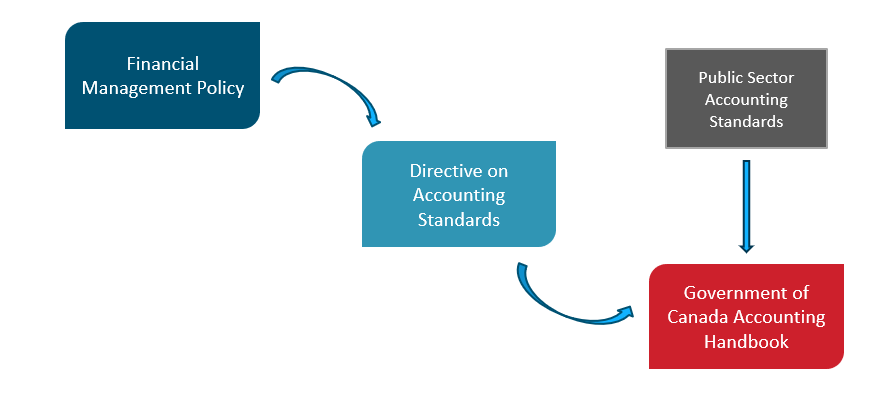
Image - Text version
The Government of Accounting Handbook identifies where a policy choice, requirement, interpretation, or other further direction has been issued to supplement Public Sector Accounting Standards
Note: Certain Crown corporations use International Financial Reporting Standards (IFRS)
2021-2022 Financial Results
| (in billions of dollars) | Budget 2021-2022 |
Actual 2021-2022 |
Actual 2020-2021 |
|---|---|---|---|
| Total revenue | 355.1 | 413.3 | 316.4 |
| Program expenses | 475.6 | 468.8 | 608.5 |
| Public debt charges | 22.1 | 24.5 | 20.4 |
| Total expenses, excluding net actuarial losses | 497.6 | 493.3 | 628.9 |
| Annual deficit before net actuarial losses | (142.5) | (80.0) | (312.4) |
Net actuarial losses |
(12.2) | (10.2) | (15.3) |
| Annual deficit | (154.7) | (90.2) | (327.7) |
| Other comprehensive income (loss) | - | 4.5 | 0.3 |
| Accumulated deficit at end of year | (1,203.5) | (1,134.5) | (1,048.7) |
| Totals may not add due to rounding. | |||
| (in billions of dollars) | 2021-2022 | 2020-2021 |
|---|---|---|
| Accounts payable and accrued liabilities | 260.3 | 207.4 |
| Pensions and other future benefits | 327.4 | 312.9 |
| Unmatured debt and other liabilities | 1,251.0 | 1,131.9 |
| Total liabilities | 1,838.7 | 1,652.2 |
| Cash and accounts receivable | 280.0 | 224.2 |
| Foreign exchange amounts | 104.0 | 92.6 |
| Loans, investments and advances | 207.0 | 179.3 |
| Public sector pension assets | 9.2 | 6.3 |
| Total financial assets | 600.3 | 502.4 |
| Net debt | (1,238.4) | (1,149.8) |
| Total non-financial assets | 103.9 | 101.1 |
| Accumulated deficit | (1,134.5) | (1,048.7) |
| Totals may not add due to rounding. | ||
2021-2022 Financial Results - Impact of the Economic Response Plan
| (in billions of dollars) | Impact 2021-2022 |
|---|---|
Table 3 Notes
|
|
| Economic Response Plan impact on the Government of Canada expenses: | |
| Canada Emergency Wage Subsidy (CEWS) | 22.3 |
| COVID-19 income support for workerstable 3 note * | 15.6 |
| Canada Emergency Rent Subsidy | 3.7 |
| Canada Worker Lockdown Benefit | 0.9 |
| Total impact of some key Economic Response Plan measures on the Government of Canada expenses | 42.5 |
2021-2022 Financial Results
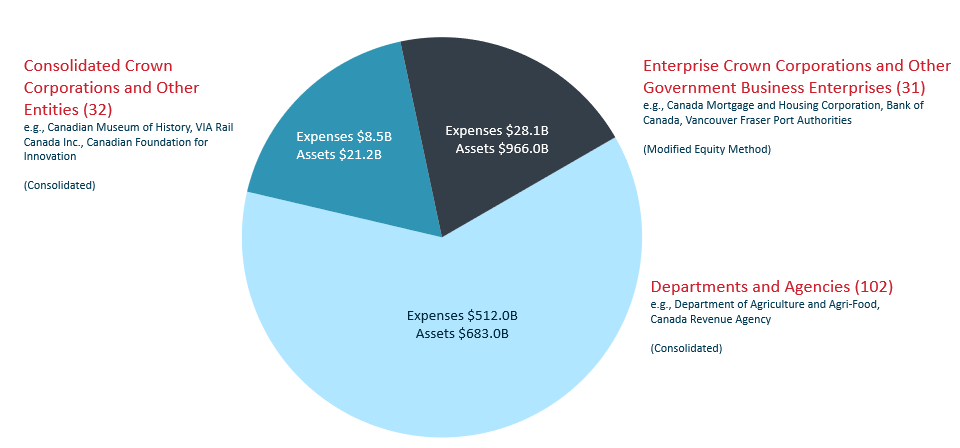
Government of Canada Reporting Entity - Text version
Consolidated Crown Corporations and Other Entities (32)
e.g., Canadian Museum of History, VIA Rail Canada Inc., Canadian Foundation for Innovation
(Consolidated)
Expenses $8.5B
Assets $21.2B
Enterprise Crown Corporations and Other Government Business Enterprises (31)
e.g., Canada Mortgage and Housing Corporation, Bank of Canada, Vancouver Fraser Port Authorities
(Modified Equity Method)
Expenses $28.1B
Assets $966.0B
Departments and Agencies (102)
e.g., Department of Agriculture and Agri-Food, Canada Revenue Agency
(Consolidated)
Expenses $512.0B
Assets $683.0B
2021-2022 Total Voted Budget – Used in Current Year
| National Defence $62,697M | Indigenous Services $18,287M | Health $15,739M | Public Safety $11,307M | Intergovermental Affairs, Infrastructure and Communities $9,296M | Innovation, Science and Industry $9,165M | Other Ministries $23,256M | |
|---|---|---|---|---|---|---|---|
| Budget (%) | 41.9 | 12.2 | 10.5 | 7.6 | 6.2 | 6.1 | 15.5 |
2021-2022 Total Voted Budget - Significant Lapses
- Health
- Total Lapse of $11,176M
Frozen Allotments: $5,560M
Net Lapse: $5,616M
- Total Lapse of $11,176M
- Indigenous Services
- Total Lapse of $3,451M
Frozen Allotments: $3,162M
Net Lapse: $289M
- Total Lapse of $3,451M
- Intergovernmental Affairs, Infrastructure and Communities
- Total Lapse of $3,436M
Frozen Allotments: $2,261M
Net Lapse: $1,175M
- Total Lapse of $3,436M
- National Defence
- Total Lapse of $2,555M
Frozen Allotments: $1,709M
Net Lapse: $846M
- Total Lapse of $2,555M
- Crown-Indigenous Relations and Northern Affairs
- Total Lapse of $2,244M
Frozen Allotments: $2,223M
Net Lapse: $21M
- Total Lapse of $2,244M
- Innovation, Science and Industry
- Total Lapse of $2,241M
Frozen Allotments: $1,009M
Net Lapse: $1,231M
- Total Lapse of $2,241M
Total Lapses $38.201M
Totals may not add due to rounding.
Observations of the Auditor General of Canada

Pay Administration
- Despite pay errors, the consolidated financial statements were presented fairly.
- A significant amount of work remains to resolve current payroll data quality problems, including backlog, in order to accurately pay employees.

National Defence
- Errors persist in both quantities and value of inventory and asset pooled items.
- Progress has been made over the past year to review how to classify items as inventory or asset pooled items.
Annex - Definitions
Accounting
- Accrual Accounting
- Transactions are recognized when revenue is earned, rather than when cash is received, and expenses are recognized when they are incurred, rather than when they are paid.
- Appropriation
- Any authority of Parliament to pay money out of the Consolidated Revenue Fund.
- Expenditure Basis of Accounting/Modified Cash Accounting (Appropriation Accounting)
- Transactions are recognized when money is paid out of the Consolidated Revenue Fund (CRF), as well as a limited number of transactions which do not affect the CRF until a later date for goods and services received just prior to year-end. Non-cash transactions (e.g., amortization) are not recognized. This is also sometimes called modified cash accounting.
- Modified Equity Accounting
- The cost of the Government’s equity is reduced by dividends received and adjusted to include the annual profits and losses of corporations, after elimination of unrealized inter-organizational gains and losses. Applies to Crown Corporations and other entities who can sustain their operations without government appropriations.
- Unmodified Audit Opinion
- Independent auditor's opinion that the financial statements are fairly presented, and in accordance with the accounting policies of the Government which conform with Canadian Public Sector Accounting Standards.
Government Concepts
- Special Revenue Spending Authorities
- Special revenue spending authorities from Parliament allows departments to use a certain amount of their revenues to finance their directly related expenditures. Those authorities include Revolving Funds and Net Voting and both of these reduce dependence on appropriations from general revenues.
- Net Voting
- Net voted operations may or may not be self-sustaining and usually the scale of operations is less significant than is the case for revolving funds. The aim of net voting provides that certain revenues offset related expenditures within a fiscal year (e.g., Shared Services Canada).
- Revolving Funds
- Generally appropriate for large, distinct, self-sustaining activities that provide client-oriented services. The aim of a revolving fund is to achieve self-sufficiency over its business cycle, therefore appropriations are non-lapsing (e.g., Passport Canada).
- Specified Purpose Accounts (SPAs)
- A broad classification of accounts established in the accounts of Canada and reported in the Public Accounts. SPAs, record transactions, and expenditures for money payable out of the Consolidated Revenue Fund (CRF) under statutory authorities established for specified purposes. For accounting purposes, SPAs are classified as either a consolidated SPA (Employment Insurance Operating Account), a non-consolidated SPA (Insurance and Death Benefit Accounts) or deferred revenue SPA (Spectrum Licence Fees).
- Frozen Allotments
- Used to prohibit the spending of funds previously appropriated by Parliament. There are two types of frozen allotments: permanent and temporary.
- Permanent Frozen Allotments
- Used where the Treasury Board has directed that funds lapse at the end of the fiscal year.
- Temporary Frozen Allotments
- Used where an appropriation is frozen until such time as a condition (conditions) has (have) been met.
- Special Purpose Allotments (SPAs)
- Used to set apart a portion of an organization’s voted appropriation for a specific initiative or item. Such an allotment is established when the Board wishes to impose special expenditure controls.
D. PAC overview note
Master Overview of the Committee
Standing Committee on Public Accounts (PACP)
Mandate of the Committee
When the Speaker tables a report by the Auditor General in the House of Commons, it is automatically referred to the Public Accounts Committee. The Committee selects the chapters of the report it wants to study and calls the Auditor General and senior public servants from the audited organizations to appear before it to respond to the Office of the Auditor General’s findings. The Committee also reviews the federal government’s consolidated financial statements – the Public Accounts of Canada – and examines financial and/or accounting shortcomings raised by the Auditor General. At the conclusion of a study, the Committee may present a report to the House of Commons that includes recommendations to the government for improvements in administrative and financial practices and controls of federal departments and agencies.
Government policy, and the extent to which policy objectives are achieved, are generally not examined by the Public Accounts Committee. Instead, the Committee focuses on government administration – the economy and efficiency of program delivery as well as the adherence to government policies, directives and standards. The Committee seeks to hold the government to account for effective public administration and due regard for public funds.
Pursuant to Standing Order 108(3) of the House of Commons, the mandate of the Standing Committee on Public Accounts is to review and report on:
- The Public Accounts of Canada;
- All reports of the Auditor General of Canada;
- The Office of the Auditor General’s Departmental Plan and Departmental Results Report; and,
- Any other matter that the House of Commons shall, from time to time, refer to the Committee.
The Committee also reviews:
- The federal government’s consolidated financial statements;
- The Public Accounts of Canada;
- Makes recommendations to the government for improvements in spending practices;
- Considers the Estimates of the Office of the Auditor General.
Other Responsibilities:
- The economy, efficiency and effectiveness of government administration;
- The quality of administrative practices in the delivery of federal programs; and,
- Government’s accountability to Parliament with regard to federal spending.
Committee Members
| Name and Role | Party | Riding | PACP Member Since |
|---|---|---|---|
| Chair | |||
| John Williamson | Conservative | New Brunswick Southwest | February 2022 |
| Vice-chair | |||
| Jean Yip | Liberal | Scarborough—Agincourt | January 2018 |
| Nathalie Sinclair-Desgagné Critic for Public Accounts; Pandemic Programs; Economic Development Agencies |
Bloc Québécois | Terrebonne | December 2021 |
| Members | |||
| Garnett Genuis Critic for International Development |
Conservative | Sherwood Park—Fort Saskatchewan | October 2022 |
| Michael Kram | Conservative | Regina—Wascana | October 2022 |
| Kelly McCauley |
Conservative | Edmonton West | October 2022 |
| Blake Desjarlais Critic for TBS; Diversity and Inclusion; Youth; Sport and PSE |
New Democratic Party | Edmonton Greisbach | December 2021 |
| Valerie Bradford | Liberal | Kitchener South – Hespeler | December 2021 |
| Han Dong | Liberal | Don Valley North | December 2021 |
| Peter Fragiskatos Parliamentary Secretary National Revenue |
Liberal | London North Centre | December 2021 |
| Brenda Shanahan | Liberal | Châteauguay—Lacolle | December 2021; and Jan 2016 – Jan 2018 |
Anticipated TBS-Related Activity – 44th Parliament
- Briefing from the Canada Audit and Accountability Foundation
- Introductory briefings from the Auditor General; Comptroller General of Canada; others.
- Public Accounts of Canada
- Reports of the Auditor General of Canada
TBS Related Committee Activity – 43rd Parliament
- Public Accounts of Canada (Link to study)
- Government Response provided: link
- Reports of the Auditor General of Canada:
- Oversight of Government of Canada Advertising (Link to study)
- Government Response provided: Link
- Procuring Complex Information Technology Solutions (Link to study)
- Investing in Canada Plan (Link to study)
- Call Centres (Link to study)
- Government Response provided: Link
- National Shipbuilding Strategy (Link to study)
- Oversight of Government of Canada Advertising (Link to study)
- Public Service Culture (Link to study)
- No report
Interest in TBS Portfolio
Conservative Party of Canada (CPC)
- Spending Oversight and Accountability
- Conservative MPs consider the government is spending too much, and without proper oversight and accountability. This criticism amplified since the election of the CPC’s new leader, MP Pierre Poilievre. Since the return of Parliament in September, most of the party’s interventions during Question Period have been about government spending.
- More broadly, Conservatives have been using the Public Accounts as an example of wasteful spending and government incompetence. MP Andrew Scheer (not a committee member) claimed that “we are constantly poring through Public Accounts to find wasteful spending and, lo and behold, we find them all the time.”
- October 28, 2022, Debate on Bill C-9
- MP Kelly McCauley recently presented the Conservatives' dissenting report on the 2021 Public Accounts report, in which the CPC claimed that should the government revise the public accounts after they are finalized, they recommend that the secretary of the Treasury Board and the comptroller general report their rationale for doing so to PACP, that the Auditor General present their views to the committee and that all three appear at PACP to discuss the matter.
- October 20, 2022, Routine Proceedings
- In the past, MPs Pat Kelly (not a committee member) and Kelly McCauley have criticized the way the government produced the 2021 Public Accounts, suggesting that the audited Public Accounts were re-opened for political gain; showed concerns that the late tabling made it impossible to hold the government accountable for “out of control spending”.
- December 8, 2021, Committee of the Whole – Supplementary Estimates (B) 2021-22; December 10, 2021, Question Period; February 3, 2022, Debate on Bill C-8; March 1, 2022, OGGO – Supplementary Estimates (C) 2021-22
- Public Service and Public Servants
- MP Philip Lawrence (no longer a committee member) claims that he is frustrated by the fact that when he was a member of PACP, the studies have always focused on the same topic ands reports that do not necessarily get implemented. He wants to focus more on improving the performance of the public sector.
- May 5, 2022, PACP – Main Estimates 2022-23 (OAG)
- MP Philip Lawrence (no longer a committee member) claims that he is frustrated by the fact that when he was a member of PACP, the studies have always focused on the same topic ands reports that do not necessarily get implemented. He wants to focus more on improving the performance of the public sector.
- Diversity & Inclusion, GBA+
- Conservative MPs have supported GBA+ in recent Parliaments, often criticizing the Government for claiming to be feminist while supposedly doing very little to enforce GBA+ practices. On multiple occasions, Conservative MPs have accused Government MPs and officials of not taking the GBA+ training that is offered to them seriously.
- February 27, 2020, FEWO – Meeting #3; June 9, 2021, Private Member’s Business
- Throughout the pandemic, Conservatives have been very vocal over the Government’s “failure to apply the GBA+ on all the COVID-19 programs”. During Question Period and in committees, several MPs, including Raquel Dancho, Jag Sahota and Karen Vecchio (not committee members) have asked questions about the lack of GBA+ analysis in COVID-related policies, claiming that it ended up isolating women and leaving them vulnerable during lockdowns.
- May 25, 2020, Statement by Members; March 12, 2021, Question Period; June 15, 2021, FEWO – Meeting #42
- More recently, in PACP meetings from the 44th Parliament, MPs Eric Duncan, Philip Lawrence and Jeremy Patzer (no longer committee members) again insisted on how quarantine measures disadvantaged women. They expressed to the Auditor General that they are “very surprised that this has not raised a red flag in any way as being worthy of an audit, particularly when it comes to a GBA+ lens”. They also asked questions to the Auditor General on ways to make National Defence more inclusive for women.
- Conservative MPs have supported GBA+ in recent Parliaments, often criticizing the Government for claiming to be feminist while supposedly doing very little to enforce GBA+ practices. On multiple occasions, Conservative MPs have accused Government MPs and officials of not taking the GBA+ training that is offered to them seriously.
- April 5, 2022, PACP – Meeting #13; June 2, 2022, PACP – Meeting #22
- Environment and Greening Government
- MP Philip Lawrence (no longer a committee member) believes that investments in many sectors of government need to be made, specifically about data management and climate change resilience. He mentioned that he would like more information on what the government is doing on that front.
- March 3, 2022, PACP – Meeting #8
- MP Philip Lawrence (no longer a committee member) believes that investments in many sectors of government need to be made, specifically about data management and climate change resilience. He mentioned that he would like more information on what the government is doing on that front.
- Order Paper Questions
- MPs Scott Aitchinson and Tom Kmiec (not committee members) respectively requested parliamentary returns on Expenditures on Transportation Machinery and Equipment listed in the 2021 Public Accounts (Q-297, January 2022) and on Losses of public money and property as listed in the 2021 Public Accounts (Q-323, February 2022)
Bloc Québécois (BQ)
- Spending Oversight and Accountability
- MP Sinclair-Desgagné criticized on multiple occasions the ‘’fiscal imbalance’’ in the Public Accounts, particularly when it comes to healthcare transfers to Quebec and other provinces from the federal government.
- October 27, 2022, Debate on Bill C-31
- MP Sinclair-Desgagné suggested that the President of the Treasury Board is happy that workers from the Office of the Auditor General are on strike because it means they are no longer able to produce reports that “embarrass the government” and that they can no longer ensure accountability.
- March 31, 2022, Statement by Members
- MP Sinclair-Desgagné showed concerns that Crown corporations make it impossible to correctly track government spending. With Crown corporations, “it is impossible to know how much money is being handed over”. She believes that the current situation is unacceptable. More recently, in a PACP meeting, she asked a TBS official what legislative changes would be needed for crown corporations to disclose information the same way departments do.
- November 1, 2022, PACP – Meeting #36 (Briefing on the Office of the Auditor General); May 9, 2022, Debate on Budget 2022
- MP Sinclair-Desgagné criticized on multiple occasions the ‘’fiscal imbalance’’ in the Public Accounts, particularly when it comes to healthcare transfers to Quebec and other provinces from the federal government.
- Public Service and Public Servants
- MP Sinclair-Desgagné showed support for employees working at the Office of the Auditor General that are on strike, saying they deserve better pay equity.
- March 31, 2022, Statement by Members
- MP Sinclair-Desgagné showed support for employees working at the Office of the Auditor General that are on strike, saying they deserve better pay equity.
- Diversity & Inclusion, GBA+
- Bloc MPs have been historically in favor of GBA+ while being repeatedly critical over the lack of results and the lack of data indicating its effectiveness. MP Andréanne Larouche (not a committee member) has been the most vocal Bloc MP on this issue, claiming on multiple occasions that GBA+ must be considered in every department and in government economic responses, with better outcomes.
- June 15, 2020, HUMA – Meeting #19; February 25, 2021, FEWO – Meeting #18
- More recently, in PACP meetings, MP Sinclair-Desgagné was interested in the Auditor General's findings on the shortcomings of the government's implementation of GBA+. She also reiterated her concern about the lack of focus on outcomes, saying that there is a lack of information to determine whether concrete improvements are being made to reduce barriers. She wonders if the problem is “with the data or the process”.
- June 2, 2022, PACP – Meeting #22
- Bloc MPs have been historically in favor of GBA+ while being repeatedly critical over the lack of results and the lack of data indicating its effectiveness. MP Andréanne Larouche (not a committee member) has been the most vocal Bloc MP on this issue, claiming on multiple occasions that GBA+ must be considered in every department and in government economic responses, with better outcomes.
- Environment and Greening Government
- MP Sinclair-Desgagné criticizes the fact that, regarding greening government, Crown corporations are held to lower environmental standards. More notably, she criticized some of the Public Sector Pension Investment Board’s environmental practices.
- February 15, 2022, PACP – Meeting #6
- MP Sinclair-Desgagné believes Government funding should be cut off to sectors where positive environmental results are lacking, such as the oil sector
- February 8, 2022, PACP – Meeting #4
- MP Sinclair-Desgagné criticizes the fact that, regarding greening government, Crown corporations are held to lower environmental standards. More notably, she criticized some of the Public Sector Pension Investment Board’s environmental practices.
New Democratic Party (NDP)
- Spending Oversight and Accountability
- MP Daniel Blaikie (not a committee member) reminded the House several times about the Parliamentary Budget Officer’s remarks about how the government has been filing the Public Accounts too late. He and the NDP believes that “…additional financial reporting (is) warranted…” and that “normally, in the countries of most of our allies and trading partners, that happens on a six-month timetable after the end of the fiscal year, so tabling them in December was very late. I think it is true, especially when the government is spending large sums of money, that accountability and transparency become that much more important”.
- February 2, 2022, March 23, 2022 & March 28, 2022, Debate on the Economic and Fiscal Update Implementation Act, 2021
- MP Daniel Blaikie (not a committee member) reminded the House several times about the Parliamentary Budget Officer’s remarks about how the government has been filing the Public Accounts too late. He and the NDP believes that “…additional financial reporting (is) warranted…” and that “normally, in the countries of most of our allies and trading partners, that happens on a six-month timetable after the end of the fiscal year, so tabling them in December was very late. I think it is true, especially when the government is spending large sums of money, that accountability and transparency become that much more important”.
- Public Service and Public Servants
- MP Blake Desjarlais criticized the Pheonix Pay System, saying that the Treasury Board not consulting with public servants resulted in a direct impact on workers. He claims that years later, the Government continues to fail with Phoenix.
- May 3, 2022, PACP – Meeting #17
- MP Blake Desjarlais criticized the Pheonix Pay System, saying that the Treasury Board not consulting with public servants resulted in a direct impact on workers. He claims that years later, the Government continues to fail with Phoenix.
- Diversity and Inclusion, GBA+
- The NDP has been one of the most vocal parties about the importance of GBA+. They believe that GBA+ analyses should be applied systematically to the “development, implementation or oversight” of every government program. NDP MPs have been particularly critical about the Government for allegedly breaking its commitment to make GBA+ an indispensable tool. They partially attribute the non-compliance of recruitment and retention targets for underrepresented groups as a result of the “failure” to implement GBA+.
- May 27, 2021, PACP – Meeting #34; June 9, 2021, Private Member’s Business
- In PACP meetings, MP Desjarlais has been a strong advocate for GBA+. He believes that shortcomings in the government's implementation of GBA+ constitute an “extreme situation” that undermines the confidence of people in marginalized communities, such as Indigenous women, in their government.
- June 2, 2022, PACP – Meeting #22
- MP Desjarlais believes more work needs to be done in the public sector and with Crown corporations when it comes to ensuring diversity inclusion and equity. He believes stronger targets and indicators should be put in place so we can see the tangible results and progress.
- February 15, 2022, PACP – Meeting #6; March 31, 2022, PACP – Meeting #12; March 31, 2022, Debate on Bill S-214
- The NDP has been one of the most vocal parties about the importance of GBA+. They believe that GBA+ analyses should be applied systematically to the “development, implementation or oversight” of every government program. NDP MPs have been particularly critical about the Government for allegedly breaking its commitment to make GBA+ an indispensable tool. They partially attribute the non-compliance of recruitment and retention targets for underrepresented groups as a result of the “failure” to implement GBA+.
- Environment and Greening Government
- MP Desjarlais often criticizes the lack of “real climate action” by the Government. He believes the government should be held accountable on the lack of progress on that front. He believes climate actions should play an integral part in the action plans of Government departments.
- December 1, 2021, Reply to the Speech of the Throne; March 1, 2022, PACP – Meeting #7; April 7, 2022, Statement by Members
- Other NDP MPs, like Laurel Collins (not a committee member) showed concerns over the fact that when it comes to the greening government, Crown corporations are not required to report on their emissions.
- May 3, 2022, ENVI – Meeting #15
- MP Desjarlais often criticizes the lack of “real climate action” by the Government. He believes the government should be held accountable on the lack of progress on that front. He believes climate actions should play an integral part in the action plans of Government departments.
Relevant Meeting Summaries
Meeting 1 – December 16, 2021
Election of Chair
Full transcript: Evidence – PACP (44) – No. 1
The Standing Committee on Public Accounts (PACP) held its first meeting of the 44th Parliament to elect a chair. Tom Kmiec (CPC) was nominated and elected as Chair of the Committee. Jean Yip (LPC) and Nathalie Sinclair-Desgagné (Bloc) were nominated and elected as Vice Chairs of the Committee.
The Committee adopted several routine motions for the committee (e.g. steering committee membership, publication of committee proceedings, research staff, travel etc.)
A motion from Blake Desjarlais (NDP) proposed to establish limits to when and how the Committee can move to meet in camera. The motion failed in a recorded division 9-1.
A motion from Jean Yip (LPC) proposed that the Committee receive a briefing from the Canadian Audit and Accountability Foundation for one meeting, which was adopted unanimously.
At 11:51, the meeting adjourned.
Next Steps
There are no future meetings scheduled for the committee. A one-meeting briefing session with the Canadian Audit and Accountability Foundation is expected to take place when the committee next meets, likely in the new year.
Meeting 2 – February 1, 2022
Briefing with Canadian Audit and Accountability Foundation
Full transcript: Evidence – PACP (44-1) – No. 2
Officials from the Canadian Audit and Accountability Foundation (CAAF) presented a briefing to the Committee during the first hour of the meeting (a briefing usually held for the committee at the beginning of every Parliament). The briefing outlined the role of the CAAF, the role of PACP as a committee, and the importance of parliamentary oversight and accountability. The briefing also discussed how to interpret OAG performance and financial audits, and the Public Accounts. CAAF officials emphasized the importance of the relationship between committee members and the OAG/ public servants, including the type of questions that are asked. Officials put a particular emphasis on the importance of non-partisanship and to approach committee meetings with a shared purpose and goal.
Committee Members agreed that regular rounds of questioning based on party would be suspended so Members were not limited in time. Members asked technical questions about the performance audits by the Auditor General. Members also showed concern about the approach with files and departments that are consistently re-appearing with very little or no improvement (Shipbuilding and clean drinking water were specifically named as reoccurring files) - in response, officials emphasized the importance of key clear recommendations with deadlines in reports, follow-ups from the committee and targeted questioning on actions being taken by the responsible departments. When responding to a question about research, the Library of Parliament analysts commented on the trickiness of using GCInfobase without experience.
At 12:06, the meeting went in camera to discuss committee business.
Meeting 6 – February 15, 2022
Public Sector Pension Investment Board
Full transcript: Evidence – PACP (44-1) – No. 6
The meeting started late due to a vote in the House of Commons.
The Deputy Auditor General began the meeting with his opening remarks on the audit. The Financial Administration Act requires a special examination be carried out every ten years, but he confirmed that they did not find any deficiencies. The OAG did find issues with performance indicators on issues such as diversity and inclusion. The OAG also noted that improvements for risk mitigation, risk monitoring and reporting were needed, such as in human resources planning. The corporation has agreed with the recommendations and has prepared an action plan.
Mr. Glynn, Chair of the Board for PSPIB explained the audit in his opening remarks and confirmed that no material deficiencies were found. Mr. Glynn explained that PSP as a crown corporation operates at arm’s length from the Government of Canada and explained the operations of PSP. Mr. Glynn gave an overview of the actions already taken by PSP to implement the recommendations by the OAG and confirmed that PSP has made significant progress. Mr. Glynn also announced the retirement of Mr. Cunningham (President and CEO) next year.
All Members were pleased with the results of the audit and commended the witnesses on the results. Members asked questions about the specifics of the audits and the workings of PSPIB in terms of investments and risks. Members had concerns about the specific targets being put in place to address bigger issues such as diversity and inclusion along with climate change, which the witnesses provided the updates on recent actions and updated targets as recommended by the OAG.
Next Steps
The committee is scheduled to meet for its work on Thursday, February 17, 2022.
Meeting 15 – April 26, 2022
Public Accounts of Canada 2021 (TBS Appearance)
Full transcript: Minutes – PACP (44-1) – No. 15 (in camera)
Meeting 17 – May 3, 2022
Public Accounts of Canada 2021 (TBS Appearance)
Full transcript: Evidence – PACP (44-1) – No. 17
Witnesses
Treasury Board Secretariat
- Roch Huppé, Comptroller General of Canada
- Monia Lahaie, Assistant Comptroller General, Financial Management Sector
- Diane Peressini, Executive Director, Government Accounting Policy and Reporting, Office of the Comptroller General
Office of the Auditor General
- Karen Hogan, Auditor General of Canada
- Etienne Matte, Principal
- Chantale Perreault, Principal
Department of Finance
- Michael J. Sabia, Deputy Minister
- Nicholas Leswick, Associate Deputy Minister
- Evelyn Dancey, Assistant Deputy Minister, Economic and Fiscal Policy Branch
Highlights
The meeting began late, due to votes in the House of Commons. Members agreed to extend proceedings to 1:30pm.
The Auditor General began the meeting with her opening remarks on the Public Accounts of Canada 2021 (PAC), and the process involved in auditing the accounts. She confirmed that the document met with her approval. She outlined why there was an amendment to the PAC, and the process that her office undertook to assess and complete the revision. The AG also review the exceptional spending related to the pandemic. She described the comments section of her review, and also touched on the state of affairs in the PS pay administration file, as well as the review of DND’s inventory control problems. Other issues mentioned included cybersecurity and data management.
Mr. Huppé provided the Committee an overview of the PAC, stressing the ‘clean’ audit the GC has received for the 23rd straight year. He highlighted the deficit numbers, and compared it favourably to initial projections. He reviewed why the PAC was re-opened last year, as well as the process of revision that led to the publishing delay beyond the norm, though still well within the statutory requirement. He reviewed the study of potential modernization of the Public Accounts, committing to work closely with parliamentarians and Canadians as the process advances.
The Committee posed a wide range of questions including a particularly sharp focus on the reopening of the PAC last fall (CPC); the gap in transparency of financial reporting between Crown Corporations and the rest of government (BQ); and the progress of the government on the Phoenix pay system problems (NDP). A full accounting of questions is included in the summary.
Follow-Ups
Will be verified against the transcript and tasked out accordingly by TBS Parliamentary Affairs
- Request for an official opinion on the options available to achieve the objective of closing the gap in financial transparency between Crown Corporations and the rest of government, specifically in creating a requirement for the jurisdictional destination of Crown Corporation funding decisions to be publicly available. - Mme. Nathalie Sinclair-Desgagné (BQ)
Next Steps
The Committee’s next meeting is Thursday, May 5, where it is expected to hear from the AG on the Main Estimates, 2022-23.
Meeting 18 – May 5, 2022
Main Estimates 2022-23 (OAG)
Full transcript: Evidence – PACP (44-1) – No. 18
Witnesses
Office of the Auditor General
- Karen Hogan, Auditor General of Canada
- Jerry V. DeMarco, Commissioner of the Environment and Sustainable Development
- Andrew Hayes, Deputy Auditor General
- Lissa Lamarche, Assistant Auditor General and Chief Financial Officer
- Paule-Anny Pierre, Assistant Auditor General
Highlights
The meeting began late, due to votes in the House of Commons. The Committee moved to in camera at the end of the meeting to consider drafting instructions for a report not related to TBS.
The Auditor General provided the Committee with an overview of her resources and the requests in the Main Estimates 2022-23 and the steps the office is taking to digitize their office, she also emphasized the efforts the Office of the Auditor General has taken after the strike.
Members were focused on the repetitive nature of the reports and wanted to understand how resources in the Office of the Auditor General to follow-up on its recommendations. CPC Members brought forward the examples of the multiple follow-ups needed with the clean drinking water and the National shipbuilding reports. MP Nathalie Sinclair-Desgagné (BQ) was concerned with overall oversight on crown corporations, which the Auditor General agreed with.
MP Blake Desjarlais (NDP) passionately questioned the Auditor General on improvements being made to the culture within the work environment after the strike and expressed concern that employees may be facing disciplinary action. The Auditor General assured the Member that she had not been made aware of any disciplinary actions and reiterated the importance of the Code of Conduct that employees must follow.
MP Jeremy Patzer (CPC) asked if there were plans to conduct an audit on the overall productivity of public servants working from home, and in response, the Auditor General confirmed that it was not in the current plans.
The Committee adopted the referred votes of the Main Estimates 2022-23 for the Office of the Auditor General (on division).
Meeting 22 – June 2, 2022
Briefing on the 2022 Reports 1 to 4 of the Auditor General of Canada
Full transcript: Evidence – PACP (44-1) – No. 22
Witnesses
Office of the Auditor General
- Karen Hogan, Auditor General of Canada
- Carey Agnew, Principal
- Carol McCalla, Principal
- Nicholas Swales, Principal
Highlights
The Auditor General appeared before the Committee to brief members on the four audit reports tabled earlier this week. In her opening remarks, she provided an overview of the reports’ findings, including on Report 3: Follow-up on Gender-Based Analysis Plus (GBA+). She indicated that while GBA+ analyses are completed, there has not been an observable impact on outcomes. She said that the Privy Council Office (PCO), Treasury Board Secretariat (TBS) and Women and Gender Equality (WAGE) need to better collaborate and ensure organizations fully integrate GBA+ in a way that produces real results.
During questioning, Brenda Shanahan (LPC) asked how departments were doing with regards to implementing GBA+. Ms. Hogan said that it was a mixed bag, with some departments using GBA+ usefully and improving outcomes, while others see it as more of an obligation. Ms. Shanahan later gave examples of improvements in gender equality in Canada, and asked Ms. Hogan to comment. Ms. Hogan repeated that results were mixed, as reporting and measuring are inconsistent across government.
Valerie Bradford (LPC) asked about the OAG process for following up with departments after audits. In her response, Ms. Hogan referenced TBS requirements that departmental audit committees to follow up on any recommendations their organizations receive.
Blake Desjarlais (NDP) said that shortcomings with the government’s implementation of GBA+ is hurting the confidence of people in marginalized communities in their government. Ms. Hogan replied that the Government seems to be more focused on process rather than outcomes.
Nathalie Sinclair-Desgagné (BQ) asked Ms. Hogan to elaborate on her findings on the shortcomings of the government’s implementation of GBA+. The Auditor General said that there was a lack of capacity, skills and data to do the analysis. She also repeated her concern about a lack of focus on outcomes, saying a lot of information was missing to determine whether concrete improvements are being made to reduce barriers.
Ziad Aboultaif (CPC) said that while the federal public service had expanded, productivity was down and outcomes are not being achieved. He asked if there needs to be a restructuring of the public service. Ms. Hogan noted her concern that the government was focused on process rather than outcomes, but said there needed to be a balance, as some controls and vetting are needed to ensure accountability.
Meeting 26 – June 16, 2022
Follow-up study on Report 9, Investing in Canada Plan (TBS Appearance)
Full transcript: Not available yet
Witnesses
Canada Mortgage and Housing Corporation
- Romy Bowers, President and Chief Executive Officer
- Nadine Leblanc, Senior Vice President, Policy
Department of Indigenous Services
- Christiane Fox, Deputy Minister
- Rory O'Connor, Director General
Office of Infrastructure of Canada
- Kelly Gillis, Deputy Minister
- Gerard Peets, Assistant Deputy Minister
- Sean Keenan, Director General
Office of the Auditor General
- Karen Hogan, Auditor General of Canada
- Gabriel Lombardi, Director
Privy Council Office
- Laurie Goldmann, Director of Operations
Treasury Board Secretariat
- Ritu Banerjee, Executive Director, Results Division, Expenditure Management Sector
Highlights
Note: The Secretary of the Treasury Board previously appeared on this subject on May 11, 2021. He did not receive any questions.
The Auditor General confirmed that no new audit work has been completed since March 2021. She stressed the importance of clear and meaningful reporting for success, especially with so many departments involved in the Plan. In her opening remarks, the Deputy Minister from Infrastructure Canada explained the improvements the department has made in reporting requirements and working collaboratively with their partners on the Investing in Canada Plan. Ms. Gillis also pointed to the fact that Infrastructure Canada works very closely with TBS and PCO on reporting requirements.
The TBS official did not respond to any questions.
MP Eric Duncan (CPC) expressed concerns about the issuing of performance pay to CMHC employees, Ms. Bowers (CMHC) explained the compensation structure as a crown corporation.
MP Alain Therrien (BQ) moved two motions unrelated to TBS.
Meeting 27 – June 21, 2022
Public Accounts of Canada 2021
Full transcript: Evidence – PACP (44-1) – No. 27
Meeting 28 – June 23, 2022
Public Accounts of Canada 2021
Full transcript: Minutes – PACP (44-1) – No. 28 (in camera)
Meeting 29 – September 27, 2022
Public Accounts of Canada 2021
Full transcript: Minutes – PACP (44-1) – No. 29 (in camera)
Meeting 32 – October 18, 2022
Report 2, Greening Government Strategy (TBS Appearance)
Full transcript: Evidence – PACP (44-1) – No. 32
Witnesses
Treasury Board Secretariat
- Graham Flack, Secretary of the Treasury Board of Canada
- Jane Keenan, Acting Executive Director, Centre for Greening Government
- Malcolm Edwards, Senior Engineer, Centre for Greening Government
Office of the Auditor General
- Jerry V. DeMarco, Commissioner of the Environment and Sustainable Development
- Milan Duvnjak, Principal
Department of National Defence
- Bill Matthews, Deputy Minister
- Nancy Tremblay, Associate Assistant Deputy Minister, Material
- Saleem Sattar, Director General, Environment and Sustainable Management
Department of Transport
- Michael Keenan, Deputy Minister
- Ross Ezzeddin, Director General, Air, Marine and Environmental Programs
Highlights
The meeting was delayed by votes in the House.
In his opening remarks, Commissioner of the Environment and Sustainable Development, Jerry DeMarco outlined the history of the Greening Government Strategy and the targets that were set and revised since the launch in 2017. He told the Committee that the audit focused on TBS’s leadership in supporting departmental progress; as well as how DND and Transport implemented controls to reduce GHG emissions. He concluded that TBS’s efforts to reduce emissions are not as complete as they could be, and that important information on greening government was hard to find, unclear or insufficient – including a lack of detail on costs and savings. He cited concerns that indirect emissions have not been reported, and that Crown corporations were outside the reach of the strategy. He said that neither DND nor Transport made it clear how they would meet the 2050 target. He concluded that the lack of info makes it difficult to track targets, and to determine if Canada is being the global leader it has set out to be. He told the Committee that of the five recommendations for TBS in the report, only one wasn’t fully agreed with. Finally, the Commissioner noted that he tabled a fall report on October 4 on the 2021 progress report on the Federal Sustainable Development Strategy.
In his opening remarks, Deputy Minister of Transport Canada, Michael Keenan, told the Committee that Transport Canada fully accepted the Commissioners recommendation and is fully committed to the GHG reduction targets. He said that Transport Canada’s emission largely result from its fleet, rather than from buildings, so its implementation plan is somewhat unique. He said that TC’s roadmap will continue to evolve and be updated, and that mechanisms would be put in place to assess risks and track reductions of emissions.
In his opening remarks, the Secretary of the Treasury Board, Graham Flack, outlined how the Government is greening its activities with a target of net-zero GHG emission by 2050, and an interim target of 40% reduction by 2025 for the conventional fleet of vehicles and federal facilities. He also reviewed the leadership role of the Centre for Greening Government (CGG) at TBS, in terms of the strategy to green buildings, vehicles and procurement by the government. This includes developing low-carbon real property portfolio plans; building new zero-carbon buildings; retrofitting existing buildings to be energy efficient and low-carbon; including environmental factors in their procurement; buying hybrid or zero-emission vehicles and clean electricity; and adopting clean technologies, such as smart building technologies, clean fuels, and renewable electricity. After touching on the top lines of the Commissioners report, the Secretary said that TBS agrees with all the recommendations of the report, other than the notion that TBS has not developed an approach to tracking costs and savings. He told the Committee that CGG uses life-cycle costing analysis and total cost of ownership methodologies to inform decision makers on the best value options to decarbonize government operations. He also said that other governments have reached out to ours on implementing a costing methodology. Finally, he said that TBS would do more to communicate the cost-effective approach to accounting for costs and emissions to Parliamentarians and Canadians.
In his remarks, DND deputy minister, Bill Matthews outlined the size and scale of DND’s operating environment. He said the department is making progress, meeting shorter term targets, but that there remains a great deal of work to achieve the Government’s long-term net-zero targets. He said that DND accepted the recommendations of the Commissioner.
Following opening statements, the Committee suspended proceedings due to additional votes in the House. The witnesses were released but are expected to be recalled for questioning at a subsequent date.
The Committee returned to meet in camera on Committee Business following the votes in the House.
Meeting 35 – October 28, 2022
Report 2, Greening Government Strategy (TBS Appearance)
Full transcript: Not available yet
Witnesses
Treasury Board Secretariat
- Graham Flack, Secretary of the Treasury Board of Canada
- Malcolm Edwards, Senior Engineer, Centre for Greening Government
Office of the Auditor General
- Jerry V. DeMarco, Commissioner of the Environment and Sustainable Development
- Milan Duvnjak, Principal
Department of National Defence
- Bill Matthews, Deputy Minister
- Nancy Tremblay, Associate Assistant Deputy Minister, Material
- Saleem Sattar, Director General, Environment and Sustainable Management
Department of Transport
- Michael Keenan, Deputy Minister
- Ross Ezzeddin, Director General, Air, Marine and Environmental Programs
Highlights
The Committee met to study Report 2, Greening Government Strategy, of the 2022 Reports 1 to 5 of the Commissioner of the Environment and Sustainable Development, and to question witnesses. Officials did not make opening statements as they had already done so during the meeting on October 18, which was interrupted due to votes in the House of Commons.
Today’s meeting was largely polite and cordial. Topics of discussion of interest to TBS included:
- TBS’s role in the Greening Government Strategy, including reporting, enforcement, and international cooperation.
- Costs associated with achieving the government’s greenhouse gas (GHG) emissions reduction goals.
- The government’s ability to provide comprehensive reporting on its GHG emissions.
- The impact of the COVID-19 pandemic on government GHG emissions
- The OAG’s recommendation that Crown corporations also report their progress, and TBS’s consultations with Crown corporations.
- Any current and future plans to purchase carbon offsets by the government.
- GHG emissions produced by ministerial travel.
The officials from DND and Transport also responded to questions regarding their own plans and progress in reducing their departments’ emissions. Mr. Matthews, from DND, made reference to tools and guidance provided to them by TBS. After the conclusion of witness testimony, the Committee met in camera to discuss committee business.
Meeting 36 – November 1, 2022
Briefing on the Office of the Auditor General (TBS Appearance)
Full transcript: Not available yet
Witnesses
Treasury Board Secretariat (TBS)
- Stephen Diotte, Executive Director, Employment Relations and Total Compensation, Strategic Compensation Management, Office of the Chief Human Resources Officer
Office of the Auditor General (OAG)
- Karen Hogan, Auditor General of Canada
- Andrew Hayes, Deputy Auditor General
Department of Finance (FIN)
- Nicholas Leswick, Associate Deputy Minister
Highlights
Pursuant to the motion adopted on October 21, 2022, the Committee received a briefing on the Office of the Auditor General.
In her opening remarks, the Auditor General (AG) emphasized the importance of considering the workload in proportion with the amount of funding the OAG receives when requesting additional audits. The AG considers the current funding model problematic due to the fact that the Department of Finance (FIN) and Treasury Board Secretariat (TBS) are organizations audited by the OAG and presents challenges to maintain independence from the Government. The AG addressed the previous strike and the resulting challenges in attracting and maintaining personnel. The AG concluded by assuring the Committee that they will continue to pursue conversations with employees to foster a better working environment.
Members showed considerable concern with the independence of the OAG in the current funding model and questioned whether or not they were appropriately resourced. All Members pointed out the increasing expression of mistrust in Government institutions and emphasized the importance of the role of the OAG in maintaining that trust. MP Blake Desjarlais (NDP) questioned all witnesses on the roles of each organization in the events during the OAG employee strike last Fall. Government Members clarified how collective bargaining mandates work and asked TBS to identify the risk in expanding the mandate in terms of the existing agreements.
Follow-Ups
- What legislative changes would be needed for crown corporations to disclose information the same way departments do? – MP Nathalie Sinclair-Desgagné
Next Steps
The Committee is expected to meet next on Friday, November 4, 2022 to discuss Committee Business. The Chair also indicated that the Committee will have a briefing with the Auditor General on the upcoming performance reports on November 15th (in camera). The Chair also indicated that the Committee will invite officials to appear on the Public Accounts 2022 on November 18th.
Bios of the Committee Members
John Williamson (New Brunswick Southwest) Conservative Chair
- Elected as MP for New Brunswick Southwest in 2011, he was then defeated in 2015 and re-elected in 2019 & 2021.
- Currently also serves as a Member of the Liaison Committee and Chair of the Subcommittee on Agenda and Procedure of the Standing Committee on Public Accounts
- Previously served on many committees, including PACP for a brief time in 2013
- Prior to his election, M. Williamson occupied different positions. He was an editorial writer for the National Post from 1998 to 2001, then joined the Canadian Taxpayers Federation until 2008. In 2009, he was hired by Stephen Harper as director of communications in the PMO.
Jean Yip (Scarborough - Agincourt) Liberal First Vice-Chair
- Elected as MP for Scarborough—Agincourt in a by-election on December 11, 2017, and re-elected in 2019 & 2021.
- Has served on Public Accounts (since 2018), as well as Government Operations and Canada-China committees in the past.
- Vice-Chair of the Subcommittee on Agenda and Procedure of the Standing Committee on Public Accounts
- Before her election, Ms. Yip was an insurance underwriter and constituency assistant.
Nathalie Sinclair-Desgagné (Terrebonne) Bloc Québécois Second Vice-Chair
- Elected as MP for Terrebonne in the 2021 federal election.
- BQ Critic for Public Accounts; Pandemic Programs; and Federal Economic Development Agencies.
- Vice-Chair of the Subcommittee on Agenda and Procedure of the Standing Committee on Public Accounts
- Worked at the European Investment Bank and at PWC London.
- Return to Quebec in 2017 to pursue a career in the Quebec business world.
Garnett Genuis (Sherwood Park—Fort Saskatchewan) Conservative
- Elected as MP for Sherwood Park—Fort Saskatchewan in 2015, re-elected ion 2019 and 2021
- Conservative Shadow Minister for International Development
- Also serves on the Standing Committee on Foreign Affairs and International Development
- Served on multiple standing committees in the past, including Citizenship and Immigration, Canada-China Relations and Scrutiny of Regulations
- Prior to his election, Mr. Genuis was an assistant to former Prime Minister Stephen Harper and adviser on the staff of former minister Rona Ambrose.
Michael Kram (Regina—Wascana) Conservative
- Elected as MP for Regina—Wascana in 2019, and re-elected in 2021.
- Served as Vice-Chair of the Standing Committee on Industry and Technology, as well as a Member of the standing committees on Transpart, Infrastration and Communities and International Trade
- Prior to his election, Mr. Kram worked for 20 years in the information technology sector, including a number of contract positions with the Department of National Defence.
Kelly McCauley Edmonton West) Conservative
- Elected as the Member of Parliament in 2015 for Edmonton West, re-elected in 2019 and 2021
- Also serves as Chair of the Standing Committee on Government Operations and Estimates
- Former Conservative Shadow Minister for Treasury Board
- Previously served on the COVID-19 Pandemic committee as well as the Subcomittee on Agenda and Procedure of OGGO in 2020
- Before his election in 2015, Mr. McCauley was a hospitality executive specialized in managing hotels and convention centres
- He has a graduate of BCIT in the Hospitality Management program
- He has a history of advocacy for seniors and veterans
Blake Desjarlais (Edmonton Greisbach) NDP
- Elected as MP for Edmonton Greisbach in 2021.
- NDP Critic for Treasury Board; Diversity and Inclusion; Youth; Sport; and Post-secondary Education.
- Also a member of the Subcommittee on Agenda and Procedure of the Standing Committee on Public Accounts
- First openly Two-Spirit person to be an MP, and Alberta’s only Indigenous Member of Parliament.
Valerie Bradford (Kitchener South – Hespeler) Liberal
- Elected as MP for Kitchener South – Hespeler in 2021.
- Also sits on the Science and Research committee and the Subcommittee on Agenda and Procedure of the Standing Committee on Science and Research
- Director of the Canada-Africa Association
- Prior to her election, Ms. Bradford worked as an economic development professional for the City of Kitchener.
Han Dong (Don Valley North) Liberal
- Elected as MP for Don Valley North in 2019, and re-elected in 2021.
- Also sits on the Industry and Technology committee.
- Has served on the Ethics, and Human Resources committees in the past.
- Co-Chair of the Canada-China Legislative Association
- Prior to his election, Mr. Dong worked with Toronto-based high-tech company dedicated to building safer communities and served as the leader of the Chinatown Gateway Committee established by Mayor John Tory.
Peter Fragiskatos (London North Centre) Liberal
Parliamentary Secretary to the Minister of National Revenue
- Elected as MP for London North Centre in 2015, and re-elected in 2019 & 2021.
- Serves as Parliamentary Secretary to the Minister of National Revenue.
- Has served on the Finance, Canada-China, Human Resources, Public Safety, and Foreign Affairs committees in the past.
- Served as a member of the National Security and Intelligence Committee of Parliamentarians (NSICOP).
- Prior to his election, Mr. Fragiskatos was a political science professor at Huron University College and King’s University College, as well as a frequent media commentator on international issues.
Brenda Shanahan (Châteauguay—Lacolle) Liberal
- Elected as MP for Châteauguay—Lacolle in 2015, and re-elected in 2019 & 2021.
- Caucus Chair of the Liberal Party
- Has served on Public Accounts (2016-2018), as well as Ethics, Government Operations, and MAID committees in the past.
- Has served as a member of the National Security and Intelligence Committee of Parliamentarians (NSICOP).
- Prior to her election, Ms. Shanahan was a banker and social worker, who has also been involved in a number of organizations such as Amnesty International and the Canadian Federation of University Women.
Volume I
Variances
Public Accounts 2022
Issue / Question:
The Public Accounts of Canada for fiscal year 2021-2022 were tabled in Parliament by the President of the Treasury Board in October 2022.
Suggested Response:
- The Government of Canada is committed to responsible financial management and oversight.
- The Public Accounts include the audited consolidated financial statements of the Government.
- For the 24th year in a row, the Government of Canada received a clean audit opinion on its consolidated financial statements.
- This demonstrates the high quality of Canada's financial reporting.
Background:
- Production and finalization of the Public Accounts of Canada is a joint responsibility between the Receiver General, the Office of the Comptroller General and the Department of Finance.
- The Public Accounts reflect the Government’s audited consolidated financial statements and other detailed financial information for the fiscal year 2021-2022 that ended March 31, 2022.
- Volume I – includes the audited consolidated financial statements of the Government; the unmodified audit report from the Auditor General; a financial statements discussion and analysis, which presents 10-year comparative financial information; as well as details on certain financial statement components.
- Volume II – includes financial operations of the departments, including the reconciliations of authorities granted and spent.
- Volume III – includes other supplementary information such as losses, claims against the Crown, ex gratia payments and Ministers’ Office expenditures.
- The Auditor General also simultaneously tables in Parliament, through the Speaker of the House, her observations on key financial audits. This year's observations focus on the pandemic measures enacted by the government, pay administration and National Defence's inventory and asset pooled items.
- The Public Accounts are tabled in the House of Commons and undergo a review by the Public Accounts Committee.
- The Public Accounts show a deficit of $90.2B compared to the projected $154.7B deficit in Budget 2021. To note, Budget 2022 revised the projection to $113.8B.
Provision for contingent liabilities
Issue / Question:
Why has the Government of Canada's provision for contingent liabilities increased in the year?
Suggested Response:
- The Government of Canada is committed to honouring its obligations and settling claims which impacts the contingent liability balance.
- The contingent liabilities amount changes annually as estimates are revised for existing liabilities, new claims are filed against the Crown, and settlements are reached.
- This year's increase is mainly due to efforts to advance reconciliation with Indigenous People.
- The Government of Canada's contingent liabilities are reviewed on a quarterly basis as required by Treasury Board's Directive on Accounting Standards to ensure that they fairly represent the financial position of Canada.
Background:
- The agreement-in-principle ($20B) was reached in December 2021 on a global resolution related to compensation for those harmed by underfunding of the First Nations Child and Family Services program and Jordan's Principle. This resulted in an increase to the pending and threatened litigation and other claims balance of $4B during the year. This amount was offset by a decrease of $2B for the settlement of Safe Drinking Water.
- Pending and threatened litigation and other claims has also increased by an additional $2,705M due to claims reassessed as likely or for reassessments of existing accrued contingent liabilities. [This information has been redacted]
In any given year, factors that could increase the provision include:
- Recent Court and Tribunal rulings and precedent setting outcomes from settlements of past grievances and claims with the Government can influence others to bring claims forward against the Government of Canada.
- Social activism such as the “Me too” movement against discrimination, sexual harassment and assault can influence individuals to bring forward claims against the Government of Canada for past injustices.
- A provision is also made when it is likely that a payment will be made to honour a guarantee and when the amount of the anticipated loss can be reasonably estimated. The way the Government structures future funding arrangements with third parties which include a Government guarantee also has the potential to increase the liability.
Other Employee and Veteran Future Benefit Liabilities
Variance Analysis
Issue / Question:
Why are there significant increases in the liabilities for 'other employee and veteran future benefits' on a year over year basis?
Suggested Response :
- Each year, adjustments are made to the liabilities for other employee and veteran future benefits to:
- add the costs of benefits earned by employees during the year and the accrued interest; and
- deduct benefit payments made to employees, retirees and veterans.
- In the 2021-22 FY, these adjustments resulted in a net increase in the liabilities of $8.4B.
- In addition, a portion of previously unrecognized net actuarial losses were expensed this fiscal year, increasing the liabilities by $7.1B.
Background:
- Other employee and veteran future benefit liabilities include:
- Veterans and Royal Canadian Mounted Police disability and other future benefits
- Pensioners’ health care and dental benefits
- Severance and other benefits
- Accumulated sick leave entitlements
- Workers' compensation
- Significant other future benefits sponsored by consolidated Crown corporations and other entities.
- The liabilities are adjusted to record:
- Any plan amendments, curtailments or settlements – In 2022, an amendment was made to introduce new mental health benefits providing immediate coverage to veterans for treatment of certain mental health conditions. The goal is to support veterans’ mental health while their disability benefits application is being processed. This amendment resulted in a one-time past service cost of $102M.
- Recognition of actuarial gains and losses – Consistent with the accounting standards, gains and losses related to experience and changes in actuarial assumptions used to estimate the liabilities are not recorded immediately, rather they are recognized over the average remaining service life of the employee group or the average remaining life expectancy of the benefit recipients under wartime veteran plans.
- Recognition of interest expense – Consistent with the accounting for other long-term liabilities, the Government uses a present value technique to estimate the current value of all future payments to be made under the benefit plans. The interest expense reflects the time value of money and the fact that we are one year closer to making these payments.
- The liabilities for other employee and veteran future benefits are subject to significant volatility. The payments for these benefit plans are made many years into the future and are dependent upon the evolution of factors such as wage increases, workforce composition, retirement rates and mortality rates. The Government estimates these liabilities based upon its historical experience, current facts and circumstances, and expected future developments. Annual changes to the estimates, and changes to the discount rates used to present value the liabilities result in unrealized gains and losses that are recorded as an expense over the average remaining service life of the employee group or the average remaining life expectancy of the benefit recipients under wartime veteran plans.
Enterprise Crown corporations
Issue / Question:
What is the cause of the increase in our investment in enterprise Crown corporations (ECC) and other government business enterprises' (GBE)?
Suggested Response:
- This amount represents both the Government's investment in share capital for these entities, as well as loans receivable. In fiscal 2021/22 the balance increased by $23.7B, this increase related primarily to:
- The total net income and other comprehensive income of ECC and GBE excluding adjustments increased the investment by $15.1B.
- An increase of $13.1B in loans and advances issues to GBEs. The majority of loans were issued to Canada Development Investment Corporation (CDEV), Farm Credit Canada (FCC), Canada Mortgage Housing Corporation (CMHC) and Business Development Bank of Canada (BDC).
- Equity adjustments of $0.9B related primarily to the adjusting entries surrounding the Bank of Canada's (BoC) Government Bond Purchase Program (GBPP).
- The government acquired shares in Business Development Bank of Canada (BDC) totalling $0.4B to support Canadian businesses though the pandemic for programs primarily involving loan guarantees and direct financing.
- These increases were offset by a return of equity in the form of dividends of $6.0B, mainly from the BoC, CMHC, BDC and FCC.
Background:
- Net income and other comprehensive income from ECCs has increased when compared to last year primarily due to reversals of provisions for expected credit losses and unrealized gains on financial instruments carried at fair value. Most ECCs experienced greater returns when compared to prior year as a result of more optimistic financial market conditions.
- To fund ongoing operations, loans and advances were issued to the following GBEs:
- CDEV - $6.2B
- FCC - $3.1B
- CMHC - $2.0B
- BDC - $1.8B
- The largest drivers of the variance is due to a significant equity adjustment in prior year, that was much smaller in PA 2022. In PA 2021 the Government of Canada (GC) recorded a $18,428M Equity Adjustment primarily due to the “Constructive Loss” which effectively represents the up-front expensing of premiums paid by the BoC on its secondary market purchases of GC Bonds through the GBPP. The vast majority of the GC bonds were purchased in fiscal 2020/21, which triggered the recording of the constructive loss.
- The equity adjustment recorded in PA 2021 was significantly higher than the $666M equity adjustment recorded in PA 2022. The $666M equity adjustment in PA 2022 is primarily attributable to a $2,369M reversal of the premium amortization (expense) recorded by the BoC. Given that the BoC purchased the GC Bonds at a very high premium throughout the GBPP, the BoC will amortize the premiums into expense until maturity of the bonds. In fiscal year 2020/21 a significant number of bonds were purchased through this program and were deemed “Constructively Retired” from a Government Reporting Entity (GRE) perspective; therefore, in PA 2021 we recognized up front the cumulative effect of this "Premium Amortization.” As a result, we recorded a $19,000M constructive loss in fiscal year 2020/21.
- Now in year 2 of the GBPP, the BoC has recorded 1 year’s worth (April 1, 2021 - March 31, 2022) of Premium Amortization (expense) in their books. It would be inappropriate to include this loss in PA 2022 because we have already recorded its impact in the 2021 constructive loss (in the year it was purchased); therefore, in fiscal year 2021/22 we reversed their loss, which results in a Gain. This is reason why this year’s equity adjustment is positive in PA 2022; we are reversing a loss. This gain is slightly offset by a -$1,216M Constructive Loss recorded on Bonds purchased through the GBPP in F2022.
Phoenix
Phoenix Overpayments
Issue / Question:
How much in Phoenix overpayments have been written-off?
Suggested Response:
- The Government of Canada is committed to resolving public service pay issues as quickly as possible and supporting employees.
- Write-offs are reported at an aggregate level in the Public Accounts. This amount reported is not broken down specifically for Phoenix overpayments.
- Write-offs for 2022 totaled $3.1B. ($2.3B in 2021).
- The 2022 Public Accounts does not include any Phoenix overpayments written off as a result of being statute-barred.
Background:
- In accordance with the Financial Administration Act and the Debt Write-Off Regulations, departments are responsible for ensuring that debts, obligations and claims written-off or forgiven are accurately reported and that the appropriate approval process has been followed.
- When a debt is written-off, it is removed from the Accounts of Canada. However, the Government maintains its legal right to recover the debt if it becomes possible to do so in the future.
- Debts, obligations and claims written off or forgiven during the fiscal year are listed in the Public Accounts of Canada, Volume III, Section 2.
- In 2018, measures for more flexible repayment options were provided to employees who received overpayments as a result of Phoenix pay issues, including emergency salary advances and priority payments. The Crown Liability and Proceedings Act (1985) places a statutory restriction of six-years on the recovery of salary overpayments. This means that salary overpayments from 2016 could become statute barred in 2022.
- Phoenix-related salary overpayments and recoveries pose a risk to the GC given the size of the outstanding amount owed; and the 6-year statutory time limit on recovery, which would bar the recovery of some amounts as of February 2022.
- The Crown has an obligation, as per the Directive on Terms and Conditions of Employment, to recover overpayments, including those relating to salary. This is built on the principles of fairness to taxpayers and the sound stewardship of public funds. Allowing a large number of cases to go unresolved could set a precedent for debtors to ignore a request to acknowledge their debt.
- To support the Government of Canada (GC) in its efforts to recover these outstanding overpayments, and in light of this statutory restriction, the recovery procedures have been modified to include a step for employees to acknowledge their debt or enter into a recovery agreement. Acknowledgement of the debt would then restart the clock on the six-year limitation period. An HR information bulletin providing additional information on this process was shared with heads of human resources and bargaining agents for consultation on August 10, 2021 and was posted on Canada.ca on October 12, 2021
- The GC has adopted the modified direction going forward for the recovery of overpayments that balances flexibilities for employees, sound stewardship of public funds, time required to review the caseload, and the relationship with Bargaining Agents.
- Current guidance states that recovery of overpayments can begin only once an employee’s outstanding transactions have been addressed, the employee has received 3 consecutive correct pay cheques and they have confirmed a recovery agreement.
- According to section 4.2 of TB’ Policy on People Management, through delegated authority by the Treasury Board, Treasury Board Secretariat’s Office of the Chief Human Resources Officer (OCHRO) is responsible for the provision of direction, feedback, and functional leadership to deputy heads and heads of human resources regarding human resources management matters, and any associated tools, systems, and oversight. OCHRO is also responsible for the oversight of the overall performance, compliance, and integrity of people management practices for the Core Public Administration. The recovery of overpayments is outlined in the Directive on Terms and Conditions of Employment.
Phoenix: TBS Role
Issue / Question:
What is TBS' role in addressing the pay issues?
Suggested Response:
- The Government of Canada recognizes that the implementation of the Phoenix pay system has had an impact, directly or indirectly, on employees.
- The ongoing stabilization of the Phoenix Pay System is being pursued while the government experiments with options for a next generation system.
- This system is currently being tested. It will be a digital solution that is mobile and accessible, designed for users and based on modern people management processes.
Background:
- Treasury Board of Canada Secretariat is responsible for:
- mandatory training related to HR to Pay Stabilization and
- leading on the implementation of the Phoenix damages agreements, negotiated with bargaining agents, to compensate federal employees impacted by the Phoenix pay system.
- The Office of the Chief Human Resources Officer within TBS also performs the business owner role for people management and design authority for the NextGen HR and Pay initiative, working closely with Shared Services Canada (SSC) who is the technical and initiative authority.
- The NextGen HR and Pay team is using an agile approach throughout the initiative and is taking the time necessary to let each step in the process inform the next.
- SSC is testing HR and pay systems to replace 34 HR systems across government and the current pay system. This high-profile initiative will produce options and recommendations for a future enterprise-wide NextGen HR and Pay system for the Government of Canada.
- Public Services and Procurement Canada is responsible for the operations of the Phoenix pay system and addressing the backlog of employee pay files.
Agreement for damages caused by the Phoenix pay system
Issue / Question:
How has the agreement for damages caused by the Phoenix pay system been incorporated into the Public Accounts of Canada? What is the "Settlement of Phoenix-related damages"?
Suggested Response:
- Costs related to the agreements are captured in the Public Accounts in two ways:
- Within the financial statements, the estimated amount is accrued as a contingent liability and recorded as an expense. As the agreements are reached the liability is reclassified to amounts payable and the expense adjusted, if required, to reflect the actual settlement.
- As payments are made, the amounts are reflected in the Claims against the Crown in Volume 3 of Public Accounts. The disclosures in 2022 primarily relate to payments for the 2020 agreement with the Public Service Alliance of Canada (PSAC) for the 2017 to 2020 period, which includes amounts for general damages and for late implementation of 2014 collective agreements.
- Any cash amounts paid to current or former employees by departments are also presented in this section.
Background:
- In May 2019, the Government of Canada reached a tentative agreement with members of the Senior Level Phoenix Union-Management sub-committee on damages for compensation for employees impacted by the implementation of the Phoenix Pay system. This agreement was ratified in June 2019 by all federal government bargaining agents, except for PSAC. Separate agencies have signed similar agreements covering their employees (except those represented by PSAC). The agreement allowed for up to 5 days of leave for eligible employees.
- In October 2020, PSAC signed a damages agreement similar to the June 2019 agreement with the exception of the general damages provided to employees which consist of cash payments of up to $2,500 instead of leave credits. This includes $1,000 for the late implementation of the 2014 collective agreements.
- Following the signing of the PSAC damages agreement, the negotiation of a catch-up agreement was ratified on March 3, 2021 with the bargaining agents who signed the initial agreement in 2019. The purpose was to align compensation for both parties, since some elements of the 2020 PSAC agreement differed from the agreement negotiated with other bargaining agents in 2019.
- Claims against the Crown in Volume 3 of Public Accounts 2022, shows Settlement of Phoenix-related damages for $125M. This largely represents payments to current and former employees under the PSAC and catch-up clause agreements. $47.5M million of the 2021 amount of $401M related to the final day granted to employees in lieu of cash associated with the non-PSAC agreement of 2019.
- The TBS Claims Office has provided guidance to departments on end-to-end business processes for resolving claims associated with a payment equivalent to leave for damages caused by the Phoenix pay system.
- The OCG provided financial coding instructions to departments for payments to former employees.
OAG observation - Department of National Defence Inventory
Issue / Question:
Can you comment on the status of the implementation for the Department of National Defence's (DND) 2016 Action Plan to address the Office of the Auditor General's (OAG) commentary observations on its inventory?
Suggested Response:
- At this time, all but one commitment has been completed.
- During fiscal year 2021-2022, DND completed one of two previously outstanding commitments.
- The Office of the Auditor General (OAG) continued to find errors in quantity, value, and classification of inventory items.
- The Office of the Comptroller General (OCG) continues to support DND to resolve these issues.
Background:
- In its 28th report on the 2016 Public Accounts, the Public Accounts Committee (PAC) directed that, beginning in 2017-18, DND is to provide an annual one-page report on progress in implementing its long-term 2016 six-point Action Plan to properly record and value its inventory. The annual progress report on the 2021-22 fiscal year was presented on May 19, 2022.
- The 2016 Action Plan comprised of six initiatives: Governance; Automatic Identification Technology; Enhanced Materiel Accountability; Inventory Management Rationalization and Modernization; Pricing; and the Pricing Legacy Data Clean Up.
- Remaining commitment:
- As of March 31, 2022, the Automatic Identification Technology (AIT) Initiative is experiencing a delay. The project is experiencing delays in the implementation of some of the Definition Phase Plan activities, DND has amended its Action Plan for completion by the end of 2028-2029.
CDEV - Trans Mountain Pipeline
Issue / Question:
Where do I see the Trans Mountain Expansion Project (TMEP) in the Public Accounts? How much did the TMEP cost the Government this year?
Suggested Response:
- The Trans Mountain Corporation (TMC) is a subsidiary of Canada Development Investment Corporation (CDEV), which is a Crown corporation that is brought into the Public Accounts using the modified equity method. Therefore, the net of assets and liabilities of CDEV is reported on an equity basis as an investment in enterprise Crown corporations (ECC) and other government business enterprises (GBE).
- Results of the Trans Mountain Corporation from April 2021 to March 2022 showed revenues of $491M, and operating expenses of $264M. Financing costs were $7M, depreciation totalled $111M, net of tax expense was $29M, for a total net income of approximately $80M.
- A quantitative goodwill impairment test was performed by CDEV for amounts presented as at June 30, 2022. The test did not result in an impairment charge.
- As at March 31, 2022, CDEV held $16.3B in outstanding loans from the government to finance the acquisition and construction of the pipeline assets. This is reported as a financial asset under loans to ECCs and GBEs on the Consolidated Statement of Financial Position.
- On February 28, 2022, the Minister of Finance stated that TMC will now need to secure external financing to fund the remaining costs of the project.
- On April 29, 2022, TMC entered into a one-year senior unsecured revolving facility for $10.0Bwith a syndicate of lenders. The Syndicated Facility contains a six-month extension option, and a guarantee provided by the Government of Canada.
- In accordance with changes to the Corporation’s Construction Credit Facility Agreement with the Canada Account administered by Export Development Canada (EDC), upon receipt of external financing, the Corporation repaid all amounts advanced by EDC to TMP Finance after February 18, 2022 of $1.6 billion including interest.
- Between February 18, 2022 and March 31, 2022, $875M was drawn, while the remaining $720M was drawn after March 31, 2022. After an amendment to the credit facilities, there are no other required payments on the Canada Account borrowings until maturity.
Background:
- Loans used to finance the acquisition and ongoing construction of the TMEP pipeline are through the Government's Canada Account, administered by Export Development Canada, at a 4.7 per cent interest rate.
- On March 31, 2022, amendments to the Construction Credit Facility Agreement were executed to permit drawdowns up to $13.5B until June 30, 2022. Additionally, the March 31, 2022 amendments to the Construction Credit Facility include the requirement to repay advances from EDC acting as agent for the Canada Account pursuant to any funding request made after February 18, 2022. Subsequent to period end, TMC closed external financing on April 29, 2022 and all amounts advanced by EDC to TMP Finance after February 18, 2022 were repaid including interest. Upon the repayment, the available credit was reduced to nil for cash draws. Effective for the June 30, 2022 interest payment date, all interest will be paid in kind and added to the loan balance.
- At June 30, 2022, an assessment of indicators of impairment was conducted for the Corporation’s cash generating units (CGU). There have been no material changes to TMC’s existing operations or the TMEP construction which would indicate impairment. Accordingly, an impairment test at March 31, 2022 was not required.
- As at June 30, 2022 work related to TMEP is underway in various phases along the majority of the route and the project construction reached approximately 60% completion, with facilities approximately 85% complete and over 550 km of pipe length in the ground.
Prior year reclassification
Issue / Question:
What were the prior year reclassification to the Public Accounts of Canada related to?
Suggested Response:
- The presentation of the Consolidated Statement of Cash Flow changed to segregate cash from non-cash items related to foreign exchange revaluation which were substantially included in change in foreign exchange accounts in the prior year's presentation.
Background:
- The Office of the Auditor General has put a particular emphasis on the classification of items in the Statement of Cash Flow in recent years, resulting in reclassification in the past 4 fiscal years to address the recommendations raised for improving this statement.
Impact of COVID-19 on Public Accounts 2022
K.1 Issue / Question:
How are the COVID-19 support measures reflected in the Public Accounts 2022?
Suggested Response:
- The Government of Canada’s COVID-19 Economic Response Plan included a variety of measures to support Canadians and businesses and stabilize the economy.
- COVID-19 support measures appear in the Public Accounts according to the nature of each measure.
- The fiscal impact of the COVID-19 support measures can be found in the Government's consolidated financial statements included in Section 2 of Volume I of the Public Accounts and is further explained in Section 1 in the Financial Statement Discussion and Analysis.
- Comprehensive information on COVID-19 authorities by response measure is available on GC InfoBase.
Background:
- Refer to TAB K.2 for additional information on how the Government is informing Parliamentarians and Canadians about its planned and actual spending, including the extraordinary amounts being spent in response to COVID-19.
- There are several places where the GC reported COVID expenditures, including Estimates, Budget and Economic Updates, the Fiscal Monitor, GC InfoBase, OPQs, and Parliamentary reporting from both Finance and TBS. This is not an exhaustive list and other sources of information may also be available.
Financial Reporting and Transparency / Reporting on COVID-19 Expenditures
Issue / Question:
How is the Government informing Parliamentarians and Canadians about its planned and actual spending? Is information provided on COVID-19 expenditures?
Suggested Response:
- Openness, transparency and accountability are guiding principles for the government and its financial reporting.
- The Estimates documents, the Departmental Plans and Departmental Results Reports play an important role by presenting Parliamentarians and Canadians with details on the government’s activities and spending.
- Estimates documents continue to include a reconciliation of the current year’s Estimates to date with the spending outlook announced in the Budget.
- The latest financial information is publicly available on GC InfoBase and Open Government.
Background:
- The Government provides Parliament with detailed financial information throughout the year.
- Before introducing the first appropriation bill of the fiscal year, the Government tables a Main Estimates, which presents Parliament with information on planned spending. Additional funding requirements during the fiscal year are presented in Supplementary Estimates.
- The Government also tables the Departmental Plans of individual organizations, at the same time as the Main Estimates or soon afterwards, presenting the results expected over the next three years.
- The Estimates documents include information on planned spending, which is approved by Parliament either through an appropriation bill or through separate legislation. They also show how departments will spend their funding on various categories of goods and services (standard objects), and by program or purpose.
- The Government reports actual spending during the fiscal year, through the Fiscal Monitor, a report prepared by Finance Canada that consolidates financial results monthly.
- After the end of the year, financial and program results are published in the Public Accounts and in individual Departmental Results Reports.
- Ministers and departmental officials appear regularly before standing committees, to support parliament’s scrutiny of government spending by answering questions and providing supplemental information.
Key Facts
- By producing a wide range of financial reports, the Government actively supports Parliament’s scrutiny of the use of public funds.
- When Standing Committees study the departments and programs reflected in the Estimates, Ministers and officials are ready to respond to their questions and to provide additional information, analysis and explanation of program design, finances and results.
- As in previous years, Supplementary Estimates include a reconciliation of the current year’s Estimates to date with the spending measures forecast in the latest federal Budget.
COVID-19 Reporting
- In 2021–22, amounts related to the COVID-19 Economic Response Plan were identified in the Estimates, and the authorities and expenditures were reported on in GC Infobase. Budget 2022 pivots the government’s focus away from broad-based emergency COVID-19 expenditures. For 2022–23, the reporting of COVID-19 authorities through GC InfoBase will be limited to those items contained in the Economic Response Plan.
- For further transparency and ease of reference, other data on government finances, people and results is available on GC InfoBase, an online visualization tool that turns complex data into simple, visual stories.
Asset retirement obligations
Issue / Question:
What will be the impact of the new accounting standard on asset retirement obligations and what actions have been taken?
Suggested Response:
- It is anticipated that the new asset retirement obligation (ARO) standard will have a significant impact on the 2022-23 Public Accounts of Canada.
- The standard, which took effect on April 1, 2022, is expected to result in an increase in the ARO liability.
- Key actions:
- A comprehensive transition working plan has been established, identifying key common implementation issues
- Working groups established to discuss implementation issues and share best practices, and Deputy Chief Financial Officer (DCFO) level governance committee for decision making
- Key implementation guidance is ongoing, including numerous presentations made to the financial community
- The Government of Canada will look at additional ways to incorporate this new data in its decision-making related to asset management.
Background:
- The Public Sector Accounting Board has released a new accounting standard, PS 3280 Asset Retirement Obligations, with an implementation date of April 1, 2022. This new standard requires departments to review existing regulations, agreements and contracts to identify retirement costs related to its tangible capital assets.
- The present value of the associated obligation will be recorded and amortized over the useful life of the asset. As a result, we expect the ARO liability will increase significantly upon implementation of this standard.
- Actions have been ongoing since 2019, as departments have worked on completing their inventory of capital assets with asset retirements obligations, and providing costs estimates.
- An executive has been hired, dedicated to work on this new standard. Their work will include oversight of the transition plan, providing key decisions and communications in a timely manner, meeting with departments and ensuring disclosures meet necessary requirements.
Volume II
M.1-M.5 Lapse Analysis
Background on lapse
Issue / Question:
What does it mean to lapse money? What is a lapse? What is a net lapse?
Suggested Response:
- For Public Accounts, the term lapse represents voted funds approved but unspent at the end of the fiscal year.
- At the beginning of each year, the Government presents a plan to spend money and the amounts that are unspent at the end form the lapse.
- Lapsing funds is a normal and expected part of the Government budgetary process.
- With a few exceptions, voted authorities lapse at the end of each fiscal year if not used and statutory authorities are carried forward to future years.
- Unlike the lapse amount, the 'net' lapse is calculated by subtracting from the lapse amount those items not directly under the control of departments such as frozen and special purpose allotments.
- The 'net' lapse provides a better indication of departmental day-to-day financial planning.
Background:
- For further details on frozen allotment, please refer to the related tab.
Top lapses for 2022
Issue / Question:
What are the top lapses for 2022?
Suggested Response:
- The total voted budgetary expenditures authorized by Parliament in fiscal year 2021-2022 for the Government was $188.8B.
- Of that amount, $149.7B was used during the year and $892M was available for use in subsequent years, resulting in a lapse of $38.2B ($32.3B in 2021).
- This represents a total lapse percentage of 20.2% for 2022 (compared to 19.4% in 2021).
- The following table identifies the significant (above $1 B) voted budgetary authorities lapsed by Ministry as per 2022 Public Accounts:
| Government and Departments and Agencies (in millions) |
Lapse as per Public Accounts | |
|---|---|---|
| 2022 | 2021 | |
Table 6 Notes
|
||
| 1. Health | 11,176 | 13,040 |
| 2. Indigenous Services | 3,451 | 1,534 |
| 3. Intergovernmental Affairs, Infrastructure and Communitiestable 6 note 1 | 3,436 | 3,481 |
| 4. National Defence | 2,555 | 1,241 |
| 5. Crown-Indigenous Relations and Northern Affairs | 2,244 | 1,491 |
| 6. Innovation, Science and Industry | 2,241 | 1,763 |
| 7. Treasury Board | 1,791 | 1,336 |
| 8. Employment, Workforce Development and Disability Inclusion | 1,611 | 789 |
| 9. Public Service and Procurement | 1,444 | 1,335 |
| 10. Fisheries, Oceans and the Canadian Coast Guard | 1,338 | 1,223 |
| 11. Natural Resources | 1,288 | 728 |
| 12. Transport | 1,088 | 1,346 |
| 13. Public Safety | 1,038 | 664 |
| Other Ministries | 3,500 | 3,553 |
| Total Government | 38,201 | 32,261 |
Background:
- These figures were reported in Public Accounts, Volume II, Section 1, Table 7.
Operating and capital budget carry-forward
Issue / Question:
What is a carry-forward?
Suggested Response:
- A carry-forward refers to funding that has lapsed in the previous year and is carried forward to the current fiscal year.
- Generally, departments can carry-forward a maximum of 5% of their operating budget and 20% of their capital budget from one fiscal year to the following fiscal year.
- Operating and capital budget carry-forward amounts must be submitted to Treasury Board for approval prior to including an amount in the estimates of the subsequent year.
Background:
NA
Frozen allotments
Issue / Question:
What are frozen allotments?
Suggested Response:
- Frozen allotments refer to funds that have been approved by Parliament but that are restricted internally by the Treasury Board. This can occur for various reasons, such as in response to an adjusted priority.
- There are two types of frozen allotments:
- Permanent - where Treasury Board has directed that funds lapse at the end of the fiscal year; and
- Temporary - where an appropriation is frozen until such time as the condition(s) has/have been met.
Background:
- During the fiscal year, the Government can take decisions to adjust priorities or the implementation of individual initiatives. These decisions are implemented by using frozen allotments to constrain appropriated authorities where necessary. At the end of the fiscal year, these frozen allotments are included in the lapse shown in Public Accounts.
- Categories of Frozen Allotments:
- Reprofiled: Reprofiling provides for unused authorities from one fiscal year to be made available in subsequent fiscal years, to reflect changes in the expected timing of program implementation. Unused funds in the current fiscal year are put into a frozen allotment. New Parliamentary authority is required for each future year of planned spending.
- Transferred or reallocated: Throughout a fiscal year, organizations may transfer or reallocate funds between votes within their organization and to other organizations. Such adjustments may be affected through frozen allotments.
- Reduction: An organization’s authorities are reduced when the funds are no longer available for the original purpose. This could happen because an initiative or program is canceled, or savings are identified to be returned to the fiscal framework.
- Other: Other forecasted lapses are largely related to uncommitted authorities in the Treasury Board central votes.
- For more details regarding frozen allotments by department please refer to the following link:
- Frozen Allotments in Voted Authorities, Supplementary Estimates (C), 2021-22 - Canada.ca
- Please note that Public Accounts reflect other adjustments to frozen allotments which were made subsequent to the Supplementary Estimates C.
Impacts of overspent authorities
Issue / Question:
What are the impacts of overspent authorities?
Suggested Response:
- Overspending on authorities means that more money was spent than authorized. It is the opposite of lapsing authorities.
- As per the Financial Administration Act (FAA), departments are required to avoid spending in excess of their authorities.
- When there is a chance of over expenditures, the departmental Chief Financial Officer (CFO) must notify the Treasury Board of Canada Secretariat as soon as possible.
- For annual voted appropriations, the departmental CFO and Treasury Board Secretariat work to ensure all possible action is taken to prevent over expenditures. Should this be unavoidable, the available spending authority of the next fiscal year is reduced by the excess to reimburse the fiscal framework.
- There were no over expenditures reported in the 2022 Public Accounts.
Background:
- NA
Volume III
Debt write-offs and forgiveness'
N.1 Issue / Question:
What are the significant debt write-offs or forgiveness in the 2022 Public Accounts?
Suggested Response:
- The government takes the stewardship of all public money and property entrusted to it very seriously.
- Total write-offs this year were $3.1B ($2.3B in 2021).
- The main write-offs relate to amounts owed to the Canada Revenue Agency (CRA) under the Financial Administration Act - $2,263M in 2022 ($1,744M in 2021).
- During the fiscal year, there were also write-offs for the CRA under the Bankruptcy and Insolvency Act ($316M in 2022, $143M in 2021).
- In 2022, $1,393M ($432M in 2021) was forgiven. Key amounts forgiven in 2022 include:
- $822M related to the Export development act (nil in 2021), and
- $208M related to Canada Student Financial Assistance Act ($183M in 2021).
- The Directive on Public Money and Receivables requires that departments ensure a risk-based system of internal controls is established, monitored and maintained to prevent losses of public money and property, and to detect issues in a timely manner.
N.2: Issue / Question:
What is the process in place to write-off/forgive debt?
Suggested Response:
- Departments require different levels of approval or authority depending on the nature of the debt and type of debt deletion being sought - generally, this is at the level of the Minister, Treasury Board, Parliament or the Governor-in-Council.
- The Debt Write-off Regulations provide the procedures that must be followed for the control and write-off of a debt. With a write-off the debt is removed from the accounts but is not legally extinguished.
- Debt forgiveness under section 24.1 of the Financial Administration Act legally extinguishes the debt, thus requiring parliamentary approval most commonly in an appropriation act.
Background:
- In accordance with the Financial Administration Act and the Debt Write-Off Regulations, departments are responsible for ensuring that debts, obligations and claims written off or forgiven are accurately reported and that the appropriate approval process has been followed. Depending on the category, departments require different types and levels of approval or authority.
- When a debt is written off, it is removed from the Accounts of Canada. However, the Government still has the legal right to recoup the debt if it becomes possible to do so in the future. In the case of debt forgiveness and debt remissions, the Government waives its right to recoup any amounts in the future and removes the legal obligation of the debtor to repay the amount.
- Debt forgiveness only applies to non-budgetary debts and debts owing by a Crown corporation to a department and legally extinguishes the debt.
- Debts, obligations and claims written off or forgiven (including waiver and remission) during the fiscal year are listed in the Public Accounts of Canada, Volume III, Section 2.
- Debt write-off procedures required by Debt Write-off Regulations include:
- Debt is recorded in the appropriate department accounts and controlled through regular reporting to management until collected or written off
- A formal review process must be established by the appropriate departmental minister or deputy head on behalf of the minister
- If amount to be written off is greater than $25,000, it must be referred to a review committee for recommendations. The committee will consist of at least three public officers
- Write-offs can be performed in the following circumstances: the debt has been determined to be uncollectible, the cost of collecting the debt outweighs the amount of the debt or the probability of collection, a full settlement at present-value of the debt or a compromise settlement.
- In fiscal 2022, there was an increase in CRA write-offs. This is due to fiscal 2021 write-offs being abnormally low due to the impact of COVID-19, specifically:
- The CRA initially put collections activities including enforcement actions on hold in response to the pandemic in March 2020. As a result, collections was unable to exhaust all avenues of collection, which is required before a write-off is approved. The gradual resumption of business activities in February 2021 for the CRA included a re-engagement with Canadians to help them resolve their outstanding amounts owing with greater flexibility, especially for our vulnerable population and taxpayers that need more time to pay.
- There are multiple debt deletion authorities which include:
- write-off under section 25 of the FAA and the Debt Write-off Regulations, 1994
- remission under section 23 of the FAA
- forgiveness under section 24.1 of the FAA
- waiver or reduction of interest and/or administrative charges under section 155.1 of the FAA and sections 9 and 12 of the Interest and Administrative Charges Regulations
- Bankruptcy and Insolvency Act
- Income Tax Act
- Service Fees Act
Write-offs, Remissions and Forgiveness due to COVID-19
Issue / Question:
Were there any write-offs, remissions or instances of debt forgiveness due to COVID-19 in Public Accounts 2022?
Suggested Response:
- Debts that are written off, forgiven, remitted, or waived are reported in Section 2 of Volume III of the Public Accounts.
- These are presented at an aggregated level by organization and don't specify a reason for a debt deletion.
- Departments require different levels of approval or authority depending on the nature of the debt and type of debt deletion being sought from the Minister, Treasury Board, the Governor-in-Council or Parliament.
- Organizations would be better placed to provide specific information on their debt deletions related to COVID-19.
Issue / Question:
What CERB and EI-ERB remissions have been reported in Public Accounts 2022?
Suggested Response:
- Remissions are included in the Public Accounts for the fiscal year the debt is remitted - and remissions operationalized in 2021-22 are published in Public Accounts 2022.
- $203M of CERB and EI-ERB remissions (for recipients who were ineligible based on the $5,000 net self-employment income threshold) was approved on April 30, 2021 and were reported in Section 2 of Volume III under Remissions of taxes, fees, penalties and other debts in Public Accounts 2022.
- The estimated $67M of debt relief to students who received, but were ineligible for, the CERB but were eligible for the Canada Emergency Student Benefit (CESB) as announced in the Economic and Fiscal Update 2021 was a remission but was not approved by the end of the fiscal year covered by these Public Accounts. This remission was only approved on June 2, 2022 and will be included in the Public Accounts 2022-23.
Background:
- Remissions of $203M related to the Canada Emergency Response Benefit and Employment Insurance Emergency Response Benefit Remission Order (P.C. 2021-363 April 30, 2021).
- The CERB’s eligibility criteria were made as broad and inclusive as possible so that workers who had at least $5,000 from employment or self-employment in 2019 or the 12 months prior to their application and were impacted by COVID-19 could get support when they needed it. The intent was that self-employed individuals would qualify if they had $5,000 in net self-employment income (before taxes). However, in the early days of CERB, some individuals were incorrectly advised that the qualification was based on gross income, before expenses, and applied for CERB on this basis.
- On February 9, 2021, the Government announced that it is allowing self-employed individuals who applied for the CERB through the CRA or Service Canada, and whose net self-employment income was less than $5,000 to keep their CERB payments, provided they meet all other eligibility requirements. This approach provides a targeted resolution specifically for self-employed individuals who applied in good faith and received benefits based on unclear eligibility information provided by the Government.
- As announced in the Economic and Fiscal Update 2021, the government also proposes to provide debt relief to students who received, but were ineligible for, the CERB but were eligible for the Canada Emergency Student Benefit (CESB) by allowing their CERB-related debt to be offset by the amount they would have received from CESB during the same benefit period. The fiscal impact of this measure is estimated at $67.9 million.
- An order-in-council was required for this CESB/CERB remission to be operationalized. The approval this debt relief announced was June 2, 2022 (P.C. 2022-617 - Certain Emergency Response Benefits Remission Order).
Overpayments due to COVID-19 measures
Issue / Question:
What overpayments were recorded in the Public Accounts 2022 due to COVID-19?
Suggested Response:
- In the Public Accounts 2022, $5.1B ($3.7B in 2021) COVID-19 benefit overpayments were recorded.
Background:
- The $5.1B gross ($3.7B in 2021) benefit overpayments recorded as a receivable largely relates to gross overpayments of $2.8B reported within the Employment Insurance operating account for Employment Insurance - Emergency Response Benefit (EI-ERB). The remaining difference of $2.3B relates to Canada Emergency Response Benefit (CERB) overpayments of $1.5B and other COVID-19 benefit overpayments of $0.8B determined on a gross basis.
- For the CERB and EI ERB payments, ESDC and CRA relied on client attestation— in order to deliver the financial support to Canadians as quickly as possible. Both ESDC and CRA will be undertaking integrity and compliance work in subsequent years to establish if an overpayment was made.
- If pressed on questions related to post-payment verification:
- Canada Revenue Agency and Employment and Social Development Canada would be best positioned to discuss plans for post-payment verification.
- Where overpayments have been determined, the government work with Canadians to recover these funds.
Payments of claims against the Crown
Issue / Question:
Why is there an increase in payments of claims against the Crown in 2022 compared to 2021? What contributed to this increase?
Suggested Response:
- Claims against the Crown represent compensation to cover losses, expenditures or damages sustained by the Crown or a claimant.
- Payments continue to be administered for a few large class-action lawsuits settled within the last three years.
- The payment timing is dependent on when claims are filed by class members, assessed, and processed.
- Due to the varying nature of payments, overall trends in payments are difficult to predict or analyze.
Background:
- Claims against the Crown has increased since prior year (2022: $1.7B versus 2021: $1.4B) largely due the settlement of large class action claims in recent years. For example:
- Federal Indian Day Schools was settled in 2019
- Heyder - Beattie was settled in 2020
- Indian Residential Schools Day Scholar (Gottfriedson) was settled in 2022
- Payments continue to be made for the above class actions as claims are filed by class members, assessed, and processed. Claims may continue to be filed by class members years after a class action is settled.
Other Material
PACP Recommendation
Issue / Question:
What is the status of the Public Accounts Committee (PACP) recommendation on Public Accounts 2020?
Suggested Response:
- Treasury Board Secretariat sent out a Public Accounts of Canada Survey to key stakeholders on September 14, 2022.
- The results from the survey are expected on December 16, 2022. The results will be reviewed to undertake potential changes to the Public Accounts of Canada.
- Any potential changes will be examined carefully to ensure all financial information currently included in the Public Accounts will remain readily available to Canadians, either through the Public Accounts or another online source.
- As this project advances, the Government will continue to work closely with Parliamentarians and stakeholders to enhance the clarity, usability and accountability of the Public Accounts.
Background:
- PACP tabled a report on its review of the Public Accounts of Canada 2020 on March 25, 2021. Pursuant to Standing Order 109, the Government tabled a comprehensive response to the recommendation of the Committee.
- It was recommended that the Office of the Comptroller General, at the Treasury Board of Canada Secretariat, in consultation with the Office of the Auditor General of Canada (OAG), PACP and interested parties, study potential changes to the Public Accounts of Canada to make them more user-friendly and accessible while ensuring a high degree of transparency and accountability.
- The Government Response agreed to the PACP recommendation to undertake a study of potential changes to the Public Accounts of Canada.
Discount Rate
Issue / Question:
Is the expected rate of return on pension assets an appropriate discount rate basis for funded pension obligations?
Suggested Response:
- The Government must account for its long-term assets and liabilities and uses discount rates to estimate the present value of future cash flows.
- Discount rates are important and have a meaningful impact on the Government’s consolidated financial statements.
- There are persuasive arguments both for and against the use of the expected rate of return on pension assets to discount the accrued benefit obligations.
- Arguments for:
- The obligation net of the pension assets represents the economic burden. It recognizes the integrated nature of the promise to pay benefits and the assets set aside to pay those benefits.
- It is allowed by Public Sector Accounting Board.
- It is common practice in the Canadian public sector.
- Arguments against:
- The obligation and the plan assets should be measured separately according to their individual economic characteristics. This is consistent with the measurement requirements for two offsetting financial instruments that may be presented net.
- Not recommended by International Private and Public Sector Accounting Standards (IPSASB and IASB).
- Criticized by C.D. Howe Institute. In their view, the pension obligation is like any other Government debt and the appropriate discount rate to use is the yield on similar federal government debt. Using a higher discount rate undervalues the reported obligations.
Background:
- Public Sector Accounting Board (PSAB) is currently reviewing its discount rate guidance.
Pay Equity
Issue / Question:
What will be the impact of the new pay equity legislation on public service wages, pension and other employee future benefit obligations, and when will the impact be reflected in Public Accounts?
Suggested Response:
- The expected impact of the new pay equity legislation on public service wages, pension and benefit costs remains uncertain at this time.
- This is because employers have 3 years after becoming subject to the act, to develop plans with employee groups and 8 years to finalize required pay equity adjustments.
- At the same time, key details still need to be negotiated with employee representatives.
- Estimated costs will be reflected in the financial statements as details of the pay equity plans materialize.
Background:
- The current status of the Pay Equity Legislation is as follows:
- The Act received Royal Assent in December 2018 and came into force on August 31, 2021.
- The Treasury Board of Canada Secretariat, on behalf of the Treasury Board as the employer, is responsible for implementing the Pay Equity Act for employees in the core public administration and for members of the Royal Canadian Mounted Police. This multi-year initiative includes developing pay equity plans with bargaining agents and employee representatives and then adjusting wages, as required.
- The fiscal impact of the pay equity adjustments was not reflected in the government's financial statements as at March 31, 2022, since key details regarding implementation of the act were not yet known.
- Plans in the public service will be subject to negotiations with the employee representatives:
- The development of the plans must be negotiated within pay equity committees, consisting of employer, bargaining agent, and non-unionized employee representatives and requires step-by-step, joint decision-making on a number of integral parameters (e.g. gender-predominance of job classes).
- In the core public administration, reaching an agreement on each legislated plan with 16 bargaining agents will be highly complex.
CERB and EI ERB
- The Government of Canada created the Canada Emergency Response Benefit (CERB) in response to the unprecedented number of job losses across the country as public health measures were imposed, businesses were shut down and schools were closed due to the global COVID-19 pandemic. The Canada Revenue Agency (CRA) and Service Canada administered the CERB jointly to facilitate delivery of benefits to millions of Canadians. Although the CERB was delivered through separate legislative mechanisms, the Government publicly communicated the two programs as one CERB.
- As part of the COVID-19 Emergency Response Act, the Government of Canada introduced the Canada Emergency Response Benefit Act, which paid income support to eligible Canadians. The CRA administered the CERB. In order to provide similar support for workers who would generally be eligible for the Employment Insurance (EI) program, amendments to the Employment Insurance Act provided for a new EI Emergency Response Benefit (EI-ERB) administered through Service Canada.
- The CERB was a taxable emergency benefit that provided $500 per week for a maximum duration of 28 weeks, between March 15, 2020, and October 3, 2020. The benefit was available to Canadians who lost their job, were sick, quarantined, or taking care of someone who was sick with COVID-19, as well as working parents who had to stay home without pay to care for children who were sick or at home because of school and daycare closures. The CERB was also available to wage earners, contract workers, and self-employed individuals who would not otherwise be eligible for Employment Insurance (EI).
Post-payment verification
The Government delivered the CERB and EI-ERB through a simplified attestation-based approach, which was designed to verify recipients’ eligibility for CERB through robust post-payment integrity measures. Although it was understood that this approach created the potential for many Canadians to receive overpayments unintentionally through error or deliberately through fraud, this approach was taken to ensure that income support went to Canadians as quickly as possible. Under this approach, the CRA is responsible for integrity measures for the CERB, while ESDC oversees the integrity measures for the EI-ERB.
To maximize government resources and minimize potential hardship on Canadians who mistakenly received emergency benefits during the COVID-19 crisis, CRA and ESDC are taking a risk-based approach to focus post-payment verification efforts on high-risk cases. High-risk cases selected for review may include identity fraud, potentially ineligible SINs, recipients under incarceration, or individuals who received multiple benefit payments for the same periods.
A large number of EI-ERB recipients also have liabilities resulting from lump sum overpayments. Many clients who applied for the CERB through Service Canada before June 14, 2020 received a $2,000 advance payment within a few days of applying. This was an advance of 4 weeks of the CERB, which was issued to deliver income support as quickly as possible. To reconcile this advance payment for Canadians who remained eligible for CERB, in the summer of 2020, the ESDC applied this advance against other claim periods in June, July and August, where recipients saw an interruption in payments in order to apply the money paid to weeks of eligibility. In order to recover the advance, an administrative action was applied to future claims, preventing payment. Not all clients submitted future claims, as they may have returned to work, which resulted in overpayments.
Additional work to identify possible overpayments is underway in the new fiscal year. Overpayments for CERB issued by CRA only includes those known overpayments at fiscal year-end. This includes only those that were identified to have received payments from both ESDC and CRA for the CERB program for the same period.
| EI-ERB | $2,797,746,691 |
|---|---|
| CERB | $1,546,080,164 |
| Total | $4,343,826,855 |
Recovery of debts
While there will not be any penalty or interest for workers if they received a payment in error, they may be required to repay the benefits for which they were determined to be ineligible. Under the Financial Administration Act, the CRA and ESDC have an obligation to take timely and cost-effective collection actions to pursue amounts owed to the Government, including debts resulting from CERB and EI-ERB overpayments. Suspected cases of deliberate fraud are being investigated and addressed as they arise.
Once debts are established, the CRA will work with clients to establish repayment schedules, considering their ability to pay. This approach will take into account the financial circumstances of the person, including deferral of debt for those who cannot repay at that time. Canadians will also have access to formal hardship assessments where repayment is not financially possible.
Procurement Primer – Bid Bonds and SMEs
Context
- At October 6th OGGO appearance on Diversity in Procurement, PSPC officials were asked about barriers for Indigenous led businesses
- PSPC citied bonding requirements as an example. When pressed on how to remove the barrier, PSPC cited it was a matter of TB policy.
Key Facts
- The Directive on the Management of Procurement does not mandate the use of bonding in procurement, it includes provision that:
- Contracting officers consider whether to obtain financial security depending on the risks involved;
- Preference is placed on finding options for exit strategies at key milestones, gates or phases, and that milestones are not missed;
- Each party accepts responsibility for risks under their control.
- The Government Contracts Regulations set out obligations for how financial security for bids and contracts are to be handled (but does not require their use).
Proposed Response
- TB policy requires that departments assess the risks of their procurements and consider whether obtaining financial security from suppliers is an appropriate mitigation to those risks.
- Although bonds and security deposits are a common tool used to protect against loss when there is a failure to meet the terms or obligations under contracts, TB policy does not mandate the use of bonding.
- Recognizing the impact of bonding on SMEs, our new policy places preference on finding options for exit strategies at key milestones, gates or phases as a means to mitigate risk
- TBS is working with PSPC officials to clarify policy requirements related to financial security to ensure interpretation does not pose an unnecessary barrier for SMEs and Indigenous suppliers.
Background:
- A bond is a form of financial security typically used in construction procurement to guarantee performance, or to provide security against default or non-performance
- a sum of money is deposited as “surety” (a guarantee) that each party will fulfil their obligations and the bond may be forfeited in defined circumstances.
- A Bid bond is typically provided with the bid and is used to guarantee that the winning bidder will undertake the contract under the terms at which they bid. This helps to avoid frivolous bids and guarantees that the supplier will enter the contract if it is awarded.
- A Performance Bond (or Completion Bond) is a guarantee of satisfactory completion of a project. The buyer is guaranteed compensation for any monetary loss up to the amount of the performance bond.
- A Payment Bond is used to guarantee payment to subcontractors
- The decision to obtain bid financial security should take into account the following:
- the type of work and industry practices;
- the likelihood of non-completion or attempts to withdraw;
- the consequences of the failure or inability of the bidder to enter into or complete a contract
- Canadian SMEs have identified lack of access to financial capital as a significant business challenge in meeting financial security and viability requirements for government contracts. In particular, this has been raised as a concern for underrepresented suppliers
- Specifically for indigenous suppliers, bonds present a challenge as businesses located on reserve are prevented by law to pledge their property to access capital to bond
- The old Contracting Policy recommended that the standard federal construction contract form (a contract template negotiated with the Canadian Construction Association) should be used for all construction contracts over $100,000. This standard construction contract included a clause that called for financial security when the estimated value of $100,000. These provisions have been removed in the new Directive on the Management of Procurement.