
Evaluation of the Canada Arts Training Fund 2018-19 to 2022-23
Evaluation Services Directorate
December 19, 2023
On this page
- Executive summary
- 1. Introduction
- 2. Program profile
- 3. Evaluation approach and methodology
- 4. Findings
- 5. Conclusion
- 6. Management Recommendations, Response, and Action Plan
- Appendix A: evaluation matrix
- Appendix B: logic Model
- Appendix C: CATF Administrative Process
- Appendix D: bibliography
List of tables
- Table 1: expected results of the CATF
- Table 2: CATF financial data by fiscal year (in $ million)
- Table 3: full-time equivalents, by fiscal year
- Table 4: evaluation questions
- Table 5: data methods and sources
- Table 6: limitations and mitigation strategies
- Table 7: contribution amounts and number of organizations funded ($ million)
- Table 8: number of funding applications, by fiscal year
- Table 9: funding by discipline, 2018-19 to 2022-23
- Table 10: funding in response to the COVID-19 pandemic ($ million)
- Table 11: funding by organization type (%)
- Table 12: funding by organization type ($ million)
- Table 13: number of awards and recognition of professionals, by fiscal year
- Table 14: admission ratio, by fiscal year
- Table 15: admission ratio, by organization type
- Table 16: number and proportion of students who graduated
- Table 17: graduates, by organization type (%)
- Table 18: number and proportion of recipients with an acceptable FVA, by fiscal year
- Table 19: satisfaction rate for artists trained in Canada and CATF organizations (%)
- Table 20: number of graduates employed, by fiscal year
- Table 21: number of graduates employed abroad, by fiscal year
- Table 22: number of awards and recognitions for students and graduates, by fiscal year
- Table 23: Canadians’ perceptions on arts and culture (%)
- Table 24: CATF administrative costs by fiscal year ($ million)
- Table 25: types of recipient funding agreements
- Table 26: recommendation 1 – Action plan
- Table 27: recommendation 2 – Action plan
List of figures
- Figure 1: proportion of organizations funded by organization type (%)
- Figure 2: CATF service standards, 2018-2019 to 2022-23 (%)
Alternate format

Evaluation of the Canada Arts Training Fund 2018-19 to 2022-23 [PDF version - 705 KB]
List of acronyms and abbreviations
- CATF
- Canada Arts Training Fund
- EDI
- Equity, Diversity, and Inclusion
- FAA
- Financial Administration Act
- FVA
- Financial Viability Analysis
- GCIMS
- Grants and Contributions Information Management System
- IDEA
- Inclusion, Diversity, Equity, and Accessibility
- NRC
- National Review Committee
- PCH
- Department of Canadian Heritage
Executive summary
Program description
The Canada Arts Training Fund (CATF) is a program established within Canadian Heritage since 1997. The Program offers financial support for the ongoing operations of Canadian arts organizations of the highest calibre that specialize in training artists for national or international professional careers in the arts. The organizations funded by the CATF provide training in arts disciplines such as dance, theatre, circus arts, music, humour, opera, visual arts, multidisciplinary arts and, under certain conditions, media arts.
Relevance
The evaluation found that the CATF remains relevant and essential to the arts and culture ecosystem by ensuring that artists have access to high-calibre arts training. Overall, the Program responds well to many of the needs of training organizations. The evaluation found that the main need of recipient organizations is the development of their students’ entrepreneurial and digital skills. In addition, the CATF met the needs of recipient organizations during the COVID-19 pandemic by providing specific funding that ensured the continuity of their operations. Although the evaluation noted the CATF’s progress in terms of financial support for equity groups, efforts in that area must continue.
Equity
In terms of inclusion, diversity, equity, and accessibility (IDEA), the CATF has made progress in many ways, including increasing both the funding and the number of equity group organizations receiving funding, as well as exempting these organizations from certain eligibility criteria. However, the eligibility criteria and the CATF’s mandate to fund high-calibre organizations are rooted in a Eurocentric paradigm and continue to limit access for equity groups. Other obstacles were identified, such as the lack of clarity concerning the vision and criteria related to IDEA and the lack of access to arts training from an early age.
Effectiveness
The CATF generally achieved its desired results over the short, medium, and long term. Organizations funded by the program provide high-calibre training, are stable from a financial and administrative standpoint, and are recognized for their training of artists who become professionally active. With respect to the long-term objective, the evaluation showed that Canadians recognize the work of professional Canadian artists and that the program contributes to this by being part of the arts and culture ecosystem. In general, funding granted by the CATF has enabled recipients to be sustainable and develop better programming. However, some results do not contribute to the measurement of the CATF’s contributions, and some indicators do not measure the overall achievements of recipient organizations.
Efficiency
In general, the CATF is delivered efficiently: the process for allocating funds is clear and rigorous, the funds in response to the COVID-19 pandemic were delivered efficiently, and the administrative ratio is lower than the two previous evaluations.
The evaluation identified some issues related to the Program’s administrative processes. For example, admission criteria are not flexible enough, particularly for equity groups. Reporting and application for funding are cumbersome processes that are simultaneously required by the Program. Finally, the service standard for funding decisions was not met during the evaluation period. This is due in part to the particularly demanding context of the evaluation period, including the COVID-19 pandemic and the delivery of additional funding in 2022-23.
Recommendations
Considering the findings and conclusions presented in this report, the evaluation has formulated the following two recommendations:
Recommendation 1
The evaluation recommends that the Senior Assistant Deputy Minister, Cultural Affairs, continues the work undertaken since the last evaluation to ensure better access for equity groups, by reviewing:
- the structure of the program, to reconcile the CATF mandate and the priority of supporting equity group training organizations;
- the logic model and indicators related to expected results, taking into account the realities of equity groups.
Recommendation 2
The evaluation recommends that the Senior Assistant Deputy Minister, Cultural Affairs, review the funding application and reporting processes to reduce the administrative burden and improve the client experience and the quality of the data collected.
1. Introduction
This report presents the findings, conclusions, and recommendations for the Canada Arts Training Fund program (CATF). The evaluation was conducted in accordance with the evaluation requirements outlined in the Policy on Results (2016) and the Financial Administration Act (FAA).
The evaluation was conducted in accordance with the requirements of the Departmental Evaluation Plan 2022-23 to 2026-27. It covers the period from 2018-19 to 2022-23 and examines the relevance, equity, effectiveness, and efficiency of the Program.
2. Program profile
2.1. Objectives
The mandate of the CATF is to contribute to the development of artists by supporting non profit arts organizations that offer high-calibre training in Canada. The CATF funds quality arts training organizations that enable artists to prepare for a national or international career. Canadians and the world can thus benefit from the artistic achievements of artists trained with the support of the CATF.
2.2. Expected results
The expected results of the CATF are shown in Table 1.
| Short-term result |
|
|---|---|
| Medium-term results |
|
| Long-term result |
|
Source: Performance Information Profile of the CATF, PCH, 2019.
The CATF contributes to the Department of Canadian Heritage’s (PCH) core responsibility 1, “Creativity, Arts and Culture”, as well as the department result: “professional arts experiences are available to Canadians in their community”.Footnote 1
2.3. Program Resources
During the evaluation period, Program expenditures totalled $128.9 million (Table 2). Regular funding of the CATF remained stable until 2021-22. Then, through Budget 2022, the CATF received $22.5 million in additional funding distributed gradually over five years starting in 2022-23Footnote 2.
For the evaluation period, the CATF received $2.7 million in 2022-23Footnote 3. The objective of this additional fund was to revive the arts sector following the COVID-19 pandemic and to address funding inequalities between European tradition organizations and equity group organizations.
In addition to the funding increase, the total contribution expenditures from 2020-21 to 2021-22 increased due to the funding in response to the COVID-19 pandemic. The use of the term “funding in response to the COVID-19 pandemic” in this report refers to the Emergency Support Fund for Cultural, Heritage and Sport Organizations in 2020-21 and the Recovery and Reopening Funds for Arts, Culture, Heritage and Sports Sectors in 2021-22.
| Fiscal year | 2018-19 | 2019-20 | 2020-21 | 2021-22 | 2022-23 |
|---|---|---|---|---|---|
| Salaries | 0.7 | 0.7 | 0.9 | 0.8 | 0.9 |
| Operations and maintenance | 0.2 | 0.2 | 0.2 | 0.1 | 0.2 |
| Total operating expenditures | 0.9 | 0.9 | 1.0 | 0.9 | 1.0 |
| Regular contributions | 22.7 | 22.8 | 22.8 | 22.8 | 25.3 |
| Contributions from COVID-19 funds | - | - | 5.2 | 2.6 | - |
| Total | 23.6 | 23.7 | 29.0 | 26.3 | 26.3 |
Source: PCH financial planning and resource management data.
Note: Funding amounts are rounded, which explains the difference in some totals.
The number of staff dedicated to executing the Program remained relatively stable during the evaluation period (Table 3).
| Fiscal year | 2018-19 | 2019-20 | 2020-21 | 2021-22 | 2022-23 |
|---|---|---|---|---|---|
| Full-time equivalents | 8.4 | 8.2 | 8.7 | 7.6 | 8.5 |
Source: CATF financial data.
3. Evaluation approach and methodology
3.1. Evaluation scope
Following the exploratory interviews with the Program’s senior management and staff it was determined that the following three themes would be further explored in this evaluation:
- Access to the CATF for equity groupsFootnote 4.
- The effects of the COVID-19 pandemic on the Program, arts training organizations, students, and graduates.
- The efficiency of the CATF administrative processes.
3.2. Calibration
For this evaluation, the theme of relevance was calibrated. On the one hand, complementarity was not evaluated because previous evaluations had determined that the CATF was unique in Canada. On the other hand, the Program’s alignment with government priorities was examined by specifically analyzing the IDEA theme.
3.3. Evaluation questions
The evaluation questions examined in this evaluation are presented in Table 4. The evaluation matrix outlining the indicators for each question is presented in Appendix A.
| Issues | Evaluation questions |
|---|---|
| Relevance | 1. To what extent does the CATF meet arts training needs in Canada? |
| Equity | 2. To what extent does the CATF contribute to inclusion, diversity, equity, and accessibility? |
| Effectiveness | 3. To what extent does the CATF contribute to its short-, medium- and long-term results? |
| Efficiency | 4. To what extent is the CATF delivered efficiently? |
3.4. Data collection methods
The methodology for this evaluation includes a combination of data collection methods as a means to answer the evaluation questions (Table 5).
| Data collection methods | Data sources |
|---|---|
| Analysis of administrative data and documents |
|
| Literature review |
|
| Key informant interviews |
|
3.5. Evaluation limitations and mitigation strategies
Table 6 presents the limitations of the evaluation, as well as the mitigation strategies adopted.
| Limitations | Mitigation strategies |
|---|---|
| Due to the COVID-19 pandemic, some of the CATF data were not collected by the Program, such as visits to recipients and the survey of employers, which limited the analysis of certain indicators for this evaluation. | Several interviews were conducted with various key informants to address these data limitations. |
| Some recommendations from the previous evaluation had still not been implemented due to the COVID-19 pandemic. | The evaluation team monitored the progress of the implementation of recommendations and ensured that the recommendations were presented in line with the previous ones. |
| Discrepancies were identified between the Program’s statistical data and the raw data received from recipients. | The evaluation team worked with the Program to determine the validity of the statistics to be presented for the evaluation. |
| The logic of the expected results in the logic model and the related performance measurement indicators do not allow for an analysis of the Program’s overall contribution. | The evaluation documented the expected results and the indicators, and the performance measurement issues were identified as needed. |
4. Findings
4.1. Relevance
To what extent does the CATF meet arts training needs in Canada?
- The CATF is essential to the arts and culture ecosystem, helping to ensure access to high-quality arts training in Canada.
- CATF recipient organizations need support to further develop their students’ entrepreneurial and digital skills.
- The funding in response to the COVID-19 pandemic allowed organizations to meet their ad hoc needs and to ensure the continuity of the recipient organizations’ operations.
- The longer-term effects of the COVID-19 pandemic are still present for some recipient organizations, which still need additional support from the CATF.
4.1.1. Needs of arts training organizations in Canada
The CATF is essential to the Canadian arts and culture ecosystem
The evaluation found that the CATF ensures that artists have access to high-calibre arts training in Canada by providing financial support. Recipient organizations stated that, without this funding, they would be forced to increase students’ tuition fees and that some students would have left the country to have access to high-calibre arts training. The CATF is, therefore, necessary for the Canadian arts and culture ecosystem, as it ensures access to arts training and keeps artists in Canada.
The number of funding applications and organizations funded by the CATF has increased
During the evaluation period, the Program’s funding, excluding the emergency funding for the COVID-19 pandemic, rose from $22.7 million to $25.3 million per year, making it possible to fund a larger number of recipient organizations (Table 7).
| Fiscal year | 2018-19 | 2019-20 | 2020-21 | 2021-22 | 2022-23 |
|---|---|---|---|---|---|
| Contribution amounts | 22.7 | 22.8 | 22.8 | 22.8 | 25.3 |
| Organizations funded | 36 | 35 | 37 | 39 | 41 |
Sources: GCIMS data and internal CATF administrative data.
Note: Does not include funding in response to the COVID-19 pandemic.
Demand for the CATF is high and increased throughout the evaluation period (Table 8). The number of funding applications increased from 34 to 54 between 2018-19 and 2022-23. The Program approved most of the 197 applications received (77%; 152). The Program used both multi-year and annual agreements, which explains the difference between the number of funding applications accepted and the number of organizations funded per fiscal year.
| Fiscal year | Total applications | Applications accepted | Applications denied | Percentage of applications accepted |
|---|---|---|---|---|
| 2018-19 | 34 | 27 | 7 | 79 |
| 2019-20 | 25 | 17 | 8 | 68 |
| 2020-21 | 37 | 31 | 6 | 84 |
| 2021-22 | 47 | 42 | 5 | 89 |
| 2022-23 | 54 | 35 | 19Table 8 note 1 | 65 |
| Total | 197 | 152 | 45 | 77 |
Source: GCIMS data.
The data do not include applications for funding in response to the COVID-19 pandemic.
Table 8 notes
- Table 8 note 1
-
Note: In 2022-23, 14 of the 19 applications denied were for additional funding only.
The Program supports various artistic disciplines, but at different levels of funding
The CATF funds organizations that offer various arts training (Table 9). The best-supported disciplines are, according to dollar amounts, dance, theatre, music and multidisciplinary training. On the other hand, the least-supported arts disciplines are circus, humour, visual arts and media arts. Most of the CATF funding was granted to dance organizations, specifically ballet training, representing 29% of the total CATF funding. There is, therefore, a disparity in funding between arts disciplines in the Program, which is explained by the fact that, when it was first created, the CATF only funded organizations offering training in classical dance, music, and theatre.
| Arts discipline | Number of organizations | Percentage of the number of organizations (%) | Funding amounts ($ million) | Percentage of funding (%) |
|---|---|---|---|---|
| DanceTable 9 note 1 | 13 | 31.0 | 43.2 | 37.2 |
| Theatre | 7 | 16.7 | 29.3 | 25.2 |
| Music | 11 | 26.2 | 21.1 | 18.2 |
| Multidisciplinary | 5 | 11.9 | 14.7 | 12.6 |
| Circus | 2 | 4.8 | 5.2 | 4.4 |
| Humour | 1 | 2.4 | 1.6 | 1.4 |
| Visual arts | 2 | 4.8 | 0.9 | 0.8 |
| Media arts | 1 | 2.4 | 0.2 | 0.2 |
| Total | 42 | 100.0 | 116.2 | 100.0 |
Sources: GCIMS data and internal CATF administrative data.
Percentages are rounded, which explains the difference in the total percentage.
Table 9 notes
- Table 9 note 1
-
Note: This discipline includes ballet, representing 29% of funding ($33.9 million) and contemporary dance, representing 8% of funding ($9.3 million).
The main need identified by recipient organizations is the development of their student’s entrepreneurial and digital skills
Recipient organizations noted a need to develop their students’ entrepreneurial skills, such as budget management, preparation of funding applications, and promotion of their art. According to many recipient organizations, their graduates should be better equipped to develop a lasting artistic career. The transition to a professional environment is complex, particularly for the arts and culture workforce, which consists of more non-traditional job types. In fact, 28% of this workforce in Canada consists of self-employed workers, over double the national average of 12%.Footnote 5
To meet this need, some recipient organizations proposed having access to more resources to offer their students learning opportunities through exchanges and peer-to-peer mentoring, or professional development. Recipient organizations also wanted to integrate technology into their training in order to offer students digital experience. The arts sector is changing and that requires offering more versatile and multidisciplinary arts training.
Unmet needs remain for equity groups
The evaluation showed the importance of the CATF continuing its work to meet the specific needs of equity groups to ensure better representation of Canadian diversity in the arts sector. Equity group organizations face issues accessing funding, particularly due to Eurocentric eligibility criteria. For example, the concept of success for Indigenous organizations focuses more on community impact, self-determination, and program quality, which is not consistent with traditional western standards in the arts and culture sector. Equity group recipient organizations also indicated that they need more funding to offer better training and infrastructure that is better located to attract more students.
4.1.2. Response to the COVID-19 pandemic
The COVID-19 pandemic had many impacts on CATF recipient organizations
The evaluation found that revenue loss was the greatest impact of the COVID-19 pandemic, particularly due to the cancellation of space rentals, conferences, recreational courses, and student shows. During the pandemic, student recruitment was also more difficult, and many employees of recipient organizations had to quit their jobs temporarily or permanently due to the decline in income.
In addition to suffering lost revenues, recipient organizations had to increase spending to carry out new public health directives and offer virtual or hybrid training. This digital shift was challenging, particularly for equity groups, who were disproportionately affected by the COVID-19 pandemic. It also reduced the quality of training for recipient organizations offering disciplines such as circus arts. Due to the isolation caused by online training during the COVID-19 pandemic, some recipient organizations noted the presence of mental health issues among their students.
The COVID-19 pandemic also led to the development of new best practices. Recipient organizations noted that they have kept the hybrid formula for auditions and some parts of their training, which encourages access for students from remote areas. In addition, several recipient organizations would like to maintain the frequency and quality of communication established with the CATF staff during the COVID-19 pandemic. Finally, some organizations mentioned that the long-term effects of the pandemic are still being felt and that they still need support from the CATF.
Funding in response to the COVID-19 pandemic was essential
The Department created two one-time fundsFootnote 6 to offset some of the revenue loss caused by the COVID-19 pandemic. A total of 33 organizations supported by the CATF received $7.7 million from those funds (Table 10).
| Fiscal year | Funding amounts | Number of organizations funded |
|---|---|---|
| 2020-21 | 5.2 | 29 |
| 2021-22 | 2.6 | 19 |
| Total | 7.7Table 10 note 1 | 33Table 10 note 1 |
Sources: GCIMS data and internal CATF administrative data.
Table 10 notes
- Table 10 note 1
-
Note: Organizations that received funding in both years were only counted once for the total. Funding amounts are rounded, which explains the difference in the total amount.
The majority of the CATF recipient organizations that responded to the PCH surveyFootnote 7 indicated that the funding in response to the COVID-19 pandemic was essential to remaining in operation. Despite the many effects of the pandemic, no funded organizations ceased operations. In order of priority, the fund allowed recipients to adapt business models, implement new security measures, pay for non-labour operating costs, and adapt online training.
4.2. Equity
To what extent does the CATF contribute to inclusion, diversity, equity, and accessibility?
- The CATF made progress, increasing the amount of funding and the number of equity group organizations.
- The Program exempted equity groups from certain eligibility criteria and provided more funding for eligible expenses compared to organizations providing training in European traditions.
- However, the mandate of the CATF to fund the highest calibre of organizations is rooted in a Eurocentric paradigm, limiting access for equity groups.
- Other obstacles related to IDEA were identified:
- A lack of clarity concerning the CATF’s IDEA vision and criteria; and
- A lack of access to arts training at a younger age for equity groups.
Definitions
- Equity groups refer to organizations that target Indigenous groups, racialized groups, and groups of persons with disabilities.
- Organizations providing training in European traditions are organizations that favour Eurocentric disciplines and modes of learning based on performance.
4.2.1 CATF projects and barriers related to IDEA
The proportion of equity group organizations funded increased
During the evaluation period, the proportion of equity group organizations funded by the CATF increased from 22% to 29%. Conversely, the proportion of organizations providing training in European traditionsFootnote 8 declined from 78% to 71% (Figure 1).
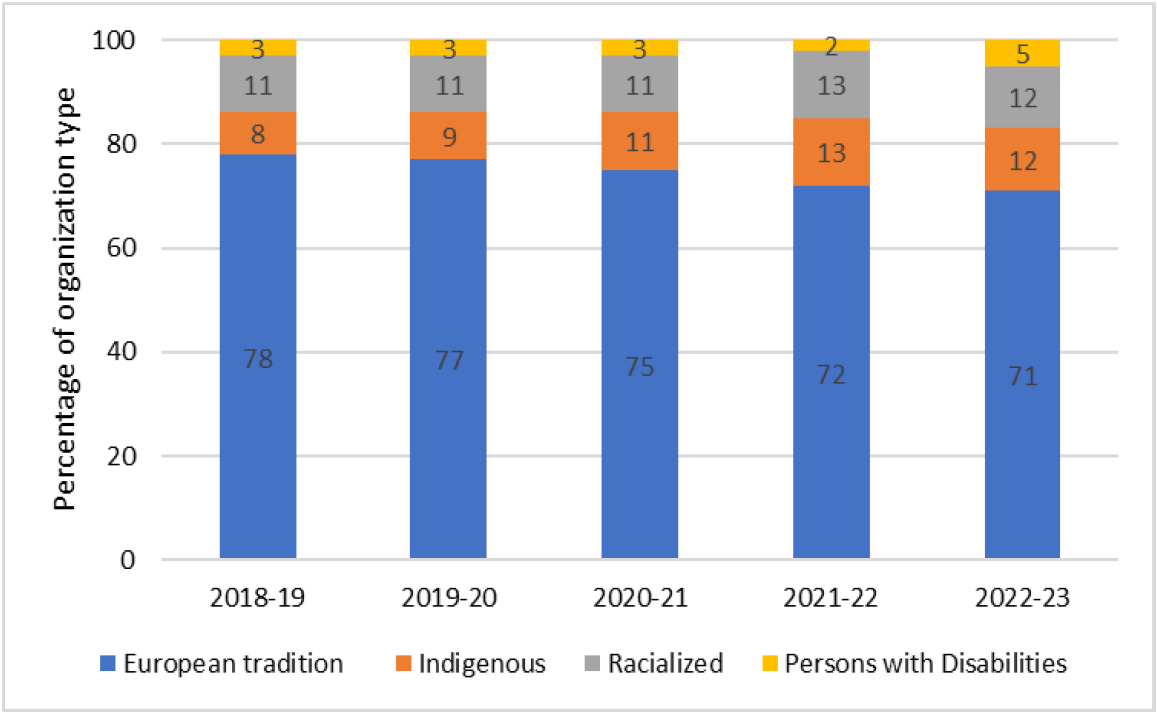
Sources: GCIMS data and internal CATF administrative data.
Figure 1: proportion of organizations funded by organization type (%) – text version
| Type of organization | 2018-19 | 2019-20 | 2020-21 | 2021-22 | 2022-23 |
|---|---|---|---|---|---|
| European tradition | 78 | 77 | 75 | 72 | 71 |
| Indigenous | 8 | 9 | 11 | 13 | 12 |
| Racialized | 11 | 11 | 11 | 13 | 12 |
| Persons with disabilities | 3 | 3 | 3 | 2 | 5 |
Sources: GCIMS data and internal CATF administrative data.
Although the number of equity group organizations increased during the evaluation period, the Program provided more funding to those groups in previous years. In 2005-06, 46%Footnote 9 of the CATF recipient organizations were equity groups, compared with 29%Footnote 10 in 2022-23. Over time, several of these equity group organizations were not approved for funding because they did not meet Program objectives.
Increased funding of equity group organizations
During the evaluation period, the proportion of total annual funding for equity group organizations increased from 6% to 12%. At the same time, annual funding for organizations training in European traditions declined from 94% to 88% (Table 11).
| Type of Organization | 2018-19 | 2019-20 | 2020-21 | 2021-22 | 2022-23 |
|---|---|---|---|---|---|
| European tradition | 93.9 | 93.4 | 93.0 | 92.3 | 88.3 |
| Indigenous | 4.5 | 4.8 | 5.2 | 5.6 | 8.2 |
| Racialized | 1.4 | 1.5 | 1.5 | 1.8 | 2.5 |
| Persons with Disabilities | 0.2 | 0.3 | 0.3 | 0.3 | 1.1 |
Sources: GCIMS data and internal CATF administrative data
Despite the increased funding for equity groups, most funds were granted to organizations training in European traditions. They received 92% of CATF funding, while equity groups received 8% of the total funding (Table 12).
| Type of organization | Amount of funding | Percentage of funding (%) |
|---|---|---|
| European tradition | 107.0 | 92.1 |
| Indigenous | 6.6 | 5.7 |
| Racialized | 2.0 | 1.8 |
| Persons with Disabilities | 0.5 | 0.5 |
| Total | 116.2 | 100.0 |
Sources: GCIMS data and internal CATF administrative data.
Note: Funding amounts are rounded, which explains the difference in the total amount.
Individual funding by organization is also higher for organizations training in European traditions than for equity group organizations. In fact, the nine organizations that received the most funding are of European tradition, representing 77% ($88.9 million) of the total CATF budget during the evaluation. Those organizations received a majority of CATF funding partly due to their size and their total budget.
The CATF mandate remains rooted in a Eurocentric paradigm, limiting access for equity groups
The gap in funding between equity groups and organizations training in European traditions is also due to the CATF mandate and criteria of funding organizations offering training of the highest calibre. According to several key informants, the CATF remains rooted in a Eurocentric paradigm that does not address the specific needs of equity groups. The Program uses terms that limit access for equity groups and accentuates historic privilege, such as “organization of national significance, students recognized for excellence, professional training at the highest level”.
To facilitate equity group access, the CATF exempted Indigenous and racialized organizations from the following eligibility criteria:
- A national competitive admissions process in both official languages.
- A bilingual website.
- A bilingual audition process.
- A national student body with at least 20% who must be from outside the training area.
The CATF implemented an additional support measure for equity group organizations by providing more funding for their eligible expenditures compared with those of organizations training in European traditions, at 80% compared to 70%. Furthermore, starting in 2023-24, the Program will cover 100% of eligible expenditures for Indigenous and racialized organizations. The guidelines make no mention of organizations for persons with disabilities, even though the CATF funds those organizations.
Funding inequalities were reduced through additional funding in 2022-23
To improve access, the Program reallocated some of the funds from certain recurrent recipients training in European traditions to new recipients from equity groups. The additional funds in 2022-23 then made it possible to better fund equity groups. Of that funding, 12 equity group organizations received 54% ($1.3M) and 15 organizations with European traditions received 46% ($1.1M). The 14 recipient organizations most funded by the CATF did not receive any additional funding.
Although the distribution of the additional funding is in line with the new departmental priorities regarding IDEA, several of those better-funded organizations would have liked to have had access to it. According to them, their funding has remained fixed since 2009, limiting their ability to intervene with respect to IDEA. Further, some recipient organizations also indicated that the Program’s vision and indicators with respect to IDEA are not clear enough.
Finally, according to recipient organizations, the lack of access to arts training at a young age is an obstacle for equity groups. In their view, better support is essential for arts training organizations whose target group is youth from equity groups if they are to ensure a more diverse succession among artists. It is a crucial period for the development of artistic knowledge and a determining factor in the professional development of an artist.
4.3. Effectiveness
To what extent does the CATF contribute to the short-, medium- and long-term results?
- The CATF generally achieved its expected results.
- The CATF funding allowed recipients to be viable and to develop better programming.
- Most graduates from organizations supported by the CATF obtained employment in their field.
- Most Canadians recognize and benefit from the work of professional artists in Canada.
- Some expected results do not allow for measurement of the CATF’s contributions, and some indicators do not measure all achievements by recipient organizations.
4.3.1. Organizations supported by the CATF offer the highest calibre of arts training
High-calibre training
Training that produces graduates who work at a high level professionally, with important artistic roles and often in a leadership capacity in their artistic field.
The CATF allows funded organizations to offer high-calibre training. The CATF evaluates funding applications based on the following three criteria: artistic merit,Footnote 11 impact,Footnote 12 and organizational stability.Footnote 13 Based on these criteria, organizations evaluated as being of the highest calibre all obtained funding, while those evaluated as lower calibre did not obtain funding.
However, the evaluation found differences among key informants with regards to the meaning of the concept of highest calibre. Although the concept of highest calibre is interpreted differently among recipient organizations, the vast majority see themselves as being of the highest calibre.
Some key informants also indicated that the concept of highest calibre is at odds with the principles of IDEA promoted by the federal government. Several equity group recipient organizations noted issues concerning how the calibre of organizations is measured. They would like the program to use qualitative and inclusive indicators, rather than, for example, report on the number of graduates and awards received.
The quality of staff contributes to the calibre of recipient organizations
Most recipients attribute the high calibre of their organization to the quality of their staff. Several stated that they have employees with excellent skills and a stable team with a lot of experience. Despite this, some identified issues related to staff recruitment due to the labour shortage, and competitiveness of salaries and benefits.
Recipient organizations also cited the quality of their training as evidence of their high calibre. Some stated that they stand out because their training adheres to recognized standards in the arts community, they offer training in both official languages and recruit students from around the world, or because they have proven longevity.
During the evaluation period, a total of 3,219 awards and achievements were awarded to staff from recipient organizations, representing an average of 805 awards and prizes annually, exceeding the Program’s target of 200 per year (Table 13).
| Fiscal year | Number of awards and recognitions |
|---|---|
| 2018-19 | 984 |
| 2019-20 | 911 |
| 2020-21 | 710 |
| 2021-22 | 614 |
| Total | 3,219 |
Sources: Internal CATF data.
Information on the CATF performance measurement
With respect to the number of awards and achievements granted to professionals, each year, the CATF asks its recipient organizations to send a list of “significant achievements” by its instructors (e.g., scholarships, principal roles, appointments). However, the understanding of what constitutes a “significant achievement” differs from one organization to another. As a result, the number of awards and achievements indicated in the reports includes awards and prizes, but also any other achievements, which complicates the analysis of this indicator and explains why the awards and achievements are well above the annual target.
Organizations supported by the CATF generally have selective admission for their students
The average admission ratio for recipients for the evaluation period is 3.7:1, exceeding the Program’s target of 2.5:1 (Table 14). The admission application ratio is, on average, higher for organizations training in European traditions than for equity group organizations (Table 15). That difference is explained, in particular, by the inclusive admission processes of equity group organizations compared to organizations training in European traditions. Some recipients are of the view that there is a paradox between selective student admission and the priority of IDEA advocated by the federal government.
| Fiscal year | Number of applications | Maximum class size | Application ratio |
|---|---|---|---|
| 2018-19 | 10,898 | 3,298 | 3.3:1 |
| 2019-20 | 12,841 | 3,255 | 3.9:1 |
| 2020-21 | 7,713 | 2,096 | 3.7:1 |
| 2021-22 | 9,473 | 2,500 | 3.8:1 |
| 2022-23 | - | - | - |
| Total | 40,925 | 11,149 | 3.7:1 |
Source: Internal CATF data.
| Type of organization | 2018-19 | 2019-20 | 2020-21 | 2021-22 | Average |
|---|---|---|---|---|---|
| European tradition | 3.5:1 | 4.1:1 | 4.1:1 | 3.9:1 | 3.9:1 |
| Racialized | 0.6:1 | 1.2:1 | 0.9:1 | 5.0:1 | 2.0:1 |
| Indigenous | 0.6:1 | 0.7:1 | 1.2:1 | 0.6:1 | 0.8:1 |
| Persons with Disabilities | 0.1:1 | 0.1:1 | 0.1:1 | 0.2:1 | 0.1:1 |
| Total | 3.3:1 | 3.9:1 | 3.7:1 | 3.8:1 | 3.7:1 |
Source: Internal CATF data.
The graduation rate for students of organizations supported by the CATF is low, particularly for equity groups
The average percentage of graduates from organizations that receive support from the CATF was 50% during the evaluation period, not reaching the Program’s target of 75% (Table 16). The graduation rate particularly decreased during the period of the COVID-19 pandemic. In addition, the total average graduation rate for equity group organizations during the evaluation period is lower than that of organizations training in European traditions (Table 17). This difference is in part because some equity group organizations do not have a graduation class and have no time limits on participation, unlike European educational models.
| Fiscal year | Number of students enrolled | Number of graduates | % of students enrolled who graduated |
|---|---|---|---|
| 2018-19 | 3,637 | 2,273 | 63 |
| 2019-20 | 3,618 | 2,010 | 56 |
| 2020-21 | 2,291 | 904 | 39 |
| 2021-22 | 2,500 | 1,028 | 41 |
| 2022-23 | - | - | - |
| Total | 12,046 | 6,215 | 50 |
Source: Internal CATF data.
| Type of organization | 2018-19 | 2019-20 | 2020-21 | 2021-22 | Average |
|---|---|---|---|---|---|
| European tradition | 65 | 58 | 42 | 41 | 51 |
| Racialized | 13 | 11 | 15 | 52 | 23 |
| Indigenous | 49 | 36 | 20 | 37 | 35 |
| Persons with Disabilities | 6 | 0 | 6 | 11 | 6 |
| Total | 62 | 56 | 39 | 41 | 50 |
Source: Internal CATF data.
Information on the CATF performance measurement
The percentage of graduated students does not measure the calibre of an arts training organization. The graduation rate can be high without a guarantee that the training is of the highest calibre. In addition, the calculation used to determine the graduation rate is the number of graduates divided by the total number of students, which does not properly represent the percentage of graduates, as a portion of students are not in their final year of training. A more representative calculation would be the number of graduates compared to the number of students in their final year of training.
4.3.2. Organizations supported by the CATF are financially and administratively stable
Organizations funded by the CATF achieved good results in the financial viability analysis
During the evaluation period, the percentage of recipients with an acceptable Financial Viability Analysis (FVA) varied between 88% and 94%. On average, 90% of recipients obtained an acceptable FVA, exceeding the Program’s target of 80%Footnote 14 (Table 18).Footnote 15
| Fiscal year | # of recipients | # of recipients with at least an acceptable FVA | # of recipients with an unfavourable FVA | FVA not applicable (under $100,000) | % of recipients with at least an acceptable FVA |
|---|---|---|---|---|---|
| 2018-19 | 36 | 25 | 2 | 9 | 93 |
| 2019-20 | 35 | 23 | 3 | 9 | 88 |
| 2020-21 | 37 | 22 | 3 | 12 | 88 |
| 2021-22 | 39 | 22 | 3 | 14 | 88 |
| 2022-23 | 41 | 32 | 2 | 7 | 94 |
| Total | 188 | 124 | 14 | 50 | 90 |
Source: Grants and Contributions Information Management System.
Note: Percentages are rounded, which explains the difference in the total percentage.
Recipient organizations maintain sound governance and administration practices
During the evaluation period, recipient organizations obtained an average mark of 7.8/10 for their administrative governance structure, meeting the Program’s target of 7.8. The vast majority of recipient organizations consulted on this topic explained that the strength of their governance is linked to their board of directors, especially describing the commitment, expertise, experience, and diversity of its members.
The CATF contributes to the financial stability of recipient organizations
According to all recipient organizations consulted on this topic, the CATF contributes to their financial stability. The funding allowed them to develop in a sustainable manner, offer better training and increase their credibility with other funders. Several noted, however, that stagnation of funding since 2009-10 in the context of inflation reduced opportunities for development and improvement of their programming. While operating costs and expectations for organizations increased, core funding declined. This makes it hard for organizations to seize opportunities for growth, implement all their ambitions, and provide job security for their employees.
Information on the CATF performance measurement
The CATF medium-term result “funded organizations are financially and administratively stable” does not correspond to an expected medium-term result, but rather to an immediate result or an eligibility criterion of the Program.
4.3.3. CATF organizations are recognized for training artists that become active professionally
Employers are satisfied with the skills of artists trained by organizations supported by the CATF
Employers in the arts and culture sector are more satisfied with the skills of artists trained by organizations that are supported by the CATF than those of other organizations in Canada, as per the last two surveys of employers of professional arts graduates.Footnote 16 In 2019, the average satisfaction rate of artists trained by organizations that are supported by the CATF was 90%, while it was 81% for artists trained in Canada. In 2015, that rate was 93% for artists trained by organizations that are supported by the CATF and 91% for artists trained in Canada, both surveys surpassing the target of 80% set by the Program (Table 19).
| Statement of artist satisfaction | Trained by the CATF2015 | Trained in Canada2015 | Trained by the CATF2019 | Trained in Canada2019 |
|---|---|---|---|---|
| Technical expertise of artists | 95 | 92 | 92 | 85 |
| Performance skills and experience | 94 | 92 | 92 | 85 |
| Professionalism and career preparation | 90 | 89 | 87 | 73 |
| Average | 93 | 91 | 90 | 81 |
Sources: Training of Professional Artists in Canada: Perceptions of Employers (2015, 2019).
Over half of employers surveyed (54%) indicated that arts training in Canada was similar to, better than or far better than training offered internationally, while some respondents (24%) were of the view that training in Canada was worse or far worse than training offered by international organizations.Footnote 17
Most graduates from organizations supported by the CATF obtained employment in their field of the arts
According to an analysis of administrative data, most graduates (81%) of recipient organizationsFootnote 18 obtained employment in their field during the evaluation period (Table 20). The employability rate for graduates, however, declined between 2018-19 and 2020-21, from 85% to 74%, which is largely explained by the COVID-19 pandemic. Finally, the target of 75% of graduates obtaining employment in their field has been surpassed during the evaluation period, while it was almost achieved in 2020-21.
| Fiscal year | Number of graduates | Number of graduates who responded to the questionnaireTable 20 note 1 | Number of graduates employed | % of graduates employed |
|---|---|---|---|---|
| 2018-19 | 2,283 | 836 | 714 | 85 |
| 2019-20 | 2,010 | 1,171 | 917 | 78 |
| 2020-21 | 904 | 635 | 471 | 74 |
| 2021-22 | 1,028 | 598 | 532 | 89 |
| 2022-23 | - | - | - | - |
| Total | 6,225 | 3,240 | 2,634 | 81 |
Source: Internal CATF data.
Table 20 notes
- Table 20 note 1
-
Note: Includes only graduates who responded to the questionnaires distributed by the recipient organizations.
Some graduates of organizations supported by the CATF (34%) obtained employment in their field abroad during the evaluation period. That rate also declined between 2018-19 and 2021-22, from 49% to 25%, corresponding to the period of the COVID-19 pandemic (Table 21).
| Fiscal year | Graduates employedTable 21 note 1 | Graduates employed abroad | % of graduates employed abroad |
|---|---|---|---|
| 2018-19 | 714 | 347 | 49 |
| 2019-20 | 917 | 293 | 32 |
| 2020-21 | 471 | 135 | 29 |
| 2021-22 | 532 | 132 | 25 |
| 2022-23 | - | - | - |
| Total | 2,634 | 907 | 34 |
Source: Internal CATF data.
Table 21 notes
- Table 21 note 1
-
Note: Includes only graduates who responded to the questionnaires distributed by the recipient organizations.
Students and graduates of organizations supported by the CATF received several awards and achievements
On average, 2,465 awards and achievements were awarded annually to students and graduates of recipient organizations during the evaluation period, exceeding the Program’s target of 600 awards per year (Table 22). To properly measure the success of graduates following their training, some key informants cited the importance of using qualitative indicators to assess the personal development of students and the impact they will have in their communities. According to them, the percentage of graduates employed, and the number of awards obtained are indicators that only partially measure the success of graduates.
| Fiscal year | Number of awards and recognitions |
|---|---|
| 2018-19 | 2 638 |
| 2019-20 | 2 903 |
| 2020-21 | 2 119 |
| 2021-22 | 2 198 |
| 2022-23 | - |
| Total | 9 858 |
Sources: Internal CATF data.
Information on the CATF performance measurement
With respect to the number of awards and achievements of students and graduates, the CATF asked its recipient organizations to send it a list each year of “significant achievements” by its students and graduates (e.g., scholarships, principal roles, appointments). They were specifically asked to exclude benefits paid by the school, scholarships from the school and graduation certificates. However, the understanding of what constitutes a “significant achievement” differs from one organization to another; thus, the number of awards and achievements indicated in the reports includes not only awards, but also any other achievements by graduates, which complicates the analysis of this indicator and explains why the awards and achievements are well above the target each year.
4.3.4. Canadians value the work of Canadian professional artists.
Canadians claim that art and culture are important to their quality of life
Canadians recognize the work of professional artists in Canada. According to a survey,Footnote 19 7 of 10 Canadians feel that artistic and cultural events are important to their quality of life. Equity groups were more likely to qualify art and culture as very important to their quality of life.
Canadians particularly agree that:
- Artistic events are a good opportunity to bring together people with different languages and cultural traditions (85%).
- Artistic events in a community make it more enjoyable to live there (83%).
- Canadian artists are among the best in the world (77%).
During the COVID-19 pandemic, however, Canadians had more mixed opinions about the importance of artistic activities to their well-being (Table 23).
| Statements on arts and culture | Agree | Disagree | Uncertain |
|---|---|---|---|
| Artistic or cultural activities in a community make it more enjoyable to live there. | 83 | 10 | 7 |
| Artistic experiences are a good opportunity to bring together people with different languages and cultural traditions. | 85 | 9 | 6 |
| Canadian actors, musicians, writers, and other Canadian artists are among the best in the world and do well on the international stage. | 77 | 13 | 10 |
| Artistic or cultural activities were important to my personal well-being during the COVID-19 pandemic. | 40 | 48 | 12 |
Source: Arts and Heritage Access and Availability Survey (2020-21).
Half of Canadians (49%) have a favourable perception of the quality of artistic events in their community, but the appreciation of the number of events is slightly lower (43%). Over half of Canadians (57%) have a sense of attachment to cultural organizations in their community. However, equity groups were less likely to have a sense of attachment to cultural organizations in their community. Further, most Canadians (85%) feel that it is important for the Government of Canada to support arts and culture.
In addition to recognizing the importance of art and culture, many Canadians took part in artistic events in person or online. The year before the pandemic, over half of Canadians (59%) took part in an artistic event. During the COVID-19 pandemic, that rate fell to 15%, but Canadians were more likely (48%) to attend an artistic event online. Further, one quarter of Canadians (26%) did not attend any artistic events in person or online, before or during the pandemic.
Finally, the majority of key informants who commented on this topic stated that the importance of the CATF goes beyond recognition of the work of Canadian artists. In their view, the fund ensures the development of artists who will influence the cultural fabric of Canada. This finding is particularly important for Indigenous organizations.
4.4. Efficiency
To what extent is the CATF delivered efficiently?
In general, the CATF is delivered efficiently:
- The process for allocating funds is clear and rigorous.
- Communication by the Program staff with recipient organizations is appreciated.
- The delivery of funds in response to the COVID-19 pandemic was very efficient.
- The administrative ratio is lower than the two previous evaluations.
- Service standards for the acknowledgment of receipt of applications and issuance of payments were met.
Issues remain for some of the CATF administrative processes:
- Eligibility criteria are not flexible enough, particularly for equity groups.
- Reporting and funding applications are cumbersome processes that are simultaneously required by the Program.
- The service standard for funding decisions was not met due, among other factors, to the context of the evaluation period, which was particularly demanding: the COVID-19 pandemic and additional funding in 2022-23.
4.4.1. Administrative contribution ratio
During the evaluation period, the administrative ratio in contributionsFootnote 20 was 3.91%. That ratio is lower than the ratios in the two previous evaluations, which were 3.93% in 2019 and 5.79% in 2014. This decrease in the administrative ratio is due in part to the increase in contributions distributed during the COVID-19 pandemic. Indeed, the additional amounts in 2020-21 increased contributions by 23% compared with 2019-20, while operations and maintenance expenses rose little in 2020-21 (11%) and then declined again in 2021-22 (Table 24).
| Financial resources | 2018-19 | 2019-20 | 2020-21 | 2021-22 | 2022-23 | TotalTable 24 note 1 |
|---|---|---|---|---|---|---|
| Total operating expenditures | 0.9 | 0.9 | 1.0 | 0.9 | 1.0 | 4.8 |
| Regular contributions | 22.7 | 22.8 | 22.8 | 22.8 | 25.3 | 116.3 |
| Contributions from COVID-19 funds | - | - | 5.2 | 2.6 | - | 7.7 |
| Total community contributions | 22.7 | 22.8 | 27.9 | 25.4 | 25.3 | 124.0 |
| Total expenditures | 23.6 | 23.7 | 29.0 | 26.3 | 26.3 | 128.9 |
| RatioTable 24 note 1 | 4.14% | 4.06% | 3.69% | 3.60% | 4.11 | 3.91% |
Source: Data published by PCH.
Table 24 notes
- Table 24 note 1
-
Note: The ratio calculation is total operations / total contributions. Funding amounts are rounded, which explains the difference in the total amount.
4.4.2. Funding application and reporting
Funding applications and reporting are useful in decision-making, but are overly cumbersome
Funding application
The purpose of the funding application process is to collect various relevant information. Recipient organizations appreciate the fact that the form keeps the information from the previous year and the questions are generally seen as being clear. Recipients claim that the process is demanding the first few times, but that the exercise becomes easier over time. However, the vast majority of key informants who commented on this noted the following issues with this process:
The form is too long for the vast majority of key informants. The form is described as being outdated and made up of repetitive questions, requiring too many supporting documents. Some non-applicants from equity groups described the process as intimidating, limiting their access to the Program.
- As the CATF’s fiscal year corresponds to the federal government’s fiscal year, in accordance with the FAA, it is not aligned with that of some recipient organizations. CATF funding, which runs until the end of March, corresponds to the busiest period for those organizations, as it is the preparation period for end-of-year shows.
- New applicants also mentioned that some questions were not clear enough. They would like to better understand what documents and questions are most important when the National Review Committee (NRC) evaluates applications.
Reporting
The importance of reporting is well understood by recipient organizations and nearly half called it relevant. However, a vast majority of key informants noted the following issues, in order of importance:
- The difficulty of reporting. The number and frequency of reports required are considered too high and some stated that certain reports were not relevant, such as the annual statistical report and the cash flow. Reporting requires a lot of time for recipient organizations, particularly for small organizations that do not have sufficient human and financial resources.
- Use of a single format for reporting. Some had difficulty completing reports because the information requested was not aligned with their context.
- The period for submitting reports does not always align with recipient organizations’ schedules, making the exercise more complicated.
- There is duplication of some documents required by the Program during the admission and reporting process, both required at the same time of the year.
Finally, data collection issues were identified, particularly due to how the Program reports recipient information from annual statistical reports. Differences were noted between the data reported by the organizations and the data reported by the Program, with no evidence of the decision or calculation that could explain the variations. This could be explained by the questions on the forms, which do not always reflect the realities of recipient organizations, and the interpretation of data by the Program’s officers.
Communication by the CATF staff with recipient organizations is highly appreciated
The vast majority of key informants who mentioned communication with the CATF staff said that interactions were excellent. The Program takes the time to answer questions from recipient organizations and to offer flexibility as needed. During the COVID-19 pandemic, several recipient organizations indicated that communications with the Program were more frequent, which allowed ad hoc needs to be met. Several would like to maintain that level of communication, as it allows for better collaboration with the Program.
The unfunded organizations also noted the exemplary communication from the CATF and the availability of staff. The feedback and suggestions provided by the Program helped them improve their next funding application.
Several recipient organizations also appreciated the Program staff’s visits to their organization. These help better demonstrate the level of quality and the needs of their organization than through an annual report. Some, however, noted that they would like to increase the frequency of visits.
4.4.3. Funding delivery approach
The process for allocating funding is rigorous, but the criteria could be more flexible for equity groups
The process for the allocation of funds is rigorous, and decisions are based on the set criteria from the guidelines. The evaluation found that the Program staff have some flexibility in their recommendations to align with departmental priorities. According to many key informants, this flexibility, which allowed for better access for equity groups, should be used more. For example, some proposed expanding the types of training eligible to include, for example, mentoring and recreational training, which for some is the gateway to professional training. Although the CATF funds mentoring, some organizations are unaware of that information because it is not clearly indicated in the eligibility criteria. The evaluation also found that the flexibility granted to certain organizations from equity groups is not sufficiently reflected in the terms and conditions of the criteria in a formal manner, which could create inconsistencies in the review of applications over time.
Recipient and non-funded organizations questioned the relevance of the criterion requiring that organizations conduct their promotion and auditions in both official languages for those in which just one language is used within the organization. The evaluation also found that some refusal letters consulted were unclear and did not indicate all reasons for the funding decision.
Finally, with respect to the application evaluation process, there is an overlap in some of the criteria assessed during the preliminary analysis of eligibility and the prioritization of applications. According to the CATF procedures, following the admission stage, funding applications are evaluated by the NRC to compare and prioritize them based on the funds available. In general, the preliminary analysis criteria do not duplicate the criteria for prioritizing applications, but the criteria for the admission process in both languages, the stability of the administrative structure, and the diversity of revenues are evaluated both during the eligibility analysis and the prioritization of applications.
Annual agreements granted during the COVID-19 pandemic to all recipient organizations reduced the efficiency of the Program
During the COVID-19 pandemic, the Program granted annual funding agreements, which increased the workload of the Program and reduced the general efficiency of the CATF. From 2020-21 to 2021-22, all recipient organizations were required to sign an annual agreement, whereas the CATF had previously granted multi-year funding to organizations with good institutional stability. As a result, over half of the funding agreements (66%) were annual during the evaluation period (Table 25).
| Fiscal years of applications | Multi-year agreements | Annual agreements | Total |
|---|---|---|---|
| 2018-19 | 18 | 9 | 27 |
| 2019-20 | 7 | 10 | 17 |
| 2020-21 | 0 | 31 | 31 |
| 2021-22 | 0 | 42 | 42 |
| 2022-23 | 26 | 9 | 35 |
| Total | 51 | 101 | 152 |
| Percentage | 34% | 66% | 100% |
Data: GCIMS data.
The goal of this temporary change in agreements was to align the fiscal year of all recipient organizations to facilitate the Program’s coordination of the additional funds in 2022-23. However, the annual agreements created several challenges for recipient organizations. They increased their administrative workload and complicated their expenditure planning due to the uncertainty concerning the amounts approved each year. Beginning in 2022-23, multi-year agreements were restored for some recurring recipient organizations.
Some recipient organizations stated that they received funding agreements over a period of two years, when they had been invited to complete a three-year funding application, which they felt had an impact on the efficiency of the process. Finally, multi-year agreements are more advantageous and are preferable to annual agreements for the efficiency of the recipient organizations and the Program.
Funding in response to the COVID-19 pandemic was distributed efficiently
The delivery of funding in response to the COVID-19 pandemic was efficient according to the vast majority (90%) of recipient organizations that discussed the topic. The Program funds were simple to administer, and the funding application was quick to complete, as indicated by the recipient organizations. In addition, the timelines were clear and were followed. According to the PCH survey,Footnote 21 the recipient organizations that responded were particularly satisfied with how fast the funds were received, the amounts allocated, and the support and information received from the program. Some mentioned that there are best practices from the delivery of the funding in response to the COVID-19 pandemic that should be adopted to improve the efficiency of the regular funds. For example, a reduction of bureaucracy, flexibility of support, speed of the process, and the predictability of payments were particularly appreciated.
4.4.4. Service standards
Service standards are respected, except for the funding decision
The average for the Program’s three service standards during the evaluation period is 87% achieving the PCH target of 80% for all its programs. The service standards for acknowledgement of receipt and receipt of payment were respected, while the service standard for funding decisions did not meet the target of 80% of decisions issued within 28 weeks (7 months) (Figure 2). Despite this, since the last evaluation in 2019, the Program has reduced its service standard for funding decisions from 29 to 28 weeks. Furthermore, it increased its speed of execution, as it respected its decision standard on average 63% of the time, compared to 42% in the last evaluation.
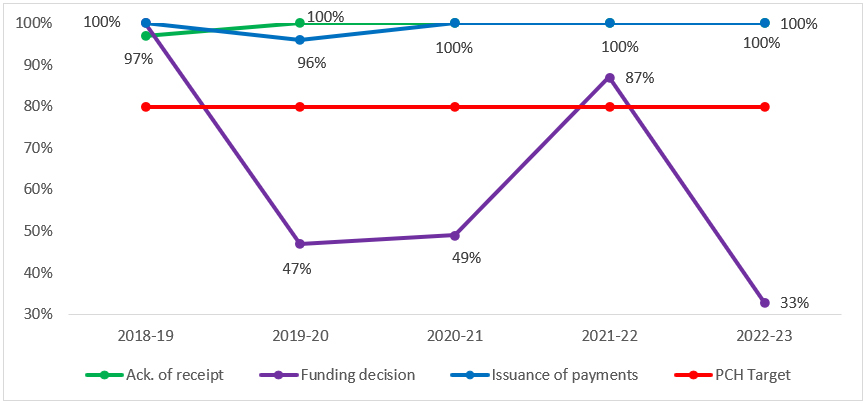
Source: Data published by PCH.
Figure 2: CATF service standards, 2018-2019 to 2022-23 (%) – text version
| Fiscal Year | Acknowledgement of receipt | Funding decision | Issuance of payments | PCH Target |
|---|---|---|---|---|
| 2018-19 | 97 | 100 | 100 | 80 |
| 2019-20 | 100 | 47 | 96 | 80 |
| 2020-21 | 100 | 49 | 100 | 80 |
| 2021-22 | 100 | 87 | 100 | 80 |
| 2022-23 | 100 | 33 | 100 | 80 |
Source: Data published by PCH.
The delays in funding decisions are explained in part by the particularly demanding context of the evaluation period, marked by the COVID-19 pandemic, the granting of additional funding in 2022-23, and the adoption of annual contribution agreements in 2020-21 and 2021-22. This specific context disrupted the regular operations of the Program, having an impact on its overall efficiency.
One of the main issues is that the funding decisions are not communicated to organizations in a timely manner, making it difficult to plan and promote their programming due to the uncertainty of funding. Predictability in funding decisions ensures better management of organizations’ human and financial resources and, when the Program is unable to meet service standards, recipient organizations would like to be informed.
When asked about their perception of a reasonable timeline for funding decisions, nearly half of recipient organizations indicated that a period of two to four months would be reasonable, while just over half felt that a period of seven to nine months would be reasonable. Given that the Program’s service standard is 28 weeks, most beneficiaries would be satisfied if the Program met its service standard.
5. Conclusion
The evaluation confirmed the relevance of the CATF. By funding the highest calibre of arts training organizations, the Program makes an essential contribution to the Canadian arts and culture ecosystem. In addition, the Program has responded well to the needs of the community, including ad hoc needs to respond to the COVID-19 pandemic.
Overall, the program achieved its expected short-, medium- and long-term results. The artists trained by the CATF are recognized for their artistic skills and are able to find employment in their field in Canada and abroad. However, there are gaps in the Program’s performance measurement that limit the evaluation of the Program’s contribution.
In addition, the CATF is generally delivered efficiently. Program staff are also recognized for their communication and availability to recipient organizations and the Program is recognized for its rigorous funding delivery process. Yet, there is an administrative burden that has an impact on the client experience and the quality of the data collected.
The main challenge of the CATF is the duality between its efforts to improve access for IDEA groups and its mandate, which is to support the highest calibre of arts training organizations. The evaluation found that the Program implemented measures to allow greater access for equity groups, particularly with the exemption of certain eligibility criteria for Indigenous and racialized organizations and additional funding in 2022 to address historic funding inequalities. However, the current structure of the CATF does not enable it to fully integrate equity groups into its Program, while continuing to support organizations training in European traditions.
PCH equity, diversity and inclusion review
[Translation] “Although PCH has made some changes and adjustments to programs and policies over the years, the systems and structures that underpin the Department’s offerings continue to confer benefits and opportunities to those who are part of the dominant, Eurocentric culture, for which those systems and structures were designed.”
The CATF has begun a serious reflection in this respect. Additionally, concrete actions have been taken to ensure better access for IDEA groups, specifically since the start of the 2023-24 fiscal year. The Program is not the only one facing these questions; the arts and culture sector and the Department are currently undertaking an important reflection on this.
In 2021-22, as part of its departmental plan,Footnote 22 Canadian Heritage publicly committed to conducting a review of its programs to “identify and help remove systemic barriers to accessing programming for equity-deserving communities and support sectors in developing their own approaches to improve equity, diversity and inclusion”. The first step in that commitment was tabling the first report on the PCH Equity, Diversity and Inclusion Review in March 2023.
Following the review of 12 of the Department’s programs from 2021 to 2023, the report on the PCH Equity, Diversity, and Inclusion (EDI) Review presented the findings and the recommendations to better support equity communities through the Department’s policies and programs. This evaluation of the CATF, which was conducted at the same time, identified issues and findings in line with several aspects highlighted in that report. The evaluation identified the following barriers under the various fundamental issues (relevance, equity, effectiveness, efficiency):
- the cumbersome requirements of the application processes;
- the unclear definitions and language concerning IDEA concepts;
- the terms “excellence” and “professional” being perceived as problematic and limiting access to a variety of unique talents;
- the issue of programs being designed based on the Eurocentric perspective;
- eligibility requirements that are hard to achieve for some groups, such as national scope, financial stability and the need to demonstrate a proven track record; and
- the traditional and Eurocentric concept of success.
Having this evaluation report and the PCH report on EDI, along with permanent additional funding, the CATF currently has an excellent opportunity to review its structure and processes so all its recipients can benefit from them.
6. Management Recommendations, Response, and Action Plan
Based on the findings and conclusions presented in this report, the evaluation is making the following two recommendations:
- Review the Program structure and performance measurement.
- Review the funding application and reporting processes.
Recommendation 1
The evaluation recommends that the Senior Assistant Deputy Minister, Cultural Affairs, continue the work undertaken since the last evaluation to ensure better access for equity groups, by reviewing:
- the structure of the Program to align the mandate of the CATF and the priority of supporting equity group training organizations;
- the Logic Model and indicators related to the expected results, taking into account the realities of equity groups.
Management response
The Canada Arts Training Fund accepts this recommendation. The Program acknowledges the need to reconcile the program’s objectives and expected results with the operating realities and training methods of Indigenous and equity-deserving arts training programs to increase equitable access to funding and remove barriers. The program has already started to implement modifications related to this Recommendation in alignment with the increased allocation received through Budget 2022.
| Action plan items | Deliverables | Timeframe | Lead |
|---|---|---|---|
| 1.1. Review current Program structure and identify/implement solutions to barriers to access for Indigenous and equity-deserving applicants. | 1.1.1. Updated Program Terms and Conditions to facilitate equitable access to funding that responds to needs of Indigenous and other equity-deserving recipients (racialized, Deaf and disability communities, 2SLGBTQI+ etc.). | Completed February 2023 | Director General, Arts and Cultural Sector Strategy Branch |
| 1.1.2. Building on work completed in the previous evaluation, continue previously-approved modifications to Program delivery structure to reflect a streamed model with specific paths for Indigenous, other equity-deserving and European tradition-based training organizations. | June 2025 | Director General, Arts and Cultural Sector Strategy Branch | |
| 1.2. Review logic model, indicators and expected results to take into account the realities of Indigenous and equity-deserving organizations. | 1.2.1. Consult with Arts Policy, Strategic Policy, Planning and Corporate Affairs, Centre of Excellence and Treasury Board Secretariat on potential adjustments/revisions. | September 2024 | Director General, Arts and Cultural Sector Strategy Branch |
| 1.2.2. Presentation of proposed revisions to senior management. | October 2024 | Director General, Arts and Cultural Sector Strategy Branch | |
| 1.2.3. Minister and/or TBS-approved logic model, indicators, and expected results. | March 2025 | Director General, Arts and Cultural Sector Strategy Branch | |
| 1.3. Meet additional GBA Plus indicators and targets developed in conjunction with the Treasury Board submission for the Budget 2022 increase. | 1.3.1. Engaged specialist in Indigenous outreach and engagement to assist training organizations in developing funding applications and create Indigenous-specific Program tools. | Completed April 2023 | Director General, Arts and Cultural Sector Strategy Branch |
| 1.3.2. Target outreach to increase application rates of Indigenous and other equity-deserving applicants. | Ongoing from June 2022 to March 2026 | Director General, Arts and Cultural Sector Strategy Branch | |
| 1.3.3. Implement 2023-2027 Investment Strategy to increase the number of Indigenous and other equity-deserving organizations supported by the Canada Arts Training Fund. | Ongoing to March 2027 | Director General, Arts and Cultural Sector Strategy Branch |
Full implementation date: March 2027
Recommendation 2
The evaluation recommends that the Senior Assistant Deputy Minister, Cultural Affairs, review the funding application and reporting processes to reduce the administrative burden and improve the client experience and the quality of data collected.
Management response
The Canada Arts Training Fund accepts this recommendation and has already identified that the application and results reporting processes require improvements and adjustments to reduce the administrative burden on recipients, eliminate duplication of information, and to increase the integrity of Program data collection processes.
| Action plan items | Deliverables | Timeframe | Lead |
|---|---|---|---|
| 2.1. Modify application processes. | 2.1.1. Revise application form to eliminate duplication and redundant information, and to reflect a client-facing streamed model with specific paths for Indigenous, other equity-deserving and European tradition-based training organizations. | May 2024 | Director General, Arts and Cultural Sector Strategy Branch |
| 2.1.2. Revise Program guidelines to align them with updated Terms and Conditions and revised application form (includes Centre of Excellence approval) | May 2024 | Director General, Arts and Cultural Sector Strategy Branch and Director, Centre of Excellence | |
| 2.1.3. Revised application form available in Canadian Heritage Funding Portal. | May 2024 | Director General, Arts and Cultural Sector Strategy Branch | |
| 2.1.4. Publish revised guidelines on PCH website. | May 2024 | Director General, Arts and Cultural Sector Strategy Branch | |
| 2.1.5. Revise assessment workbook to reflect revised guidelines and application form. | July 2024 | Director General, Arts and Cultural Sector Strategy Branch | |
| 2.1.6. Publish revised application deadline date (May 15 annually) on PCH website. | July 2024 | Director General, Arts and Cultural Sector Strategy Branch | |
| 2.2. Review and implement Expert Assessment tools and processes with an equity lens. | 2.2.1. Review Expert Assessment processes and tools, create and implement new versions. | May 2025 | Director General, Arts and Cultural Sector Strategy Branch |
| 2.3. Review and implement site visit/client monitoring plans, tools and processes with an equity lens. | 2.3.1. Review the program’s site visit/client monitoring plan to ensure it responds to the needs of Indigenous and other equity-deserving recipients. | April 2026 | Director General, Arts and Cultural Sector Strategy Branch |
| 2.3.2. Initiate visits according to revised site visit/client monitoring plan. | April 2026 | Director General, Arts and Cultural Sector Strategy Branch | |
| 2.4. Improve reporting processes and timelines with an equity lens. | 2.4.1. Review interim report template and due date and revise as required. | March 2025 | Director General, Arts and Cultural Sector Strategy Branch |
| 2.4.2. Review final report template and due date and revise as required. | March 2025 | Director General, Arts and Cultural Sector Strategy Branch | |
| 2.4.3. Review annual statistical report template and due date and revise as required. | March 2025 | Director General, Arts and Cultural Sector Strategy Branch | |
| 2.4.4. Approval of revised reporting processing and timelines as applicable. | March 2025 | Director General, Arts and Cultural Sector Strategy Branch | |
| 2.4.5. Revised report templates available to recipients. | November 2025 | Director General, Arts and Cultural Sector Strategy Branch | |
| 2.4.6. Contribution Agreement templates updated. | April 2025 | Director General, Arts and Cultural Sector Strategy Branch | |
| 2.5. Improve data collection and internal reporting processes. | 2.5.1. Review Program data collection practices to identify common data entry errors and inconsistencies in recipient reporting on current annual statistical report. | September 2024 | Director General, Arts and Cultural Sector Strategy Branch |
| 2.5.2. Based on findings from 2.5.1., revise Program data collection methodology and tools and annual statistical report template. | January 2025 | Director General, Arts and Cultural Sector Strategy Branch | |
| 2.5.3. Revised data collection and internal reporting processes implemented by Program. | March 2025 | Director General, Arts and Cultural Sector Strategy Branch | |
| 2.5.4. Revised annual statistical report template available to recipients. | March 2025 | Director General, Arts and Cultural Sector Strategy Branch |
Full implementation date: April 2026
Appendix A: evaluation matrix
| Indicators | Analysis of documents and data | Interviews | Literature review |
|---|---|---|---|
| 1.1. Evidence and perceptions that the CATF meets the current and emerging training needs of artists and arts training organizations in Canada | X | X | X |
| 1.2. Number and characteristics of organizations funded by the CATF (location of institution, type of art taught, target group) | X | - | - |
| 1.3. Evidence and perceptions that the Emergency Fund and the Recovery and Reopening Funds supported the activities of CATF recipients | X | X | - |
| Indicators | Analysis of documents and data | Interviews | Literature review |
|---|---|---|---|
| 2.1. Evidence and perceptions of measures in place to support IDEA, existing barriers, and opportunities for improvement | X | X | X |
| 2.2. Proportion of funded arts organizations offering services to equity groups | X | - | - |
| Indicators | Analysis of documents and data | Interviews | Literature review |
|---|---|---|---|
| Short-term result 1: Funded organizations offer the highest calibre of arts training. | |||
| 3.1. Evidence and perceptions that the funded organizations offer the highest calibre of arts training | X | X | - |
| 3.2. Ratio of student demand/available spaces | X | - | - |
| 3.3. Percentage of students who graduated from the training programs | X | - | - |
| Medium-term result 1: Funded organizations are financially and administratively stable. | |||
| 3.4. Percentage of recipients with at least an acceptable FVA | X | - | - |
| 3.5. Evidence and perceptions that recipients maintain sound governance and administrative practices | X | X | - |
| 3.6. Evidence and perceptions that the training organizations are financially and administratively stable | X | X | - |
| Medium-term result 2: Funded organizations are recognized for training artists that become active professionally. | |||
| 3.7. Percentage of employers in the arts sector who feel that graduates from the organizations supported by the CATF are well prepared for professional careers | X | X | - |
| 3.8. Percentage of graduates with professional employment in their field in Canada or abroad | X | X | - |
| 3.9. Evidence and perceptions that funded organizations are recognized for their training of artists who become professionally active | X | X | - |
| Long-term result 1: Canadians value the work of Canadian professional artists. | |||
| 3.10. Percentage of Canadians who appreciate arts and heritage organizations | X | - | X |
| 3.11. Evidence and perceptions that Canadians recognize the work of Canadian professional artists | X | X | X |
| Indicators | Analysis of documents and data | Interviews | Literature review |
|---|---|---|---|
| 4.1. Evidence and perceptions that the delivery of the CATF is efficient, including ad hoc funding granted during the COVID-19 pandemic | X | X | - |
| 4.2. Evidence and perceptions that service standards are being met | X | X | - |
| 4.3. Ratio of administrative cost | X | X | - |
| 4.4. Evidence and perceptions of a clear approach to allocating funds based on established criteria and priorities | X | X | - |
| 4.5. Evidence and perceptions of relevant reporting that supports decision-making | X | X | - |
Appendix B: logic Model
| Activities | Provide financial assistance through transfer payments to support nationally significant Canadian institutions that offer arts training of the highest calibre.
|
|---|---|
| Output |
|
| Short-term result |
|
| Medium-term results |
|
| Long-term result |
|
Appendix C: CATF Administrative Process

Appendix C: CATF Administrative Process – text version
June
- Receipt of applications
July
- Preliminary Assessment and Eligibility (risk of delays)
July, August and beginning of September
- File assessments
Beginning of September to end of September
- NRC meetings (risk of delays)
October
- Final approvals, briefings, RAFS
November
- Centre of Expertise RAF review, MINO briefing
December
- Minister final decision (risk of delays)
June to December is the 28 weeks service standard
January
- Decision letters send off
February
- Contribution Agreement (risk of delays)
Reporting process
- Annual final report and cash flow due June 30th (date may fluctuate)
- Interim report due December 1
- Expenditures to be incurred by March 31st, due February 15
Annual Statistical Report and Audited financial statements due March 31st (date may fluctuate)
Appendix D: bibliography
- Aboriginal Peoples Television Network and NVision Insight. “National Indigenous Music Impact Study”. Aboriginal Peoples Television Network and NVision Insight (January 2021) (PDF format)
- Beland, Louise-Philippe, Fakorede, Oluwatobi, and Mikola, Derek. “Short-Term Effect of COVID-19 on Self-Employed Workers in Canada.” University of Toronto Press, vol. 46, no. S1 (July 2020), pp. S66-S81. (PDF format)
- Boulay, Jenn. “Disability Theatre in Canada: Working Together and Closing the Gaps in the East.” Canadian Theatre Review, vol. 190, no. 2. (Spring 2022), pp. 46-49.
- Burgess, Quentin. “Public Research Findings: Canadians Understand the Cultural and Economic Impacts of the Pandemic on Live Music – and Its Need for Continued Support.” Music Canada (February 2021).
- Canadian Live Music Association. “Closing the Gap: Impact & Representation of Indigenous, Black, and People of Colour Live Music Workers in Canada.” Canadian Live Music Association (March 2022), p. i-89. (PDF format)
- Archipel Research and Consulting Inc. “Organismes artistiques et patrimoniaux autochtones : obstacles, besoins et réussites.” Canadian Heritage (April 2022). (internal document) (French only)
- CBC News. “Lack of Performing Arts Spaces in Nunavut Pushes Artist Summit to Ottawa.” CBC/Radio-Canada (Octobre 2022). Nunavut.
- Coles, Amanda, MacNeill, Kate, Vincent, Jordan B., Vincent, Caitlin and Philippe Barré. “The status of women in the Canadian arts and cultural industries: Research review 2010-2018.” Ontario Arts Council (August 2018). (PDF format)
- The Conference Board of Canada. “Labour Market Information Study of the Cultural Labour Force.” Ottawa: Cultural Human Resources Council (September 2019), pp. 1-163. (PDF format)
- Dénommé-Welch, Spy. “Engaging Indigenous Artistic Process through Embodied Practice: A Conversation with Yolanda Bonnell.” Canadian Theatre Review. University of Toronto Press, vol. 187 (Summer 2021), pp. 30-34. (PDF format)
- Derksen, Cris, McKiver, Melody, Cusson, Ian, McKiver, Beverley, Dutcher, Jeremy, Rider, Sonny-Ray Day, Lafferty, Michelle, Payette, Corey, McMann, Jessica, and Andrew Balfour. “Indigenous Musical Sovereignty.” Indigenous Performing Arts Alliance (February 2019).
- EDI in the Cultural Sector. “Equity, Diversity and Inclusion in the Cultural Sector: The Role of Cultural Organizations”, Pan-Canadian Virtual Conference (June 2022).
- Espinet, Ian Andre. “Breaking Down Racial Barriers: Anti-Black Racism in the Canadian Music Industry.” Canadian Independent Music Association, vol. 1 (July 2021), pp. 1-34. (PDF format)
- Government of Canada – Canada Council for the Arts, Overview of Canadian Cultural Statistics. Ottawa: Canada Council for the Arts, 2022. (PDF format)
- Government of Canada – Canada Council for the Arts, Arts and Resilience: Annual Report 2020-2021. Ottawa : Conseil des arts du Canada, 2021. (PDF format)
- Government of Canada – Canada Council for the Arts, Executive Summary: Environmental Scan and Evaluation of Cultural Leadership Initiatives. Ottawa: Canada Council for the Arts, 2021. (PDF format)
- Government of Canada – Canada Council for the Arts, Deaf and Disability Arts Practices in Canada. Ottawa: Canada Council for the Arts, 2021.
- Government of Canada – Canada Council for the Arts, Annual Report 2021-2022. Ottawa: Canada Council for the Arts, 2022 (PDF format).
- Government of Canada – Canada Council for the Arts, Research on the Value of Public Funding for Indigenous Arts and Cultures. Ottawa: Canada Council for the Arts, 2022.
- Government of Canada – Treasury Board, Policy on Results. Ottawa: Treasury Board, 2017.
- Government of Canada – Creative Marketplace and Innovation Branch, Literature review on the Canadian art market and the socio-economic conditions of the visual arts market. Final report. Ottawa: Canadian Heritage, 2018.
- Government of Canada – Finance Canada, A Plan to Grow Our Economy and Make Life More Affordable. Ottawa: House of Commons, 2022. (PDF format)
- Government of Canada – Department of Justice, Financial Administration Act. Ottawa: Department of Justice, 2023.
- Government of Canada – Parliament of Canada, Impacts of the COVID-19 Pandemic on the Arts, Culture, Heritage and Sports Sectors. Report of the Standing Committee on Canadian Heritage. Ottawa: House of Commons, 2021. (PDF format)
- Government of Canada – Canadian Heritage, Backgrounder: Targeted recovery support for Canadian arts, culture and heritage organizations as they welcome back audiences and rebuild revenues. Ottawa: Canadian Heritage, 2022.
- Government of Canada – Canadian Heritage, Government of Canada Survey of Heritage Institutions: 2019. Ottawa: Canadian Heritage, 2019.
- Government of Canada – Canadian Heritage, Evaluation of the Canada Arts Training Fund 2012-13 to 2017-18. Ottawa: Canadian Heritage, 2019.
- Government of Canada – Canadian Heritage. “Focus Groups on Canadians’ Participation in the Arts” Halifax: Corporate Research Associates Inc (2018).
- Government of Canada – Canadian Heritage, Guide on the public acknowledgement of financial support - Canadian Heritage. Ottawa: Canadian Heritage, 2020.
- Government of Canada – Canadian Heritage, Application Guidelines (for the Canada Arts Training Fund). Ottawa: Canadian Heritage, 2023.
- Government of Canada – Canadian Heritage, Service standards for Canadian Heritage funding programs. Ottawa: Canadian Heritage, 2020.
- Government of Canada – Canadian Heritage, Departmental Evaluation Plan 2022-23 to 2026-27. Ottawa: Evaluation Services Directorate, 2022.
- Government of Canada – Canadian Heritage, National Culture Summit: The Future of Arts, Culture and Heritage in Canada. Ottawa: Canadian Heritage, 2022.
- Government of Canada – Canadian Heritage, Recipient survey – Emergency Support Fund for Cultural, Heritage and Sport Organization. Ottawa: Canadian Heritage, 2022.
- Government of Canada – Statistics Canada, Chart 2 – Change in jobs by culture domain, third quarter of 2022. Ottawa : Statistics Canada, 2022.
- Government of Canada – Statistics Canada, National Culture Indicators: Interactive tool.
- Ottawa: Statistics Canada, 2023.
- Government of Canada – Statistics Canada, Juno Awards: And the winner is… Ottawa: Statistics Canada, 2022.
- Government of Canada – Statistics Canada, Occupation by major field of study (detailed, 4-digit): Canada. Ottawa: Statistics Canada, 2022.
- Environics Research Group. “Arts and Culture Access and Availability Survey 2016-2017, Final Report” Ottawa: Canadian Heritage and Canada Council for the Arts, 2017.
- Environics Research Group. “Arts and Heritage Access and Availability Survey 2020-2021, Final Report”. Ottawa: Canadian Heritage and Canada Council for the Arts, 2021. (PDF format)
- Hill, Kelly. “Demographic Diversity of Artists in Canada in 2016.” Hill Strategies, No. 51 (January 2020), pp. 1-37. (PDF format)
- Hill, Kelly. “Artists in the pandemic: Recent and long-term labour force trends.” Hill Strategies Research Inc., no. 56 (February 2022), pp. 1-12. (PDF format)
- Hill, Kelly. “Canadians’ Arts Participation, Health, and Well-Being.” Hill Strategies, No. 53 (February 2021), pp. 1-46.
- Hill, Kelly, et Jessa Agilo. “I Lost My Gig Canada: Impacts of COVID-19 on Canadian Artists and Independent Cultural Workers.” Hill Strategies Research Inc. (June 2020).
- Indigenuity for the Indigenous Performing Arts Alliance. “Impacts of the Pandemic on Indigenous Artists.” Advocacy, Announcement, Artists – IPAA News (June 2022), pp. 1-34.
- Jeannotte, M.S. “When the Gigs Are Gone: Valuing Arts, Culture and Media in the COVID-19 Pandemic.” Research Gate. Social Sciences & Humanities Open, vol. 3, no. 1, (December 2020), pp. 1-7.
- MacKinnon, Elizabeth, et Christine Pellerin. “More Than Money: How Social Finance Can Build Resilience in the Arts Sector.” (January 2018), pp. 1-46. (PDF format)
- Marsland, Jane. “Shared Platforms and Charitable Venture Organizations.” Metcalf Foundation (June 2013), pp. 1-39. (PDF format)
- Nanos Research. “Arts Response Tracking Study.” Business/Arts (May 2020).
- Nanos Research, Laplaca Cohen et Affaires / Arts. “Culture Track: Canada.” Business / Arts (August 2021).
- Nanos Research, National Arts Centre and Business / Arts. “Culture-goers are three times more likely to say they intend to spend more rather than less on arts/culture in 2022 compared 2021.” Business / Arts (October 2022). (PDF format)
- Nanos Research, National Arts Centre et Business / Arts. “Given the scarcity of in-person experiences during the COVID-19 pandemic, culture-goers turn to digital experiences in the short term” Business / Arts” (May 2020). (PDF format)
- Neighbourhood Arts Network. (2021). “Arts & Equity Toolkit.” Toronto Arts Foundation (July 2021).
- Taylor, Kate. “New Study Reveals the Diversity of Canada’s Arts Audiences.” The Globe & Mail (June 20, 2018).
- Wall-Andrews, Charlie, Walker, Emma, et Wendy Cukier. “Support Mechanisms for Canada’s Cultural and Creative Sectors During COVID-19.” Journal of Risk and Financial Management, Vol. 14, No. 595, (December 2021), pp. 1-20. (PDF format)
- Wilhelm, Kelly. “A Balancing Act: Supporting the Arts in Canada.” The Philanthropist Journal, (May 2019).
© His Majesty the King in Right of Canada, as represented by the Minister of Canadian Heritage, 2024
Catalogue No.: CH7-19/1-2024E-PDF
ISBN: 978-0-660-70783-9