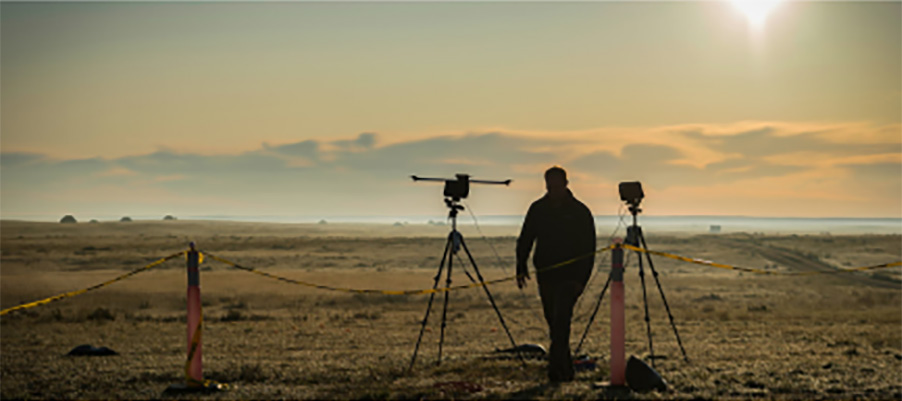
CUAS Applicant Guide 2022
Suffield, Alberta
12 Sep - 7 Oct 2022
Deadline to Apply:
April 13, 2022, 2 pm EST
“How might we detect and/or defeat (kinetically or non-kinetically) Micro and Mini Unmanned Aerial Systems (UAS) with systems that can be integrated into the broader military command and control system.”
Can you detect and/or defeat our Red Team of drones? Come and show us!
- Up to 5 days of your free personal full-time use of our fully equipped CUAS test range including targets.
- On-site one-on-one continual interaction with CAF military and RCMP end-users, and science experts.
- Iteratively test, demonstrate, and improve your technology.
- Customize and adjust your test plan with the CAF on the fly to optimize your range time.
- Expose your innovation to multiple Canadian & international defence and security trusted partners.
Building on the results of the CUAS 2019 Sandbox, the theme for CUAS 2022 is effective detect and defeat technologies that can be integrated into broader military command and control systems.
Please note that in the event of any discrepancy between the information in the downloadable documents and the IDEaS website, the downloadable documents take precedence unless otherwise indicated.
Eligibility and How to Apply
Who can apply?
Applications are open to individuals, academia, not for profit organizations, and industry of any size, as well as provincial, territorial, and municipal organizations.
Federal government departments/agencies, and federal Crown Corporations are not eligible to submit applications to this CFA.
Foreign companies can apply. Sandboxes are not exclusively restricted to made in Canada products/solutions; however, the level of Canadian content within each application will be given consideration during the evaluation process as described in section 6 of the Application Form.
Solution Readiness Level (SRL). At a minimum, at the time of application your solution must have already successfully completed the work and validation testing associated with refining the integration of the solution’s components (Solution Readiness Level 5 or higher). This ensures that solutions are ready for the near-end state demonstrations and testing in a simulated environment that DND/CAF expects in a Sandbox. Learn more about Solution Readiness Levels (SRLs).
Step 1: Read this Applicant Guide for all the information on the challenge, sandbox, criteria, selection, test plans, your responsibilities, funding, and other information.
Step 2: Download and complete the following:
- The Application Form. This is a multiple choice short answer series of questions used to describe your solution. The questions are the technical criteria used for evaluating your application to attend the sandbox. The scoring metrics and weight factors are included within the form. The evaluation method and scoring calculations are explained on Page 4 of the form.
- The Test Plan Template. This tells us what you are proposing to show us during your time in the sandbox, enabling us to ensure that your plan aligns with the intent of the sandbox and that the sandbox is suitably equipped and ready for your arrival.
- Radio Frequency Spectrum, DND 552. Only if your solution emits any RF energy you must submit an “Application for Spectrum Supportability” DND Form 552, as part of your application. DND will use this to determine if the RF usage is supportable in the Sandbox. See Section 4 of the application form for additional details and technical assistance on this topic, as well as the 552 form itself.
Step 3: Create a Canada Post Connect Conversation, the submission portal for your application.
To enable the acceptance of files larger than email will normally permit, all applications must be submitted through Canada Post Connect service, via a “conversation” from your account to the IDEaS account. There are no fees to you for using this service.
To create your account, go to the CP Connect service, click on Login to Connect, then select Register now, and complete your Personal Canada Post Profile.
To initiate the specific CP Connect Conversation with IDEaS for this sandbox:
- Do this at least five business days prior to the application period closing, in order to provide time for the connection to be established.
- Email us at IDEaSSandboxes-environnementsprotegesIDEeS@forces.gc.ca requesting a Connect conversation including your email address associated with your CPC Connect account.
- We will initiate the Connect conversation which will create an email notification from CP Connect to you.
- You will then be able to access and action messages within the conversation and submit your application at any time prior to the closing date and time.
Step 4: Submit your application prior to 2 PM EST on April 13, 2022, using your CP Connect conversation to transmit:
- Your Application Form.
- Your Test Plan.
- Your video of your solution being used.
- If your solution emits any radio frequency energy, you must also submit the DND 552 form.
You will receive a confirmation email after we download your application.
When will I be told if I am selected to attend the sandbox?
You will be notified by email of your evaluation results and selection status approximately six to eight weeks after the Call for Applications closes. The selected Applicants will have five business days to accept their invitation. Typically, this will give you 1-3 months of notice prior to the sandbox start date.
Should a selected Applicant not accept their invitation, or withdraws their acceptance, or is removed from the Sandbox process, additional offers to other Applicants may be made under the same selection process at DND/CAF’s discretion and providing sufficient time is available before the Sandbox commences.
CUAS Sandbox
Overview
Successful applicants will be invited to demonstrate their solutions to this CUAS challenge at CFB Suffield, Alberta, 12 September to 7 October 2022, noting that the selected participants are only present for their specific 2 to 5 days within that window. The Department of National Defence (DND) and Canadian Armed Forces (CAF) DND/CAF will provide a well-equipped and fully staffed test environment specifically designed for that challenge with such things as test articles, weapon ranges, targets, imagery, data collection, and operational scenarios, as well as work and storage space, security, etc. We will also provide on-site military and science experts, as well as other government safety and security potential users, to give innovators observational feedback on their solutions.
There are no fees to the innovator for using the sandbox.
Innovators operate their own prototypes for their desired test and demonstration plan, receiving on-site immediate feedback from our end-users. It is not a contest with multiple innovators publicly competing with each other and an isolated panel of judges. Instead, we are seeking proactive continuous one-on-one engagement with each innovator to mutually help each other.
Collectively this CUAS sandbox provides a venue for:
- Innovators to refine and develop their prototype during and after the sandbox, including iterative testing and on-site improvement while concurrently receiving direct feedback from DND/CAF.
- DND/CAF personnel to learn about the state of possible future upcoming solutions to the challenge, potentially influencing future DND/CAF acquisition decisions.
- Selected allied military and security partners to DND/CAF may also be present, expanding the exposure an innovator may receive during and after the sandbox.
- Interaction and discussion with others in the field of work.
How does the sandbox process work in general?
- The Call for Applications is usually published 3-5 months in advance of the Sandbox.
- An evaluation and selection process determines which innovators are accepted.
- After selection, DND and the selected innovators complete their pre-sandbox preparations, shipping, and travel to attend the sandbox.
- The sandbox is conducted.
- Post-Sandbox reporting and administration with each innovator is completed.
What happens during the sandbox itself?
Each innovator will typically get 2-5 days at the sandbox, with 8-12 innovators hosted in total over 4 weeks. Applicants can indicate their preferred dates to attend in the Application Form; however, the precise dates given to each Participant are at DND’s sole discretion and are non-negotiable.
Innovator demonstrations are isolated from each other to protect intellectual property and prototype performance.
Our military and science experts are paired with each innovator for a continuous full-time interaction during your testing.
The Sandbox Red Team will fly representative UAS threats and operating scenarios to be demonstrated against, adjusting based on the capability of each CUAS system.
The Test Plan template contains a more detailed description of the likely scenarios that will be available. Final test plans will be designed through consultation with the selected Participants to exhibit the capabilities and explore the challenges related to each technology. Actual target UAS will be subject to change based on availability.
Data collected from the target UAS and Participant countermeasures will allow the calculation of range, accuracy and time, to be used as performance outputs and reports for both the Canadian Armed Forces, as well as the Participant.
What happens after a Sandbox?
After the Sandbox is concluded a written report will be provided to each Participant documenting the observations from DND/CAF on only the Participant’s solution.
DND/CAF will internally consider the observations they made at the sandbox in order to monitor any progression towards solving the specific challenge and how that may or may not influence further force development planning, procurement, priorities, and other considerations internal to IDEaS and across DND/CAF.
Attendance at a Sandbox, or even successful demonstrations within the Sandbox, does not imply any intent or commitment that DND/CAF will undertake any further activity with any solution or organization. It is a one-time Sandbox event only. It is completely up to the Participant what they do with the information learned during the Sandbox.
What’s the Sandbox schedule for a specific participant?
A detailed schedule will be developed with each selected Participant prior to the Sandbox, based on the following expectations:
- Arrive at your hotel prior to Day 1.
- Work days will be 8 am to 4 pm.
- Day 1 will entail suitable in-briefs, unpacking, and calibration.
- Demonstrations may commence on Day 1 if time permits.
- Lunch/breaks will be provided on-site to maximize testing time.
- Securing of all equipment will be completed by 1600 each day.
- Days 2, 3, and 4 (if used) conducted as per the DND approved Test Plan.
- Final Day:
- All tests will be concluded by 1200.
- A verbal out-brief will be conducted with the Participant. Provision of test data and written information will follow at a later date.
- A full pack up and departure of the Participant’s materiel and personnel must be completed by 1600 of that day.
- Departure date/time after the Sandbox is at the Participant’s discretion.
What’s provided in the sandbox? DND/CAF will provide the following at no cost to the participants:
- A test area of suitable boundaries and airspace control for the planned activities including the operation of drones, limited electronic signals, and weapons. Precise details and sizes will depend on the proposed solutions that are selected for the Sandbox, commensurate with safety, environmental, and other considerations.
- Various UAS targets operated by our Red Team, representative of those encountered in the operational scenarios.
- A limited variety of small portable antennae mounting masts are available, approximately 5-10 feet high. These could be used for temporarily mounting small sensors for example. The Participant would be responsible for any required mounting hardware and tools.
- For solutions choosing to demonstrate mobile capability a gravel road will be available, however the Participant will be responsible for providing an appropriate vehicle on which their system is safely mounted for such mobile demonstrations.
- Escorts for site transportation.
- Communications equipment.
- Some pre-existing inventory such as tables, chairs, fridge etc.
- Materiel Handling Equipment (MHE) such as forklifts or small cranes if required.
- Lockup facilities for each Participant’s equipment, with on-site security.
- Office facilities including phones, computers and WIFI.
- Data collection equipment if feasible and subject to the type of solution.
- Limited photography/video services.
- DND/CAF will provide Observers for each test. Participants will receive all test data, photographic and video imagery, as well as any pertinent feedback, for their solution, subject to any security classifications and approvals that may arise.
- Lunches and coffee breaks.
- If requested in Section 4 of the Application Form, additional resources may be made available at DND/CAF’s sole discretion on a case by case basis.
CUAS Challenge
Sandbox Requirements vs CAF End-State Operational Requirements. Please note that the descriptions, characteristics, and criteria used for this Sandbox represent the limitations and desired characteristics in order to prioritize and select the accepted Sandbox Participants. They do not represent final operational requirements for any current or future DND/CAF procurement program which may well be quite different.
Challenge Statement
- 1.1. How might we detect and/or defeat (kinetically or non-kinetically) Micro and Mini Unmanned Aerial Systems (UAS) with systems that can be integrated into the broader military command and control system.
Background and Context
- 1.2. As stated in Canada’s defence policy Strong, Secure, Engaged, “As the development of remotely piloted systems increases… Canada will require the appropriate capabilities to identify and defend against these burgeoning threats” (Strong Secure Engaged 2017, p73).
- 1.3. The Canadian Joint Operations Command (CJOC) is leading the CUAS effort, coordinating with the Canadian Army, Royal Canadian Navy (RCN), Royal Canadian Air Force (RCAF), and Canadian Special Operations Forces Command (CANSOFCOM). The information presented in this IDEaS CUAS sandbox represents a blending of requirements and characteristics of interest to one or more of the services, as well as the Royal Canadian Mounted Police (RCMP).
- 1.4. The following CAF projects have a direct interest in CUAS systems and the results of this sandbox:
- 1.4.1 Canadian Forces Land Electronic Warfare Modernization (CFLEWM). CFLEWM is upgrading the Army’s Mobile Electronic Warfare Teams in Light and Armoured platforms. While dedicated CUAS capabilities are out of scope for CFLEWM, it is interested in understand how multi-role EW Sense and Attack capabilities can contribute to the CUAS fight, and how dedicated CUAS sensors could feed into the EW sensor network.
- 1.4.2 Intelligence, Surveillance and Reconnaissance Modernization (ISR Mod). ISR Mod is investigating CUAS systems that are capable of providing direction finding and location of UAS and Ground Control Stations for the purposes of targeting. This projects is mandated under SSE: Canada’s Defence Policy – Initiative #42 and is funded. This project is still undergoing initial planning; however, a potential Request For Proposals including some CUAS requirements may come to fruition in 2022-23.
- 1.4.3 Counter Unmanned Aerial Systems (CUAS). A specific CUAS initiative is investigating CUAS systems capable of defending critical infrastructure, vehicles and personnel from micro and mini UAS. This project is not funded at this time, and consequently an intended date for any future procurement cannot yet be stated.
- 1.5. The CUAS 2022 sandbox will build upon the demonstrations seen at CUAS 2019. While the breadth of technologies in 2019 was interesting many were not yet at a sufficient readiness level for operational use and/or their effectiveness left operational, integration, and command and control concerns. With the threat drone’s increasing complexity, size, and speed, it is time for an additional sandbox to provide the opportunity for new or improved innovations in this difficult problem space.
- 1.6. While UAS threats come in many sizes, those of concern in this particular Sandbox are:
- 1.6.1 Micro UAS with typical characteristics of: <2kg, up to 200ft Above Ground Level (AGL), normal mission radius of 5km Line of Sight (LOS);
- 1.6.2 Mini UAS with typical characteristics of: 2-15kg, up to 3000ft AGL, normal mission radius of 25km LOS; and
- 1.6.3 While operating at high speeds up to 200 kph.
- 1.7.The increase of the availability, complexity and capabilities of such UAS is posing increasing threats to Canadian Armed Forces (CAF) elements including observation of such CAF elements and what they are doing, delivery of weapons against them including UAS loitering weapons, as well as swarming attacks by multiple UAS concurrently. Additionally, potential adversaries are now adapting UAS designs in response to the development of CUAS capabilities, to reduce visibility, minimize radio-frequency emissions, increase autonomy, and operate at higher velocities making current CUAS capabilities increasingly obsolete.
- 2. Operational Scenarios. The UAS threats occur in a variety of operational scenarios, five of which are of specific interest to defend against. Note that not all scenarios will be duplicated in the sandbox itself, even if evaluated for sandbox selection purposes:
- 2.1. Operating Base. Defending a Forward Operating Base (FOB), airfield, or VIP conference location in which a Counter-UAS system can be in a static location once deployed, and where equipment size and power consumption is not a major issue. The perimeter of the area to be defended is circle with a 2.5 km radius, so the combined location and quantity of the systems used must be within that circle with an effective range extending beyond that perimeter in all directions.
- 2.2. Mobile Vehicle. Defending a mobile vehicle force element such as a patrol of five vehicles, in which the CUAS system must be vehicle mounted and powered for mobility, creating a defensive bubble around the centre vehicle while on the move.
- 2.3. Dismounted Personnel. Defending a small element of 12 dismounted soldiers or a VIP group in a static location, in which case the counter UAS system and its power source must be “Person Portable”, ideally also operating while the group is on the move, creating a defensive bubble around the group.
- 2.4. Urban Environment. Functional in urban scenarios such as complex and cluttered infrastructure, obstacles, and electromagnetic environment. The area to be defended is a major city downtown location square of 4 city blocks, with office towers up to 10 stories high on the blocks to be defended and the surrounding area.
- 2.5. Naval Environment. Defending a ship that is (i) underway in littoral waters that vary from large straits to confined entries to harbours; and (ii) alongside a dock or anchored in a harbour. The equipment must contented with obstacles such as the ship's superstructure, the unique electromagnetic environment surrounding the ship, the various speeds and movements of a ship, a variety of coastal, urban, and port landscapes, and it must be able to withstand prolonged exposure to the marine salt environment.
- 3. CUAS Outcomes. While each operational scenario can have different parameters and priorities at any one time, the common counter-UAS effects sought are to:
- 3.1. Detect and track the UAS before the UAS detects/observes/acts against CAF units. This range, altitude, and bearing based aspect varies with the type and capability of sensors that the threat UAS is using.
- 3.2. In addition to basic detection, the associated and more precise aspects of recognition and identification are also of interest, with the following definitions for this Sandbox:
- 3.2.1 Detection means that the solution is able to consistently distinguish an object from the background clutter.
- 3.2.2 Recognition means that the solution is able to recognize the broad class of an object’s type (is it a mini/micro UAS, or a larger UAS, or an aircraft, etc.?), and by consequence reduce the likelihood of nuisance alarms.
- 3.2.3 Identify means that the solution is able to specifically determine details about the object detected, and differentiate between types of mini/micro UAS.
- 3.3. Prevent/limit the UAS’s ability to transmit any data it collects.
- 3.4. Prevent/limit the UAS’s ability to close within its sensor or weapon range of our forces, noting that this range varies with the type and capability of sensors and weapons that the UAS is using.
- 3.5. Concurrently overlaid with the above, countering swarms of such UAS.
- 3.6. All conducted with a system whose internal functions are seamlessly integrated, as well as being externally integrated into the CAF’s broader command and control systems enabling mutually supportive decisions and actions across layered capabilities without having to monitor and operate each capability/system manually.
- 4. CUAS Methodologies. The general methodologies for achieving such CUAS effects can be characterized as:
- 4.1. Active detection, in which the CUAS system is transmitting a signal in order to detect the UAS (such as radar), which has the disadvantage of potentially revealing the location of the transmitter, depending on the technology used.
- 4.2. Passive detection, which conceals our own position and relies on detecting the UAS from effects it generates (such as visual detection, electronic signatures, audible noise, etc.).
- 4.3. Non-kinetic neutralization as a soft-kill, using means such as radiofrequency effects or other methods to deter, disable, take over, or otherwise mitigate the UAS.
- 4.4. Kinetic neutralization as a hard-kill, using ammunition, nets, entanglers, missiles, or other means to physically disable the UAS.
- 5. CUAS Areas of CAF Interest. DND/CAF is open to receiving sandbox applications regardless of the technology used; however, as DND/CAF is using the sandbox to build and increase our knowledge beyond what is already known certain technology types are of higher interest. The overall process for determination of which applications are selected to attend will be made as described in the sandbox Call For Applications, noting the following:
- 5.1. Selection emphasis in the following technology areas can be expected provided their performance is relevant:
- 5.1.1 Interceptors.
- 5.1.2 Hard-kill munitions.
- 5.1.3 Beyond line of sight capability.
- 5.1.4 Networks of low cost sensors.
- 5.1.5 Systems already designed for integration into external command and control systems.
- 5.2. All technologies selected for the sandbox must be operated in a safe manner. The following technology areas may have restrictions imposed during actual demonstrations at the sandbox to ensure compliance with regulatory and safety standards:
- 5.2.1 RF jamming.
- 5.2.2 Lasers.
- 5.2.3 High powered Microwaves.
- 5.1. Selection emphasis in the following technology areas can be expected provided their performance is relevant:
Criteria
Sandbox Criteria vs End-State Operational Requirements: The criteria used for this Sandbox represent the limitations and desired characteristics in order to prioritize and select the accepted Participants to the sandbox only. They do not represent final operational requirements for any current or future DND/CAF procurement program which may be quite different.
What are the criteria and how are they scored?
- The multiple choice/short answer questions on the Application Form are the technical criteria used for describing your solution and evaluating your application to attend the sandbox. Each question includes its specific scoring metrics.
- The evaluation method and total score calculations are explained on Page 4 of the form.
- The list of the technical criteria and their relative weighting factors is on Page 5 of the form.
Solution Categories
On the Application Form, solutions are described under one of the following three categories, and selections to attend the sandbox may be made from each category:
- Detect Only. These are solutions that have the capability to provide the detection that a UAS threat has appeared, but do not include a capability to defeat the UAS in any way.
- Defeat Only. These are solutions that do not have the capability to do the initial detection that a UAS threat has appeared, but once cued to that threat by a separate Detect system do have the capability to target and defeat those detected threats.
- Detect and Defeat. These are solutions that can both detect the appearance of a UAS threat and defeat it.
This does mean that solutions in the different categories are responding to different sets of criteria which may result in different potential maximum numerical scores. However, selections of who comes to the sandbox are made separately within each category, so an applicant is only competing against those in the same category with the same available scores.
Selection
Eligibility to apply to the Sandbox
Applications are open to individuals, academia, not for profit organizations, and industry of any size, as well as provincial, territorial, and municipal organizations. Federal government departments/agencies, and federal Crown Corporations are not eligible to submit applications to this CFA. Sandboxes are not exclusively restricted to made in Canada products/solutions; however, the level of Canadian content within each application will be given consideration during the evaluation process as described in section 6 of the Application Form
Acceptance into the pool of Qualified Applications
Following the evaluation of all technical criteria, all Applications that achieve a “Pass” on all mandatory criteria and all minimum mandatory scores are placed into the pool of Qualified Applications. There is no minimum overall score required.
Read the Criteria section for a full description of all criteria and how they are scored. Acceptance into the pool of Qualified Applications does not constitute an invitation to participate in the sandbox. Applications that do not qualify for the pool will not receive any further consideration for attending the sandbox.
Selection of the Sandbox Participants from the pool of Qualified Applications
- Applicants do not provide any additional information to respond to these parameters. They only provide the information as described in the Application Form.
- Selection of the applications is at the sole direction of the Challenge Steering Committee. Applications that achieve a full technical score are not guaranteed selection for participating in the sandbox.
- The committee will consider the evaluation results of the applications and examine the distribution of selections against the following parameters, listed below in no particular order:
- Alignment with priorities – Aligns with current and emerging departmental and/or Government of Canada priorities.
- Alignment with DND/CAF – Aligns and integrates within the DND/CAF, i.e. the solution integrates with departmental military systems, doctrines, standard operating practices.
- Operational investment – Considered worthwhile for investing operational resources (e.g. personnel, equipment, data, budget, etc.) to implement the solution.
- Distinction of solution – Does not duplicate previous/existing/planned work of Canada and its Allies known at the time of evaluation.
- Strength of Application – The strength of an individual application.
- Impact – The application’s potential to be a disruptor in the field of the Challenge and/or S&T domain.
- Type of solution – Allows DND/CAF to select a balance across solution categories, methodologies, and various applicable military environments. For this sandbox, and subject to the number and type of qualified applications received, selections may be dispersed across the following categories:
- Detect Only. These are solutions that have the capability to provide the detection that a UAS threat has appeared, but do not include a capability to defeat the UAS in any way.
- Defeat Only. These are solutions that do not have the capability to do the initial detection that a UAS threat has appeared, but once cued to that threat by a separate Detect system do have the capability to target and defeat those detected threats.
- Detect and Defeat. These are solutions that can both detect the appearance of a UAS threat and defeat it (as described above) in a seamless comprehensive system.
Companies with Multiple Applications
The guiding intent is that a company gets a single demonstration period at the Sandbox, even if they submit multiple applications for different technologies. To achieve this effect all applications a single company submits will initially be evaluated and considered for selection independently; however, once any one of those applications is selected:
- All other applications from that company will be disregarded until such time as all other applications from all other companies have been considered;
- Unless an exemption is made based on the Strategic Selection Parameters, the demonstration period for the company will not exceed the already established five day maximum for any single Participant, and only with time permitting and subject to DND’s approval, demonstrations of the company’s other technologies may be permitted.
Multiple submissions from one applicant are permitted, provided the solutions are thoroughly different from each other and not simply a variation of the same method or technology. Each solution must be submitted with its own complete application package. The determination of the degree of difference and acceptability of each additional submission shall be at the sole discretion of DND.
Invitation and Acceptance
The selected Applicants will receive a formal letter of invitation to participate in the Sandbox and will then have five business days to accept the invitation and any supplemental terms and conditions it may include. Note that:
- The basic terms and conditions for attending each Sandbox are specified in Section 8 of the Application Form.
- Additional supplemental terms and conditions may be imposed as a result of the evaluation of an individual application. For example, there may be a special safety protocol imposed due to the nature of an Applicant’s solution and the desired testing/demonstration.
Should a selected Applicant not accept their invitation, or withdraws their acceptance, or is removed from the Sandbox, additional offers to other Applicants may be made under the same selection process at DND/CAF’s discretion and providing sufficient time is available before the Sandbox commences.
Test Plans
Effective and efficient use of the Sandbox is enabled when the proposed demonstrations and testing are:
- Safely possible within the Sandbox’s environment and provided resources;
- Relevant to the challenge;
- Of interest to DND/CAF;
- Collaboratively optimized between DND/CAF and the Participant attending the sandbox.
To enable that determination each applicant must submit their completed Test Plan Template as part of their application:
- The Test Plan Template includes detailed instructions on any constraints and restraints for developing a proposed plan.
- The Test Plan will be evaluated as a Pass/Fail criteria, as per Section 4 of the Application Form.
- DND/CAF will be the sole authority for final approval of the Participant’s test plans:
- If portions of a proposed test plan are not acceptable to DND/CAF, the offer of acceptance to attend the Sandbox may impose changes to the test plan that the Participant must accept if they agree to attend the Sandbox.
- After a Participant is selected, additional refinement and detailed scheduling of the proposed test plan may occur to optimize use of the Sandbox for each Participant. Such changes will remain within the overall intent of the original plan.
- Final approval of all test plans will be at the sole discretion of DND/CAF.
Responsibilities
- Read and accept all Terms and Conditions in Section 8 of the Application Form
- It is emphasized that Participants agree to abide by all reasonable safety and security protocols that may be imposed during the Sandbox, including those related to COVID. Participants are responsible to ensure they and their equipment meet and follow all entry or transit requirements imposed by all applicable authorities for their itinerary in order to arrive at the sandbox location ready to commence their demonstrations on schedule.
- Participants are responsible for arranging all transportation, shipping, food (except lunch at the Sandbox site), and lodging of all of their equipment and personnel to, from, and during the Sandbox.
- Participants are responsible for all maintenance, tools, parts, and technical support required for their solution during the Sandbox.
- Participants are to complete all tasks as per Section 8 of the Application Form.
- Tasks to be completed prior to the Sandbox (administration and planning).
- Tasks to be completed at the Sandbox (safety and demonstrations).
- Tasks to be completed after the sandbox (administration).
- Refinement of these generic tasks will occur with each Participant after acceptance to attend the sandbox is confirmed.
- Failure by the Participant to complete any task on schedule constitutes grounds for removing the Participant from attendance at the Sandbox.
- DND will be responsible for all pre-sandbox coordination with the Participants, the provision and functioning of the Sandbox, and the post-sandbox administration. Note that much of this is conducted by the DND contractor for organizing the Sandbox events, called Parleview. Participants can expect to be contacted by Parleview after accepting an invitation.
Funds
Funding provided for Travel, Accommodations, Living, Shipping, and Consumables
DND/CAF is providing the test environment at no cost to Participants; however, DND/CAF recognizes there are costs incurred by Participants to attend the Sandbox. On a cost sharing basis, IDEaS will fund 50 percent of identified eligible expenses as outlined below provided the Participant also pays 50%, up to a maximum combined 100% amount identified as the Cost Sharing Ceiling for that Sandbox. The Participant is 100% responsible for all costs above the ceiling amount, as well as all costs not covered as described below. The cost ceiling for this Sandbox is $24,000 and the maximum share provided by DND/CAF to Participants is $12,000 or 50% of eligible expenses, whichever is less.
Eligible Costs. All costs claimed must be directly attributable to attending the Sandbox itself and are inclusive of delivered duty paid and applicable taxes. The types of claimable expenses under this cost-sharing arrangement are limited to:
- Travel, accommodation, and living expenses. The National Joint Council Travel Directive will apply for any travel, accommodation and living expenses.
- Shipping and transportation expenses of equipment to/from the Sandbox environment.
- Consumables used during the demonstrations themselves, such as munitions or fuel, which must be pre-approved by DND/CAF in order to be eligible. This does not include the damage or loss of equipment.
Each Participant will submit a forecast of such reasonable expenses prior to the Sandbox which will be subject to approval by Canada.
Upon conclusion of the Sandbox, applicable processes for submitting actual expenses and payments will be administered.
Example Application of the Cost Sharing Model
- The published cost ceiling for eligible expenses is $24,000 CAD. The Participant submits receipts for $30,000 for travel and shipping of their equipment to/from the Sandbox, and $2,000 of travel they made prior to the Sandbox to develop their prototype.
- The $2,000 CAD for their internal sandbox preparations is not an eligible expense.
- The $30,000 CAD for the travel and shipping to the Sandbox is eligible; however, only the amount of $24,000 CAD is eligible within the ceiling limit.
- The IDEaS 50% share of that eligible amount and amount paid to the Participant would be $12,000 CAD. The Participant is responsible for all other costs.
Miscellaneous
Helpful definitions
Innovators: The innovation community at large.
Applicants: Those Innovators that actually complete and submit an Application to a specific Sandbox when it is offered.
Applications: The information form(s) submitted by an Applicant for a specific Sandbox.
Participants: Applicants who have been selected, received, and accepted a confirmed invitation to attend an actual Sandbox. Note that a Participant is the organization, and may send multiple personnel to a Sandbox.
Test Environment: The physical or virtual environment in which demonstrations are conducted.
Solution Readiness Levels (SRLs)
- SRL 1: Identification—basic principles and/or properties are observed.
- SRL 2: Definition—practical applications and/or concepts are formulated.
- SRL 3: Observation and Analysis—analytical and/or laboratory research and/or experiments are undertaken.
- SRL 4: Proof of Concept—basic integration of applications and/or concepts to demonstrate viability.
- SRL 5: Validation—refined integration of applications and/or concepts to confirm validity.
- SRL 6: Simulated Demonstration—near-end state solution is demonstrated and tested in a simulated environment.
- SRL 7: Real-World Demonstration—near-end state solution is demonstrated and tested in an appropriate real-world environment.
- SRL 8: Qualified Solution—end state solution is completed and refined through testing.
- SRL 9: Proven Solution—final solution is implemented and proven successful.
Intellectual property
The Participant retains full ownership and control of the solution being demonstrated and its intellectual property. See additional detail on the IDEaS FAQ page.
Security requirements
A formal security clearance to participate in the Sandbox may be required. Participants will be under appropriate escort at all times while on DND property.
Access to the Sandbox test site may impose certain physical, communication, and electronic restrictions on Participants which will be detailed prior to the Participants arrival at the Sandbox.
Participants will need to provide lists and descriptions of all personnel and equipment being brought to the Sandbox for security screening purposes. The following information will be required once a Participant is selected:
- Copies of Passports and birth certificates; and
- Visit Clearance Requests.
Participants will need to permit security verifications and background information on their personnel that attend the sandbox.
Security screening criteria will depend on, in part by innovator residence and proposed sandbox venue.
For any Participants whose proposed solution includes controlled goods (see section below), additional security aspects may be imposed if necessary on a case by case basis.
Controlled goods
The Participant must identify any Controlled Goods used in its proposed solution to the Department of National Defence. Controlled Goods are defined in the Defence Production Act and the Controlled Goods List is contained in the Schedule (section 35) of the Act.
If Controlled Goods are used in the proposed solution, Participants must identify and confirm that they are registered in the Controlled Goods Program with Public Services and Procurement Canada (PSPC), or are excluded or exempt from registration in the Controlled Goods Program with an explanation therefor.
For further information on the Controlled Goods Program, visit the website
Insurance
At its expense, the Participant must obtain insurance commensurate with the complexity and magnitude of its planned demonstration; to fulfill its obligations as a Participant in the Sandbox; and to ensure compliance with any applicable law.
The Participant must maintain the required insurance coverage for the duration of the Sandbox. Compliance with the insurance requirements does not release the Participant from or reduce the liability inherent in becoming a Participant at the Sandbox.
The Participant must forward to the CFA Authority at least two (2) weeks prior to the commencement of the Sandbox, a Certificate of Insurance evidencing the insurance coverage and confirming that the insurance policy complying with the requirements is in force. For Canadian-based Participants, coverage must be placed with an insurer licensed to carry out business in Canada, however, for Foreign-based Participants, coverage must be placed with an insurer with an A.M. Best Rating no less than “A-.” The Participant must, if requested by the CFA Authority, forward to Canada a certified true copy of all applicable insurance policies.
Liability
The Participant is liable for any damage caused by the Participant, its employees, subcontractors, or agents to Canada or any third party. Canada is liable for any damage caused by Canada, its employees or agents to the Participant or any third party. Canada and the Participant agree that no limitation of liability or indemnity provision applies to this CFA unless it is specifically incorporated in full text in this CFA. Damage includes any injury to persons (including injury resulting in death) or loss of or damage to property (including real property) caused as a result of or during the performance of the Sandbox. DND/CAF has no responsibility for maintenance, repair, loss, or damage to any Participant’s materiel or equipment during or as a result of the Sandbox. Subject to Section 0, Participants are fully responsible for insuring their own personnel, equipment, and activities at their discretion.
Language
Responses and consultations are to be provided in one of the two official languages of Canada (English or French).
Additional notes to applicants
Access to Information. All Applicant consultations are documented and this information is subject to the Access to Information Act. Applicants should identify any submitted information that is to be considered as either company confidential or proprietary. DND/CAF will not reveal any designated confidential or proprietary information to public and/or third parties, except for independent consultant(s) who may participate in the CFA process.
Participants will be asked to fill out the IDEaS Photo and Video Release Form for Individuals and the IDEaS Photo and Video Release Form for Entities before the start of their Sandbox participation.
IDEaS Program Surveys: As a condition of the program, Participants are required to respond to short surveys from IDEaS for up to two years following the completion of the Sandbox event. The results of the surveys will feed into the measurement of performance indicators through the reporting requirements of the IDEaS program.
Public Affairs / Communication notification: The Government of Canada retains the right to make primary Sandbox announcements. Canada and the Participant shall consult with each other, after the Sandbox selection, about all proposed news releases or public announcements relating to the Sandbox. This is to provide all parties sufficient notice of key Sandbox communications, and, where appropriate, the time to determine a course of action (including a mutually agreed date and location), line up representatives and prepare joint material. Notwithstanding the advance notice requirement, consent shall not be unreasonably withheld by either Party if a news release or public announcement must be issued in less than 15 working days as the result of unforeseeable circumstances, including matters of public safety or where an emergency response is required.
Enquiries
All enquiries and other communications related to this CFA must be directed exclusively to the CFA Authority identified in the following Section.
CFA authority
Tom Hughes
Manager – Innovation Exploitation
Department of National Defence, Defence Research and Development Canada
Innovation for Defence Excellence and Security Program (IDEaS)
Email: IDEaSSandboxes-EnvironnementsprotegesIDEeS@forces.gc.ca
Annex: Photos
The sandbox is located at Canadian Forces Base Suffield, a 30 minute drive west of Medicine Hat which is the closest city for hotels. The closest international airport is at Calgary with a four hour drive to Medicine Hat, or you can use a domestic flight to the Medicine Hat airport.