
First Nations virtual regional engagement sessions (October-December 2025) – What we heard report
On this page
- 1. Introduction
- 2. Participation
- 3. Information shared by the Major Projects Office
- 4. Key themes and considerations
- 4.1 First Nations Leaders and Representatives
- 4.1.1 First Nations involvement in decision-making
- 4.1.2 Federal oversight and processes for projects
- 4.1.3 Accountability to Treaty Rights and legal obligations
- 4.1.4 Meaningful engagement and governance
- 4.1.5 Funding and resource allocation
- 4.1.6 Environmental and resource stewardship
- 4.1.7 Economic participation and opportunities
- 4.1.8 Key takeaways from First Nations Leaders and Representatives
- 4.2 Ministerial and Major Projects Office participation
- 4.2.1 Commitment to listening and consultation
- 4.2.2 The importance of Indigenous contributions to the economy
- 4.2.3 Economic reconciliation
- 4.2.4 Recognizing cumulative effects
- 4.2.5 Commitment to clean water and infrastructure development
- 4.2.6 Expanding opportunities for Indigenous procurement and investment
- 4.2.7 Addressing challenges of economic development and land acquisition
- 4.2.8 Key takeaways from ministerial participation
- 4.1 First Nations Leaders and Representatives
- 5. Next steps
- 6. Contact information

1. Introduction
Indigenous Peoples are stewards of the lands and will help shape how major projects are developed through participation in federal assessments, Indigenous-led assessments, and economic opportunities, including equity involvement.
Advancing the interests of Indigenous Peoples is a vital part of advancing major projects and is one of the factors considered under the Building Canada Act (the Act) in the designation of a project to be in the national interest. Meaningful consultation is key to the success of all future projects.
Following discussions at the July 17, 2025, First Nations Major Projects Summit, the Major Projects Office (MPO), in partnership with Crown-Indigenous Relations and Northern Affairs Canada (CIRNAC), held virtual regional engagement sessions with First Nations leaders and/or representatives from across the country.
The sessions allowed the government to receive additional feedback and provided First Nations leaders and representatives and Modern Treaty and Self-Governing partners with an opportunity to further discuss major projects. The format allowed for more direct discussions in a smaller group setting, enabling participants to explore projects, challenges, and impacts of particular relevance to each region. Discussions during the virtual sessions focused on:
- the implementation of the Building Canada Act;
- the mandate of the MPO;
- engagement and consultation requirements;
- projects referred to the MPO; and
- the Indigenous Advisory Council.
This document provides an overview of the sessions, including participation, key themes raised and next steps.
2. Participation
Nine regional virtual sessions were held from October 24 to December 10, 2025 (Figure 1). Invitations were sent to over 600 First Nations leaders and their representatives, councils and regional organizations; and 29 Modern Treaty and Self-Governing Partners. In total, over 310 First Nations leaders and representatives attended. The sessions were facilitated by Valerie Gideon, Deputy Minister of Crown-Indigenous Relations and Northern Affairs and President of the Federal Economic Development Agency for Northern Ontario.
Senior officials from the MPO attended all sessions with the following Ministers and Parliamentary Secretaries each in attendance for at least one session:
- Rebecca Alty, Minister of Crown-Indigenous Relations;
- Buckley Belanger, Secretary of State (Rural Development);
- Rebecca Chartrand, Minister of Northern and Arctic Affairs and Minister responsible for the Canadian Northern Economic Development Agency;
- Julie Dabrusin, Minister of Environment and Climate Change;
- Mandy Gull-Masty, Minister of Indigenous Services;
- Patty Hajdu, Minister of Jobs and Families and Minister responsible for the Federal Economic Development Agency for Northern Ontario;
- Corey Hogan, Parliamentary Secretary to the Minister of Energy and Natural Resources;
- Dominic LeBlanc, Minister responsible for Canada-U.S. Trade, Intergovernmental Affairs, Internal Trade and One Canadian Economy;
- Eleanor Olszewski, Minister of Emergency Management and Community Resilience and Minister responsible for Prairies Economic Development; and
- Gregor Robertson, Minister of Housing and Infrastructure and Minister responsible for Pacific Economic Development Canada.
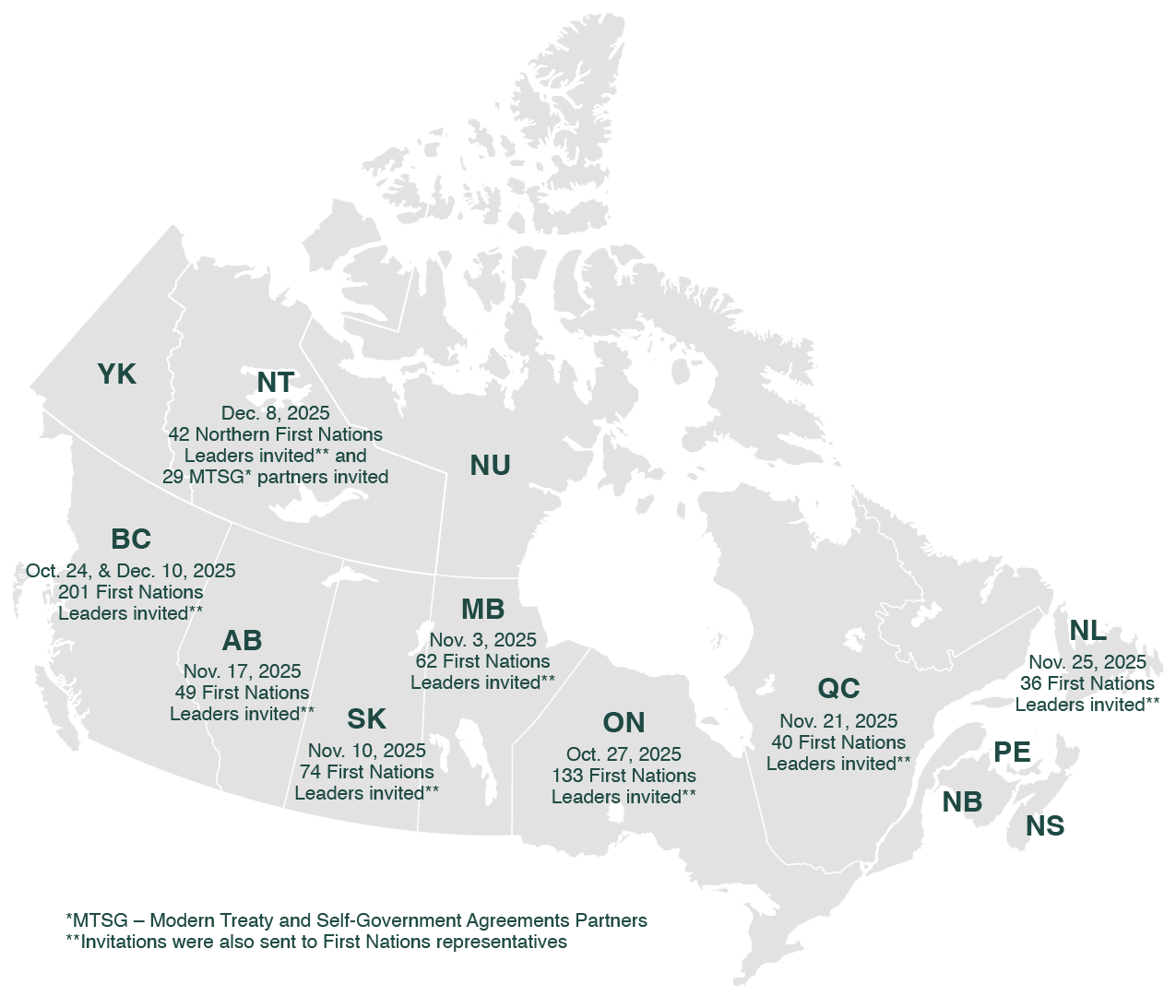
Text version
- In Newfoundland and Labrador, the engagement session was held on November 25, with 36 First Nations Leaders and representatives invited.
- In Quebec City, the engagement session was held on November 21, with 40 First Nations Leaders and representatives invited.
- In Ontario, the engagement session was held on October 27, with 133 First Nations Leaders and representatives invited.
- In Manitoba, the engagement session was held on November 3, with 62 First Nations Leaders and representatives invited.
- In Saskatchewan, the engagement session was held on November 10, with 74 First Nations Leaders and representatives invited.
- In Alberta, the engagement session was held on November 17, with 49 First Nations Leaders and representatives invited.
- In British Columbia, the engagement session was held on November 21, with 40 First Nations Leaders and representatives invited.
- In Northwest Territories, the engagement session was held on December 8, with 42 First Nations Leaders and representatives invited, as well as 29 Modern Treaty and Self-Government Agreement Partners.
Figure 1. Nine regional engagement sessions were held from October 24 to December 10, 2025
3. Information shared by the Major Projects Office
During the sessions, the MPO shared:
- General information about the MPO:An overview of the MPO’s mandate to advance nation-building projects in Canada by streamlining regulatory processes, coordinating financing, and collaborating with federal departments, provinces, territories, Indigenous Peoples, and private-sector partners.
- Updates on referred projects and transformative strategies:Key updates on the projects referred to the MPO, including their current status and progress made. Information on transformative strategies was shared, highlighting priority areas like clean energy, critical minerals, and transportation infrastructure, and how these initiatives align with Canada’s long-term economic and environmental goals.
- The components of the Building Canada Act regarding Indigenous consultation:Details on how the Act embeds Indigenous consultation requirements throughout the project decision-making process, ensuring Indigenous perspectives are integral to the advancement of nation-building projects.
- Outcomes from the First Nations Major Projects Summit and how the Government of Canada is responding:Key insights from the July 17, 2025, First Nations Major Projects Summit, where First Nations leaders shared priorities and concerns on nation-building projects. The MPO explained how this valuable input is shaping policies, including efforts to strengthen Indigenous economic participation; refine project consultation approaches; and address capacity-building needs.
- Information on the Indigenous Advisory Council:An overview of the Indigenous Advisory Council’s role in providing guidance on MPO policies, programs, and processes. The Council will not undertake consultations or make decision on projects but will ensure that Indigenous perspectives, interests, and rights are fully reflected in discussions.
4. Key themes and considerations
4.1 First Nations Leaders and Representatives
Below are some of the key themes and messages that were raised by First Nations leaders and representatives throughout the sessions.
4.1.1 First Nations involvement in decision-making
- First Nations leaders emphasized that proper consultation is needed in substantive decision-making processes regarding project designation, consultation scope, and evaluation of potential impacts.
- First Nations leaders and representatives would like to be actively involved in decisions about projects early on, not just consulted at the last minute. They want to be treated as equal decision-making partners rather than stakeholders or consultees.
- There needs to be adequate advanced notifications about meetings and projects, and clear and timely communication, ensuring important information reaches Chiefs, councils, and others involved in decision-making.
- First Nations want full participation in the planning, designing, and carrying out of major projects.
- There is value of Indigenous knowledge and expertise in developing infrastructure, resource governance, and economic frameworks for major projects.
4.1.2 Federal oversight and processes for projects
- First Nations leaders have concerns about the limitations of federal involvement in major projects that overlap federal and provincial jurisdictions.
- There needs to be straightforward, accessible processes for project intake and addressing support needs such as funding and lack of capacity.
- First Nations emphasized the centrality of Indigenous rights, land stewardship, and environmental protection in evaluating major projects.
- Many First Nations leaders asked the MPO whether projects would go ahead if their consent was not provided and spoke about the definition or different interpretations of "consent".
- Concerns were also raised about how members of the Indigenous Advisory Council were selected, their role, and who they represent.
4.1.3 Accountability to Treaty Rights and legal obligations
- First Nations leaders made it clear that First Nations rights need to be addressed comprehensively.
- The Building Canada Act must respect Treaty rights and align with both Section 35 of the Constitution and the United Nations Declaration on the Rights of Indigenous Peoples (UNDRIP), ensuring that Free, Prior, and Informed Consent (FPIC) is achieved prior to decision-making.
- Indigenous leaders highlighted the limitations of the Government of Canada’s current "duty to consult" framework and the need for better alignment with modern treaty rights and UNDRIP principles around FPIC.
- First Nation communities want guarantees that major projects won’t move forward without their Free, Prior, and Informed Consent.
4.1.4 Meaningful engagement and governance
- First Nations leaders and representatives highlighted that proper communication and coordination are needed to ensure meaningful First Nations engagement.
- First Nations leaders are frustrated with inadequate consultation processes that lack proper funding and timely engagement.
- Request for a more inclusive consultation process that properly accounts for downstream and broad territorial impacts; clarity on consultation procedures; and assurances of meaningful engagement without confusion.
- Increase First Nations participation in planning processes, particularly in projects like Churchill, Port Nelson, and Northern infrastructure.
- First Nations are frustrated over the lack of proper consultation on safe drinking water and other community-based issues that are limiting prosperity.
4.1.5 Funding and resource allocation
- First Nations leaders and representatives pointed out that many communities do not have enough funding, staff, or time to fully respond to consultation requests or participate in planning major projects.
- First Nations leaders noted that a lack of allocated resources for First Nations to participate in major projects would undermine the sense of partnership and inclusion.
- There were concerns over cuts to the federal budget, highlighting the critical need for sufficient funding and support for Indigenous communities to build capacity to meaningfully engage in major project development and consultation processes.
- First Nations leaders and representatives suggested focusing on creating sustainable and meaningful major project opportunities and leveraging provincial capabilities in ways that align with Indigenous support and priorities.
- First Nations requested that mechanisms be put in place to ensure smaller or under-resourced communities can get involved, so no one is left out.
4.1.6 Environmental and resource stewardship
- There is a strong need for governments to take responsibility for safeguarding the environment alongside Indigenous voices. Major projects should carefully assess cumulative impacts and protect the land, water, and cultural sites for future generations.
- First Nations leaders want strong systems to monitor and enforce environmental protections, project conditions, and consultation commitments.
- First Nations are concerned about "fast-tracking" major projects, bypassing critical regulations and oversight.
- Consideration should be provided to meaningful environmental protection and restoration for areas already affected by industrial activity.
- First Nations leaders and representatives are concerned about environmental degradation, contamination, and wildlife impacts from industrial activities, particular with projects like critical mineral mining.
4.1.7 Economic participation and opportunities
- First Nations leaders and representatives want fair access to jobs; business opportunities; royalties; revenue sharing; and the ability to participate in and benefit financially from projects.
- Need for First Nations participation in economic opportunities through procurement and equity in project structures.
- Many First Nations communities lack essential infrastructure (like reliable internet and road access) and resources for job training or skilled personnel, which makes it hard to do business, access services, or be part of high-tech opportunities. Addressing these gaps is necessary for communities to fully benefit from major development projects, and to have opportunities as co-owners or partners in projects.
- Support is needed with hiring skilled staff and building capacity to manage and benefit from major projects without overloading existing resources.
- First Nations leaders spoke about how communities need better housing, roads, and other infrastructure so they can support workers and take part in larger development projects.
- First Nations want assurance that major projects create opportunities, diffuse racist stereotypes, and bring real benefits to support jobs and new businesses.
- Advocacy for First Nations equity ownership in major projects, particularly energy infrastructure.
- Additionally, First Nations leaders commented on their interest in renewable energy as a sustainable alternative to outdated systems powered by diesel. First Nations leaders highlighted specific energy challenges for diesel-dependent communities and the limitations for addressing these issues without sufficient federal support.
4.1.8 Key takeaways from First Nations Leaders and Representatives
The sessions highlighted several areas of focus for the MPO as work moves forward with First Nations:
- Ensure transparency about MPO processes;
- Provide funding to support First Nations participation with MPO-related business;
- Implement and undertake meaningful consultation;
- Include First Nations perspectives at all stages of major project planning and designations (per the Act);
- Support the safeguarding of the environment, including understanding for cumulative effects; and
- Supporting mechanisms that facilitate Indigenous equity ownership.
4.2 Ministerial and Major Projects Office participation
Several Ministers participated (refer to Participant section) and provided the following key messages.
4.2.1 Commitment to listening and consultation
Ministers affirmed that the Government of Canada is listening carefully to the important feedback shared. They emphasized that meaningful consultation, including free, prior and informed consent, is essential to effectively implement the Act. They highlighted that major projects will provide meaningful engagement with impacted Indigenous communities. Under the Building Canada Act, for projects designated in the national interest, this consultation is required: it’s protected by the Canadian Constitution and is embedded in this legislation.
4.2.2 The importance of Indigenous contributions to the economy
Ministers recognized the vital contributions of Indigenous Peoples to the Canadian economy. They noted the central role First Nations play in advancing clean energy, opening trade and transportation corridors, and fostering partnerships that drive local and regional economic growth. Ministers emphasized that Indigenous-led initiatives and businesses are helping create new jobs and cultivate economic diversity. The Government of Canada’s long-term vision is to make these partnerships the norm, ensuring they become an integral part of Canada’s economic framework.
4.2.3 Economic reconciliation
The concept of "economic reconciliation" was a central message shared by Ministers. For the Government of Canada, this involves engaging Indigenous Peoples from the very beginning of projects – as equal partners. Economic reconciliation means providing Indigenous communities with opportunities for co-ownership of projects, for helping to shape key decisions, and for directly sharing in the benefits generated by those initiatives. Ministers reiterated their strong commitment to working alongside Indigenous communities to make this vision a reality. To that end, the Government of Canada is providing $40 million over three years to support the participation of Indigenous leadership in nation-building projects, with a focus on supporting consultation activities for projects being considered under the Building Canada Act and supporting community readiness.
4.2.4 Recognizing cumulative effects
Ministers emphasized the importance of addressing cumulative effects when evaluating major projects and ensuring adequate environmental protections are put in place. First Nations communities have an intimate knowledge of their lands, which can help the MPO better understand and assess the broader environmental, social, and cultural impacts of proposed developments. Ministers recognized this knowledge as a critical component in this process.
4.2.5 Commitment to clean water and infrastructure development
Ministers underscored the continued focus on addressing clean water and essential infrastructure challenges in Indigenous communities. While infrastructure development is not managed directly by the MPO, the Government of Canada remains committed to supporting the communities that continue to experience water-related challenges. Budget 2025 includes dedicated funding to advance progress in building and upgrading infrastructure, while also bolstering the capacity of communities to maintain and operate these systems effectively.
4.2.6 Expanding opportunities for Indigenous procurement and investment
Ministers referred to the opportunities available for Indigenous Peoples to actively participate in procurement processes connected to national projects and highlighted the Government of Canada’s support for their engagement. Indigenous communities and organizations interested in participating in major projects or investing in them are encouraged to engage with the MPO for further discussions on potential opportunities.
4.2.7 Addressing challenges of economic development and land acquisition
Ministers acknowledged feedback regarding barriers faced by Indigenous communities in pursuing economic development and land acquisition, including challenges related to discriminatory attitudes toward land purchases. They highlighted the recent reforms to the Additions to Reserve policy; shared positive examples of successful urban Reserve developments; and reiterated their commitment to supporting Indigenous communities in navigating these processes. Ministers affirmed their willingness to work with communities in overcoming obstacles and fostering greater equity and inclusion.
4.2.8 Key takeaways from ministerial participation
Throughout the discussion, Ministers expressed a shared commitment to:
- Ensure meaningful consultation, including free, prior and informed consent, and respecting Indigenous rights in accordance with Canada’s legal and constitutional obligations;
- Build strong economic partnerships with Indigenous communities, grounded in co-creation, co-ownership, and shared benefits;
- Advance environmental sustainability and stewardship, leveraging Indigenous knowledge at all stages of project evaluation;
- Invest in clean water and infrastructure, supporting communities with both the development and ongoing maintenance of critical infrastructure;
- Expand opportunities for Indigenous procurement, entrepreneurship, and equity participation to achieve economic reconciliation; and
- Acknowledge and address challenges to economic development, such as land purchases and systemic barriers, while providing tangible solutions and support.
5. Next steps
The MPO has taken note of the important concerns raised during the sessions and will continue to consider them. We will also engage First Nations leaders and the Indigenous Advisory Council on ways to ensure we reflect these concerns as we build processes, policies, and operations for the MPO.
Where concerns lay outside of the MPO’s mandate, we will share them with the appropriate federal government department or agency and will continue to work with proponents to ensure projects comply with consultation requirements.
Any outstanding questions brought up during the sessions will also be addressed with participants directly.
The MPO would like to thank First Nations leaders and representatives for participating in these regional engagement sessions and welcomes additional meetings to learn more and continue working together.
Please contact the MPO for further information on the regional engagement sessions and/or to request a copy of the background presentation provided to participants.
6. Contact information
Email: info@mpo-bgp.gc.ca
Website: canada.ca/majorprojectsoffice
Page details
- Date modified: