
National Vaccination Coverage Goals and Vaccine Preventable Disease Reduction Targets by 2025
As part of the National Immunization Strategy objectives for 2016-2021, vaccination coverage goals and vaccine preventable disease (VPD) reduction targets were set based on international standards and best practices. The goals and targets are consistent with Canada's commitment to the World Health Organization's (WHO) disease elimination targets and Global Vaccine Action Plan, while reflecting the Canadian context.
Table of Contents
- Vaccination Coverage Goals by 2025
- Vaccine Preventable Disease Reduction Targets by 2025
Vaccination Coverage Goals by 2025
Vaccination coverage goals were developed for infant, childhood, adolescent and adult vaccines that are publicly funded in all provinces and territories (PT). Progress toward the national vaccination coverage goals is reported based on the data collected using national coverage surveys, such as the childhood National Immunization Coverage Survey (cNICS), the adult National Immunization Coverage Survey (aNICS) and the Seasonal Influenza Vaccination Coverage Survey. Vaccine coverage monitoring at the national level takes into account variations in PT vaccination programs.
Infants and Children
To ensure children are protected through routine vaccination, a high vaccination coverage goal of 95% has been established for all childhood vaccines by 2 and 7 years of age.
This level of vaccination coverage is based on the level of population protection required for measles, the most easily spread vaccine preventable disease.
Achieve 95% vaccination for the first 3 doses of the pertussis vaccine for infants
The majority of hospitalizations due to pertussis occur in infants under 1 year of age. The first 3 doses of the vaccine are highly effective in preventing death. Specific vaccination goals have been set for infants under 1 year of age.
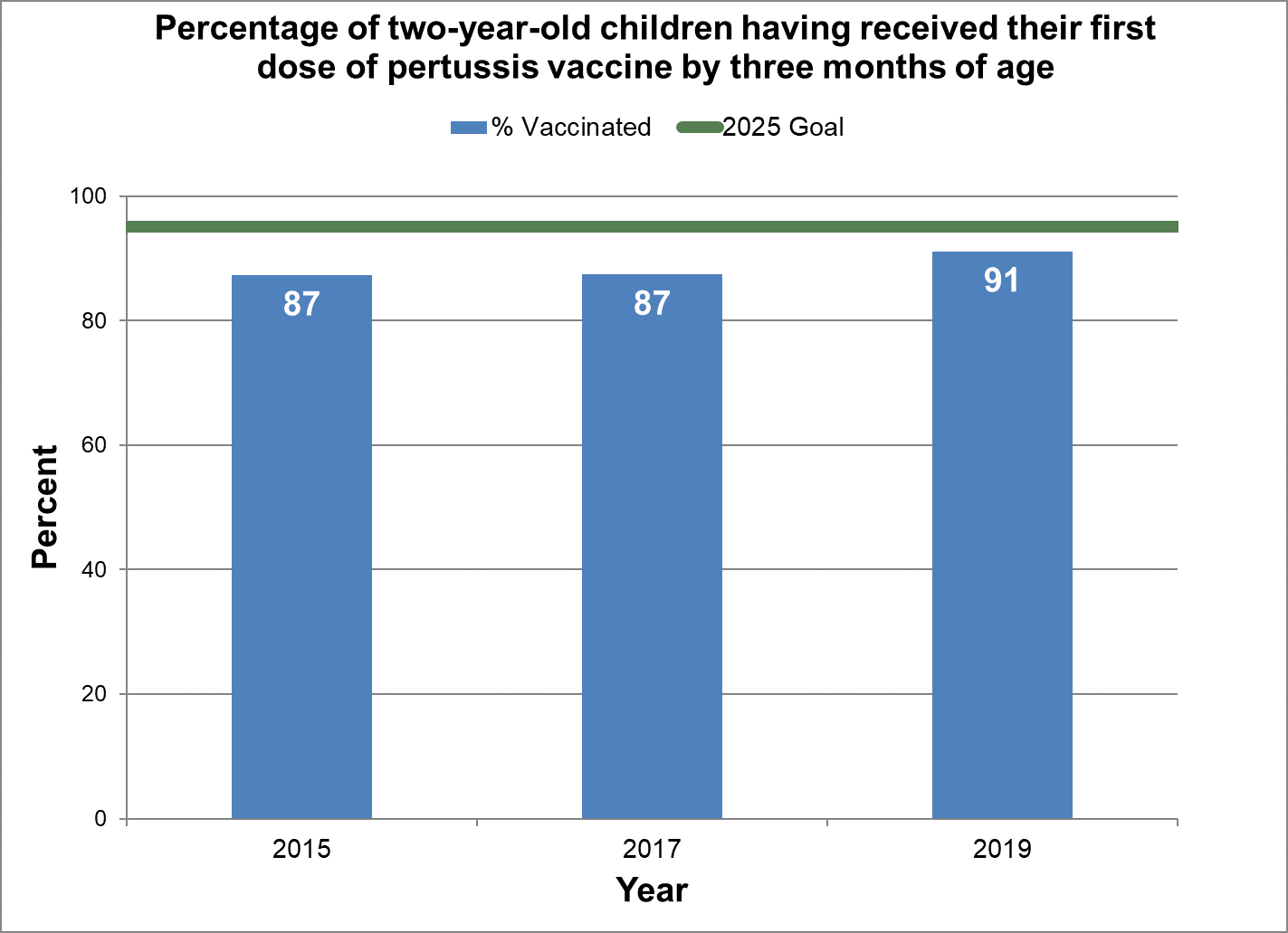
First dose of pertussis vaccine by 3 months of age
- Baseline:
- In 2015, 87% of 2 -year-old children in Canada had their first dose of pertussis vaccine by 3 months of age.
- Target:
- 95%
- Data sources:
- Childhood National Immunization Coverage Survey (cNICS) 2015, 2017, 2019 and 2021
Figure 1 - Percentage of 2-year-old children having received their first dose of pertussis vaccine by 3 months of age
Text description: Figure 1
| Percent | Year | 2025 vaccination goal |
|---|---|---|
| 87.3 | 2015 | 95 |
| 87.4 | 2017 | 95 |
| 91.1 | 2019 | 95 |
| 90.6 | 2021 | 95 |
Three doses of pertussis vaccine by 7 months of age
- Baseline:
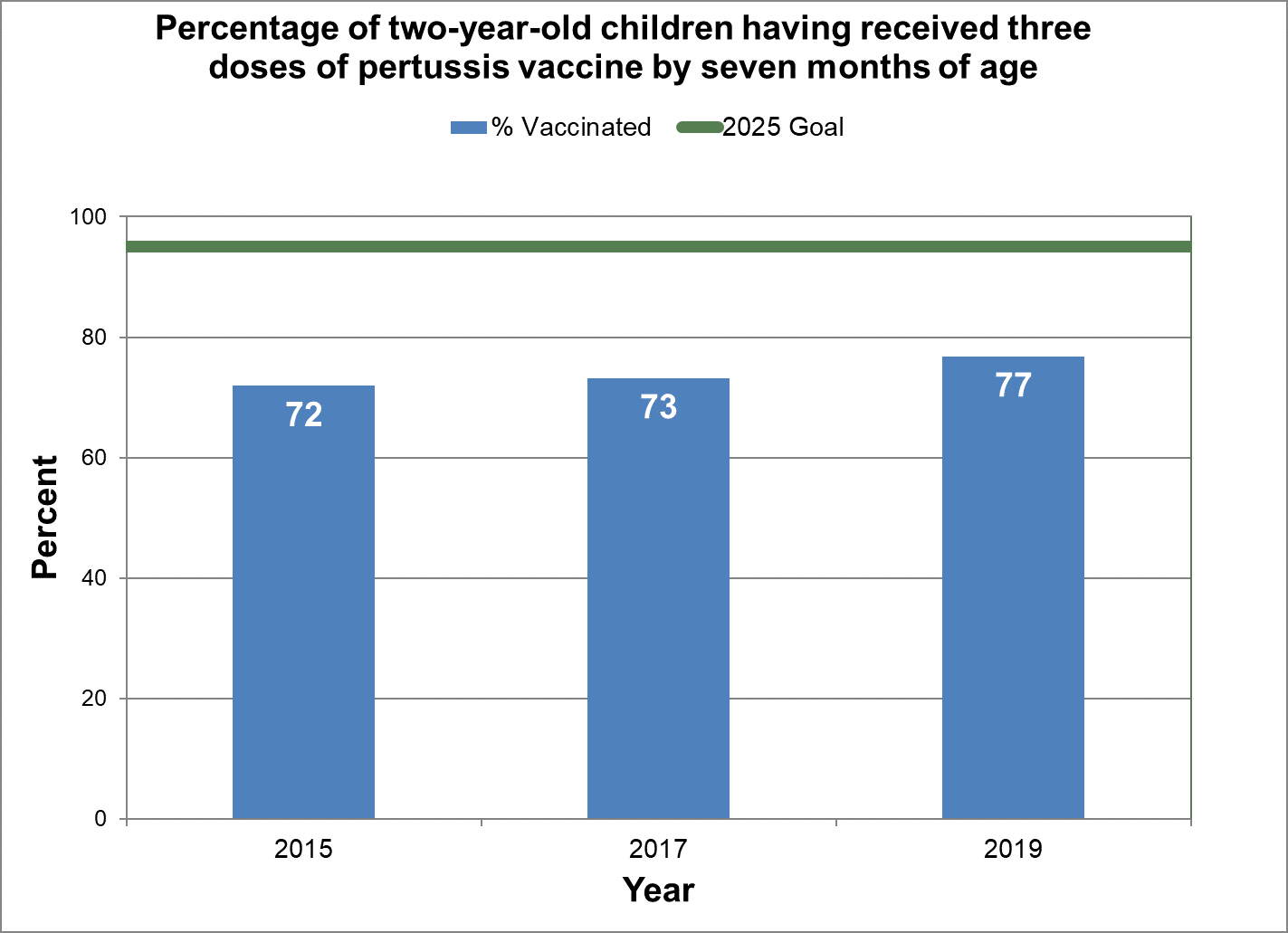
- In 2015, 72% of two-year-old children in Canada had 3 doses of pertussis vaccine by 7 months of age.
- Target:
- 95%
- Data sources:
- Childhood National Immunization Coverage Survey (cNICS) 2015, 2017, 2019 and 2021.
- Notes:
- Based on the immunization schedule in Quebec as of April 2019, only 2 doses of pertussis are required by 7 months (2 months, 4 months) for children born after June 1, 2019. Coverage estimates from the 2017, 2019 and 2021 cNICS are calculated based on a 3 dose schedule as this change did not yet apply to children in the corresponding age cohorts, but will be changed for future cycles.
Figure 2 - Percentage of 2-year-old children having received 3 doses of pertussis vaccine by 7 months of age
Text description: Figure 2
| Percent | Year | 2025 vaccination goal |
|---|---|---|
| 71.9 | 2015 | 95 |
| 73.2 | 2017 | 95 |
| 76.8 | 2019 | 95 |
| 76.4 | 2021 | 95 |
Three doses of pertussis vaccine by 12 months
- Baseline:
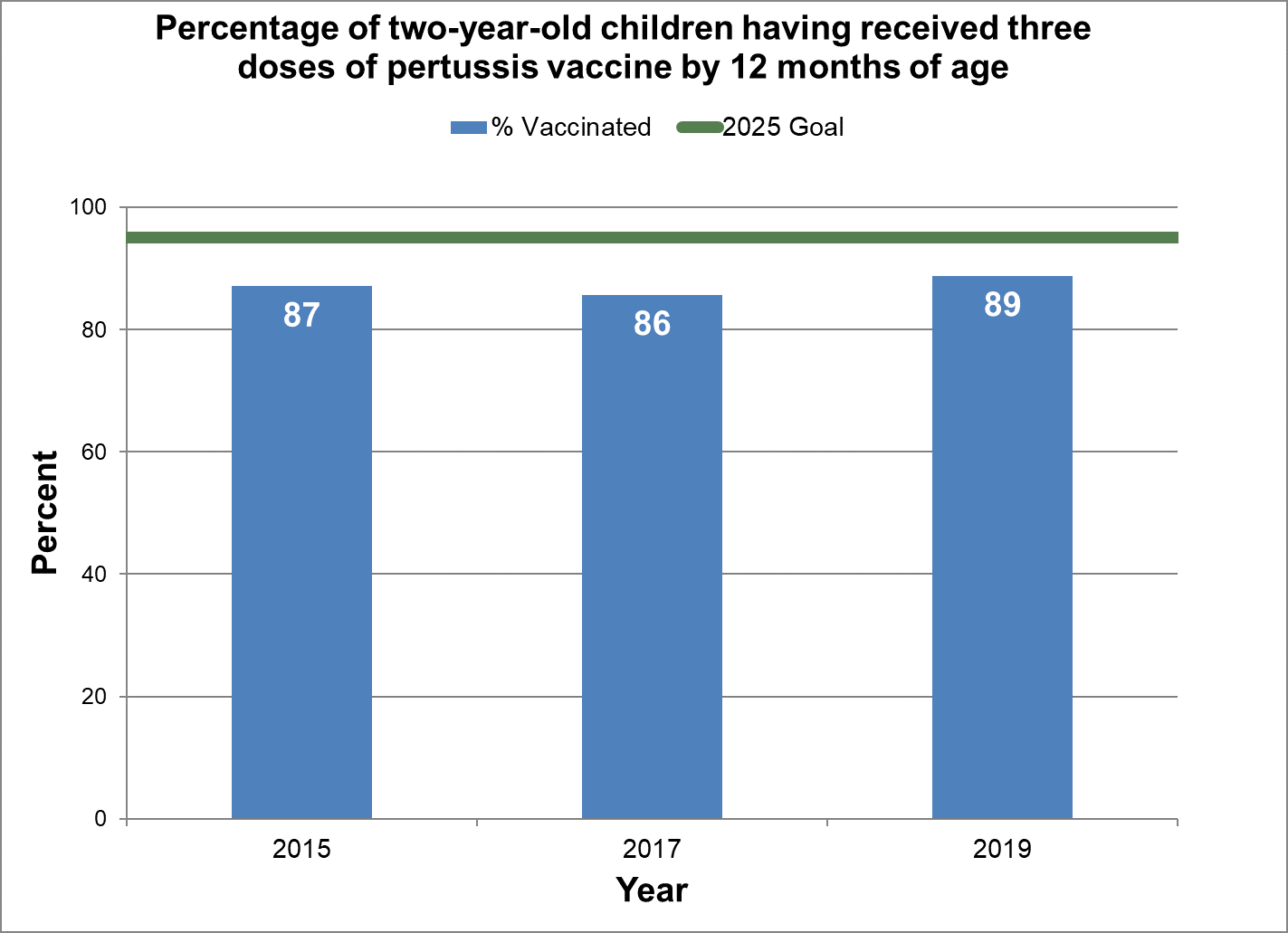
- In 2015, 87% of 2-year-old children in Canada had 3 doses of pertussis vaccine by 12 months of age.
- Target:
- 95%
- Data sources:
- Childhood National Immunization Coverage Survey (cNICS) 2015, 2017, 2019 and 2021.
- Notes:
- Based on the immunization schedule in Quebec as of April 2019, only 2 doses of pertussis are required by 12 months (2 months, 4 months) for children born after June 1, 2019. Coverage estimates from the 2017, 2019 and 2021 cNICS are calculated based on a 3 dose schedule as this change did not yet apply to children in the corresponding age cohorts, but will be changed for future cycles.
Figure 3 - Percentage of 2-year-old children having received 3 doses of pertussis vaccine by 12 months of age
Text description: Figure 3
| Percent | Year | 2025 vaccination goal |
|---|---|---|
| 87.1 | 2015 | 95 |
| 85.7 | 2017 | 95 |
| 88.8 | 2019 | 95 |
| 87.6 | 2021 | 95 |
Achieve 95% vaccination coverage by 2 years of age for the following childhood vaccines:
Four doses of diphtheria, tetanus, pertussis and Haemophilus influenzae type B (Hib) vaccine
- Baseline:
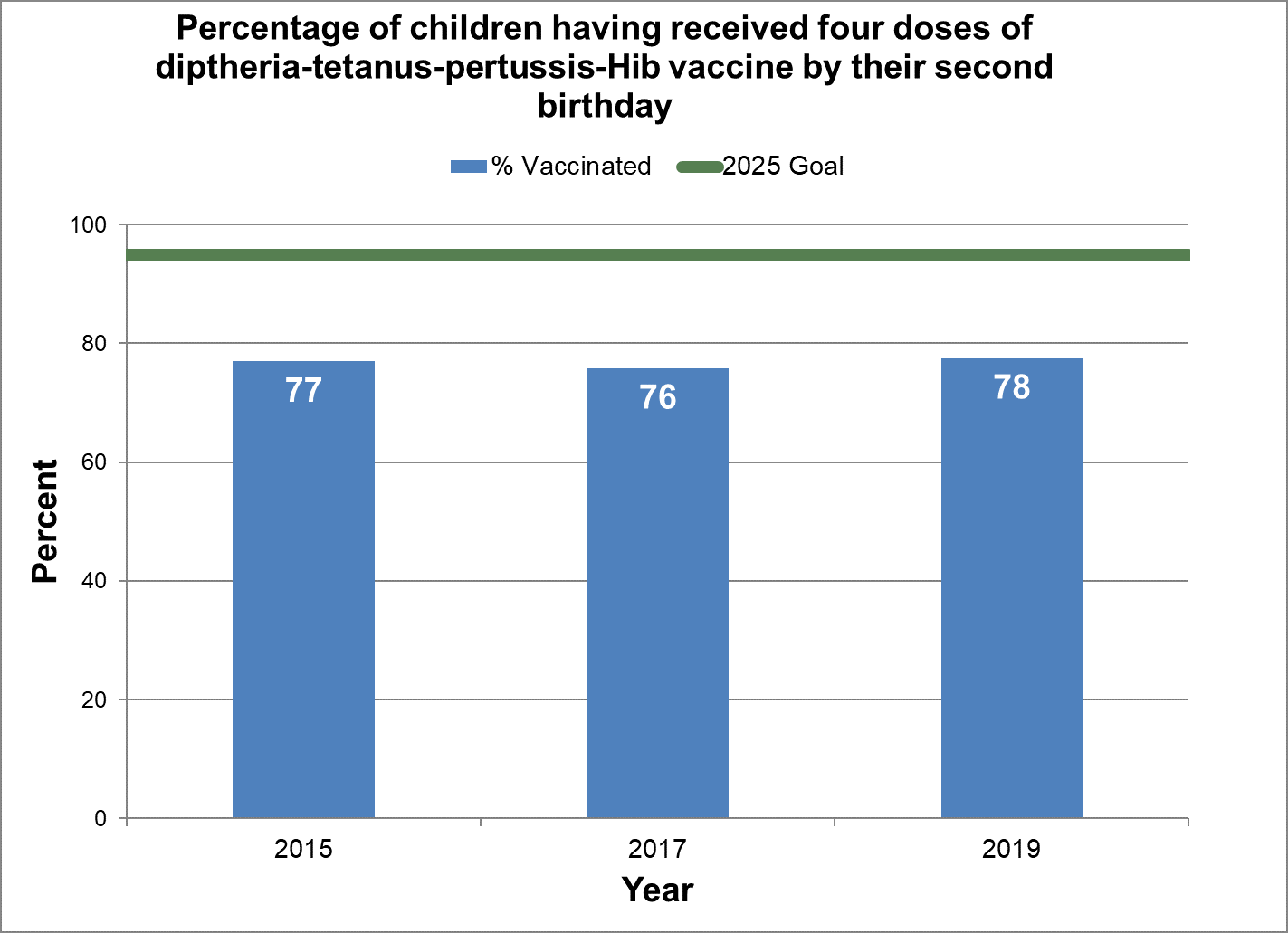
- In 2015, 77% of 2-year-old children in Canada had 4 doses of diphtheria, tetanus, pertussis and Hib vaccine by their second birthday.
- Target:
- 95%
- Data sources:
- Childhood National Immunization Coverage Survey (cNICS) 2015, 2017, 2019 and 2021.
- Notes:
- Based on the immunization schedule in Quebec as of April 2019, only 3 doses of pertussis are required by 2 years (2 months, 4 months, 12 months) for children born after June 1, 2019. Coverage estimates from the 2017, 2019 and 2021 cNICS are calculated based on a 3-dose schedule as this change did not yet apply to children in the corresponding age cohorts, but will be changed for future cycles.
Figure 4 - Percentage of children having received 4 doses of diphtheria, tetanus, pertussis and Haemophilus influenzae type B (Hib) vaccine by their second birthday
Text description: Figure 4
| Percent | Year | 2025 vaccination goal |
|---|---|---|
| 76.9 | 2015 | 95 |
| 75.8 | 2017 | 95 |
| 77.5 | 2019 | 95 |
| 77.1 | 2021 | 95 |
Three doses of polio vaccine
- Baseline:
- In 2015, 91% of 2 -year-old children in Canada had 3 doses of polio vaccine by their second birthday.
- Target:
- 95%
- Data sources:
- Childhood National Immunization Coverage Survey (cNICS) 2015, 2017, 2019 and 2021.
Figure 5 - Percentage of children having received 3 doses of polio-containing vaccine by their second birthday
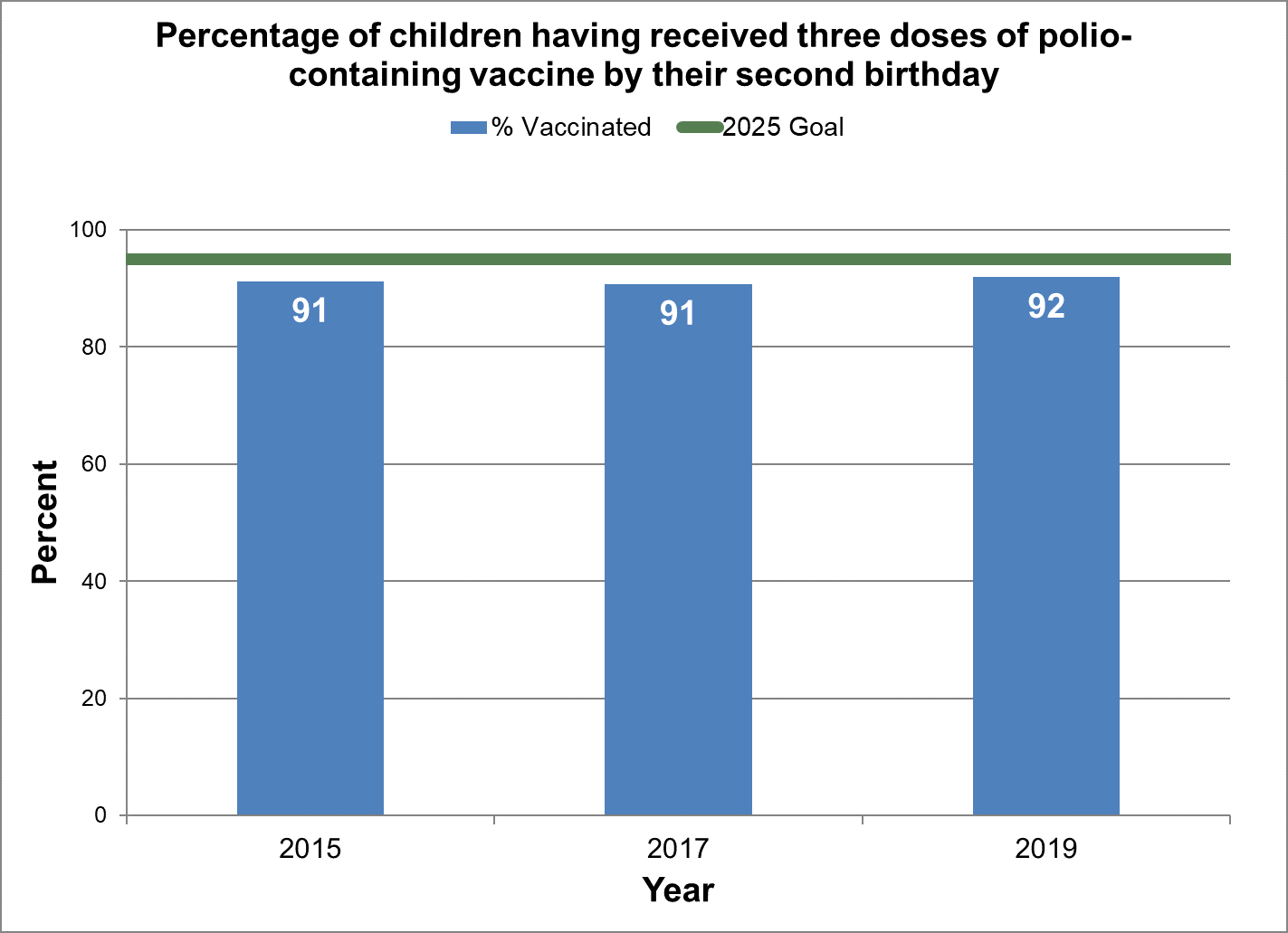
Text description: Figure 5
| Percent | Year | 2025 vaccination goal |
|---|---|---|
| 91.2 | 2015 | 95 |
| 90.7 | 2017 | 95 |
| 91.9 | 2019 | 95 |
| 91.8 | 2021 | 95 |
Three doses of hepatitis B vaccine among children targeted in publicly-funded programs
- Baseline:
- In 2015, 69% of 2-year-old children in Canada had 3 doses of hepatitis B vaccine by their second birthday
- Target:
- 95%
- Data sources:
- Childhood National Immunization Coverage Survey (cNICS) 2015, 2017 and 2019 and 2021
- Notes:
-
Coverage estimates were measured in jurisdictions where a 3-dose program for infants was in place (British Columbia, Québec, New Brunswick, Prince Edward Island, Yukon, Northwest Territories, and Nunavut). In Alberta, children born as of March 31, 2018, are eligible for the DTaP-HB-Hib vaccine at 2, 4 and 6 months and this will be reflected in the next cycle of the cNICS.
In other jurisdictions, the vaccine is given at school.
High vaccination coverage is required to support the WHO goal of eliminating viral hepatitis by 2030.
Figure 6 - Percentage of children having received 3 doses of hepatitis B vaccine by their second birthday
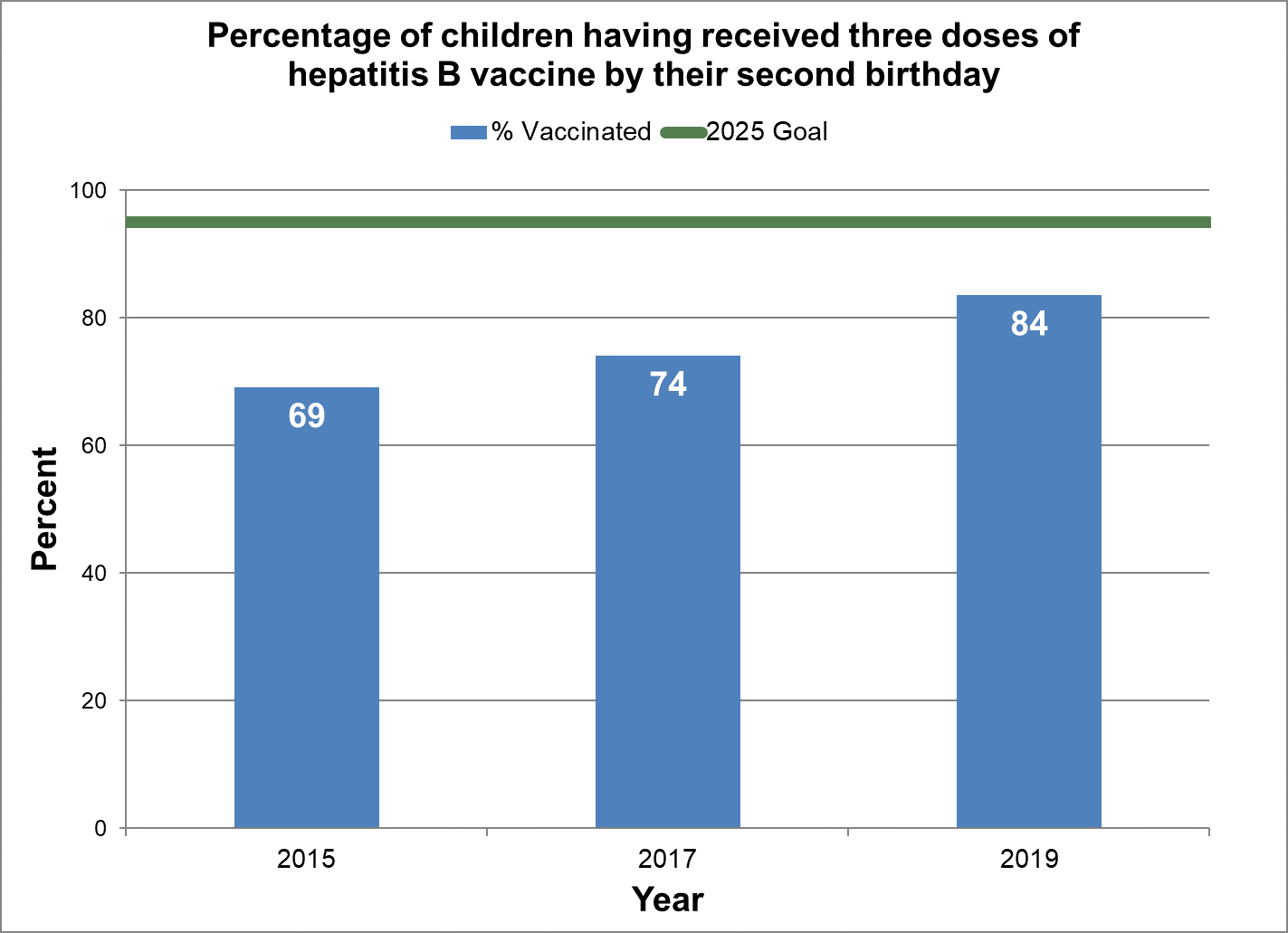
Text description: Figure 6
| Percent | Year | 2025 vaccination goal |
|---|---|---|
| 69.2 | 2015 | 95 |
| 74.1 | 2017 | 95 |
| 83.6 | 2019 | 95 |
| 82.6 | 2021 | 95 |
One dose of measles, mumps, and rubella vaccine
- Baseline:
- In 2015, 89% of 2 -year-old children in Canada had their first dose of measles, mumps and rubella vaccine before their second birthday.
- Target:
- 95%
- Data sources:
- Childhood National Immunization Coverage Survey (cNICS) 2015, 2017, 2019 and 2021.
- Notes:
- The estimates for mumps coverage are used to report on uptake of the measles, mumps and rubella (MMR) vaccines. Measles is not used because foreign-born children in Canada may have received the monovalent measles vaccine in another country and coverage would consequently be higher.
Figure 7 - Percentage of children having received 1 dose of measles, mumps and rubella vaccine by their second birthday
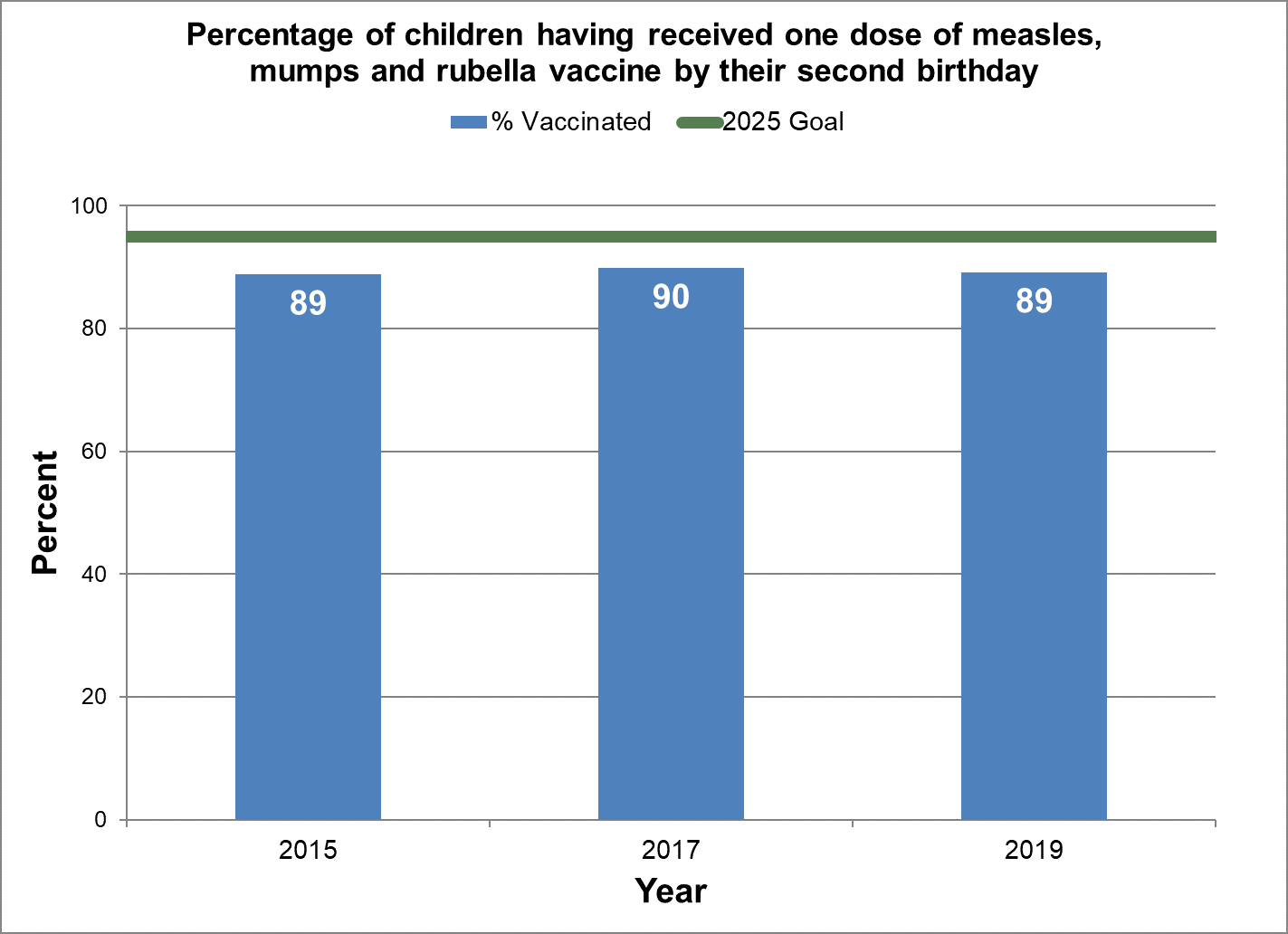
Text description: Figure 7
| Percent | Year | 2025 vaccination goal |
|---|---|---|
| 88.9 | 2015 | 95 |
| 89.9 | 2017 | 95 |
| 89.2 | 2019 | 95 |
| 91.5 | 2021 | 95 |
One dose of varicella vaccine
- Baseline:
- In 2017, at least 83% of 2-year-old children in Canada had their first dose of varicella vaccine before their second birthday.
- Target:
- 95%
- Data sources:
-
Childhood National Immunization Coverage Survey (cNICS) 2015, 2017, 2019 and 2021.
- Notes:
- Due to an issue with data collection, varicella vaccination was underreported in previous cNICS cycles (see cNICS 2015 for more information). This issue was corrected from cNICS 2017 onwards.
Figure 8 - Percentage of children having received 1 dose of varicella-containing vaccine by their second birthday

Text description: Figure 8
| Percent | Year | 2025 vaccination goal |
|---|---|---|
| 82.9 | 2017 | 95 |
| 82.7 | 2019 | 95 |
| 87.5 | 2021 | 95 |
Three or 4 doses of pneumococcal vaccine
- Baseline:
- In 2015, 80% of 2-year-old children in Canada had 3 or 4 doses of pneumococcal vaccine by their second birthday.
- Target:
- 95%
- Data sources:
- Childhood National Immunization Coverage Survey (cNICS) 2015, 2017, 2019 and 2021.
- Notes:
- Vaccination coverage is estimated by a 4-dose program in Northwest Territories and Nunavut; 3-dose program in all other provinces/territories.
Figure 9 - Percentage of children having received 3 or 4 doses of pneumococcal vaccine by their second birthday
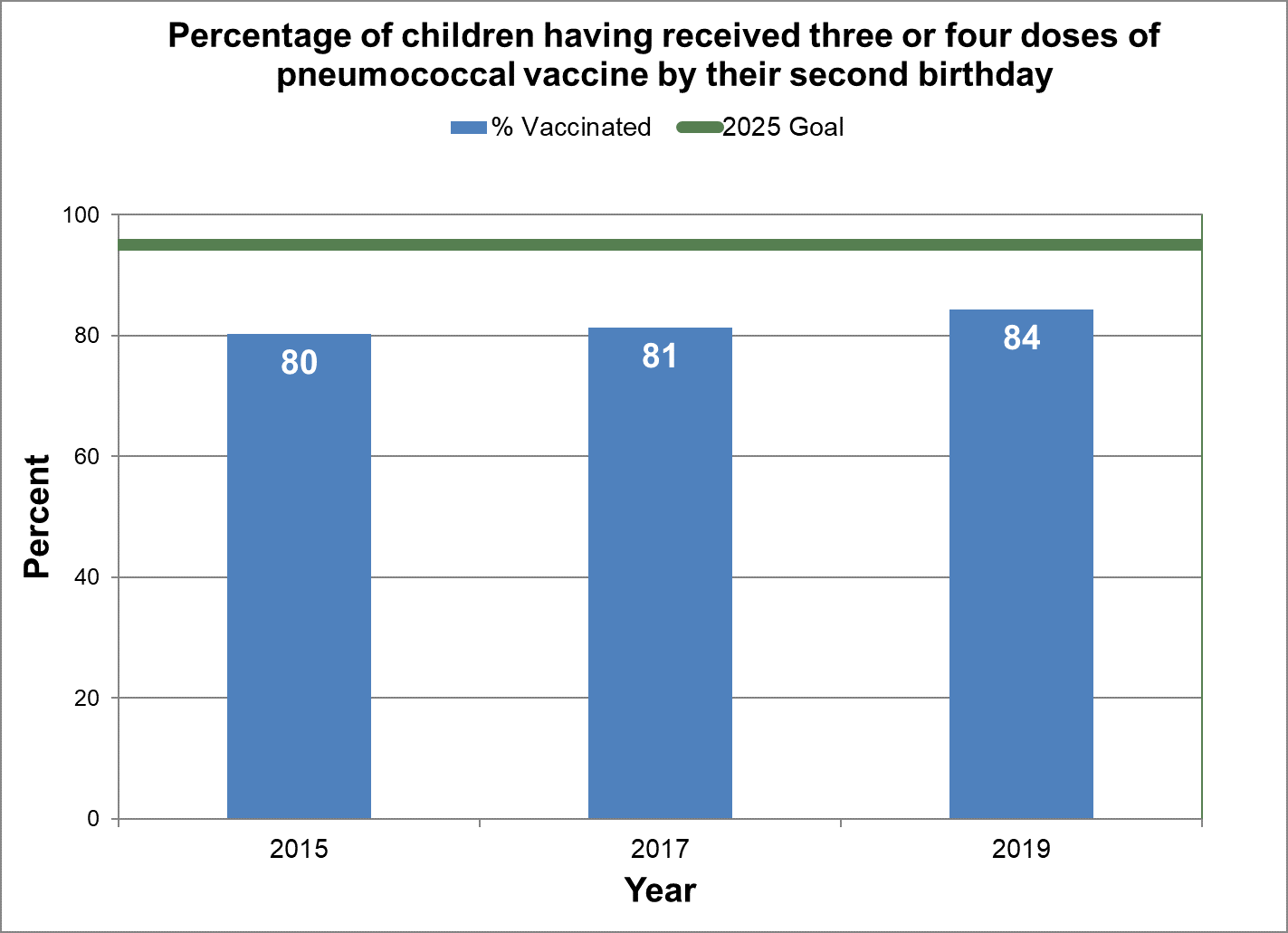
Text description: Figure 9
| Percent | Year | 2025 vaccination goal |
|---|---|---|
| 80.3 | 2015 | 95 |
| 81.4 | 2017 | 95 |
| 84.4 | 2019 | 95 |
| 85.1 | 2021 | 95 |
One dose of meningococcal C vaccine
- Baseline:
- In 2015, 88% of 2-year-old children in Canada had at least 1 dose of meningococcal C vaccine before their second birthday.
- Target:
- 95%
- Data sources:
- Childhood National Immunization Coverage Survey (cNICS) 2015, 2017, 2019 and 2021
- Notes:
- Vaccination coverage is estimated by a 2-dose program in British Columbia, Alberta, Yukon and Northwest Territories; and by a 1-dose program in all other provinces/territories.
Figure 10 - Percentage of children having received at least 1 dose of meningococcal C vaccine by their second birthday

Text description: Figure 10
| Percent | Year | 2025 vaccination goal |
|---|---|---|
| 87.8 | 2015 | 95 |
| 87.6 | 2017 | 95 |
| 91.1 | 2019 | 95 |
| 90.5 | 2021 | 95 |
Achieve 95% vaccination coverage by 7 years of age for the following childhood vaccines:
Five doses of diphtheria, tetanus and pertussis vaccine
- Baseline:
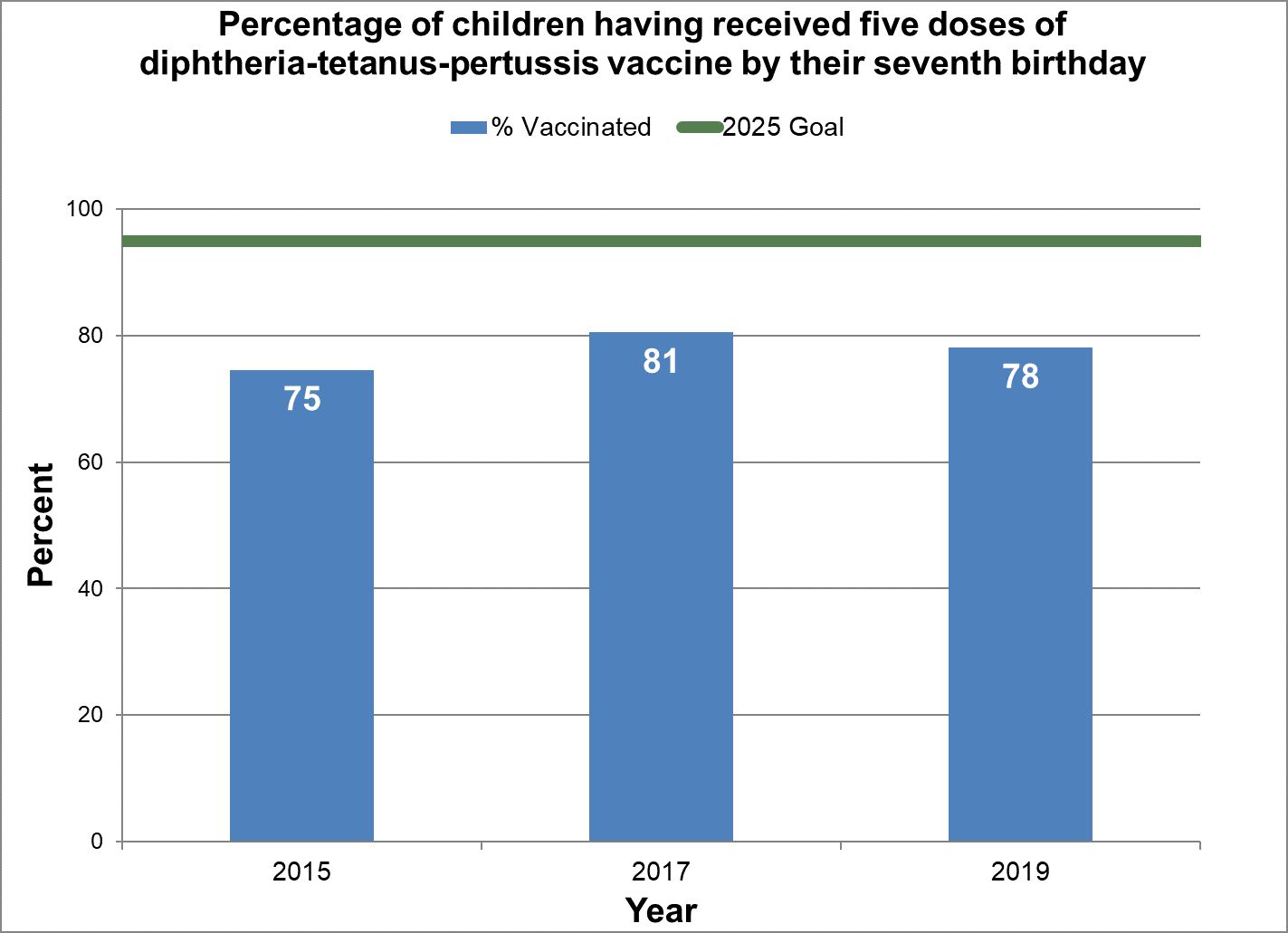
- In 2015, 75% of 7-year-old children in Canada had 5 doses of diphtheria, tetanus and pertussis vaccine by their seventh birthday.
- Target:
- 95%
- Data sources:
- Childhood National Immunization Coverage Survey (cNICS) 2015, 2017, 2019 and 2021.
- Notes:
- Based on the immunization schedule in Quebec as of April 2019, 4 doses of pertussis are required by 7 years (2 months, 4 months, 12 months and 4-6 years) for children born after June 1, 2019. Coverage estimates from the 2017, 2019 and 2021 cNICS are calculated based on a 5-dose schedule as this change did not yet apply to children in the corresponding age cohorts, but will be changed for future cycles.
Figure 11 - Percentage of children having received 5 doses of diphtheria-tetanus-pertussis vaccine by their seventh birthday
Text description: Figure 11
| Percent | Year | 2025 vaccination goal |
|---|---|---|
| 74.6 | 2015 | 95 |
| 80.5 | 2017 | 95 |
| 78.1 | 2019 | 95 |
| 71.9 | 2021 | 95 |
Four doses of polio vaccine
- Baseline:
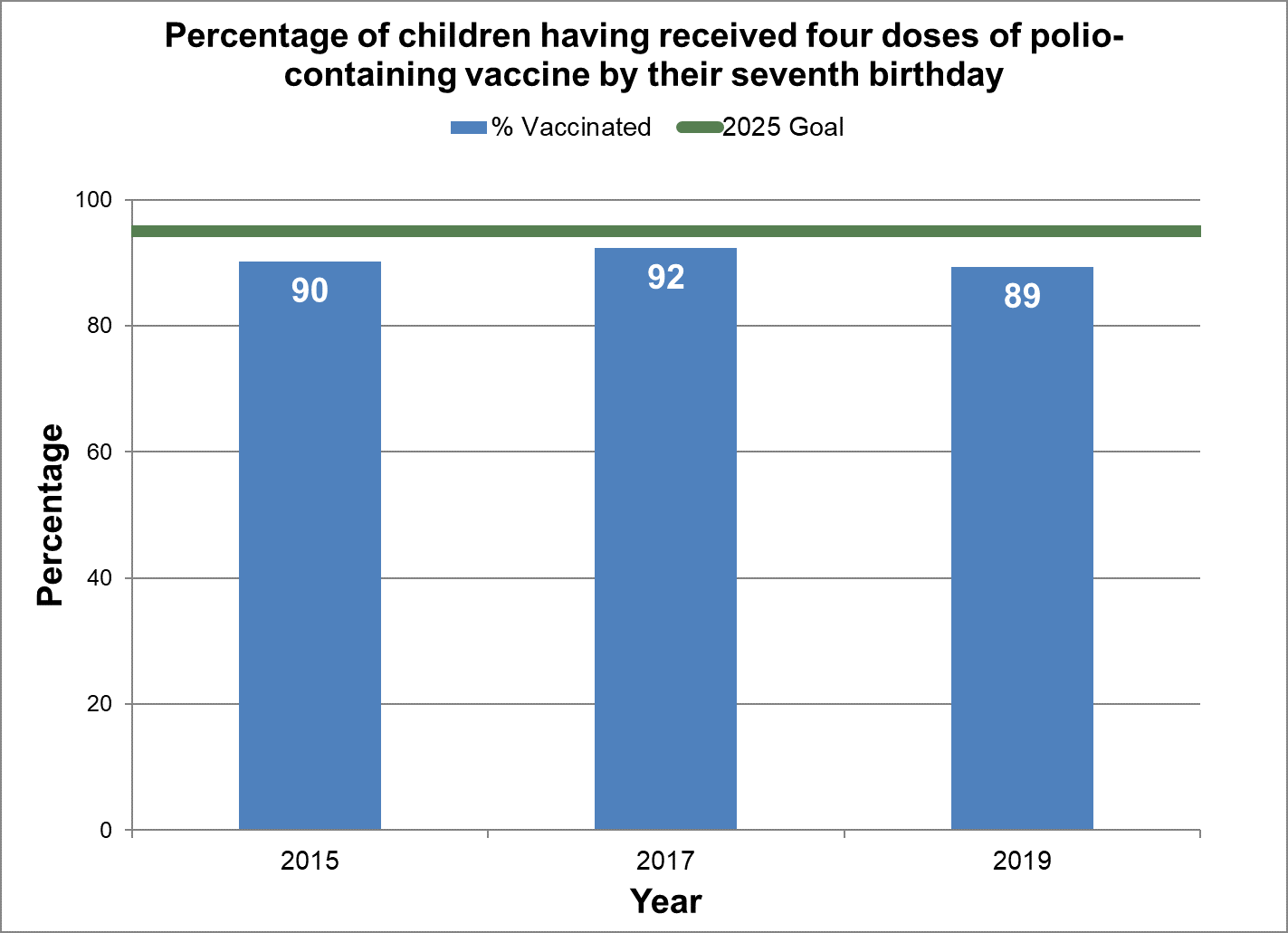
- In 2015, 90% of 7-year-old children in Canada had 4 doses of polio vaccine by their seventh birthday.
- Target:
- 95%
- Data sources:
- Childhood National Immunization Coverage Survey (cNICS) 2017, 2019 and 2021
Figure 12 - Percentage of children having received 4 doses of polio vaccine by their seventh birthday
Text description: Figure 12
| Percent | Year | 2025 vaccination goal |
|---|---|---|
| 90.2 | 2015 | 95 |
| 92.3 | 2017 | 95 |
| 89.3 | 2019 | 95 |
| 87.3 | 2021 | 95 |
Two doses of measles, mumps, and rubella vaccine
- Baseline:
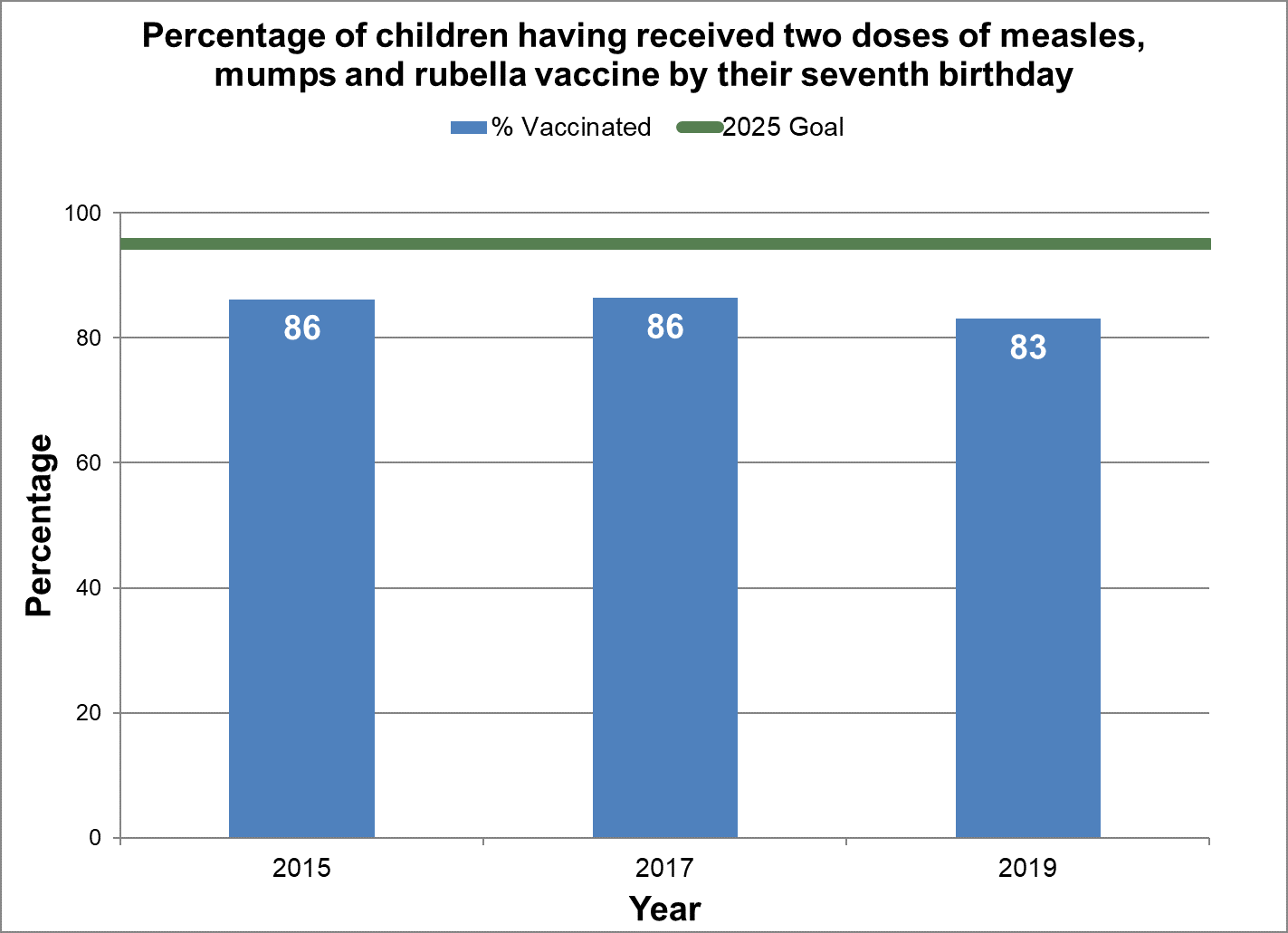
- In 2015, 86% of seven-year-old children in Canada had 2 doses of measles, mumps, and rubella vaccine by their seventh birthday.
- Target:
- 95%
- Data sources:
- Childhood National Immunization Coverage Survey (cNICS) 2015, 2017, 2019 and 2021.
- Notes:
- The coverage estimates for mumps coverage are used to report on uptake of the measles, mumps and rubella (MMR) vaccine. Measles vaccine coverage is not used because foreign-born children in Canada may have received the monovalent measles vaccine in another country and coverage would by consequence be higher.
Figure 13 - Percentage of children having received 2 doses of measles, mumps and rubella vaccine by their seventh birthday
Text description: Figure 13
| Percent | Year | 2025 vaccination goal |
|---|---|---|
| 86.2 | 2015 | 95 |
| 86.4 | 2017 | 95 |
| 83.1 | 2019 | 95 |
| 79.5 | 2021 | 95 |
Adolescents
The vaccine coverage goal of 90% for all adolescent vaccines is based on disease reduction targets, program impact, disease characteristics, achievability, and jurisdictional variation in vaccination programs as well as quality of and effectiveness of the vaccine.
Achieve 90% vaccination coverage by 17 years of age for the following adolescent vaccines:
One dose of meningococcal vaccine
- Baseline:
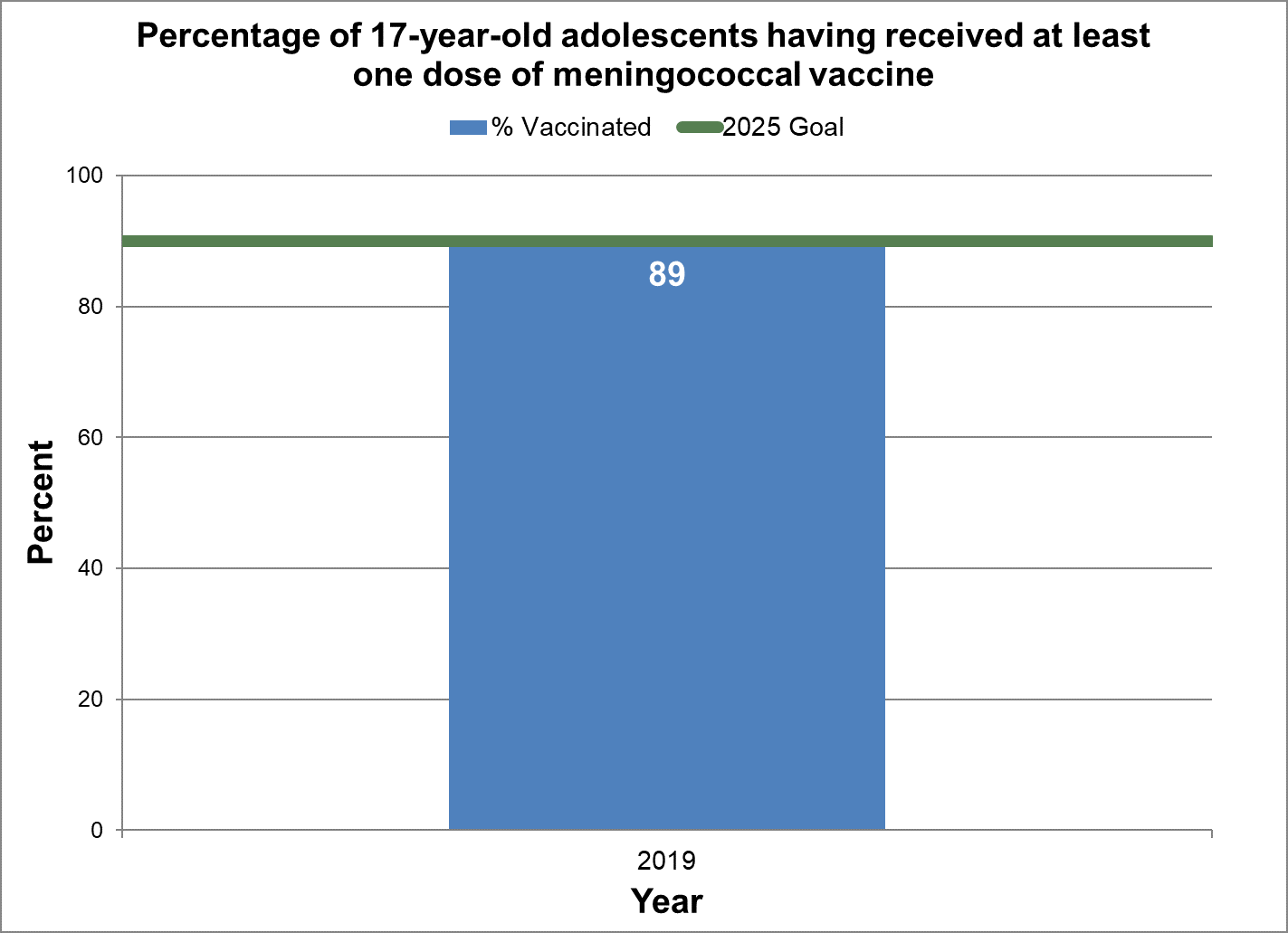
- In 2019, 89% of 17-year-old adolescents in Canada had at least 1 dose of meningococcal vaccine.
- Target:
- 90%
- Data sources:
- Childhood National Immunization Coverage Survey (cNICS) 2019 and 2021.
- Notes:
- Meningococcal vaccine in adolescents was measured starting in the 2019 childhood National Immunization Coverage Survey (cNICS). The type of meningococcal vaccine administered varies by provincial/territorial program.
Figure 14 - Percentage of 17-year-old adolescents having received at least 1 dose of meningococcal vaccine
Text description: Figure 14
| Percent | Year | 2025 vaccination goal |
|---|---|---|
| 89.3 | 2019 | 90 |
| 89.0 | 2021 | 90 |
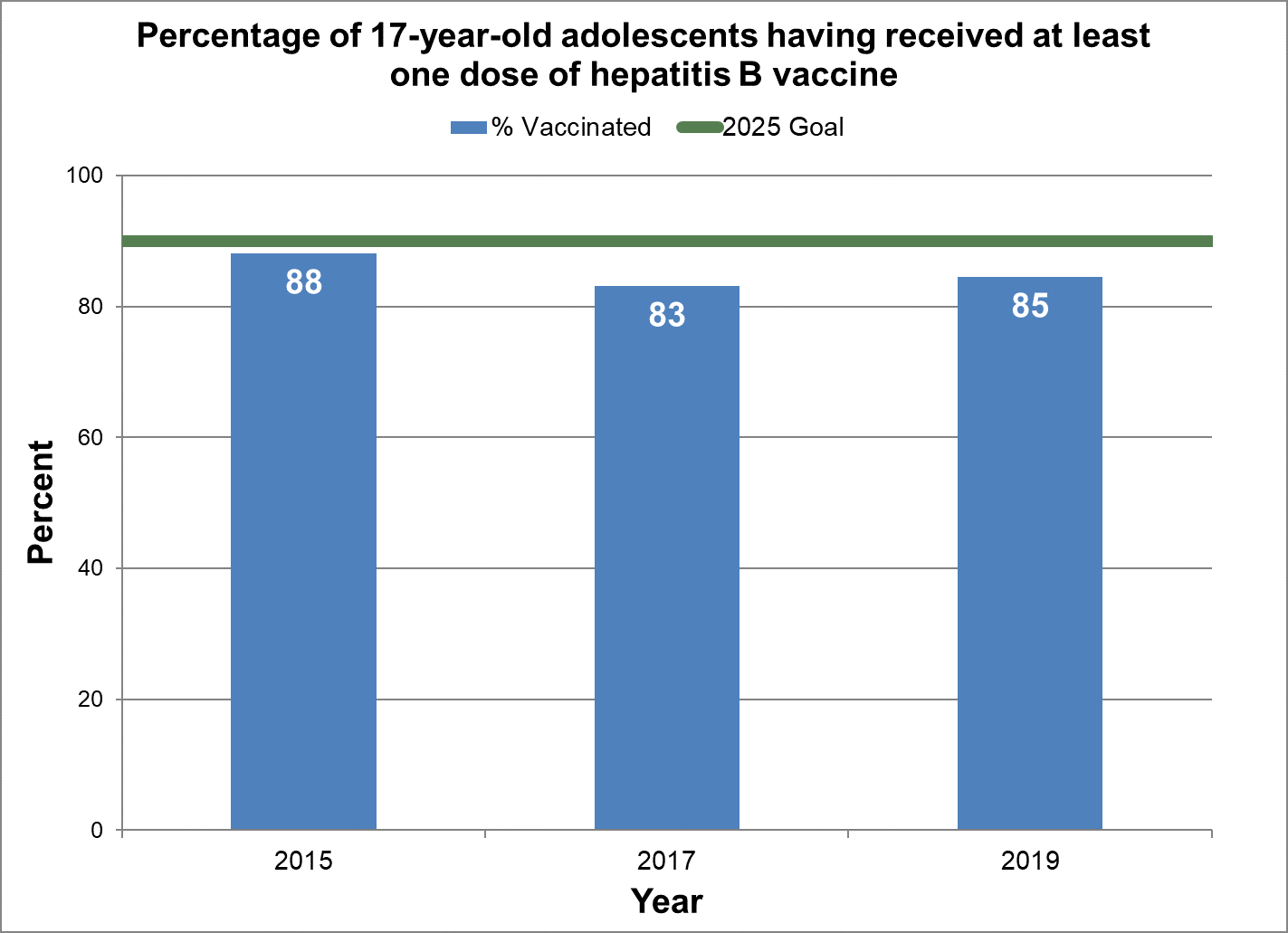
One or more doses of hepatitis B vaccine among adolescents
- Baseline:
- In 2015, 88% of 17-year-olds adolescents in Canada had received at least 1 dose of hepatitis B vaccine.
- Target:
- 90%
- Data sources:
- Childhood National Immunization Coverage Survey (cNICS) 2015, 2017, 2019 and 2021.
- Notes:
-
Coverage estimates from the cNICS 2019 and 2021 were based on receipt of at least one dose by age 14. High vaccination coverage is required to support the WHO goal of eliminating viral hepatitis by 2030.
Figure 15 - Percentage of 17-year-old adolescents having received at least 1 dose of hepatitis B vaccine
Text description: Figure 15
| Percent | Year | 2025 vaccination goal |
|---|---|---|
| 88.1 | 2015 | 90 |
| 83.1 | 2017 | 90 |
| 84.5 | 2019 | 90 |
| 89.0 | 2021 | 90 |
Two or more doses of human papillomavirus vaccine (HPV)
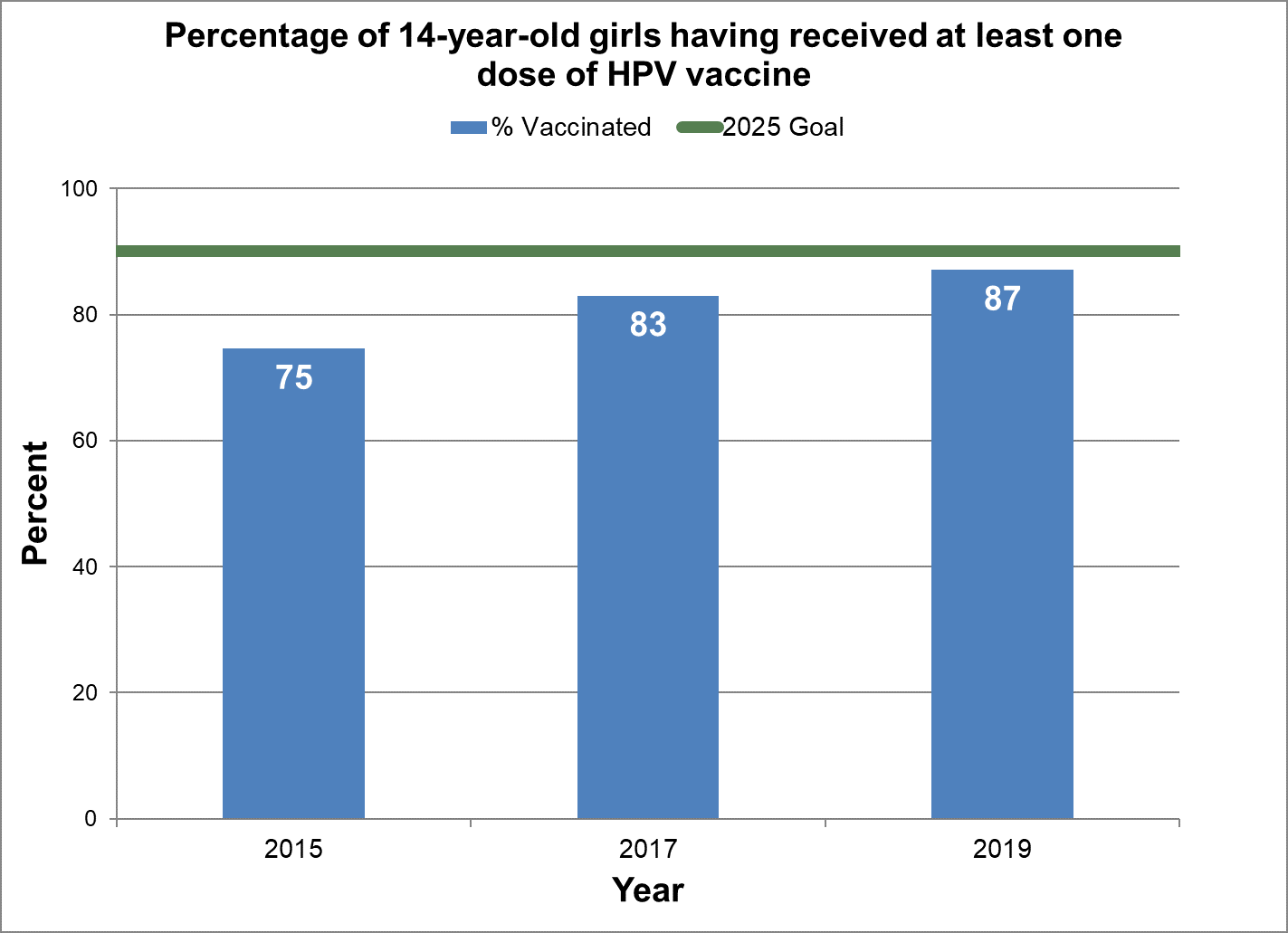
Girls
- Baseline:
- In 2015, 75% of 14-year-old girls in Canada had at least 1 dose of HPV vaccine.
- Target:
- 90%
- Data sources:
- Childhood National Immunization Coverage Survey (cNICS) 2015, 2017, 2019 and 2021.
- Notes:
- In the cNICS, only the estimate for receiving at least 1 dose of HPV vaccine was measured to minimize recall bias. cNICS reports by age 14 if parent recalled child ever having received a dose. The age group measured over the years has changed (13–14 years in 2015, 14 years in 2017 and 2019), therefore caution is advised when making comparisons over time.
Figure 16 - Percentage of 14-year-old girls having received at least 1 dose of HPV vaccine
Text description: Figure 16
| Percent | Year | 2025 vaccination goal |
|---|---|---|
| 74.6 | 2015 | 90 |
| 83.0 | 2017 | 90 |
| 87.1 | 2019 | 90 |
| 86.4 | 2021 | 90 |
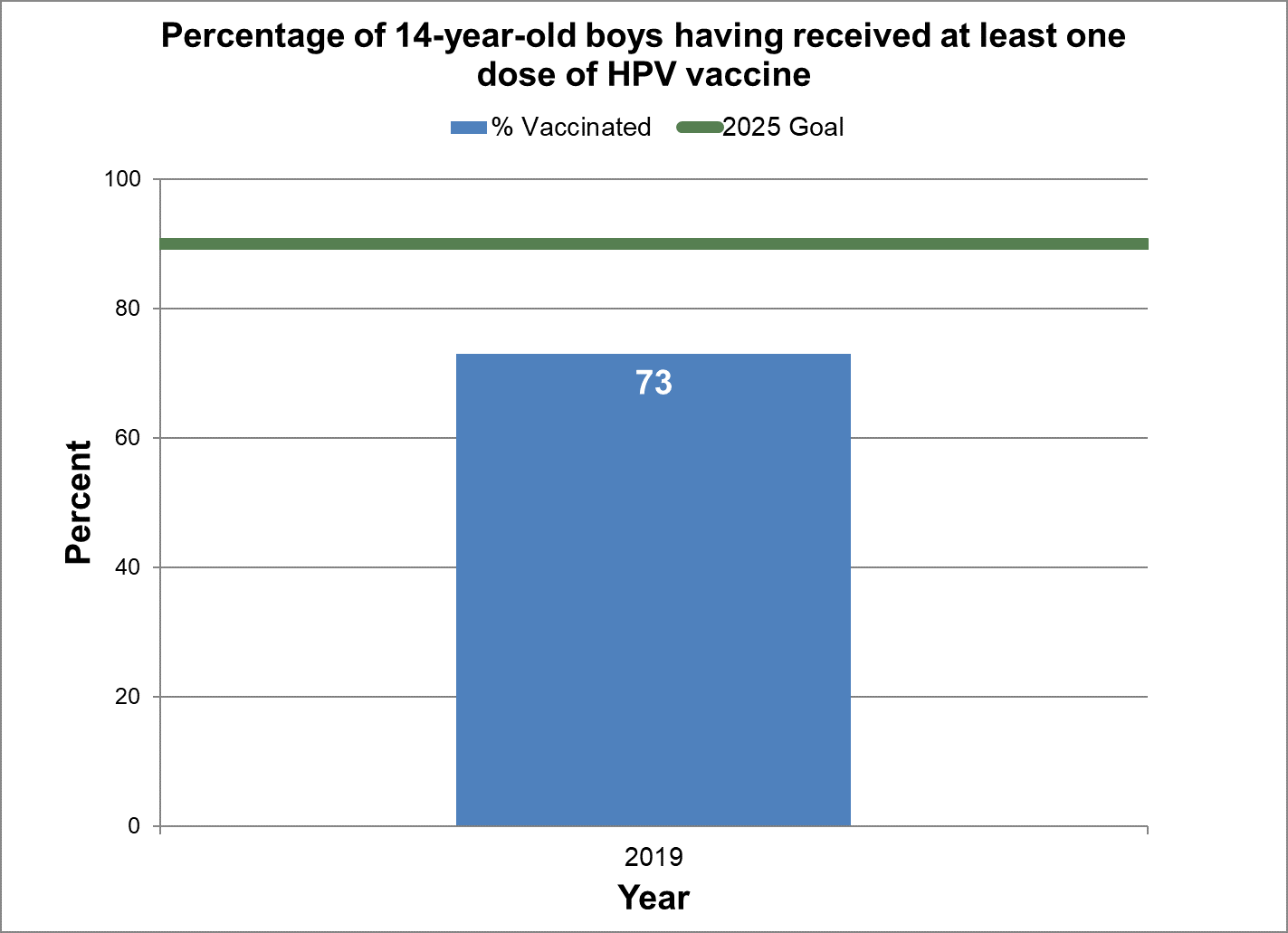
Boys
- Baseline:
- In 2019, 73% of 14-year-old boys in Canada had at least 1 dose of HPV vaccine.
- Target:
- 90%
- Data sources:
- Childhood National Immunization Coverage Survey (cNICS) 2019 and 2021.
- Notes:
- Although, HPV coverage for boys was measured in the 2017 cNICS, the estimate was not included in the overall HPV coverage estimate since male vaccination programs had not been consistently implemented across all provinces and territories at that time and coverage remained low.
Figure 17 - Percentage of 14-year-old boys having received at least 1 dose of HPV vaccine
Text description: Figure 17
| Percent | Year | 2025 vaccination goal |
|---|---|---|
| 73.0 | 2019 | 90 |
| 81.5 | 2021 | 90 |
One dose of tetanus-diphtheria-pertussis booster vaccine (Tdap)
- Baseline:
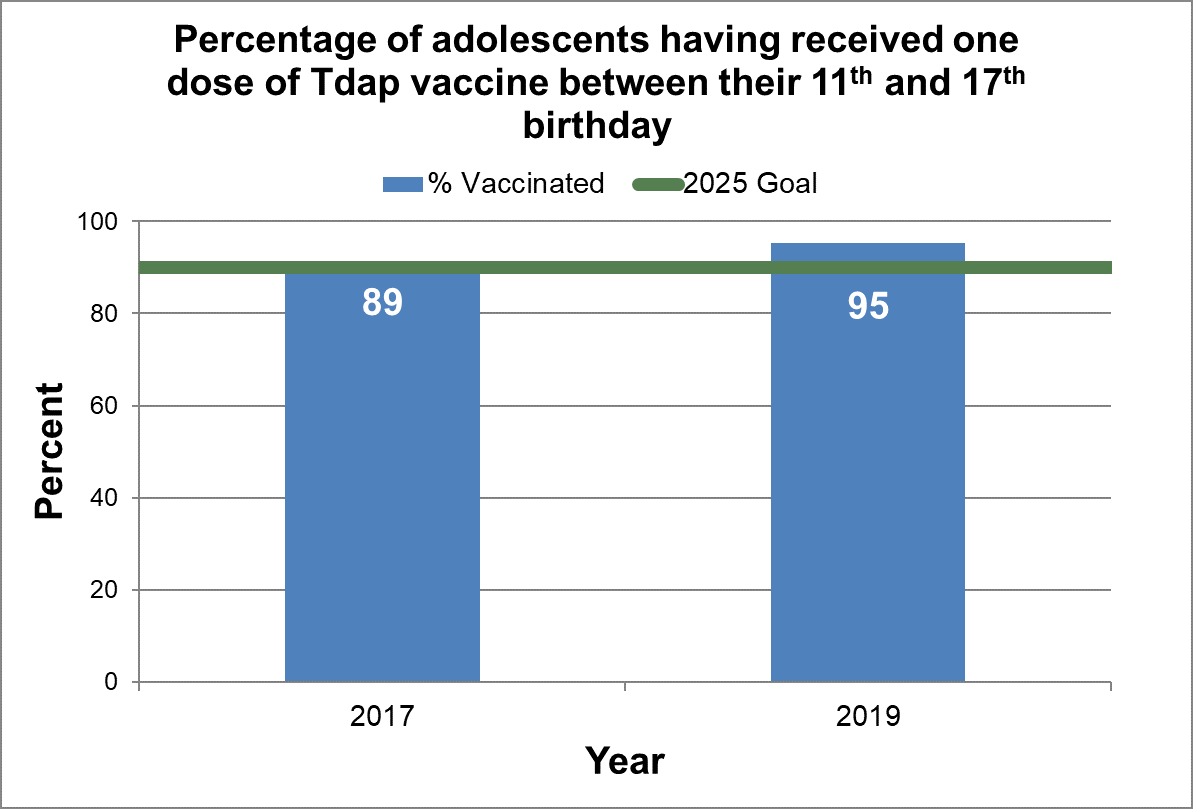
- In 2017, 89% of adolescents in Canada received at least 1 dose of diphtheria, tetanus, acellular pertussis (Tdap) booster by their 17th birthday.
- Target:
- 90%, which was met in 2019.
- Data sources:
- Childhood National Immunization Coverage Survey (cNICS) 2017, 2019 and 2021.
- Notes:
- Starting in 2017, cNICS determined the percentage of adolescents having received 1 dose of Tdap vaccine between their 11th and 17th birthday.
Figure 18 - Percentage of adolescents having received 1 dose of Tdap vaccine by 17 years
Text description: Figure 18
| Percent | Year | 2025 vaccination goal |
|---|---|---|
| 89.3 | 2017 | 90 |
| 95.3 | 2019 | 90 |
| 92.8 | 2021 | 90 |
Adults
The following vaccination coverage goals for adults were established because of the importance of protecting adults living in Canada at high risk for infection and medical complications.
Increase vaccination coverage for the following adult vaccines:
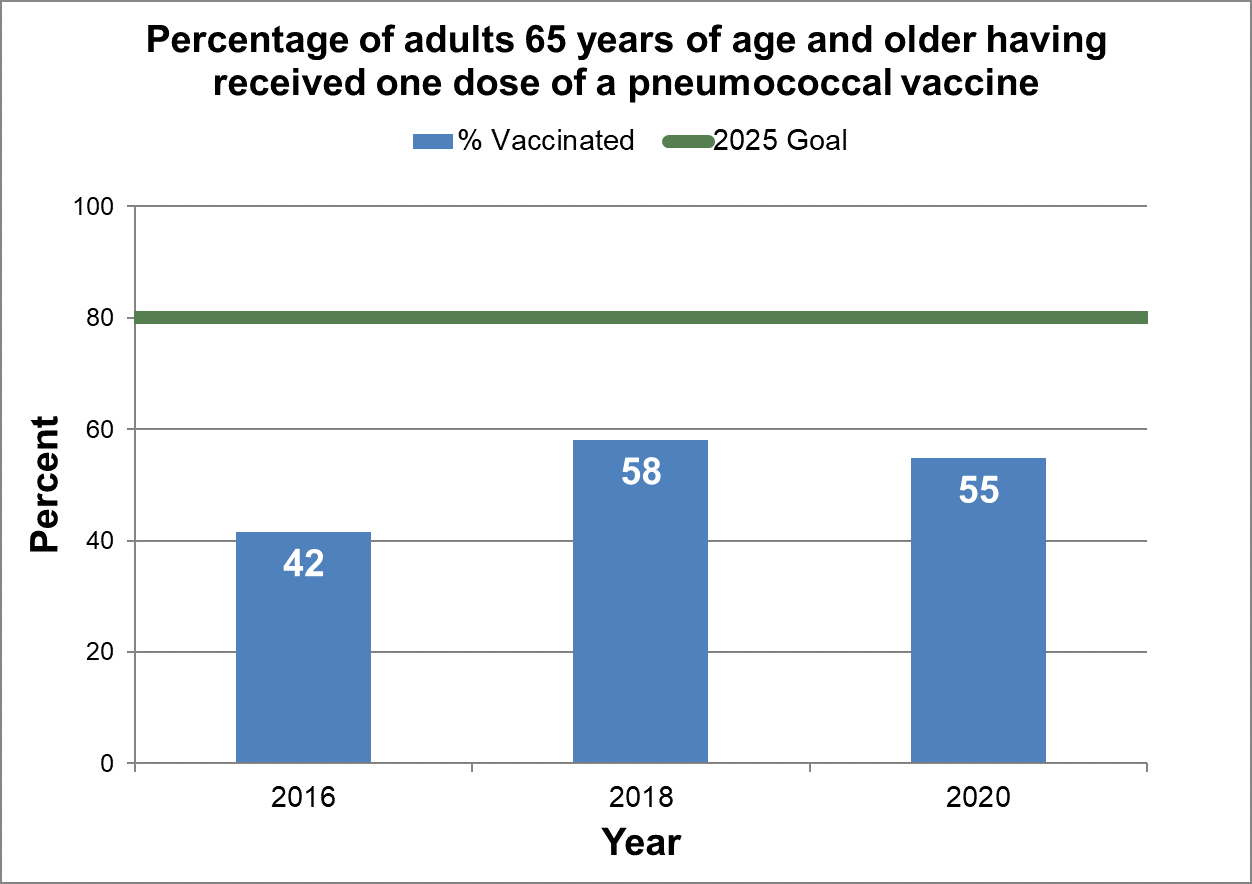
Achieve 80% vaccination coverage (1 dose) of a pneumococcal vaccine among adults 65 years of age and older.
- Baseline:
- In 2016, 42% of seniors (aged 65 years or older) in Canada had been vaccinated with 1 dose of a pneumococcal vaccine.
- Target:
- 80%
- Data sources:
- 2016 adult National Immunization Coverage Survey; Vaccine uptake in Canadian Adults 2019; Vaccine uptake in Canadian adults: Highlights from the 2020-2021 Seasonal Influenza Vaccination Coverage Survey; Seasonal Respiratory Vaccination Coverage Survey (SRVCS) 2024-2025; Adult National Immunization Coverage Survey (aNICS): 2023 results - Canada.ca
Figure 19 - Percentage of adults 65 years of age and older having received 1 dose of a pneumococcal vaccine
Text description: Figure 19
| Percent | Year | 2025 vaccination goal |
|---|---|---|
| 41.6 | 2016 | 80 |
| 58.1 | 2018 | 80 |
| 54.8 | 2020 | 80 |
| 54.7 | 2023 | 80 |
Achieve 90% coverage (1 dose) of hepatitis B vaccine among health care professionals.
- Baseline:
- Not available
- Target:
- 90%
- Data sources:
- To be determined
Seasonal Influenza Vaccination Coverage Goals
A vaccination coverage goal of 80% with the seasonal influenza vaccine has been established based on the importance of protecting adults living in Canada at high-risk for influenza-related complications or hospitalizations. This goal also reflects the importance of the influenza vaccine as a component of comprehensive infection control practices to protect health care professionals and patients from getting influenza.
Increase vaccination coverage for the seasonal influenza vaccine for the following groups:
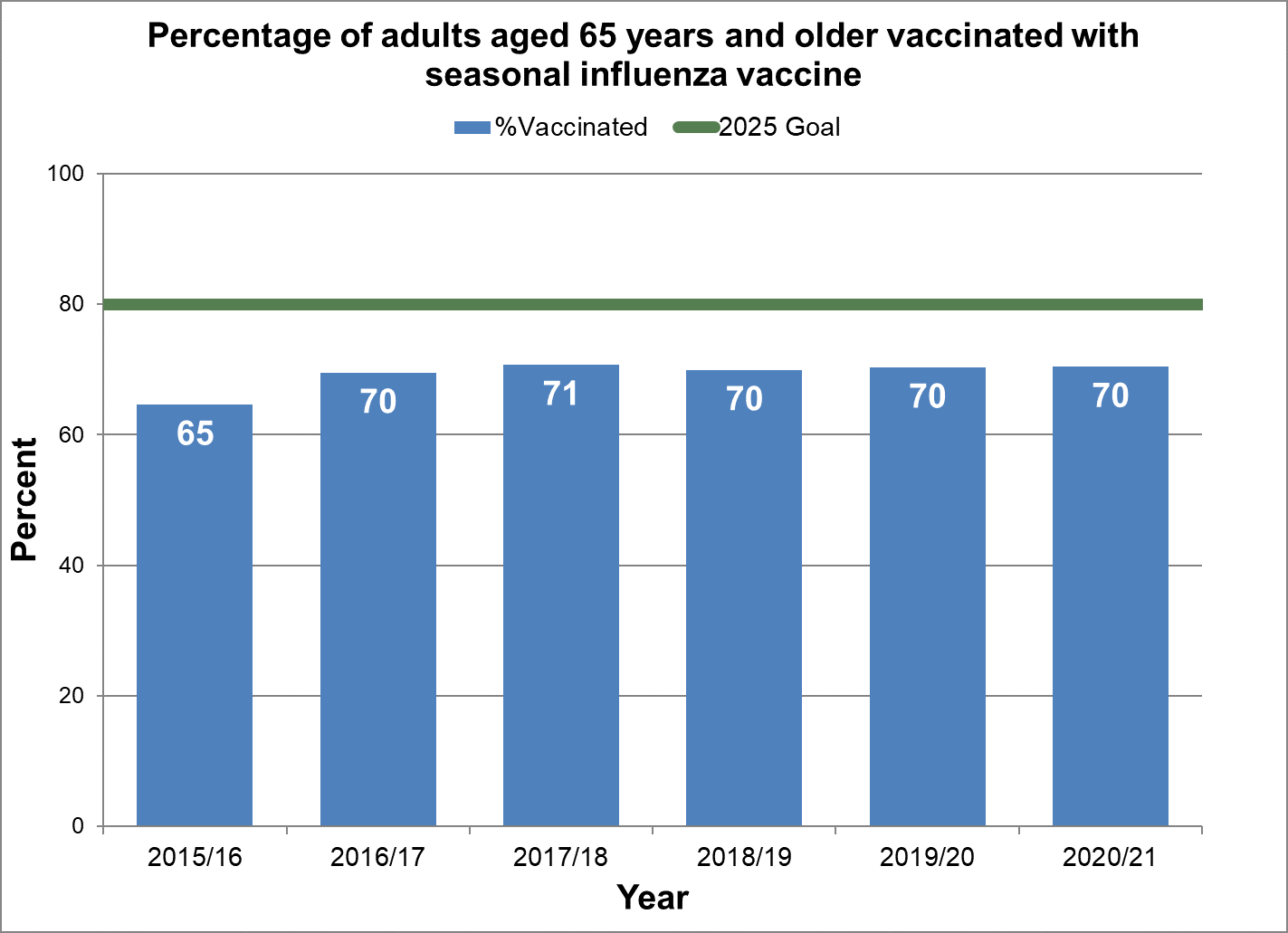
Achieve 80% vaccination coverage among adults aged 65 years and older.
- Baseline:
- For the 2015/2016 influenza season, 65% of adults aged 65 years and older in Canada had been vaccinated.
- Target:
- 80%
- Data sources:
- National influenza immunization coverage survey 2015/16 , 2016/17, 2017/18 , 2018/19 , 2019/20, 2020/21, 2021/22, 2022/23, 2023/24 and 2024/25
Figure 20 - Percentage of adults aged 65 years and older vaccinated with seasonal influenza vaccine
Text description: Figure 20
| Percent | Year | 2025 vaccination goal |
|---|---|---|
| 64.6 | 2015/16 | 80 |
| 69.5 | 2016/17 | 80 |
| 70.7 | 2017/18 | 80 |
| 69.9 | 2018/19 | 80 |
| 70.3 | 2019/20 | 80 |
| 70.4 | 2020/21 | 80 |
| 71.0 | 2021/22 | 80 |
| 73.7 | 2022/23 | 80 |
| 72.7 | 2023/24 | 80 |
| 63.2 | 2024/25 | 80 |
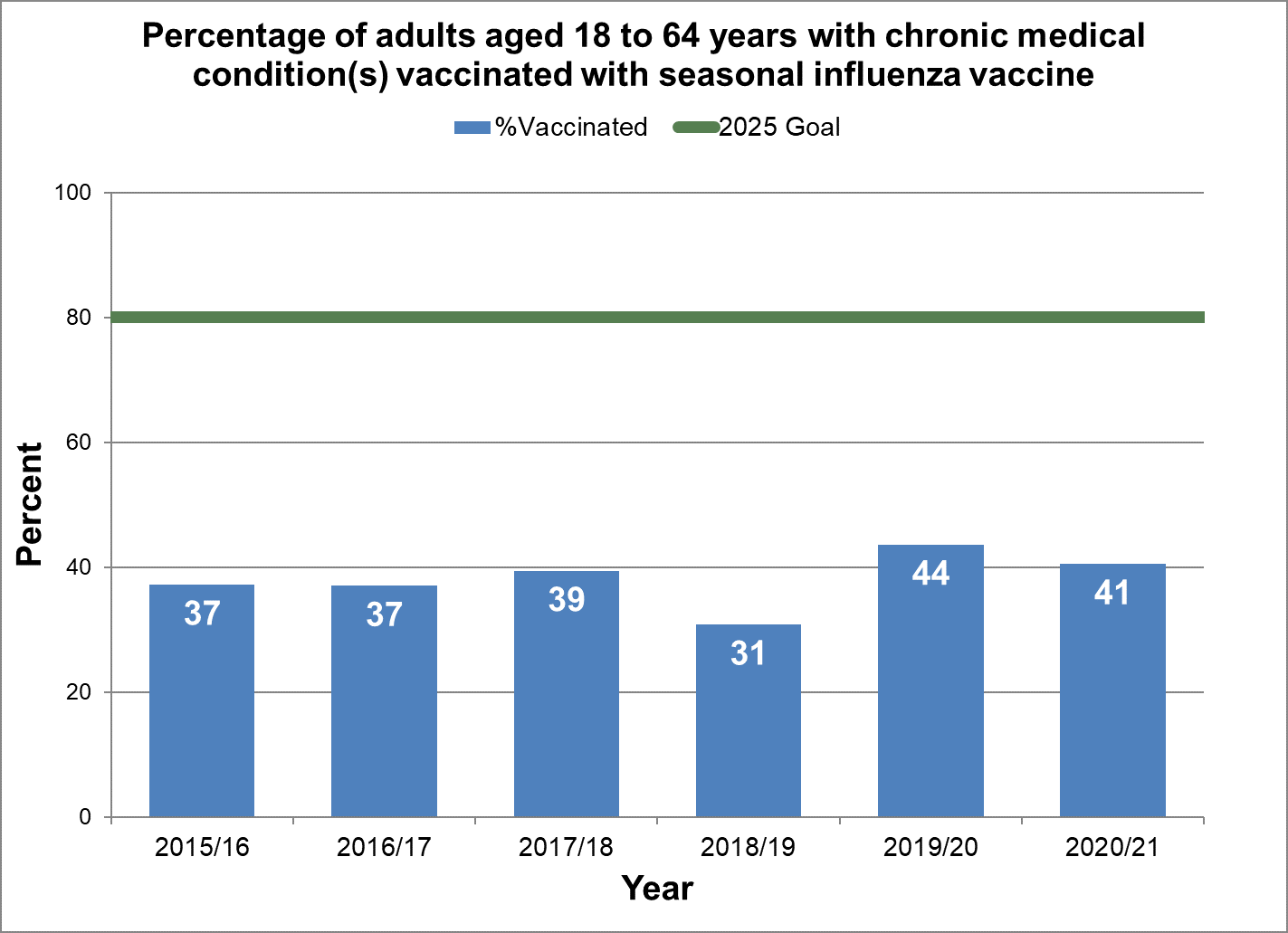
Achieve 80% vaccination coverage among adults aged 18 to 64 years with chronic medical conditions.
- Baseline:
- For the 2015/2016 influenza season, 37% of adults aged 18 to 64 years with a chronic medical condition in Canada had been vaccinated.
- Target:
- 80%
- Data sources:
- National influenza immunization coverage survey 2015/16, 2016/17, 2017/18, 2018/19, 2019/20, 2020/21, 2021/22, 2022/23, 2023/24 and 2024/25
- Notes:
-
Chronic medical conditions are based on the Canadian Immunization Guide Chapter on Influenza and Statement on Seasonal Influenza Vaccine for 2017–2018.
Figure 21 - Percentage of adults aged 18 to 64 years with chronic medical condition(s) vaccinated with seasonal influenza vaccine
Text description: Figure 21
| Percent | Year | 2025 vaccination goal |
|---|---|---|
| 37.2 | 2015/16 | 80 |
| 37.0 | 2016/17 | 80 |
| 39.4 | 2017/18 | 80 |
| 30.8 | 2018/19 | 80 |
| 43.6 | 2019/20 | 80 |
| 40.5 | 2020/21 | 80 |
| 37.6 | 2021/22 | 80 |
| 43.1 | 2022/23 | 80 |
| 44.1 | 2023/24 | 80 |
| 32.3 | 2024/25 | 80 |
Achieve 80% vaccination coverage among health care professionals
- Baseline:
- For the 2022 /2023 influenza season, 56.5% (round up) of health care professionals in Canada have been vaccinated.
- Target:
- 80%
- Data sources:
- Adult National Immunization Coverage Survey (aNICS): 2023 results - Canada.ca
Figure 22 - Percentage of health care workers vaccinated with seasonal influenza vaccine

Text description: Figure 22
| Percent | Year | 2025 vaccination goal |
|---|---|---|
| 56.5% (round up) | 2022/23 | 80 |
Vaccine Preventable Disease Reduction Targets by 2025
Diseases under elimination: Maintain elimination status
Maintain 0 cases of polio in Canada.
| Year | Number of cases |
|---|---|
| 2015 Baseline (range 2011-2015) | 0 |
| 2016 | 0 |
| 2017 | 0 |
| 2018 | 0 |
| 2019 | 0 |
| 2020 | 0 |
| 2021 | 0 |
| 2022 | 0 |
| 2023 | 0 |
- Target:
- 0 cases
- Rationale:
- Polio is expected to be globally eradicated before 2025.
- Data sources:
- Notifiable Diseases online
- Notes:
- Maintaining 0 cases is defined as the absence of paralytic cases of wild or circulating vaccine-derived poliovirus (cVDPV) acquired within the country (i .e . importation of a cVDPV case would not affect this target). The last Canadian-acquired infection of wild polio was in 1996 (asymptomatic).
Maintain the elimination of endemic measles in Canada.
| Year | Number of endemic cases |
|---|---|
| 2015 Baseline (range 2011-2015) | 0 |
| 2016 | 0 |
| 2017 | 0 |
| 2018 | 0 |
| 2019 | 0 |
| 2020 | 0 |
| 2021 | 0 |
| 2022 | 0 |
| 2023 | 0 |
- Target:
- 0 endemic cases
- Rationale:
-
Canada first achieved measles elimination in 1998 and was maintained at the time the baseline was established.
The World Health Assembly has endorsed the Global Vaccine Action Plan with the objective to eliminate measles in 5 WHO Regions by 2020.
- Data sources:
- Notes:
-
Measles elimination is defined as an interruption of endemic measles virus transmission for a period ≥12 months, in the presence of high-quality surveillance.
Canada may continue to detect occasional imported cases, but with a vaccination coverage goal of 95% by 2025, community (herd) immunity will help to protect against second and subsequent generation cases.
Maintain the elimination of endemic rubella in Canada.
| Year | Number of endemic cases |
|---|---|
| 2015 Baseline (range 2011-2015) | 0 |
| 2016 | 0 |
| 2017 | 0 |
| 2018 | 0 |
| 2019 | 0 |
| 2020 | 0 |
| 2021 | 0 |
| 2022 | 0 |
| 2023 | 0 |
- Target:
- 0 endemic cases
- Rationale:
- Endemic rubella has been eliminated in Canada since 2005 and the Region of the Americas since 2015.
- Data sources:
- Canadian Measles and Rubella Surveillance System (CMRSS)
- Notes:
- Canada may continue to detect occasional imported cases, but with a vaccination coverage goal of 95% by 2025, community (herd) immunity will help to protect against second and subsequent generation of cases.
Maintain 0 cases of congenital rubella syndrome (CRS)/congenital rubella infection (CRI) in Canada.
| Year | Number of endemic cases |
|---|---|
| 2015 Baseline (range 2011-2015) | 0 |
| 2016 | 0 |
| 2017 | 0 |
| 2018 | 0 |
| 2019 | 0 |
| 2020 | 0 |
| 2021 | 0 |
| 2022 | 0 |
| 2023 | 0 |
- Target:
- 0 cases
- Rationale:
-
There have been no cases of endemically acquired CRS/CRI in Canada since 2000.
Endemic rubella has been eliminated in Canada since 2005 and the Region of the Americas since 2015.
- Data sources:
- Canadian Measles and Rubella Surveillance System (CMRSS)
Endemic diseases with low-level incidence: Maintain low levels
Achieve 0 annual cases of respiratory diphtheria resulting from exposure in Canada.
| Year | Number of cases |
|---|---|
| 2015 Baseline (range 2011-2015) | Not available |
| 2016 | Not available |
| 2017 | Not available |
| 2018 | Not available |
| 2019 | Not available |
| 2020 | Not available |
| 2021 | Not available |
| 2022 | Not available |
| 2023 | Not available |
- Target:
- 0 cases
- Data sources:
- Notifiable Diseases Online
- Notes:
- In order to measure this target, the national case definition for diphtheria requires revision to distinguish between respiratory and cutaneous diphtheria and to address geographic location of exposure. Between 2011 and 2015, an average of 1 case per year (range 0-2) of diphtheria (respiratory and cutaneous) was reported to CNDSS, while an average of 4 cases per year (range 1-10) were reported for 2016 to 2023.
Maintain less than 5 cases of tetanus annually in Canada.
| Year | Number of cases |
|---|---|
| 2015 Baseline (range 2011-2015) | 4 (2-6) |
| 2016 | 5 |
| 2017 | 4 |
| 2018 | 1 |
| 2019 | 4 |
| 2020 | 3 |
| 2021 | 4 |
| 2022 | 5 |
| 2023 | 3 |
- Target:
- Less than 5 cases
- Rationale:
-
Clostridium tetani spores are ubiquitous and are impossible to eliminate from the environment.
A threshold of less than 5 cases is sufficiently low to demonstrate success of the vaccination program.
- Data sources:
- Notifiable Diseases Online
- Notes:
- As tetanus is not a communicable disease, community (herd) immunity is not applicable.
Maintain 0 cases of maternal/neonatal tetanus in Canada.
| Year | Number of cases |
|---|---|
| 2015 Baseline (range 2011-2015) | 0 |
| 2016 | 0 |
| 2017 | 0 |
| 2018 | 0 |
| 2019 | 0 |
| 2020 | 0 |
| 2021 | 0 |
| 2022 | 0 |
| 2023 | 0 |
- Target:
- 0 cases
- Rationale:
- Remain consistent with WHO goal of eliminating maternal and neonatal tetanus.
- Data sources:
-
Canadian Institute for Health Information Discharge Abstract Database (DAD)
MED-ÉCHO - Sources de données et métadonnées
Internal communications with provincial/territorial partners to validate hospitalization data
- Notes:
- Maternal and neonatal tetanus was eliminated in the Regions of the Americas in 2017. Due to universally available, high quality healthcare, maternal/ neonatal tetanus is not expected in Canada. Maternal/neonatal tetanus case counts were estimated based on diagnostic codes from Canadian hospital databases and consultations with provincial and territorial partners.
Maintain less than 5 cases of preventable Haemophilus influenzae type B (Hib) annually in children less than 5 years of age.
| Year | Number of cases |
|---|---|
| 2015 Baseline (range 2011-2015) | 0 (0- <5) |
| 2016 | 0 |
| 2017 | 0 |
| 2018 | <5 |
| 2019 | 0 |
| 2020 | 0 |
| 2021 | 0 |
| 2022 | 0 |
| 2023 | <5 |
- Target:
- Less than 5 cases annually of preventable Hib in children less than 5 years of age.
- Rationale:
- The threshold is sufficiently low to demonstrate success of the vaccination program and was set to address modifiable outcomes by targeting cases among un/partially-vaccinated children.
- Data sources:
- Immunization Monitoring Program ACTive (IMPACT)
- Notes:
-
Data from the Canadian Immunization Monitoring Program, ACTive (IMPACT) are obtained from 14 tertiary-care paediatric hospitals across Canada, representing over 90% of all tertiary care paediatric beds in Canada; therefore, cases may be under-represented. Data cells under 5 are suppressed for privacy.
Preventable Hib cases refer to those who were either vaccine eligible but did not receive the vaccine or, are under-vaccinated for their age-appropriate vaccination schedule. Vaccine failures are not considered to be preventable.
Maintain an average of less than 100 mumps cases annually in Canada (based on a 5-year rolling average).
| Year | Number of cases (5-year rolling average) |
|---|---|
| 2015 Baseline (range 2011-2015) | 103 (103-617) |
| 2016 | 122 |
| 2017 | 565 |
| 2018 | 707 |
| 2019 | 734 |
| 2020 | 738 |
| 2021 | 667 |
| 2022 | 219 |
| 2023 | 67 |
- Target:
- Five-year average of less than 100 cases annually
- Rationale:
- Given the cyclical nature of mumps outbreaks, the target number of cases is a 5-year average, rather than annual target.
- Data sources:
- Notifiable Diseases Online
- Notes:
-
The intended target should reflect the need for continued control of mumps and recognizes the cyclical nature of mumps outbreaks.
Data are presented as the 5-year rolling average in the reporting year.
Maintain less than 5 cases of invasive meningococcal disease (IMD) serogroup C in children less than 18 years of age.
| Year | Number of cases |
|---|---|
| 2015 Baseline (range 2011-2015) | 0 (0-3) |
| 2016 | 0 |
| 2017 | 2 |
| 2018 | 2 |
| 2019 | 3 |
| 2020 | 0 |
| 2021 | 0 |
| 2022 | 0 |
| 2023 | 0 |
- Target:
- Less than 5 cases in children under 18 years of age.
- Rationale:
- The low incidence in baseline years (2011-2015) is indicative of an effective vaccine delivered through mature vaccination programs in the provinces and territories. This level of success should be sustained.
- Data sources:
- Enhanced Invasive Meningococcal Disease Surveillance System (eIMDSS)
Endemic disease with moderate levels of incidence: Reduce levels
Reduce incidence of invasive pneumococcal disease (IPD) in adults aged 65 years and older.
| Year | Incidence rate (per 100,000 population) |
|---|---|
| 2015 Baseline (range 2011-2015) | 23.6 (23.6-26.0) |
| 2016 | 22.7 |
| 2017 | 24.0 |
| 2018 | 25.8 |
| 2019 | 23. 5 |
| 2020 | 11.2 |
| 2021 | 9.2 |
| 2022 | 18.4 |
| 2023 | 23.8 |
- Target:
- A 5% reduction in the overall incidence of IPD among adults ≥65 years of age.
- Rationale:
-
Due to the serotypes associated with adult IPD, it is estimated that 61% of isolates from adults aged 65 and older were potentially preventable by vaccination (serotypes contained in pneumococcal conjugate vaccine 13 and pneumococcal polysaccharide vaccine 23).
Despite the pneumococcal polysaccharide vaccine (PPV23) being funded in all provinces and territories, and the National Advisory Committee on Immunization recommending 1 dose for ages ≥65 years, the vaccine coverage is only 55% according to 2023 aNICS.
- Data sources:
-
Canadian Notifiable Disease Surveillance System (CNDSS)
- Notes:
- The table includes data from 8 provinces and territories, representing over 90% of Canadians aged 65 years and older. Data from the remaining jurisdictions could not be incorporated due to differences in the age group categories submitted to CNDSS.
Maintain less than 50 hospitalizations annually for varicella in vaccine-eligible children less than 18 years of age.
| Year | Number of hospitalizations |
|---|---|
| 2015 Baseline (range 2011-2015) | 31 (12-31) |
| 2016 | 15 |
| 2017 | 9 |
| 2018 | 5 |
| 2019 | <5 |
| 2020 | 7 |
| 2021 | <5 |
| 2022 | 8 |
| 2023 | 9 |
- Target:
- Less than 50 hospitalizations annually.
- Rationale:
- The varicella vaccine program was initiated in 2000 and was fully implemented across Canada in 2007. Compared to pre-vaccine era, an 85% reduction in varicella-related pediatric hospitalizations was seen since 2008. Since then, varicella-related hospitalizations have remained stable.
- Data sources:
- Immunization Monitoring Program ACTive (IMPACT)
- Notes:
- Data from the Canadian Immunization Monitoring Program, ACTive (IMPACT) are obtained from 14 tertiary-care paediatric hospitals across Canada, representing over 90% of all tertiary care paediatric beds in Canada; therefore, cases may be under-represented. Data include hospitalizations for children 16 and under. Data cells under 5 are suppressed for privacy.
Maintain an average of less than 3 deaths annually that are due to pertussis in infants less than 6 months of age.
| Year | Target Assessment |
|---|---|
| 2015 Baseline (range 2011-2015) | Target met |
| 2016 | Target met |
| 2017 | Target met |
| 2018 | Target met |
| 2019 | Target met |
| 2020 | Target met |
| 2021 | Target met |
| 2022 | Target met |
| 2023 | Target met |
- Target:
- Less than 3 deaths in infants less than 6 months of age.
- Rationale:
-
The highest incidence of pertussis is in infants less than 1 year of age, and most deaths are in infants less than 6 months of age.
The goal of pertussis vaccination programs is to reduce hospitalizations and mortality in the under 1 age group. To align with this goal, the disease reduction target focuses on mitigating severe outcomes, including death, which are most likely to occur in infants less than 6 months.
- Data sources:
- Immunization Monitoring Program ACTive (IMPACT)
- Notes:
- Data from the Canadian Immunization Monitoring Program, ACTive (IMPACT) are obtained from 14 tertiary-care paediatric hospitals across Canada, representing over 90% of all tertiary care paediatric beds in Canada; therefore, cases may be under-represented. Data cells under 5 are suppressed for privacy.