
Meeting between Patrick Borbey, PSC President, and Dr. Harpreet S. Kochhar, President, Public Health Agency of Canada (PHAC)
*Information valid as of November 2021
Introduction
Deputy Head
Dr. Harpeet S. Kochhar was appointed as the President of the Public Health Agency of Canada (PHAC), on October 12, 2021.
Dr. Kochhar is exercising the Public Service Commission’s (PSC) authority for the first time as Deputy Head (DH). A copy of the New Direction in Staffing (NDS) highlights for DHs is attached as Annex A.
Dr. Kochhar is also the Deputy Minister Champion for the Science and Technology community.
Organizational Context
Mandate
PHAC helps protect the health and safety of all Canadians. Its activities focus on preventing chronic diseases, such as cancer and heart disease, preventing injuries, and responding to public health emergencies and infectious disease outbreaks. PHAC is responsible for emergency preparedness and response for issuing public health notices, and for immunization and vaccines.
Through research, programs and services, PHAC’s goals are to bring about healthier Canadians, reduced health disparities, and a stronger capacity to deliver on and support public health activities. As part of PHAC’s program activities, it uses grants and contributions to fund community, volunteer and not-for-profit agencies to support government policies and priorities.
Challenges
In its 2020-2021 departmental plan, PHAC focuses on three aspects of public health: health promotion and chronic disease prevention; infectious disease prevention and control; and health security.
To achieve expected results, the organization is seeking to attract and retain the best possible medical and scientific candidates. As PHAC is competing with other governments and the industry, hiring and promotion practices are continuously reviewed. As the more classic recruitment approaches proved to be a deterrent to valuable candidates, the organization is looking at more innovative and simplified application procedures, and using talent management to promote individuals, as it is the practice by employers in scientific and medical industries.
PHAC will continue to examine the level of resources required for priority initiatives. With the COVID-19 crisis, the organization had to shift its resources to be dedicated to the crisis response. This was established through the reassignment of existing capacity and the recruitment of additional resources, especially in the NU (nursing) classification, dedicated to community health and epidemiology response.
As part of a shared services model, all Human Resources programs and services are provided by Health Canada (HC). PHAC is continuously in search of the best and brightest public health specialists and pandemic prevention authorities. In the recruitment of these professionals, obtaining timely confirmation of official language results and the recognition of foreign education credentials can be a challenge.
PHAC must also ensure an agile approach to recruitment when facing emergency situations. This became even more important with the COVID-19 pandemic, where PHAC hired 717 employees specifically dedicated to Canada’s response to the pandemic between January 1, and November 1, 2020, and has since continued to hire more staff.
From the beginning of the COVID-19 Pandemic, PHAC approached the PSC requesting information regarding the possibility of making an Exclusion Approval Order (EAO) to extend the 90-day casual period to address their urgent needs, in the context of the pandemic. Discussions have been ongoing with PHAC, where it was decided that the proposed approach (EAO) was not the appropriate solution. Other approaches to the challenges are being considered, but the organization has suspended its work on the matter for the time being.
Once the Government of Canada’s efforts in response to COVID-19 diminish, PHAC will face the challenge of reorganizing its workforce in a post-pandemic setting.
Experimentation
PHAC is working with HC on making talent management and performance appraisal practices more compatible for use in staffing processes, as valuable information to assess merit. For the hiring of doctors (MD group), PHAC has adapted its advertisement approach. They now simply ask candidates to submit their resume, and the hiring manager contacts them to ask for any pertinent additional information. Various outreach initiatives were also launched, including developing brochures, banners, videos, and social media campaigns. All of these initiatives have increased the number of applications for the MD group. The approach has proven successful, leading to an increased recruitment.
Population and Staffing Activities
Population
PHAC is a large organization that has a population of 3,283 employees (as of March 31, 2021). During the 2020-2021 fiscal year, it performed 2,483 staffing actions.
Please refer to Annex B for additional details.
Staffing Activities
In 2020-2021, PHAC processed a total of 2,483 staffing actions:
- 1,498 appointments to the public service (including casual workers and students);
- 678 casual workers
- 232 students
- 588 others
- 334 promotions
- 342 acting appointments
- 309 lateral and downward movements
Please refer to Annex B for additional details on staffing activities.
Time to Staff
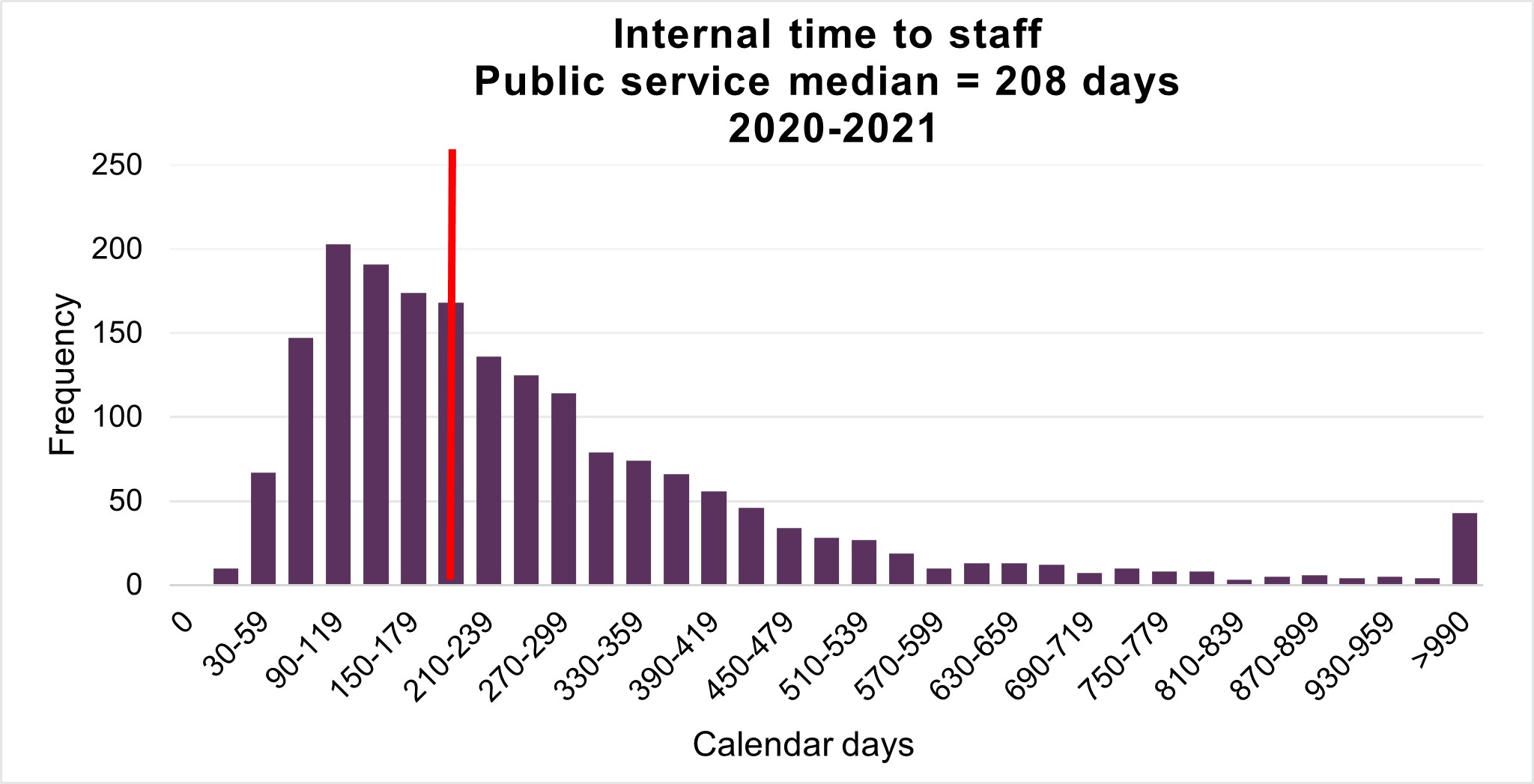
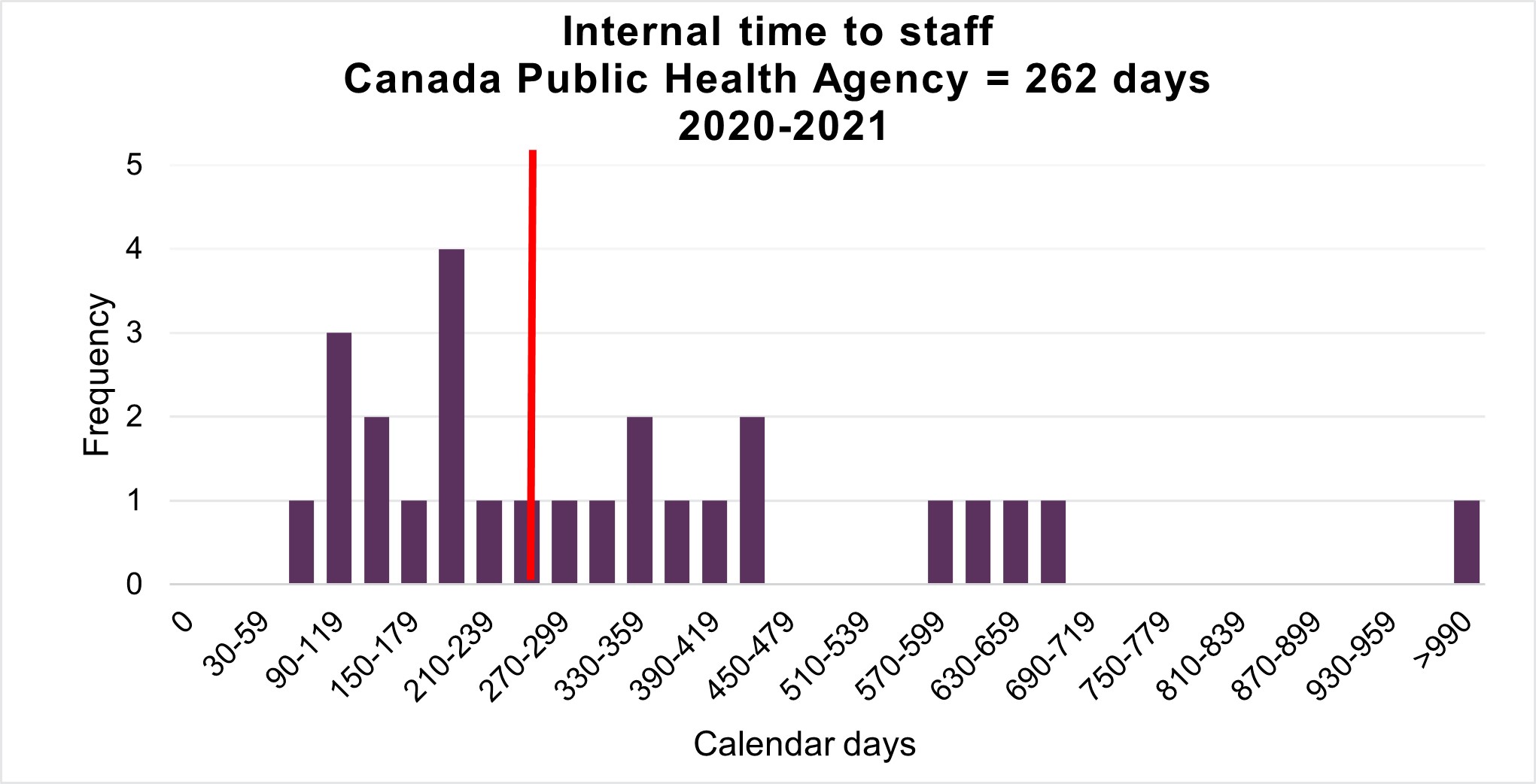
PHAC has a median time of 262 days for internal appointments, which is higher than the median of the public service, which is 208 days.
PHAC has a median time of 193 days for external appointments, which is lower than the median of the public service, which is 250 days.
Please refer to Annex B for additional details.
Staffing Framework
New Direction in Staffing Implementation
PHAC has put in place their mandatory staffing framework, and shared a copy with the PSC:
- Policy on Area of selection (2019)
- Direction on the use of advertised and non-advertised appointment process (2019)
- Requirement(s) for the articulation of the selection decision (2019)
- Sub-delegation instrument (2019)
In February 2019, at the request of the organization, the PSC examined PHAC’s sub‑delegation instrument. The PSC identified some areas of improvement which were implemented when updating their sub-delegation instrument in June 2019.
Appointment Delegation and Accountability Instrument Annex D Reporting
Use of the Public Service Official Languages Exclusion Approval Order (PSOLEAO) and the Public Service Official Languages Appointment Regulations (PSOLAR)
PHAC reported that the organization made two uses of the PSOLEAO and no use of the PSOLAR for the period of April 1, 2020, and March 31, 2021. Both uses of the PSOLEAO are of less than two years and are compliant.
Approved Deputy Head Exceptions to the National Area of Selection (NAOS) Requirements for an External Advertised Appointment Process
PHAC reported that the DH did not approve any exceptionto the NAOS in 2020-2021.
Results of Organizational Cyclical Assessment
Inquiries and Trends
As PHAC and Health Canada share the same HR services provider, inquiries are often common to both organizations. The inquiries are therefore accounted for as either specific to one organization or common to both.
From October 20, 2020, to October 29, 2021, PHAC made 44 inquiries specific to its organization. In addition, during the same period, there were 22 questions common to both PHAC and Health Canada, which brings the total of inquiries to 66.
Of those, 24 were related to COVID-19 (19 were on the use of second language evaluation alternatives and 5 were related to the special arrangements for extending the allowed period for casual employment).
Oversight
Audits
PHAC was included in two past horizontal audits: the Pilot System-Wide Staffing Audit (SWSA) that was published in 2018 and the Horizontal Audit on Credential Validation (HACV) that was published in 2019.
SWSA was a review of system-wide compliance in staffing. In all, 25 departments and agencies participated in the audit, providing a sample of 386 appointments; 7 of these appointments were from PHAC.
HACV explored whether public servants had obtained the necessary level of education for their position when they were hired. The audit examined a representative sample of 278 external appointments across 15 departments and agencies; 6 of the appointments in the sample were from PHAC.
Investigations
The following table outlines the different investigations by the PSC for PHAC, between October 2018 and October 2021.
| Nature of Issue | Cases Received | Cases Referred by Organization | Closed - Not Accepted | Completed Unfounded | Completed Founded | Ongoing |
|---|---|---|---|---|---|---|
| s.66 External Appointments (Merit, Error, Omission, Improper Conduct) | 7 | 7 | 1 | 0 | 0 | 6 |
| s.69 Fraud | 1 | 1 | 0 | 0 | 0 | 1 |
| s.118 Improper Political Activities - Employees | 0 | 0 | 0 | 0 | 1 | 0 |
| Total | 8 | 8 | 1 | 0 | 1 | 7 |
Note: The numbers may not add up as discontinued cases, and cases resolved via early intervention are not included in this table.
Staffing and Non-Partisanship Survey Results
Overall, PHAC’s Staffing and Non-Partisanship Survey (SNPS) results are similar in comparison with other large organizations and the public service. Below are key findings from PHAC 2018 SNPS results:
- 59.0% of employees agreed that people hired can do the job, compared to 52.3% in organizations of similar size, and 53.8% in the federal public service.
- 56.7% of managers agreed that the New Direction in Staffing has improved the way they hire and appoint persons to and within their organization, compared to 54.4% in organizations of similar size, and 56.1% in the federal public service.
- 63.7% of managers indicated that they understand their organization’s policies with respect to staffing, compared to 72.1% in organizations of similar size, and 73.1% in the federal public service.
- 90.5% of managers agreed that within their organization, the administrative to staff a position is burdensome, compared to 88.6% in organizations of similar size, and 87.9% in the federal public service.
- 57.3% of managers reported understanding of the provisions that help veterans gain employment in the federal public service, as compared to 65.6% in similar size organizations and 65.8% across all organizations in the federal public service.
Diversity Profile
PHAC is above the representation for women (68.8%) and members of visible minority (23.2%). The organization is below workforce availability for:
- Indigenous peoples, who represent 3.3% of its workforce, while the WFA is 4.0%;
- Persons with disabilities, who represent 5.6% of its workforce, while the WFA is 9.0%.
| Designated Group | Public Service Work Force Availability (WFA) |
Public Health Agency of Canada As of March 31, 2020 |
Public Health Agency of Canada As of March 31, 2019 |
Representation across the Public Service of Canada |
|---|---|---|---|---|
| Women | 52.7% | 68.8% | 68.3% | 55.0% |
| Indigenous peoples | 4.0% | 3.3% | 3.1% | 5.1% |
| Persons with Disabilities | 9.0% | 5.6% | 5.5% | 5.2% |
| Members of Visible Minorities | 15.3% | 23.2% | 21.4% | 17.8% |
Source:
Employment Equity in the Public Service of Canada 2018-2019 Treasury Board of Canada Secretariat
Employment Equity in the Public Service of Canada 2019-2020, Treasury Board of Canada Secretariat
PHAC needs to take action to close the gap for Indigenous peoples and persons with disabilities and continue to make merit-based appointments of members of the designated groups when required to ensure ongoing representativeness of its workforce.
The Clerk of the Privy Council asked senior leaders to commit to making measurable change to the diversity and inclusiveness of the public service which includes the creation of staffing plans to close representation gaps for employment equity groups.
The data below sent to organizations in February 2021 by the President of the PSC, highlights the gap in representation of persons with disabilities (PWD) at PHAC from 2018-2019 and the estimated level of recruitment required to close this gap within the next five years, taking into consideration factors such as attrition.
- Representation of PWD: 5.5%
- WFA for PWD: 8.2%
- Gap between WFA and representation: 2.7%
- Closing the gap: PWD population increase required to reach WFA over 5 years: 57
- Closing the gap: Recruitment of PWD required to achieve population increase over 5 years (estimate): 104
Priority Entitlements and Veterans
Appointments of Persons with a Priority Entitlement
From April 1, 2021, to October 28, 2021, PHAC has appointed one person with a priority entitlement (PPE) indeterminately.
Appointments of Persons with a Canadian Armed Forces (CAF) Priority Entitlement
Since the coming into force of the Veterans Hiring Act on July 1, 2015, until October 28, 2021, PHAC has not made any appointment of persons with a CAF Priority Entitlement. However, they are in the process of hiring two veterans (both of which have expired priority entitlements). Additionally, PHAC has taken considerable steps by naming a champion and participating in recruitment events organized by Veterans Affairs Canada.
Priority Clearance Requests
From April 1, 2021, to October 28, 2021, PHAC submitted 1236 priority clearance requests.
| Priority Clearance Type | Amount | Percentage |
|---|---|---|
Internal advertised processes
|
117 | 9.5% |
| Internal non-advertised processes | 297 | 24.0% |
External advertised processes
|
282 | 22.8% |
| External non-advertised processes | 508 | 41.1% |
| Simultaneous Advertised Internal and External Appointment Process | 5 | 0.4% |
| Appointment of persons with a priority entitlement (includes term and indeterminate appointments) | 2 | 0.2% |
| Student bridging | 25 | 2.0% |
| Section 43 | 0 | 0.0% |
| Total | 1236 | 100.0% |
Source: Priority Information Management System
COVID-19 Related Priority Clearance Requests
Since the Priority Entitlements Policy Division began monitoring priority entitlement clearances related to Covid-19, PHAC has submitted 1309 requests to the PSC:
- 23 requests in 2019-2020
- 596 requests in 2020-2021
- 690 requests in 2021-2022
Persons with a Priority Entitlement
As of October 28, 2021, PHAC had 15 activated files in the Priority Information Management System.
Non-Partisanship in the Public Service
Over the past five years, the PSC has received two candidacy permission requests from employees of PHAC, both requests were for participation in candidacy at the municipal level.
During that period, an employee at PHAC was not in compliance with subsection 115(1) of the PSEA when they did not request and obtain permission from the PSC prior to seeking nomination as a candidate in a municipal election. The ordered corrective actions included that the employee participate in an individual awareness session on the political activities regime applicable to employees of the federal public service and that a letter be sent by the PSC to the employee to inform them that they failed to comply with subsection 115(1) of the PSEA and to remind them of their obligations.
According to the results of the 2018 Staffing and Non-partisanship Survey, 78.9% of the respondents from PHAC indicated that they are aware of their rights and obligations for engaging in political activities to a moderate and great extent, which is slightly below than the Public Service in general at 80.1%.
Recruitment Programs
Federal Internship Program for Canadians with Disabilities
PHAC is not currently participating in the Federal Internship Program for Canadians with Disabilities (FIPCD). The FIPCD is an excellent initiative to contribute to the Government of Canada’s Accessibility Strategy by having an intern and supporting them in skill development to increase their employability. The program also offers for a 50% salary reimbursement to hiring departments for the duration of the internship period. In addition, the program provides managers and interns with career coaching services and tools to support the interns’ development such as recommended training offered by the Canada School or Public Service.
Should PHAC wish to hire interns, they may contact the PSC to explore this option at: cfp.diversitedetalent-talentdiversity.psc@canada.ca
Employment Opportunity for Students with Disabilities / Indigenous Student Employment Opportunity
PHAC submitted 29 requests for referrals for Students with Disabilities and 40 for Indigenous Students through Federal Student Work Experience Program (FSWEP) between April 30, 2020, and September 30, 2021. The Employment Opportunity for Students with Disabilities (EOSD) and the Indigenous Student Employment Opportunity (ISEO) are excellent recruitment options to increase diversity in the workplace by hiring students living with disabilities or indigenous students. Managers and students are provided with resources, such as onboarding tools, training, and networking events. The candidates from both these initiatives are available year-round in the FSWEP ongoing inventory.
- Number of available students in EOSDFootnote 1: 4,811
- Number of available students in ISEOFootnote 2: 2,204
Federal Student Work Experience Program
PHAC has submitted 350 requests for referrals from FSWEP between April 30, 2020, and September 30, 2021. This program remains an excellent way for an organization to renew its workforce and bring new energy, ideas, and approaches to its workplace. The number of available students in this program is 73,740Footnote 3.
Post-Secondary Recruitment
PHAC has submitted 21 requests for referrals from existing Post-Secondary Recruitment inventories to staff a total of 35 positions in the AS, PM, EC and SG-SRE categories in 2020‑2021, for which 299 candidates were referred
The 2021 Post-Secondary Recruitment Campaign was launched at the end of October and features two new inventories that will be available to all departments:
- Business, Project Management and Government Programs which will cater to a wide range of program needs across the government.
- Programs and services to Canadians – Officer Level (PM-01 targeted PWD). In partnership with ESDC, this initiative is expected to support all departments that provide services directly to Canadians.
Participation in Initiatives Related to the Hiring of Indigenous Peoples
PHAC has requested information on one of the graduate candidates within the Indigenous Career Pathway (ICP) inventory since this initiative has been launched in 2020. There was no resulting hire. The Indigenous Career Pathway (ICP) is an initiative that may be of interest to them for the hiring of Indigenous People. They may contact the Aboriginal Centre of Expertise for more information.
The PSC’s Aboriginal Centre of Expertise and the Treasury Board Secretariat’s Office of the Chief Human Resources Officer have developed an ICP that may be of interest to PHAC. It provides information on indigenous recruitment, career progression, as well as development and retention:
- The Inventory of Indigenous Applicants facilitates the matching between hiring managers and candidates by sourcing indigenous talents from existing inventories of the PSC and proactively promoting their profiles to federal organizations. As of September 30, 2021, there were 12 pre-qualified students available at various groups and levels. In addition, 13 graduates are currently availableFootnote 4 with previous student experience within Government of Canada.
- The Indigenous Recruitment Toolkit provides a repository of tools, resources and advice on indigenous recruitment, outreach and initiatives that PSC and other departments offer.
More information about the Indigenous recruitment programs is available on the Indigenous recruitment – Information for hiring managers website.
Staffing Support
Public Service Commission Representatives and Organizational Contacts
The Staffing Support Advisor (SSA) assigned to this organization is Yannick Fortin, the primary organizational contact is Beth Popplow, Acting Executive Director, Corporate Policies and Programs and Mental Health and the Head of HR is Daryl Gauthier, Director General, Human Resources.
PREPARED BY:
Yannick Fortin,
Staffing Support Advisor
APPROVED BY:
Lynn Brault
Director General, Staffing Support, Priorities and Political Activities Directorate,
Policy and Communications Sector
Gaveen Cadotte
Vice-President, Policy and Communications Sector
Annexes:
Annex A – The New Direction in Staffing (NDS) highlights for DHs
Annex B - Data on Population and Staffing Activities
Annex A
Highlights for Deputy Heads
A New Direction in Staffing – A Merit-Based System That is Effective, Efficient and Fair
Appointment Policy
New focus on core requirements to provide sub-delegated persons with greater discretion in making an appointment
- One Appointment Policy, no duplication of legal requirements
- Broader focus on values-based system, away from rules-based system
- Appointment Policy supported by streamlined guidance:
- A roadmap to the legislative, regulatory and policy requirements
- Options and considerations for decision-making where there is discretion
- Clear expectations for priority entitlements
- No restrictions on assessment methods for EX appointments
- Exceptions to National Area of Selection approved by deputy head
Delegation
- New ability to customize organizational staffing system based on unique context and evolving business needs
- Deputy heads establish a direction on the use of advertised and non-advertised appointment processes
- Deputy heads to establish requirement(s) for sub-delegated persons to articulate, in writing, their selection decision
- Clarity on requirements related to investigations
- Attestation form to reinforce the accountabilities of sub-delegated persons
All PSC monitoring and reporting requirements now found in the Appointment Delegation and Accountability Instrument
Monitoring and Reporting
Monitoring built by organizations, targeted to their needs
- Annual Departmental Staffing Accountability Report no longer required
- Annual reporting to the PSC limited to:
- Use of Public Service Official Language Exclusion Approval Order
- Exceptions to the National Area of Selection approved by the deputy head
- Results of any internal investigations
- Actions taken following any PSC investigations or audits.
- Deputy head responsible for ongoing monitoring of organizational staffing system based on the organization’s unique context
- Assessment of adherence to requirements, based on organization’s own risks, every five years, at a minimum.
PSC Oversight
System-wide focus
- Government-wide compliance audit every two years
- Renewed Survey of Staffing administered in alternating years with government-wide audit
- System-wide effectiveness and efficiency reviews to support continuous improvement
- Targeted PSC audits as a result of identified system-wide or organizational risks or at the request of deputy head
- Investigations conducted when there is reason to believe there was political influence, fraud or improper conduct in an appointment process
This document should be read in conjunction with the Public Service Employment Act, the Public Service Employment Regulations, the PSC Appointment Policy and the PSC Appointment Delegation and Accountability Instrument.
Annex B
Population by tenure as of March 31
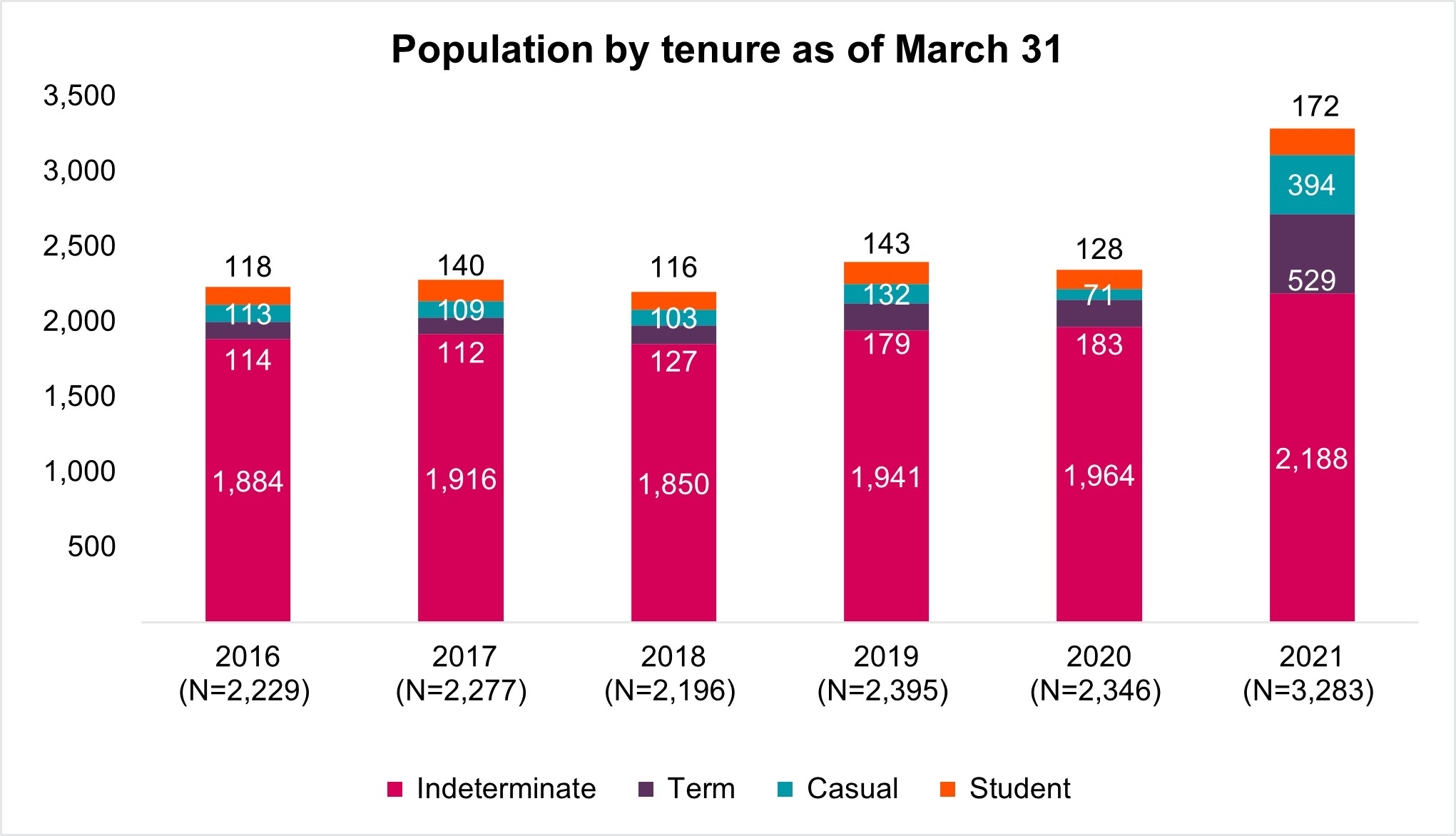
Text version
| Year | Indeterminate population | Term population | Casual population | Student population | Total population |
|---|---|---|---|---|---|
| As of March 31, 2016 | 1,884 | 114 | 113 | 118 | 2,229 |
| As of March 31, 2017 | 1,916 | 112 | 109 | 140 | 2,277 |
| As of March 31, 2018 | 1,850 | 127 | 103 | 116 | 2,196 |
| As of March 31, 2019 | 1,941 | 179 | 132 | 143 | 2,395 |
| As of March 31, 2020 | 1,964 | 183 | 71 | 128 | 2,346 |
| As of March 31, 2021 | 2,188 | 529 | 394 | 172 | 3,283 |
Population by language requirements as of March 31, 2021
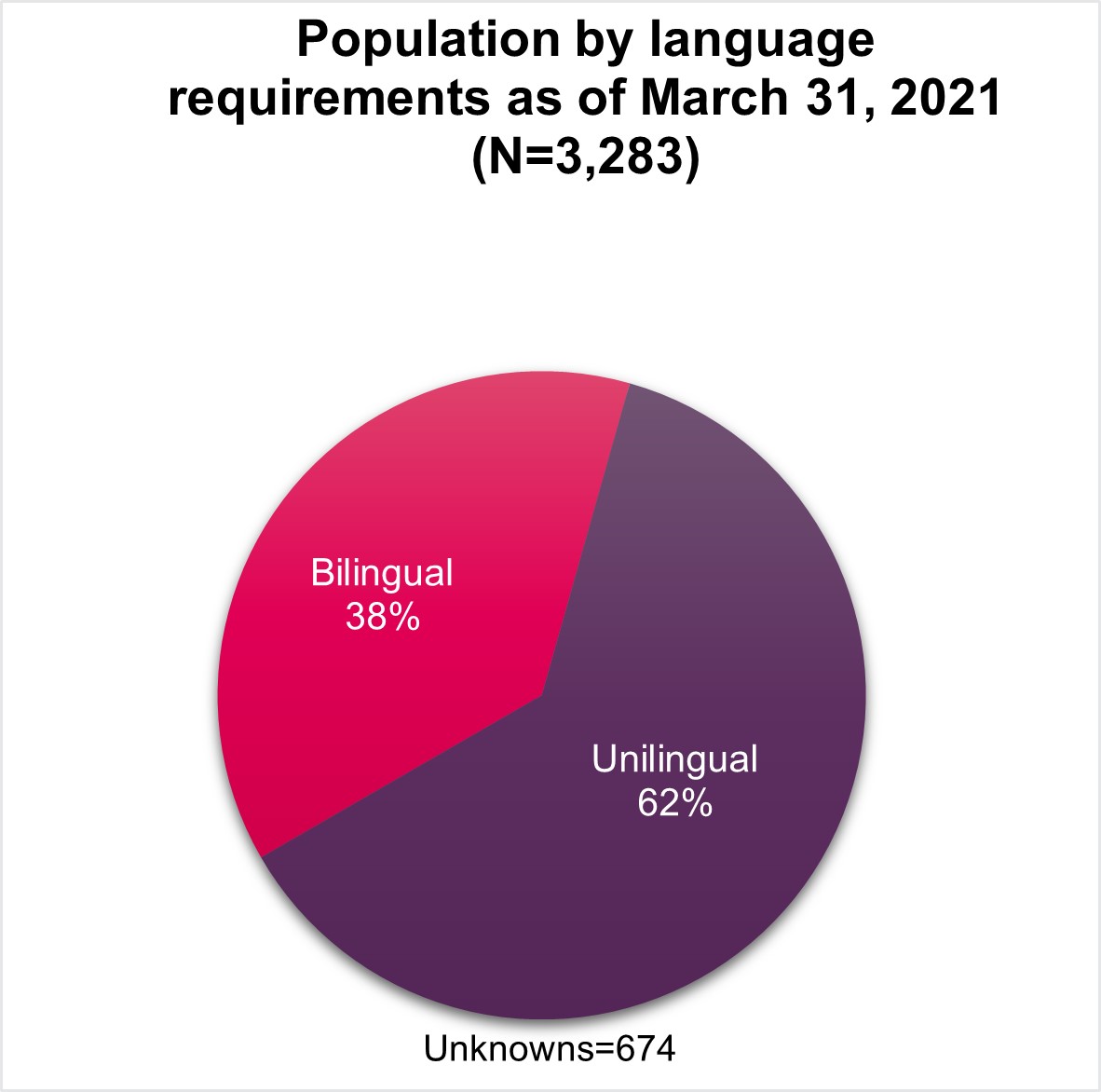
Text version
| Linguistic requirements of the position | Population as of March 31, 2021 | Percentage of population as of March 31, 2021 |
|---|---|---|
| Bilingual | 984 | 38% |
| Unilingual | 1,625 | 62% |
| Unknowns | 674 | Not Applicable |
Population by occupational group as of March 31, 2021

Text version
| Occupational group | Population as of March 31, 2021 | Percentage of population as of March 31, 2021 |
|---|---|---|
| EC – Economics and Social Science Services | 1,112 | 36% |
| AS – Administrative Services | 489 | 16% |
| PM – Programme Administration | 434 | 14% |
| EG – Engineering and Land Survey | 289 | 9% |
| BI – Biological Sciences | 180 | 6% |
| Other | 607 | 20% |
| Unknowns | 172 | Not Applicable |
Population by region as of March 31, 2021,
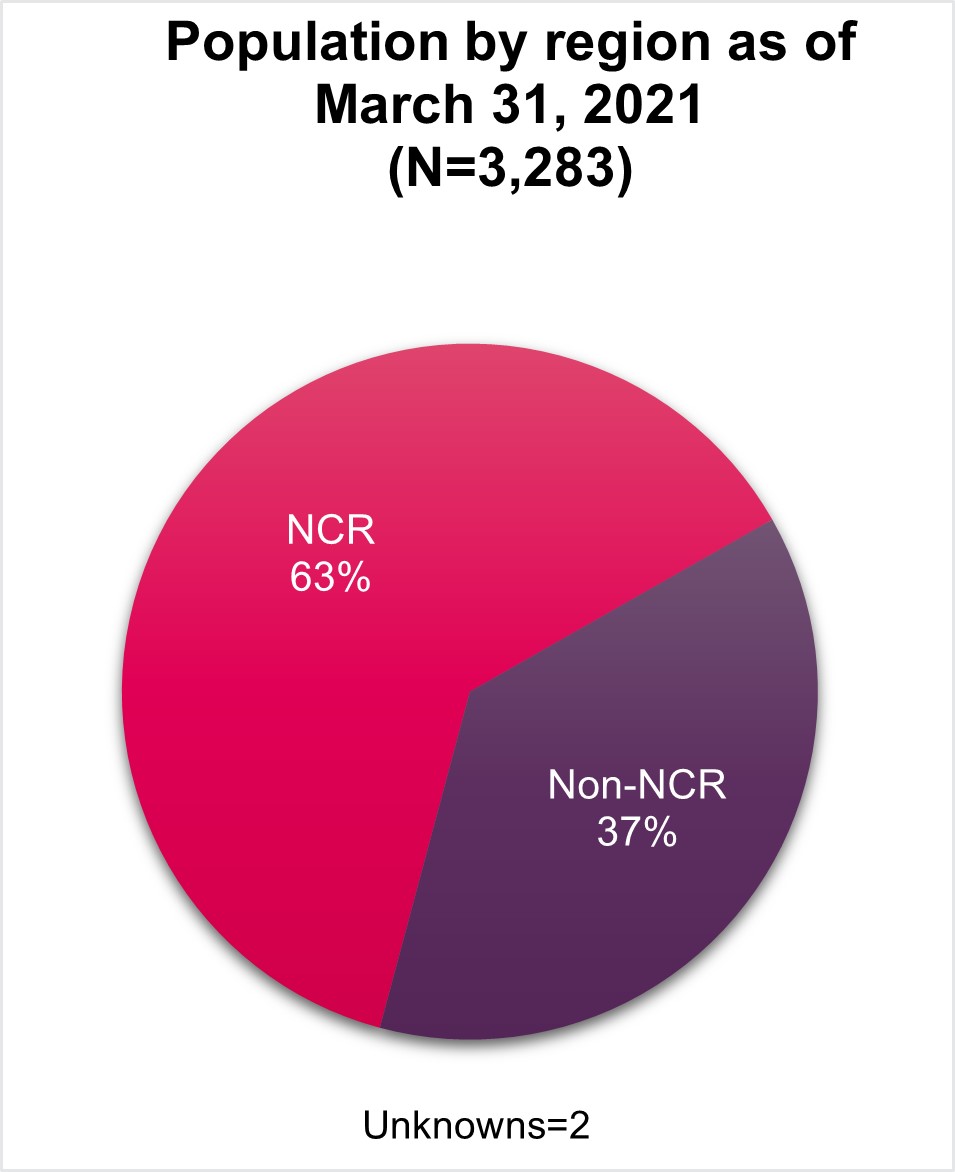
Text version
| Region | Population as of March 31, 2021 | Percentage of population as of March 31, 2021 |
|---|---|---|
| National Capital Region (NCR) | 2,054 | 63% |
| Non-NCR | 1,227 | 37% |
| Unknown | 2 | Not Applicable |
External indeterminate hires by occupational group, 2020-2021
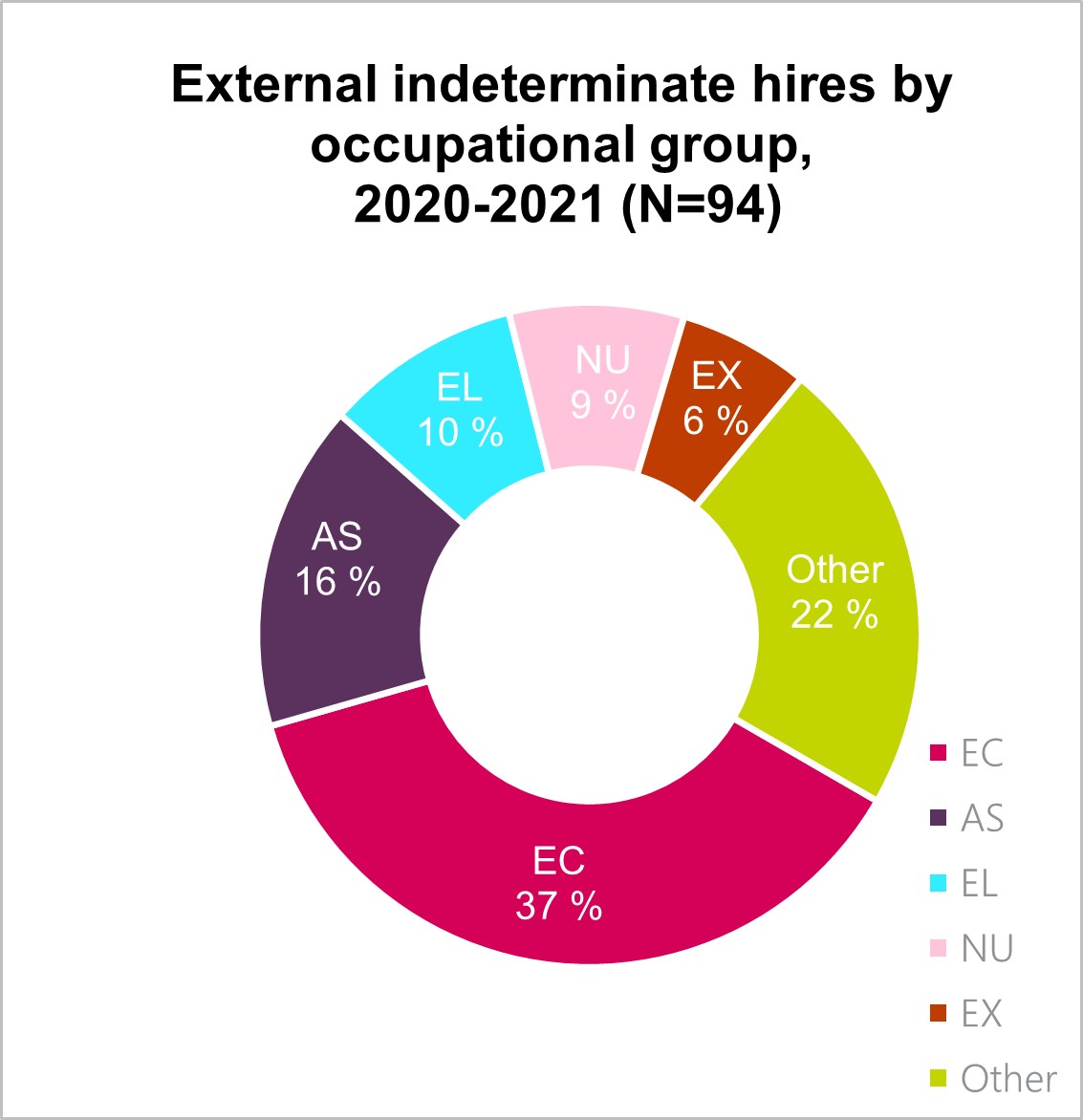
Text version
| Occupational group | Number of indeterminate hiring activities | Percentage of all indeterminate hiring activities |
|---|---|---|
| EC – Economics and Social Science Services | 35 | 37% |
| AS – Administrative Services | 15 | 16% |
| EL – Electronics | 9 | 10% |
| NU – Nursing | 8 | 9% |
| EX – Executive | 6 | 6% |
| Other | 21 | 22% |
| Total | 94 | 100% |
Staffing by region
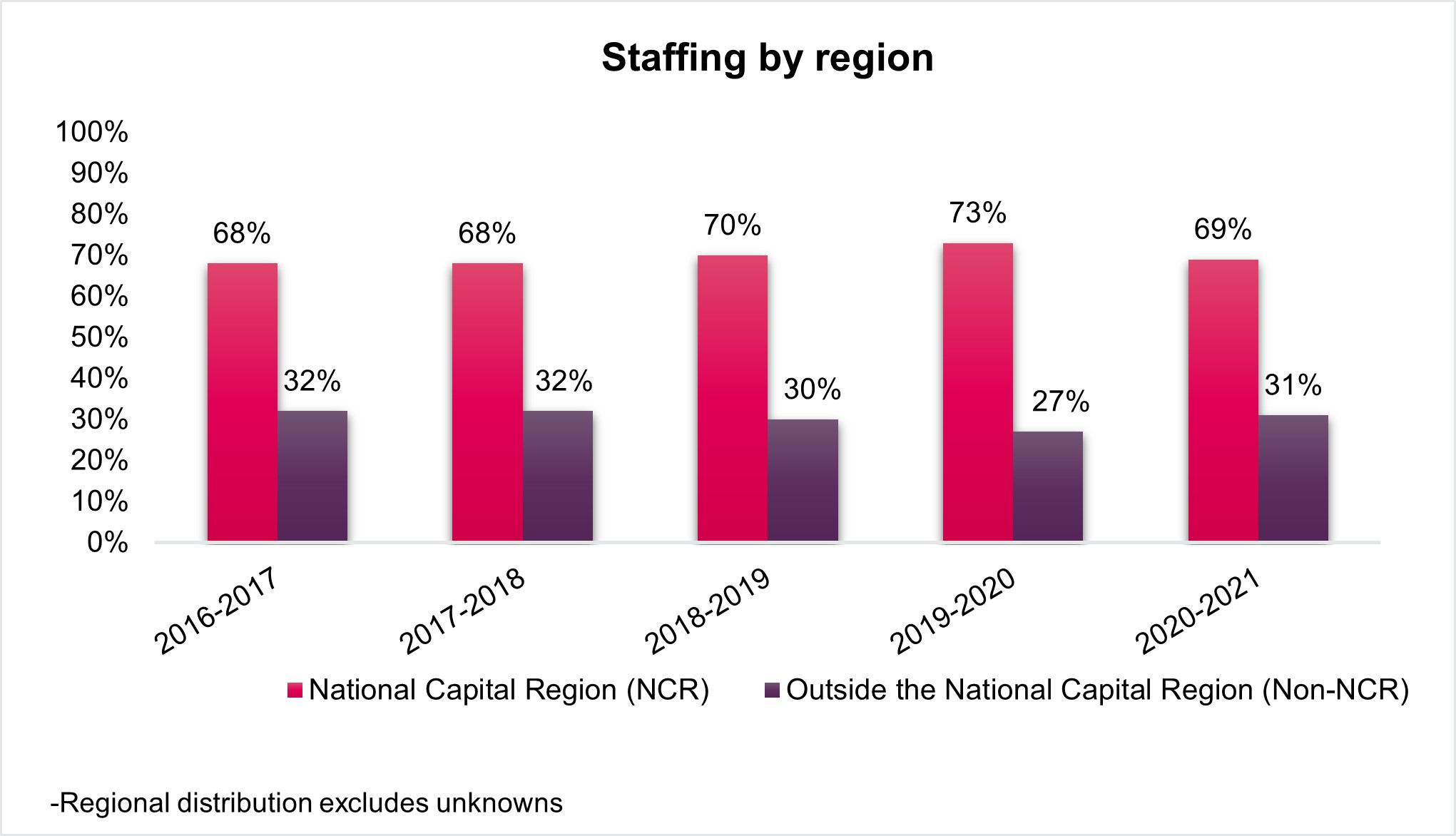
Text version
| Fiscal year | Percentage of staffing activities in the National Capital Region (NCR) * | Percentage of staffing activities in all other regions (Non-NCR) * |
|---|---|---|
| 2016-2017 | 68% | 32% |
| 2017-2018 | 68% | 32% |
| 2018-2019 | 70% | 30% |
| 2019-2020 | 73% | 27% |
| 2020-2021 | 69% | 31% |
* Regional distribution excludes unknowns
Staffing Activities by appointment process type
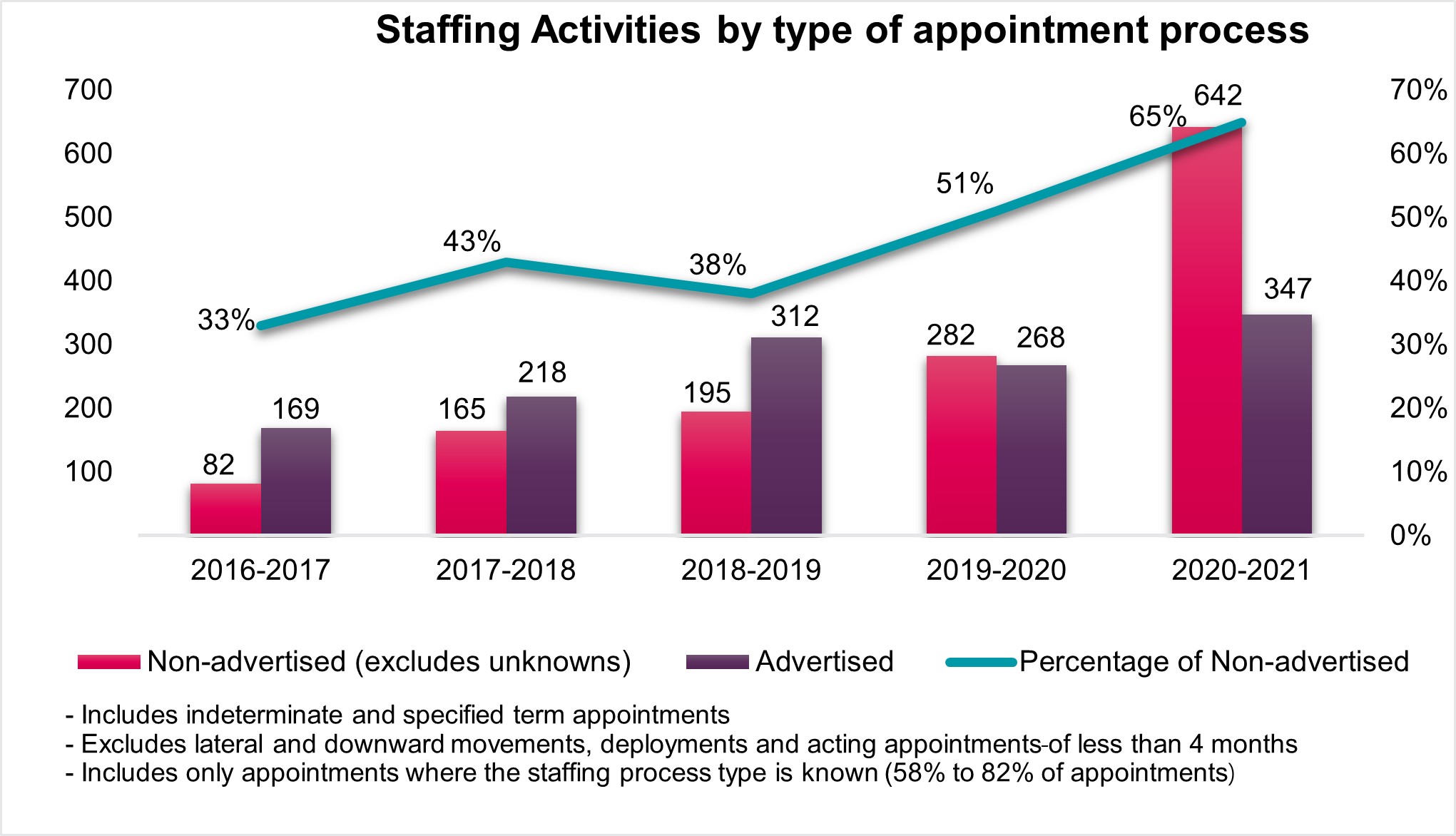
Text version
| Fiscal year | Non-advertised appointments (excludes unknowns) | Advertised appointments | Percentage of Non-advertised appointments |
|---|---|---|---|
| 2016-2017 | 82 | 169 | 33% |
| 2017-2018 | 165 | 218 | 43% |
| 2018-2019 | 195 | 312 | 38% |
| 2019-2020 | 282 | 268 | 51% |
| 2020-2021 | 642 | 347 | 65% |
- Includes indeterminate and specified term appointments
- Excludes lateral and downward movements, deployments and acting appointments of less than 4 months
- Includes only appointments where the staffing process type is known (58% to 82% of appointments)
Staffing by appointment type
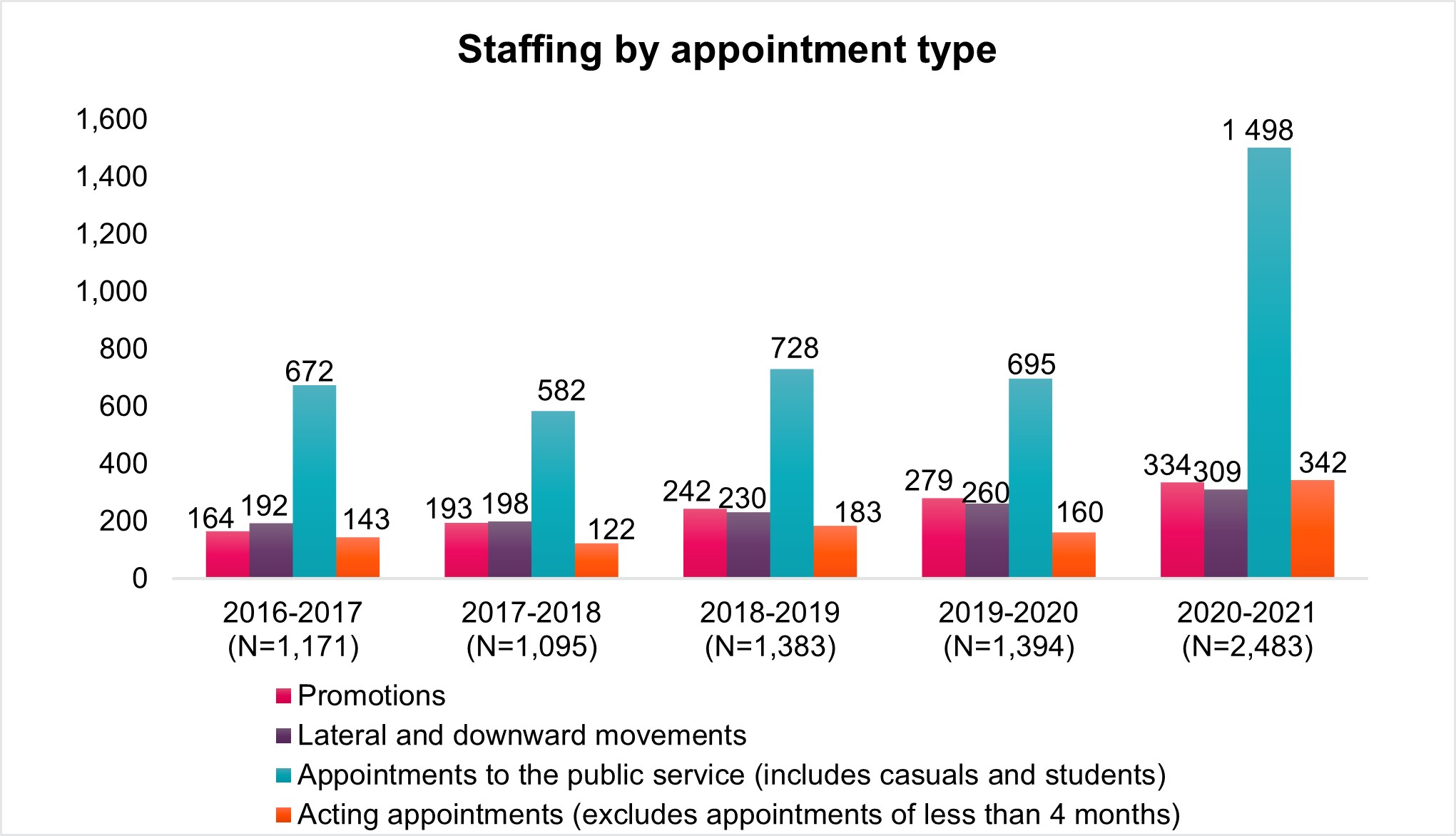
Text version
| Fiscal year | Promotions | Lateral and downward movements | Appointments to the public service (includes casuals and students) | Acting appointments (excludes appointments of less than 4 months) | Total |
|---|---|---|---|---|---|
| 2016-2017 | 164 | 192 | 672 | 143 | 1,171 |
| 2017-2018 | 193 | 198 | 582 | 122 | 1,095 |
| 2018-2019 | 242 | 230 | 728 | 183 | 1,383 |
| 2019-2020 | 279 | 260 | 695 | 160 | 1,394 |
| 2020-2021 | 334 | 309 | 1,498 | 342 | 2,483 |
Staffing by tenure
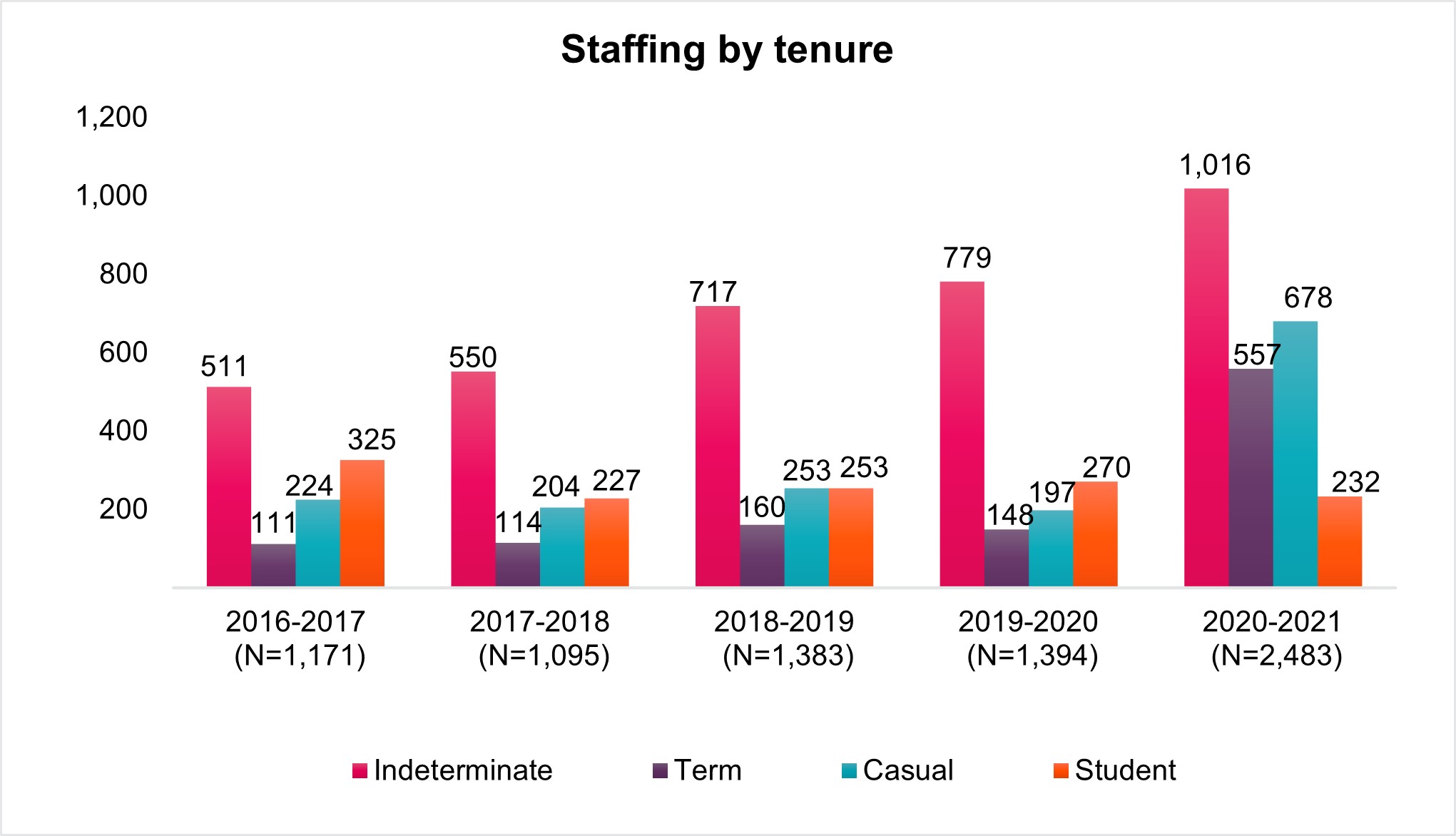
Text version
| Fiscal year | Indeterminate staffing activities | Term staffing activities | Casual staffing activities | Student staffing activities | Total staffing activities |
|---|---|---|---|---|---|
| 2016-2017 | 511 | 111 | 224 | 325 | 1,171 |
| 2017-2018 | 550 | 114 | 204 | 227 | 1,095 |
| 2018-2019 | 717 | 160 | 253 | 253 | 1,383 |
| 2019-2020 | 779 | 148 | 197 | 270 | 1,394 |
| 2020-2021 | 1,016 | 557 | 678 | 232 | 2,483 |
Key findings - Staffing and non-partisanship survey (2018)
- 59.0% of employees agreed that people hired can do the job, compared to 52.3% in organizations of similar size, and 53.8% in the federal public service
- 56.7% of managers agreed that the New Direction in Staffing has improved the way they hire and appoint persons to and within their organization, compared to 54.4% in organizations of similar size, and 56.1% in the federal public service
- 90.5% of managers agreed that within their organization, the administrative to staff a position is burdensome, compared to 88.6% in organizations of similar size, and 87.9% in the federal public service.
Student program hires
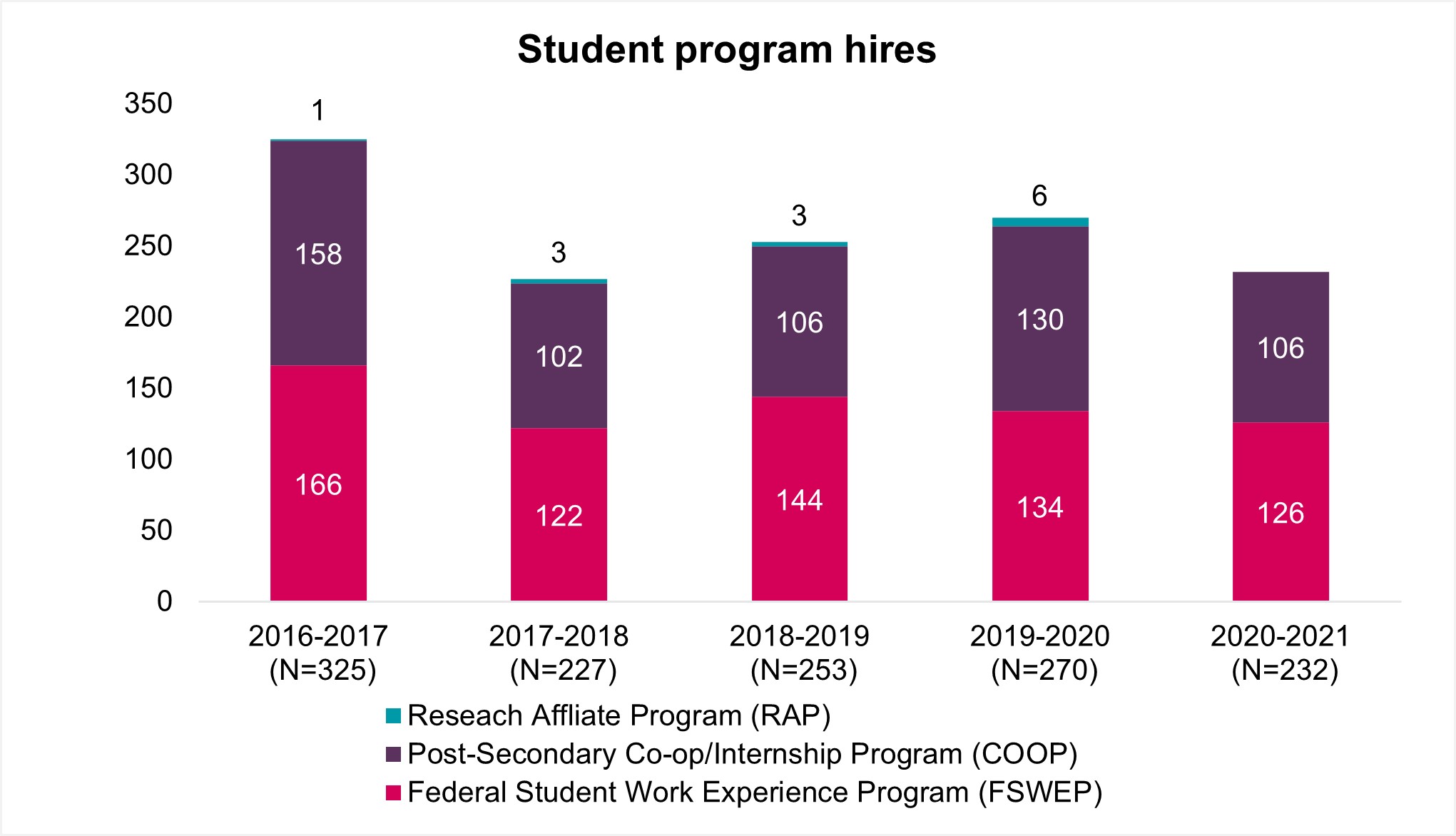
Text version
| Fiscal year | Federal Student Work Experience Program | Post-Secondary Co-op/Internship Program | Research Affiliate Program | Total |
|---|---|---|---|---|
| 2016-2017 | 166 | 158 | 1 | 325 |
| 2017-2018 | 122 | 102 | 3 | 227 |
| 2018-2019 | 144 | 106 | 3 | 253 |
| 2019-2020 | 134 | 130 | 6 | 270 |
| 2020-2021 | 126 | 106 | 0 | 232 |
Post-Secondary Recruitment Program and former student hires
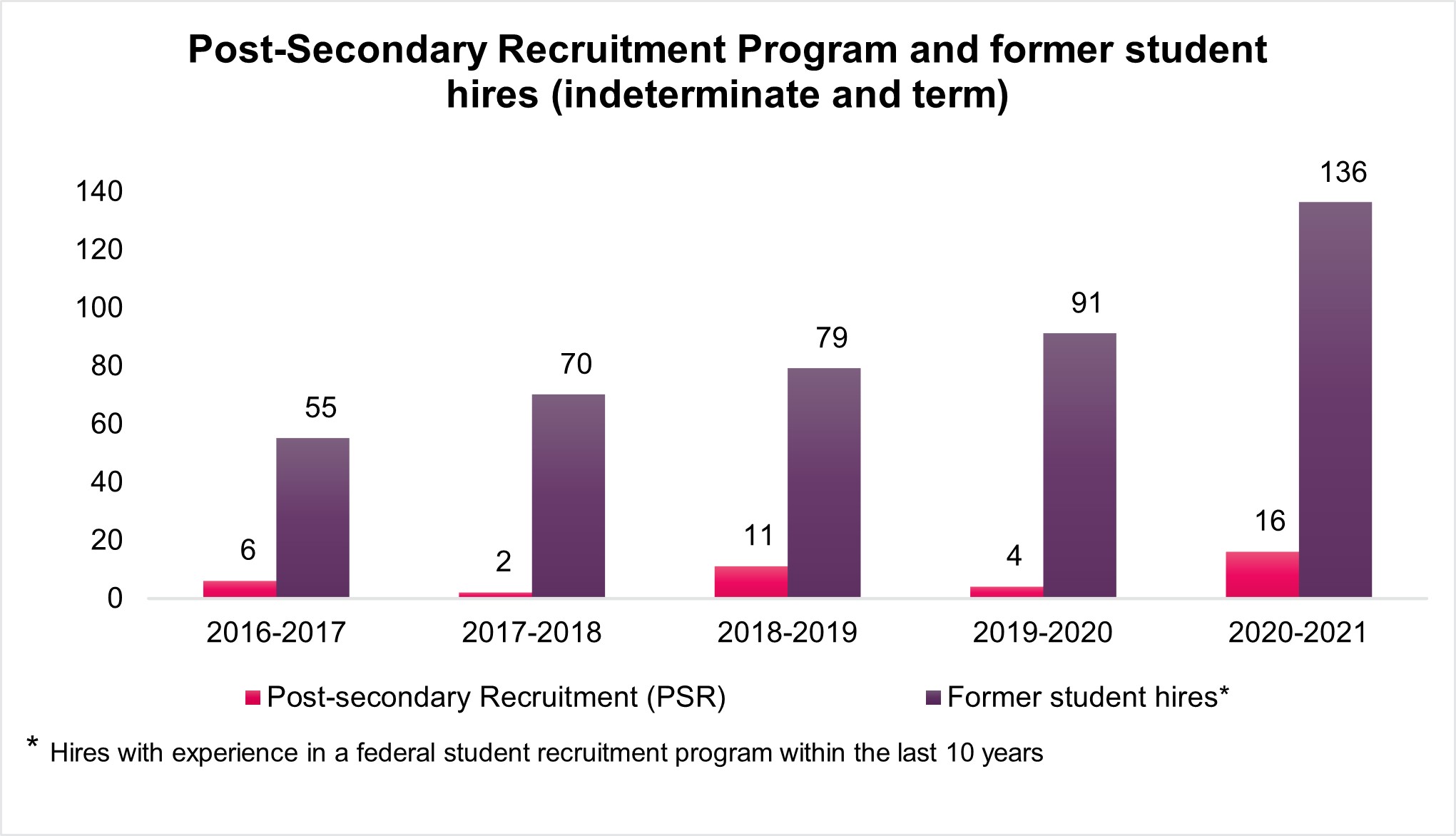
Text version
| Fiscal year | Post-secondary Recruitment (PSR) | Former student hires* |
|---|---|---|
| 2016-2017 | 6 | 55 |
| 2017-2018 | 2 | 70 |
| 2018-2019 | 11 | 79 |
| 2019-2020 | 4 | 91 |
| 2020-2021 | 16 | 136 |
*Hiring of former students includes indeterminate and term hires with experience in a federal student recruitment program within the last 10 years.
Internal time to staff
Text version
| Number of calendar days | The number of internal appointments for which the internal time to staff was within the specified number of calendar days for organizations subject to the Public Service Employment Act | The number of internal appointments for which the internal time to staff was within the specified number of calendar days for the specified organization |
|---|---|---|
| 0 calendar days | 0 | 0 |
| 0 to 29 calendar days | 10 | 0 |
| 30 to 59 calendar days | 67 | 0 |
| 60 to 89 calendar days | 147 | 1 |
| 90 to 119 calendar days | 203 | 3 |
| 120 to 149 calendar days | 191 | 2 |
| 150 to 179 calendar days | 174 | 1 |
| 180 to 209 calendar days | 168 | 4 |
| 210 to 239 calendar days | 136 | 1 |
| 240 to 269 calendar days | 125 | 1 |
| 270 to 299 calendar days | 114 | 1 |
| 300 to 329 calendar days | 79 | 1 |
| 330 to 359 calendar days | 74 | 2 |
| 360 to 389 calendar days | 66 | 1 |
| 390 to 419 calendar days | 56 | 1 |
| 420 to 449 calendar days | 46 | 2 |
| 450 to 479 calendar days | 34 | 0 |
| 480 to 509 calendar days | 28 | 0 |
| 510 to 539 calendar days | 27 | 0 |
| 540 to 569 calendar days | 19 | 0 |
| 570 to 599 calendar days | 10 | 1 |
| 600 to 629 calendar days | 13 | 1 |
| 630 to 659 calendar days | 13 | 1 |
| 660 to 689 calendar days | 12 | 1 |
| 690 to 719 calendar days | 7 | 0 |
| 720 to 749 calendar days | 10 | 0 |
| 750 to 779 calendar days | 8 | 0 |
| 780 to 809 calendar days | 8 | 0 |
| 810 to 839 calendar days | 3 | 0 |
| 840 to 869 calendar days | 5 | 0 |
| 870 to 899 calendar days | 6 | 0 |
| 900 to 929 calendar days | 3 | 0 |
| 930 to 959 calendar days | 2 | 0 |
| 960 to 989 calendar days | 2 | 0 |
| More than 990 calendar days | 36 | 1 |
Internal time to staff is calculated as the number of calendar days between the opening date of the advertisement and the date of the first notification.
Internal time to staff for fiscal year 2020-2021
The median internal time to staff for the public service (organizations subject to the Public Service Employment Act) for fiscal year 2020-2021 is 208 days. Canada Public Health Agency’s median internal time to staff for fiscal year 2020-2021 is 262 days.
External time to staff
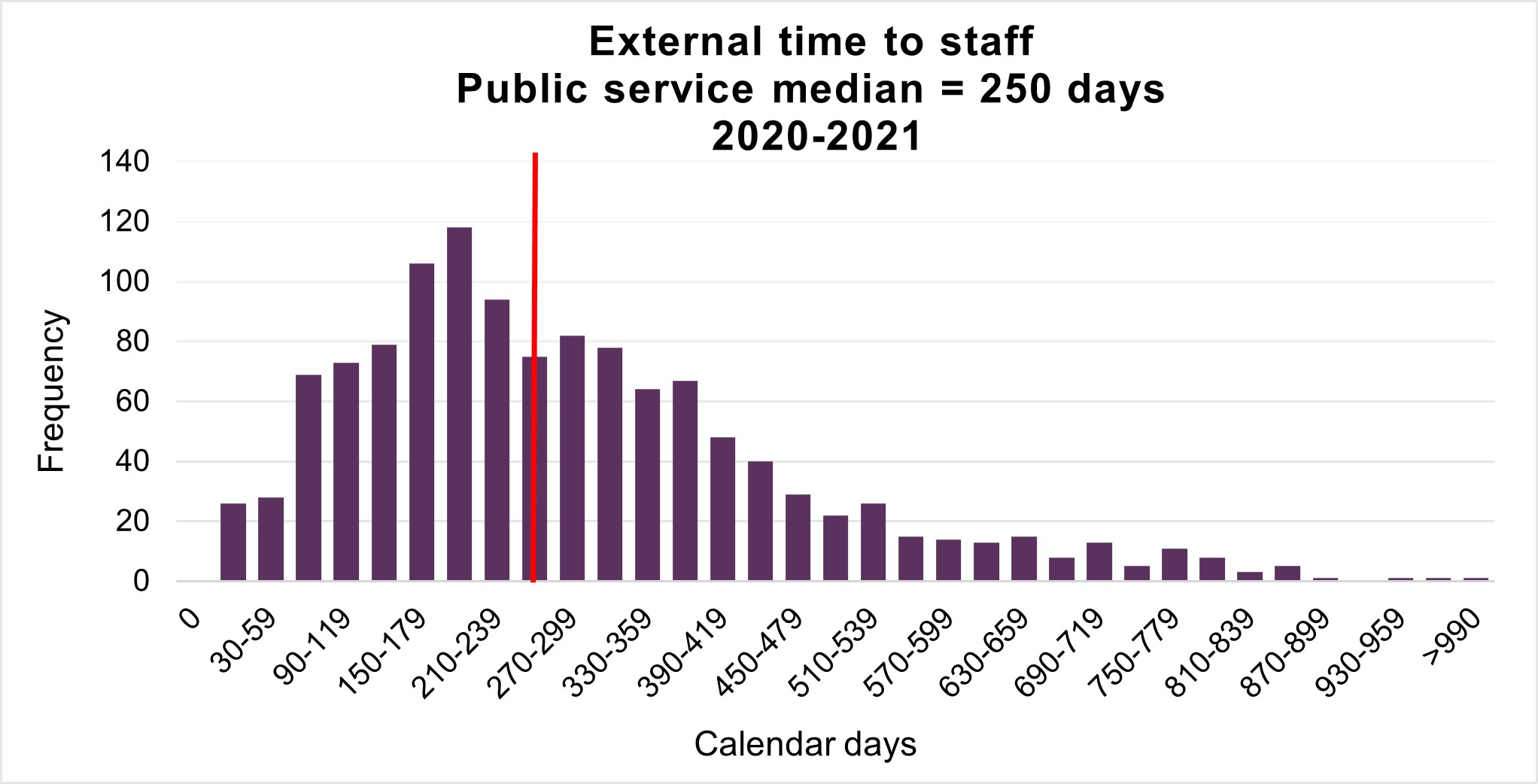

Text version
| Number of calendar days | The number of external appointment processes for which the external time to staff was within the specified number of calendar days for organizations subject to the Public Service Employment Act | The number of external appointments for which the external time to staff was within the specified number of calendar days for the specified organization |
|---|---|---|
| 0 calendar days | 0 | 0 |
| 0 to 29 calendar days | 26 | 2 |
| 30 to 59 calendar days | 28 | 0 |
| 60 to 89 calendar days | 69 | 2 |
| 90 to 119 calendar days | 73 | 2 |
| 120 to 149 calendar days | 79 | 3 |
| 150 to 179 calendar days | 106 | 1 |
| 180 to 209 calendar days | 118 | 1 |
| 210 to 239 calendar days | 94 | 1 |
| 240 to 269 calendar days | 75 | 0 |
| 270 to 299 calendar days | 82 | 2 |
| 300 to 329 calendar days | 78 | 1 |
| 330 to 359 calendar days | 64 | 1 |
| 360 to 389 calendar days | 67 | 0 |
| 390 to 419 calendar days | 48 | 1 |
| 420 to 449 calendar days | 40 | 0 |
| 450 to 479 calendar days | 29 | 0 |
| 480 to 509 calendar days | 22 | 0 |
| 510 to 539 calendar days | 26 | 0 |
| 540 to 569 calendar days | 15 | 1 |
| 570 to 599 calendar days | 14 | 0 |
| 600 to 629 calendar days | 13 | 0 |
| 630 to 659 calendar days | 15 | 1 |
| 660 to 689 calendar days | 8 | 1 |
| 690 to 719 calendar days | 13 | 0 |
| 720 to 749 calendar days | 5 | 0 |
| 750 to 779 calendar days | 11 | 1 |
| 780 to 809 calendar days | 8 | 0 |
| 810 to 839 calendar days | 3 | 0 |
| 840 to 869 calendar days | 5 | 0 |
| 870 to 899 calendar days | 1 | 0 |
| 900 to 929 calendar days | 0 | 0 |
| 930 to 959 calendar days | 1 | 0 |
| 960 to 989 calendar days | 1 | 0 |
| More than 990 calendar days | 1 | 0 |
External time to staff is calculated as the number of calendar days between the opening date of the advertisement and the date of the first estimated external hire.
External time to staff for fiscal year 2020-2021
The median external time to staff for the public service (organizations subject to the Public Service Employment Act) for fiscal year 2020-2021 is 250 days. Canada Public Health Agency’s median external time to staff for fiscal year 2020-2021 is 193 days.
Technical Notes:
- The Time to Staff for internal appointments is the median number of calendar days between the opening date of an internal advertisement and the date of the first Notice of Appointment or Proposal of Appointment (NAPA) from the Public Service Resourcing System for internal term and indeterminate positions. As NAPAs are not required for all internal staffing actions, this measure is limited to reporting on internal promotional appointments
- Only estimated term and indeterminate appointments/notifications are included (deployments, casual and acting appointments are excluded)
- The Time to Staff for external appointments is the median number of calendar days between the opening date of an external advertisement and the date of the first estimated appointment of an individual from outside an organization subject to the Public Service Employment Act for term and indeterminate positions. Only estimated term and indeterminate appointments/notifications are included (deployments, casual and acting appointments are excluded)
- Because data between systems is linked using a deterministic match, errors in data linkage are a potential source of measurement error
Sources:
- Hiring and staffing activities data are derived from information received from the Treasury Board of Canada Secretariat Incumbent File. The Incumbent File is extracted from the Public Services and Procurement Canada’s pay system. The data constitutes an estimate of hiring and staffing activities to and within organizations
- Information from the Priority Information Management System and the Public Services Resourcing System is also used to determine if staffing actions are advertised or non-advertised as well as for calculating time to staff
- The data are not expected to match an organization’s human resources data, due to methodology and timing differences