
Greening Real Property
Context
The Government of Canada is the largest owner of fixed assets (such as laboratories, lands, buildings, bridges, dams, military bases) in Canada. It owns over 30,000 buildings and 20,000 engineering assets (for example, bridges, roads and highways, wharves, canals, central heating and cooling plants). The vast portfolio includes assets that span all regions of the country.
The Greening Government Strategy requires that departments and agencies review and update, if necessary, their net-zero climate-resilient real property portfolio plan every 5 years to determine the most cost-effective pathway to achieve net-zero by 2050. Possible measures include rationalizing portfolios, co-sharing facilities, maximizing energy efficiency and phasing out fossil fuels (such as switching to lower-carbon fuels).
It also includes ensuring that climate risks to critical assets—including increased costs for building maintenance and repair or disruption to services—are assessed as soon as possible (and no later than 2030), and that measures to reduce these risks are implemented no later than 2035. Action to assess and take measures to address the climate risks to remaining high-value assets will be taken as soon as possible, and at the latest by 2040.
The Greening Government Strategy aligns with the Treasury Board Policy on the Planning and Management of Investments and Directive on the Management of Real Property. Management of the real property portfolio and investment decisions must demonstrate best value to the Crown and sound stewardship, while considering the life cycle costs of assets and services, including initial capital investment, ongoing capital reinvestment, and operating and maintenance costs.
For the commitments and targets related to real property, refer to the Greening Government Strategy. For the most recent results from greening real property operations, see the Progress Summary and Facilities tabs of the Government of Canada’s Greenhouse Gas Emissions Inventory.
Implementation
Departments are implementing these commitments by:
- integrating greening into their real property portfolio planning. The highest-emitting departments have completed their respective net-zero portfolio plans and real property emissions across the federal government decreased by 43% from 2005–06 to 2024–25
- incorporating greenhouse gas (GHG) life cycle costing and shadow carbon pricing into real property decision-making:
- GHG life cycle cost analysis focuses on full life cycle costs (initial capital investment and operational savings) and on achieving greening outcomes at the lowest cost
- shadow pricing refers to a method of investment or decision analysis that adds a surcharge for the GHG emissions that would be released over a specified period of time
- working to decarbonize the highest‑emitting facilities in their portfolios, whether they are defence bases, correctional facilities, laboratories or office buildings; actions being taken on buildings include making them more energy efficient, recommissioning them, and installing lower‑carbon heating and ventilation equipment
- working with Public Services and Procurement Canada to procure clean electricity where grids have high emissions, such as in Alberta, Saskatchewan, Nova Scotia and New Brunswick. As of 2024–2025, 85% of electricity consumption came from clean (non-emitting) sources
- developing procurement requirements for construction projects to reduce the embodied carbon—both in construction materials (such as concrete and steel) and through more efficient designs based on whole-building life cycle assessments. For more information on these requirements, see the Standard on Embodied Carbon in Construction
Examples of greening real property projects
New construction
1. The Canadian Food Inspection Agency’s Centre for Plant Health, North Saanich, British Columbia

Photo source: Public Services and Procurement Canada (PSPC)
Completed in late 2024, the Canadian Food Inspection Agency’s Centre for Plant Health is LEED Gold certified, demonstrating excellence in the use of carbon, energy, water, waste, transportation, materials, health and indoor environmental quality.
The building is a net-zero carbon facility and is estimated to save 200 tonnes of carbon dioxide equivalent (CO2e) annually. The facility is also one of the Government of Canada’s first buildings using a geothermal field as an energy source, powered by 55 onsite wells. Other climate-resilient design features include:
- sustainable and resilient materials to aid building cooling and energy preservation
- rainwater management and retention
- the integration of bird-friendly design features, such as special glass treatments and architectural elements that reduce the risk of bird collisions
2. Preservation Storage Facility: Library and Archives Canada, Gatineau, Quebec
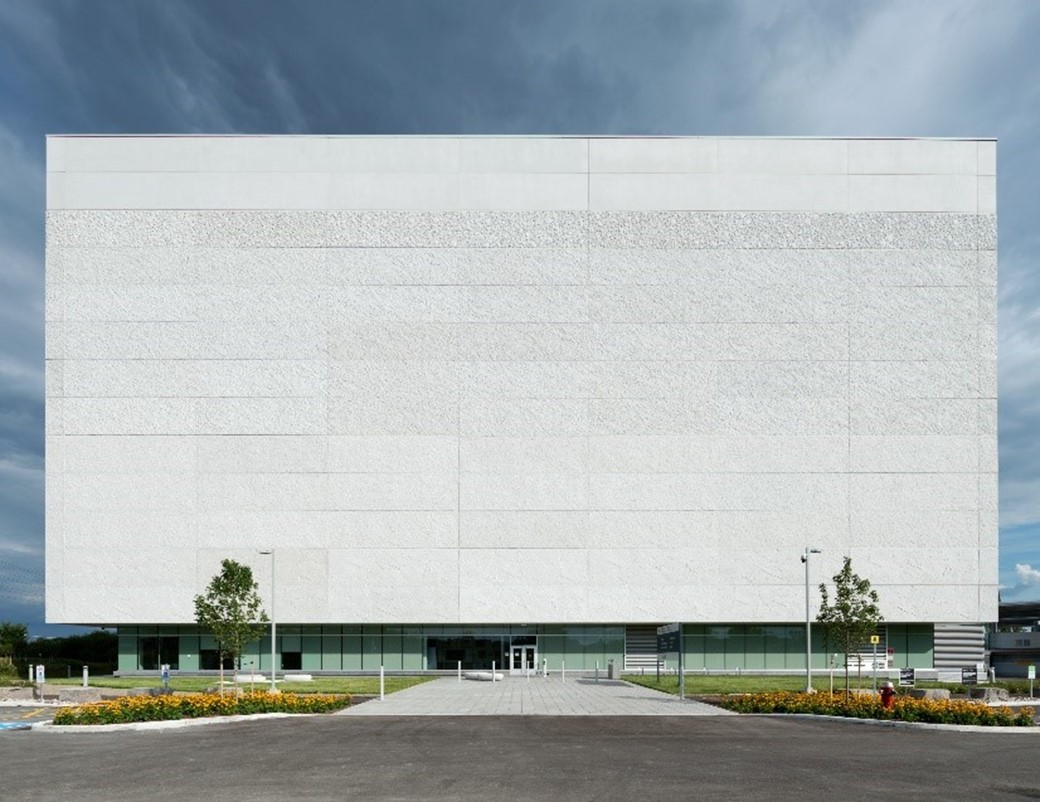
Photo by Roy Grogan. Preservation storage facility webpage
Completed in 2022, this facility:
- is the first net-zero carbon archival preservation facility in the Americas
- is the first special‑purpose federal facility built to meet the requirements of Canada’s Greening Government Strategy
- is one of the largest automated archival facilities in the world
- achieved LEED Gold certificationFootnote 1
The vaults use an automated storage and retrieval system that operates in the dark, which conserves energy while maintaining optimal preservation conditions.
3. Ādisōke: Library and Archives Canada–Ottawa Public Library joint facility, Ottawa, Ontario

Photo source: Ādisōke webpage

Photo source: Ādisōke webpage
Now in its final stages of construction, this building, born from a unique federal-municipal partnership, will serve as the Ottawa Public Library’s Central Branch, as well as the main location for Library and Archives Canada’s in‑person services.
This project was designed in accordance with the LEED Goldi and Canada Green Building Council’s Zero‑Carbon Building (ZCB) Standards. It has received the ZCB Design certification and is being constructed with the goal of achieving net-zero carbon emissions in operations. Building to these standards helps reduce embodied carbon through material efficiency in design, during construction and throughout operations.
Ādisōke will bring together the rich collections of a world-class public library and a national institution under one roof, giving life to the stories and histories that connect us. This modern, sustainable facility with its iconic architecture will be a must-see destination in the National Capital Region.
Built on the traditional, unceded territory of the Algonquin Anishinābe People, the project is coming to life with the close collaboration of that nation. In the Anishinābemowin Algonquin language, the name of the building means “storytelling.”
4. CFB Gagetown’s Explosive Ordnance Training Facility, Gagetown, New Brunswick

Photo source: 403 Squadron Imagery
As National Defence’s first net-zero emissions building, this facility:
- is powered by almost 1,000 solar panels
- is heated using geothermal energy
- uses water collected in underground wells and in cisterns for use in greywater and septic systems
The solar farm and battery energy storage system allows the building to operate off the grid, except on exceptionally cold days when there is an increased demand for heat.
5. Canada Revenue Agency’s National Verification and Collections Centre, 4695 Shawinigan-Sud Boulevard, Shawinigan, Quebec

Photo source: New federal building in Shawinigan: construction project page on Public Services and Procurement Canada website
Completed in 2025, this building is a leader in both operational emissions and embodied carbon reductions. The building is owned by Public Services and Procurement Canada and used by the Canada Revenue Agency, Employment and Social Development Canada, and Shared Services Canada. It was designed with strong climate and nature goals in mind, aiming to:
- generate 99% less greenhouse gas emissions than the old building
- use 100% clean electricity
- use less potable water
- improve HVAC efficiency
- protect and maintain existing green spaces
The construction and deconstruction involved in the project also reduced waste, with over 90% of construction waste diverted from landfill and similar numbers expected from the ongoing deconstruction process.
6. Estimauville Public Services and Procurement Canada building
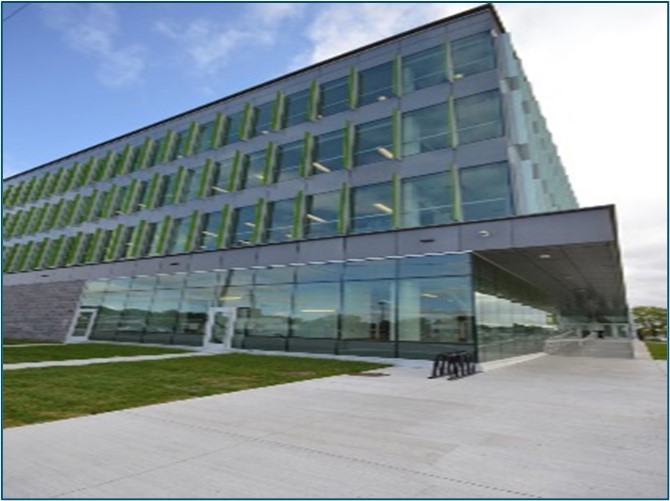
Photo source: TBC Constructions website
This net-zero emissions building, completed in 2015, is a leader in energy and environmental efficiency. The building features innovative solutions including a passive solar wall, heat recovery for parking lot heating, and water heating via hydronic solar panels. Its all-electric concept has eliminated all sources of greenhouse gas emissions. Now home primarily to employees of the Canada Revenue Agency and National Defence, this building is a valued component of the Estimauville neighbourhood.
Major retrofits and renovations
1. Permanent Mission of Canada in Geneva, Switzerland

Photo Source: Global Affairs Canada
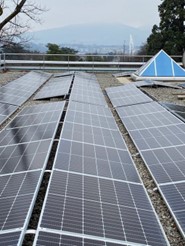
Photo Source: Global Affairs Canada
This is the first building outside of Canada to be certified under the Canada Green Building Council (CAGBC)’s Zero Carbon Building – Performance standard, becoming Global Affairs Canada’s first zero-carbon diplomatic mission. In 2022, it won the Government Leadership Award from the CAGBC.
2. Place du Portage, Phase III, Gatineau, Quebec
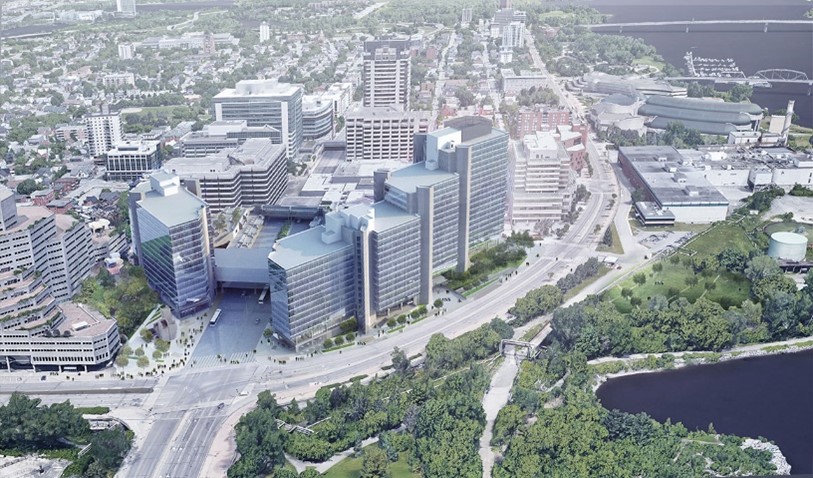
Photo source: Public Services and Procurement Canada website
Portage III, the largest of the buildings at Place du Portage, serves as the headquarters of Public Services and Procurement Canada.
Expected to be completed by 2028, the office towers (excluding underground parking) are being retrofitted to become net-zero emissions-ready, more accessible and more modern.
Sustainability retrofits include:
- LED lighting
- low-flow plumbing fixtures
- modern, high‑efficiency heating, cooling and ventilation (HVAC) systems
- smart building features
Additionally, by giving a “second life” to the building’s concrete and steel structure, this project will minimize embodied carbon by requiring less construction material compared to a new building.
3. 25 St. Clair Avenue East, Toronto, Ontario
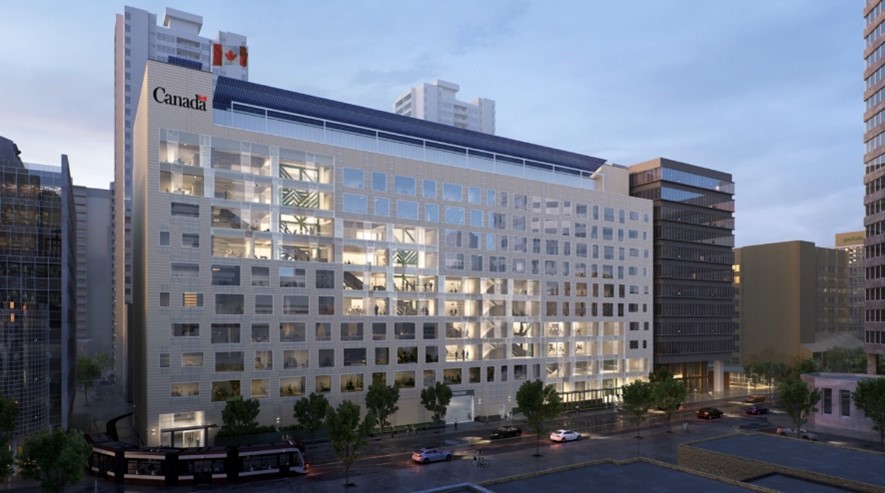
Photo source: Public Services and Procurement Canada, architectural rendering
This renovation project will reduce the building’s GHG emissions by over 80%. It was part of the Canada Green Building Council’s (CAGBC) Zero‑Carbon Pilot Projects.
Sustainable elements include a geothermal system and solar photovoltaic panels.
The finished building has reduced the federal government’s space holdings in downtown Toronto by housing several federal departments and agencies together and by applying the GCworkplace standard. It has been open since 2023.
4. Burlington Lift Bridge Deck Replacement Project, Burlington, Ontario

Photo source: Burlington Canal Lift Bridge: Bridge deck replacement project
The Burlington Canal Lift Bridge is a crucial connection point for motorists, pedestrians and boat traffic in Hamilton Harbour. The replacement project, completed in 2024, is expected to have extended the life of the bridge by 50 years for the deck and sidewalk and 30 years for the approaches, all while reducing embodied carbon in its concrete by 21% relative to the project baseline. The corresponding reduction from the embodied carbon of the concrete used as compared to the average embodied carbon of the concrete available in the region was 31 tCO2e.
Related links
- Greener Federal Buildings (Public Services and Procurement Canada)
- Government of Canada’s Greenhouse Gas Emissions Inventory (Treasury Board of Canada Secretariat)
- Making the Case for Zero‑Carbon Building (Canada Green Building Council report, 2019)
- Decarbonizing Canada’s Large Buildings (Canada Green Building Council report, 2021)