
Annual Report on Official Languages 2023-24
On this page
- Message from the President of the Treasury Board
- Introduction
- Chapter 1. Official languages and the Treasury Board of Canada Secretariat
- Chapter 2: Communications with and services to the public
- Chapter 3. Language of work
- Chapter 4. Federal institutions and the participation of English-speaking and French-speaking Canadians
- Chapter 5. Advancement of equality of status and use of English and French
- Chapter 6. Institutions and the management of official languages files
- Conclusion and trends
- Appendix A. Methodology for reporting on the status of official languages programs
- Appendix B. Federal institutions required to submit an official languages review for the 2023–24 fiscal year
- Appendix C. Definitions
- Appendix D. Statistical tables
- Appendix E. Information on events held by the Treasury Board of Canada Secretariat during the 2023–24 fiscal year
- Appendix F. Distribution of federal offices and service locations as of March 31, 2024
Message from the President of the Treasury Board
President of the Treasury Board
I am honoured to present the 36th Annual Report on Official Languages, which outlines the Government of Canada’s performance in promoting official languages during the 2023–24 fiscal year.
The Government of Canada is committed to protecting and advancing official languages within federal organizations and throughout Canadian society. The Official Languages Act enshrines rights and responsibilities, and guides our ongoing efforts to improve the delivery of services to Canadians in the official language of their choice.
This report presents performance results for federal institutions in key areas, such as communications with and services to the public, language of work, and monitoring official languages programs. I am pleased to note that these results show that the majority of institutions are meeting or exceeding their targets.
As the report notes, we still need to continue to improve to meet our official languages obligations across government, and the report details Treasury Board of Canada Secretariat activities to support institutions, including the development of a new Official Languages Accountability Framework and the creation of the Second Official Language Training Framework. These frameworks clarify roles and responsibilities and provide federal institutions and public servants with tools and resources to make second-language learning more accessible.
I invite you to read the report to find out more about our work to better serve Canadians and strengthen Canada’s two official languages.
Original signed by
The Honourable Shafqat Ali, P.C. M.P.
President of the Treasury Board
Introduction
Bill C-13: An Act to amend the Official Languages Act, to enact the Use of French in Federally Regulated Private Businesses Act, and to make related amendments to other Acts received royal assent on June 20, 2023.
The Treasury Board is responsible for the overall direction and coordination of policies and programs relating to the application of Parts IV, V and VI of the Official Languages Act (the Act) in federal institutions. As a result of major amendments to the Act in 2023, the Treasury Board is now also responsible for certain aspects of Part VII of the Act.
Within the Treasury Board of Canada Secretariat (TBS), the Office of the Chief Human Resources Officer is responsible for establishing official languages policies and programs and evaluating their effectiveness across federal institutions, as well as analyzing the results achieved. In concrete terms, TBS helps some 200 federal institutions subject to the Act—including departments and agencies, Crown corporations and entities that have been privatized—fully meet their linguistic obligations.
The obligations of federal institutions under the Act fall into five broad categories. Institutions must:
- serve and communicate with members of the public in both official languages
- establish a bilingual workplace in designated bilingual regions
- help maintain a public service whose workforce tends to reflect Canada’s demographic composition in terms of official languages
- take positive measures to ensure the equality of status and use of English and French in Canadian society, and to strengthen the protection and promotion of the French language
- ensure proper management of official languages issues
This 36th Annual Report on Official Languages examines the extent to which federal institutions succeeded in meeting their obligations under the Act during the 2023–24 fiscal year. It also provides examples of practices that would benefit from widespread implementation in the federal public service.
TBS now requires federal institutions to submit an official languages review (OL review) at least once every two yearsFootnote 1 (rather than once every three years as was done previously). In addition, 30 institutions must submit an OL review annually.
This year’s report provides an overview of the results of the OL reviews submitted by the federal institutions for the 2021–22, 2022–23 and 2023–24 fiscal years, comparing them, where possible, with those obtained during the 2018–21 cycle. Appendix A presents the methodology used to analyze the results obtained.
Chapter 1 of this report highlights some of the measures taken by TBS in 2023–24 to ensure overall compliance and alignment with the modernized Act. Chapter 2 analyzes the results of communications with and services to the public. Chapter 3 covers language of work; Chapter 4, the representation of English-speaking and French-speaking Canadians in institutions subject to the Act. Chapter 5 addresses the advancement of equality of status and use of both official languages, and Chapter 6 outlines official languages governance.
Chapter 1. Official languages and the Treasury Board of Canada Secretariat
In this section
- 1.1 Modernized legislation, new responsibilities
- 1.2 Expanding public access to federal services
- 1.3 Strengthen bilingualism and equity, diversity and inclusion in the public service
- 1.4 Supporting the official languages community of practice
- 1.5 Supporting the advancement of equality of status and use of English and French
- 1.6 Conclusion
Highlights of the 2023–24 fiscal year include:
- the adoption of the modernized Official Languages Act (the Act)
- the transfer of certain responsibilities from Canadian Heritage to the Treasury Board of Canada Secretariat (TBS), notably concerning Part VII of the Act
- the launch of the Official Languages Regulations Reapplication Exercise (OLRRE)
- TBS’s development of a new Official Languages Accountability Framework
- TBS’s creation of a Second Official Language Training Framework
- analyses and pre-consultations conducted with official language minority communities (OLMC), the Office of the Commissioner of Official Languages and other stakeholders, with a view to developing regulations on Part VII of the Act
1.1 Modernized legislation, new responsibilities
The modernized Official Languages Act (the Act) was adopted on June 20, 2023. One of its key changes is the reinforcement of provisions regarding the promotion of the equality of status and use of English and French in Canada. To help Canada advance towards this equality, the modernized Act has two new objectives:
- to promote and protect the French language
- to strengthen support to OLMCs
Within the government, the modernized Act also seeks to ensure greater compliance by federal institutions with their obligations (both ongoing and new), and greater oversight of this compliance by a central agency: TBS. The modernized Act gives TBS and its President a greater role in the implementation, coordination, and governance of the legislation.
Some previously discretionary powers of the Treasury Board are now powers that must be exercised. The Treasury Board is now required to:
- establish policies and directives to federal institutions on the implementation of parts of the Act for which Treasury Board was already responsible: communications with and services to the public (Part IV); language of work (Part V); and equitable participation of English-speaking and French-speaking Canadians in the federal public service (Part VI)
- monitor and audit federal institutions for compliance with official languages policies, directives, and regulations
- evaluate and audit the official languages policies and programs of these institutions
- inform the public and employees of federal institutions about policies and directives that apply to them
The Treasury Board’s responsibilities have also broadened. They now include monitoring and auditing federal institutions for compliance with requirements to take positive measures to support the advancement of equality of status and use of both official languages, and for including language clauses in federal–provincial–territorial agreements.
The Treasury Board is also responsible for establishing policies for the application of the Act in this area and has the authority to develop regulations for the application of Part VII of the Act, in consultation with the Minister of Canadian Heritage.
The modernized Act also has implications for the disposal of surplus federal real property, since institutions now have a legislative obligation to consider the interests of OLMCs in the disposal process. In January 2024, TBS updated its Directive on the Management of Real Property and related guidelines to reflect this new obligation.
To better guide the federal government’s official languages initiatives and provide a framework for the application of the Act, TBS has been developing a new Official Languages Accountability and Reporting Framework.
The framework clarifies and reiterates the roles and responsibilities of the key players in official languages governance—both government-wide and in federal institutions—and sets out TBS’s accountability expectations. This will help federal institutions establish their own official languages governance framework. TBS consulted key federal partners (including the Office of the Commissioner of Official Languages (OCOL)) to draft this framework.
To fully assume its strengthened monitoring, audit and evaluation responsibilities, TBS also revised its annual OL review exercise. The purpose of this exercise is to gather information from federal institutions to, for example, monitor their level of compliance with their official languages obligations.
The OL review exercise also provides a diagnostic tool for identifying institutional strengths and challenges, which enables TBS to identify trends and best practices as well as effective support activities.
Changes to the OL review exercise include updating the questions that federal institutions are asked (for example, introducing questions about positive measures and language clauses in federal–provincial–territorial agreements), and requiring institutions to provide additional evidence or clarification to support their responses. To help institutions answer these new questions, TBS created an instruction sheet and organized information sessions.
The new process also requires federal institutions to respond to the OL review questions every two years, rather than every three years. Some thirty institutions, selected based on their size or mandate, will continue to submit their OL reviews annually.
1.2 Expanding public access to federal services
In September 2023, as part of the implementation of the Official Languages (Communications with and Services to the Public) Regulations (the Part IV Regulations), TBS launched the OLRRE.
Undertaken every ten years, the OLRRE is an exercise through which some 200 federal institutions use the most recent census data to confirm the linguistic designation of nearly 10,000 offices and service locations by re-applying the criteria set out in the Part IV Regulations. The OLRRE will be carried out in several stages, and full implementation of the new linguistic obligations is expected in 2027.
TBS offered information sessions on OLRRE implementation to the institutions concerned. The information sessions covered:
- the validation of results for offices subject to automatic rules (offices subject to rules that do not require additional tasks, such as holding consultations, defining service areas and measuring demand)
- the principle of proportionality and the holding of consultations
- the definition of service areas
- the measurement of demand for services in English and in French
TBS also created tools, which are available in the Official Languages (Communications with and Services to the Public) Regulations Toolbox, to support institutions. These tools include a glossary of terms commonly used in the context of the OLRRE and fact sheets on the application of various rules.
TBS also developed a new online application—the System for Official Languages Obligations (SOLO)—to coordinate the OLRRE and manage the application of the Part IV Regulations.
TBS anticipates that the OLRRE will result in increased access to bilingual services across Canada, estimating that an additional 700 federal offices and service locations will be designated bilingual by 2027.
1.3 Strengthen bilingualism and equity, diversity and inclusion in the public service
TBS’s efforts to promote bilingualism in federal workplaces while increasing equity, diversity and inclusion in the public service continued in 2023–24.
Amendments to the Act include two provisions designed to promote bilingualism in the public service:
- the right of employees working in designated bilingual regions to be supervised in the official language of their choice as of June 20, 2025, regardless of the linguistic identification of their position
- the requirement for newly appointed deputy heads, deputy ministers, associate deputy ministers, and people appointed at an equivalent level, to take the language training that is necessary to be able to speak and understand clearly both official languages
To support employees and deputy heads in learning their second official language, TBS worked on two initiatives during the reporting period. The first, launched in February 2024, is the Language Training Hub, a one-stop shop for language training needs.
As a first step, it includes three new guidance tools:
- a guide to help institutions and managers plan and prioritize language training activities
- a compilation of best practices that managers can apply to create a workplace conducive to learning English or French as a second language
- a guide for learners, directing them to free self-directed learning tools
The second initiative involves the creation of a second official language training framework. This framework is designed to support federal government employee training by providing learning options that are effective, flexible, accessible, learner-centred, and responsive to the needs of equity-seeking groups. The framework will include:
- guidelines to ensure equitable access to training and promote learner success
- a handbook that will include best practices and recommendations for implementing these guidelines
- a playbook containing various learning paths, tools, and resources, tailored to the needs of learners in a variety of organizational contexts
The second official language training framework will also present various training options to meet the needs of employees who belong to equity-seeking groups. To this end, in May 2023, TBS created an advisory committee on second official language training for equity-seeking groups. This committee considered the tools in the language training framework to determine how they could be used to eliminate barriers that could hinder the learning journey of people belonging to equity-seeking groups.
In fiscal year 2023–24, TBS published the Guide to Official Languages in Federal Procurement to help federal institutions meet their linguistic obligations when acquiring goods and services. It also produced the Manager’s Guide: Key Considerations When Procuring Professional Services, designed to support managers in making informed decisions about contracting.
1.4 Supporting the official languages community of practice
Over the course of 2023–24, TBS organized a number of activities to inform and equip those responsible for official languages.
In June 2023, over 70 federal institutions participated in the Conference of Official Languages Champions. Entitled “Dare to Lead,” this event gave participants the opportunity to discuss questions such as:
- How can we encourage the use of both official languages in a hybrid work environment?
- How can we ensure that official languages remain an institutional priority?
- What tools are available to help those who promote official languages play their role more effectively?
In February 2024, TBS once again organized the Best Practices Forum on Official Languages in collaboration with the Official Languages Branch at Canadian Heritage and the Council of the Network of Official Languages Champions. The week-long event mobilized more public servants than ever: 2,000 people viewed the webcast and 1,390 participated in the workshops. During the Forum, participants were able to:
- visit virtual and in-person kiosks to discover the tools available online through the Language Portal of Canada and the Language Training Hub
- take part in virtual workshops, such as the Canada Deposit Insurance Corporation’s effective management of a mentoring language program and Farm Credit Canada’s bilingual coaching circles
- attend a discussion on the modernization of the Official Languages Act and its impact on the public service and Canadians
TBS organized an introductory workshop on official languages (“Official Languages 101”) and an information session on updates to the Second Official Language Training Framework.
In collaboration with Canadian Heritage, Farm Credit Canada, the Public Health Agency of Canada, the Canada School of Public Service, and the Canadian Food Inspection Agency, TBS also held the “Bringing Together the Community of Practice” hybrid learning and networking event. This targeted initiative, restricted to persons responsible for official languages (PROLs), champions and section 41Footnote 2 coordinators, created a dynamic space for participants to exchange best practices.
From April 2023 to March 2024, TBS also organized more than a dozen events for the official languages community of practice. These covered topics such as the modernization of the Act, Part VII of the Act, the OLRRE, the OL review exercise, and the Second Official Language Learning Framework.Footnote 3
Finally, in January 2024, TBS provided the Commissioner of Official Languages with an overview of initiatives undertaken to implement recommendations, including:
- an action plan on the application of section 91 of the Act, which involves staffing and the objective consideration of language requirements
- a conference on “Emergency Preparedness in a Diverse Federation” organized by the Canada School of Public Service in February 2024 as part of its series on Canadian federalism
- the integration of some questions from OCOL’s Official Languages Maturity Model into the questionnaires used by institutions for their OL reviews
- guidelines on optimizing a hybrid workforce, including those relating to official languages
1.5 Supporting the advancement of equality of status and use of English and French
The modernized Act gives the President of the Treasury Board the authority to develop regulations on Part VII of the Act, in consultation with the Minister of Canadian Heritage. The purpose of these regulations is to specify how federal institutions are to fulfill their obligations to advance the equality of status and use of English and French in Canadian society, and to ensure compliance with the commitments made by the Government of Canada.
As part of the work to develop new regulations for Part VII of the Official Languages Act, TBS held regular meetings with the Fédération des communautés francophones et acadienne du Canada, TALQ (Talking. Advocating. Living in Quebec, formerly the Quebec Community Groups Network), the OCOL, and federal institutions.
In fall 2023, TBS conducted a preliminary analysis of existing documentation (documents prepared as part of the modernization of the Act, reports submitted by stakeholders on issues related to Part VII) and the expectations identified by stakeholders to guide the development of the regulations. This analysis enabled TBS to identify recurring themes that needed to be explored in greater depth:
- The ability of organizations to take part in OLMC consultations with federal institutions
- The importance of clarifying certain concepts in Part VII
- The importance of including language clauses in federal–provincial–territorial agreements to ensure greater transparency and accountability
- The importance of transparency and accountability in taking positive measures
Finally, in winter 2024, TBS launched a series of pre-consultations with OLMCs; organizations whose mandates involve the promotion of bilingualism in Canadian society; the OCOL; and federal institutions. These pre-consultations enabled TBS to address four main themes:
- consultation with OLMCs and other stakeholders, and understanding their needs
- agreements between federal institutions and provincial and territorial governments
- accountability of federal institutions
- possible clarification of certain elements of Part VII. This work was intended to guide TBS in the preparation of regulatory proposals for the subsequent statutory consultations in fall 2024.
1.6 Conclusion
TBS has assumed its new responsibilities following the modernization of the Act.
In the subsequent reporting period, TBS will work with Canadian Heritage to develop Part VII regulations that will guide federal institutions in their new responsibilities—particularly with regard to taking positive measures to ensure the equal status and use of English and French in Canadian society. Within the limits of the powers granted by the Act, these regulations will consider the needs and realities of OLMCs and the operational context of federal institutions.
In addition, TBS will continue to support institutions in their efforts to promote bilingualism in their workforce, which include enabling employees to be supervised in the official language of their choice, or by helping them to take training and maintain their second official language skills.
Chapter 2: Communications with and services to the public
In this section

Graphic 1 - Text version
The proportion of designated bilingual offices and points of service across all institutions is 32.9%.
In the core public administration, 41% of all positions serving the public are bilingual.
95% of incumbents in these positions meet the language requirements of their position.
In other institutions subject to the Act, 33% of all positions serving the public are bilingual.
2.1 Summary
Federal services must be accessible to the entire population. To achieve this goal, federal institutions operate a vast network of offices and service locations across Canada and abroad.
This network, whose geographic distribution is detailed in Appendix F, comprises 10,861 locations.Footnote 4 Nearly a third of these (32.9%, or 3,572) were required to offer services and communicate with the public in both official languages as of March 31, 2024.
These customer service points offer support and information via channels including service counters, call centres, websites, onboard staff on airplanes, ferries, and trains, and interactive digital kiosks.
What does TBS expect from institutions?
According to the target set by TBS, at least 90% of federal institutions must be able to confirm that their offices and service locations “always” or “almost always” comply with their obligations under the Act, and that certain best practices are “always” or “almost always” applied (such as ensuring that official languages issues are a regular item on the agenda of senior management meetings).
The importance of institutions collectively reaching this 90% target will be reiterated in every chapter of this annual report.
As shown in table 1, the majority of federal institutions indicate that they “always” or “almost always” comply with their obligations related to communications with and services to the public (see definition in Appendix C). This positive trend is based largely on the operational capacity of institutions to provide services in both official languages.
For example, data as of March 31, 2024, reveals that, of the 123,112 positions dedicated to serving the public in the core public administration, 41% are held by employees capable of offering services in both English and French, and that 95.2% of these 50,517 public servants actually have the language skills required for their position.
However, action is still required to reach the 90% target set by TBS. Currently, this target is achieved for 7 of the 14 statements in table 1. Although this represents significant progress from the previous OL review cycle (when the 90% threshold was reached for only 4 of 12 statements), work remains to be done.
| Questions | 2018–21 | 2021–24 |
|---|---|---|
| The institution’s oral communications (for example, public speeches, public announcements, public consultations, seminars, conferences, booths, animation during exhibition booths) were in both official languages or in the official language chosen by the targeted audience when the office was designated as bilingual. | 87% | 84% |
| The institution’s written communications (for example, official correspondence, mass mailings of letters or emails, mass distribution of leaflets or pamphlets, press releases, newsletters, posters) were in both official languages or in the official language chosen by the targeted audience when the office is designated as bilingual. | 91%Footnote * | 91%Footnote * |
| All communications material is produced in both official languages and was simultaneously issued in full in both official languages when the material comes from a designated bilingual office. | 83% | 91%Footnote * |
| The English and French versions of websites are simultaneously posted in full and were of equal quality. | 93%Footnote * | 96%Footnote * |
| The English and French versions of the institution’s social media content are posted in full and simultaneously and are of equal quality. New statement | Not applicable | 94%Footnote * |
| Signs identifying the institution’s offices or facilities are in both official languages at all locations. | 96%Footnote * | 94%Footnote * |
| Appropriate measures were taken to greet the public in person in both official languages. | 83% | 86% |
| Appropriate measures were taken to greet the public by telephone, including recorded messages, in both official languages. | 84% | 86% |
| Contracts and agreements with third parties to provide services on behalf of the institution included clauses setting out the language obligations of the offices, with which third parties had to comply. | 76% | 85% |
| The institution ensured that the language obligations set out in these clauses were respected. | 71% | 81% |
| The institution selected and used advertising media that reach the targeted public in the most efficient way possible in the official language of their choice. | 94%Footnote * | 100%Footnote * |
| The institution took its language obligations into account when it was organizing or participating in public events (fairs, exhibitions, ceremonies, symposia, conferences, and so on), whether at home or abroad. New statement | Not applicable | 81% |
| The institution took measures to ensure respect for the principle of substantive equality in its communications with and services to the public, as well as in the development and evaluation of policies and programs. | 78% | 77% |
| In crisis or emergency situations, measures were taken to ensure that external communications were in both official languages or in the public’s preferred official language (Part IV of the Act). | 34% | 99%Footnote * |
2.2 Oral and written communications
Federal institutions must make efforts to ensure that their oral communications (for example, press conferences, events and public consultations they organize) are in both official languages or in the official language chosen by the target audience. In 2021–24, only 84% of institutions stated that they “always” or “almost always” did this—a drop of 3 percentage points compared to the previous OL review cycle.
That said, institutions continued to perform well overall when it comes to written communications. Between 2021 and 2024, 91% stated that written material intended for the public (for example, press releases and newsletters) was “always” or “almost always” produced in both official languages, or in the official language chosen by the specific target audience. This result is the same as for the 2018–21 cycle.
Good practice
Agriculture and Agri-Food Canada’s Public Affairs Branch (PAB) organized nearly 20 press conferences or face-to-face meetings with the media in 2023–24. During these events, the same approach was systematically used in each of the two official languages to explain the meeting to participants and give them instructions for the question-and-answer sessions. Participants were free to express themselves in the official language of their choice and received a response in the chosen language. During the same period, all PAB recruitment activities were promoted and conducted in both official languages. Management ensured that Open House spokespeople and the persons responsible for regional exhibition booths were all bilingual.
Good practice
Canada Mortgage and Housing Corporation ensures that all oral communications are in both official languages. This includes speeches, conferences, seminars and booths. One of the tools that the Crown corporation uses to ensure that its oral communications are conducted in both English and French is simultaneous interpretation services (for example, at public meetings).
Good practice
The Canadian Radio-television and Telecommunications Commission’s customer service team responds to enquiries and questions from the public and provides support to anyone who wishes to file a written complaint. All written communications (whether by email, chat or traditional correspondence) are in the official language chosen by the person making an enquiry. To ensure quality of service, all customer service positions require a CCC/CCC linguistic profile—the highest level of proficiency—and employees are tested every 5 years.
2.3 Active offer
Active offer is a way of signalling to members of the public that they have the right, from their very first contact, to interact with and receive services from federal institutions in either English or French, without having to make an explicit request. Through, for example, bilingual greetings (in person or over the phone) such as “Welcome! Bienvenue!,” bilingual signature blocks in email communications, or recorded messages in both official languages, institutions encourage customers to use the official language of their choice from the start of an interaction.
This practice is key to respecting the public’s language rights, since, as the Commissioner of Official Languages has pointed out, “clients who are not immediately offered service in the official language of their choice may assume that service is not available in that language, or that asking for it may cause delays or embarrassment.”Footnote 5
However, the results of OL reviews over the last three years show that the active offer is not yet used systematically by federal institutions: in the 2021–24 OL review period, only 86% of institutions said that they “always” or “almost always” use appropriate measures (such as using the phrase “Hello! Bonjour!”) to inform people who come to their offices that they have the choice of using English or French. The result is the same (86%) for the active offer by phone. This is, however, a slight increase (3 and 2 percentage points, respectively) compared to the results of the 2018–21 OL reviews.
Good practice
In addition to mandatory training for all front-line officers, the Canada Border Services Agency regularly reminds employees of the importance of active offer and proactively checks bilingual capacity. Standard operating procedures also ensure that travellers are either redirected to bilingual channels or greeted directly by a bilingual agent.
2.4 Dissemination of information and advertising
To ensure that the public has access to federal information in the official language of their choice, institutions must ensure that information or advertising is disseminated equitably.
This means that all communications material from a designated bilingual office must be produced and distributed simultaneously and in full in both official languages. The same applies to website content and social media posts.
Institutions have made progress in these three areas. With regard to communications material from designated bilingual offices, 91% of institutions said they “almost always” or “always” met their obligations between 2021 and 2024. This represents an increase of 8 percentage points over the 2018–21 figure. A more modest, but still notable, increase was also observed with regard to website content: 96% of institutions reported meeting language requirements in this area, compared to 93% in the previous cycle.
The question of social media was asked for the first time in the 2021–24 OL reviews: 94% of institutions confirmed that, with rare exceptions, they publish full English and French versions of all their content simultaneously, while guaranteeing equal quality in both languages.
Finally, it is worth noting that 100% of institutions said they choose and use the advertising media most likely to reach their target audience in their preferred official language (newspapers, radio or social media, for example), an increase of 6 percentage points from the previous cycle.
Good practice
The Canada Revenue Agency’s Public Affairs Branch ensures that all content published on social media is created in collaboration with its Linguistic Services to ensure equal quality in both official languages. Specialized resources from the Linguistic Services team work closely with the Social Media team to ensure that content is not only accurate, but also adopts an appropriate tone and style for these platforms. In addition, any puns, wordplay or cultural references are designed from the outset from a bilingual perspective. This approach ensures that they are culturally appropriate for each language audience and equally effective in both languages.
Good practice
At Immigration, Refugees and Citizenship Canada, all documents requiring translation are entrusted to professional translators. An in-house editing team ensures (through regular checks and comparative reviews) that all communication material intended for the public is not only disseminated simultaneously in both official languages by the Web Services team, but also of equal quality. In addition, all web pages are updated in both languages simultaneously.
Good practice
Before being broadcast in any medium, any message in Innovation, Science and Economic Development Canada’s advertising campaigns must be tested with both English- and French-speaking audiences (usually through focus groups). Marketing videos with smaller budgets are always subtitled in both official languages at a minimum.
2.5 Contracts and agreements with third parties
Under the Act, federal institutions are responsible for ensuring that any partner organization that communicates information or offers services to the public on their behalf respects the official languages rights of the public. Although the results obtained for 2021–24 represent a marked improvement over 2018–21, the 90% target has still not been reached.
Table 1 shows that 85% of institutions that enter into contracts or agreements with third parties to provide services on their behalf always or almost always include clauses specifying the linguistic obligations these third parties must meet (compared with 76% in the previous cycle). Of these same institutions, only 81% report that these clauses are always or almost always respected by third parties. While still insufficient, this result represents an improvement of 10 percentage points compared to 2018–21.
Good practice
The Greater Toronto Airports Authority’s Tenant Handbook specifies that businesses operating on airport premises must provide their employees with adequate training to meet the service requirements of the Official Languages Act. It also recommends that, insofar as the local hiring pool at Toronto Pearson International Airport allows, preference should be given to recruiting bilingual managers and team members. In addition, business partners should have sufficient staff onsite to offer services in both English and French.
Good practice
To ensure compliance with official language clauses, the National Arts Centre has established a compliance monitoring system that includes a feedback mechanism to ensure that suppliers meet the language requirements set out in their contracts. The contract holder must also carry out a compliance check, and invoices are paid only once the results have been deemed satisfactory.
2.6 Respecting the principle of substantive equality
According to the principle of substantive equality, official language minority communities (OLMCs) have the right to receive government services that are equal in quality to those offered to the majority. Access to these services must also be equal for both official language communities (the principle is not respected if, for example, the choice of one language over the other has a substantial impact on wait times on the telephone, or on the distance to travel to reach a point of service).
To achieve substantive equality, federal institutions must adapt their practices (for example, by changing their mode of delivery or offering distinct content) to consider the specific needs and characteristics of local OLMCs.
Institutions achieved the weakest result in respect for substantive equality in the 2021–24 cycle. The OL reviews submitted show that only 77% of federal institutions “always” or “almost always” respect this principle when communicating with or providing services to the public. This represents a slight drop (1 percentage point) compared to 2018–21.
Good practice
Employment and Social Development Canada overhauled its OLMC consultation process to take into account the 2019 amendments to the Official Languages Regulations. The new process aims to better communicate the obligation to consult or inform OLMCs when changes are made to the department’s network of service locations. By consulting OLMCs, the department is able to understand their specific needs and adapt its communications and service delivery to ensure respect for the principle of substantive equality.
2.7 External communications in crisis or emergency situations
The clearest improvement in this OL review cycle was measures taken by institutions in crisis or emergency situations to ensure that external communications are in both official languages or in the public’s preferred official language. The result for 2021–24, 99%, represents a major leap of 65 percentage points over 2018–21 results.
It should be noted that TBS has deployed significant efforts following the publication in 2020, by the OCOL, of the report “A Matter of Respect and Safety: The Impact of Emergency Situations on Official Languages,” to improve the institutional performance with respect to official languages during crisis or emergency situations. In collaboration with other institutions, TBS has for example created and made available to all federal institutions a bank of pre-translated messages on recurring issues relating to emergency and crisis communications.
An interdepartmental working group led by TBS has also developed a strategy and an integrated action plan. The main measures implemented included the revision of relevant policy instruments and the Information Sharing Protocol on Significant Events (which establishes for staff members an integrated process for the dissemination of bilingual information on security and safety matters); awareness and mobilization efforts targeting stakeholders in emergency and crisis communications; and, finally, the strengthening of accountability mechanisms based on annual official languages reports.
This work has no doubt contributed to the marked improvement observed in crisis or emergency situations for the 2023–24 fiscal year.
Good practice
The Greater Toronto Airports Authority has invested in translation technology that can be accessed from a mobile device by terminal staff, including passenger services and terminal service representatives. The technology enables staff to converse with travellers in French and over 240 other languages.
2.8 Conclusion
Federal institutions have made great strides in certain areas of bilingual communications and services to the public, such as emergency response, the use of advertising media, and the simultaneous distribution of communications material. They also achieved a remarkable level of excellence in, for example, the use of French and English in their written communications, web activities, and social media interactions.
That said, nearly a quarter of federal institutions must improve efforts to respect the principle of substantive equality when their employees communicate with or provide services to the public. In addition, as in the previous cycle, still too few institutions use the active offer in person and on the telephone, include language clauses in their agreements with third parties, or verify that existing clauses are respected. Finally, too few federal institutions take their linguistic obligations into account at public events—whether as organizers or participants.
Chapter 3. Language of work
In this section
- 3.1 Summary
- 3.2 Language of written communications
- 3.3 Language of meetings
- 3.4 Language of employee supervision
- 3.5 Personal and central services
- 3.6 Computer systems and work tools
- 3.7 Training and professional development
- 3.8 Communicating with staff and promoting the use of both official languages
- 3.9 Measures to support linguistic security
- 3.10 Conclusion

Graphic 2 - Text version
Within the core public administration, 96% of incumbents in bilingual supervisory positions meet the language requirements of their position.
66% of bilingual supervisory positions required Level C proficiency in oral interaction.
95% of incumbents who offer personal and central services in both official languages meet the language requirements of their position.
37% of bilingual positions that offer personal and central services require Level C proficiency in oral interaction.
3.1 Summary
In order to foster full recognition of both official languages in federal institutions, Part V of the Act sets out the obligations they must respect regarding the language of work. The amended text of the Act provides new provisions concerning the use of French and English in the professional environment of public servants. For example, in regions designated bilingual for language of work purposes, federal employees can now be supervised in the official language of their choice, regardless of their position’s linguistic designation.
Institutions must intensify their efforts to ensure that the language rights of employees are respected. Despite some progress observed for the 2021–24 period, the 90% compliance target is met for only one of the 13 statements in table 2.
The most concerning results relate to the language of meetings: fewer than one institution in two (47%) says it “always” or “almost always” conducts meetings in both official languages and offers employees the opportunity to use the official language of their choice during these meetings. Furthermore, too many institutions still do not systematically provide their employees the opportunity to draft documents in the official language of their choice, and do not ensure that senior management regularly communicates with staff in both official languages.
As in the previous cycle, a high proportion of bilingual supervisory positions (96%) appears to be filled by employees who meet the linguistic requirements attached to them. Similarly, 95% of employees who provide personal and central services in both official languages meet, in principle, the linguistic requirements of their position.
Therefore, something other than the lack of mastery of both official languages by employees likely explains the poor results of institutions regarding the language of meetings, the creation of a climate that promotes writing documents in both languages, and the use of French and English by senior officials when they interact with employees.
One probable contributing factor is linguistic insecurity, which may discourage employees from using their second official language—even when they meet the required proficiency levels.
TBS has implemented several initiatives to address this issue, such as the development of workshops for employees on linguistic security and the creation of an interdepartmental working group.
This group, which includes representatives from the OCOL, has a mandate to analyze, understand and raise awareness among federal public servants of the phenomenon of linguistic insecurity. This report also highlights good practices adopted by certain institutions to enhance linguistic security in their organization.
| Questions | 2018–21 | 2021–24 |
|---|---|---|
| In bilingual regions for language-of-work purposes | ||
| Employees had the option of writing documents in their official language of choice, except for situations where the language of service prevailed. | 59% | 67% |
| Meetings for employees were conducted equally in English and in French, and employees were able to use the official language of their choice. | 42% | 47% |
| Incumbents of bilingual or either/or positions located in a region designated as bilingual for language-of-work purposes were supervised in the official language of their choice, regardless of whether the supervisors were in bilingual or unilingual regions. | 72% | 75% |
| Personal and central services were provided in the official language of their choice to employees who held a position in a bilingual region. | 87% | 85% |
| The institution offers employees training (other than second-language training) in the official language of their choice. | 75% | 83% |
| In bilingual regions for language-of-work purposes, electronic systems were available in the official language of the employees’ choice. | 77% | 82% |
| The institution took steps to create a work environment that promotes the use of the first and second official languages and fostered linguistic security so that employees could maintain and improve their language skills. New statement | Not applicable | 74% |
| The institution took its language obligations into account when organizing activities for employees located in regions designated as bilingual for language-of-work purposes (information sessions, informal training, town halls, presentations by guest speakers, and so on). New statement | Not applicable | 84% |
| Senior management communicated in both official languages with employees located in regions designated as bilingual for language-of-work purposes. | 63% | 69% |
| Senior management demonstrated leadership by promoting the use of English and French in offices that are located in regions designated bilingual for language-of-work purposes. New statement | Not applicable | 87% |
| The institution’s results in the Public Service Employee Survey were analyzed and were communicated in the organization. When deficiencies related to official languages were identified, an action plan was developed and implemented to resolve them. New statement | Not applicable | 86% |
| In crisis or emergency situations, measures were taken to ensure that internal communications were in both official languages or in the preferred official language of employees who held a position in a bilingual region (Part V of the Act). | 34% | 96%Footnote * |
| In all regions | ||
| Employees who were required to provide bilingual services to the public or to employees in a region designated bilingual had access to documentation and regularly and widely used work instruments in both official languages. | 83% | 85% |
3.2 Language of written communications
Work remains to be done in terms of respecting the right of employees in bilingual regions to use their preferred official language when drafting documents: only two thirds (67%) of institutions said they “always” or “almost always” give their employees in designated bilingual regions the opportunity to draft documents in the official language of their choice. This is up from 59% in 2018–21, but still unsatisfactory.
Good practice
The Parole Board of Canada encourages its employees to write documents in the official language of their choice. The institution has created a position dedicated to the translation and revision of internal documents in both official languages. It also uses the Translation Bureau when necessary.
3.3 Language of meetings
Particular attention must be paid to the issue of the language spoken at employee-only meetings. Only 47% of institutions indicate that meetings in designated bilingual regions are “always” or “almost always” held in both official languages, and that their employees feel comfortable speaking in the official language of their choice.
This is the lowest result recorded in this OL review period. It is essential for every institution to create conditions conducive to the use of both official languages during meetings.
Good practice
Parks Canada has established a bilingual meeting culture that encourages all employees to express themselves in the official language of their choice. Documents and agendas are shared at the same time in both languages, and simultaneous translation is provided at major events and meetings. To reinforce this culture, best practices in chairing bilingual meetings are widely disseminated throughout the organization. In Ontario, field unit directors set the example by systematically holding meetings in both official languages.
3.4 Language of employee supervision
Prior to the new dispositions that came into effect on June 20, 2025, only employees in bilingual or either/or positions in bilingual regions could choose the official language they were supervised in. Between 2021 and 2024, only 75% of institutions “always” or “almost always” respected this right—a slightly higher result than in 2018–21 (72%).
In the core public administration, the language requirements of bilingual supervisory positions are met by almost all (96%) of their incumbents.Footnote 6 However, in institutions that are not part of the core public administration but have offices in regions designated bilingual for language-of-work purposes, only 79.3% of managers required to be bilingual actually meet the requirements to perform their supervisory duties in both official languages.
Good practice
Public Services and Procurement Canada seeks to ensure that every employee is supervised in the official language of their choice, regardless of the location of their supervisor. Managers’ and supervisors’ performance agreements contain a commitment in this regard, which creates a clear accountability mechanism. The department’s “Manager’s Reference Guide” advises every manager to confirm with new employees the official language they want to be supervised in when they occupy bilingual or either/or positions.
Good practice
At the Office of the Privacy Commissioner of Canada, the minimum language profile for 99% of supervisory positions is CBC. The majority of incumbents have valid results at the required level. Employees are supervised in the official language of their choice, regardless of the region in which they work.
3.5 Personal and central services
In bilingual regions, employees have the right to receive personal and central services (such as help with their pay or with their information systems) in the official language of their choice. However, 2021–24 OL review results indicate that only 85% of federal institutions meet their obligations in this area—a drop of 2 percentage points from the previous OL review cycle.
The language skills of public servants do not seem to be at issue here: 95% of employees required to provide bilingual personal and central services in the central public administration meet the language requirements of their position.
Good practice
Some institutions, such as Export Development Canada and the Business Development Bank of Canada, offer all personal and central services to their employees in both official languages, regardless of the region they work in (bilingual or unilingual regions).
3.6 Computer systems and work tools
Under the Act, federal institutions must provide employees working in bilingual regions with access to regularly and widely used computer systems (such as word processing and presentation software) in the official language of their choice. From 2021 to 2024, 82% of employees in bilingual regions indicated that they “always” or “almost always” had such access, an improvement of 5 percentage points over 2018–21.
In addition, in unilingual regions, employees required to communicate with or provide services to the public or to employees in both official languages have the right to obtain regularly and widely used documents and work tools in both official languages. The latest OL reviews show that 85% of institutions respected this right, a modest improvement of 2 percentage points over the previous cycle.
Good practice
To respect the language of work rights of employees at the Financial Transactions and Reports Analysis Centre of Canada (FINTRAC), all policies, directives, procedures and publications are available in English and in French on both internal and external platforms. As part of its digital modernization, the organization deployed Workday, a fully bilingual human capital management system that complies with accessibility standards. This platform enables employees to manage their data on a self-service basis in the official language of their choice. This initiative reflects FINTRAC’s commitment to offering high-performance technological tools that fully respect official languages requirements.
Good practice
Innovation, Science and Economic Development Canada provides employees who offer bilingual services to the public with work instruments in both official languages. Documents are professionally edited and translated to ensure consistency of messaging and compliance with Canada.ca’s bilingualism and accessibility requirements.
3.7 Training and professional development
According to the Policy on Official Languages and the Directive on Official Languages for People Management, employees in designated bilingual regions can receive training or professional development in their preferred official language. The data compiled for 2021–24 indicates that 83% of institutions ensured that this right was respected, representing a significant improvement of 8 percentage points over 2018–21.
Good practice
The Business Development Bank of Canada offers all its employees training in both official languages, regardless of where they work. Its human resources platform provides access to over 1,000 bilingual courses.
3.8 Communicating with staff and promoting the use of both official languages
The results achieved in 2018–21 for senior management communicating with their staff in both official languages improved slightly in the 2021–24 period.
In the previous cycle, only 63% of federal institutions had affirmed that their senior management “almost always” communicated with employees in both official languages. In 2021–24, this figure increased to 69%—a result still well below expectations, but an improvement of 6 percentage points.
That said, when it comes to crisis or emergency communications, institutions report having produced materials and defined the processes required to meet employees’ needs in English and French (a remarkable leap of 62 percentage points over the previous cycle). The work carried out by TBS to address the Official Languages Commissioner’s recommendations in his report “A Matter of Respect and Safety: The Impact of Emergency Situations on Official Languages” no doubt played a role in the progress achieved.
A new question for the fiscal year 2023–24 aimed to confirm whether institutions had analyzed the Public Service Employee Survey results and communicated the findings to their employees. A large majority of institutions (86%) confirmed that they had done so.
Furthermore, for the first time, the 2021–24 OL reviews asked institutions to indicate whether senior management in designated bilingual regions showed leadership in promoting the use of both official languages in the workplace: 87% of institutions replied that this is “always” or “almost always” the case.
Good practice
Immigration, Refugees and Citizenship Canada’s results from the Public Service Employee Survey are always analyzed and communicated in the organization. A comparison document (heat map) is usually created and made available to all in the organization in both official languages (OL). This tool helps identify any gaps by order of importance, by sector and branch. Many branches have reported that they consult these results and, upon identifying OL deficiencies, develop an action plan to address them in alignment with the department’s overarching approach to OL. The OL team also takes note of these results in order to draw a portrait of the department and analyze its strengths and challenges in general, but also more specifically by sector and branch. In some cases, the OL team intervenes with managers in sectors that have had poorer results and supports them in ensuring that OL rights and obligations are well understood.
3.9 Measures to support linguistic security
To help employees maintain and improve their official language skills, federal institutions must create environments where everyone feels comfortable using the official language of their choice, without fear of being judged or discriminated against. This is called linguistic security. However, from 2021 to 2024, only 74% of institutions confirmed that they had taken measures to create a work environment conducive to language security and to public servants’ use of their first or second official language.
Good practice
In 2023, Parks Canada’s Network of Official Languages Employees organized an Official Languages Day whose central theme was language insecurity. The event took the form of a round table discussion moderated by the institution’s two official languages co-champions. The panelists, all of whom were in management positions inside and outside the agency, humbly shared the “linguistic blunders” they had made along their journey to learning their second official language. Employees were also able to share their own blunders in a video presented at the event. These testimonials helped reduce feelings of linguistic insecurity by de-dramatizing mistakes and creating a space where learning difficulties are recognized as a normal part of the learning process. The initiative contributed to establishing an organizational culture that, in terms of bilingualism, values effort and progress over perfection.
Good practice
To help create a safe and welcoming bilingual workplace, Agriculture and Agri-Food Canada’s Programs Branch implemented a number of initiatives, including Pause-Café: open consultation sessions for employees to discuss the use of both official languages in the workplace. A French-language version of Toastmasters—Francs-Parleurs—was also introduced to enable employees to hone their French oratory skills and develop their self-confidence when speaking French to an audience. The branch has also developed a language retention program called “Dare and Share.” This pilot official language buddy program provides employees with a safe environment to partner with colleagues in their second official language.
3.10 Conclusion
Clearly, much work remains to be done to ensure that the language-of-work rights of employees are respected. Although more institutions now offer their employees in designated bilingual regions access to training, computer systems, and tools in the official language of their choice, not all employees in bilingual regions have such access.
As in the previous cycle, the results indicate that some supervisors and senior managers lack leadership in communicating bilingually with their employees. In particular, institutions need to increase efforts to create a work environment conducive to the use of both official languages, to encourage bilingual meetings, and to allow their employees to draft documents in their preferred official language.
Finally, in institutions that are not part of the core public administration, steps must be taken to ensure that managers who are required to be bilingual have a sufficient level of proficiency in their second official language to carry out their supervisory functions in both English and French.
Chapter 4. Federal institutions and the participation of English-speaking and French-speaking Canadians
In this section
4.1 General situation
According to Part VI of the Act, federal institutions must ensure equal employment and advancement opportunities for English-speaking and French-speaking Canadians, without compromising the merit principle that guides human resources management. Part VI also stipulates that the composition of the workforce in federal institutions must tend to reflect the composition of the country’s two official language communities, while taking into account factors such as the institution’s mandate, its target audience, and the location of its offices.
Institutions can take various measures to meet representation commitments, including:
- developing evidence-based recruitment decision-making tools
- establishing partnerships with universities in English- or French-speaking minority communities
- expanding the geographic area of selection for some recruitment processes to achieve a more balanced representation of candidates from both linguistic communities

Graphic 3 - Text version
Linguistic representation in the federal public service:
- Canadian population in 2021: Anglophones, 75.5%; Francophones, 21.4%; and 1.3% who reported both English and French as their first official languages
- Core public administration: Anglophones, 69.9%; and Francophones, 30.1%
- Institutions that are not part of the core public administration: Anglophones, 78.1%; and Francophones, 21.0%
- In all the institutions: Anglophones, 74.5%; and Francophones, 25.0%
Sources: Census 2021; Positions and Classification Information System and System for Official Languages Obligations as of March 31, 2024.
Whereas 90% of large federal institutions took steps during the 2018–21 cycle to ensure that the composition of their workforce tended to reflect that of the Canadian population, only 77% did so for the current cycle—a decline of 13 percentage points.
Graphic 1 shows that the representation of Anglophones and Francophones in the public service is relatively consistent with that of the Canadian population. Statistics from the 2021 population census show that 75.5% of the population reported English as their first official language, and 21.4% French (1.3% of those surveyed reported both English and French as their first official languages). As of March 31, 2024, 69.9% of employees working for the core public administration were Anglophones and 30.1% were Francophones. In federal institutions outside the core public administration, these rates were 78.1% and 21.0% respectively. In all institutions subject to the Act, Anglophones represented 74.5% of the workforce, and Francophones, 25.0%.
The OL reviews for the 2021–24 three-year cycle included a new question concerning Part VI. It asked institutions to indicate whether they had put in place measures to ensure that all Canadians have equal opportunities for employment and advancement, regardless of their first official language. A total of 93% of institutions reported having such measures in place.
Good practice
Each quarter, Employment and Social Development Canada produces Workforce Demographic Profiles (WDPs) at the departmental, portfolio, branch and directorate levels. The WDPs provide key indicators on the workforce, including official languages. This information is available for evidence-based decision-making and action, facilitating the development of human resources planning and recruitment strategies. To attract bilingual talent, some branches and regions have also developed recruitment strategies with post-secondary institutions and organizations in official language minority communities.
Good practice
To ensure that it has the skills needed to develop future talent and succession plans for entry-level bilingual positions, the Financial Transactions and Reports Analysis Centre of Canada (FINTRAC) has established strong partnerships with bilingual universities to attract and retain students who are proficient in both official languages. FINTRAC also pays particular attention to students from minority language communities by targeting the universities they attend.
4.2 Situation of specific groups
Official language communities are well represented in federal institutions and federal offices across provinces and territories. That said, some employment equity groups have fewer members in bilingual positions than the federal average.
Currently, 41.7% of all public servants in the core public administration are bilingual. This proportion is the same for people with disabilities, but slightly lower for certain groups. For example, 33.0% of Indigenous people and 35.4% of visible minorities hold bilingual positions. Of note, 95.3% of Indigenous people, 94.4% of visible minorities and 95.0% of people with disabilities meet the language requirements of their position. These results mirror those of the public service as a whole.
| Questions | 2018–21 | 2021–24 |
|---|---|---|
| Measures have been taken to ensure that the institution’s workforce tends to reflect the composition of the two official language communities in Canada (based on the 2021 Census of Population), taking into account its mandate, the public served and the location of its offices. | 90%Footnote * | 77% |
| The institution put measures in place to ensure that Canadians have equal opportunities for employment and advancement, regardless of their first official language. New statement | Not applicable | 93%Footnote * |
Good practice
In 2023–24, Farm Credit Canada reviewed some of its recruitment processes to ensure a more accurate representation of English and French speakers in its workforce. In addition to implementing a new second-language test, the institution reviewed and updated its job advertisements and recruitment practices for positions designated unilingual English, unilingual French, and bilingual. It also re-examined its interview practices to give equal opportunities to candidates (whether English- or French-speaking) and expanded the area of selection used for certain competitions to ensure more equitable representation of candidates from both official language groups.
4.3 Conclusion
The participation of Canada’s two official language communities in the workforce of federal institutions is an undeniable success. It is important that, in the context of significant demographic transformation, these efforts are maintained so that Canadians continue to recognize themselves in their public service.
Chapter 5. Advancement of equality of status and use of English and French
In this section
5.1 Summary
Part VII of the Official Languages Act was substantially changed when the Act was amended in 2023. Previously entitled “Advancement of English and French,” this part of the legislation contained the following commitment on the part of the federal government: “enhancing the vitality of the English and French linguistic minority communities in Canada and supporting and assisting their development, and fostering the full recognition and use of both English and French in Canadian society.”
Section 41 of Part VII of the modernized Act now sets out three distinct commitments. The Government of Canada shall take measures to:
- enhance the vitality of the English and French linguistic minority communities in Canada and support and assist their development, taking into account their uniqueness, diversity and historical and cultural contributions to Canadian society, and foster the full recognition and use of both English and French in Canadian society
- protect and promote the French language, taking into account its minority status in Canada and North America
- advance formal, non-formal and informal opportunities for members of English and French linguistic minority communities to pursue quality learning in their own language throughout their lives, including from early childhood to post-secondary education
Institutions must take these three commitments into account when taking positive measures under Part VII.
The modernized Act provides greater detail on the nature of positive measures. It stipulates that these measures must be concrete and intend to produce a favourable effect on the implementation of the three commitments. The Act also establishes that positive measures must respect the need to protect and promote French in each province and territory.
Finally, positive measures must be based on analyses and implemented by institutions by taking into account the specific needs of English- and French-speaking communities. The analyses must be founded, to the extent possible, on the results of dialogue and consultation activities, research and evidence.
These dialogue and consultation activities are an opportunity for federal institutions to gather information that enables them to analyze community needs, obtain the opinion of OLMCs and other partners regarding the positive measures they plan to take, and present OLMCs with the information on which these measures are based.
A variety of positive measures can be taken, including:
- promoting the learning of both official languages
- promoting public acceptance of English and French
- encouraging organizations to reflect Canada’s bilingual character
- contributing to the demographic recovery and growth of French-speaking minorities
- supporting the creation and dissemination of scientific information in French
- supporting sectors essential to the vitality of official language minorities, such as culture, education, health, justice, employment and immigration
Action can take many forms, such as:
- financial support for a community development project
- supporting a non-governmental organization with human resources (loan of service) for the purpose of imparting knowledge or providing specific expertise
- incentives to help private, pan-Canadian organizations reflect and promote Canada’s bilingual character at home and abroad
Since the modernization of the Act, federal institutions have also had to promote the inclusion of language clauses in agreements with the provinces and territories, where such agreements can contribute to the federal commitment to the equality of status and use of English and French in Canadian society.
Finally, institutions must consult the OLMCs of the province or territory concerned when they plan to sell or dispose of a federal building or land that is no longer in use. This consultation is mandatory in order to ensure that strategies for disposing of surplus federal properties or buildings take into account the needs and priorities of OLMCs.
It is important to note that the commitments and obligations of federal institutions under Part VII of the Act must be taken into account at all stages: from strategic planning; through the development of policies, programs and initiatives; to the monitoring and evaluation of these policies, programs and initiatives.
If the analyses carried out at any stage reveal the potential for negative impacts on official languages, institutions must study the possibilities of eliminating or, at least, mitigating these risks, and take action.
The powers of the Treasury Board have been expanded so that it can support federal institutions in complying with the new Part VII requirements. TBS’s compliance monitoring now includes questions on how federal institutions meet their Part VII commitments.Footnote 7
5.2 Institutions and advancement of equality of status and use of English and French
Table 4 lists the questions asked in the Part VII OL reviews about:
- positive measures
- the inclusion of language clauses in agreements
- the consultation of OLMCs when an institution develops an asset disposal strategy
The institutions surveyed were asked to indicate how often, in 2023–24, they had fulfilled the obligation described in each of the bolded statements in table 4. They were also asked to indicate the statements that best corresponded to the nature of the positive measures they had taken. Finally, as mentioned in Chapter 1 of this report, institutions were asked to provide TBS with an explanation and, where appropriate, documents to support their responses.
Table 5 shows the proportion of institutions surveyed that indicated, in 2023–24, that their mandate and the services they provide would enable them to meet the government’s Part VII commitments.
Note on methodology
As 2023–24 represents the first year of a new two-year cycle, only 57% of institutions (91 out of a total of 161) had to answer the new questions relating to Part VII as part of the 2023–24 OL reviews. The other institutions will answer these same questions for the first time as part of the 2024–25 OL reviews. The results presented in tables 4 and 5 therefore only allow us to paint a preliminary picture of the current situation, without any possible comparison with previous years.
It should also be noted that the number and nature of positive measures that a given federal institution can take depend on a variety of factors, including its mandate. Some institutions have a very broad mandate and, consequently, a greater potential for taking measures, while others have a very targeted mandate, which limits their potential for action.
| Questions | 2023–24 |
|---|---|
| The institution ensured that positive measures were taken for the advancement of equality of status and use of English and French. | 63% |
| The positive measures taken were designed to: | |
• promote and support the learning of both official language |
58% |
• foster an acceptance and appreciation of both English and French |
80% |
• promote the bilingual character of Canada at home and abroad |
76% |
• support the creation and dissemination of information in French that contributes to the advancement of scientific knowledge |
37% |
• support sectors that are essential to enhancing the vitality of official languages minority communities: |
|
• culture |
48% |
• education |
46% |
• health |
16% |
• justice |
15% |
• employment |
45% |
• immigration |
23% |
• protect and promote the presence of strong institutions serving official languages minority communities |
47% |
• other |
16% |
| The institution has ensured that a mechanism is in place to promote the inclusion of provisions on official languages in agreements with provincial or territorial governments. | 65% |
| The institution consulted with OLMCs and other stakeholders to take into account the needs and priorities of OLMCs when disposing of real property. | 61% |
| Questions | 2023–24 |
|---|---|
| According to the institution, the programs and services it has deployed have enabled it to: | |
• support the development of official-language minority communities |
59% |
• foster the full recognition and use of English and French in Canadian society |
76% |
• protect and promote the French language |
71% |
• advance opportunities for members of English and French linguistic minority communities to pursue quality learning in their own language |
46% |
About two-thirds of the institutions that responded to the questions in the Part VII OL reviews for the 2023–24 fiscal year report that they “always” or “almost always”:
- take positive measures to advance the equality of status and use of both official languages (63%)
- ensure that they have a mechanism in place to include official language provisions in agreements with provincial or territorial governments (65%)
- consult with OLMCs and other stakeholders to take OLMC needs and priorities into account when disposing of real property (61%)
Of the institutions that report taking positive measures, over three-quarters report that the measures taken were designed to promote Canada’s bilingual character at home and abroad (76%), or foster acceptance and appreciation of both official languages (80%).
In addition, 58% of institutions indicated that the positive measures taken were aimed at promoting and supporting the learning of English and French, 47% maintain that the measures served to protect and promote the presence of strong institutions serving OLMCs, and just over a third (37%) indicated that they were intended to support the creation and dissemination of information in French that contributes to the advancement of scientific knowledge.
Positive measure
Every year, Farm Credit Canada (FCC) provides financial support to OLMCs through its Linguistic Duality Fund. The projects supported vary from year to year. Last year, FCC funded four projects to support the development and preservation of OLMC culture, and to promote and protect the French language. Two of these projects were pan-Canadian: the training and cultural activities program of the National Ambassador Youth Forum of French for the Future and the pan-Canadian youth forum of the Fédération de la jeunesse canadienne-française [French Canadian youth federation].
Positive measure
The system used by Pacific Economic Development Canada to evaluate and manage project proposals for grants and contribution programs requires that, for each project evaluated, the potential for adapting project activities to support OLMCs be taken into account. This requirement ensures that the needs and priorities of OLMCs are considered in each project, for all programs.
Positive measure
The National Arts Centre in Ottawa promotes both official languages to young audiences through its Arts Alive learning and cultural mediation platform. This platform offers school workshops, family and school performances, professional development activities, and resources for educators and artists in both English and French.
Positive measures and key sectors for OLMC development
Of the sectors essential to the development of OLMCs presented in table 4, institutions indicate most support for culture, education and employment.
Positive measure: Employment
Agriculture and Agri-Food Canada launched the Youth Employment and Skills Program (YESP) in February 2023. This program provides financial support for young people facing barriers to employment. In 2023–24, YESP supported 29 agricultural internships where employees identified themselves as youth from an OLMC. Under the program, agricultural employers who hire youth from OLMCs are eligible for 80% of the cost of wages and benefits, rather than the normal 50%, since this is a priority for the organization. Of the 29 young OLMC members, 9 identified themselves as Anglophones living in Quebec, and 20 as Francophones living outside Quebec.
Positive measure: Culture
Through many of its grant programs, the National Arts Board enables OLMC artists to travel, present their work and meet audiences around the world—a way for the institution to promote Canada’s bilingual character internationally.
Positive measure: Health and education
The Public Health Agency of Canada contributed $1,701,000 to the Société Santé en français [French health society] and $425,250 to the Community Health and Social Services Network for the Healthy Early Years program. These funds are redistributed to 59 organizations across the country, benefiting over 16,000 participants. Overall, the Healthy Early Years program’s prevention and early intervention activities aim to help children living in OLMCs get a strong start in life, prepare them for school, and maximize their chances of becoming healthy adults who participate fully in Canadian society.
Positive measure: Employment and education
The regional offices of the Canada Border Services Agency carry out awareness-raising activities in local schools across Canada to promote bilingualism. The agency also organizes and participates in the “Young Women in Public Service” internship program, which promotes diversity, inclusion and official languages, and encourages participants to continue learning in their second official language.
To have a positive impact on OLMCs with respect to their mandate or the implementation of their programs, institutions must first take the time to identify stakeholders from these communities. The 2023–24 OL reviews reveal that 74% of the institutions surveyed had done this—an encouraging result.
Overall, institutions that report taking positive measures indicate that these measures have an impact primarily on promoting the full recognition and use of English and French in Canadian society (76%), and on protecting and promoting the French language (71%).
To a lesser extent, they also believe that these positive measures enable them to support the development of OLMCs (59%) and strengthen opportunities for individuals in OLMCs to learn in their own language (46%).
5.3 Conclusion
A number of federal institutions have taken positive measures to advance the status and use of English and French in Canadian society. Close to two thirds of institutions declare they “always” or “almost always” ensure that they have a mechanism in place to include official language provisions in agreements with provincial or territorial governments and consult with OLMCs and other stakeholders to take OLMC needs and priorities into account when disposing of real property (61%).
It should be noted that the results presented in tables 4 and 5 do not yet provide a complete picture, as almost half the institutions will answer those questions for the first time in 2024–25. Still, some observations can be made.
First, considering that federal institutions were already required to take positive measures to promote the full recognition and use of both official languages, enhance the vitality of OLMCs, and support their development before the modernization of the Act, the number of institutions reporting that they are “always,” or “almost always” taking positive measures to support the advancement of the equality of status and use of both official languages still needs to be improved.
Second, in the 2023–24 OL review exercise, a third of institutions responded “not applicable” to the request to provide one or two examples of good practices they had put in place as part of their commitment to Part VII of the Act. This result seems to indicate that more orientation is needed from TBS to help institutions understand the role they are called upon to play in advancing the equality of status and use of English and French in the country.
Therefore, increased and sustained awareness on the part of institutions of the implications of Part VII of the Act will be critical. TBS will review existing tools related to Part VII and will develop new ones to support federal institutions. Paired with the forthcoming Part VII regulations, these resources should enable institutions to better understand the nature of their obligations and what constitutes a positive measure.
Chapter 6. Institutions and the management of official languages files
In this section
6.1 Summary
Federal institutions must establish rigorous and sustainable official languages management processes to ensure compliance with the Act. This section presents the institutional measures taken in this regard in the areas of human resources management, governance and monitoring.
According to TBS’s analysis of institutions’ OL reviews, of the 26 management processes listed in tables 6, 7 and 8, only 6 are “almost always” implemented by at least 90% of institutions.
Of the 20 processes that only a small number of institutions engage in systematically, 7 indicate particularly low results (below 70%):
- Half of all institutions do not carry out audit or evaluation activities to assess the extent to which official language requirements are being applied
- About a third of institutions:
- still have no mechanisms in place to systematically determine the impact of their decisions on Parts IV, V, VI and VII (where applicable) of the Act
- do not regularly include language issues on the agenda of senior management meetings
- do not systematically establish specific language objectives in performance agreements or planning instruments such as action plans
- do not offer regular language training to promote career advancement
- do not take sustained measures to create an environment conducive to second-language practice once language training has been completed
6.2 Official languages governance
In addition to ensuring compliance with legislative obligations relating to official languages, institutions subject to Parts IV, V and VI and section 91 of the Act must comply with the requirements of the Policy on Official Languages (the policy) and related directives in an effective and timely manner. Deputy heads must provide leadership in this area.
Among other things, the policy requires deputy heads to establish governance structures, mechanisms, and resources “to ensure coherent management of [their] institution’s official languages obligations.”
Thus, taking into account the size and mandate of their organization, deputy heads are required to create a unit dedicated to coordinating official languages responsibilities. They must also appoint an official languages champion and designate a senior manager as the person responsible for official languages.
Finally, deputy heads are expected to integrate compliance with the policy, directives, and related standards into employees’ annual performance assessments.
Table 6 presents the results of the OL reviews regarding practices aimed at ensuring good governance in the area of official languages. While some progress has been made since the last cycle, the results also indicate persistent shortcomings.
For example, only 62% of institutions (61% in 2018–21) report that institutional obligations under Parts IV, V, VI and VII of the Act were “regularly” included on the agenda of their senior management committee from 2021 to 2024. This practice is important to ensure that language issues are taken into account at all levels of the organization.
In addition, one-third of institutions only “sometimes” include objectives relating to official languages in performance agreements. Institutions must be more consistent in this area to indicate to all employees the importance of official languages in the institution, and to better define the role of each employee in official languages matters.
Additional efforts are also needed to ensure that every institution adopts an official languages–specific action plan or adds specific and comprehensive official languages objectives to their existing planning tools (such as their strategic plan). The objectives chosen should cover the parts of the Act relating to:
- communications with and services to the public (Part IV)
- language of work (Part V)
- participation of English-speaking and French-speaking Canadians (Part VI)
- advancement towards the equality of status and use of English and French (Part VII)
OL reviews from 2021 to 2024 reveal that just under a third (31%) of institutions have not incorporated such language objectives into their planning, compared with 43% in the previous cycle. This is a cause for concern, as the inclusion of specific official language objectives in planning helps to set a clear direction for the organization, coordinate efforts, and effectively measure institutional progress in this area.
Good practice
Agriculture and Agri-Food Canada’s senior management recently approved a new 2023–28 Official Languages Strategy, which covers all the updated parts of the Official Languages Act. Agriculture and Agri-Food Canada is also developing an action plan to define the measures to take to achieve the strategic objectives, monitor the organization’s progress, and communicate of results.
Good practice
The performance agreements of all Canada Border Services Agency managers, including executives, include work objectives and indicators related to official languages. One of these indicators requires managers to respect the official language chosen by employees in bilingual regions, and to cultivate an inclusive environment that supports linguistic duality. Managers’ performance agreements include indicators requiring them to demonstrate support for language training as part of career development for under-represented communities. Front-line staff have indicators requiring compliance with official language obligations in customer service.
That said, the 2021–24 OL reviews show an encouraging improvement in the number of meetings held in institutions to discuss official languages issues. In fact, the champion (and/or co-champion) and the person(s) responsible for Parts IV, V, VI and VII of the Act met “regularly” in 79% of institutions during this period (a jump of 8 percentage points compared to 2018–21).
In addition, 82% of institutions reported that an official languages committee, network, or working group comprised of representatives from different sectors or regions met periodically to deal horizontally with issues relating to Parts IV, V, VI and VII of the Act. This result represents a significant increase of 21 percentage points over the previous cycle.
Good practice
Canada Post has established its own Official Languages Council, made up of senior executives from various areas of the corporation. This forum meets monthly and holds strategic and proactive discussions on official languages projects, risk areas, mitigation plans, and opportunities for improvement. Official languages priorities are also discussed by senior management through an Official Languages Steering Committee.
Good practice
At the Public Health Agency of Canada, the Official Languages Champion, the Manager of the Centre of Excellence for Official Language Minority Communities and the Manager of the Official Languages Unit meet monthly to discuss current issues. These meetings keep everyone informed and identify key issues and current challenges related to official languages. The outcomes of these discussions are communicated to senior management at Executive Committee meetings, and to Official Languages Champions and Coordinators at quarterly meetings.
A new question in the 2021–24 OL reviews concerned the means taken by institutions to comply with official languages requirements. Most institutions (87%) stated that they had taken various steps to comply with this obligation, such as referring to the Official Languages Act and its regulations, Treasury Board– and institution-specific policies, or the OCOL Maturity Model.
Good practice
At Farm Credit Canada (FCC), the person responsible for official languages has created a network of counterparts in other Crown corporations. These individuals share information and consult frequently on best practices and issues. FCC’s legal team has also been an invaluable source of information and support in helping the institution better understand and comply with official language requirements.
| Questions | 2018–21 | 2021–24 |
|---|---|---|
| The institution has incorporated specific objectives into a corporate planning instrument or had an action plan in place to ensure compliance with its obligations under all parts of the Official Languages Act (the Act)for which it is responsible. | 57% | 69% |
| Performance agreements included performance objectives based on the requirements related to employees’ language rights and on the requirements related to employees’ contributions to the implementation of the institution’s official languages program. | 60% | 66% |
| Obligations stemming from Parts IV, V, VI and VII of the Act were on the agenda of the institution Senior Management Committee. | 61% | 62% |
| The champion (and/or co-champion) and the person or persons responsible for Parts IV, V, VI and VII of the Act met to discuss the official languages file. | 71% | 79% |
| An official languages committee, network or working group made up of representatives from different sectors or regions of the institution held meetings to deal horizontally with questions related to Parts IV, V, VI and VII of the Act. | 61% | 82% |
| The institution used different means to meet its official language obligations and requirements. New statement | Not applicable |
87% |
6.3 Human resources management
Human resources (HR) management plays an important role in ensuring that the language rights of the public and of federal public servants are respected. In addition to being responsible for (along with other managers) the linguistic identification of positions, staffing, training, and employee development, all managers must also ensure that their institution complies with the Directive on Official Languages for People Management.
There is still room for improvement in this area: at the end of the 2021–24 OL review period, federal institutions met only 2 of the 8 obligations and practices listed in table 7.
The data collected indicates, for example, that only 75% of federal institutions feel they “always” or “almost always” have the necessary resources to meet their official language obligations, in terms of both service to the public and language of work, when required. This result, which represents an increase of 7 percentage points over the previous cycle, remains insufficient.
| Questions | 2018–21 | 2021–24 |
|---|---|---|
| Overall, the institution had the necessary resources to fulfill its linguistic obligations related to services to the public (Part IV of the Act) and language of work (Part V), if applicable. | 68% | 75% |
| During the creation process of a non-supervisory position, the language requirements were established objectively. They corresponded to the work of the employees or their work units and took into account language obligations relating to service to the public and language of work to determine whether the position should be bilingual or unilingual. When a position was bilingual, communication complexity was considered to determine the level of bilingualism required for reading comprehension, written expression and oral interaction. | 83% | 83% |
| The institution objectively examined the linguistic identification of each non-supervisory position during human resources activities such as staffing, reorganization or reclassification. | 96%Footnote * | 92%Footnote * |
| Bilingual positions are staffed by candidates who are bilingual upon appointment. | 76% | 75% |
| If a person was not bilingual, administrative measures were taken to ensure that services required to be available in both official languages were offered to the public and employees in the official language of their choice | 95%Footnote * | 91%Footnote * |
| The institution was aware of its employees’ language training and language maintenance needs and took the necessary measures to meet them. New statement | Not applicable | 74% |
| The institution ensured that individuals had completed the language training to meet the language requirements of their position before starting in the position, or as soon as possible. | 58% | 64% |
| The institution led by example and ensured that working conditions were conducive to the use and development of second-language skills of employees who were returning from language training and provided them with all reasonable assistance to this end, including ensuring that they had access to the tools necessary to retain their skills. | 60% | 64% |
In order to offer Canadians quality services in both official languages, the public service must objectively establish language requirements for each position, taking into account the nature of the work to be performed and the obligations relating to service to the public and/or language of work.
Positions requiring the use of both English and French (either orally or in writing) must be filled by employees who are genuinely comfortable in both languages. The results of the OL reviews show that 83% of institutions “always” or “almost always” comply with this requirement, exactly the same proportion as in the previous cycle.
In the same vein, 92% of institutions indicate they “always” or “almost always” objectively re-examine the linguistic identification of a position when staffing, reclassifying or reorganizing—a very good result, albeit slightly lower than in 2018–21 (96%).
Good practice
The language requirements of positions at Agriculture and Agri-Food Canada are established objectively by managers through a structured process that includes specific questions and reflections. The “Determining the Linguistic Profile of Bilingual Positions” tool is used to evaluate tasks and requirements in terms of communication (services, communications with the public, supervision). The official languages team is consulted when positions are created or modified, and when the nature of the tasks associated with them changes. The organization has also developed reference documents that enable staffing and classification advisors to identify positions requiring review, particularly those involving employee supervision or communication with the public.
Good practice
At Transport Canada, the linguistic identification of positions is always reviewed during reorganizations, reclassifications and staffing actions based on the addition of new services or the modification of existing ones. The ratio of bilingual to non-bilingual staff reporting to the same manager is also reviewed. In consultation with HR and classification advisors, managers objectively review the position’s language requirements and linguistic profile to determine the level of proficiency required to meet the unit’s official language obligations, including communications with and services to the public, and language-of-work obligations. Managers periodically review the language requirements of positions in their unit to ensure that official language capacity is sufficient to meet the department’s current and future language obligations.
It is also important to confirm that candidates recruited for bilingual positions meet the language requirements of their position at the time of hiring. This ensures that language skills are assessed with the same rigour as the candidates’ other professional qualifications. However, the OL reviews filed from 2021 to 2024 reveal that only 74% of institutions (1 percentage point less than in 2018–21) “always” or “almost always” comply with this important practice.
If candidates do not meet the language requirements of their position from the start, the institution must provide them with the means to achieve the required level of proficiency in their second official language.
At the end of the 2021–24 OL reviews, 64% of institutions stated that newly-hired employees had been able to take the necessary language training to meet the language requirements of their position before starting work, or as soon as possible.
After completing language training, federal public servants need to benefit from working conditions and tools (for example, software for second-language writing) that encourage them to maintain their second official language skills. However, over a third of institutions still do not systematically offer such support to their employees.
To address situations where an employee does not meet the language requirements of their position, 91% of the institutions surveyed between 2021 and 2024 confirmed taking appropriate administrative measures to ensure quality service in both official languages for both the public and employees.
The new Second Language Training Framework is helping institutions address gaps in this area by providing a guide to second official language training and a playbook for all federal public servants.
Good practice
Every effort is made by Employment and Social Development Canada to prioritize imperative appointments (appointments for which the language requirements—English and French—must be met by the candidate upon hiring). In fiscal year 2023–24, 99.2% of all appointments and transfers to positions were made on an imperative basis. The Human Resources Branch’s Official Languages Centre of Expertise closely monitors the use of non-imperative appointments and, in conjunction with College@ESDC (responsible for the language training of the department’s employees), ensures that candidates appointed non-imperatively take language training and meet the language requirements of their position within the established time frames.
Good practice
At the Canada School of Public Service, internal employees returning from language training are invited to participate in weekly teacher-led conversation clubs and other second-language maintenance activities.
Good practice
The Parole Board of Canada provides its employees with various tools to help them continue learning or to maintain their second language skills. An iNet page provides access to various free resources (offered by the Canada School of Public Service, Language Portal of Canada, the Mauril, among others). The Official Languages Champion has created a language pairing system between English and French speakers, enabling them to meet on a regular basis to improve their language skills. The Champion also organizes monthly one-hour sessions where employees are invited to practise their second language in a safe and respectful environment.
6.4 Monitoring
Monitoring is instrumental to the vitality and respect of Canada’s official languages. By establishing monitoring mechanisms, federal institutions can measure their progress in applying language policies, identify problem areas, and make any necessary adjustments.
The effectiveness of these monitoring processes is therefore a determining factor in the ability of institutions to serve all Canadians equitably, regardless of their preferred official language.
| Questions | 2018–21 | 2021–24 |
|---|---|---|
| Measures were taken regularly to ensure that employees were aware of the institution’s obligations in accordance with the Official Languages Act (the Act). | 89% | 90%Footnote * |
| Activities were carried out during the fiscal year to measure both the availability and the quality of the services provided to the public, in both official languages (Part IV of the Act). | 71% | 70% |
| In regions designated bilingual for language-of-work purposes (Part V of the Act), activities were carried out periodically to measure whether employees were able to use the official language of their choice in the workplace. | 77% | 72% |
| The deputy head is informed of the results of monitoring activities. | 91%Footnote * | 89% |
| Mechanisms are in place to ensure that the institution remains systematically informed of official-language minority communities’ priorities (Part VII of the Act). | 77% | 79% |
| To respect the principle of the substantive equality of English and French, the institution had mechanisms in place to determine and document the impact of its decision on the implementation of Parts IV, V, VI and VII of the Act (as applicable). | 68% | 67% |
| Audit or evaluation activities were undertaken, either by the internal audit unit or by other units, to evaluate to what extent official languages requirements are being implemented. | 59% | 50% |
| When the institution’s monitoring activities or mechanisms reveal shortcomings or deficiencies, steps are taken and documented to quickly improve or rectify the situation. | 95%Footnote * | 94%Footnote * |
| The institution took official languages requirements into account when acquiring or developing regularly and widely used technological tools and applications. New statement | Not applicable | 96%Footnote * |
| The institution had mechanisms in place to ensure that information published using technology (for example, web tools and mobile applications) was available simultaneously in both official languages and was of equal quality. New statement | Not applicable | 98%Footnote * |
| The institution had monitoring mechanisms in place to determine whether offices designated as bilingual for the purposes of communications with and services to the public (Part IV of the OLA) were actively offering services in both official languages. New statement | Not applicable | 70%Footnote * |
| The institution had a monitoring mechanism in place to ensure that contracts and agreements with third parties that provided services to the public on behalf of the institution contained language clauses when required. New statement | Not applicable | 78% |
As table 8 shows, between 2021 and 2024, 90% of federal institutions periodically ensured that their employees were aware of the requirements imposed on them by the Act (compared with 89% in 2018–21).
In addition, 89% of institutions have taken the necessary steps to inform the deputy head—the person responsible for applying official languages policies—of any issues. From 2021 to 2024, 94% of institutions have also ensured that corrective measures are taken as soon as possible in the event of shortcomings or failures detected through monitoring mechanisms in place.
Two of the four new monitoring questions included in the latest OL review cycle addressed the consideration of official languages in the technological context. In this area, institutions are well within the 90% compliance target. In fact, 96% indicate that they “always” or “almost always” take into account linguistic obligations when developing or acquiring common use technologies.
Similarly, 98% report having mechanisms in place to ensure that information published using technology (for example, web tools or mobile applications) is accessible simultaneously and of equal quality in both official languages.
Good practice
To ensure that all employees are aware of their obligations under the Official Languages Act, the Office of the Superintendent of Financial Institutions Canada has put in place several awareness and training initiatives. These include semi-annual information sessions on the various parts of the Act, complemented by specialized training for staffing and classification advisors, and workshops on bilingual meetings developed in collaboration with the OCOL. To support these educational initiatives, the office has also created the “Official Languages Hub” on its intranet—a platform that centralizes all useful resources relating to official languages. The Hub informs staff of their obligations; shares best practices; provides access to the Official Languages Strategy and Action Plan; and provides information on language training, the Official Languages Committee and in-house translation services.
Good practice
As part of its Official Languages Program, the Canada Revenue Agency devotes resources to handling official languages complaints and analyzing trends to develop lasting solutions to recurring problems. Careful monitoring of the nature of complaints enables the agency to quickly apply appropriate corrective measures. The Program’s ongoing collaboration with the OCOL makes it easy to coordinate complaint handling and develop solutions that comply with the Official Languages Act.
The OL reviews reveal several areas where institutions need to strengthen their monitoring efforts. For example, only 70% of federal institutions carry out activities (such as informal evaluations, random checks and surveys) to measure the availability and quality of services to the public in English and French. Furthermore, only 72% carry out activities to determine whether the linguistic preferences of staff are respected in the workplace (in bilingual regions). These two results represent a slight decrease from the results of the previous cycle.
Additionally, 67% of institutions reported that they have mechanisms in place (such as completing the checklist created for Treasury Board submissions) to assess and document the impact of their decisions on official languages (such as, the decision to review a policy or close an office). This result is virtually unchanged from the previous cycle (68%).
Good practice
The Bank of Canada Museum conducts visitor surveys, the results of which are broken down by official language to identify any disparities in service quality. To ensure the availability and quality of telephone services, the Information Desk and the Unclaimed Property Desk use a bilingual call tree that allows members of the public to select their preferred language. The institution also incorporates language objectives into its development and performance plan: each team member responsible for public information has a plan that includes a commitment to provide bilingual, courteous and accurate service. This accountability is reinforced by a monitoring process where approximately 10% of calls received each month are reviewed to measure the achievement of service objectives in both official languages.
Good practice
During exit interviews, the Financial Transactions and Reports Analysis Centre of Canada (FINTRAC) asks employees about the general use of English and French in the organization. FINTRAC also asks employees whether their supervisors encouraged and respected the use of both official languages during their employment, and whether training was available in the official language of their choice.
Good practice
Any Treasury Board of Canada Secretariat decision that creates, modifies or removes a program or initiative must be part of a Treasury Board submission, following a rigorous process that must take into account statutory considerations on official languages. The authors of the submission must, among other things, complete and attach to the submission an appendix on official languages and an analysis of the impacts of the decision on official languages when an impact is expected, including the outcomes and measures to be taken, as required.
To respond to the specific needs of OLMCs, it is essential to understand those needs and to systematically monitor their evolution. However, only 79% of institutions indicate that they are taking steps to do so (down 2 percentage points from 2018–21).
In addition, only 1 in 2 institutions reports assessing official language requirements through audits or other evaluation activities—a drop of 9 percentage points from the previous cycle.
The 2021–24 OL reviews included two new questions about the implementation of mechanisms to monitor active offer and the inclusion of language clauses in contracts and agreements with third parties.
The results indicate that 30% of federal institutions have yet to establish mechanisms to monitor active offer in designated bilingual offices, and that 22% have yet to set up control systems to ensure that contracts and agreements with third parties providing services to the public on behalf of the institution contain language clauses where required.
Good practice
At the Royal Canadian Mint, active offer is monitored through spot checks, usually conducted by the Official Languages Co-champion, who informs the Champion of the results. An active offer reminder leaflet was distributed in 2023, and again in 2024, following spot checks to ensure active offer in a particular sector.
Good practice
The Canada School of Public Service uses a statement of work template that is based on the Public Services and Procurement Canada’s standard statement of work template. This template is available on the school’s intranet site, and includes a section entitled “language of work.” The instructions in this section ask the customer to specify the language the work is to be carried out in, and for which specific role or task. Therefore, if a specific role or task requires the contractor to deal with the public on behalf of the school, the working language will be specified in the statement of work.
6.5 Conclusion
To comply with the various provisions of the Act, federal institutions have adopted a wide range of mechanisms and processes.
Nearly 90% have adopted human resources and monitoring practices that contribute to the promotion of English and French. The data collected indicates, for example, that almost all institutions surveyed implement appropriate corrective measures when an employee is unable to offer services in the official language chosen by a member of the public, or when their monitoring systems identify deficiencies. In addition, many regularly take steps to ensure that their employees are aware of their obligations under the Act.
Nevertheless, some practices have yet to be adopted more systematically. In particular, institutions should strengthen their language training offerings for the professional advancement of their employees, and take measures that allow the employees to maintain their second official language skills.
More frequent auditing and evaluation activities are also needed to provide a clearer picture of the language challenges to be addressed. Implementing these practices and including language issues on the agenda of senior management committees would help resolve many of the shortcomings identified in this report.
Conclusion and trends
Federal institutions made progress in several areas in 2023–24. These include satisfactory results in terms of written communications, web activities and social media interaction. They have greatly improved their handling of emergency situations and their use of bilingual advertising media tailored to their target audience. In addition, almost 90% of institutions have implemented mechanisms and processes for human resources and monitoring and are implementing corrective measures when shortcomings are identified.
Despite this progress, challenges remain in a number of areas, which prevents full compliance. For example:
- nearly a quarter of institutions are struggling to respect the principle of substantive equality in providing services to the public
- active offer in person and by phone remains a challenge in many organizations
- the inclusion of language clauses in agreements with third parties is not yet systematic
- some aspects of federal employees’ language rights require sustained attention, including bilingual supervision and the creation of work environments conducive to the use of both official languages in bilingual regions
- sustained measures to ensure equitable representation of both official language communities within their workforce need to continue or be reinforced
- federal institutions’ understanding of their obligations under Part VII of the Act is incomplete, since one-third of institutions think that these requirements do not apply to their mandate
Given these findings, a concerted effort needs to be made on several fronts, including sustained awareness building and support from TBS. The new accountability framework and the Part VII regulations will clarify expectations and guide institutions in their new responsibilities. Particular emphasis will need to be placed on strengthening the systematic provision of active offer, integrating language clauses into all third-party agreements, and improving bilingual supervision throughout the federal administration.
The language training framework will give employees tools to help them succeed. It will also encourage the use of technology to support self-directed learning. While managers have a key role to play in ensuring that their employees have the resources they need to learn their second official language and maintain their language skills, federal public servants also have responsibilities that are outlined in the Guidelines on Second Official Language Training and the Handbook on Second Official Language Training.
With respect to advancing the equal status and use of French and English, TBS will intensify its efforts to support federal institutions in implementing the commitments outlined in Part VII of the Act. This will include raising awareness of their obligations, developing tools, and providing guidance and advice. Beyond the development of the Part VII regulation, the creation of awareness tools will also help encourage dialogue with OLMCs and foster a better understanding of their needs.
Finally, evaluation and audit activities will be essential to measure progress and identify areas requiring targeted intervention.
This progress will depend on the sustained efforts of the entire federal public service. By working together, institutions can build on the solid foundations already established, and on a renewed commitment from the government, through the modernized Act, to shape an administration that reflects the bilingual character of Canadian society and responds to the needs and aspirations of Canada’s two official language communities.
Appendix A. Methodology for reporting on the status of official languages programs
Federal institutions must submit a review on official languages (OL review) to TBS at least once every three years.Footnote 8 This 2023–24 fiscal year marks the third year of the 2021–24 three-year cycle. Ninety-one organizations had to complete a questionnaire on the application of Parts IV, V, VI and VII of the Act in 2023–24.
In addition, 21 were asked to complete only the section of the OL review related to Part VII of the Act. For the other sections of the OL review, we retained the most recent answers of their previous OL reviews (see Appendix B).
Institutions were required to report on the following elements:
- communications with and services to the public in both official languages
- language of work
- human resources management
- governance
- monitoring of official languages programs
- advancement of equality of status and use of English and French
These six elements were evaluated mainly by using multiple-choice questions. To reduce the administrative burden on small institutions, they were asked fewer questions than large institutions. Airport authorities received even shorter questionnaires, as Part VII of the Act does not apply to them.
Deputy heads were responsible for ensuring that their institution’s responses were supported by facts and evidence. TBS took the liberty of requesting further clarifications or a review of their answers when inconsistencies were identified.
Table 1 describes the response scales used in the 2023–24 OL review. The scale now includes the options “always” and “never.” However, to be able to compare this OL review with previous reviews, the responses “always” and “nearly always” have been grouped together in this report. The same applies for the responses “almost never” and “never.”
| Always | In 100% of cases |
|---|---|
| Nearly always | Between 90% to 99% of cases |
| Very often | Between 70% to 89% of cases |
| Often | Between 50% to 69% of cases |
| Sometimes | Between 25% to 49% of cases |
| Almost never | Between 1% to 25% of cases |
| Never | In 0% of cases |
| Yes | Completely agree with the statement |
| No | Completely disagree with the statement |
| Regularly | With some regularity |
| Sometimes | From time to time, but not regularly |
| Almost never | Rarely |
| Never | On no occasion |
| N/A | Does not apply to the institution |
The previous sections outline the status of official languages programs based on the most recent results of the OL reviews submitted by 178 institutions over the 2021–24 cycle. The best practices mentioned in this report were drawn from the 112 institutions that submitted an OL review during the 2023–24 fiscal year. The statistical tables in Appendix D of this report outline the results for all federal institutions.
Appendix B. Federal institutions required to submit an official languages review for the 2023–24 fiscal year
In this section
In total, 112 federal institutions submitted an OL review for 2023–24 fiscal year. The difference between small institutions and large institutions is size. Large institutions were required to respond to a longer questionnaire. Small institutions have fewer than 500 employees. Airport authorities were also asked to submit an OL review.
The 21 institutions marked with an asterisk were only required to answer questions relating to Part VII of the Act. The lists of federal institutions that submitted an OL review for the two previous years of the three-year cycle are available in Appendix B of the Annual Report on Official Languages 2021–22 and the Annual Report on Official Languages 2022–23.
Large institutions
- Agriculture and Agri-Food Canada
- Air Canada
- Atlantic Canada Opportunities Agency*
- Bank of Canada
- Business Development Bank of Canada
- Canada Border Services Agency
- Canada Energy Regulator
- Canada Lands Company
- Canada Mortgage and Housing Corporation
- Canada Post Corporation
- Canada Revenue Agency
- Canada School of Public Service
- Canadian Broadcasting Corporation*
- Canadian Food Inspection Agency*
- Canadian Heritage
- Canadian Nuclear Safety Commission
- Canadian Radio-Television and Telecommunications Commission
- Correctional Service Canada
- Courts Administration Service
- Crown-Indigenous Relations and Northern Affairs Canada*
- Defence Construction Canada
- Department of Justice Canada
- Employment and Social Development Canada
- Environment and Climate Change Canada*
- Export Development Canada
- Farm Credit Canada
- Financial Transactions and Reports Analysis Centre of Canada
- Fisheries and Oceans Canada
- Global Affairs Canada
- Health Canada
- Immigration, Refugees and Citizenship Canada
- Innovation, Science and Economic Development Canada
- National Arts Centre Corporation
- National Defence
- Natural Resources Canada
- Natural Sciences and Engineering Research Council of Canada*
- Office of the Auditor General of Canada
- Office of the Chief Electoral Officer of Canada
- Office of the Superintendent of Financial Institutions Canada
- Parks Canada
- Parole Board of Canada
- Privy Council Office*
- Public Health Agency of Canada
- Public Safety Canada
- Public Services and Procurement Canada
- Royal Canadian Mint
- Royal Canadian Mounted Police
- Shared Services Canada
- Statistics Canada
- Transport Canada
- Treasury Board of Canada Secretariat
- Veterans Affairs Canada
- VIA Rail Canada Inc.
Small institutions
- Atomic Energy of Canada Limited
- Belledune Port Authority
- Canada Council for the Arts*
- Canada Deposit Insurance Corporation
- Canada Economic Development for Quebec Regions*
- Canadian Centre for Occupational Health and Safety
- Canadian Centre on Substance Use and Addiction
- Canadian Grain Commission
- Canadian Human Rights Commission
- Canadian Intergovernmental Conference Secretariat
- Canadian Museum for Human Rights*
- Canadian Museum of History
- Canadian Museum of Immigration at Pier 21
- Canadian Northern Economic Development Agency
- Destination Canada*
- Farm Products Council of Canada
- Federal Economic Development Agency for Northern Ontario*
- Federal Economic Development Agency for Southern Ontario
- Freshwater Fish Marketing Corporation
- Great Lakes Pilotage Authority Canada*
- Halifax Port Authority
- Hamilton-Oshawa Port Authority
- Housing, Infrastructure and Communities Canada*
- National Capital Commission*
- National Film Board*
- National Gallery of Canada
- Office of the Commissioner of Official Languages*
- Office of the Information Commissioner of Canada
- Office of the Privacy Commissioner of Canada
- Pacific Economic Development Canada*
- Port Alberni Port Authority
- Prairies Economic Development Canada*
- Prince Rupert Port Authority
- RCMP External Review Committee
- Saint John Port Authority
- Sept-Îles Port Authority
- St. John’s Port Authority
- Telefilm Canada*
- Thunder Bay Port Authority
- Transportation Safety Board of Canada
- Vancouver Fraser Port Authority
- Women and Gender Equality Canada*
Airport authoritiesFootnote 9
- Aéroport de Québec Inc.
- Aéroports de Montréal
- Calgary Airport Authority
- Charlottetown Airport Authority Inc.
- Edmonton Regional Airports Authority
- Fredericton International Airport Authority
- Greater Moncton International Airport Authority Inc.
- Greater Toronto Airports Authority
- Halifax International Airport Authority
- Ottawa MacDonald-Cartier International Airport Authority
- Regina Airport Authority
- Saint John Airport Inc.
- Saskatoon Airport Authority
- St. John’s International Airport Authority
- Vancouver International Airport Authority
- Victoria Airport Authority
- Winnipeg Airport Authority Inc.
Appendix C. Definitions
- “Anglophone”
- refers to employees whose first official language is English.
- “bilingual position”
- is a position in which all or part of the duties must be performed in both English and French.
- “first official language”
- is the language declared by the employee as the one that they primarily identify with.
- “Francophone”
- refers to employees whose first official language is French.
- “incomplete record”
- means a position for which data on language requirements is incorrect or missing.
- “position”
- means a position filled for an indeterminate period or a determinate period of three months or more, according to the information in the Position and Classification Information System (PCIS).
- “public”
- means any person, group of persons (professional associations or others) or organization or company (other than a Crown corporation) in Canada or abroad, any representative of another level of government communicating with or receiving a service from an institution, excluding officers and employees of institutions subject to the Official Languages Act when carrying out their duties.
- “resources”
- refers to the resources required to meet obligations on a regular basis, according to the information available in the System on Official Languages Obligations (SOLO). Resources can consist of a combination of full-time and part-time employees, as well as contract resources. Some cases involve automated functions, hence the need to use the term “resources” in this report.
- “either/or position”
- is a position in which all the duties can be performed in English or French, depending on the employee’s preference.
Appendix D. Statistical tables
In this section
There are four main sources of statistical data:
- Burolis is the official inventory that indicates whether offices have an obligation to communicate with the public in both official languages
- The Position and Classification Information System (PCIS) covers the names and positions of employees working in institutions that are part of the core public administration
- The System on Official Languages Obligations (SOLO) provides information on the resources of institutions that are not part of the core public administration (in other words, Crown corporations and separate agencies)
- The Employment Equity Data Bank (EEDB) provides data based on voluntary declarations by employment equity groups and, for women, the Pay System
March 31 is the reference date of the data in the statistical tables and in the data systems (the Pay System, Burolis, the PCIS, SOLO and the EEDB).
Notes
Percentage totals may not add up to 100% due to rounding.
The data in this report relating to positions in the core public administration are compiled from the PCIS, except for tables 15 to 18, which also use the EEDB. Because the data related to official languages are based on the PCIS, they do not match those included in the annual report on Employment Equity in the Federal Public Service.
The sum of the designated employment groups does not equal the total of all employees because employees may have chosen to self-identify in more than one group and because employees who identified as male were added to the total.
Pursuant to the Public Service Official Languages Exclusion Approval Order, incumbents may not meet the language requirements of their position for the following reasons:
- They are exempted
- They have two years to meet the language requirements
The linguistic profile of a bilingual position is based on three levels of second-language proficiency:
- Level A: minimum proficiency
- Level B: intermediate proficiency
- Level C: superior proficiency
Table 1
Bilingual positions and pool of bilingual employees in the core public administration as of March 31
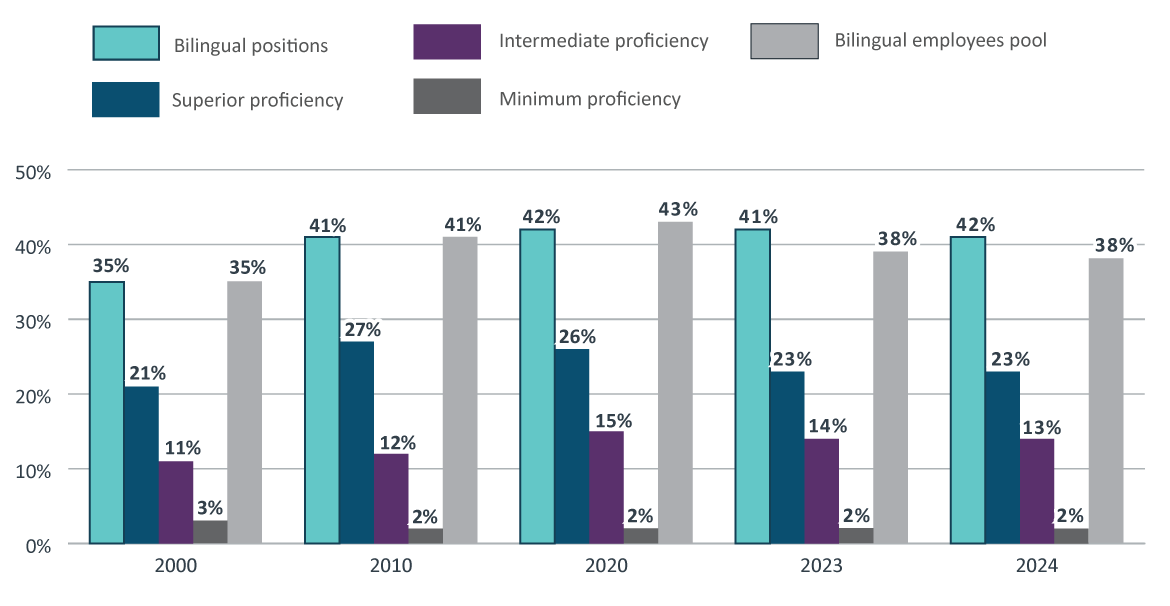
| Year | Bilingual positions | Superior proficiency | Intermediate proficiency | Minimum proficiency | Pool of bilingual employees |
|---|---|---|---|---|---|
| 2000 | 35% | 21% | 11% | 3% | 35% |
| 2010 | 41% | 27% | 12% | 2% | 41% |
| 2020 | 42% | 26% | 15% | 2% | 43% |
| 2023 | 41% | 23% | 14% | 2% | 38% |
| 2024 | 42% | 23% | 13% | 2% | 38% |
Table 2
Language requirements of positions in the core public administration as of March 31
| Year | Bilingual positions | English essential positions | French essential positions | English or French essential positions | Incomplete records | Total positions | |||||
|---|---|---|---|---|---|---|---|---|---|---|---|
| 2000 | 50,535 | 35.3% | 75,552 | 52.8% | 8,355 | 5.8% | 7,132 | 5.0% | 1,478 | 1.0% | 143,052 |
| 2010 | 82,985 | 41.0% | 102,484 | 50.6% | 7,827 | 3.9% | 8,791 | 4.3% | 450 | 0.2% | 202,537 |
| 2020 | 89,632 | 42.4% | 105,062 | 49.7% | 7,191 | 3.4% | 9,334 | 4.4% | 50 | 0.0% | 211,269 |
| 2023 | 105,547 | 41.4% | 127,550 | 50.1% | 8,997 | 3.5% | 12,663 | 5.0% | 17 | 0.0% | 254,774 |
| 2024 | 110,599 | 41.7% | 132,853 | 50.1% | 8,680 | 3.3% | 13,260 | 5.0% | 13 | 0.0% | 265,405 |
Table 3
Language requirements of positions in the core public administration, by province, territory or region as of March 31, 2024
| Unilingual positions | |||||||||||
|---|---|---|---|---|---|---|---|---|---|---|---|
| Province, territory or region | Bilingual positions | English essential | French essential | English or French essential | Incomplete records | Total positions | |||||
| British Columbia | 751 | 3.5% | 20,486 | 95.4% | 1 | 0.0% | 237 | 1.1% | 1 | 0.0% | 21,476 |
| Alberta | 655 | 4.9% | 12,488 | 94.2% | 0 | 0.0% | 113 | 0.9% | 0 | 0.0% | 13,256 |
| Saskatchewan | 144 | 2.6% | 5,301 | 96.9% | 0 | 0.0% | 23 | 0.4% | 1 | 0.0% | 5,469 |
| Manitoba | 643 | 7.5% | 7,877 | 91.4% | 2 | 0.0% | 96 | 1.1% | 3 | 0.0% | 8,621 |
| Ontario (Excluding NCR) | 3,152 | 9.6% | 28,988 | 88.1% | 17 | 0.1% | 741 | 2.3% | 3 | 0.0% | 32,901 |
| National Capital Region (NCR) | 77,032 | 62.0% | 35,751 | 28.8% | 378 | 0.3% | 11,047 | 8.9% | 3 | 0.0% | 124,211 |
| Quebec (Excluding NCR) | 19,612 | 68.7% | 373 | 1.3% | 8,043 | 28.2% | 536 | 1.9% | 0 | 0.0% | 28,564 |
| New Brunswick | 6,066 | 53.9% | 4,724 | 41.9% | 220 | 2.0% | 253 | 2.2% | 1 | 0.0% | 11,264 |
| Prince Edward Island | 609 | 23.5% | 1,959 | 75.7% | 5 | 0.2% | 15 | 0.6% | 0 | 0.0% | 2,588 |
| Nova Scotia | 1,212 | 11.0% | 9,630 | 87.6% | 12 | 0.1% | 135 | 1.2% | 1 | 0.0% | 10,990 |
| Newfoundland and Labrador | 163 | 3.7% | 4,142 | 94.8% | 2 | 0.0% | 62 | 1.4% | 0 | 0.0% | 4,369 |
| Yukon | 23 | 5.9% | 363 | 93.6% | 0 | 0.0% | 2 | 0.5% | 0 | 0.0% | 388 |
| Northwest Territories | 18 | 3.6% | 483 | 96.4% | 0 | 0.0% | 0 | 0.0% | 0 | 0.0% | 501 |
| Nunavut | 13 | 4.4% | 285 | 95.6% | 0 | 0.0% | 0 | 0.0% | 0 | 0.0% | 298 |
| Outside Canada | 506 | 99.4% | 3 | 0.6% | 0 | 0.0% | 0 | 0.0% | 0 | 0.0% | 509 |
| Total | 110,599 | 41.7% | 132,853 | 50.1% | 8,680 | 3.3% | 13,260 | 5.0% | 13 | 0.0% | 265,405 |
Table 4
Bilingual positions in the core public administration and linguistic status of incumbents as of March 31
| Incumbents do not meet requirements | |||||||||
|---|---|---|---|---|---|---|---|---|---|
| Year | Incumbents meet requirements | Exempted | Must meet | Incomplete records | Total employees | ||||
| 2000 | 41,832 | 82.8% | 5,030 | 10.0% | 968 | 1.9% | 2,705 | 5.4% | 50,535 |
| 2010 | 77,331 | 93.2% | 3,625 | 4.4% | 831 | 1.0% | 1,198 | 1.4% | 82,985 |
| 2020 | 85,676 | 95.6% | 3,297 | 3.7% | 35 | 0.0% | 624 | 0.7% | 89,632 |
| 2023 | 100,207 | 94.9% | 3,549 | 3.4% | 159 | 0.2% | 1,632 | 1.5% | 105,547 |
| 2024 | 105,122 | 95.0% | 4,211 | 3.8% | 88 | 0.1% | 1,178 | 1.1% | 110,599 |
Table 5
Bilingual positions in the core public administration and level of second-language proficiency required (oral interaction) as of March 31Footnote 10
| Year | Level C | Level B | Level A | Other | Total positions | ||||
|---|---|---|---|---|---|---|---|---|---|
| 2000 | 12,836 | 25.4% | 34,677 | 68.6% | 1,085 | 2.1% | 1,937 | 3.8% | 50,535 |
| 2010 | 26,738 | 32.2% | 53,659 | 64.7% | 724 | 0.9% | 1,864 | 2.2% | 82,985 |
| 2020 | 32,435 | 36.2% | 55,471 | 61.9% | 335 | 0.4% | 1,391 | 1.6% | 89,632 |
| 2023 | 39,737 | 37.6% | 64,195 | 60.8% | 330 | 0.3% | 1,285 | 1.2% | 105,547 |
| 2024 | 41,686 | 37.7% | 67,265 | 60.8% | 345 | 0.3% | 1,303 | 1.2% | 110,599 |
Table 6
Services to the public: bilingual positions in the core public administration and linguistic status of incumbents as of March 31
| Incumbents do not meet requirements | |||||||||
|---|---|---|---|---|---|---|---|---|---|
| Year | Incumbents meet requirements | Exempted | Must meet | Incomplete records | Total employees | ||||
| 2000 | 26,766 | 82.3% | 3,429 | 10.5% | 690 | 2.1% | 1,631 | 5.0% | 32,516 |
| 2010 | 46,413 | 93.0% | 2,217 | 4.4% | 555 | 1.1% | 746 | 1.5% | 49,931 |
| 2020 | 42,839 | 95.8% | 1,468 | 3.3% | 14 | 0.0% | 378 | 0.8% | 44,699 |
| 2023 | 46,760 | 95.3% | 1,566 | 3.2% | 44 | 0.1% | 681 | 1.4% | 49,051 |
| 2024 | 48,077 | 95.2% | 1,826 | 3.6% | 26 | 0.1% | 588 | 1.2% | 50,517 |
Table 7
Services to the public: bilingual positions in the core public administration and level of second-language proficiency required (oral interaction) as of March 31Footnote 11
| Year | Level C | Level B | Level A | Other | Total positions | ||||
|---|---|---|---|---|---|---|---|---|---|
| 2000 | 9,088 | 27.9% | 22,421 | 69.0% | 587 | 1.8% | 420 | 1.3% | 32,516 |
| 2010 | 17,645 | 35.3% | 31,780 | 63.6% | 340 | 0.7% | 166 | 0.3% | 49,931 |
| 2020 | 18,599 | 41.6% | 25,872 | 57.9% | 99 | 0.2% | 129 | 0.3% | 44,699 |
| 2023 | 20,713 | 42.2% | 28,188 | 57.5% | 81 | 0.2% | 69 | 0.1% | 49,051 |
| 2024 | 21,521 | 42.6% | 28,841 | 57.1% | 79 | 0.2% | 76 | 0.2% | 50,517 |
Table 8
Services to the public: positions in the core public administration and linguistic status of incumbents, by province, territory or region as of March 31, 2024
| Bilingual positions | Unilingual positions | |||||||
|---|---|---|---|---|---|---|---|---|
| Province, territory or region | Incumbents do not meet requirements | English essential | French essential | English or French essential | Total employees | |||
| Incumbents meet requirements | Exempted | Must meet | Incomplete records | |||||
| Western and Northern Canada | 1,099 | 59 | 0 | 52 | 28,124 | 1 | 112 | 29,447 |
| Ontario (excluding the NCR) | 1,384 | 79 | 0 | 83 | 16,466 | 6 | 111 | 18,129 |
| National Capital Region (NCR) | 30,479 | 1,035 | 25 | 119 | 10,907 | 128 | 2,275 | 44,968 |
| Quebec (excluding the NCR) | 10,124 | 396 | 0 | 283 | 116 | 3,920 | 145 | 14,984 |
| New Brunswick | 3,462 | 197 | 0 | 25 | 2,589 | 161 | 62 | 6,496 |
| Other Atlantic provinces | 1,079 | 48 | 1 | 21 | 7,412 | 14 | 46 | 8,621 |
| Outside Canada | 450 | 12 | 0 | 5 | 0 | 0 | 0 | 467 |
| All regions | 48,077 | 1,826 | 26 | 588 | 65,614 | 4,230 | 2,751 | 123,112 |
Table 9
Personal and central services: bilingual positions in the core public administration and linguistic status of incumbents as of March 31
| Incumbents do not meet requirements | |||||||||
|---|---|---|---|---|---|---|---|---|---|
| Year | Incumbents meet requirements | Exempted | Must meet | Incomplete records | Total employees | ||||
| 2020 | 61,915 | 95.5% | 2,385 | 3.7% | 18 | 0.0% | 545 | 0.8% | 64,863 |
| 2023 | 72,111 | 95.1% | 2,456 | 3.2% | 46 | 0.1% | 1,223 | 1.6% | 75,836 |
| 2024 | 74,718 | 95.0% | 2,911 | 3.7% | 24 | 0.0% | 964 | 1.2% | 78,617 |
Table 10
Personal and central services: bilingual positions in the core public administration and level of second-language proficiency required (oral interaction) as of March 31Footnote 12
| Year | Level C | Level B | Level A | Other | Total positions | ||||
|---|---|---|---|---|---|---|---|---|---|
| 2020 | 23,697 | 36.5% | 39,879 | 61.5% | 177 | 0.3% | 1,110 | 1.7% | 64,863 |
| 2023 | 28,062 | 37.0% | 46,540 | 61.4% | 166 | 0.2% | 1,068 | 1.4% | 75,836 |
| 2024 | 29,178 | 37.1% | 48,163 | 61.3% | 187 | 0.2% | 1,089 | 1.4% | 78,617 |
Table 11
Supervision: bilingual positions in the core public administration and linguistic status of incumbents as of March 31
| Incumbents do not meet requirements | |||||||||
|---|---|---|---|---|---|---|---|---|---|
| Year | Incumbents meet requirements | Exempted | Must meet | Incomplete records | Total employees | ||||
| 2020 | 26,089 | 95.9% | 1,005 | 3.7% | 22 | 0.1% | 86 | 0.3% | 27,202 |
| 2023 | 31,620 | 95.8% | 949 | 2.9% | 120 | 0.4% | 311 | 0.9% | 33,000 |
| 2024 | 32,916 | 96.4% | 1,060 | 3.1% | 65 | 0.2% | 101 | 0.3% | 34,142 |
| Note: This table excludes employees working outside Canada. | |||||||||
Table 12
Supervision: bilingual positions in the core public administration and level of second-language proficiency required (oral interaction) as of March 31Footnote 13
| Year | Level C | Level B | Level A | Other | Total positions | ||||
|---|---|---|---|---|---|---|---|---|---|
| 2020 | 16,502 | 60.7% | 10,604 | 39.0% | 36 | 0.1% | 60 | 0.2% | 27,202 |
| 2023 | 21,618 | 65.5% | 11,319 | 34.3% | 22 | 0.1% | 41 | 0.1% | 33,000 |
| 2024 | 22,549 | 66.0% | 11,521 | 33.7% | 23 | 0.1% | 49 | 0.1% | 34,142 |
| Note: This table excludes employees working outside Canada. | |||||||||
Table 13
Participation of Anglophones and Francophones in the core public administration, by province, territory or region as of March 31, 2024
| Province, territory or region | Anglophones | Francophones | Unknown | Total employees | |||
|---|---|---|---|---|---|---|---|
| British Columbia | 21,022 | 97.9% | 452 | 2.1% | 2 | 0.0% | 21,476 |
| Alberta | 12,809 | 96.6% | 447 | 3.4% | 0 | 0.0% | 13,256 |
| Saskatchewan | 5,391 | 98.6% | 78 | 1.4% | 0 | 0.0% | 5,469 |
| Manitoba | 8,306 | 96.3% | 315 | 3.7% | 0 | 0.0% | 8,621 |
| Ontario (excluding the NCR) | 31,287 | 95.1% | 1,614 | 4.9% | 0 | 0.0% | 32,901 |
| National Capital Region (NCR) | 78,485 | 63.2% | 45,718 | 36.8% | 8 | 0.0% | 124,211 |
| Quebec (excluding the NCR) | 3,836 | 13.4% | 24,725 | 86.6% | 3 | 0.0% | 28,564 |
| New Brunswick | 6,037 | 53.6% | 5,227 | 46.4% | 0 | 0.0% | 11,264 |
| Prince Edward Island | 2,318 | 89.6% | 270 | 10.4% | 0 | 0.0% | 2,588 |
| Nova Scotia | 10,372 | 94.4% | 618 | 5.6% | 0 | 0.0% | 10,990 |
| Newfoundland and Labrador | 4,308 | 98.6% | 61 | 1.4% | 0 | 0.0% | 4,369 |
| Yukon | 370 | 95.4% | 18 | 4.6% | 0 | 0.0% | 388 |
| Northwest Territories | 468 | 93.4% | 33 | 6.6% | 0 | 0.0% | 501 |
| Nunavut | 279 | 93.6% | 19 | 6.4% | 0 | 0.0% | 298 |
| Outside Canada | 326 | 64.0% | 183 | 36.0% | 0 | 0.0% | 509 |
| All regions | 185,614 | 69.9% | 79,778 | 30.1% | 13 | 0.0% | 265,405 |
Table 14
Participation of Anglophones and Francophones in the core public administration, by occupational category as of March 31, 2024
| Categories | Anglophones | Francophones | Unknown | Total employees | |||
|---|---|---|---|---|---|---|---|
| Management (EX) | 4,660 | 65.2% | 2,484 | 34.8% | 0 | 0.0% | 7,144 |
| Scientific and professional | 40,937 | 77.5% | 11,890 | 22.5% | 0 | 0.0% | 52,827 |
| Administration and foreign service | 88,577 | 63.8% | 50,192 | 36.2% | 5 | 0.0% | 138,774 |
| Technical | 11,280 | 77.8% | 3,223 | 22.2% | 4 | 0.0% | 14,507 |
| Administrative support | 16,034 | 74.0% | 5,616 | 25.9% | 3 | 0.0% | 21,653 |
| Operations | 24,126 | 79.1% | 6,373 | 20.9% | 1 | 0.0% | 30,500 |
| All categories | 185,614 | 69.9% | 79,778 | 30.1% | 13 | 0.0% | 265,405 |
Table 15
Language requirements of positions in the core public administration, by employment equity group as of March 31, 2024Footnote 14
| Target groups | Bilingual positions | English essential positions | French essential positions | English or French essential positions | Incomplete records | Total | |||||
|---|---|---|---|---|---|---|---|---|---|---|---|
| Women | 66,581 | 44.5% | 71,417 | 47.7% | 4,919 | 3.3% | 6,782 | 4.5% | 10 | 0.0% | 149,709 |
| Indigenous People | 4,631 | 33.0% | 8,639 | 61.5% | 251 | 1.8% | 517 | 3.7% | 0 | 0.0% | 14,038 |
| Persons with disabilities | 8,706 | 41.7% | 10,538 | 50.5% | 390 | 1.9% | 1,219 | 5.8% | 1 | 0.0% | 20,854 |
| Members of visible minorities | 21,294 | 35.4% | 32,671 | 54.3% | 1,412 | 2.3% | 4,788 | 8.0% | 1 | 0.0% | 60,166 |
| All employees | 110,599 | 41.7% | 132,853 | 50.1% | 8,680 | 3.3% | 13,260 | 5.0% | 13 | 0.0% | 265,405 |
Table 16
Bilingual positions in the core public administration and linguistic status of incumbents, by employment equity group as of March 31, 2024
| Incumbents do not meet requirements | |||||||||
|---|---|---|---|---|---|---|---|---|---|
| Target groups | Incumbents meet requirements | Exempted | Must meet | Incomplete records | Total | ||||
| Women | 63,518 | 95.4% | 2,445 | 3.7% | 39 | 0.1% | 579 | 0.9% | 66,581 |
| Indigenous People | 4,414 | 95.3% | 162 | 3.5% | Footnote * | Footnote * | Footnote * | Footnote * | 4,631 |
| Persons with disabilities | 8,268 | 95.0% | 354 | 4.1% | Footnote * | Footnote * | Footnote * | Footnote * | 8,706 |
| Members of visible minorities | 20,109 | 94.4% | 941 | 4.4% | 29 | 0.1% | 215 | 1.0% | 21,294 |
| All employees | 105,122 | 95.0% | 4,211 | 3.8% | 88 | 0.1% | 1,178 | 1.1% | 110,599 |
Table 17
Bilingual positions in the core public administration and level of second-language proficiency required (oral interaction), by employment equity group as of March 31, 2024Footnote 15
| Target groups | Level C | Level B | Level A | Other | Total | ||||
|---|---|---|---|---|---|---|---|---|---|
| Women | 25,350 | 38.1% | 40,391 | 60.7% | 61 | 0.1% | 779 | 1.2% | 66,581 |
| Indigenous People | 1,832 | 39.6% | 2,770 | 59.8% | 12 | 0.3% | 17 | 0.4% | 4,631 |
| Persons with disabilities | 3,448 | 39.6% | 5,211 | 59.9% | 8 | 0.1% | 39 | 0.4% | 8,706 |
| Members of visible minorities | 7,059 | 33.2% | 14,091 | 66.2% | 30 | 0.1% | 114 | 0.5% | 21,294 |
| All employees | 41,686 | 37.7% | 67,265 | 60.8% | 345 | 0.3% | 1,303 | 1.2% | 110,599 |
Table 18
Participation of Anglophones and Francophones in the core public administration, by employment equity group as of March 31, 2024
| Target groups | Anglophones | Francophones | Unknown | Total | |||
|---|---|---|---|---|---|---|---|
| Women | 103,327 | 69.0% | 46,379 | 31.0% | 3 | 0.0% | 149,709 |
| Indigenous People | 10,594 | 75.5% | 3,444 | 24.5% | 0 | 0.0% | 14,038 |
| Persons with disabilities | 15,673 | 75.2% | 5,181 | 24.8% | 0 | 0.0% | 20,854 |
| Members of visible minorities | 46,682 | 77.6% | 13,482 | 22.4% | 2 | 0.0% | 60,166 |
| All employees | 185,614 | 69.9% | 79,778 | 30.1% | 13 | 0.0% | 265,405 |
Table 19
Supervision: bilingual positions in institutions not part of the core public administration and capacity as of March 31, 2024
| Regions designated bilingual | Number of supervisors who have to be bilingual | Number of those supervisors who can discharge their supervisory functions in both official languages | Percentage |
|---|---|---|---|
| Northern and Eastern Ontario (excluding the NCR) | 312 | 201 | 64% |
| National Capital Region (NCR) | 9,652 | 7,784 | 81% |
| Region of Montréal | 4,094 | 3,428 | 84% |
| Bilingual regions in other parts of Quebec (excluding the NCR) | 107 | 97 | 91% |
| New Brunswick | 1,485 | 903 | 61% |
| Total | 15,650 | 12,413 | 79% |
Table 20
Internal services: bilingual positions in institutions not part of the core public administration and capacity as of March 31, 2024
| Regions designated bilingual | Resources in English only | Resources in French only | Bilingual resources | Total |
|---|---|---|---|---|
| Northern and Eastern Ontario (excluding the NCR) | 1,452 | 6 | 533 | 1,991 |
| National Capital Region (NCR) | 15,625 | 1,263 | 15,110 | 31,998 |
| Region of Montréal | 552 | 559 | 6,491 | 7,602 |
| Bilingual regions in other parts of Quebec (excluding the NCR) | 11 | 45 | 239 | 295 |
| New Brunswick | 1,252 | 121 | 1,919 | 3,292 |
| From a unilingual region | 17,315 | 643 | 3,666 | 21,624 |
| Total | 36,207 | 2,637 | 27,958 | 66,802 |
Table 21
Services to the public: number of resources serving the public in bilingual offices in institutions not part of the core public administration, by province, territory, region or method of delivery as of March 31, 2024Footnote 16
| Province, territory, region or method of delivery | Resources in English only | Resources in French only | Bilingual resources | Total resources |
|---|---|---|---|---|
| Western and Northern Canada | 22,431 | 74 | 1,868 | 24,373 |
| Ontario (excluding the NCR) | 15,875 | 161 | 1,815 | 17,851 |
| National Capital Region (NCR) | 7,225 | 887 | 8,085 | 16,197 |
| Quebec (excluding the NCR) | 694 | 1,747 | 10,467 | 12,908 |
| New Brunswick | 945 | 130 | 1,462 | 2,537 |
| Other Atlantic provinces | 5,058 | 59 | 773 | 5,890 |
| Outside Canada | 349 | 0 | 44 | 393 |
| Routes | 4,416 | 0 | 4,982 | 9,398 |
| Telephone | 1,083 | 3 | 814 | 1,900 |
| Total | 58,076 | 3,061 | 30,310 | 91,447 |
Table 22
Participation of Anglophones and Francophones in institutions not part of the core public administration, by province, territory or region as of March 31, 2024
| Province, territory or region | Anglophones | Francophones | Unknown | Total resources | |||
|---|---|---|---|---|---|---|---|
| British Columbia | 39,517 | 96.2% | 1,294 | 3.2% | 258 | 0.6% | 41,069 |
| Alberta | 29,435 | 95.6% | 1,242 | 4.0% | 104 | 0.3% | 30,781 |
| Saskatchewan | 7,898 | 96.9% | 237 | 2.9% | 16 | 0.2% | 8,151 |
| Manitoba | 14,904 | 95.1% | 716 | 4.6% | 49 | 0.3% | 15,669 |
| Ontario (excluding the NCR) | 80,541 | 92.9% | 4,501 | 5.2% | 1,661 | 1.9% | 86,703 |
| National Capital Region (NCR) | 43,123 | 73.0% | 15,879 | 26.9% | 94 | 0.2% | 59,096 |
| Quebec (excluding the NCR) | 16,324 | 27.6% | 42,824 | 72.3% | 66 | 0.1% | 59,214 |
| New Brunswick | 7,243 | 73.1% | 2,623 | 26.5% | 38 | 0.4% | 9,904 |
| Prince Edward Island | 2,232 | 93.0% | 168 | 7.0% | 0 | 0.0% | 2,400 |
| Nova Scotia | 12,761 | 93.3% | 911 | 6.7% | 3 | 0.0% | 13,675 |
| Newfoundland and Labrador | 6,616 | 97.2% | 122 | 1.8% | 66 | 1.0% | 6,804 |
| Yukon | 362 | 90.5% | 37 | 9.3% | 1 | 0.3% | 400 |
| Northwest Territories | 604 | 87.4% | 87 | 12.6% | 0 | 0.0% | 691 |
| Nunavut | 342 | 88.8% | 42 | 10.9% | 1 | 0.3% | 385 |
| Outside Canada | 2,535 | 71.4% | 382 | 10.8% | 632 | 17.8% | 3,549 |
| All regions | 264,437 | 78.1% | 71,065 | 21.0% | 2,989 | 0.9% | 338,491 |
Table 23
Participation of Anglophones and Francophones in institutions not part of the core public administration, by occupational category or equivalent category as of March 31, 2024
| Categories | Anglophones | Francophones | Unknown | Total resources | |||
|---|---|---|---|---|---|---|---|
| Management | 16,584 | 72.6% | 5,278 | 23.1% | 971 | 4.3% | 22,833 |
| Professionals | 38,029 | 74.4% | 11,848 | 23.2% | 1,206 | 2.4% | 51,083 |
| Specialists and technicians | 18,168 | 76.8% | 5,005 | 21.2% | 484 | 2.0% | 23,657 |
| Administrative support | 41,270 | 76.7% | 12,320 | 22.9% | 195 | 0.4% | 53,785 |
| Operations | 84,969 | 82.4% | 18,053 | 17.5% | 133 | 0.1% | 103,155 |
| Canadian Armed Forces and regular members of the Royal Canadian Mounted Police | 64,258 | 77.6% | 18,552 | 22.4% | 0 | 0.0% | 82,810 |
| Unknown | 1,159 | 99.2% | 9 | 0.8% | 0 | 0.0% | 1,168 |
| All categories | 264,437 | 78.1% | 71,065 | 21.0% | 2,989 | 0.9% | 338,491 |
Table 24
Participation of Anglophones and Francophones in all federal institutions subject to the Official Languages Act, by province, territory or region as of March 31, 2024
| Province, territory or region | Anglophones | Francophones | Unknown | Total | |||
|---|---|---|---|---|---|---|---|
| British Columbia | 60,539 | 96.8% | 1,746 | 2.8% | 260 | 0.4% | 62,545 |
| Alberta | 42,244 | 95.9% | 1,689 | 3.8% | 104 | 0.2% | 44,037 |
| Saskatchewan | 13,289 | 97.6% | 315 | 2.3% | 16 | 0.1% | 13,620 |
| Manitoba | 23,210 | 95.6% | 1,031 | 4.2% | 49 | 0.2% | 24,290 |
| Ontario (excluding the NCR) | 111,828 | 93.5% | 6,115 | 5.1% | 1,661 | 1.4% | 119,604 |
| National Capital Region (NCR) | 121,608 | 66.3% | 61,597 | 33.6% | 102 | 0.1% | 183,307 |
| Quebec (excluding the NCR) | 20,160 | 23.0% | 67,549 | 77.0% | 69 | 0.1% | 87,778 |
| New Brunswick | 13,280 | 62.7% | 7,850 | 37.1% | 38 | 0.2% | 21,168 |
| Prince Edward Island | 4,550 | 91.2% | 438 | 8.8% | 0 | 0.0% | 4,988 |
| Nova Scotia | 23,133 | 93.8% | 1,529 | 6.2% | 3 | 0.0% | 24,665 |
| Newfoundland and Labrador | 10,924 | 97.8% | 183 | 1.6% | 66 | 0.6% | 11,173 |
| Yukon | 732 | 92.9% | 55 | 7.0% | 1 | 0.1% | 788 |
| Northwest Territories | 1,072 | 89.9% | 120 | 10.1% | 0 | 0.0% | 1,192 |
| Nunavut | 621 | 90.9% | 61 | 8.9% | 1 | 0.1% | 683 |
| Outside Canada | 2,861 | 70.5% | 565 | 13.9% | 632 | 15.6% | 4,058 |
| All regions | 450,051 | 74.5% | 150,843 | 25.0% | 3,002 | 0.5% | 603,896 |
Appendix E. Information on events held by the Treasury Board of Canada Secretariat during the 2023–24 fiscal year
| Activity | Date | Number of participants | Key topics and issues |
|---|---|---|---|
| Council of the Network of Official Languages Champions meeting | May 18, 2023 |
Unavailable |
Verbal updates
|
| Virtual meeting of official languages communities of practice (Departmental Advisory Committee on Official Languages [DACOL] and Crown Corporations Advisory Committee on Official Languages [CCACOL]) | May 31, 2023 |
116 persons responsible for official languages (PROLs) |
Presentations
Verbal updates
|
| Official Languages Champions’ Conference | June 8, 2023 |
55 Champions 31 others (PROLs, TBS, Canadian Heritage (PCH)) |
Theme: Dare to Lead
|
| Official Languages Day | September 14, 2023 |
2,500 (public servants and the general public) |
Theme: Our languages, a window on the world
|
| Special session: Presentation on the new Official Languages Act | September 20, 2023 |
518 (PROLs, Champions and coordinators for section 41) |
Presentations
|
| Council of the Network of Official Languages Champions meeting | September 26, 2023 |
Unavailable |
Verbal updates from TBS
Presentations
|
| Special session: Learning and training in official languages rights and obligations | November 15, 2023 |
249 PROLs and coordinators of section 41 |
Verbal updates from TBS
Presentations
|
| Council of the Network of Official Languages Champions meeting | November 21, 2023 |
Unavailable |
Verbal update from TBS
Presentation
|
| One-time meeting between CADMOL and Deputy Minister Isabelle Mondou | November 29, 2023 |
Members of CADMOL |
Consultation
|
| Special meeting of the Council of the Network of Official Languages Champions | November 30, 2023 |
All the champions and members of the Council |
Consultation
|
| Information session for airport authorities | December 13, 2023 |
19 PROLs and official languages champions |
Presentation
|
| Council of the Network of Official Languages Champions meeting | January 16, 2024 |
Unavailable |
Verbal updates from TBS
Presentation
|
| Meeting of official languages communities of practice | January 24, 2024 |
246 PROLs Coordinators of section 41 |
Verbal updates from TBS
Updates from Canadian Heritage
|
| Best Practices Forum on Official Languages | February 5 to 7, 2024 |
Web broadcast: 2,007 views Participants in six workshops: 1,388 Total number of participants: 3,395 |
|
| Welcome and integration session on official languages for federal institutions | March 5, 2024 |
PROLs from 5 institutions |
|
| Information session for airport authorities | March 18, 2024 |
PROLs and official languages champions 22 participants |
|
| Presentations to federal institutions on the modernized Official Languages Act (in partnership with Canadian Heritage) | From September 26, 2023, to March 28, 2024 |
Senior management tables in federal institutions, various committees, and various events |
|
|
Note: TBS does not organize meetings of the Council of the Network of Official Languages Champions. |
|||
Appendix F. Distribution of federal offices and service locations as of March 31, 2024

Appendix F - Text version
- British Columbia: 237 bilingual offices, 1,045 unilingual
- Alberta: 202 bilingual offices, 761 unilingual
- Saskatchewan: 95 bilingual offices, 702 unilingual
- Manitoba: 146 bilingual offices, 475 unilingual
- Ontario: 569 bilingual offices, 1,471 unilingual
- National Capital Region: 400 bilingual offices, none unilingual
- Quebec: 622 bilingual offices, 1,342 unilingual
- New Brunswick: 295 bilingual offices, 166 unilingual
- Prince Edward Island: 43 bilingual offices, 70 unilingual
- Nova Scotia: 185 bilingual offices, 372 unilingual
- Newfoundland and Labrador: 64 bilingual offices, 512 unilingual
- Yukon: 31 bilingual offices, 37 unilingual
- Northwest Territories: 41 bilingual offices, 70 unilingual
- Nunavut: 31 bilingual offices, 53 unilingual
- Offices outside Canada: 219 bilingual, 61 unilingual (consulates and embassies are automatically bilingual. Other offices must measure the demand (for example, Public Services and Procurement Canada, International Development Research Centre))
- Toll-free lines: 189 bilingual, none are unilingual
- Routes: 203 bilingual, 152 unilingual (includes air, train and ferry routes)
Sources: Data from the System for Official Languages Obligations and from Canada Post as of March 31, 2024.
- Includes air, rail and ferry routes.
- Consulates and embassies are automatically bilingual. The offices of Immigration, Refugees and Citizenship Canada located in embassies and consulates are also automatically bilingual. Others must measure the demand (for example, Public Services and Procurement Canada, International Development Research Centre).
© His Majesty the King in Right of Canada, represented by the President of the Treasury Board, 2025
ISSN: 1486-9683