
The Government of Canada’s progress on environmental indicators: Climate resilience
In Canada and abroad, the effects of climate change are evident. For example, we know that Canada is experiencing more frequent and intense extreme events, such as the forest fires, extreme heat and flooding of recent years, in many areas of the country. These areas include locations where federal services are delivered to Canadians and where many public servants live. The Government of Canada must ensure that Canadians still have access to their government services during climate disruptions.
Under the Greening Government Strategy, federal organizations have committed to enhancing the climate resilience of their critical assets, services and activities by 2035. To help guide decision-making, organizations assess climate risks to services and activities through a departmental climate risk assessment, and develop adaptation measures to address those risks. Organizations also assess risks to critical assets through real property portfolio and facility-specific climate risk assessments and, similarly, develop adaptation measures to reduce the risks. This work complements existing business continuity planning in federal organizations.
The following figures provide an overview of the progress on enhancing climate resilience at the departmental and individual facility levels.
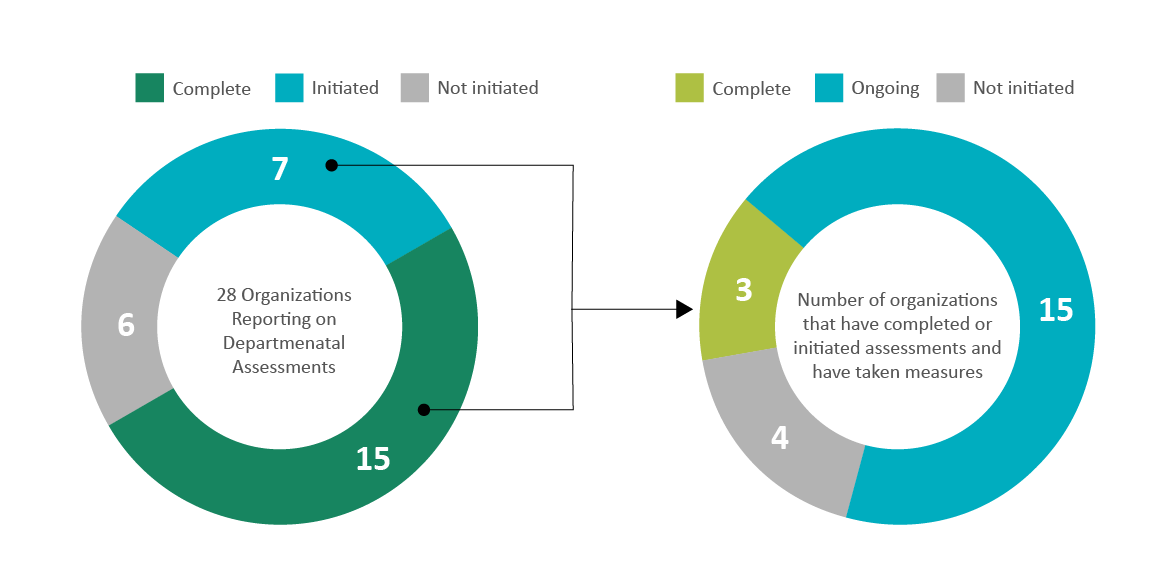
Figure 5 - Text version
The pie chart on the left shows the status of the departmental risk assessments for 30 reporting departments in 2024-25. The pie chart on the right shows the status of measures taken to reduce risk identified in the 27 organizations that have completed or initiated departmental risk assessments.
| Status | Number of federal organizations |
|---|---|
| Departmental risk assessment | 30 |
Completed |
15 |
Initiated |
12 |
Not initiated |
3 |
| Measures taken on completed or initiated assessments | 27 |
Completed |
2 |
Ongoing |
21 |
Not initiated |
4 |
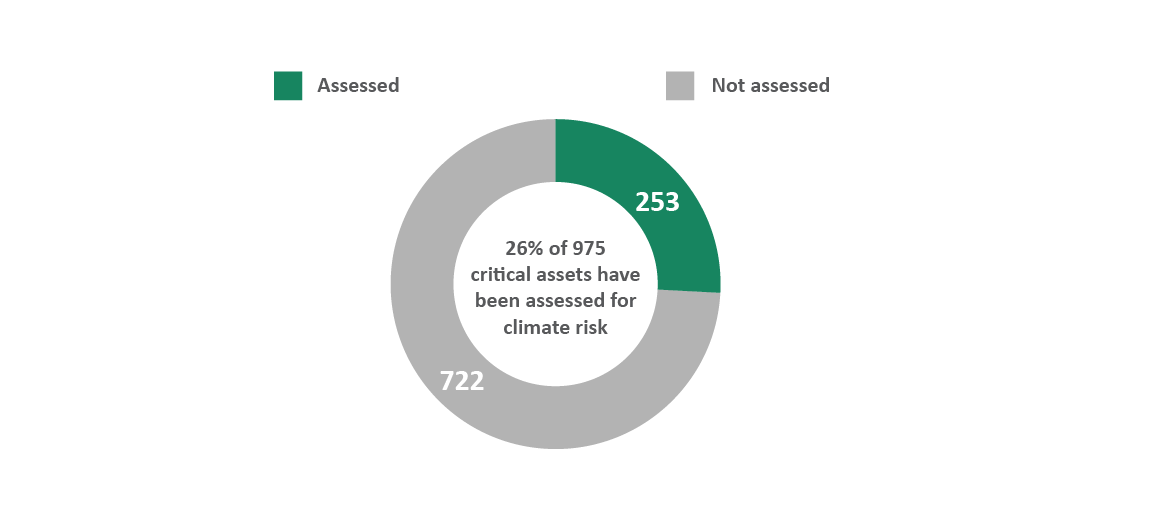
Figure 6 - Text version
The donut chart shows the number of critical assets where a facility-level risk assessment has or has not been completed.
| Facility assessment | Number of assets |
|---|---|
| Assessed | 89 |
| Not assessed | 1489 |
| Federal organization | Services and Activities | Critical Assets | ||
|---|---|---|---|---|
| Departmental risk assessment of services and activities | Measures taken to reduce risks | Climate resilient portfolio assessment | Percentage of critical assets with site-specific assessment | |
| Agriculture and Agri-Food Canada | Completed | Ongoing | Yes | 17% |
| Canada Border Services Agency | Completed | Ongoing | Yes | 0% |
| Canada Revenue Agency | Completed | Ongoing | N/A (does not own real property) | N/A |
| Canadian Food Inspection Agency | Completed | Ongoing | Yes | 0% |
| Canadian Forces Morale and Welfare Services | Not initiated | Not initiated | No | No critical assets |
| Canadian Space Agency | Completed | Ongoing | Yes | 100% |
| Correctional Service Canada | Initiated | Ongoing | No | 70% |
| Communications Security Establishment Canada | Initiated | Not initiated | No | 0% |
| Crown-Indigenous Relations and Northern Affairs Canada | Completed | Ongoing | Yes | No critical assets |
| Environment and Climate Change Canada | Completed | Completed | Yes | 0% |
| Employment and Social Development Canada | Not initiated | Ongoing | N/A (does not own real property) | N/A |
| Fisheries and Oceans Canada | Initiated | Ongoing | Yes | 27% |
| Global Affairs CanadaFootnote * | Completed | Ongoing | Yes | 18% |
| Health Canada | Completed | Ongoing | Yes | 0% |
| Immigration, Refugees and Citizenship Canada | Completed | Ongoing | N/A (does not own real property) | N/A |
| Indigenous Services Canada | Completed | Ongoing | No | 0% |
| Innovation, Science and Economic Development Canada | Completed | Completed | Yes | 40% |
| Library and Archives Canada | Not initiated | Not initiated | Yes | No critical assets |
| National Battlefields Commission | Initiated | Ongoing | No | No critical assets |
| National Defence | Initiated | Ongoing | Yes | 0% |
| National Research Council Canada | Initiated | Ongoing | Yes | 100% |
| Natural Resources Canada | Initiated | Not initiated | Yes | 0% |
| Parks Canada | Completed | Ongoing | No | 0% |
| Polar Canada | Initiated | Ongoing | Yes | 100% |
| Public Health Agency of Canada | Initiated | Not initiated | No | 0% |
| Public Safety Canada | Initiated | Not initiated | No | 0% |
| Public Services and Procurement Canada | Initiated | Ongoing | No | 0% |
| Royal Canadian Mounted Police | Completed | Ongoing | Yes | 0% |
| Shared Services Canada | Initiated | Ongoing | No | 0% |
| Transport Canada | Completed | Ongoing | No | 58% |
Key results
- 27 of 30 federal organizations have initiated or completed a departmental climate risk assessment. These assessments help identify and prioritize the critical services and activities that are at risk due to the impacts of climate change.
- Critical services and activities are defined in the Directive on Security Management as those that are critical to the health, safety, security or economic well-being of Canadians or to the effective functioning of government, based on an analysis of the potential impacts of disruption. Examples of critical services and activities are those that:
- ensure the safety of consumer health products, drugs, drinking water and food
- coordinate and support to key national players in the event of national emergencies
- respond to transportation-related emergencies
- Once the risks are identified, measures should be taken to reduce those risks. Twenty-one organizations have completed or initiated such measures. Examples of risk reduction measures are:
- applying FireSmart Canada approaches to building and landscaping
- adapting site drainage to accommodate heavier precipitation
- using nature-based solutions for landscaping to manage both too much and too little precipitation
- At the individual building (facility) level, organizations focus first on critical assets, which are those that support the delivery of the critical services and activities. Local climate data and future projections are then used in facility-specific climate risk assessments to determine climate hazards specific to that location and identify actions that will reduce the risks specific to the facility. Assets of high value that are at moderate to high risk are also prioritized for facility-level assessments.
- Of the 1,578 critical assets reported in 2024–25, 89 have been assessed while 1,489 remain to be assessed. If necessary, based on the outcome of the assessments, actions specific to the facility and local nature of the climate impact will be taken to reduce the risks.
- Organizations, particularly those that have larger real property portfolios, continue to identify and report on critical assets. For that reason, the number of critical assets is expected to increase in the coming years.