
Online and telephone immigration scams
Don’t become a victim of immigration scams and fraud. If it sounds too good to be true, it probably is. Scams can result in
- identity theft
- fraud
- theft from your bank account or credit card
- computer viruses
On this page
- Tips to avoid fraud and scams
- Beware of representative fraud
- Artificial intelligence (AI) scams
- Social media scams
- Fake websites and other Internet scams
- Email scams
- Telephone scams
- Reporting fraud and scams
Tips to avoid fraud and scams
Remember:
- No one can guarantee you a job or a visa to Canada.
- Only immigration officers in Canada, at Canadian embassies, high commissions and consulates can decide to issue a visa.
- Processing fees are the same for all of our services in Canada and around the world.
- Fees in local currencies are based on official exchange rates.
- They’re the same amount as fees in Canadian dollars.
- Visa application centres (VACs) don’t charge you to give your biometrics. Your appointment is already included in your biometrics fee.
- We’ll ask you to pay fees for Canadian government services to the “Receiver General for Canada,” unless we state something different on a visa office website.
- Our employees will never
- ask you to deposit money into a personal bank account
- ask you to transfer money through private money transfer service
- threaten you
- offer special deals to people who want to immigrate or
- use free email services, such as Hotmail, Gmail or Yahoo Mail to contact you
- You’ll find free application forms and guides for all our services on our website.
- Be careful if the salary of a job you are applying for seems too high to be real.
Beware of representative fraud
You’re responsible for all the information in your application, even if a representative completes it for you.
Beware of representatives who
- advertise their services as free and later ask you to pay a fee
- promise guaranteed approval on an immigration or citizenship application
- claim that they can expedite your biometrics appointment for a fee
- advise you to lie on your application
It’s against the law to give false or misleading information in your application.
Learn more about how to
- choose a representative
- book a biometrics appointment
- protect yourself from fraud
- report a fraudulent representative
Artificial intelligence (AI) scams
The use of AI, especially Generative AI (GenAI), is becoming more popular. AI can improve efficiency and innovation, but it also makes it easier to create fake content that seems real.
Some scammers use AI to generate fake content that appears to be from Immigration, Refugees and Citizenship Canada (IRCC).
This content can include:
- videos of public figures, representatives and officials that
- promote fast or guaranteed immigration opportunities
- often spread through social media
- fake websites that offer immigration advice
- fake emails or suspicious phone calls claiming to be from IRCC officials
Always verify the accuracy of the information you find online through our
Video: Scammers use artificial intelligence to create fake videos and voices that seem official
This video is also available in HD on YouTube. You can share it on your social network or embed it into your website.
Social media scams
Immigration and citizenship scams can spread quickly through social media.
Beware of these social media scams:
- instant or direct messages claiming to be from IRCC (we’ll never start a conversation through social media)
- posts and videos that
- sound too good to be true (like offering special immigration deals or faster processing)
- are not from our verified social media accounts
Find us on social media
Make sure that the immigration information you see on social media comes from our official channels:
You can ask us general questions via Facebook Messenger
The service is available from Monday to Friday from 9 a.m. to 5 p.m. (ET).
- We won’t discuss your personal details or application through Messenger.
- Do not share your personal information with us.
Fake websites and other Internet scams
If you need to apply for an electronic travel authorization (eTA), be careful when you deal with companies that claim they can help to get one. These companies are not working with the Government of Canada. Many have websites that charge a fee for information and submitting eTA applications.
This Government of Canada website is the official place to apply for an eTA.
It’s easy for criminals to copy a real website or build one that looks professional. Websites may claim to be official Government of Canada sites or their partners. Others may claim to offer special immigration deals or guaranteed high-paying jobs. They do this to trick people into paying them money.
Some of these sites may try to get you to give them your private information. This could be used to steal your identity.
Here are some things to watch for:
- If the website claims to offer special deals to people who want to immigrate, don’t deal with them. Don’t pay for offers of guaranteed entry into Canada or faster processing of your application. These claims are false.
- Check the address in your browser’s address bar when you land on a website. It should match the address you typed.
Here are some other ways to protect yourself:
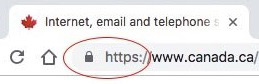
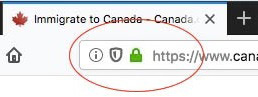
Never enter private information unless there is a padlock in the browser window or “https://” at the beginning of the web address to show it is secure.
Examples:


- If a website seems wrong to you, do a web search to see if anyone has reported any problems with that site.
- Make sure your browser is up-to-date. Browser filters can help detect fake websites.
- Beware of websites advertised in emails from strangers that you didn’t ask for.
- Don’t give out personal information unless you are sure you know whom you are dealing with.
- If in doubt, contact the website owner by telephone or email before you do anything.
- Find out more about who can legally represent you if you choose to hire a representative.
Email scams
To improve our services, we routinely email surveys to collect feedback from current and past applicants.
Not sure if the survey you received came from us? Find a list of our surveys.
You may get an email that looks like it’s from a real company or the Government of Canada. It may ask you for private information, such as your date of birth, passwords or credit card details. Sometimes the email will tell you to visit a fake website.
Some people get emails that look like they are from IRCC. They offer special immigration deals if you give them personal information. We will never send you an email asking for your private information.
If you get this kind of email, don’t click on any links or give any information about yourself. If you have any doubts about where the email came from, make sure to check the identity of the sender.
These things may mean an email is a scam:
- The email is sent from a private address or a free Web mail address (for example, Yahoo Mail, Hotmail or Gmail) and not from the Government of Canada “gc.ca” or “Canada.ca” email account.
- The email uses a standard greeting such as “Dear customer” instead of your real name. (Note: We address some automated emails as “Dear client.” If you get an email like this, check and make sure it’s from a Government of Canada email account.)
- The sender asks for personal information, such as your date of birth, password, credit card or bank details.
- You didn’t expect the email.
- The message is an image instead of text.
We do not send visas by email.
Telephone scams
Watch out for a known telephone scam targeting international students in Canada. This scam was reported in Ottawa and London but other cities may be affected too.
We will never ask you for any sort of payment by telephone.
People can use telephone scams to steal your money or identity, which is why we take strict measures to keep your information confidential. Be very careful of scams asking for details like your credit card number, bank account number or any other payment information.
IRCC may contact you by telephone to ask for more information to continue processing an application, or to follow up on outstanding fees and loans. IRCC agents will always identify themselves.
Reporting fraud and scams
If you suspect fraud or scams, find out how to report them.
Video: This is how immigration scams work online
This video is also available in HD on YouTube. You can share it on your social network or embed it into your website.