Annual Report 2024 to 2025: Building tomorrow’s public service today

Contents
- Message from the Commissioners
- Public service recruitment
- Enriching the public service through veterans hiring
- Safeguarding merit and non-partisanship
- Responding to a changing environment
- Looking forward
- Endnotes
- Annex 1: Employment equity group applicants to external advertised processes and hires, compared to workforce availability
- Annex 2: Geographical distribution of public service hires and Public Service Employment Act population
- Annex 3: Employment equity group non-advertised appointments
- Annex 4: Empowering Excellence newsletters
Message from the Commissioners
We are proud to present our Annual Report for Fiscal Year 2024 to 2025.
More than ever, the Public Service Commission of Canada plays a key role within the federal administration. In addition to helping safeguard non-partisanship and the merit principle in the public service, we help ensure that the public service is a model of excellence, representativeness, integrity and linguistic duality. In so doing, we contribute directly to the respect and protection of our democracy, and to the provision of services to all Canadians.
Protecting merit-based hiring is paramount in the Public Service Commission’s mandate. In an environment where responsibility for hiring is largely delegated to deputy heads, the Commission has remained vigilant in its oversight activities of monitoring and auditing, and of investigating irregularities. In fiscal year 2024 to 2025, a number of audit reports were published which highlighted where improvements could be made, and investigation activity was expanded to address areas of possible bias or barriers in hiring which may have had a negative impact on members of equity-seeking groups.
The merit principle was introduced in the Public Service Employment Act to protect the public service from political influence. While our mandate is firmly rooted in this principle, we must also respect the rights of employees, as citizens, to engage in political activities. When employees aspiring to become candidates in an election apply to the Commission for permission to seek candidacy, we objectively analyze their requests, weigh the associated risks on the political neutrality of the public service, and determine whether they should be granted permission and if so, under what conditions. The 2024 to 2025 fiscal year saw a record number of permission requests come before the Commission. These requests were handled rigorously yet expeditiously to ensure employee rights were balanced with the need to maintain the political neutrality of the public service.
In this era of digital transformation, we have not ignored the increasing effect of emerging technologies on the recruitment, hiring and assessment of candidates for public service positions, including second language evaluation. We have introduced electronic tools to leverage technology and have published a guide on artificial intelligence (AI) in hiring processes to assist managers navigate this new reality effectively, fairly and cautiously.
Since the end of the fiscal year 2024 to 2025, there have been developments in our environment which have led us to focus our efforts in the short term on areas where we can best contribute to assisting in recruitment in high demand areas, reducing time and costs associated with hiring, and enhancing our hiring and referral systems to be agile and responsive. Public service employees and managers will be relying on the Public Service Commission to help address future challenges, and we are determined to position ourselves to respond to the need.
We share responsibility for recruiting and maintaining a public service that is competent, professional, bilingual, non-partisan and representative of the Canadian population it serves. We could not fulfil our mandate without the dedication of the many professionals and leaders in the various departments and agencies which comprise the public service. We are certain we can look to their ongoing support and commitment as we face important transformation in the coming years.
President
Commissioner
Commissioner
Public service recruitment
Overview of the public service
Workforce and recruitment
Public Service Employment Act workforce population and new hires
For the first time in 10 years, the federal public service workforce under the Public Service Employment Act declined.
Driven by a steep decline in external hiring, the population fell by 1.0% (2 861 employees) over the fiscal year, resulting in an overall population of 279 707 employees as of March 31, 2025. Endnote1, Endnote2
Slightly more than half of the workforce hired worked outside the National Capital Region (53.2%); this share has remained stable for the past 5 years. Endnote3
Despite a 34.4% reduction in indeterminate hiring, their population grew. This is primarily the result of 8 514 employees being converted from term to indeterminate status.
Student hiring increased, but the overall student population on March 31, 2025, declined; likely because many assignments ended before the last day of the fiscal year.
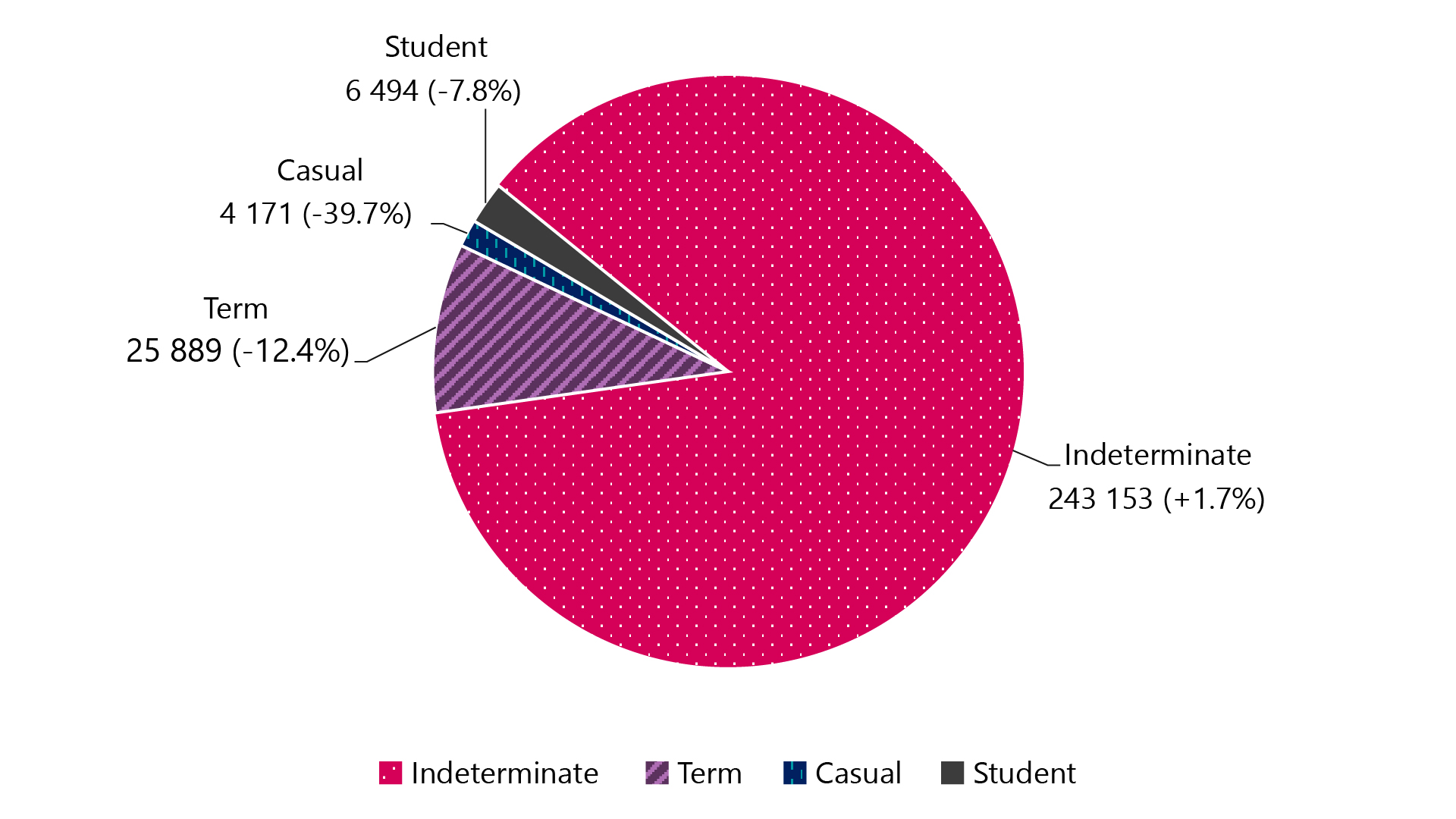
Count and year-over-year change, Public Service Employment Act workforce population, March 31, 2025 - Alternative text
| Type | Population | Year-over-year change in population |
|---|---|---|
| Indeterminate | 243 153 | +1.7% |
| Term | 25 889 | -12.4% |
| Casual | 4 171 | -39.7% |
| Student | 6 494 | -7.8% |
| Total | 279 707 | -1.0% |
| Region | 2020 to 2021 | 2021 to 2022 | 2022 to 2023 | 2023 to 2024 | 2024 to 2025 |
|---|---|---|---|---|---|
| National Capital Region | 46.8% | 47.5% | 47.6% | 46.8% | 46.7% |
| Outside the National Capital Region |
52.4% | 51.9% | 52.2% | 53.1% | 53.2% |
| Unknown | 0.8% | 0.6% | 0.1% | 0.2% | 0.1% |
See Annex 2 for the geographical distribution of public service external hires and Public Service Employment Act workforce population.
Refer to our interactive graphic on regional representation for more information on the regional breakdown of total and employment equity group population and external hiring.
| Type | External hires | Year-over-year change in external hires |
|---|---|---|
| Indeterminate | 7 762 | -34.4% (4 063 fewer hires) |
| Term | 12 895 | -31.0% (5 801 fewer hires) |
| Casual | 12 745 | -23.4% (3 887 fewer hires) |
| Student | 15 155 | +1.5% (231 more hires) |
| Total | 48 557 | -21.8% (13 520 fewer hires) |
The decline in external hiring is also reflected in the top 5 occupational groups that typically account for the highest number of indeterminate and term hires.
| Occupational groups | External hires | Year-over-year change in external hires |
|---|---|---|
| Clerical and Regulatory (CR) | 3 728 | -47.9% (3 422 fewer hires) |
| Administrative Services (AS) | 3 069 | -36.0% (1 727 fewer hires) |
| Program Administration (PM) | 2 851 | -37.5% (1 709 fewer hires) |
| Information Technology (IT) | 1 748 | -18.0% (384 fewer hires) |
| Economics and Social Science (EC) | 1 620 | -27.3% (608 fewer hires) |
| All other groups | 7 641 | -20.9% (2 014 fewer hires) |
A historic recruitment wave for the Canadian Coast Guard in response to growing operational needs
In January 2024, Fisheries and Oceans Canada and the Canadian Coast Guard launched an unprecedented national recruitment campaign, its largest to date, to address the demographic realities of an aging workforce and increased operational demands driven by fleet expansion.
The campaign focused on 21 hard-to-fill roles, including ones that were historically challenging to staff or considered high priority, particularly in remote or specialized operational environments. These included engine room assistants, engineering officers, marine communications and traffic services trainees, maritime search and rescue coordinators, cooks, and a range of Arctic-based positions.
The campaign drew significant interest, receiving 5 062 applications, with 2 559 candidates advancing to further evaluation. The process was guided by diversity and inclusion, with priority given to applicants from employment equity groups, reflecting the department’s commitment to building a representative and resilient workforce.
Evidence of the campaign’s reach was demonstrated by its digital engagement metrics; the careers page became the most visited section of the Canadian Coast Guard website, attracting 73 526 visits. This successful, collaborative and data-informed effort paved the way for the department to meet its evolving staffing needs over the next decade and fostered a more inclusive and future-ready workforce aligned with long-term operational goals.
External non-advertised processes
Public service hiring may be done through advertised processes that are posted on the GC Jobs website, or through non-advertised processes, where a hiring manager may identify a specific individual to be hired.
Deputy heads are responsible for establishing the conditions for when each of these processes should be used, based on their specific context and hiring needs.
In fiscal year 2024 to 2025, 46.8% of external hires were through non-advertised processes, compared to 47.8% the year before. Endnote4
See Annex 3 for employment equity group non-advertised appointments.
Student hiring
Over the fiscal year, the number of hires through the Federal Student Work Experience Program and the Research Affiliate Program increased compared to the previous year, while the number of hires through the Post-Secondary Co‑op/Internship Program remained stable. Endnote5
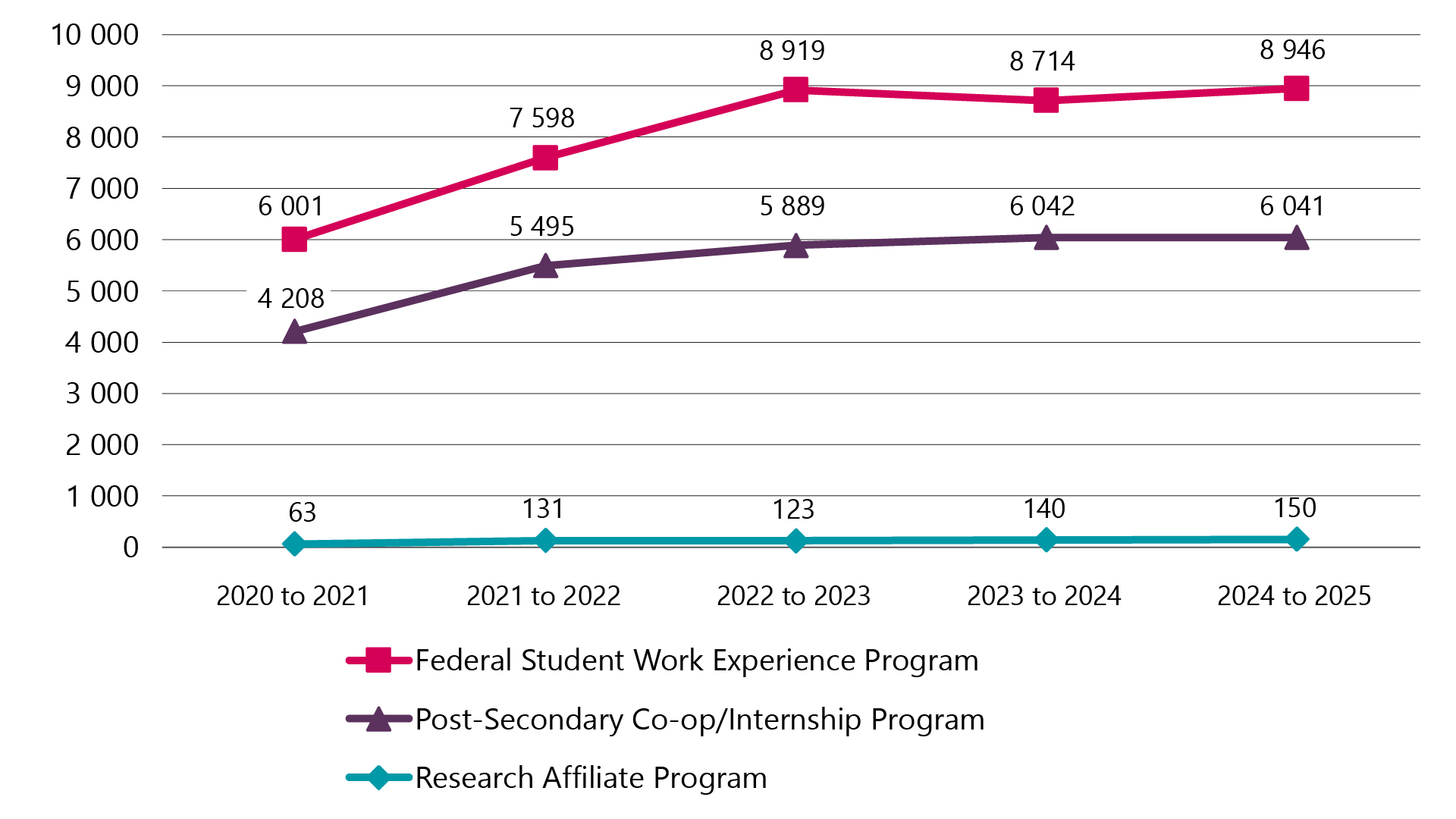
Count of external hires, Federal Student Work Experience Program, Post-Secondary Co‑op/Internship Program and Research Affiliate Program, by fiscal year - Alternative text
| Programs | 2020 to 2021 | 2021 to 2022 | 2022 to 2023 | 2023 to 2024 | 2024 to 2025 |
|---|---|---|---|---|---|
| Federal Student Work Experience Program | 6 001 | 7 598 | 8 919 | 8 714 | 8 946 |
| Post-Secondary Co‑op/ Internship Program |
4 208 | 5 495 | 5 889 | 6 042 | 6 041 |
| Research Affiliate Program | 63 | 131 | 123 | 140 | 150 |
| Employment equity groups | Appointments* | Share of Federal Student Work Experience Program appointments |
|---|---|---|
| Indigenous Peoples | 527 | 5.9% |
| Persons with disabilities | 929 | 10.4% |
| Members of visible minorities | 2 984 | 33.4% |
| Women | 5 463 | 61.1% |
*People who self-declare in more than 1 designated employee equity group are included in the total count for each group (for example, an Indigenous woman is included in the total count for both women and Indigenous Peoples).
Students give high marks to the online application process for the Federal Student Work Experience Program
More than 10 000 students shared their feedback through an automated survey sent to every new applicant to the program. The survey focused on the applicant experience, including ease of application, clarity of instructions, and the support received throughout the process.
The results for fiscal year 2024 to 2025 are noteworthy: 93% of respondents expressed overall satisfaction with the online application process, 97% found the application process easy, and 94% agreed that the system and instructions were clear. Additionally, 71% of respondents reported completing their application in 15 minutes or less.
While family, friends and colleagues (39%) and the GC Jobs website (31%) remain the primary awareness channels for the program, outreach events and career fairs (21%) are becoming increasingly important, reinforcing the value of connecting with students and engaging with them directly.
These results highlight the efficiency of the application process, as well as the program’s growing presence across various channels that help us connect with the next generation of talent.
This fiscal year, there were 4 006 indeterminate and term external hires with previous student experience in a federal student recruitment program. This is a decrease from 4 626 external hires in fiscal year 2023 to 2024.
Bringing students into the public service introduces fresh perspectives while also helping to fill critical skills gaps in high-demand and specialized fields. This is why I am committed to promoting the Government of Canada as an employer to students at the schools I represent as Deputy Minister University Champion.
We continued to support the Deputy Minister University Champion Initiative by organizing and participating in on-campus and virtual activities across Canada to promote careers in the public service. This initiative encourages high-quality education and research, ensuring the public service has access to cutting-edge ideas and emerging scholars, as well as a well-educated, bilingual and expert workforce to drive innovation and service excellence.
Strengthening student recruitment to build a workforce ready to deliver services in the digital age
At Shared Services Canada, student recruitment (particularly in information technology) is seen as an investment in building a strong, skilled and modern workforce that reflects Canada’s diversity and is prepared to meet future challenges.
The department reviewed its internal Post-Secondary Champions Initiative and relaunched it in fiscal year 2024 to 2025 to support student recruitment across the federal public service. The program connects 24 senior leaders with 26 post-secondary institutions across the country. These champions raise awareness of the Government of Canada as an employer, promote student opportunities and help shape curriculum to better align with public service needs.
This initiative supports both the federal government’s commitment to hiring students as part of public service renewal and our efforts to create a more inclusive, fair and user-friendly hiring process.
Applicants to public service jobs
In fiscal year 2024 to 2025, there were 453 250 applicants to externally advertised federal public service positions, an increase of 8.7% (36 085 more applicants), compared to the previous year.
The share of applicants who self-declared as Indigenous Peoples, persons with disabilities and women was lower than their workforce availability. In contrast, the share of applicants who self-declared as members of visible minorities continues to surpass their workforce availability.
| Employment equity groups | Applicants (2023 to 2024) | Workforce availability 2023 (Census 2016) | Applicants (2024 to 2025) |
Workforce availability 2024 (Census 2021) |
|---|---|---|---|---|
| Indigenous Peoples | 3.2% | 3.8% | 2.8% | 4.1% |
| Persons with disabilities | 6.7% | 9.2% | 6.4% | 12.0% |
| Members of visible minorities | 34.2% | 17.3% | 35.0% | 22.7% |
| Women | 52.8% | 53.7% | 49.0% | 55.3% |
See Annex 1 for detailed applicant data for employment equity groups and subgroups. Endnote7 Endnote9 Endnote11
Refer to our interactive employment equity dashboard for more data on hiring activities and applicants for employment equity groups and subgroups.
Median time to hire new public servants
In fiscal year 2024 to 2025, the median time to hire new public servants increased to 221 days, up from 214 days in the previous year. Endnote13 More work is needed to achieve our target timeframe of 167 days for hiring new public servants.
Efficient and timely staffing processes are essential to maintaining the effectiveness of public service activities and program delivery. Prolonged delays can significantly diminish candidates’ engagement and motivation. Timely staffing allows managers to hire the best candidates while reducing productivity losses.
Rethinking staff recruitment at Elections Canada: an example of agility
To successfully deliver the 45th general election, Elections Canada needed to staff over 500 entry-level positions in less than 6 months. In response, the agency launched the “Rethinking Electoral Staffing” initiative, replacing 16 separate hiring processes with 2 collective ones.
This streamlined approach helped fill a wide range of roles including reviewing agents, project assistants, administrative officers, call centre agents, enquiries officers, electoral coordination officers and field support network officers.
Key success factors included a dedicated team, a project management approach, a targeted social media campaign, the appropriate use of technology, simultaneous assessments and the active involvement of leadership.
The initiative enabled timely recruitment, ensuring Elections Canada was adequately staffed to uphold Canada’s democratic process.
To foster accountability across departments and agencies, we provided deputy heads with time-to-staff ranking reports. In parallel, we shared best practices with departments and agencies to help streamline assessment processes. As well, when meeting with newly appointed deputy heads, we emphasized the importance of improving staffing timelines and highlighted the need to adopt a collective approach for processes targeting groups and levels with generic job descriptions.
While the Public Service Commission of Canada plays a central role in supporting and overseeing staffing processes, it is important to recognize that responsibility for improving time to staff is shared across all departments and agencies. Efficiencies must be found not only in how we staff, but also in our overall approach to hiring. A recent analysis showed that more than one third of applicants to the most common job advertisements, particularly in the AS, EC, PM, and CR occupational groups, also applied to other postings at the same group and level. This means that candidates are frequently applying to multiple processes at the same group and level, and that departments are expending significant effort to assess them.
For more data on time to staff, refer to our time-to-staff interactive graphic.
Mobility
Internal mobility
In fiscal year 2024 to 2025, 24.8% of public servants in indeterminate or term positions changed roles through a promotion, an acting appointment or a lateral move. This represents a 2.4 percentage point decrease compared to the previous fiscal year, marking a decline for 2 consecutive years. Endnote14
The rates of promotion, acting appointment and lateral movement slightly decreased from the previous fiscal year. Notably, the rate of promotion decreased from 13.0% to 9.5% over the last 2 fiscal years. Endnote15
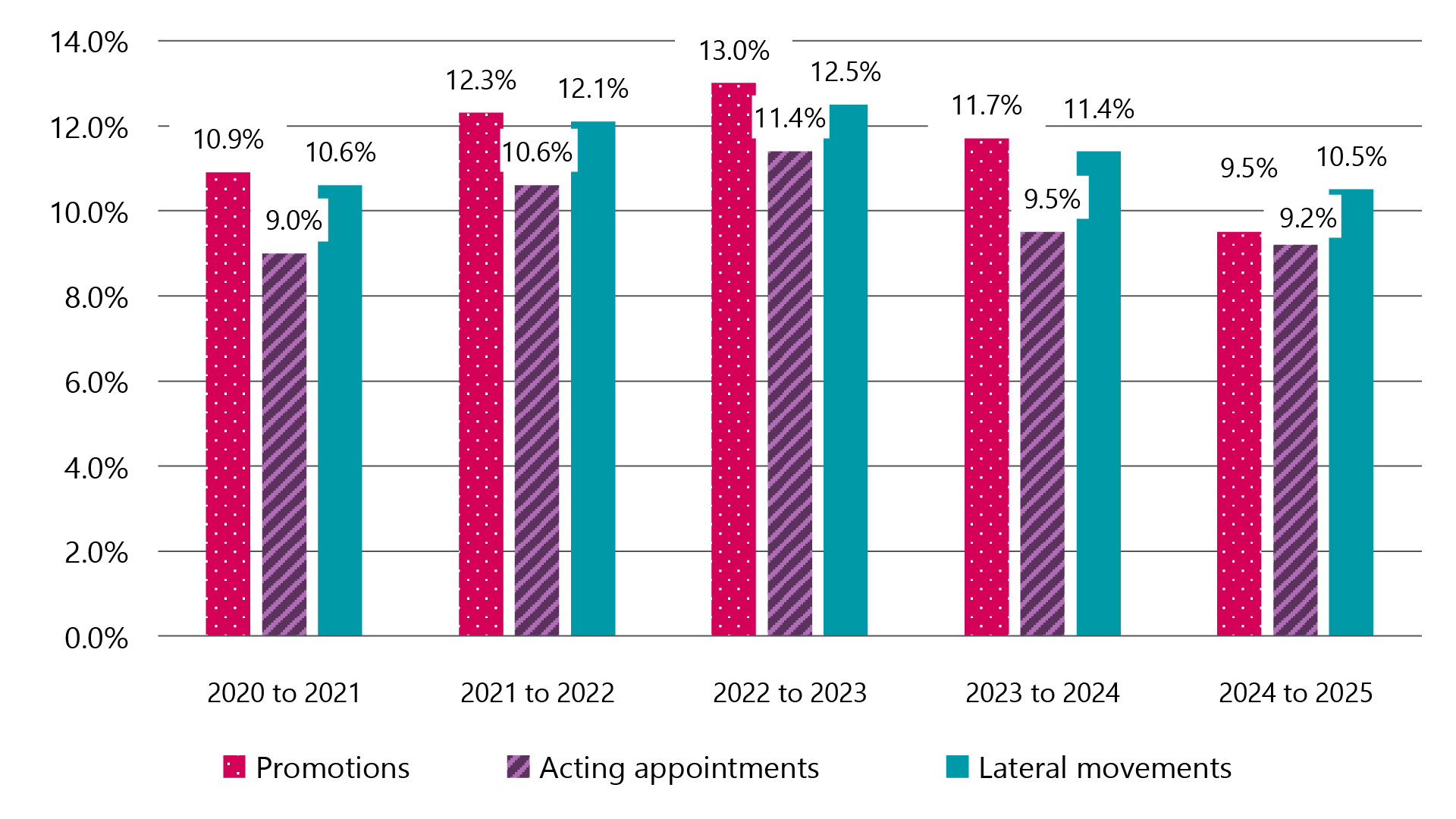
Internal mobility rates, by fiscal year - Alternative text
| Type | 2020 to 2021 | 2021 to 2022 | 2022 to 2023 | 2023 to 2024 | 2024 to 2025 |
|---|---|---|---|---|---|
| Promotions | 10.9% | 12.3% | 13.0% | 11.7% | 9.5% |
| Acting appointments | 9.0% | 10.6% | 11.4% | 9.5% | 9.2% |
| Lateral movements | 10.6% | 12.1% | 12.5% | 11.4% | 10.5% |
Priority entitlements
Priority entitlements support people who experience career changes because of events often beyond their control, including:
- being medically released from the Canadian Armed Forces or the Royal Canadian Mounted Police
- workforce adjustment
- no longer able to perform the duties of their position
- returning from extended leave
In fiscal year 2024 to 2025, the number of persons with a priority entitlement increased by 13.1%, from 1 142 to 1 292. This ends a 4-year trend where the size of the priority talent pool consistently declined. An increase was also observed in the number of new registrations, up from 686 to 824 (20.1%).
The priority talent pool remains a sound first option for meeting varied staffing needs. The number of priority appointments declined (to 316, compared with 353 in the previous year), coinciding with an overall drop in staffing activities.
Continuing to enhance our data and analysis
Use of recruitment platforms
Application data is derived from the Public Service Resourcing System (the recruitment and data management platform of the Public Service Commission of Canada). However, 26 departments and agencies acquired licenses to use other recruitment platforms or used the Treasury Board of Canada Secretariat’s GC Digital Talent platform for all or part of their staffing processes. As a result, the application data reported is underrepresented by approximately 100 000 applications received through these platforms. Without full access to applicant data from these platforms, our ability to identify and report on key hiring trends is impacted.
We have begun working with departments and agencies to close the gap by creating a data transfer to monitor and report on all recruitment activity and support our oversight of public service hiring.
Having multiple platforms also increases overall costs at a time when departments and agencies are looking to find efficiencies and reduce operating costs. Based on a sampling in fiscal year 2024 to 2025, we noted that 21 departments and agencies collectively awarded over $2.5M in new contracts for alternative recruitment solutions to support their staffing and recruitment processes. Across the federal government, the cumulative annual expenditure on alternative platforms is conservatively estimated to exceed $5M, not including indirect costs for setting these contracts up and implementing systems within departments.
Enhanced data collection on non-advertised processes
We are taking steps to increase our understanding of non-advertised appointments. This fiscal year, we introduced new data entry fields to capture the rationale for non-advertised processes. While the data will be refined, it provided more transparency and some early indications of how non-advertised processes are being used.
Highly specialized skills, shortage areas and pressing operational needs were the most frequently given rationales for non-advertised processes. Other reasons included shifts in employment type (for example, casual to term), hiring of former students (bridging) and appointments in support of employment equity objectives.
Enriching the public service through veterans hiring
In fiscal year 2024 to 2025, we published our Audit on the Application of the Order of Preference for Veterans During the Data Transfer Outage Between the Department of National Defence and the Public Service Commission of Canada. The audit found that the preference entitlement for appointment was not respected for some veterans, and that this was due to a technical issue related to the data transfer process. The issue may have led to some eligible veterans not being properly identified for preference entitlement in the Public Service Resourcing System.
As a result of the audit, we worked with departments, agencies and veterans to help qualified veterans who may have been affected by the issue to secure public service employment. The audit’s results led to new data transfer management practices between the Department of National Defence and the Public Service Commission of Canada to help ensure information is more accurate and up to date. We also took steps to increase departments and agencies’ understanding of the preference entitlement for veterans, including developing new guidance for hiring managers.
Eligible veterans who may have been affected by the data transfer outage were also provided with an additional period to apply to jobs open only to public servants through the Eligibility of Certain Former Members of the Canadian Forces Regulations. Endnote16
Appointment of veterans
The Veterans Hiring Act came into force in July 2015. It amended the Public Service Employment Act to facilitate the transition of eligible Canadian Armed Forces members and veterans into federal public service positions. It introduced 3 key mechanisms to improve their access public service jobs: priority appointment (priority entitlement), access to internal jobs (mobility) and preference in external appointments.
The number of medically released Canadian Armed Forces members activating their priority entitlement declined, down 5%, from 336 members available for job opportunities on March 31, 2024, to 318 on March 31, 2025. This reduction corresponds to a decrease in priority appointments of medically released Canadian Armed Forces members, with 75 appointments, representing 8 fewer appointments compared to the previous year.
In fiscal year 2024 to 2025, there were 122 appointments under the mobility provision, up from 106 in the previous fiscal year.
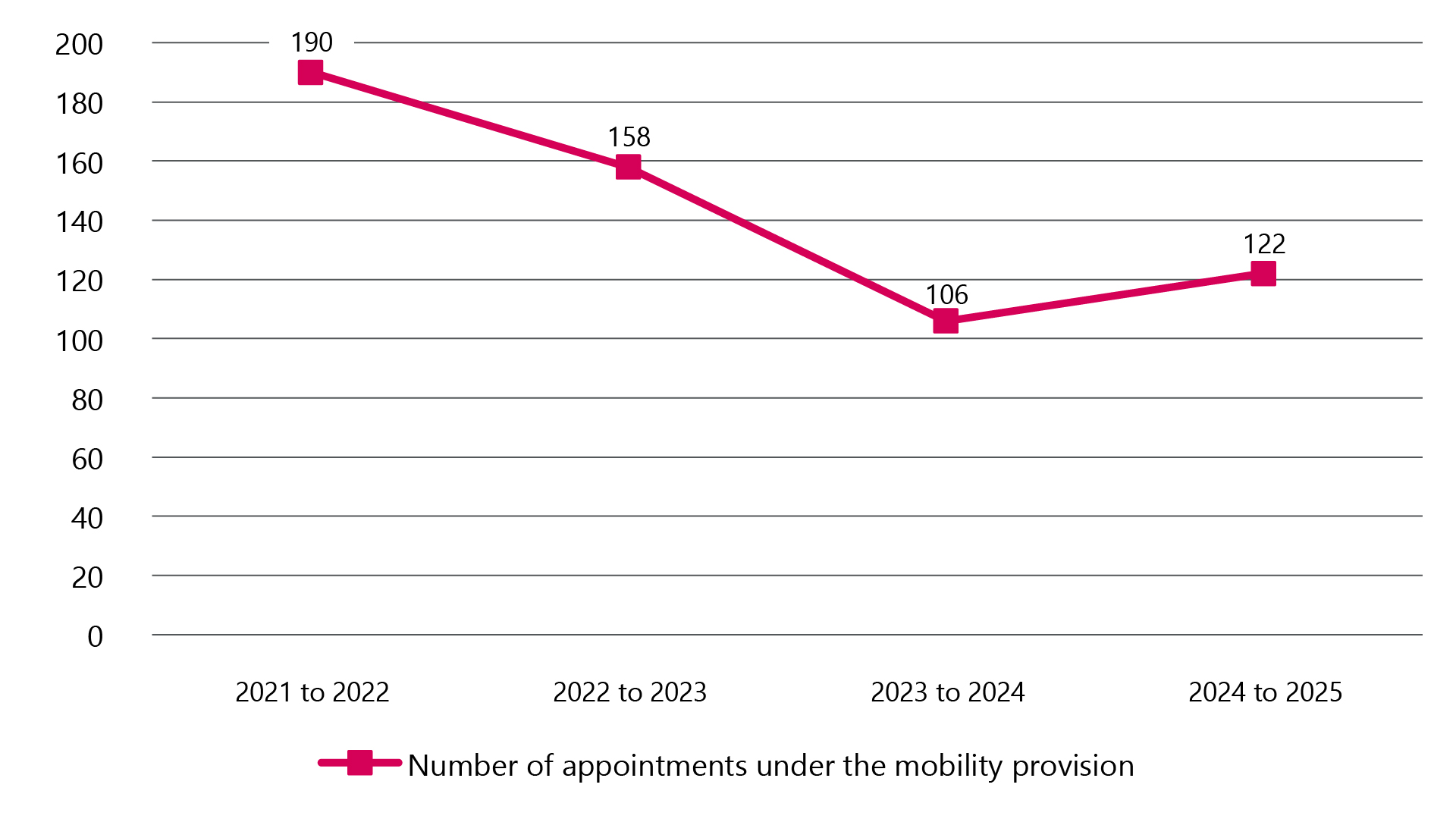
Number of appointments under the mobility provision, by fiscal year - Alternative text
| Type | 2021 to 2022 | 2022 to 2023 | 2023 to 2024 | 2024 to 2025 |
|---|---|---|---|---|
| Mobility | 190 | 158 | 106 | 122 |
Following the Audit on the Application of the Order of Preference for Veterans During the Data Transfer Outage Between the Department of National Defence and the Public Service Commission of Canada, the number of appointments made under the preference provision was updated for fiscal years 2021 to 2022, 2022 to 2023, and 2023 to 2024.
As a result, we identified the following additional appointments under the preference provision:
- 21 in fiscal year 2021 to 2022
- 47 in fiscal year 2022 to 2023
- 15 in fiscal year 2023 to 2024
In fiscal year 2024 to 2025, there were 96 appointments under the preference provision, down from 119 in the previous year.
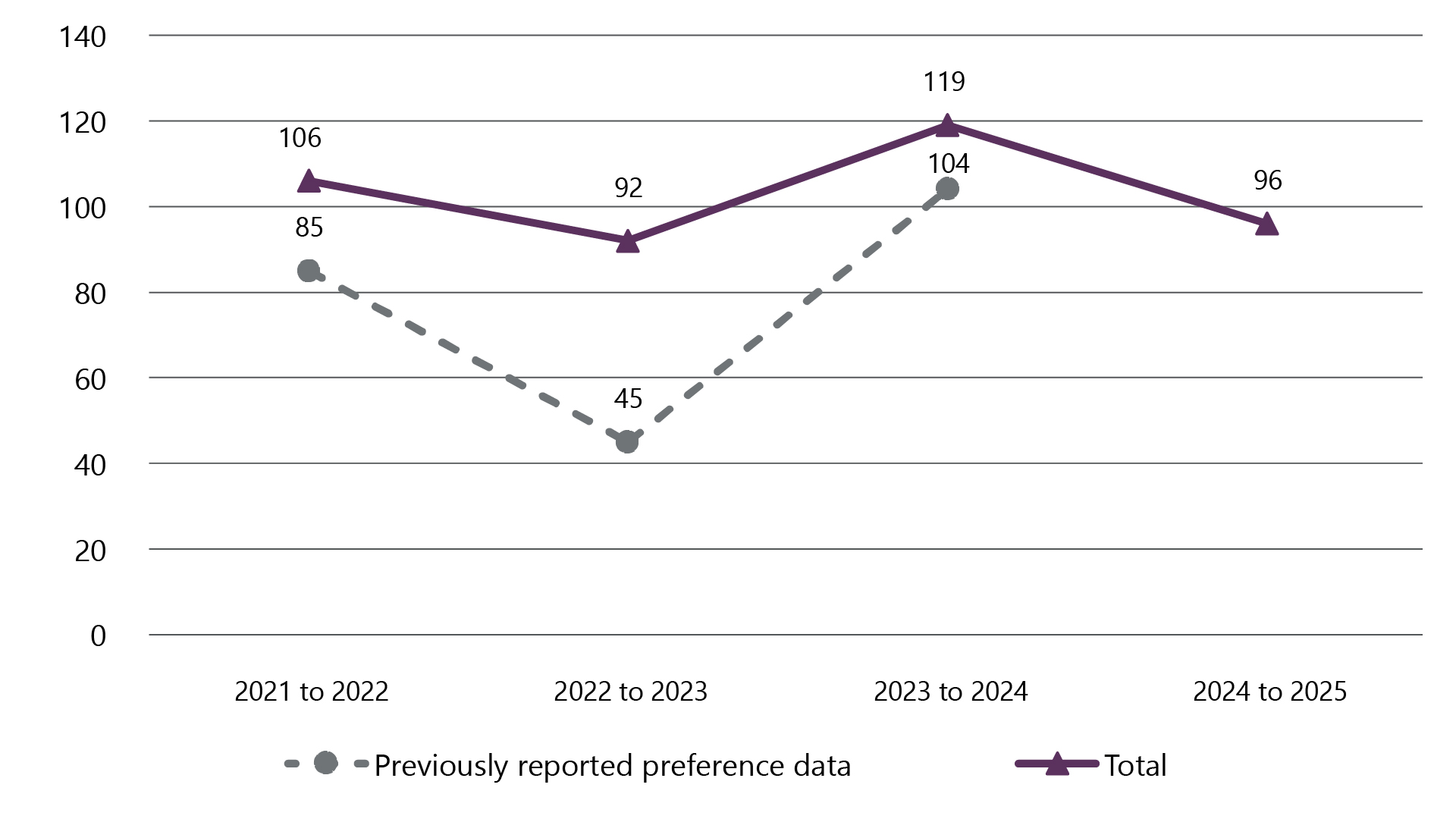
Previously reported and updated number of appointments under the preference provision, by fiscal year - Alternative text
| Type | 2021 to 2022 | 2022 to 2023 | 2023 to 2024 | 2024 to 2025 |
|---|---|---|---|---|
| Previously reported preference data | 85 | 45 | 104 | n/a |
| Total | 106 | 92 | 119 | 96 |
Safeguarding merit and non-partisanship
Protecting and overseeing the staffing system’s integrity
The Public Service Commission of Canada safeguards the core values of merit and non-partisanship to maintain the trust of Canadians in the integrity of the public service and to uphold our accountability to Parliament.
Through audits, surveys, studies and data analytics, the Commission monitors public service hiring and non-partisanship at a system-wide level. This overview provides a picture of compliance with legislation and policy, as well as a view of key trends, issues and opportunities to enhance the staffing system. This view is complemented by monitoring and oversight within departments and agencies, which provides an understanding of hiring on a case-by-case basis.
The investigation function allows detection and correction of founded issues, such as cases of fraud in appointments, or improper political activities. These investigations also highlight any emerging gaps or risks, which may influence future audits or policy guidance.
Merit-based hiring
Merit is the cornerstone of federal public service hiring, ensuring that hiring decisions are based on candidates’ qualifications. To be hired in the public service, candidates must meet all essential merit criteria such as education, experience, knowledge, competencies, and official languages. Managers can also identify asset qualifications, operational requirements (such as availability to travel), and specific organizational needs (for instance, increasing representation of an employment equity group) that candidates must meet to be appointed.
The following section presents the results of our audit in this regard for fiscal year 2024 to 2025.
System-wide staffing audit
The Results of the Second System-Wide Staffing Audit was published in fiscal year 2024 to 2025. Drawing from close to 300 appointment files from 19 departments and agencies, the audit looked at compliance with legislative and policy requirements, as well as any risks to the integrity of public service hiring.
Overall, the audit results revealed strong compliance with key requirements and provided assurance that hiring was based on merit. The rate of compliance in appointment files exceeded 96% for most job qualifications and those qualifications met applicable standards in 93% of cases.
Despite finding strong overall compliance, the audit did reveal a weakness in current practices: a lack of consistency between the English and French versions of key appointment process information. Inconsistencies such as differences in statements of qualification between English and French advertisements may increase or decrease the likelihood of francophones or anglophones applying to, or qualifying for, these positions. The audit recommended that deputy heads take concrete steps to respect official languages obligations throughout the appointment process.
Investigations of appointment processes
This fiscal year, the Public Service Commission of Canada received 265 requests for investigations related to allegations of fraud, errors, omissions or improper conduct in an appointment process that could affect meritorious hiring. These included:
- 139 requests related to error, omission or improper conduct, or to merit not being met, in external appointment processes (jobs open to the public)
- 29 deputy head requests for investigations on their behalf related to error, omission or improper conduct in internal appointment processes (jobs open to public servants)
- 97 requests related to fraud
Finding efficiencies
To ensure resources are dedicated to cases posing the greatest risk to the integrity of public service hiring, and to address alleged irregularities as effectively as possible, we conducted a review of our active investigation cases. We assessed the risk to the staffing system, the possibility of ordering corrective actions and the impact of closing identified cases. This review resulted in closing 14 cases. Detailed explanations for closing these files were provided in letters to the affected parties.
Once we receive an investigation request, we perform a preliminary analysis to determine whether an investigation will be conducted. If so, under the Public Service Employment Act, the Commission can take any corrective action it considers appropriate in founded cases. The goal of corrective actions is to correct irregularities and prevent reoccurrences.
Among the founded cases related to errors, omissions or improper conduct, there were cases where hiring practices under the Federal Student Work Experience Program and Post-Secondary Co‑op/Internship Program were irregular. This included manipulating criteria to favour specific candidates, undisclosed relationships, as well as errors in eligibility assessments and in reference assessments. Other irregularities involved a non-merit-based appointment where the appointee did not meet educational requirements.
In these cases, the Commission ordered corrective actions that included reassessment of affected candidates, mandatory training followed by a discussion and temporarily withdrawing sub-delegated authorities. In some cases, people were required to notify the Public Service Commission of Canada for a prescribed period before accepting any position or work in a federal department or agency subject to the Public Service Employment Act.
Founded cases related to fraud included false information on education, false documents (physical abilities test results, second language test results, education credential evaluations for Canadian equivalency), unauthorized assistance during exams and misuse of standardized testing. In response, corrective actions were ordered, such as eliminating candidates from appointment processes, revoking appointments, mandatory training and requiring candidates to notify the Public Service Commission of Canada before accepting any position or work in a federal department or agency subject to the Public Service Employment Act.
In some cases, the Commission disclosed the results of its investigations to external bodies, such as the Royal Canadian Mounted Police and Public Services and Procurement Canada’s National Security and Sensitive Investigations Division, to promote accountability, correct irregularities and prevent future occurrences.
The Public Service Commission of Canada reviewed 13 cases of concerns related to biases or barriers that disadvantage people belonging to equity-seeking groups. Two of these cases have proceeded to an investigation to determine if the appointment process involved an error, an omission or improper conduct resulting from a bias or barrier disadvantaging persons who belong to an equity-seeking group. Endnote17
| Grounds | 2020 to 2021 | 2021 to 2022 | 2022 to 2023 | 2023 to 2024 | 2024 to 2025 |
|---|---|---|---|---|---|
| Fraud | 9 | 10 | 14 | 17 | 8 |
| Error, omission or improper conduct in an external appointment process | 13 | 8 | 66* | 18 | 9 |
| Total | 22 | 18 | 80* | 35 | 17 |
* This number can be explained by the investigation of 1 appointment process that yielded multiple individual cases.
This fiscal year, 17 investigation cases were founded (compared to 35 in fiscal year 2023 to 2024), and 29 were unfounded.
Staffing and non-partisanship survey: perceptions of merit
In fiscal year 2024 to 2025, we published findings from the 2023 Staffing and Non-Partisanship Survey, which gathered views of 84 741 employees, managers and staffing advisors on a wide range of staffing-related topics. The survey’s findings confirmed the Results of the Second System-Wide Staffing Audit, revealing a fairly high degree of trust that staffing processes were made in accordance with the principle of merit. The survey found that 84% of respondents agreed that people hired into the public service can do the job, and 83% agreed that advertised job requirements reflect those of the position to be filled.
However, the survey found that public servants who self-identified as members of visible minorities, Indigenous Peoples and persons with disabilities had less positive perceptions of merit than their comparator groups (4% lower on average for each group). Public servants who identified as another gender had the least positive perceptions of any demographic group of merit in the appointment process (69%, compared to 83% overall, agreed that advertised job requirements reflect those of the position to be filled).
Departments and agencies will need to take action to build trust in their staffing processes. This may include better communication and implementing strategies to make hiring policies and practices more inclusive.
The survey’s results also shed light on whether staffing decisions influence employees’ perceptions of merit. The findings revealed that:
- employees’ perceptions of merit within the staffing system are not directly affected by the choice of process (advertised or non-advertised)
- when information about staffing actions is communicated, employees tend to have a more positive view of the staffing system
- managers who reported feeling pressured to select a particular candidate during a staffing process are significantly less likely to believe that the process is based on the core principle of merit
Non-advertised appointments
Our study on non-advertised appointments, based on data for fiscal year 2022 to 2023, showed that representation of women and visible minorities in both advertised and non-advertised appointments has improved, with notable gains across most visible minorities subgroups. We also observed significant progress in non-advertised appointments for persons with disabilities since the Accessibility Strategy for the Public Service of Canada was implemented. For Indigenous Peoples, representation in non-advertised appointments was consistently above their workforce availability; however, they have not experienced a strong upward trend in these appointments.
We looked at how various factors affected whether promotions were non-advertised or advertised. Our data suggests that occupational category, region and gender may influence the odds of a promotion being non-advertised:
- promotions in the technical category are most likely to be non-advertised, while those in the operational category are least likely
- promotions in the National Capital Region are more likely to be non-advertised compared to other regions
- women are slightly more likely than men to receive non-advertised promotions
Acting appointments
In the public service, when an employee is away on leave or due to other circumstances, another employee may replace them; this is referred to as an acting appointment. This year, we looked deeper into these temporary appointments.
Audit of Employment Equity Representation in Acting Appointments
The Audit of Employment Equity Representation in Acting Appointments (published in September 2024) examines 10 years of acting appointment data (from 2011 to 2021). It looks at trends in the representation of designated employment equity groups in federal public service acting appointments, as well as departmental staffing practices related to employment equity.
This audit found that representation in acting appointments of 6 months and more for 3 of the 4 employment equity groups (women, visible minorities and Indigenous Peoples) was on par with or exceeded their representation in the federal public service.
Employees with disabilities were consistently underrepresented in acting appointments in comparison to their representation in the public service. All 4 employment equity groups were underrepresented in acting appointments in positions related to skilled technical activities, like engineering and inspection.
The audit provides recommendations for improving representation in the workplace so that all public servants can realize their full potential.
Study on acting appointments
The audit was complemented by our study titled Representation in Acting Appointments (published in February 2025), which looked at whether the 4 employment equity groups are proportionately represented in acting appointments of 4 months or more.
Like the audit, the study found that the representation of women, Indigenous Peoples and members of visible minorities in acting appointments was higher than their representation in the federal public service. However, a breakdown by occupational categories shows areas where representation of employment equity groups and subgroups in acting appointments of 4 months or more is below their representation in the federal public service.
The study also found that persons with disabilities are underrepresented in acting appointments in all occupational categories compared to their representation in the federal public service.
Non-partisanship and political activities
Public servants wishing to seek nomination as, or to be, a candidate in a municipal, provincial, territorial or federal election must first request and obtain permission from the Commission.
Through our assessments, and by implementing conditions and mitigation measures that those public servants must comply with, we help ensure that their right is exercised without compromising the neutrality of the public service. This process helps safeguard the impartiality and trustworthiness of the public service, reinforcing public confidence.
When making these decisions, the Commission considers factors such as:
- the level of the election
- the employee’s duties, including their level of authority and influence in decision making
- the level and visibility of the employee’s position
Taking into consideration these factors and their interconnection, the Commission must be satisfied that seeking candidacy and being a candidate will not impair or be perceived as impairing the employee’s ability to perform their duties in an impartial manner.
We work with the employee and their management to understand an employee’s responsibilities before deciding to grant permission. We also collaborate with deputy heads, who are responsible for overseeing the implementation of conditions imposed on permissions granted to their employees. This careful review of each request allows most candidacy permission requests to be granted, but with targeted conditions to mitigate any risk, real or perceived, to non-partisanship in the federal public service.
| Election level | Permission requests carried over from 2023 to 2024 | Permission requests received in 2024 to 2025 | No decision rendered | Permission requests carried over to 2025 to 2026 | Number of decisions rendered |
|---|---|---|---|---|---|
| Municipal | 2 | 38 | 1 | 7 | 32 |
| Provincial | 0 | 13 | 3 | 0 | 10 |
| Territorial | 0 | 0 | 0 | 0 | 0 |
| Federal | 2 | 52 | 11 | 0 | 43 |
| Total | 4 | 103 | 15 | 7 | 85 |
All permission requests handled in fiscal year 2024 to 2025 were granted, as any risks identified to political impartiality could be addressed with mitigating conditions that removed risks of political influence in public service operations.
2025 federal election and outreach
For the 2025 federal election, the Commission granted the highest ever number of permission requests, including an influx of 14 requests in March 2025, soon before the election was called.
Despite the volume and timing of the requests, decisions were provided within the regulated 30-day timeframe.
As the federal election approached, we increased our engagement with employees by:
- including new guidance on public servants, political activities and social media
- delivering 34 outreach sessions, tailored by topic (candidacy or non-candidacy political activities) and by audience (managers, departments/agencies, all employees, designated political activities representatives)
- we also participated in panels and other events, reaching more than 5 500 participants
- responding to 198 inquiries from employees, departments and agencies and members of the public about legal rights and obligations related to political activities
Political activities and public service values
This fiscal year, we took part in the Clerk of the Privy Council’s renewed conversation on values and ethics within the federal public service.
We continued to work closely with the values and ethics community, as well as our designated political activities representatives in departments and agencies. The goal was to provide clear and consistent messaging to help employees make informed decisions on their political engagement and to uphold public sector values, such as respect for democracy.
Staffing and Non-Partisanship Survey: Awareness of rights and responsibilities related to political activities
The 2023 Staffing and Non-Partisanship Survey emphasized the continued importance of non-partisanship in the federal public service. It reminded employees of their responsibilities regarding political neutrality, and enhanced awareness and understanding of the standards for political impartiality across the public service.
Survey results indicate that public servants’ understanding of their responsibilities related to political impartiality is high (90%). Results also show that public servants believe that employees in their work unit carry out their duties in a politically impartial manner (91%). As well, 91% of employees reported being aware that expressing their political views on social media could impact their ability to remain politically impartial or to be perceived as impartial, when carrying out their public service duties. However, less than two thirds (65%) of public servants are aware of their responsibilities when seeking a nomination as, or becoming, a candidate in an election.
Investigating improper political activities
The Public Service Commission of Canada implemented a new approach for investigating allegations of improper candidacy-related political activities to ensure irregularities are addressed and corrected in a timely manner.
Under this new model, when making the decision to investigate, various factors are considered, including the risk to the political impartiality of the federal public service and the possibility of addressing the issue without an investigation. This could include an awareness letter informing an individual of an allegation, reminding them of their obligations if they wish to participate in political activities in the future as well as the possible consequences for future non-compliance.
We continue to receive and analyze all allegations of improper political activities, determining the appropriate response on a case-by-case basis. In fiscal year 2024 to 2025, we received 22 requests related to improper political activities, completed 3 investigations that were founded and sent awareness letters in 10 of the reported cases.
Responding to a changing environment
To support non-partisan and merit-based hiring, we provide proactive support in the fields of recruitment and workforce adjustment (selection of employees for retention or lay-off), assessment, job advertising and staffing support. These services aim to help departments and agencies navigate the ever-evolving staffing environment, while also preventing errors or omissions and, consequently, costly complaints and investigations that can impact the workplace.
Changes to the Public Service Employment Regulations
In fiscal year 2024 to 2025, the Public Service Commission of Canada completed a review of the Public Service Employment Regulations to ensure that:
- they continue to support the enabling legislation, the Public Service Employment Act
- they meet the current and emerging needs of departments and agencies
- the federal public service continues to benefit from a staffing regime that is both modern and inclusive
As part of this review, extensive consultations were conducted with stakeholders across the federal public service. These included departments, agencies, the employer, bargaining agents, as well as employment equity, diversity and inclusion networks. The proposed amendments were also published in the Canada Gazette, providing an opportunity for stakeholders to comment on the proposed regulatory text. These consultations helped identify areas for improvement and ensured that the amendments took into account diverse perspectives and operational realities.
The amending regulations came into force on January 29, 2025, except for provisions related to priority entitlements, which came into force on April 1, 2025.
Summary of key changes
- Aligned and clarified various priority entitlements
- Extended the priority entitlement period from 2 to 5 years for Royal Canadian Mounted Police members discharged for medical reasons and employees unable to carry out their duties due to disability
- Clarified requirements for identifying and selecting employees for lay-off
- Introduced new requirements to improve transparency and communication in the lay-off process, and to identify and remove or mitigate biases and barriers that disadvantage persons belonging to equity-seeking groups in assessment
We worked with departments and agencies to ensure they had the tools and support to implement these changes.
AI and the future of hiring
With the rapid evolution of AI and the introduction of a number of new digital tools, we have launched a guide to help hiring managers navigate its use in hiring. Aligned with the Treasury Board’s Directive on Automated Decision-Making, this guide aims to help departments and agencies use AI responsibly in their hiring processes. It highlights the opportunities offered by AI, and clarifies responsibilities. It also identifies key considerations, including:
- mitigating the risks of bias and barriers
- transparent and clear communication with candidates
- the need for vigilance to maintain the integrity of hiring processes
In parallel, we completed an AI roadmap initiative that identified key foundational elements for AI adoption.
Second language evaluation
During fiscal year 2024 to 2025, over 76 000 unsupervised second language tests of reading comprehension and written expression were administered through our online Candidate Assessment Tool platform, compared to over 95 000 the previous fiscal year. We also conducted over 29 500 oral language tests in 2024 to 2025, slightly more than the 29 000 tests administered during the previous fiscal year.
We continued to improve the platform, with a strong focus on accessibility and user experience. Candidates needing assessment accommodation measures can now submit their requests directly through the platform, track their progress and manage their profiles, without the help of a department or agency’s human resources team. This makes testing more efficient, strengthens the protection of personal information related to accommodation measures and improves the experience for candidates with disabilities.
To prepare for government-wide efforts to modernize official languages and for changes to the Official Languages Act, we improved the efficiency of second language testing. These improvements include a new self-serve scheduling system and prioritizing test requests for staffing. Ensuring timely second language testing helps reduce the time it takes to staff bilingual positions in the federal public service.
Test integrity
With the transition from in-person to unsupervised and virtually supervised assessment methods, we have seen a year-over-year increase in the number of cases of suspected cheating.
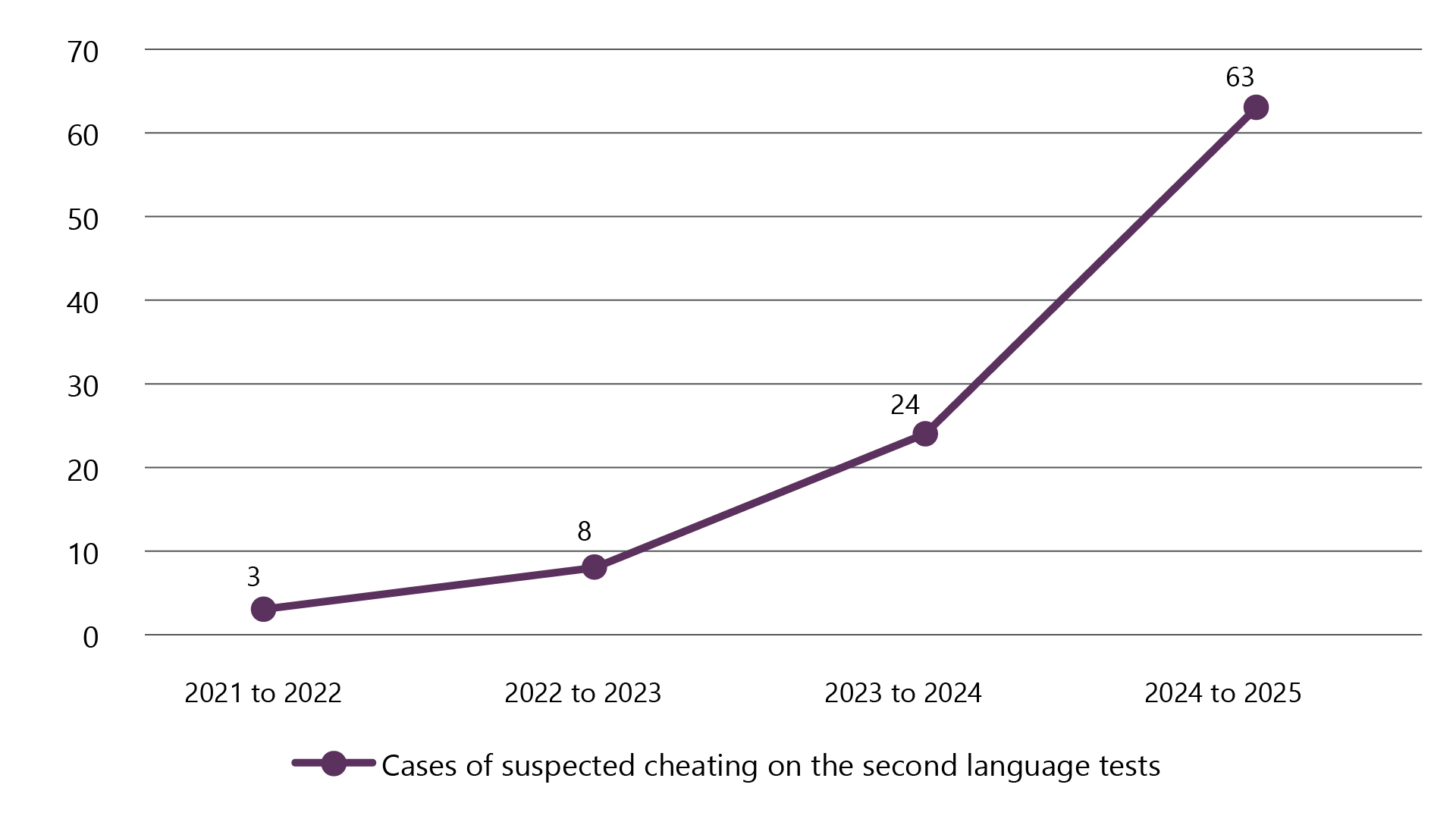
Cases of suspected cheating on the Public Service Commission of Canada’s second language tests - Alternative text
| Cases | 2021 to 2022 | 2022 to 2023 | 2023 to 2024 | 2024 to 2025 |
|---|---|---|---|---|
| Number of cases of suspected cheating | 3 | 8 | 24 | 63 |
In fiscal year 2024 to 2025, 63 cases of suspected cheating on our second language tests were reported. We review each case of suspected cheating carefully, and we take action that can include ending test sessions early, suspending or invalidating test results, imposing conditions to increase the security of future tests, such as in-person supervision, and referring cases to the proper authority for investigation.
When test takers don’t follow standardized testing conditions, it can lead to inaccurate test results and an unfair advantage. Cheating also jeopardizes our ability to ensure candidates meet the second language requirements of bilingual positions in the federal public service. We have started to explore new ways to prevent and detect cheating in assessments, including leveraging technology to strengthen the integrity of our tests.
Medical exclusion requests
People appointed to bilingual positions must meet official language proficiency requirements. However, there are exceptions to this general rule. When a medical condition prevents someone from attaining the linguistic requirements of a bilingual position through language training and accommodation measures, they may be granted a medical exclusion. In these cases, a person can be appointed non-imperatively, meaning that they can be hired without meeting the language requirements of the position. When this occurs, measures must be put in place to ensure that the language obligations of the position are still met.
In fiscal year 2024 to 2025, the Public Service Commission of Canada received 10 requests for medical exclusions, representing the first decline after a 4-year increase.
People who have been granted an exclusion on medical grounds can now include this information in their Government of Canada Workplace Accessibility Passport, supporting inclusive hiring under the Accessibility Strategy for the Public Service of Canada. While the Commission’s approval is still required for subsequent medical exclusion requests, the process is typically completed within a short timeframe.
Modernized and inclusive recruitment
Student programs
Modernizing student programs is one of our ongoing priorities. In fiscal year 2024 to 2025, we continued to test a flexible approach to recruiting specific students from the Federal Student Work Experience Program, including students who are:
- members of an employment equity group
- located remotely
- in a specialized field of study
The Specific Name Referral pilot expanded significantly in fiscal year 2024 to 2025, with 27 participating departments and agencies, compared to 8 the previous year.
As a result, 506 requests for students were received this fiscal year, leading to 222 new hires. Nearly half (47%) of all requests were for students specializing in fields like scientific machine learning, hydrology, geomatics engineering, firefighting and wildlife conservation, highlighting the wide array of specialized expertise and in-demand skills in the public service.
Bringing new talent to Canada’s health portfolio
Health Canada and the Public Health Agency of Canada took part in the second phase of the Specific Name Referral pilot project, which began on July 30, 2024.
From August 1, 2024, to March 31, 2025, Health Canada hired 14 new students, including 9 from employment equity groups and 5 with specialized backgrounds in fields of study like social services, finance, information technology and AI. During the same period, the Public Health Agency of Canada recruited 5 new students, including 2 from employment equity groups and 3 with expertise in epidemiology, statistics and public health. This initiative provided managers with increased flexibility in their hiring decisions.
Student recruitment in support of the G7 Leader’s Summit in Kananaskis, Alberta
Global Affairs Canada needed to quickly recruit approximately 150 students to successfully host international leaders at the G7 Leaders’ Summit in Kananaskis, Alberta. We created a specialized student inventory and actively promoted it with a QR code at outreach events at post-secondary institutions in Alberta. The collaboration generated a significant volume of applications, providing Global Affairs Canada with a large pool of candidates to support their recruitment objectives.
Digital Talent Co‑op/Internship Initiative
With the support of the Treasury Board of Canada Secretariat’s Office of the Chief Information Officer, we took the lead on the Digital Talent Co‑op/Internship Initiative. Building on a successful pilot from Innovation, Science and Economic Development Canada, this initiative creates a pipeline for students from top academic programs who are learning cutting-edge digital skills in AI, data science and cybersecurity to join our workforce. In fiscal year 2024 to 2025, 46 talented students joined this pilot, contributing their skills to innovative projects across the federal government, and participating in networking and career events.
Hiring persons with disabilities
As part of the Government of Canada’s accessibility strategy launched in May 2019, a goal was set to hire 5 000 net new persons with disabilities in the federal public service over 5 years.
Since then, we have worked with the Treasury Board of Canada Secretariat to monitor progress and support departments and agencies. This helped set targets for closing the representation gap while taking projected attrition into consideration. We developed a specialized forecasting tool (a macrosimulation model) that uses data on staffing, employee movement, departures and self-identification to project future hiring needs. The latest data available showed that a total of 6 921 net new persons with disabilities had been hired by the end of fiscal year 2023 to 2024, exceeding the original target one year ahead of schedule.
We continued to support inclusive hiring by expanding our Ambassador Network for Inclusive Assessments (accessible only on the Government of Canada network). In fiscal year 2024 to 2025, the network welcomed 13 new members, bringing the total to 74 ambassadors from 40 departments and agencies. To promote inclusive practices, the network organized 29 activities for ambassadors, including training sessions on the use of AI in assessment and strategies to reduce biases and barriers in assessment processes.
As well, through the Federal Internship Program for Canadians with Disabilities, over fiscal year 2024 to 2025, we launched several initiatives, including a project to retain interns who have not found ongoing employment. A total of 40 internships were completed. Of those, 28 interns were offered continued employment, resulting in a 70% retention rate.
GC Jobs Transformation
Through the GC Jobs Transformation project, we lead the recruitment component of the future human resources and pay solution.
Originally implemented government-wide in 2003, the current recruitment platform is dated and lacks the end-to-end recruitment functionality departments and agencies need.
As a short-term measure, we’ve taken these steps to modernize the current recruitment platform:
- made system enhancements which have reduced inquiries from HR by 41%
- released an improved Web Experience Toolkit, optimizing performance on mobile devices
- strengthened security and performance through technology upgrades, laying the groundwork for a more intuitive and user-friendly experience
These enhancements established a strong foundation for continued modernization and improved user experience across the recruitment platform.
In parallel, the GC Jobs Transformation project represents a longer-term initiative to integrate recruitment into the Government of Canada’s broader vision for transforming human resources and pay systems. During fiscal year 2024 to 2025, processes related to recruitment were designed and configured as part of the Human Capital Management Feasibility Project, led by Public Services and Procurement Canada’s HR and Pay Transformation initiative.
Communication for enhanced support and efficiency
As we navigate this rapidly evolving environment and face the risk of inconsistent or false information about staffing, the Public Service Commission of Canada is committed to communicating actively with departments and agencies, as well as with the human resources community, to provide effective support and factual information. To this end, we launched the Empowering Excellence newsletter in fiscal year 2024 to 2025. The newsletter, sent to deputy heads, and shared with the human resources community and bargaining agents, includes highlights, updates and staffing support tools for the federal public service. Three editions were published in fiscal year 2024 to 2025, including a special issue on diversity, inclusion and accessibility.
See Annex 4 for Empowering Excellence newsletters issued in fiscal year 2024 to 2025. Endnote18
Looking forward
As Canada navigates unprecedented challenges, the role of the Public Service Commission of Canada is crucial in supporting and safeguarding the integrity and non-partisanship of the public service. We fulfill this mandate through our investigative, monitoring and research activities, among others, so that Canadians can continue to count on a stable and representative public service that can withstand challenges with professionalism, integrity and neutrality.
Our priorities for fiscal year 2025 to 2026 will support these values and aim to foster a public service that is both resilient and flexible.
We will continue to actively help departments and agencies that will be called upon to increase or reduce their workforce. We will provide them with more flexibility so they can adapt to the evolving context. We will continue to promote conditional job offers as a flexible staffing tool for recruiting the best talent. To retain experienced and qualified employees and meet future needs, we will ensure that mobility and reassignment options are promoted.
It will also be important to safeguard student hiring, which is essential to public service renewal, dynamism and diversity. Student recruitment helps address emerging skills gaps in areas like digital technology, cybersecurity, data management and AI, ensuring an innovative and responsive workforce for the future.
We must collaborate with departments and agencies to eliminate redundant and fragmented hiring practices, including the use of other recruitment platforms. We will initiate a focused and timely discussion on inefficiencies related to common staffing processes. In addition, we will:
- evaluate opportunities to centralize investments in recruitment systems and minimize any redundancies across departments and agencies
- pilot recruitment and candidate assessment platforms to assess functionalities and policy compliance
- explore enhancements to GC Jobs and our service delivery to address the evolving needs of departments and agencies
- reduce the additional administrative burden caused by the use of these platforms
At the same time, we will remain vigilant in overseeing the integrity of our tests, including implementing tools to leverage task automation and AI. We will also finetune our cheating prevention and detection techniques. In this way, we will draw on new technologies to make recruitment and assessment more effective, thereby helping public servants increase their digital and data literacy.
Working together with departments and agencies, we will continue to build a public service that is modern, professional, equipped and ready to meet future challenges.
Endnotes
Annex 1: Employment equity group applicants to external advertised processes and hires, compared to workforce availability
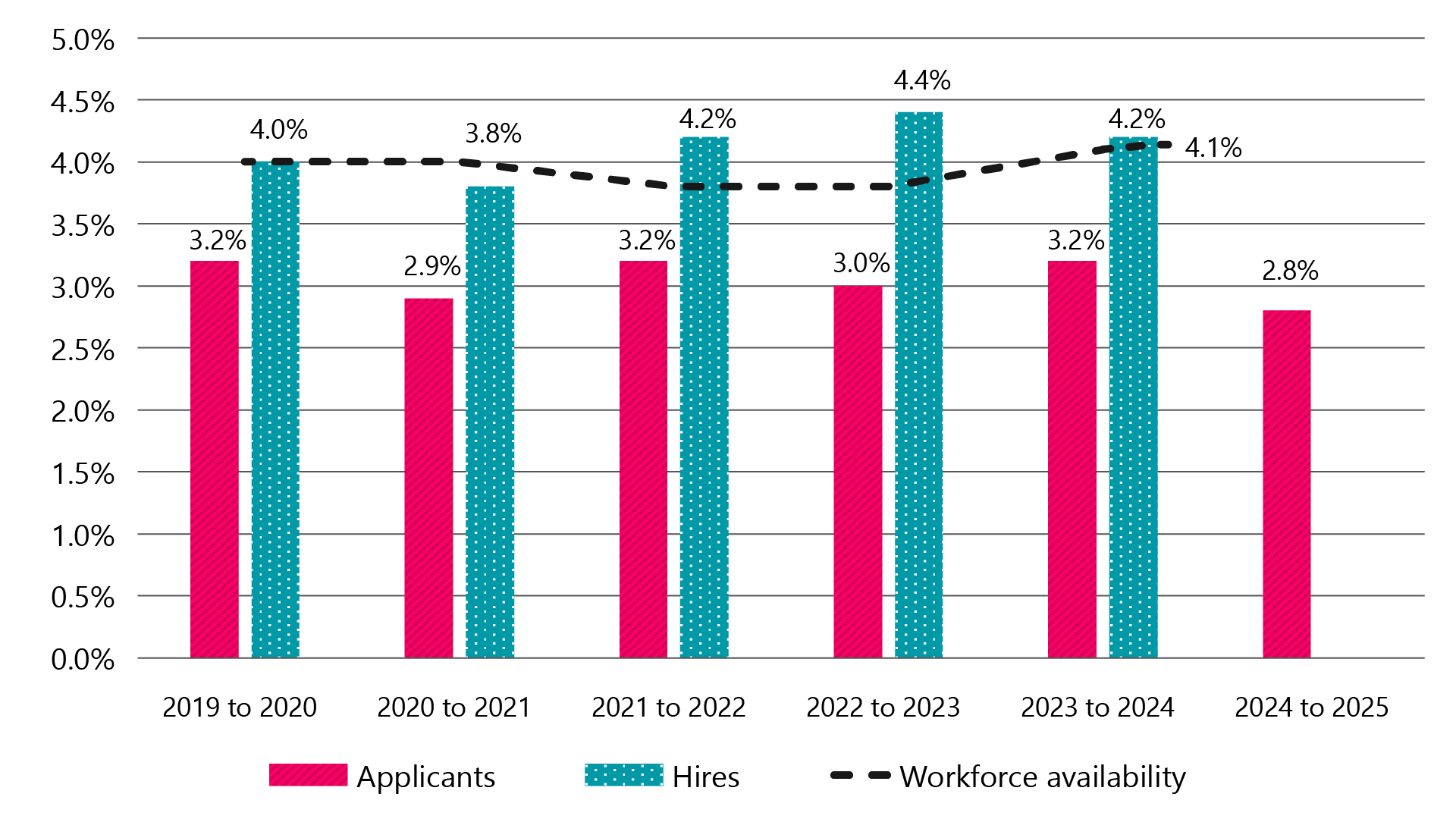
Indigenous Peoples: Applicants and hires to external advertised processes, compared to workforce availability, by fiscal year - Alternative text
| Category | 2019 to 2020 | 2020 to 2021 | 2021 to 2022 | 2022 to 2023 | 2023 to 2024 | 2024 to 2025 |
|---|---|---|---|---|---|---|
| Applicants | 3.2% | 2.9% | 3.2% | 3.0% | 3.2% | 2.8% |
| Hires | 4.0% | 3.8% | 4.2% | 4.4% | 4.2% | |
| Workforce availability | 4.0% | 4.0% | 3.8% | 3.8% | 4.1% |
| Subgroup | Applicants 2023 to 2024 |
Hires 2023 to 2024 |
Applicants 2024 to 2025 |
|---|---|---|---|
| Inuit | 5.6% | 4.8% | 4.6% |
| Métis | 36.9% | 41.5% | 40.1% |
| North American Indian / First Nation | 48.4% | 47.0% | 46.7% |
| Other | 9.1% | 7.0% | 8.5% |
Note: These totals may exceed 100%, since a person can self-declare and self-identify in more than 1 category given that the categories above are not mutually exclusive.
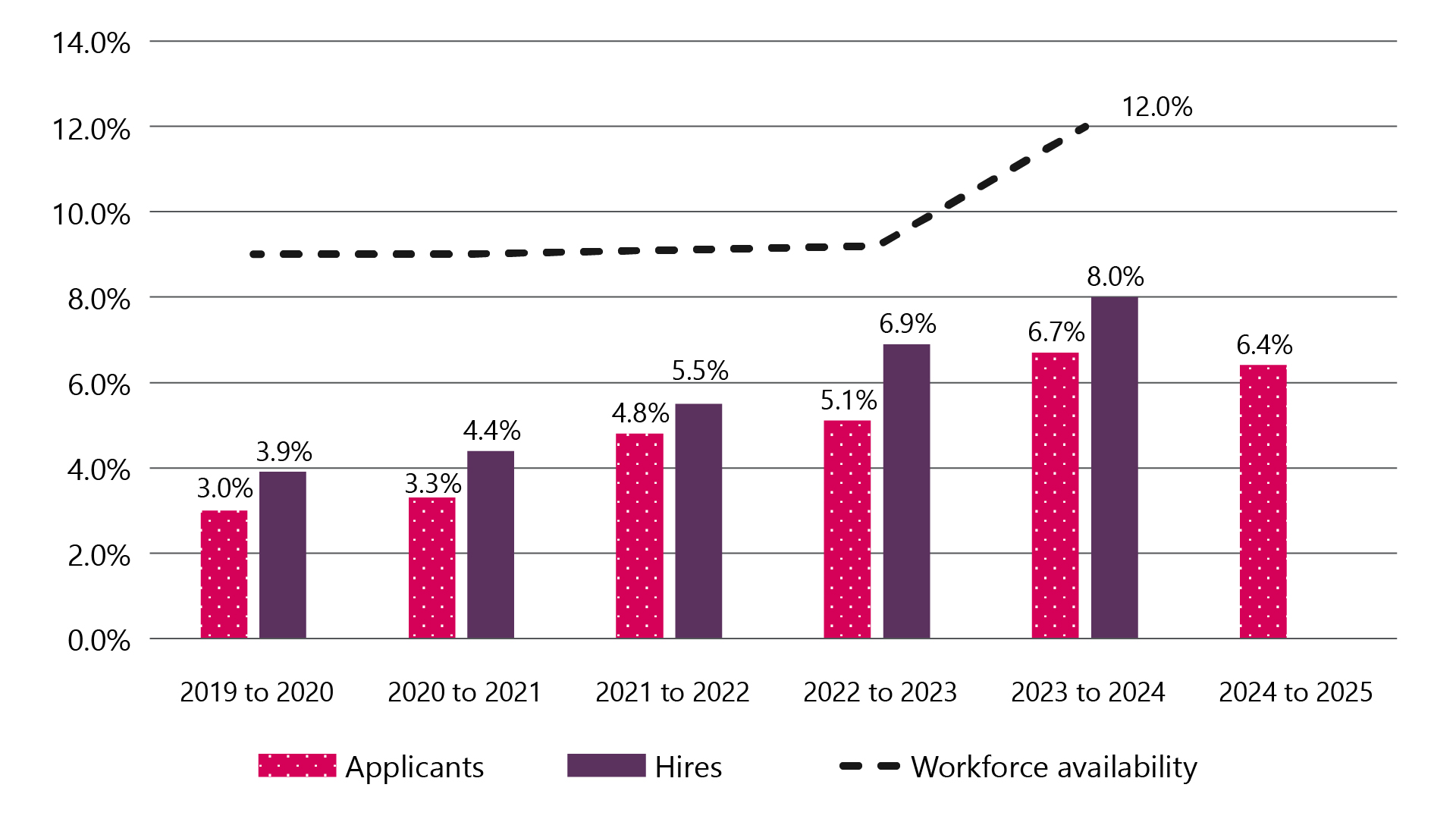
Persons with disabilities: Applicants and hires to external advertised processes, compared to workforce availability, by fiscal year - Alternative text
| Category | 2019 to 2020 | 2020 to 2021 | 2021 to 2022 | 2022 to 2023 | 2023 to 2024 | 2024 to 2025 |
|---|---|---|---|---|---|---|
| Applicants | 3.0% | 3.3% | 4.8% | 5.1% | 6.7% | 6.4% |
| Hires | 3.9% | 4.4% | 5.5% | 6.9% | 8.0% | |
| Workforce availability | 9.0% | 9.0% | 9.1% | 9.2% | 12.0% |
| Subgroup | Applicants 2023 to 2024 |
Hires 2023 to 2024 |
Applicants 2024 to 2025 |
|---|---|---|---|
| Blind or visual impairment | 4.3% | 5.1% | 4.4% |
| Coordination or dexterity | 4.0% | 4.8% | 3.6% |
| Deaf or hard of hearing | 6.9% | 7.1% | 6.5% |
| Mobility | 12.1% | 11.8% | 10.9% |
| Other disability | 80.4% | 81.8% | 81.6% |
| Speech impairment | 1.9% | 2.2% | 2.1% |
Note: These totals may exceed 100%, since a person can self-declare and self-identify in more than 1 category given that the categories above are not mutually exclusive.
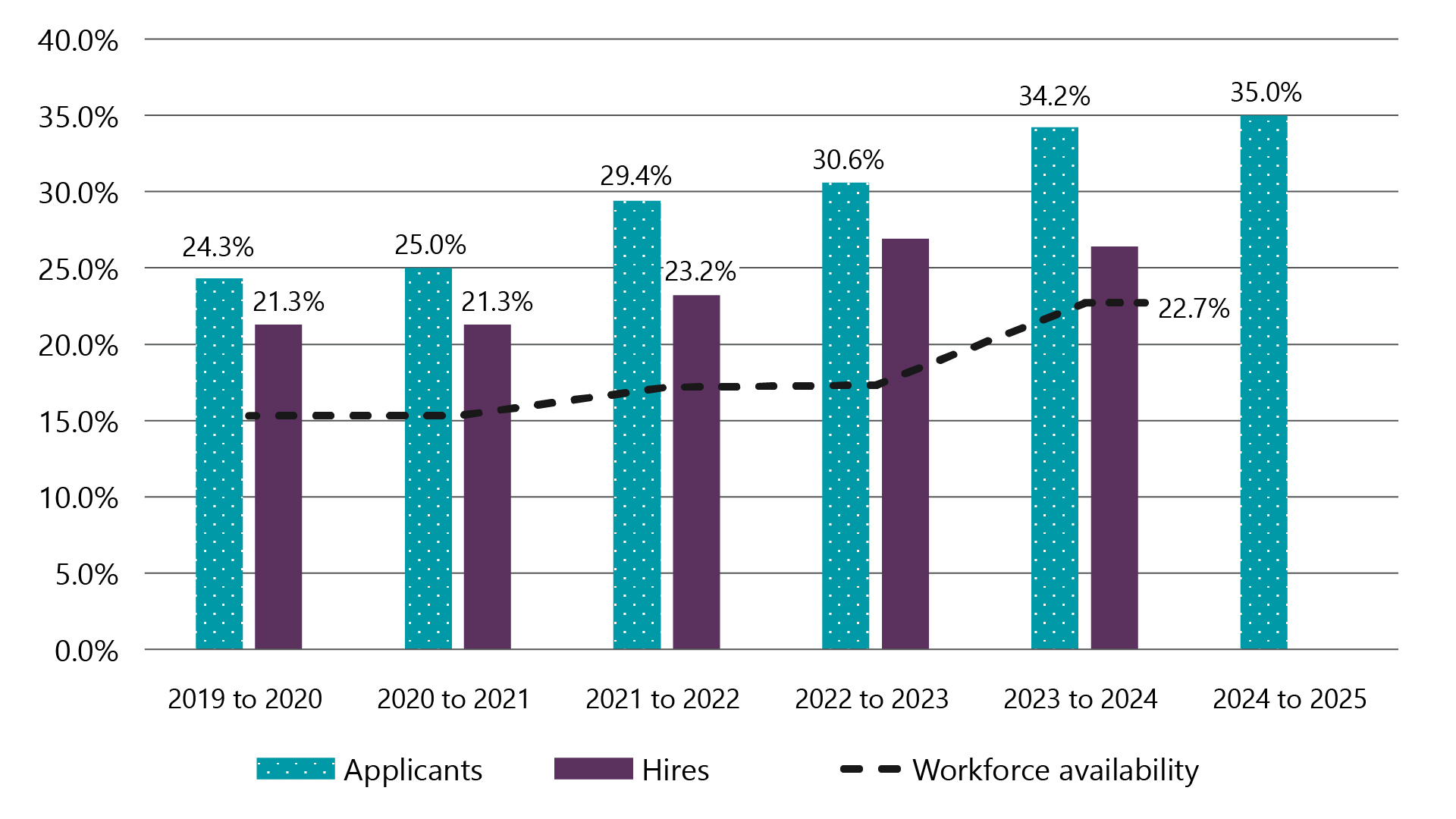
Members of visible minorities: Applicants and hires to external advertised processes, compared to workforce availability, by fiscal year - Alternative text
| Category | 2019 to 2020 | 2020 to 2021 | 2021 to 2022 | 2022 to 2023 | 2023 to 2024 | 2024 to 2025 |
|---|---|---|---|---|---|---|
| Applicants | 24.3% | 25.0% | 29.4% | 30.6% | 34.2% | 35.0% |
| Hires | 21.3% | 21.3% | 23.2% | 26.9% | 26.4% | |
| Workforce availability | 15.3% | 15.3% | 17.2% | 17.3% | 22.7% |
| Subgroup | Applicants 2023 to 2024 |
Hires 2023 to 2024 |
Applicants 2024 to 2025 |
|---|---|---|---|
| Black | 28.3% | 25.7% | 29.3% |
| Chinese | 9.5% | 9.5% | 9.0% |
| Filipino | 4.5% | 4.5% | 4.4% |
| Japanese | 0.4% | 0.4% | 0.3% |
| Korean | 1.4% | 1.2% | 1.2% |
| Non-white Latin American | 4.5% | 4.9% | 4.4% |
| Non-white West Asian, North African or Arab | 11.6% | 13.7% | 11.6% |
| Person of mixed origin | 4.7% | 8.0% | 4.6% |
| South Asian / East Indian | 31.8% | 21.3% | 32.2% |
| Southeast Asian | 2.6% | 4.8% | 2.6% |
| Other visible minority | 7.1% | 5.9% | 6.9% |
Note: These totals may exceed 100%, since a person can self-declare and self-identify in more than 1 category given that the categories above are not mutually exclusive.
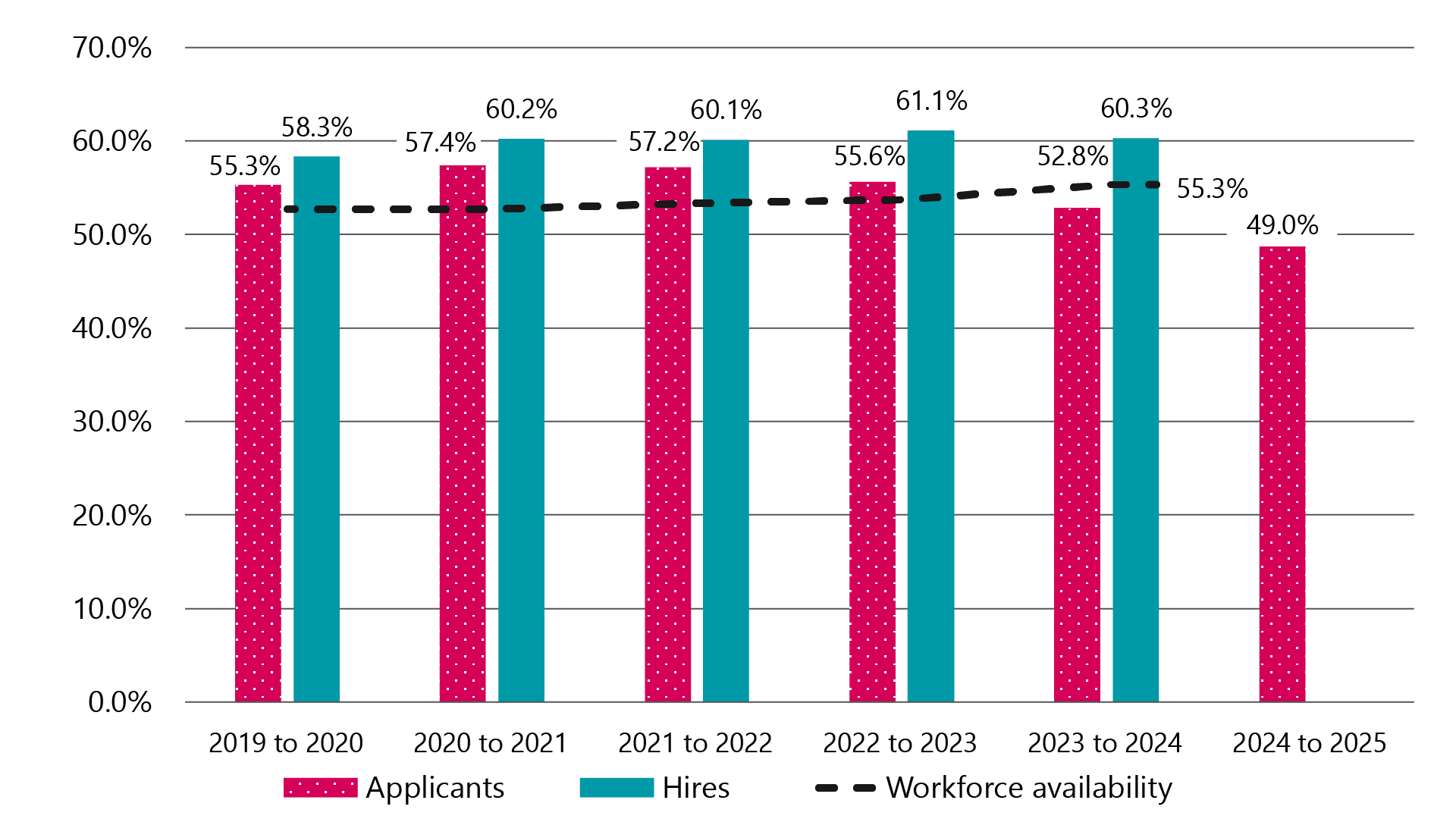
Women: Applicants and hires to external advertised processes, compared to workforce availability, by fiscal year - Alternative text
| Category | 2019 to 2020 | 2020 to 2021 | 2021 to 2022 | 2022 to 2023 | 2023 to 2024 | 2024 to 2025 |
|---|---|---|---|---|---|---|
| Applicants | 55.3% | 57.4% | 57.2% | 55.6% | 52.8% | 49.0% |
| Hires | 58.3% | 60.2% | 60.1% | 61.1% | 60.3% | |
| Workforce availability | 52.7% | 52.7% | 53.3% | 53.7% | 55.3% |
Annex 2: Geographical distribution of public service hires and Public Service Employment Act population
Geographical distribution of:
- hires that happened during fiscal year 2024 to 2025
- the population of people working for the federal public service who were appointed subject to the Public Service Employment Act, as of March 31, 2025
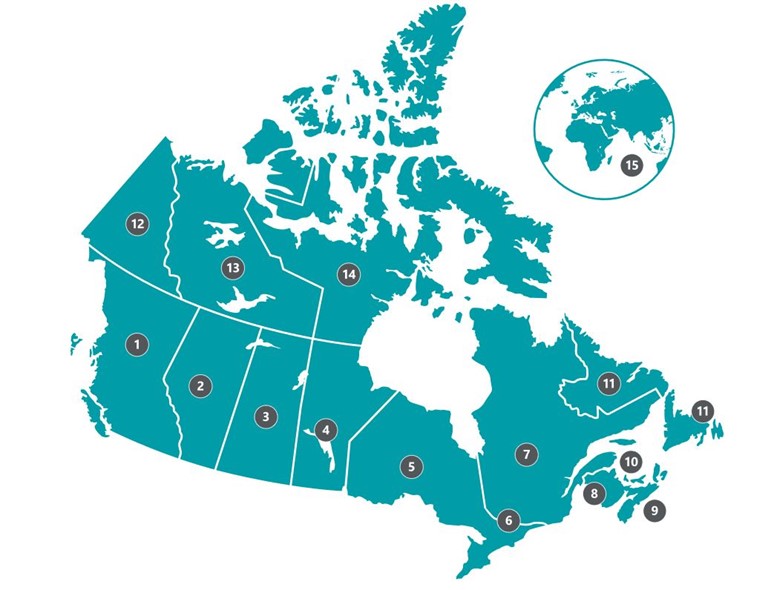
| Regions | Hires | Population as of March 31, 2025 |
|---|---|---|
| 1. British Columbia | 3 684 | 22 133 |
| 2. Alberta | 2 435 | 14 328 |
| 3. Saskatchewan | 944 | 5 617 |
| 4. Manitoba | 1 387 | 8 853 |
| 5. Ontario (except NCR) | 5 954 | 35 057 |
| 6. National Capital Region (NCR) | 23 583 | 130 628 |
| 7. Quebec (except NCR) | 5 011 | 29 934 |
| 8. New Brunswick | 1 722 | 11 623 |
| 9. Nova Scotia | 1 908 | 11 452 |
| 10. Prince Edward Island | 437 | 2 603 |
| 11. Newfoundland and Labrador | 526 | 4 379 |
| 12. Yukon | 86 | 388 |
| 13. Northwest Territories | 113 | 496 |
| 14. Nunavut | 65 | 304 |
| 15. International | 62 | 1 575 |
| Unknown* | 640 | 337 |
* Some hiring records were missing a regional indicator, and for this reason are not included in the breakdown.
Annex 3: Employment equity group non-advertised appointments
Non-advertised appointments in the charts in this annex include external hires, promotions and acting appointments of 4 months or more.
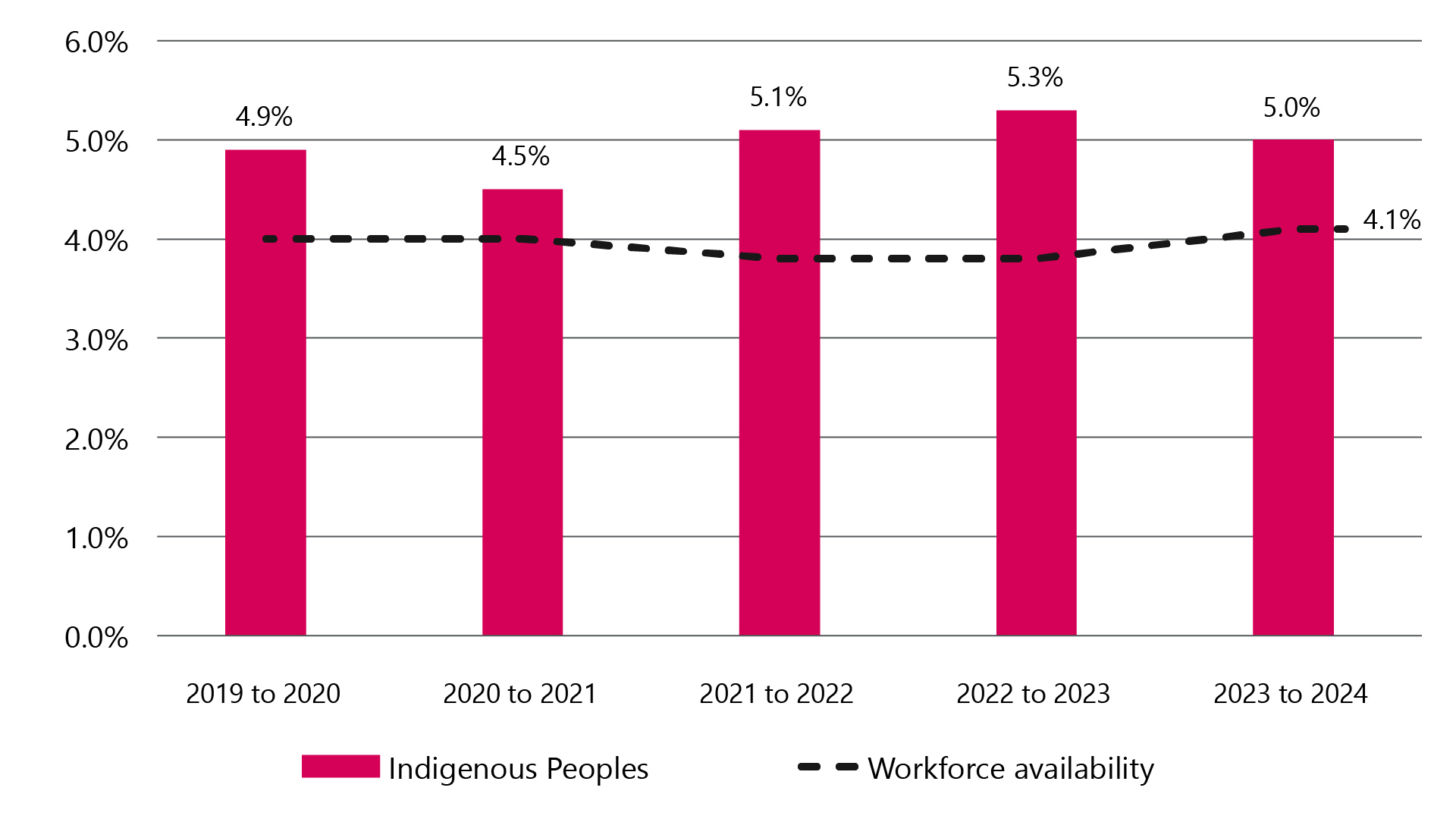
Indigenous Peoples: Share of non-advertised appointments compared to workforce availability, by fiscal year - Alternative text
| Category | 2019 to 2020 | 2020 to 2021 | 2021 to 2022 | 2022 to 2023 | 2023 to 2024 |
|---|---|---|---|---|---|
| Indigenous Peoples | 4.9% | 4.5% | 5.1% | 5.3% | 5.0% |
| Workforce availability | 4.0% | 4.0% | 3.8% | 3.8% | 4.1% |
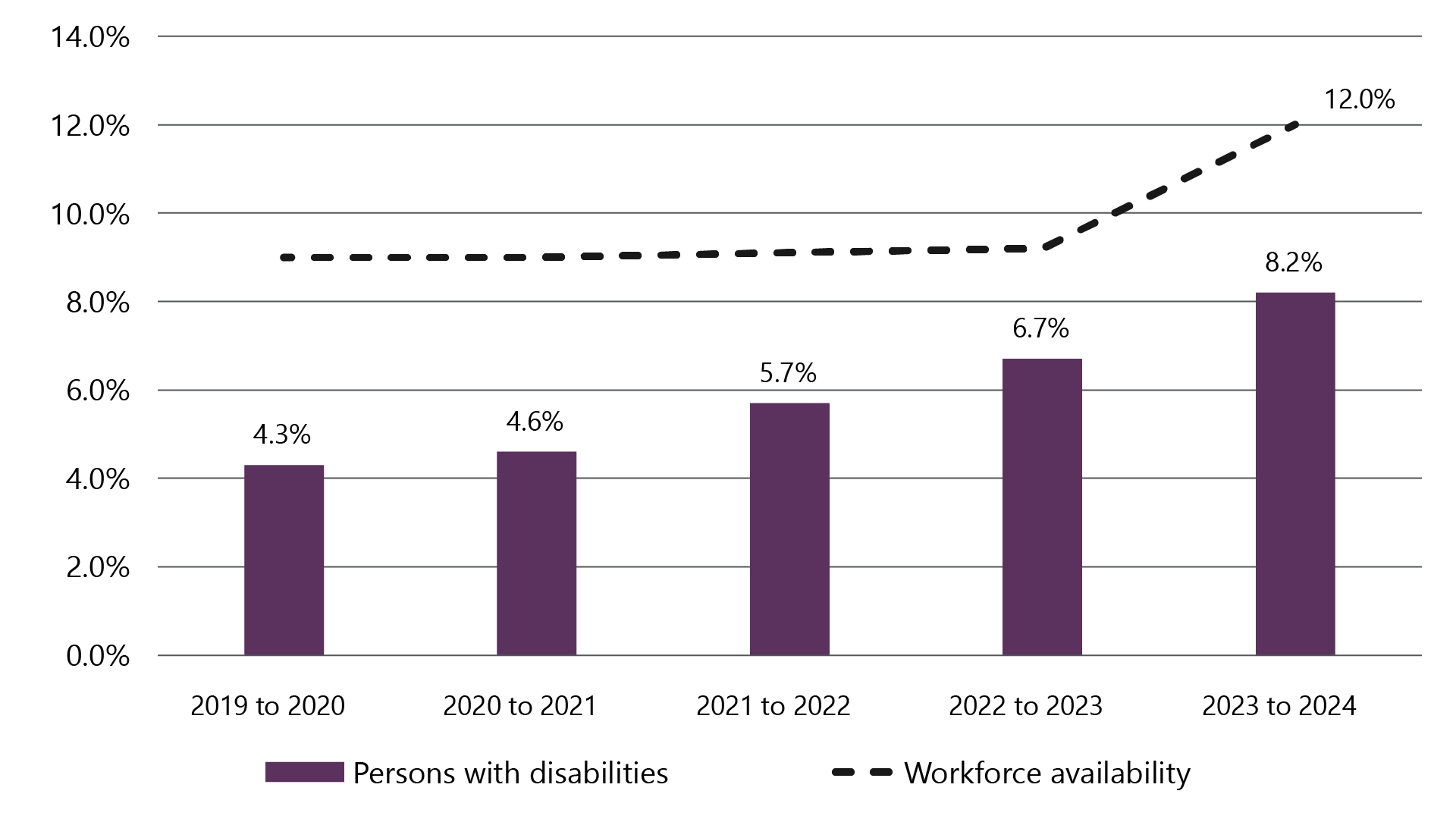
Persons with disabilities: Share of non-advertised appointments compared to workforce availability, by fiscal year - Alternative text
| Category | 2019 to 2020 | 2020 to 2021 | 2021 to 2022 | 2022 to 2023 | 2023 to 2024 |
|---|---|---|---|---|---|
| Persons with disabilities | 4.3% | 4.6% | 5.7% | 6.7% | 8.2% |
| Workforce availability | 9.0% | 9.0% | 9.1% | 9.2% | 12.0% |
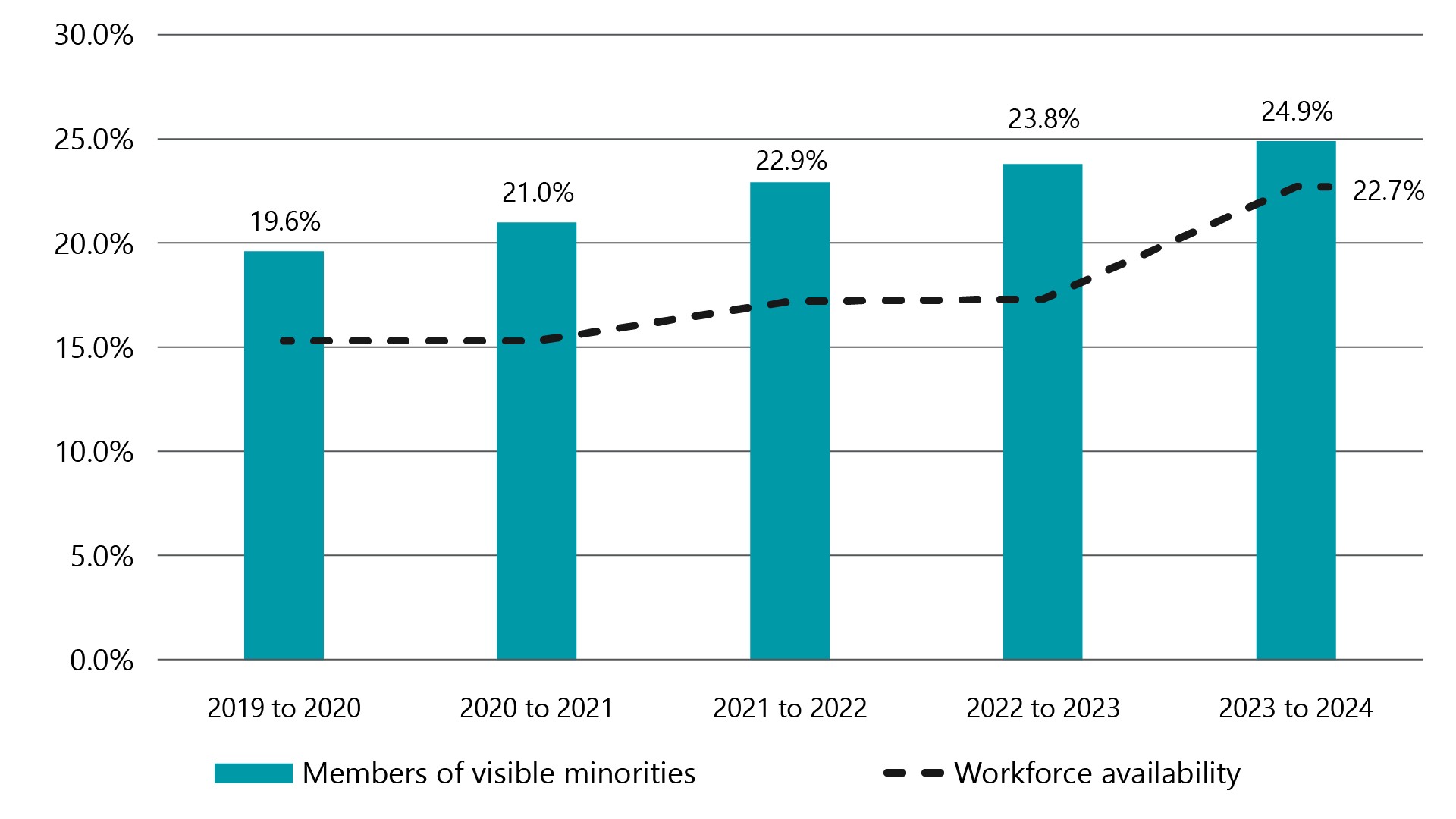
Members of visible minorities: Share of non-advertised appointments compared to workforce availability, by fiscal year - Alternative text
| Category | 2019 to 2020 | 2020 to 2021 | 2021 to 2022 | 2022 to 2023 | 2023 to 2024 |
|---|---|---|---|---|---|
| Members of visible minorities | 19.6% | 21.0% | 22.9% | 23.8% | 24.9% |
| Workforce availability | 15.3% | 15.3% | 17.2% | 17.3% | 22.7% |
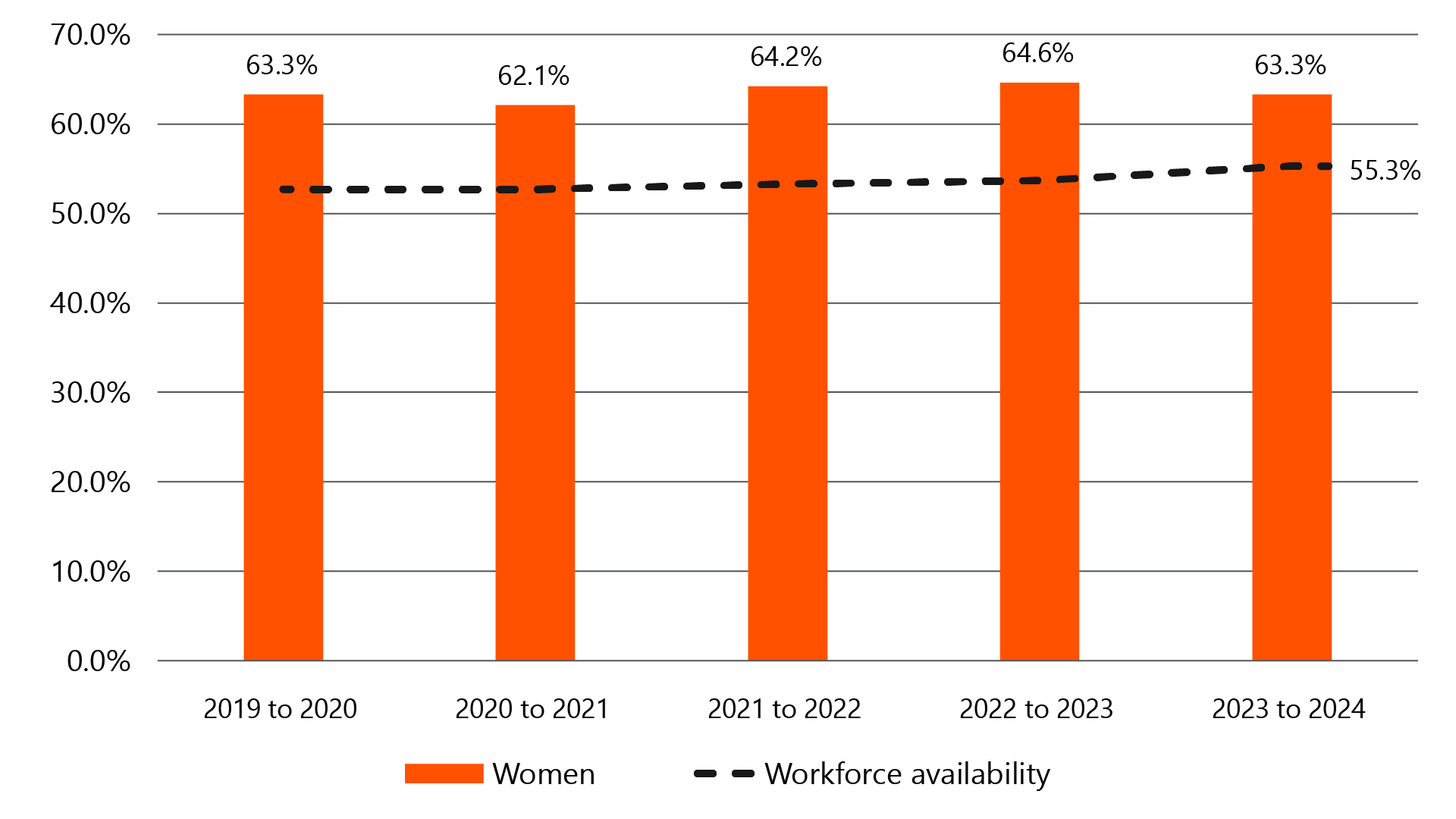
Women: Share of non-advertised appointments compared to workforce availability, by fiscal year - Alternative text
| Category | 2019 to 2020 | 2020 to 2021 | 2021 to 2022 | 2022 to 2023 | 2023 to 2024 |
|---|---|---|---|---|---|
| Women | 63.3% | 62.1% | 64.2% | 64.6% | 63.3% |
| Workforce availability | 52.7% | 52.7% | 53.3% | 53.7% | 55.3% |
Annex 4: Empowering Excellence newsletters
Empowering Excellence
June 2024
Strengthening Official Languages: Audit insight
While our second System-Wide Staffing Audit found high compliance with staffing requirements, departments and agencies need to implement measures to tackle ongoing issues related to official languages obligations in the staffing process and report on their progress to the PSC.
Deep dive into staffing and diversity: the data you need
Where does your organization stand? Explore the Staffing and Non-Partisanship Survey results to help improve your staffing strategies. This year’s survey included new questions assessing perceptions of biases and barriers in staffing processes that affect equity-seeking groups, helping you identify gaps or areas requiring attention.
Making the Federal Student Work Experience Program more agile
We heard you, and we’re innovating. Eight organizations are testing a flexible approach to recruit specific students to the Federal Student Work Experience Program, including students who are:
- members of an employment equity group
- located remotely
- in a specialized field of study
The Specific Name Referral pilot will onboard more organizations this summer, with the goal of full adoption within the next year.
Cutting wait times: second language testing
With the modernized Official Languages Act, we’re boosting capacity to meet increased demand for our oral second language tests. We’re also exploring innovative solutions to address surge demand, including portable departmental tests, a self-serve automated scheduling system, and the use of technology to enhance testing robustness. We believe this will improve user experience and time to staff.
Political activities as a public servant
Thanks to those of you who sent a reminder to all employees about the requirement to seek PSC permission before engaging in candidacy-related activities in any election.
Through onboarding processes and values and ethics discussions, continued engagement with employees on their rights and obligations will help protect our non-partisan public service.
To guide these discussions and help employees make informed decisions about political activities, they can refer to the PSC’s Political Activities Self-Assessment Tool.
This is of particular importance with a federal election on the horizon.
Non-advertised processes: focus on clarity and transparency
While departments and agencies continue to meet policy and legislative requirements when using non-advertised appointment processes, we lack data on how they’re being used.
For this reason, we’re:
- increasing our data on the reasons for non-advertised processes, including tracking those from pools and inventories
- enhancing transparency of non-advertised processes for employees
- reinforcing our guidance to ensure clarity on factors influencing decisions on the choice of advertised versus non-advertised
Empowering Excellence
Fall 2024
Did you know: Conditional offers
Hiring managers can make conditional offers to candidates in a range of circumstances, including on-the-spot hiring at career fairs, or to hire a student awaiting graduation.
See our guidance on conditional offers for considerations and details.
Improving second language testing
We’re working on implementing a self-serve automated test scheduling system by March 31, 2025, to improve efficiency and user experience. In the meantime, we’re drawing on operational improvements and innovation in assessment to improve wait times for oral language testing.
Fall workshops on staffing irregularities
The PSC’s Investigations Directorate is pleased to offer awareness workshops tailored to staffing advisors and managers. Sign up for one of our PSC English Investigations Awareness Sessions (accessible only on the Government of Canada network), and explore ways to prevent, detect and address the most common irregularities, including cheating, favouritism and fraud.
Expanding the Specific Name Referral Pilot
In July we expanded this pilot, which launched in February 2024, to 19 more departments and agencies. We aim to extend it across the public service next year, subject to its continued success. The pilot enables managers to request specific students from the Federal Student Work Experience Program inventory based on one of these 3 criteria:
- hiring a member of an employment equity group
- hiring in a remote location
- hiring for a specialized field
Explore sources for your hiring needs
Planning to recruit? Find skilled and diverse candidates easily by taking advantage of our pools. Consult the GC Hiring Managers Hub, where you’ll find candidates ready for EC, BI, PG, PM and AS roles, and more information on other talent sources and recruitment services. Please note that some of our pools will be closing on November 29, 2024, as we focus on leading programs.
Empowering Excellence
Special Edition 2024
Presenting the Diversity and Inclusion Compass
A new interactive data visualization tool* allows users to explore the progress of departments and agencies in improving the representation and mobility of employment equity group members. This tool provides results you can use to draw comparisons with other federal public service organizations, over a range of time periods.
*Accessible only on the Government of Canada network.
Update on non-advertised appointment analysis
This updated analysis looks at the representation of employment equity groups in advertised and non-advertised appointments from April 1, 2013, to March 31, 2023.
Citizenship of applicants and external appointments
Our report on citizenship and advertised external appointments updates past analyses on trends in applications and appointments of permanent residents and other non-Canadian citizens. It extends the analysis up to March 2023.
2023 survey results: A diversity of views on staffing
Take a deep dive into employment equity groups’ perceptions of the staffing system with our report on results for employment equity groups and equity-seeking groups from the 2023 Staffing and Non-Partisanship Survey. Explore results for your department or agency, including new questions on biases and barriers and additional demographic groups.
Separation trends for employment equity groups
Our updated report on separation trends for employment equity groups analyzes trends for employment equity group members who left the federal public service between April 1, 2022, and March 31, 2023, relative to other public servants.
Representation in acting appointments
Read our Audit of Employment Equity Representation in Acting Appointments to learn about related trends and departmental staffing practices. This audit provides 3 recommendations for improving representation in your workplace so that all public servants can realize their full potential.
© His Majesty the King in Right of Canada, as represented by the President of the Public Service Commission of Canada, 2025.
Cat. No. SC1E-PDF (Electronic PDF, English)
ISSN 1912-0842