
Annual Report on Addressing Wrongdoing and Misconduct, 2024 to 2025
This report provides a clear and transparent overview of cases of misconduct and wrongdoing within the Correctional Service of Canada, as well as the concrete measures implemented to address them and strengthen organizational integrity.
Alternative format

List of acronyms
- CD
- Commissioner's Directive
- CHRC
- Canadian Human Rights Commission
- CHRT
- Canadian Human Rights Tribunal
- CSC
- Correctional Service Canada
- ESDC
- Employment and Social Development Canada
- IT
- Information Technology
- NOO
- notice of occurrence
- OICR
- Office of Informal Conflict Resolution
- OIR
- Office of Integrity Risk
- PSC
- Public Service Commission of Canada
- PSDPA
- Public Servants Disclosure Protection Act
- PSEA
- Public Service Employment Act
- PSIC
- Public Sector Integrity Commissioner
- RFC
- Review for Cause
- TB
- Treasury Board
- TBS
- Treasury Board of Canada Secretariat
Message from the Commissioner
I am pleased to share our first Annual Report on Addressing Wrongdoing and Misconduct for the Correctional Service Canada (CSC). This Report provides a transparent account of the wrongdoing and misconduct at CSC for the 2024 to 2025 fiscal period, and the actions to address them.
As part of the commitment on value and ethics in the public service, the Clerk of the Privy Council tasked government departments to produce a misconduct and wrongdoing disclosure report to advance the dialogue on values and ethics and to continue to uphold the public trust in the integrity of the public service.
As Commissioner, I am committed to adapting and strengthening our culture to foster a safe and respectful environment for both staff and offenders. Addressing misconduct and wrongdoing in a timely and efficient manner directly contributes to our organizational culture by continuing to strengthen a culture of respect, and environments that are free of harassment, discrimination and violence of any kind. As part of my commitment to ensure that our workplaces are diverse, inclusive, and respectful, I commissioned the 2024 Audit of Organizational Culture, and created a dedicated Culture team to identify meaningful actions that directly responds to employee feedback.
Our policies and programs support employee wellness, ensuring all staff can work in a supportive environment. In January 2023, as part of our ongoing efforts to strengthen the well-being of all employees, we set up the Office of the Ombuds for Workplace Well-being. This office is an impartial resource for employees to address workplace issues and find solutions.
Our employees are expected to follow Standards of Professional Conduct that emphasizes our core values: respect, fairness, professionalism, inclusiveness, and accountability. All employees, including managers, are held to the same professional standards and consequences. Breaches of conduct are addressed effectively, regardless of position, to ensure fairness and accountability. Executives, managers and supervisors, however, have special obligations. As leaders, they are expected to set an example by demonstrating high ethical and professional standards in their own conduct. It is also their responsibility to take prompt action to correct misconduct.
Despite our efforts, wrongdoing and misconduct can occur, impacting CSC’s reputation and public trust. It is our responsibility to address these issues promptly and effectively.
Any employee – whether at headquarters, regional offices, or institutions – who witnesses or experiences misconduct or wrongdoing, should report it, regardless of the level of those involved. Employees can trust that complaints and disclosures will be handled with due diligence, assessed, and, if founded, addressed with corrective actions. CSC opposes any form of reprisal and is committed to protecting employees who speak up.
Our public service values serve as "guardrails", guiding us as we serve Canadians. We will continue to strengthen our efforts to prevent misconduct and wrongdoing by educating employees, improving our reporting mechanisms, and ensuring fair disciplinary processes.
I am proud of the more than 18,000 employees of CSC that consistently demonstrate a commitment to personal and professional integrity and professionalism. We all have a role to play to create and maintain a healthy, respectful and inclusive organization that our employees and the public can trust.
Anne Kelly
Commissioner
Introduction
The Annual Disclosure Report on Employee Wrongdoing and Misconduct aims to increase transparency on how wrongdoing and misconduct are addressed at CSC. It presents a summary of the cases of misconduct and wrongdoing deemed founded in 2024 to 2025, the disciplinary measures given and decisions of external bodies over the period.
Departmental Context
CSC plays a crucial role in maintaining public safety across Canada. As the federal agency responsible for managing offenders serving sentences of two years or more, CSC's mission is to help these individuals reintegrate into society as law-abiding citizens. This mission is carried out with a commitment to safety, security, and humane treatment. CSC is a large and complex organization with approximately 18,000 staff members across Canada. Of these, around 13,500 employees are dedicated to front-line roles, including correctional officers, parole officers, and other personnel directly involved in the day-to-day operations of institutions and community supervision.
CSC manages 43 federal institutions, ranging from minimum to maximum security levels, including specialized institutions such as regional treatment centres for offenders with serious mental health conditions and healing lodges for Indigenous offenders. CSC also operates four community correctional centres and 81 parole offices and sub-parole offices across five regions.
Everyone at CSC, both employees and managers, are expected to contribute to a healthy, respectful, and safe workplace that is free from harassment and discrimination. Every employee is expected to uphold our core values: respect, fairness, professionalism, inclusiveness, and accountability. These values are the foundation of our work and guide our interactions with offenders, colleagues, and the public. Our Mission, Values, and Ethics Framework provides a common understanding of CSC’s shared beliefs and expected standards of behavior in achieving its mission.
Addressing Wrongdoing and Misconduct
Understanding Wrongdoing and Misconduct
Misconduct is defined as any action whereby an individual willfully contravenes, an act, a regulation, a rule, a departmental or Treasury Board (TB) policy instrument, an approved procedure, Commissioner’s Directive 060: Code of Discipline, a reasonable and lawful management request, or the Values and Ethics Code for the Public Sector. In short, when an employee contravenes any of the obligations they agree to abide by when becoming an employee of CSC.
Wrongdoing is strictly used to describe incidents addressed under the Public Servants Disclosure Protection Act (PSDPA). As per the PSDPA, wrongdoing is defined as:
- a contravention of any Act of Parliament or of the legislature of a province, or of any regulations made under any such Act, other than a contravention of section 19 of the PSDPA;
- a misuse of public funds or a public asset;
- a gross mismanagement in the public sector;
- an act or omission that creates a substantial and specific danger to the life, health or safety of persons, or to the environment, other than a danger that is inherent in the performance of the duties or functions of a public servant;
- a serious breach of a code of conduct established under section 5 or 6 of the PSDPA; and
- knowingly directing or counselling a person to commit a wrongdoing set out in any of paragraphs (a) to (e).
Ethical Responsibilities and Reporting
Employees have an ethical responsibility to disclose information posing immediate danger to health and safety. Some noteworthy documents that provide directions to employees include:
- Commissioner’s Directive 060 Code of Discipline directs employees to report incidents that could constitute a criminal offence to the police immediately
- Commissioner’s Directive 574 Sexual Coercion and Violence directs employees to report any sexual assault or allegations to the police and management immediately; and
- The Canada Labour Code directs employees to report any event or circumstance concerning the health and safety of employees or people to the employer immediately.
CSC is committed to protecting those who report misconduct. Any employee impacted by misconduct should be able to report it without fear of reprisal and be confident that their report will be addressed promptly and impartially, with appropriate disciplinary or administrative actions taken if misconduct is deemed to have occurred.
Information on reporting misconduct and available support resources can be found in Annex A.
Handling Reports of Wrongdoing and Misconduct
CSC applies a robust framework of departmental policies and Government of Canada guidelines when misconduct is reported or suspected. This includes principles of procedural fairness: expediency, fairness, and transparency. Employees are assured of confidentiality, the opportunity to present information, the right to be heard, and a rationale for decisions.
For misconduct cases, when information is disclosed, CSC completes a fair and objective examination of the evidence and may decide to convene an investigation.
For wrongdoing cases, any disclosure, by a public servant, of information that wrongdoing has been committed, about to be committed or that a public servant has been asked to commit a wrongdoing, may be addressed through the PSDPA. An admissibility analysis determines if an investigation is needed by ensuring the disclosure meets the definition of wrongdoing as per the PSDPA. If the disclosure does not fall within the PSDPA, the information may be addressed through other internal mechanisms.
Measures taken in founded cases of Wrongdoing and Misconduct
If an allegation of wrongdoing or misconduct is found to be substantiated after reviewing the available facts and applying the standard of proof for administrative investigations, CSC is responsible for taking appropriate disciplinary or administrative measures, as per the TB's Guidelines for Discipline. On occasion, both disciplinary and administrative measures may be warranted.
| Disciplinary measures | Administrative measures |
|---|---|
Consideration of aggravating and mitigating circumstances. Formal disciplinary measures to correct behaviours. Progressive severity with repeated misconduct. Severe action possible for serious first offences. Subject to grievances. Measures range from verbal reprimand, written reprimand, suspension without pay, financial penalty, demotion, and termination. |
Application of one or several administrative measures, such as training. Enables to make changes to address a situation. Provide tools to prevent future misconduct. Subject to grievances. Measures may include administrative leave without pay, temporary removal of human resources and/or financial delegation, or other appropriate measures. |
Overview of Wrongdoing and Misconduct
This Report covers investigative processes and founded cases of wrongdoing and misconduct in fiscal year 2024 to 2025.
The founded cases of wrongdoing and misconduct involve CSC employees at all levels including management.
The Government of Canada provides guidance on protecting privacy when releasing information in their Privacy Implementation Notice 2023. If there is a reasonable expectation that individuals can be identified through the information, alone or in combination with other available information, it constitutes personal information. When information is considered personal, it must be protected in accordance with the Privacy Act. Strategies were used in this Report to minimize risk and respect the privacy of CSC employees.
Internal Investigations
Appropriate Use of Electronic Resources Violations
CSC monitors, gathers, and processes electronic information and conducts investigations into the misuse of the department’s electronic network and associated devices. Any finding of potential misuse of CSC’s electronic network and associated devices may be referred to management to determine administrative and/or disciplinary measures, if required.
Every CSC employee must adhere to the TB Guideline on Acceptable Network and Device Use and Commissioner’s Directive 226 Use of Electronic Resources (CD 226) . Violations of TB guidelines and CD 226, including the misuse of Information Technology (IT) resources and networks that may impede departmental operations, disrupt service delivery, or result in data loss, whether intentional or due to negligence, can lead to administrative measures, disciplinary measures or criminal charges.
Inappropriate use of IT credentials
Inappropriate use of IT credentials includes attempting to access data for which the user is not entitled to view, sharing work credentials (passwords), and using access privileges to make changes without permission. When misuse of IT credentials is suspected, CSC resets the credentials, educates the users on proper security practices, and investigate how the credentials could have been compromised. If ill intent is suspected, the issue is escalated as appropriate to management and/or the local police authority.
Total cases: 5 investigations were opened.
Closed cases: 3 were resolved which were not deemed to have ill intent.
Ongoing cases as of March 31, 2025: 1 case of intentional impersonation 1 case of intentional misconduct.
Of the 5 investigations, 3 were reported to management.
Unacceptable activity
Unacceptable activity includes information breaches, suspicious network activity, and inappropriate access to information resources. CSC mitigates unacceptable activity by recalling misdirected emails and reinstalling the operating system and applications on affected computers as required.
Total cases: 72 investigations were opened.
Closed cases: 65 cases were resolved. These include incidents of emails sent to the wrong recipients, incorrect access permissions set, sharing of sensitive information with an unauthorized user, and configuration issues.
None of the cases were referred to management for further review as it was concluded by Cyber and IT Security that there was no ill intent.
Ongoing cases as of March 31, 2025: There are 7 ongoing cases, which include instances of email sent to the wrong recipient and inappropriate site access.
Unauthorized hardware and software
Unauthorized hardware and software include unauthorized installation and use of software, rogue devices, and peripherals.
Total cases: 11 investigations were opened.
Closed cases: 10 investigations were resolved. Resolution included correcting the issue where possible. For example: removing the unauthorized software or hardware or disposing of the device.
Of the 10 closed cases, 6 were reported to management.
Ongoing cases as of March 31, 2025: 1 inappropriate use of software.
Unauthorized travel with government furnished equipment
Unauthorized travel with government furnished equipment includes unauthorized travel outside of Canada with laptops, tablets and/or cellular phones.
Total cases: 43 investigations were opened.
Closed cases: In all instances, all accounts were immediately locked rendering the device inoperative. The employee and the employee’s director (or higher) were informed.
In 2025 to 2026, CSC will implement The Policy on Acceptable Use of CSC Networks and Devices, which further specifies the employee responsibilities, and care and duty of IT resources and systems which will support CSC’s effort to improve cyber and IT security.
Harassment and Violence Notices of Occurrence
In 2021, the Work Place Harassment and Violence Prevention Regulations came into force. This shifted the way work place harassment and violence was managed across the Government of Canada, with a greater emphasis on prevention.
Harassment and violence in the work place is defined as any action, conduct or comment, including of a sexual nature, that can reasonably be expected to cause offence, humiliation or other physical or psychological injury or illness to an employeeFootnote 1 . An employee who believes that they have been harassed, can submit a notice of occurrence (NOO), to report the incident(s).
A NOO can begin in a fiscal year, but can be finalized in the following year, depending, among other things, on when it was received, the complexity of the file, and/or if one of the parties was absent from the work place.
Total NOOs received: 186Footnote 2
Total NOOs resolved: 85 were resolved through alternative means such a negotiated resolution, the use of alternate recourse mechanismsFootnote 3 , or through a workplace assessment.
Outstanding NOOs: 101 are still on-going at various stages of the process.

Long description
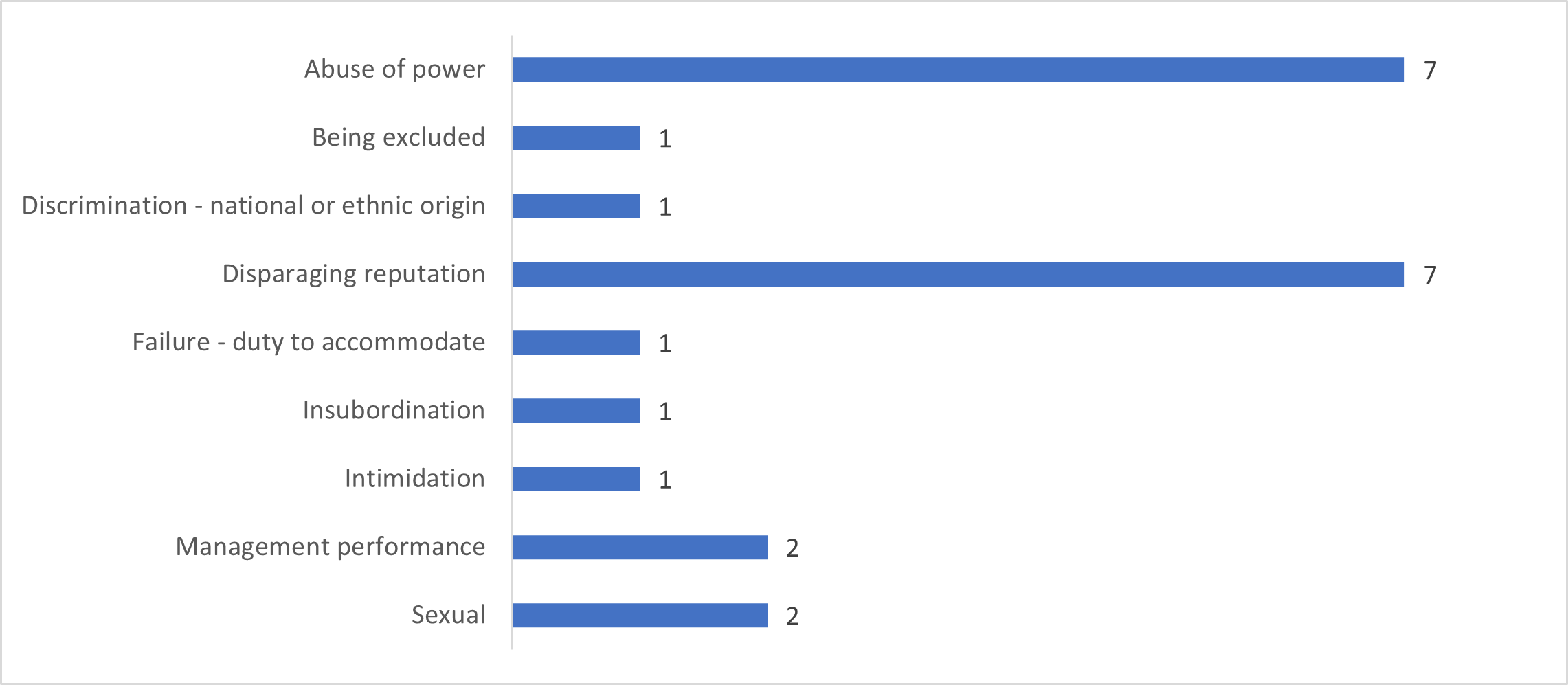
In 2024 to 2025, 67 workplace violence and harassment investigations were completed, which includes investigations commenced in a previous year. Of these, 23 were deemed to have met the definition of harassment while 44 were deemed not to have met the definition of harassment.
Long description
In 2024 to 2025, of cases which met the definition of harassment and violence, 7 were considered abuse of power, 1 was considered exclusion, 1 was considered discrimination, 7 were considered disparaging reputation, 1 was considered a failure related to duty to accommodate, 1 was considered insubordionation, 1 was considered intimidation, 2 were considered management performance and 2 were considered sexual.
Given the preventative nature of the Regulations, recommendations from harassment and violence investigations focus on workplace improvements and measures to prevent similar incidents. It should be noted, however, that employee misconduct involving harassment or violence may be addressed through a separate disciplinary process.
The most common recommendations in investigation reports are categorized into the following themes:
| Communication |
|
|---|---|
| Employee support |
|
| Performance management |
|
| Training and development |
|
Misconduct
CSC employees are responsible for conducting themselves at all times in a way that upholds the public interest and is in keeping with the Values and Ethics Code for the Public Sector and Commissioner’s Directive 060 – Code of Discipline. Each founded incident of employee misconduct is organized into the following categories:
Professional standards of conduct |
Examples of misconduct |
|---|---|
Responsible discharge of duties |
Fraudulently recording or failing to record attendance, being late for duty, being absent from duty, leaving the assigned place of duty without authorization, failing to act or otherwise neglecting duty as a peace officer, excessive use of force, or performing duty in a careless fashion to risk or cause bodily harm. |
Conduct and appearance |
Displaying appearance and/or deportment that is unbecoming of an employee while on duty, being abusive or discourteous by word or action to the public while on duty, acting, while on or off duty, in a manner likely to discredit CSC, consuming alcohol or other intoxicants while on duty, reporting for duty impacted or unfit for duty due to the influence of alcohol or drugs, or sleeping on duty. |
Relationship with other staff members |
Interfering with the work of others, being abusive by word or action to other employees while on duty, committing any act of personal or sexual harassment or discrimination against another staff member, disregarding established safety practices, or fighting with other employees of the CSC or a member of the public while on duty. |
Relationship with offenders |
This may include being abusive by word or action, to an offender or offender’s friends or relatives, entering a personal or business relationship not approved by a supervisor, giving or receiving any gifts, gratuities, benefits, or favours, or engaging in personal business transactions with an offender or ex-offender, or the offender's or ex-offender's friends or relatives. |
Conflict of interest |
Failing to disclose a conflict of interest as it pertains to the Treasury Board Secretariat’s Directive on Conflict of Interest, improperly using title or authority for personal gain or advantage, or improperly using the services of another employee, the property of the CSC, or anything produced by offender labour at any time for activities that have not been officially approved. |
Protection and sharing of information |
Failing to properly safeguard all documents, reports, directives, manuals, or other information of the CSC, neglecting to respect the privacy rights of offenders' and employees' by failing to observe the Privacy Act and the Access to Information Act, committing a breach or violation of the Policy on Government Security, or failing to disclose any information that must be shared. |
Long description
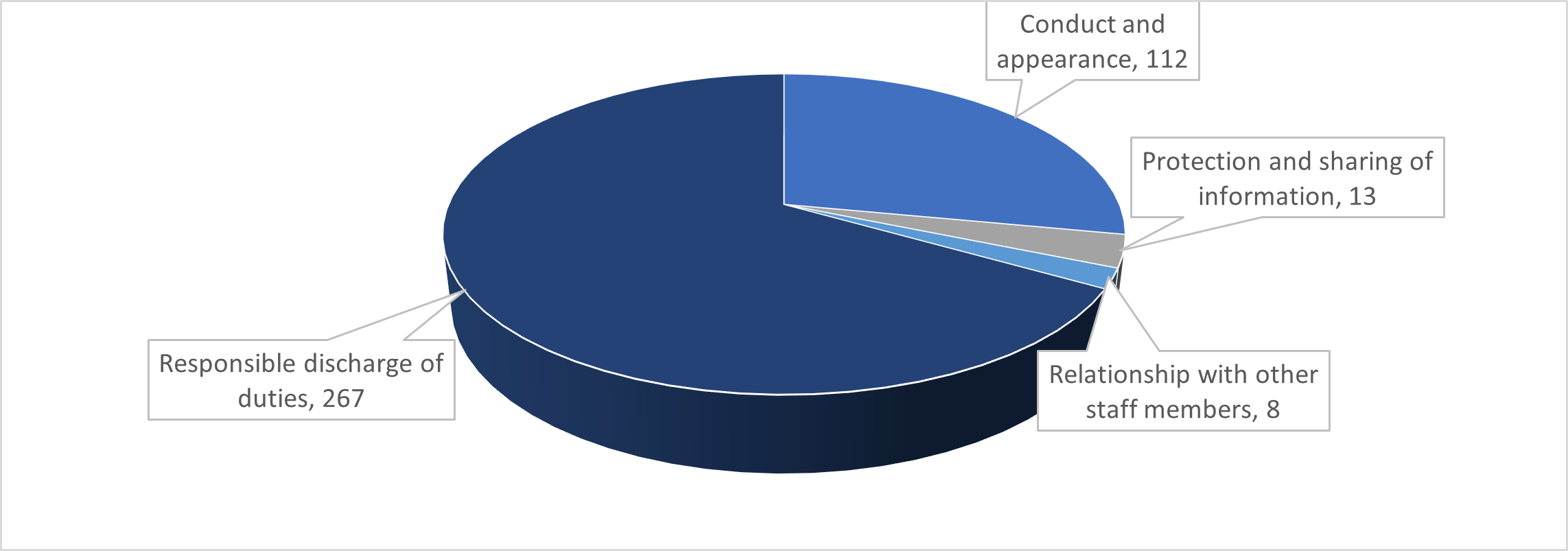
In 2024 to 2025, there were 400 findingsFootnote 4 of misconduct where discipline was receivedFootnote 5 . The breakdown into the Standards of Professional Conduct is as follows. 267 were identified as responsible discharge of duties, one hundred and twelve were identified as conduct and appearance, thirteen were identified as protection and sharing information, and eight were identified as relationship with other staff members.
When misconduct occurs, CSC applies disciplinary measures as outlined in Treasury Board of Canada Secretariat’s (TBS) Guidelines for Discipline by taking into consideration the nature of the misconduct, the circumstances, and all aggravating and mitigating factors. The application of disciplinary measures is to be corrective, rather than punitive, and its purpose is to motivate employees to behave in accordance with the rules and standards of conduct that are desirable or necessary to achieve CSC’s goals and objectives. In certain cases, misconduct does warrant the most severe disciplinary measure, namely termination of employment.
Long description
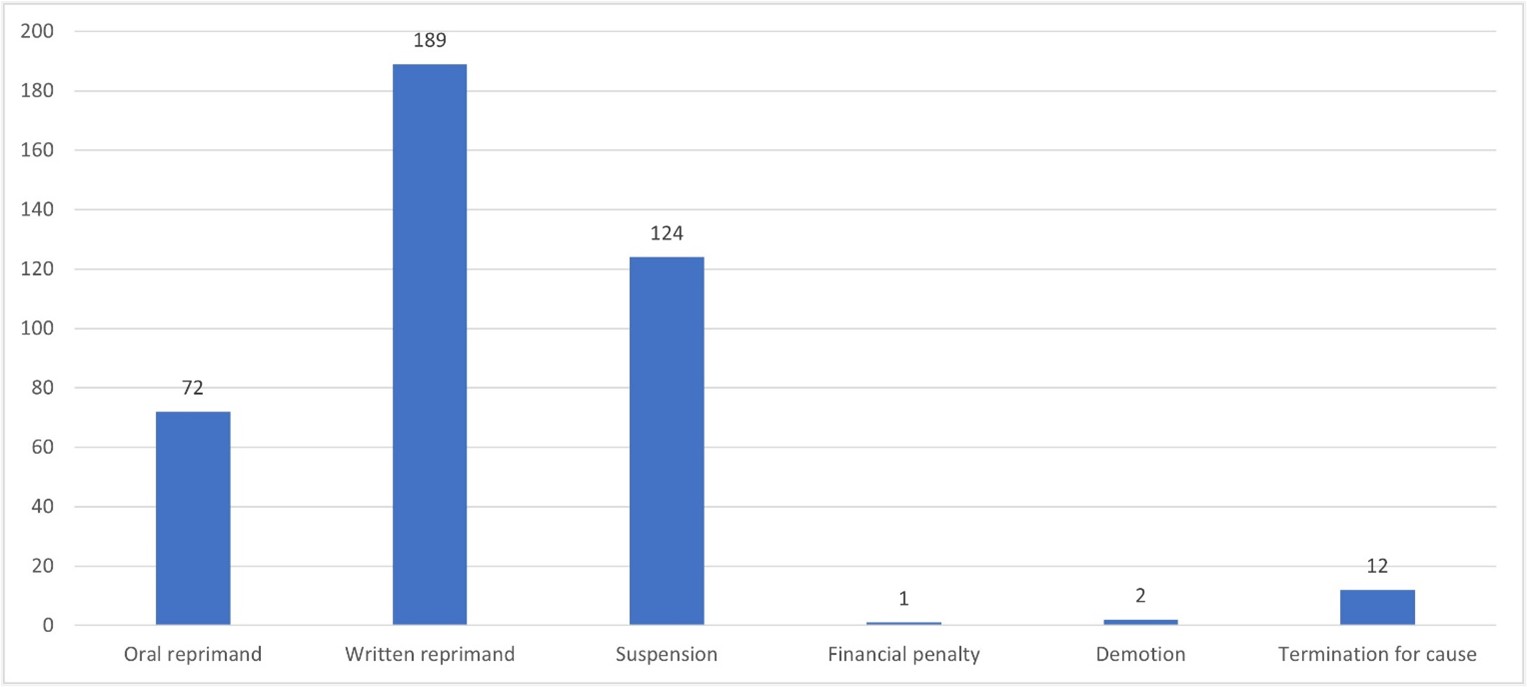
In 2024 to 2025, there were 400 findings of misconduct where discipline was received. The types of discipline received were 72 oral reprimands, one hundred and 189 written reprimands, 124 suspensions without pay, 1 financial penalty, 2 demotions and 12 termination for cause.
The table below presents the type of disciplinary measures received by all employees by category of Professional Standards of Conduct. In accordance with the Privacy Act, small data values have been consolidated to prevent any inadvertent disclosure of employee personal information.
| Professional standard of conduct | Disciplinary measure |
|---|---|
Responsible discharge of duties |
|
Conduct and appearance |
|
Relationship with other staff members |
|
Protection and sharing of information |
|
Suspensions without pay, financial penalties, demotions and terminations are given as disciplinary measures to address the most serious cases of founded misconduct. Below are some examples of the type of misconduct that resulted in a suspension without pay, financial penalty and demotion.
| Misconduct | Examples |
|---|---|
Conduct and appearance |
|
Protection and sharing of information |
|
Relationship with other staff members |
|
Responsible discharge of duties |
|
Termination from CSC is the most severe disciplinary measure givenFootnote 10 . Reasons for terminations included one or more of the causes below:
- Abuse of authority
- Biased participation in a staffing process
- Breach of confidentiality
- Bringing a cellular phone into an institution
- Bringing contraband into an institution
- Engaging in sexual acts in the workplace
- Entering an inappropriate relationship with an offender
- Entering an inappropriate relationship with an offender’s family
- Entering an inappropriate relationship with a subordinate
- Failure to act when an offender was in distress
- Inappropriate conduct while off duty
- Inappropriate touching
- Making offensive comments
- Negligence of duties
- Providing false information to CSC
- Sharing protected information with an offender
Personnel Security Violations
In accordance with the TBS, all individuals with access to government information, assets or facilities must undergo security screening and is a condition of employment within the federal public service. As per the CD 564-1 Individual Security Screening, employees must accurately and truthfully provide personal information and documentation for their security screening. This includes supplementary updates required due to changes in personal circumstances (for example, change in marital status) or more promptly, when convicted of a criminal offence. Additionally, employees are required to report any persistent or unusual contact from individuals, and any behavior or security concerns (for example, alcohol or drug misuse, fraudulent activity).
In 2024 to 2025, the guidelines for security screening activities changed from the TBS Standard on Security Screening to the Directive on Security Screening. Under both policies, an employee’s security status or clearance can be reassessed under an administrative action known as a Review for Cause (RFC) investigation.
An RFC investigation is initiated when new information is uncovered or reported about an individual that may call into question their reliability and/or loyalty to Canada.
Total cases: 5 RFC investigations were opened.
All investigations involved the introduction of contraband into institutions and/or employees having associations with individuals with criminality outside of their professional responsibilities.
Closed cases: 5 were resolved.
Of the 5 cases, 3 employees had their security classification revoked which resulted in termination, in accordance with the Treasury Board Directive on Terms and Conditions of Employment, and 2 administrative cancellations were applied based on resignations before the investigations were completed.
Wrongdoing under the Public Servants Disclosure Protection Act
The Public Servants Disclosure Protection Act (PSDPA) offers federal public sector employees a secure and confidential way to disclose workplace wrongdoing, while also protecting them from reprisal. It is designed to address serious wrongdoing that could undermine public confidence in the integrity of the public service. It is not meant for personal issues like individual harassment complaints or workplace grievances, which should be handled through existing procedures. The PSDPA does not replace other recourse mechanisms available within CSC.
Employees can make an internal protected disclosure of serious wrongdoing to CSC’s Office of Integrity Risk (OIR). These disclosures are assessed to determine whether an investigation is warranted under the PSDPA. If wrongdoing is found at the conclusion of an investigation, CSC must publish a summary describing the wrongdoing and any corrective action taken as part of proactive disclosure.
The OIR received 22 inquiries from employees.
2 of these inquiries resulted in the submission of protected disclosures currently being reviewed. If wrongdoing is established, it will be published.
The remaining twenty (20) employees were informed about the OIR internal investigation and Public Sector Integrity Commissioner (PSIC) reprisal processes, as well as the CSC Fraud Risk Management Framework. They were also made aware of various alternative avenues for recourse. These include internal CSC mechanisms such as CSC Office of Informal Conflict Resolution (OICR), the Office of the Ombuds for Workplace Well-being, the grievance process, and union support. Additionally, external options such as the Canadian Human Rights Commission (CHRC) were suggested. Employees were advised that their information could be reassessed if new information comes to light.
The OIR does not report on investigations or disclosures that have not yet been substantiated, as doing so would be premature. This requirement complies with the PSDPA and ensures that only verified instances of wrongdoing are made public. By adhering to this approach, the OIR maintains the integrity and confidentiality of the process, thereby protecting the identities of all employees involved, as required by law.
Each year, the Chief Human Resources Officer of the Treasury Board of Canada publishes an Annual Report on the Public Servants Disclosure Protection Act. This report provides an overview of disclosure-related activities in federal public sector organizations made in accordance with the internal procedures established under the PSDPA, including CSC.
External Investigations
Various Canadian organizations conduct their own investigations into our department or its employees as part of their mandate. This section provides information regarding the types of investigations these organizations undertook, as well as a summary of any investigations completed concerning the alleged misconduct and wrongdoing at CSC.
Canadian Human Rights Commission
Under the Canadian Human Rights Act (CHRC), an individual or group of individuals may submit a human rights complaint to the CHRC related to any action or decision for which they have reasonable grounds to believe resulted in the unfair or negative treatment of a person under the prohibited grounds of discrimination. The CHRC may refer the complaint to the Canadian Human Rights Tribunal (CHRT) for a hearing to determine if discrimination has occurred.
Total received complaints: CSC received 30 human rights complaints filed by employees with the CHRC.
Closed complaints: 22 were referred to the internal grievance process.
Ongoing complaints: 8 complaints received remain open at different stages of the CHRC process.
Total current ongoing complaints: 31. In addition to the 8 ongoing complaints received in 2024 to 2025, there are 23 complaints carried over from prior fiscal years that are also at different stages of the CHRC or CHRT process.
CHRT decision: The CHRT issued 1 decision that found that CSC failed to adequately accommodate a casual worker’s disability by not actively engaging in ongoing accommodation discussions or adjusting the workload to match reduced working hours.
Employment and Social Development Canada Labour Program
Employment and Social Development Canada’s (ESDC) Labour Program is responsible for promoting and enforcing occupational health and safety standards in federally regulated workplaces by applying the Canada Labour Code, Part II (the Code), to ensure safe and healthy work environments.
Labour Program health and safety officers enforce the Code by conducting workplace inspections, responding to employee complaints, and investigating accidents. They follow a compliance policy to ensure fair and consistent application of the Code in all federally regulated workplaces. As part of enforcement activities, Ministerial Delegates may issue directions. A direction is a formal written order directing the employer or employee to terminate and correct a contravention of the Code within a specified period.
Total directions: CSC received 3 directions under Part II of the Canada Labour Code.
Closed directions: ESDC issued CSC 2 directions to provide information requested by a local CSC Work Place Health and Safety Committee during a complaint investigation related to inmate security classification levels within a Structured Intervention Unit. CSC complied with both directions by providing the requested information.
Ongoing direction: ESDC issued CSC 1 direction to conduct a search for materials from a broken mirror. CSC complied by conducting a frisk search of offenders using a metal detection wand. CSC did not find mirror pieces during the search. CSC is contesting the direction. The Canada Industrial Relations Board will hear the appeal and may uphold, rescind or amend the direction.
Office of the Public Sector Integrity Commissioner
The Office of the Public Sector Integrity Commissioner of Canada is an independent federal organization established to implement the PSDPA. The Office investigates wrongdoing in the federal public sector and helps protect whistleblowers and those who participate in investigations from reprisal. If wrongdoing is found to have occurred, the Public Sector Integrity Commissioner (PSIC) will report the findings to Parliament.
No case report related to CSC on wrongdoing by published by PSIC.
No decision on reprisal by the Public Servants Disclosure Protection Tribunal.
Staffing Investigations Mechanisms Under the Public Service Employment Act
As part of its mandate to oversee the integrity of the staffing system and the political impartiality of the federal public service, the Public Service Commission of Canada (PSC) investigates concerns relating to appointment processes and allegations of improper political activities for organizations that are subject to the Public Service Employment Act (PSEA).
Submitted complaints: PSC received 11 new investigation requests of external or internal appointment processes at CSC. There were 31 active investigations throughout the year, which included outstanding files from previous years.
Closed complaints:
- 8 files were dismissed since the PSC decided not to investigate.
- 3 files were unfounded, after investigation.
- 1 file was founded, after investigation:
- The PSC concluded that an external candidate committed fraud by receiving unauthorized assistance and using unauthorized tools during a virtual exam. As a result, the candidate was eliminated from the selection process. Additionally, for a period of two years, they must notify the PSC in writing before accepting any position or work within the federal public service. The PSC will inform any sub-delegated manager about the investigation before confirming the appointment. If hired within this period, they must complete the "Values and Ethics foundations for employees" course and discuss it with their director within two months of appointment.
Ongoing investigations: 19 investigations are outstanding, which included outstanding investigations from previous years.
Conclusion
The 2024 to 2025 Annual Report on Addressing Wrongdoing and Misconduct marks a significant advancement in our commitment to ethical conduct, accountability, and transparency. It highlights CSC's dedication to thoroughly investigating all allegations of misconduct and wrongdoing, ensuring that any substantiated cases are met with appropriate and timely action. By taking swift and effective action to address misconduct and wrongdoing, we continue to foster trust and uphold the core values that shape our organizational culture. CSC remains dedicated to evolving and strengthening this culture to support the health and wellbeing of its employees, while promoting workplaces that are safe, inclusive, diverse, and respectful.
Through transparency in how CSC address’s misconduct and wrongdoing, we aim to strengthen confidence both within our organization and among the public.
We are dedicated to upholding the highest ethical standards, treating all reports of misconduct and wrongdoing with fairness, diligence and impartiality.
Annex A: Resources for Addressing Misconduct and Wrongdoing
Internal resources
Harassment and Violence Prevention
CSC intranet site: Work place harassment and violence prevention
Email: harcelement-violence-harassmentprevention.gen-nat-prevention@csc-scc.gc.ca
Fraud Risk Management - Office of Integrity Risk
CSC intranet site: Fraud prevention and reporting
Email: gen-nhq.integrity/integrite@csc-scc.gc.ca
Ombuds for Workplace Well-being
CSC intranet site: CSC's Ombuds for Workplace Well-being
Email: ombuds.gen-nat@csc-scc.gc.ca
Toll Free: 1-844-234-3583
Personnel security
CSC intranet site: Reporting personal changes and security concerns
Email: gen-nhq persec persec.gen-nhq@csc-scc.gc.ca
Violation of Use of Electronic Resources and Network Acceptable Use Policy
CSC intranet site: IT security
Email: citsecurity.gen-nhq@csc-scc.gc.ca
Toll Free: 1-877-943-0349
Wrongdoing - Office of Integrity Risk
CSC intranet site: Disclosure of wrongdoing Email: disclosuredivulgation.gen-nhq@csc-scc.gc.ca
For further information on reporting an incident, employees can visit this Intranet page.
External resources
Canadian Human Rights Commission for more information on human rights complaints.
Toll Free: 1-888-214-1090
Employment and Social Development Canada: Occupational Health and Safety
Toll Free: 1-800-641-4049
Office of the Public Sector Integrity Commissioner
Toll free: 1-866-941-6400
Public Service Commission of Canada: Staffing processes
Toll Free: 1-844-533-9202
Support resources
CSC Critical incident stress management
CSC intranet site: Critical incident stress management
Email: mailto:eap-cism@csc-scc.gc.ca
CSC Employee Assistance Program/LifeWorks
Toll free: 1-855-709-2477
CSC Office of Informal Conflict Resolution (OICR)
CSC intranet site: Informal conflict resolution
Email: oicr-bric.gen-nhq@csc-scc.gc.ca
CSC Tip Line
CSC intranet site: CSC Anonymous Tip Line
Email: mailtorespect@csc-scc.gc.ca
Toll Free: 1-866-780-3784
CSC Values and Ethics Office
CSC intranet site: Values and Ethics
Email: valuesandethics/valeursetethique.gen-nhq@csc-scc.gc.ca
Grievances
Grievance rights: Federal Public Sector Labour Relations Regulations
CSC intranet site: Labour relations grievance procedures