
Guide to Applying a Black-Centric Lens to ESDC’s Policies, Programs and Services
Official title: Applying the Black-Centric Lens at Employment and Social Development Canada: A Guide for Equitable Policies, Programs, and Internal and External Services
Published: 2026
On this page
- Introduction
- Understanding anti-Black racism in Canada
- Government of Canada's Commitment to combating systemic racism and addressing equity
- Understanding intersectionality in Black Communities
- Applying the Black-Centric Lens to policies, programs and services
- Applying principles of the Black-Centric Lens to internal corporate processes
- What we have learned from Black public servants and why it matters for our workplace
- Government Response: Taking Action Across Departments
- Human resources processes: Where the Black-Centric Lens must be applied
- Anchoring in government values
- Beyond compliance: Creating a culture of inclusion
- Measuring impact and tracking progress: Making equity real
- Data needs for measuring impact and tracking progress:
- Best practices and what is working across government
- Leadership accountability and champions
- Tailored coaching and career support for Black employees
- Anti-Racism performance objectives in management reviews
- Disaggregated data dashboards and transparent reporting
- Anti-racism and trauma-informed training
- Black employee networks with decision-making influence
- Black-centric enhancements to the Employee Assistance Program
- Final notes
- Annexes
- Annex A: Glossary
- Annex B: Impacts of our history on Black Canadians today - Two case studies on education policy and housing discrimination
- Annex C: Black-Centric Lens Impact Analysis Checklist
- Annex D: Questions to be asked when applying the Black-Centric Lens
- Annex E: Dos and don'ts when applying the Black-Centric Lens
- Annex F: The Anti-Racism Secretariat's continuum on becoming an anti-Racist organization
- Annex G: Additional resources
Introduction
Over the years, the Government of Canada has taken several steps to address systemic barriers faced by racialized and underserved populations. In 2018, Canada became a signatory to the United Nation International Decade for People of African Descent (UNDPAD).
The mandate of Employment and Social Development Canada (ESDC) includes efforts to "build a stronger and more inclusive Canada, to support Canadians in helping them live productive and rewarding lives and improving their quality of life." Under this mandate, ESDC focuses on policy areas that influence key social determinants of well-being by leading critical social supports and services relating to education, skills training, income security, working conditions and childcare funding.
To fulfill ESDC's mandate and align with priorities set by the UNDPAD and the Federal Anti-Racism Secretariat, employees must strengthen their understanding of systemic anti-Black racism in Canada. This includes knowledge of its history, key statistics and lived experiences, as well as the intersecting barriers faced by many Black people, in support of the Gender-based Analysis Plus approach.
To this end, ESDC's Gender-based Analysis Plus Centre of Expertise has developed a Black-Centric Lens.
Purpose of the Black-Centric Lens
The Black-Centric Lens is a practical initiative designed to ensure that policies, programs and services are inclusive and can fully meet the needs of Canada's diverse Black communities, including Black employees. In other words, it seeks to equip employees and executives with knowledge and resources so that they can address the existing disparities facing Black communities in Canada. It encourages public servants at ESDC and beyond to ask: Who is being left out? What barriers still exist? And how can I do better?
The Black-Centric Lens helps in the following five key ways:
Improving all aspects of our Work
The Black-Centric Lens does not apply only to policy or program design. It is a tool that offers guidance to employees and executives on embedding equity into all aspects of our work, from internal business lines such as human resources activities, to program and program design and service delivery to external clients.
Looking at the past to understand the present
Many of Canada's current systems, including education, immigration, housing and employment, have been shaped by policies that excluded or harmed Black people. By recognizing the historical marks of present inequities, government employees can better target interventions to address root causes.
Understanding the historical roots of anti-Black racism and its influence on past policies is critical to developing effective new strategies that address structural inequities and inequalities faced by Black populations in Canada.
Using data to understand inequities
Disaggregated data reveal variances across groups in areas such as income, education and health. The Black-Centric Lens uses data to show the diverse realities within Black communities in Canada-who they are, where they live, the barriers they face and how anti-Black racism affects them across generations. An understanding of disaggregated data can forcefully challenge our assumptions and inform inclusive policies, programs, initiatives and services.
Centring lived experience and building trust
Black communities in Canada have long expressed concerns about how policies are made and how they are left out of those conversations. The Black-Centric Lens encourages public servants to listen to the voices of diverse Black communities. Acknowledging past harms and working in partnership helps build trust that leads to more effective and community-informed solutions.
Recognizing regional realities
Black experiences are not the same across Canada. From the long-standing African Nova Scotian communitiesFootnote 1 to recent immigrants in urban centres, each group has unique needs shaped by geography, language, culture and history. The Black-Centric Lens reinforces that effective policies, services and programs must be tailored to local realities rather than national averages.
Why now?
There are more data than ever before indicating that Black CanadiansFootnote 2 experience unequal outcomes in terms of income, employment, education, housing and health.
Black communities across Canada are calling for long-term, meaningful change rather than short-term fixes. Government departments are being held accountable to lead by example and deliver services that are equitable and inclusive. The Black-Centric Lens helps public servants avoid overlooking or reinforcing racial inequities. It encourages thoughtful, equity-focused decision-making in hiring, developing policies, delivering services and evaluating programs. The Black-Centric Lens helps us do all of this with care, curiosity and a commitment to building a more inclusive Canada.
Understanding anti-Black racism in Canada
Context
What is anti-Black racism?
The term "anti-Black racism" describes discriminatory policies and practices that are rooted in the histories of colonialism and the Transatlantic Slave Trade. Beginning in the early 1500s and lasting until 1888, this unique historical legacy influenced how we understand "race" today by making chattel slavery and the widespread dehumanization of dark-skinned African people part of formal systems and institutions.
Anti-Black racism is distinct from other forms of racism in three key ways:
- First , while many racialized groups face stereotypes, anti-Black racism uniquely operates by both excessively targeting (criminalization, over-surveillance) and erasing (lack of representation, historical exclusion) Black people.
- Second, anti-Black racism is structurally entrenched and persists across multiple systems-including criminal justice, employment, education and housing-specifically targeting Black communities in ways that differ from broader racial discrimination.
- Third, anti-Black racism is global and exists across different societies, even in places where Black people are a small minority or are historically absent.
History of the African enslavement system in Canada
Black enslavement through the transatlantic slave trade was actively practised in Canada during the periods of French and British colonialism.Footnote 3 Colonialists in Canada used unpaid labour from enslaved people to advance their individual and collective wealth.
The number of enslaved people is estimated at between 1,200 and 2,000 in the Maritimes (New Brunswick, Nova Scotia and Prince Edward Island), about 300 in Lower Canada (Quebec) and between 500 and 700 in Upper Canada (Ontario). The number of people enslaved by a given individual is estimated to have ranged from 5 to 60.
While these numbers do not match the scale of slavery in the United States, Black exploitation and subjugation were inherent in the system of slavery in Canada, as in the rest of the world. The Canadian climate did not allow plantations to exist, meaning that large groups of enslaved people were not economically viable. However, the treatment of enslaved people remained the same as in other countries-the forced destruction of spiritual and cultural identities, as well as widespread physical, psychological and sexual violence.
It is important to understand that the goal of enslavement in Canada was about using unpaid labour to advance the economic individual and the colonialist collective wealth. Canadians who enslaved Black people-including men, women and children-came from all walks of life. They were government and military officials, disbanded soldiers, Loyalists, merchants, fur traders, tavern and hotel keepers, millers, tradesmen, bishops, priests and nuns. Print advertising was regularly used to buy and sell enslaved people.Footnote 4
The Slavery Abolition Act (1833), passed by the British Parliament, freed enslaved people across the British Empire, including Canada. On August 1, 1834, slavery was officially abolished in all British territories, including Canadian provinces.
The impact of Canada's history of slavery on Black Canadians Today
"History is not about the past; it is about arguments we have about the past. And because it is about arguments that we have, it is about us."
The legacy of slavery has created and sustained economic inequality, systemic anti-Black racism, and institutional barriers that continue to affect Black Canadians in key tangible ways.
| Barriers | Challenges |
|---|---|
| Economic inequality & the racial wealth gap | Enslaved Black people in Canada were denied wages, land ownership, and economic opportunities, leading to an intergenerational wealth gap. After slavery ended in 1834, Black Canadians were continually excluded from land grants, skilled trades, and business opportunities available to white settlers. Today, Black Canadians continue to face:
|
| Anti-Black racism in policing and justice | Enslaved and free Black people in Canada were historically heavily policed, criminalized, and excluded from legal rights and recognition as people.Footnote 6 After slavery ended, Canada's legal system continued to discriminate against Black people. Today, Black Canadians continue to face the following:
|
| Educational disparities and exclusion of Black history | Beginning in the 18th century, Black people were denied equal access to education, reinforcing inequality across generations. Even after slavery ended, Black students in Canada faced segregated, inferior schools, and were excluded from higher education.Footnote 7 Today's challenges include the following:
|
| Health disparities and medical racism | During slavery, Black people were subjected to forced medical experimentation and denied proper healthcare. After slavery was abolished, Black communities continued to face systemic neglect and be excluded from health services. Today, the following disparities persist:
|
Please consult Annex B: Impacts of our history on Black Canadians today - Two case studies on education policy and housing discrimination to better understand the historical and ongoing impacts of anti-Black racism in Canada.
Government of Canada's Commitment to combating systemic racism and addressing equity
Legislative frameworks and federal commitments
Over the years, the Government of Canada has taken several steps over the years to address systemic barriers faced by racialized people and to consult with them on its policies, programs and services.
The Government of Canada has a clear constitutional and international legal obligation to combat systemic racism, based on both section 15 of the Canadian Charter of Rights and Freedoms (Charter) signed in 1982, and its ratification of the International Convention on the Elimination of All Forms of Racial Discrimination (ICERD).
- Section 15(2) of the Charter explicitly affirms that governments can and should implement special programs to improve the conditions of disadvantaged groups. As such, the Charter not only protects against discriminatory laws or actions but also encourages and protects proactive measures to reduce inequality.
- Systemic racism, which results in persistent disparities for racialized communities-particularly Black people and Indigenous Peoples-triggers this responsibility. Systemic racism, which results in persistent disparities for racialized communities-particularly Black people and Indigenous Peoples-triggers this responsibility. The government must actively identify, prevent and remove systemic barriers and unequal outcomes, which goes beyond merely responding to individual instances of overt racism. This is the legal principle of substantive equality.
Additionally, Canada ratified the ICERD in 1970, making it legally bound under international law to eliminate racial discrimination "in all its forms." This includes reviewing laws, policies and practices, and amending or rescinding those that create or perpetuate discrimination. Articles 1(4) and 2(2) allow for and encourage "special measures" (equity-focused programs and affirmative action) to ensure equality for marginalized racial groups, particularly where structural or systemic inequalities exist.
- The ICERD has been cited by United Nations bodies and Canadian courts as a key instrument reinforcing Canada's duty to take positive, sustained action to address systemic racism-not just individual acts.
In 2018, Canada became a signatory to the United Nation's International Decade for People of African Descent and continues to invest significantly in the government-wide Anti-Racism Strategy, Changing Systems, Transforming Lives: Canada's Anti-Racism Strategy 2024-2028, led by ESDC. The federal government has recognized that efforts to address societal systemic racism must begin within the public service.
In 2019, the federal government released Building a Foundation for Change: Canada's Anti-Racism Strategy 2019-2022, which provided the mandate for the Federal Anti-Racism Secretariat tasked with leading a whole-of-government approach in addressing racism.
In 2021, the Clerk of the Privy Council's Call to Action on Anti-Racism, Equity, and Inclusion in the Federal Public Service (Call to Action) called on all public service leaders to recognize and combat systemic racism and "invest in developing inclusive leadership skills and in establishing a sense of belonging and trust for all public servants…regardless of race, ethnicity, sex, age, disability, sexual orientation or gender expression" to build a diverse public service.
The Call to Action directed all Public Service leaders to:
- Appoint Indigenous employees and Black and other racialized employees to and within the Executive Group through career development and talent management
- Sponsor high-potential Indigenous employees and Black and other racialized employees to prepare them for leadership roles
- Support the participation of Indigenous employees and Black and other racialized employees in leadership development programs (for example, the Executive Leadership Development Program) and career development services (for example, official language training)
- Recruit highly qualified candidates from Indigenous communities and Black and other racialized communities from across all regions of Canada
In February 2024, the Government of Canada issued a press release extending its commitment to the UNDPAD until 2028 and signalling that efforts will continue to support Black Canadian populations. That year, the federal government also released Changing Systems, Transforming Lives: Canada's Anti-Racism Strategy 2024-2028 to "tackle systemic racism by removing barriers and making systems more inclusive-especially for marginalized communities."
Equity in practice: The Canadian Charter of Rights and Freedoms
As detailed earlier in this document, past policies and practices have shaped present-day assumptions, perceptions, attitudes and practices at both the interpersonal and systemic levels about who deserves to participate fully and equally in Canadian society.
The need to address the associated policies and practices that have placed Black populations in precarious positions is recognized within Canadian legal codes and legislation such as the Charter and the Employment Equity Act (EEA).
The Charter is the legal foundation for equality, justice and non-discrimination in Canada. It guarantees fundamental rights that protect all Canadians, including Black communities, from systemic discrimination, government overreach and unequal treatment.
- Understanding the Charter is essential for designing policies that uphold racial justice, dismantle anti-Black racism and ensure equity for Black Canadians. Specifically, the Charter supports policies that actively correct racial inequalities, rather than assuming that all groups start from the same position or treating all people the same.
- Additionally, the Charter includes constitutional protection for any equal-opportunity policy or program that "has as its object the amelioration of conditions of disadvantaged individuals or groups including those that are disadvantaged because of race, national or ethnic origin, colour, religion, sex, age or mental or physical disability."
- This language was included to address concerns that judicial interpretations of section 15 on equality rights may be used to render affirmative-action programs unconstitutional. Rather, courts recognize that systemic discrimination exists, allowing for race-conscious policies like employment equity and affirmative action.Footnote 8 In essence, the Charter acknowledges that disadvantaged groups require targeted supports that must always be constitutionally protected.
In line with the Charter, the EEA (established in 1986 and revised in 1995) demands that working conditions are free of barriers, corrects the conditions of disadvantage in employment, and promotes the principle that employment equity requires special measures and the accommodation of differences for the four designated groups in Canada: Women, Indigenous Peoples, persons with disabilities, and members of visible minorities.
- The EEA was an attempt to demonstrate the historical evolution of inequality in Canada. It remains one of the many efforts made to address inequalities faced by racialized groups. However, many concerns have been raised about the ineffective use of the term "visible minorities." In 2017, the United Nations Committee on the Elimination of Racial Discrimination reiterated "its concern about the continued use of the term 'visible minority' in the State party [Canada] to describe minority groups, as it renders invisible the differences in the lived experiences of diverse communities."
- In July 2021, the federal government established a task force to review the EEA. It was mandated to consult stakeholders and diverse communities on employment equity issues, as well as review the EEA and its supporting programs.
- In December 2023, the task force released a report indicating a series of commitments to modernize the EEA, which included creating two new designated groups under the EEA: Black people and 2SLGBTQIA+ people.
Together, the Charter and EEA serve as tools for racial justice. Policies that fail to consider the Charter and EEA risk being weak, unconstitutional or ineffective in dismantling systemic anti-Black racism.
Definition of key concepts
Equality and equity - What do they mean and what is the difference?
The distinctions between equality and equity can be confusing because the terms are related in many ways. Both have been examined in depth, especially in legal human rights contexts. To better advance inclusion at all levels of society, equality should be understood as an aspiration to achieve equal outcomes for all, and equity as a means to making it happen. Furthermore, it is critical that policymakers understand the differences between formal equality and substantive equality.
Formal equality
Formal equality means ensuring that all individuals receive the same minimal level of access, rights and opportunities, regardless of their background, identity or group affiliation. Formal equality implies a uniform approach, where everyone is treated the same without necessarily accounting for individual or group differences.
Substantive equality
Unlike formal equality, substantive equality recognizes aspects of differences, identifies inequalities and aims for true equality in outcomes. It also recognizes that formal equality can be discriminatory in practice.
In terms of race, substantive equality focuses on achieving true equality in outcomes by recognizing that not all people start from the same position based on race. It aims to address inequalities due to individual circumstances, ensuring that everyone has full access to opportunities and equitable outcomes. Again, this concept is rooted in legal and constitutional principles such as the Charter and the Canadian Human Rights Act.
Equity
Distinct from formal equality, equity is about the processes and measures used to achieve substantive equality. It refers to fairness in practices and outcomes, focusing on eliminating systemic barriers that prevent equitable opportunities for all groups, particularly those that are historically disadvantaged. The goal is to ensure that all individuals, regardless of their background, identity or group affiliation, have fair access to opportunities, resources and support to live productive and rewarding lives. This is different from treating everyone the same.
In Canada, the terms equity and substantive equality are closely related and are often used interchangeably. Both concepts challenge the idea that treating everyone the same (formal equality) is fair, emphasizing instead the importance of context-sensitive responses to inequality. Equity is the means, and substantive equality is the goal.
Understanding intersectionality in Black Communities
What is intersectionality?
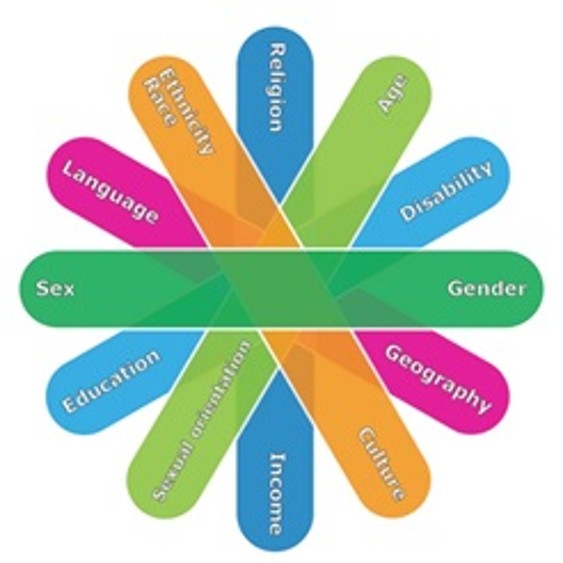
Text version of Intersectionality image
This figure illustrates some of the factors which can intersect with sex and gender. Six oblong shapes of differing colors overlap and fan out. Each oblong has two identity factors written on it. The top oblong has "sex and gender" written in a larger font. Starting below sex and gender and going clockwise, the additional identities identified are: geography, culture, income, sexual orientation, education, language, race, ethnicity, religion, age and disability.
Intersectionality is a framework for understanding how people's experiences are shaped by multiple overlapping factors such as race, gender, disability, language and immigration status. These factors do not operate in isolation. Rather, they interact in complex ways-with one another and with broader social contexts-to shape how individuals are treated and how they experience policies, programs and services (See Annex A: Glossary for more information).
Why Intersectionality is important
As public servants, our work affects many different communities. Applying an intersectional approach, particularly with Black communities, helps us:
- recognize their lived experiences;
- assess the potential positive or negative impacts of policies, programs and services based on multiple factors; and
- identify potential risks, challenges and mitigation strategies at an early stage.
This approach also helps public servants to include more perspectives in planning, service delivery and decision-making, to create policies and services that better reflect real needs, and to support innovation by challenging assumptions.
Understanding intersectionality within Black Communities
Black communities in Canada are not a single, homogeneous group. Individuals hold diverse identities that shape their daily lives, experiences of discrimination, access to opportunities and interactions with government initiatives. Recognizing the intersection of multiple identities enables us to see individuals as whole people, rather than reducing them to one label at a time. Canada's Black communities are made up of diverse groups of individuals, each with distinct lived realities, as illustrated in the following non-exhaustive examples:
- A Black immigrant man with a disability may face racism, ableism, and xenophobia at the same time. These factors interact and influence how he navigates systems and services.
- A Black 2SLGBTQIA+ person may experience both anti-Black racism and homophobia or transphobia, which can affect their safety, access to housing, mental health care, and community belonging.
- A Black Indigenous (Afro-Indigenous) individual may face layered forms of racism, rooted in both anti-Blackness and anti-Indigenous colonial systems often invisible within programs that are not designed using intersectional lenses.
- A young Black woman, especially if she is navigating school or entering the workforce, may face ageism, sexism, and anti-Black racism. These overlapping challenges can limit access to opportunities, representation, and support.
- An older Black Francophone Muslim woman, who may also be a caregiver or community leader, may face gendered racism, ageism and religious discrimination. If she lives in a predominantly English-speaking area, she may also face language barriers that make it harder to access services or participate fully in her community. At the same time, she may carry the responsibility of supporting others in systems that often overlook or undervalue her contributions.
Intersectionality helps us understand that broad identity categories do not exist in isolation. It supports public servants in recognizing these diverse experiences not as exceptions but as key realities that must inform the design and delivery of inclusive programs and services.
Where to start
Public servants are encouraged to use the Intersectionality Job Aid from Women and Gender Equality Canada. It provides practical guidance to help include intersectionality at every stage of an initiative, from design to implementation.
Also, take the time to explore the resources included in the Black-Centric Lens (Annex G: Additional resources). Use them to reflect, ask questions and be open to having your thinking challenged. Growth happens when we lean into discomfort with curiosity and care.
Applying the Black-Centric Lens to policies, programs and services
Understanding Black population demographics and socioeconomic profile
The Black population has contributed to Canada's heritage since the arrival of Mathieu Da Costa, an Afro-French navigator and interpreter for Pierre Dugua de Mons and Samuel de Champlain whose presence in Canada dates back to the early 1600s.
Black people in Canada have diverse backgrounds and experiences. Many have immigrated in recent decades, while others have family roots tracing 10 generations or more. Black people have contributed in many ways to Canada's growth, diversity and development.
The trends identified as follows are based on census data from 2016 and 2021, as published in the following Statistics Canada reports: Diversity of the Black population in Canada: An overview and The Diversity of the Black Populations in Canada, 2021: A Sociodemographic Portrait. These trends are not exhaustive but have remained consistent throughout the years of data collection.
The 2021 census data present new information as well as support the 2016 census data. These data combined provide reliable statistics for this document.
Policies, programs and services must be grounded in accurate demographic and sociographic data about Black Canadians to effectively address their specific needs, challenges and opportunities. These realities must be understood to ensure that policies are effective and equitable and reflect the diversity and evolving experiences of Black communities across Canada.
Trend #1: Size, ethnicity and native countries of Black people living in Canada
Size: There were approximately 1.54 million Black people living in Canada in 2021, representing 4.3% of the Canadian population. Among them, 50.9% were immigrants, 40.9% were born in Canada, and 7% were non-permanent residents.
Ethnicity: Black people reported approximately 371 different ethnic or cultural origins in 2021. This was the largest number of ethnic or cultural origins reported among all racialized groups, highlighting the importance of recognizing the diversity among Black communities in Canada.
Native countries: In 2016, African-born Black Canadians surpassed Caribbean-born Black Canadians to become the second-largest group based on place of birth. In 2021, the Black populations in Canada were born in over 180 different countries. Jamaica and Haiti were the top countries of birth for Caribbean-born Black Canadians, while Nigeria, Ethiopia and the Democratic Republic of the Congo were the most common for African-born Black Canadians.
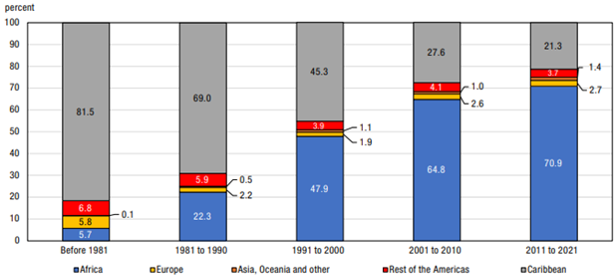
Text version of Figure 1
| Place of birth | Period of immigration | ||||
|---|---|---|---|---|---|
| Before 1981 (%) | 1981 to 1990 (%) | 1991 to 2000 (%) | 2001 to 2010 (%) | 2011 to 2021 (%) | |
| Africa | 5.7 | 22.3 | 47.9 | 64.8 | 70.9 |
| Europe | 5.8 | 2.2 | 1.9 | 2.6 | 2.7 |
| Asia, Oceania and other | 0.1 | 0.5 | 1.1 | 1.0 | 1.4 |
| Rest of the Americas | 6.8 | 5.9 | 3.9 | 4.1 | 3.7 |
| Caribbean | 81.5 | 69.0 | 45.3 | 27.6 | 21.3 |
- Note: In the 2021 Census of Population, data on the year of immigration are available for immigrants who were admitted to Canada on or before May 11, 2021.
- Source: Statistics Canada, Census of Population, 2021.
Trend #2: Gateways to immigration of the Black population to Canada
The present-day composition of Black people in Canada reflects successive periods of Black immigration to Canada starting in the 1960s, a trend that continues today. In 2021, one-half (50.9%) of Black people in Canada were immigrants.
The largest share of Black Caribbean immigrants (42.5%) migrated to Canada between 1960 and 1990, while over half (54.8%) of Black immigrants from Africa came to Canada more recently (between 2011 and 2021). It is important to recognize immigration status when considering the intersecting barriers and needs of diverse Black communities in Canada.
Trend #3: Geographic diversity of the Black populations
Ontario has the largest Black population in Canada: In 2021, Ontario was home to nearly half (49.7%) of the total Black population in Canada, followed by Quebec (27.3%), Alberta (11.6%), and British Columbia (4%).
| Region | Number | Percentage |
|---|---|---|
| Ontario | 768 740 | 49.66 |
| Quebec | 422 405 | 27.29 |
| Nova Scotia | 28 220 | 1.82 |
| New Brunswick | 12 155 | 0.79 |
| Manitoba | 46 485 | 3.00 |
| Saskatchewan | 22 575 | 1.46 |
| Alberta | 177 945 | 11.55 |
| British Columbia | 61 755 | 3.99 |
| Newfoundland and Labrador | 3 590 | 0.23 |
| Prince Edward Island | 1 815 | 0.11 |
| Yukon | 560 | 0.04 |
| Northwest Territories | 1 060 | 0.08 |
| Nunavut | 565 | 0.04 |
| Total | 1 547 865 | 100 |
- The majority of Black people in Canada live in urban areas: 97.8% of Black Canadians live in census metropolitan areas and 2.2% reside in rural areas, according to 2021 data.
- Toronto is home to 36.9% of Canada's Black population, the largest representation in the country. Black people make up 7.5% of Toronto's total population, the highest proportion among census metropolitan areas.
- Montreal and Ottawa-Gatineau have the second- and third-highest proportions.
- It is essential to acknowledge how regional characteristics shape the unique barriers and needs of diverse Black communities, and to ensure that groups from less populous regions are not overlooked simply because they represent a smaller share of the overall Black population.
| CMA | Percentage of Black Population |
|---|---|
| Toronto | 7.5 |
| Montreal | 6.8 |
| Ottawa-Gatineau | 6.0 |
| Oshawa | 5.7 |
| Edmonton | 4.5 |
| Calgary | 3.9 |
| Halifax | 3.8 |
Black communities in Nova Scotia have deeper historical roots than anywhere else in Canada: 59.5% of Black people in Nova Scotia are third generation or more, underscoring a long-standing presence that dates back to the 18th century.
Trend #4: Canada's Black population is growing and is young
In 2021, Canada's Black population reached 1,547,870 people, representing 4.3% of the total population. Data trends indicate that growth is likely to continue, up to 5% of the total population by 2036.
Black Canadians are among the youngest people in Canada:
- In 2021, the Black population was notably young, with a median age of 30.2 years, compared with 41.2 years for the total population in Canada.
- Nearly three-quarters (72.8%) of the Black population was younger than 45, while over half of Canada's total population (54.9%) was in that age group.
- Black people born in Canada were also younger than Black Canadians born abroad.
- Age is another critical factor to consider when examining the barriers and needs of diverse Black communities.
Trend #5: Linguistic diversity of the Black population
Official languages: Almost three-quarters of Black Canadians report English or French as their only mother tongue: this includes 54% who report English as their only mother tongue and 18.1% who report French.
The trend across generations shows that the use of official languages as mother tongue increased, while non-official languages declined. For example, among Black populations in Canada, English as a mother tongue more than doubled from the first to third generation, while non-official languages as a mother tongue dropped over a hundred-fold.
Mother tongue: 20.7% of the Black population reported a non-official language as their mother tongue in 2021, while 7.2% reported multiple mother tongues. The most common non-official language mother tongues reported were Afro-Asiatic languages (e.g., Somali), Niger-Congo languages (e.g., Yoruba) and Creole languages (e.g., Haitian Creole).
Trend #6: Educational attainment of Black populations
Education is highest among Black Canadians born in Africa and lowest among those born in Canada: Among Canadians aged 25 to 54, Canadian‑born Black people are just as likely as non‑racialized people to have a bachelor's degree or higher (29% versus 28%).
Across all age groups, African-origin Black Canadians were the most likely to have a bachelor's degree or higher, at 46%, compared with 27% of Caribbean-origin Black Canadians and 16% among Black people born in Canada.
The educational attainment of Canadian-born Black people differs considerably across groups:Footnote 9
- Compared with people born in Canada, both Black and non-racialized second-generation Canadians tend to have higher educational attainment: The proportion of Black people with a bachelor's degree or higher in 2021 (32.4%) was similar to the national average (32.9%). Educational attainment was highest among first‑generation (61.6%) and second‑generation (74.8%) Black people, but much lower among third‑generation Black people (15.8%). This large drop may reflect the long-term effects of anti-Black racism on Canada's education system.
- African-origin second-generation women had particularly high levels of education: Over half (57%) of African-origin Black women had a bachelor's degree or higher. This is 16 percentage points higher than non-racialized second-generation women, and 25 percentage points higher than non-racialized third-generation or more women.
- In comparison, 36% of African-origin Black men had a bachelor's degree or higher. This is 6 percentage points higher than non-racialized second-generation men and 15 percentage points higher than non-racialized third-generation or more men.
- Educational attainment and gender-and their intersections with race-should also be considered when assessing the barriers and needs of diverse Black communities in Canada.
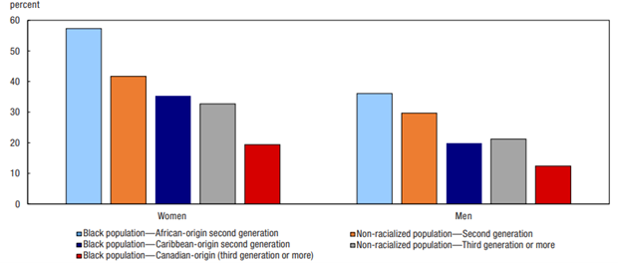
Text version of Figure 2
| Population group | Women (%) | Men (%) |
|---|---|---|
| Black population-African-origin second generation | 57.3 | 36.1 |
| Non-racialized population-Second generation | 41.7 | 29.7 |
| Black population-Caribbean-origin second generation | 35.3 | 19.7 |
| Non-racialized population-Third generation or more | 32.7 | 21.2 |
| Black population-Canadian-origin (third generation or more) | 19.4 | 12.4 |
Trend #7: Labour market outcomes for Black Canadians
Despite their diversity in terms of educational attainment and other characteristics, all Black groups experience earnings gaps (ranging from $1,400 to $4,100) associated with working in lower-level occupations relative to their education and being less likely to have full-time and full-year work, compared with the non-racialized third-generation or more population.
While having a university degree in Canada is generally associated with a higher employment rate and higher earnings, Black Canadians are the only racialized group to have a Canadian-born population with a lower employment rate than established immigrants (in Canada for more than 10 years) and the Canadian average. This data point may indicate the harmful effects of anti-Black racism on Canada's employment systems.
In January 2021, Black Canadians with a university degree had a lower employment rate (86.1%) than their non-visible-minority counterparts (91.1%).
The data also indicate that at every level of education, Black men have lower employment income than the average for Canadian men.
In the 2021 Statistics Canada report, the employment rate for Black women in Canada was 67.1% compared with 66.1% for other Canadian women, excluding Indigenous women. However, Black women accounted for 33.8% of those employed in health care or social assistance.
Although on average the income gaps are narrower among Canadian-born Black women, immigrant Black women and other Canadian women, Black women earn less, regardless of education level.
According to national demographic data, Black women are uniquely situated within Canada. Many studies show a prevalence of single parenthood among Black women in Canada (Thomas 2001; Mata 2011; Livingstone and Weinfeld 2015), and this family dynamic is negatively associated with their socioeconomic situation.
- Among immigrant Black women aged 25 to 59 in 2016, about 3 in 10 were single parents.
- Immigrant women from African countries have the lowest employment rates in Canada.
- One-third of Black women work in health care and social assistance.
- Among African-origin men and Caribbean-origin women, the negative wage impact from these factors outweighs the benefits of higher education.
- All Black men earn less than their non-racialized counterparts, with Canadian-origin Black men experiencing the largest gap (-$16,300) and African-origin Black men the smallest (-$8,500).
Similarly, Canadian-origin (-$9,500) and Caribbean-origin (-$1,300) Black women earn less than non-racialized women, while African-origin Black women earn more (+$3,100). For more details, see the full report: Statistics Canada.
Trend #8: Attitudinal anti-Black racism is on the rise
Discrimination: On the 2019 General Social Survey, considerably more Black people reported experiencing discrimination in 2019 than in 2014 (46% versus 28%).
Additionally, 70% of Black people who reported they had experienced discrimination in the past five years indicated that they had been discriminated against for more than one reason (including, religion, ethnicity or culture, sex, gender identity or expression, language and/or physical or mental disability). The data indicate that other intersecting marginalized identity features can amplify experiences of discrimination.Footnote 10
Anti-Black racism: Data published by Statistics Canada in 2022 indicate that in the first year of the COVID-19 pandemic, police reported 2,669 hate crimes in Canada, an increase of 37% since 2019. In 2020, police-reported hate crimes targeting race or ethnicity nearly doubled (+80%) compared to 2019. This trend accounts for the largest type of increase in hate crimes nationally.
While hate crimes rose against the East Asian, Southeast Asian and Indigenous populations in most provinces and two territories, the largest number of hate crimes occurred against Black people. And while most police-reported hate crimes in Canada occurred in large urban centres, rates increased at a similar pace in smaller cities, small towns and rural areas (+35%). The motivation (race, ethnicity, religion, sexual orientation, sex, other) for this increase was not indicated in the Statistics Canada report.Footnote 11
Trend #9: The pandemic disproportionately impacted the livelihoods of Black Canadians
Unemployment rate: The COVID-19 pandemic had long-lasting and disproportionate effects on the lives of Black Canadians. In the three months before January 2021, the unemployment rate of Black Canadians (13.1%) was about 70% higher than that of non-visible-minority Canadians (7.7%).Footnote 12 These data highlight how marginalizing factors such as race can compound hardship.
Return to work: The effects of the pandemic made it particularly hard for Black Canadians to find or return to work. In fact, Black Canadians (33.2%) were almost twice as likely as non-visible-minority Canadians (16.6%) to be living in a household reporting that they had been facing financial hardship over the last four weeks.
According to 2021 Statistics Canada data, just over 75% of Black mothers (aged 25 to 54 years) with a child younger than six years old were active in the labour market in January 2021, compared with four-fifths (81.1%) of non-visible-minority mothers. This trend was observed only in mothers of young children.
Crises always have and will continue to magnify pre-existing inequities among groups. Black Canadians are disproportionately affected by economic and social crises due to systemic racism, labour market inequality, health care discrimination and economic barriers. Without targeted policy responses, these disparities worsen with each crisis, reinforcing cycles of economic and social exclusion.
These differences also underscore the need for disaggregated race-based data, equity-informed public health policies and long-term investments to address the root causes of racial disparities.
Common Concerns: What We Heard from Black-led and Black-serving Organizations
Between January and June 2021, ESDC's Gender-based Analysis Plus Centre of Expertise led a series of engagement sessions with Black-led and Black-serving organizations. A total of 60 organizations participated, representing English- and French-speaking Black communities across Canada. These organizations reflect the diversity of Canada's Black population, and the participants' input highlighted a number of common concerns.
Some of the organizations represent Canadians by geographic origin (e.g., North and Sub-Saharan Africa, the Caribbean, North and South America). Others represent specific segments of marginalized Black Canadians (e.g., youth, seniors, women, people with disabilities). And others represent specific issues or groups of interest (e.g., entrepreneurs, access to employment, immigration, history and heritage, technology, official languages).
Many of the Black organizations expressed a strong desire to build capacity in areas such as entrepreneurship, innovation, democratic engagement, knowledge mobilization and communications infrastructure, and to do so in a fundamental and sustainable manner.
- Lack of trust in government institutions has deterred Black populations from accessing supports for which they are eligible. Additionally, community organizations have cited unsuccessful outreach efforts as a reason for low-take- up. Both factors have contributed to individuals opting to seek support from their communities rather than seeking access to government resources.
- Addressing barriers to employment and labor market integration are critical for Black communities facing longstanding structural issues preventing their successful transition into the workforce. In addition, Black Canadians have been drastically impacted by barriers to access education and the retention process of many organizations.
- Government funding requirements limit the positive impact community organizations can have on individuals accessing services. Often, government involvement is not sought because accepting funding may lead to a loss of independence and ability to exercise a legitimate advocacy role.
- Funding application processes lack transparency, and the funding provided is generally short term and lacks an equitable distribution system for medium and/or small sized organizations.
- The accessibility of applications is a recurrent concern from several groups within the diverse Black Canadian population. It has been raised that the software required to submit applications is difficult to navigate, with some organizations having no prior experience with the software used.
- Targeted policies that consider intersecting identities are needed to better understand the experiences of living with various potentially confounding identities such as: sex, disability or diverse abilities, various gender identities, migrant status, and citizenship.
For instance, Black women, who live with disproportionate rates of poverty and precarity, bear the disproportionate burden of childcare and caregiving within their communities. Community members have also indicated that any federal childcare plan must recognize that Black children are more likely to face child welfare risks.
- Many have expressed the desire for a stronger voice to better understand and inform policy and program priorities that affect them. Many feel that their views are not represented in the Department's many external roundtables and advisory groups. Community organizations have also indicated the need for ongoing engagement throughout policy development stages as a way of ensuring their needs, concerns and suggestions are effectively represented.
Additionally, addressing the lack of Black Canadians within the ranks of senior management in the government has been cited as a critical first step in efforts to include diverse representation in decision-making spaces.
- The unique circumstances of Black Canadians in the regions requires a tailored approach when addressing issues specific to their communities. For example, the geographic situation in the Territories presents unique challenges for the Black population in their efforts to access government program and services.
Similarly, Black Nova Scotians have historically experienced housing discrimination and forced relocation, and this must be considered when developing policies targeting their communities.
Steps to Applying the Black-Centric Lens
Applying the Black-Centric Lens is everyone's responsibility. This is not something that can be achieved by simply hiring one or two Black employees, hosting a single focus group, or making small, one-time changes. Real equity takes ongoing work and a clear commitment from programs, policies, and services at every stage.
Each program at ESDC operates in a unique context and serves Canadians in different ways. Applying the lens means looking closely at how our program is designed, how decisions are made, and how services are delivered, so that they actively remove barriers and lead to fair outcomes for Black communities.
The steps below provide practical guidance for employees, managers, and decision-makers on how to apply the lens in a way that fits our program's reality. These are not just checkboxes, they are actions that, when applied thoughtfully, help ensure policies and services are inclusive, equitable, and informed by the lived experiences of Black Canadians.
The following are the seven steps to applying the Black-Centric Lens to policies, programs, services and initiatives, each accompanied by specific guiding questions outlined in Annex D: Questions to be asked when applying the Black-Centric Lens.
Identify community needs
- Challenge our own assumptions and look to those with lived experience to inform our decision-making process.
- Remember that Black Canadians are not a homogeneous group. By understanding how multiple identity factors intersect in Black communities, government employees can make informed decisions on designing and delivering policies, programs and services.
- Specify the community's needs and concerns to make services more inclusive and beneficial to those who need them, and to reduce potential barriers.
Build the right team
- Managers should ensure that diverse and expert perspectives are represented during the policy development stage.
- Include the lived experiences of diverse employees in hiring processes and promotions to better inform all-inclusive and impactful policies, programs and services.
- Consider the knowledge and perspectives stemming from professional experiences relating to Black Canadians, as they can provide critical insights and shape outcomes.
Understand the social and historical context
- Consider past experiences and decisions to identify potential barriers that may prevent a policy, program, service or initiative from achieving its intended outcome.
- Identify links between the past and present to gain insight as to the nature of the issue and how best to serve Black Canadians.
- For example, employees working on labour market-related issues should be aware that although people who identify as Black have had higher labour market participation rates over the years than their non-racialized counterparts, they also continue to have higher unemployment rates and larger wage gaps than the average for all racialized workers.
Collect and use data
- Establish a data collection strategy that is critical for refining, developing and modifying policies to better support the targeted population.
- Prioritize collecting disaggregated data and include lived experiences of individuals with intersecting identities when collecting qualitative data.
- Recognize and challenge unconscious biases that influence the type, scope and source of the data collected.
- Understand how to analyze, interpret, report and discuss disproportionalities, as this approach, if not applied carefully, has several limitations that can lead to misinterpretation, oversimplification or ineffective policy responses.
Establish an effective engagement and outreach strategy
- Look at existing communication strategies to make sure targeted communities have the information they need to access services.
- Examine alternate outreach strategies that are more likely to reach Black Canadians and contribute to high take-up supports.
- Identify and engage with stakeholders.
Evaluate the impacts of policy, program and service implementation
- Design approaches to assess and evaluate policy, program, and service design outcomes that will positively impact their ability to support targeted communities.
- Work with Black employees and communities to assess impacts.
- Communicate results and recommendations for improvement if necessary.
Make the Black-Centric Lens work for our team
- Reflect on our own practices, acknowledging deficiencies and making adjustments as part of an ongoing commitment to anti-racism and equity.
- Focus on how to apply the Black-Centric Lens consistently and effectively across our day-to-day work.
- Scale proven best practices to our context and adapt solutions to our region and mandate.
- Share the lessons we have learned with other federal employees through communities of practice.
Applying the Black-Centric Lens to policies, programs and services is more than just completing a checklist. It involves shifting how work is conducted, how thinking occurs, how collaboration takes place and how outcomes are delivered in a way that is equitable, responsive and informed by the realities of Black Canadians. This process includes reflecting on existing practices, acknowledging deficiencies and making adjustments as part of an ongoing commitment to anti-racism and equity.
Applying principles of the Black-Centric Lens to internal corporate processes
As public servants, we are responsible for not only creating fair and inclusive programs for Canadians but also ensuring that the workplace itself reflects those same values. Applying the Black-Centric Lens internally means looking at how we recruit, retain, support and promote Black employees, including those in leadership roles, and identifying where systemic barriers continue to exist in the federal public service.
What we have learned from Black public servants and why it matters for our workplace
In 2024, a government-sponsored study was released on the experience of Black executives working in Canada's federal public service. Prepared by Dr. Rachel Zellars, "A Study on the Black Executive Community in the Federal Public Service" (the Study) examines barriers that limit career advancement for career Black public servants and Black executives compared to their non-racialized peers. It is also the first study of its kind to document clear patterns of anti-Black racism across the federal public service.
Like in many other internal departmental studies and records documenting the challenging career experiences of Black employees, ESDC's Black Engagement and Advancement Team reported similar findings after a design jam session in 2022. Many of the key overlapping concerns shared by Black employees and executives were about barriers to career mobility. For example:
- denied advancement opportunities such as language training; and
- acting assignments that do not lead to promotion or permanent appointment.
Numerous studies and data points across the federal public service support these findings of discrimination uniquely affecting Black public servants.
Government Response: Taking Action Across Departments
Following this study, the Clerk of the Privy Council and the Treasury Board Secretariat (TBS) issued a joint response. This response outlines a commitment to repair the harms experienced by Black public servants and ensure equity is embedded in all internal operations-not just in public-facing programs. The response plan is built around four key pillars:
- Prevention: Embedding anti-racist values and inclusive practices across recruitment, retention, and performance management.
- Protection: Strengthening safeguards against racism, harassment, and retaliation.
- Repair: Addressing past harms and fostering healing through transparent, trauma-informed approaches.
- Promotion: Supporting the advancement of Black employees, especially into executive ranks, through focused talent development.
The response plan also confirms that the "actions correspond to those in the Forward Direction on the Clerk's Call to Action on Anti-Racism, Equity, and Inclusion in the Federal Public Service (CTA) and will serve to reinforce the desired outcomes outlined in the CTA."
Notably, the Study and response plan also reflect the recommendations in the Office of the Auditor General of Canada's Report 5-Inclusion in the Workplace for Racialized Employees.
The response plan sets forth the following actions to ensure that equity measures applied to public-facing policies and programs are reflected in internal corporate processes:
- Implement anti-racist behaviours in performance management, with guidance from deputy heads. This includes departmental participation in the Treasury Board of Canada Secretariat pilot to explicitly include anti-racist and inclusive behaviours in performance management as of the summer or fall of 2025.
- Review existing complaint resolution processes (e.g., informal conflict resolution processes, disciplinary processes, grievance processes, processes for handling and preventing harassment and violence in the workplace [Bill C-65]) to ensure they are being handled in a way that is anti-racist and trauma-informed.
- Develop and publish an annual report on addressing misconduct and wrongdoing (following Global Affairs Canada's lead), with disaggregated complainant and respondent data, to ensure robust transparency.
- Heads of human resources are to provide clear information on where Black executives and managers can go for advice and support (e.g., if they experience or witness inappropriate behaviour, require advice in a workplace situation, need support during a performance discussion or in a disciplinary matter or investigation).
- Strengthen Assistant Deputy Minister Talent Management for Black executives and support executive leadership development for Black employees.
Human resources processes: Where the Black-Centric Lens must be applied
Human resources is one of the most critical areas where systemic inequities can persist-and where meaningful change can begin. Applying the Black-Centric Lens to human resources processes involves asking deeper questions about who is included, who is overlooked and what barriers exist across the employee life cycle. Questions may include the following:
Recruitment and Hiring
- Are job descriptions and screening criteria unintentionally excluding qualified Black candidates?
- Is lived experience valued alongside academic and professional qualifications?
- Have we established recruitment partnerships with Black-serving organizations?
- Are hiring panels diverse, and are panel members trained on bias?
Onboarding and Integration
- Are new Black employees welcomed into safe, inclusive spaces?
- Do onboarding processes include awareness of anti-Black racism, workplace rights and access to support systems?
Talent Development and Promotion
- Are Black employees being offered the same access to language training, acting assignments, coaching and executive development programs?
- Are performance appraisals inclusive of anti-racist behaviours and cultural competence?
- Is advancement tied to leadership potential beyond traditional pathways?
Retention and Wellness
- Are Black employees leaving at higher rates? If so, why?
- Do workplace mental health initiatives address race-based stress and trauma?
- Are there trusted, accessible human resources contacts for Black employees dealing with discrimination?
Complaints and Conflict Resolution
- Are informal conflict and harassment resolution processes trauma-informed and anti-racist?
- Is race-based discrimination acknowledged in investigations and tracked through disaggregated data?
- Are outcomes reported transparently to build trust and accountability?
Anchoring in government values
Applying the Black-Centric Lens to internal corporate processes demonstrates commitment to the Values and Ethics Code for the Public Sector and fosters a workplace that upholds the highest ethical standards.
Respect for People
Treating all people with dignity and fairness, including recognizing systemic barriers and taking steps to eliminate them.
Integrity
Acting honestly and ethically when confronting discrimination or bias, even when it's uncomfortable.
Stewardship
Using our roles to foster a workplace culture that enables everyone to thrive and contribute fully.
Excellence
Ensuring that the public service attracts and retains top talent-including Black leaders-by removing obstacles to success.
Beyond compliance: Creating a culture of inclusion
Policies alone are not enough. Managers and human resources professionals must lead by example and model inclusive leadership, make space for tough but necessary conversations and build trust through action.
This means
- supporting staff through career milestones, not just performance reviews;
- listening without being defensive when harm is named; and
- being accountable to racial equity-not as an extra task, but as part of everyday leadership.
The Black-Centric Lens is a tool for transformation. As we enter the Second International Decade for People of African Descent (2025-2034), the federal public service has a chance to become a workplace where Black employees are respected, valued and empowered to lead.
By applying the Black-Centric Lens to all internal processes and human resources decisions-from hiring to promotion to retention-we ensure that our internal practices truly reflect the inclusive and equitable future we are striving to build for all Canadians.
Measuring impact and tracking progress: Making equity real
Applying the Black-Centric Lens internally is about more than making commitments-it's about tracking results and holding ourselves accountable. To ensure that our efforts lead to meaningful, lasting change, departments must develop clear performance measures and collect the right data, specifically disaggregated data.
Collecting and analyzing disaggregated data helps organizations understand where progress is happening, where gaps remain and how to adjust their approaches to meet equity goals. A consistent performance measurement framework ensures that the actions we take align with real outcomes, not just intentions.
Effective measurement practices would help ESDC answer questions such as the following:
- Are Black public servants at ESDC better supported than before?
- Have barriers to hiring and promotion been removed?
- Are our internal systems more transparent, fair, and accountable?
- Are Black employees staying and thriving?
- Do they trust the system to support them?
The Gender-based Analysis Plus Centre of Expertise team has developed a Black-Centric Lens Impact Analysis Checklist to make it easier to apply the Black-Centric Lens at all stages of policies, programs, services and any other initiatives (see Annex C: Black-Centric Lens Impact Analysis Checklist).
Data needs for measuring impact and tracking progress
Representation
It is important to gather data on the percentage of Black employees across all occupational groups, levels and tenures, particularly in leadership and management classifications such as EX, EC, PM and AS. It is equally important to track how many Black candidates are entering hiring processes, both internally and externally, and their participation in talent management programs.
Example: Human Resources Services Branch Power BI Report on the representation of racialized employees in ESDC's workforce.
Advancement and talent development
These data would indicate who is participating in leadership development programs, who is being offered language training, mentoring or coaching, and whether acting roles and permanent promotions are distributed equitably. These data reveal whether Black employees are being supported and recognized as leaders, or whether they are being excluded from critical growth opportunities.
Workplace experience
Data from tools like the Public Service Employee Survey, when broken down by race, ethnicity, gender and other intersecting identities, can offer insight into how Black employees perceive their work environment.
Participation in anti-racism and inclusion training can also be tracked to ensure that learning is taking place across the organization, not just among equity-seeking groups.
Retention and departure
Exit interviews and departure surveys can provide valuable qualitative information about why people are leaving-whether because of lack of opportunity, experiences of discrimination or other workplace challenges. Analyzing turnover rates among Black employees and comparing them to other groups would help pinpoint structural issues that may be causing disengagement or burnout.
Complaints and resolution
Data on the number of formal and informal race-based complaints as well as investigation outcomes are essential. Data should also show whether Black employees have access to trauma-informed supports during these processes and whether systems are perceived as fair and responsive.
Caution: Over-representation or under-representation of Black employees in certain areas does not always signal discrimination but a need for deeper analysis. Historical context, organizational culture and structural barriers must all be considered when drawing conclusions and making decisions. Data must inform not only measurement but also learning, accountability and change.
Best practices and what is working across government
Implementing the Black-Centric Lens across internal operations and human resources practices requires not only commitment but also practical steps that can be adapted to fit different departmental realities. Fortunately, several federal organizations have already taken meaningful action to build more equitable, inclusive and anti-racist workplaces.
The following best practices, drawn from departments and agencies across government, have shown promising results and can help others effectively apply the Black-Centric Lens.
Leadership accountability and champions
Some departments, including ESDC, have appointed deputy minister-level anti-racism champions. These senior leaders publicly report on progress, engage regularly with racialized employee networks and are held accountable through departmental scorecards. Leadership commitment is critical for creating sustained momentum.
When senior leaders are visible and vocal about equity and inclusion, it signals that these efforts are essential to the department's success.
Tailored coaching and career support for Black employees
Global Affairs Canada's Deputy Minister Pilot Sponsorship Program introduced a coaching and sponsorship program specifically for Black and racialized employees. Participants are paired with senior leaders to receive support in navigating career pathways, preparing for executive roles and building professional networks.
Generic leadership programs may not address the unique barriers Black employees face. Targeted initiatives create space for tailored career development, trust-building and mentorship, while reducing reliance on informal or biased networks.
Anti-Racism performance objectives in management reviews
The Treasury Board of Canada Secretariat launched a pilot initiative requiring managers to demonstrate anti-racist behaviours and inclusive leadership in annual performance reviews. This approach is also being adapted by departments such as Innovation, Science and Economic Development Canada.
Embedding inclusion into performance expectations moves anti-racism from a conversation to concrete behavioural change. It enables departments to recognize and reward inclusive leadership-and course-correct where needed. Significant progress has been made, and new initiatives are being deployed.
Disaggregated data dashboards and transparent reporting
Immigration, Refugees and Citizenship Canada (IRCC) has developed an internal equity dashboard that tracks representation, hiring, promotions and retention by race, gender and other identity factors. Results are shared with employees and updated regularly to ensure transparency and foster discussion. You can't improve what you don't measure. Disaggregated data, when shared with intention and sensitivity, help identify trends, measure progress and build employee trust.
IRCC has also developed a tool called the Institutional Bias and Racism Identification Method, which uses a mix of data such as immigration trends, program results and socioeconomic factors to analyze differential outcomes for racialized groups. This evidence-based approach has already been used to examine immigration processing patterns, including a case study on applications from Nigeria. The department used these findings to build an action plan aimed at creating more equitable and risk-informed processing strategies.
Further applications of this tool are under way across other immigration streams.
Anti-racism and trauma-informed training
IRCC has taken a proactive approach by introducing mandatory anti-racism and inclusion training for all employees. These courses, offered through the Canada School of Public Service, focus on cultivating inclusive mindsets, addressing unconscious bias and promoting equitable hiring practices. In addition to department-wide learning, IRCC also offers targeted training for managers and decision-makers to help them recognize and reduce bias in operational and policy-related decisions. The department's Anti-Racism Task Force supports this work by curating updated learning resources for all staff. In addition, ESDC has developed a Black-Centric Lens training course for all employees on the Saba platform.
Black employee networks with decision-making influence
Many departments-including ESDC, Health Canada, National Defence and the Public Health Agency of Canada-have supported the creation or expansion of Black employee networks that play an advisory role in shaping departmental equity strategies. Some networks are given dedicated resources, staff and a direct reporting line to the deputy minister's office. Black employees must be meaningfully involved in the solutions.
Networks that are resourced and empowered rather than symbolic help ensure that lived experiences inform real decision-making. Remember, "Not about us, without us!"
Black-centric enhancements to the Employee Assistance Program
The enhancements to Health Canada's Employee Assistance Program (EAP) aim to provide culturally competent and trauma-informed mental health support to Black public servants and their immediate family members. The dedicated Black-centric Engagement and Advancement team ensures Health Canada applies a Black-centric and Sex- and Gender-based Analysis Plus lens to this initiative.
Health Canada has launched training for EAP mental health professionals. Offered in English and French, the sessions cover topics such as anti-Black racism and trauma-informed, culturally competent approaches to care so that mental health professionals in the EAP network are better equipped to support Black public servants and understand their unique experiences. The sessions include case studies, discussions and practical application exercises to help professionals understand the principles discussed and apply them to their day-to-day work.
Final notes
- Using the Black-Centric Lens should become an embedded practice as it would inform every stage of the policy cycle and service design, from issue identification and planning to analysis, delivery, monitoring and improvement.
- We must establish mechanisms that ensure accountability across all our teams and departments. This means setting clear goals, tracking progress and sharing results transparently with colleagues, leaders and Black communities.
- Using performance indicators, disaggregated data and meaningful community input would inform ongoing learning and foster change.
- Implementing the Black-Centric Lens also means creating space for internal reflection, especially when conversations about race, systemic barriers or exclusion feel difficult. ESDC should equip teams with anti-racism and trauma-informed tools to have honest, respectful dialogue and foster a workplace culture where equity is a shared responsibility.
- Implementation requires institutional support. Managers, executives and employees must reinforce the importance of applying the Black-Centric Lens through internal communications, performance expectations, and recognition of inclusive leadership.
- To ensure the Black-Centric Lens is applied properly, all employees, managers and executives are strongly encouraged to consult the following annexes and resources:
- Annex A: Glossary
- Annex B: Impacts of our history on Black Canadians today: Two case studies on education policy and housing discrimination
- Annex C: Black-Centric Lens Impact Analysis Checklist
- Annex D: Questions to be asked when applying the Black-Centric Lens
- Annex E: Dos and Don'ts when Applying the Black-Centric Lens
- Annex F: The Anti-Racism Secretariat's Continuum on Becoming Anti-Racist Organization
- Annex G: Additional resources
Role of ESDC's Gender-based Analysis Plus Centre of Expertise
ESDC's Gender-based Analysis Plus Centre of Expertise is responsible for advising, working with and supporting the department in applying an intersectional lens when developing policies, programs and initiatives that reflect the Government of Canada's commitment to equality, equity, inclusion and diversity.
The Centre is available to provide guidance and support in applying a Black-Centric Lens at all stages of policies, programs and services. Its analysts can help incorporate considerations and provide tools to support Gender-based Analysis Plus. For more information, visit the GBA Plus GCpedia website at ESDC GBA CoE - GCpedia or contact the Gender-based Analysis Plus team at NC-GBA-ACS-GD.
For additional resources, please reach out to the Federal Anti-Racism Secretariat and the Supporting Black Canadians Initiative, both part of the Income Security and Social Development Branch.
Annexes
Annex A: Glossary
Employment and Social Development Canada and many departments, academic institutions and other sectors in Canada are conducting research and engaging in dialogue with Canadians to better understand terminologies that are important to deepen our collective understanding about modern manifestations of racism. These efforts include looking closely at the following terms: visible minorities, race, racialization and racialized, systemic racism, implicit or unconscious bias, microaggression, white privilege, intersectionality, merit and meritocracy, and allyship.
We want to recognize the positive influence and intellectual contributions of critical Black feminists such as Audre Lourde, Kimberlé Crenshaw, Gloria Jean Watkins (pen name: bell hooks), Dr. OmiSoore Dryden, Dionne Brand and Dr. Rachel Zellars in shaping diversity and inclusion. We also want to acknowledge how their contributions have advanced the rights and well-being of all people.
Applying a Black-Centric Lens requires critical self-reflection and a willingness to recognize that we all carry assumptions and implicit biases that are shaped by our lived experiences. In addition, identifying and acknowledging the "systemic" or "institutional" aspect is a main factor that calls for the Black-Centric Lens to be applied. Therefore, it is crucial for employees to carefully read this document's introduction and history sections in their entirety.
What is race?
Race is a social construct that was historically used to falsely classify people as superior and inferior based on traits like skin colour and ethnicity. Historically, race was used to justify the enslavement system in Canada, and those who were categorized as "non-white" were subject to some of the greatest atrocities in human history. Racism produced race, not the other way around. According to historian Barbara Fields, racism should not be viewed as an attitude but as an action performed based on a double standard. In Canada, human rights legislation and codes identify race as a prohibitive ground of discrimination, and the social construct of race remains a potent force in society.
What's the difference? Systemic racism vs. implicit or unconscious bias
Understanding the difference between systemic racism and implicit or unconscious bias is critical. Systemic racism consists of policies, directives, practices or procedures that exclude, displace or marginalize racialized groups by creating barriers preventing access to resources. These mechanisms are persistent and negatively impact historically oppressed populations. On the other hand, implicit or unconscious bias refers to internalized individual belief patterns shaped by assumptions, historical stereotypes about groups of people, and practices rooted in prejudiced social norms. These biases arise out of our history. They usually operate outside of a person's awareness and can directly contradict their espoused beliefs and values. Implicit or unconscious biases often manifest as microaggressions, which are defined as the everyday interactions that subtly communicate a bias toward marginalized populations in any sector or community. Implicit or unconscious biases do not just rest in the brain; they inform human decisions and actions. Even without intent, they cause harm.
Microaggression
A microaggression is a subtle behaviour directed at a member of a marginalized group that has a derogatory and harmful effect. It may be verbal or non-verbal, conscious or unconscious. Chester Pierce, a psychiatrist at Harvard University, first introduced the term microaggression in the 1970s. While this definition distinguishes between implicit and explicit forms of discrimination, particularly racism, it is important to understand that microaggressions have significant adverse effects-cumulative, chain-linked and long-term impacts-on individuals and communities. The following are some examples of microaggressions:
- "Where are you really from?"
- "Where were you born?"
- "You speak English well."
- A non-Black person asking a Canadian of African descent if they can touch their hair.
- Asking a Black person: "Why do you have to be so loud/animated? Just calm down."
- A Black person being mistaken for a service worker.
- A Black person being ignored at a store counter as attention is given to the white customer behind them.
It is important to address microaggressions because they occur daily and are the most common form of anti-Black racism. People who engage in microaggressions may mean no harm toward the person or group being targeted. They may not even realize that what they are saying or doing is a microaggression. Regardless, microaggressions are hurtful to the people who experience them and, over time, they can have both long-term and devastating consequences.
Intersectionality
The term "intersectionality" was first coined by African-American legal scholar Kimberlé Crenshaw to highlight the erasure of the specific experiences faced by Black women in the American legal system categories. But it stems from a much longer Black feminist tradition. For example, the Combahee River Collective Statement, drafted in 1977, states the following:
The most general statement of our politics at the present time would be that we are actively committed to struggling against racial, sexual, heterosexual, and class oppression, and see as our particular task the development of integrated analysis and practice based upon the fact that the major systems of oppression are interlocking.
Intersectionality is an important concept that illustrates how people can experience multiple forms of discrimination at the same time, due to different aspects of their physical characteristics and/or identities, such as race, gender, class, disability or sexual orientation. These factors don't exist separately; rather, they interact and create unique, compounded experiences of oppression or privilege for many people. For example, when the Treasury Board of Canada Secretariat's intersectional data for persons with disabilities by salary is examined across the core public service, it becomes clear that Black employees with disabilities face the most pronounced disadvantages of all groups who also identify as having a disability. Without intersectionality, this crucial quantitative data reality would be obscured.
Traditional views of discrimination often focus on one identity at a time (e.g., racism or sexism). However, intersectionality shows that discrimination is much more complex. People who belong to multiple marginalized groups face overlapping, simultaneous barriers that are larger and more complex, create greater disproportionalities and are often overlooked. So, for example, a Black woman may experience compounding racism and sexism at the same time. This is called misogynoir and differs from what white women or Black men face.
Understanding intersectionality helps decision-makers and policymakers
- identify overlapping barriers faced by marginalized groups;
- avoid reinforcing discrimination by assuming all people experience oppression in the same way; and
- design policies that actually reach those most affected by systemic inequality.
Equity, diversity and inclusion
Equity, diversity and inclusion (EDI) are three linked principles that aim to ensure all people-regardless of race, religion, ethnicity, ability, gender and sexual orientation-are welcomed, included and treated fairly in an organization. EDI is also sometimes referred to as DEI (diversity, equity and inclusion).
The Government of Canada has standardized the use of EDI across federal departments and agencies. This is exemplified by the Guide on Equity, Diversity and Inclusion Terminology, which was co-developed by a committee involving over 20 federal entities. Its purpose is to provide a unified framework for understanding and implementing EDI principles.
Equity and EDI are often used interchangeably in the workplace. Equity, diversity and inclusion are three key principles used in workplaces, education and policy to create fair and inclusive environments; EDI as a concept is founded on the belief that true equality is achieved in outcomes. Similar to equity, EDI aims to correct systemic inequities by ensuring proportional representation and success rates for marginalized groups. It recognizes that historical disadvantages create unequal starting points, requiring intervention to achieve fairer outcomes.
Meritocracy and merit
Meritocracy is a system, organization or society in which individuals attain success, power and influence based on their demonstrated abilities, skills and achievements.Footnote 13 While the definition and application of merit are job-specific, the term generally refers to commendable qualities, actions or skills that determine what a person rightfully earns in the workplace.
Meritocracies and the concept of merit-particularly in public service hiring-have been increasingly critiqued by scholars, equity advocates and practitioners for being less objective or fair than they appear.Footnote 14 While the intent is to promote fairness and non-partisanship, critics argue that merit often reinforces existing inequalities, masks bias and overlooks systemic barriers faced by marginalized groups.
Canada's public service defines merit uniquely under the Public Service Employment Act.Footnote 15 In it, merit refers to the principle that appointments to and within the public service must be based on the qualifications of the person, without political influence or preferential treatment. This is a foundational element of a professional, non-partisan public service. Dr. Rachel Zellars' research highlights that historically, merit has been applied unevenly in the federal public service, which has led to discrimination against and exclusion of Black Canadians.Footnote 16
Ally
The term ally is increasingly being used to support individuals and populations facing persistent prejudice, discrimination and harm. The Canadian Race Relations foundation defines an ally as "[a] member of a different group who works to end a form of discrimination for a particular individual or designated group." For example, a more privileged group or individual may work to end a form of oppression that gives them privileges; this could be men who work to end sexism, or white individuals who engage in anti-racist work.
An ally
- takes responsibility for helping make things fair for marginalized individuals and populations because they see this as being part of a community;
- understands their various earned and unearned privileges;
- stands up for others even if it may be difficult for them; and
- recognizes their own challenges versus those of others and puts them in context.
Equality and equity - What do they mean and what is the difference?
The distinctions between equality and equity can be confusing because the terms are related in many ways. Both have been examined in depth, especially in legal human rights contexts. To better advance inclusion at all levels of society, equality should be understood as an aspiration to achieve equal outcomes for all, and equity as a means to making it happen. Furthermore, it is critical that policymakers understand the differences between formal equality and substantive equality.
Formal equality
Formal equality means ensuring that all individuals receive the same level of access, rights and opportunities, regardless of their background, identity or group affiliation. Formal equality implies a more uniform approach, where everyone is treated the same without necessarily accounting for individual or group differences.
Substantive equality
Unlike formal equality, substantive equality recognizes aspects of differences, identifies inequalities and aims for true equality in outcomes. It also recognizes that formal equality can be discriminatory.
In terms of race, substantive equality focuses on achieving true equality in outcomes by recognizing that not all people start from the same position based on race. It aims to address inequalities due to individual circumstances, ensuring that everyone has the same opportunities and equitable outcomes. Again, this concept is rooted in legal and constitutional principles such as the Canadian Charter of Rights and Freedoms and the Canadian Human Rights Act.
Equity
Distinct from formal equality, equity is about the processes and measures used to achieve substantive equality. It refers to fairness in practices and outcomes, focusing on eliminating systemic barriers that prevent equitable opportunities for all groups, particularly those that are historically disadvantaged. The goal is to ensure that all individuals, regardless of their background, identity or group affiliation, have fair access to opportunities, resources and support to live productive and rewarding lives. This is different from treating everyone the same.
In Canada, the terms equity and substantive equality are closely related and are often used interchangeably. Both concepts challenge the idea that treating everyone the same (formal equality) is fair, emphasizing instead the importance of context-sensitive responses to inequality. Equity is the means, and substantive equality is the goal.
Annex B: Impacts of our history on Black Canadians today - Two case studies on education policy and housing discrimination
The legacy of slavery has created and sustained economic inequality, systemic anti-Black racism, and institutional barriers that continue to affect Black Canadians in key tangible ways.
Education policy
Although Ontario (1840s to 1965) and Nova Scotia (1700s to 1983) were the only provinces that legislated the segregation of Black students, several other jurisdictions also engaged in the practice. The 1850 Common Schools Act in Ontario created the conditions for racial segregation by allowing white parents to create separate schools for Black children. Segregated schools were also created in response to an influx of Black free and enslaved people fleeing the United States in the 19th century, and in many cases, electoral boundaries were redrawn to ensure Black students would not be educated with white children.
Segregated schools were based on the belief that Black children were subhuman and would "contaminate" white schools and children.Footnote 17 Nearly all the segregated Black schools were greatly under-resourced, and students were taught in subpar conditions. In the rare event that a Black child was allowed in a common school, they were either kept isolated in the classroom or made to sit on a separate bench. Teachers were threatened and warned that speaking out in favour of integration could lead to their job being terminated. It was only six years after the 1977 Canadian Human Rights Act was passed that Canada's last segregated school was finally closed. The last racially segregated school in Ontario closed in 1965, and in Nova Scotia in 1983. In addition, many medical schools in Canada excluded Black Canadians from enrolling until the 1960s.Footnote 18
The consequences of these wide-reaching discriminatory policies are still felt today. Changes to Ontario's Education Act in 2000 legislated a zero-tolerance approach to school discipline under which students could face expulsion or suspension if charged with a serious infraction. This policy disproportionately affected Black students, who reported being disciplined for minor infractions.Footnote 19 Policymakers were heavily criticized for implementing measures that were known to contribute to social exclusion, unemployment and criminal involvement. The school-to-prison pipeline describes the systemic policies and practices that push Black students out of schools and into the criminal justice system. These policies often place Black students in direct contact with law enforcement and include harsh discipline, such as zero-tolerance policies, expulsions and police presence in schools, which disproportionately target Black students and limit their educational opportunities. Evidence suggests that the school-to-prison pipeline begins as young as preschool and that anti-Black racism is present throughout the education continuum.
Hostile environments in higher education (including hyper-surveillance such as being stopped or detained by on-campus police, verbal and physical abuse, discrimination and low expectations from professors and administrators) also push Black students out of education. In addition, research shows that the persistent use of academic streaming (the process of dividing students into differentiated groups based on their perceived academic ability and/or prior achievement) disproportionately affects Black students by pushing them into non-academic streams.
Housing discrimination
Discriminatory housing practices remained legal until the 1960s.Footnote 20 Before then, Black people were either left landless or were forced to settle in poorer quality areas, unlike white settlers in Canada. These practices progressed over time to become residential segregation. Policies were also designed to prevent Black communities from living and owning property in certain districts, a practice that is reflected in continued housing discrimination faced by Black people.
Over the decades, many thriving Black Canadian neighbourhoods were destroyed under the guise of "urban renewal," including Africville in Nova Scotia and Hogan's Alley in Vancouver. Africville was a close-knit Black Nova Scotian community that was razed in 1964 following a City Council vote, and Hogan's Alley was a poor multi-ethnic neighbourhood that resulted from housing discrimination. Those that lost their homes in Africville weren't compensated enough to buy another house, so residents transitioned from homeowner to renter. This meant a loss of opportunity to build intergenerational wealth through equity. Neighbourhoods like Hogan's Alley resulted from limited housing options available to Black Canadians who were routinely turned away when seeking rental accommodations. Over time, this systemic discrimination has pushed many Black residents into certain neighbourhoods in major Canadian cities. In Quebec, the St. Antoine neighbourhood of Montreal (later renamed Little Burgundy) was demolished under the guise of urban renewal, and 14,000 residents, most of whom were Black Canadians, were forced out.
Many Black and Indigenous communities in Canada also face environmental racism, which refers to the practice of disproportionately placing environmental hazards-such as industrial sites or landfills-near racialized communities.
Since the COVID‑19 outbreak in March 2020, infection and death rates have been disproportionately higher in communities with a greater proportion of Black residents and in low‑income neighbourhoodsFootnote 21. Canadian studies conducted during the pandemic show that Black populations experienced higher rates of COVID‑19 infection, hospitalization, and mortality, largely driven by structural factors such as income insecurity, overcrowded housing, and occupational exposureFootnote 22. More recent scoping reviews and syntheses emphasize that while overall COVID‑19 mortality has declined, the socio‑economic and housing conditions that contributed to these disparities persist. As a result, Black communities and people living in low‑income neighbourhoods continue to face heightened vulnerability to COVID‑19 and other public‑health threats, even though up‑to‑date national, race‑disaggregated mortality data are not currently available.
Annex C: Black-Centric Lens Impact Analysis Checklist
ESDC's Black-Centric Lens helps public servants better serve Black communities in Canada.
The purpose of this checklist is to provide ESDC employees with simplified guidance on applying the Black-Centric Lens at all stages of policies, programs, services and other initiatives (collectively referred to here as "proposal").
- Are you aware of the needs, priorities and concerns of Black communities in relation to the proposal?
- Did you or do you plan to consult Black communities or Black-led and Black-serving organizations?
- Do you have data or statistics on Black communities in the area in which your proposal will be implemented or renewed? (Did you consult research studies from relevant organizations such as Statistics Canada or the Chief Data Office Branch?)
- If data are unavailable, did you mention it in your analysis? Do you have a plan to address the lack of data?
- Will the proposal have a positive impact on Black communities or support activities that will benefit Black communities even if they are not directly targeted by the proposal?
- Reminder: Include any measures targeting Black people in Canada or related expected equity-improving outcomes.
- Could the proposal negatively affect Black communities?
- If yes, please list the potential negative impacts and describe what measures can be taken to eliminate or mitigate them.
- Will the proposal be accessible to Black communities regardless of geographic area and sociodemographic characteristics (such as low-income status) and other factors?
- Will notices and other publicity be placed in free and accessible news outlets reaching the targeted population?
- What communication activities (in your communication plan or strategy) relating to Black communities have been planned?
- Have outreach activities been planned, such as heads-up emails to Black-led and Black-serving organizations ahead of launching the proposal?
- Are any third parties involved in delivering the proposal?
- If yes, did you plan partnerships with Black-led and Black-serving organizations?
- Did you consult, apply or otherwise use the Black-Centric Lens for the proposal?
Specifically, did you consider and apply the following:- Identifying community needs
- Building the right team
- Understanding the historical context
- Effectively collecting and using data
- Establishing an effective engagement and outreach strategy
- Evaluating the impacts of policy, program and service implementation
Annex D: Questions to be asked when applying the Black-Centric Lens
There are seven steps to applying the Black-Centric Lens to policies, programs, services or initiatives. Each step comes with specific guiding questions.
Identify community needs
Questions to ask ourselves:
- What are our assumptions about these communities? How might our assumptions impact delivery?
- Has the community asked for this type of support, service or opportunity?
- What is the purpose of the program, policy or service, and what questions does it set out to address?
- Which individuals and/or communities will benefit from the program, policy or service?
- Will certain identity factors result in different impacts or limit the benefits for certain individuals?
- Has the community been consulted to validate the proposed approach and priorities?
- Has the community's feedback been incorporated into the program's design to improve the ability to address community needs? (lived experiences, unique history and main concerns raised)
- Have we consulted all available disaggregated data to inform the program's, policy's or service's design?
- What data are lacking? Which type of data is not available?
- Will the program, policy or service be equally accessible given various factors including the cultural and ethnic origins, disabilities and geographic location of these communities?
- Have we done a scan to identify which voices are not being meaningfully reflected in our approach?
Build the right team
Questions to ask ourselves:
- Who is working on the file?
- Do the employees working on the file have the necessary professional or lived experience to effectively lead and contribute to the initiative's success?
- Do they have subject-matter expertise on the diverse Black communities in Canada?
- Do they have any lived experience that may give them additional insight?
- Have we considered establishing recruitment partnerships with community-based organizations?
- Note that it is important for hiring managers to receive further guidance on how to respectfully inquire about the lived experiences of potential candidates and to prevent tokenismFootnote 23 practices.
Understand the social and historical context
Questions to ask ourselves:
- Do we have the required understanding of the historical context and its present-day impacts?
- Have we identified gaps in our knowledge and how to address them?
- How does Canada's historical treatment of Black Canadians shape the way the federal government interacts with Black communities today?
- How does this understanding inform the way ESDC engages with Black communities?
Collect and use data
Questions to ask ourselves:
- What data and research are we considering in developing the initiative?
- Have we established a data collection strategy that considers intersectionality?
- What exactly are we measuring?
- How will we measure the impacts?
- Have we included a qualitative data approach?
- When developing this strategy, did we consult the communities that will be impacted?
- What do we know about our population?
- How are data collected in existing datasets? Does data collection include Black Canadians and immigrants?
- What data are lacking?
- Are our programs inclusive of the public serve?
Establish an effective engagement and outreach strategy
Question to ask ourselves:
- Have we consulted Black-serving organizations in developing the outreach plan?
- Have community-based organizations been engaged in a meaningful way?
- Have we established ongoing engagement with the community?
- Has the community's input been considered in a meaningful way?
- Did the department's support help advance, limit or impede the desired outcome?
- Are Black Canadians accessing the initiative as expected?
- Where Black-led and Black-serving organizations may not be widely available, have we considered how to strengthen current organizations to facilitate engagement and outreach?
Evaluate the impacts of policy, program and service implementation
Questions to ask ourselves:
- Do you have an assessment and evaluation plan when developing and implementing policies, programs, and services?
- Do you have a consultation plan to receive feedback from the communities in question?
- Do you have a plan to report back to the population on established outcomes and impact?
- Do you have a consultation plan that provides the opportunity for the Black community to take part in policy development, program and service implementation intended to support their community?
- Were you successful in building relationships with local Black-led/serving organizations by creating ongoing relationships? How frequently are you planning to conduct performance measurement analysis to support movement toward attaining intended outcomes and share the results with senior management?
Make the Black-Centric Lens work for our team
Questions to ask ourselves:
- Have we integrated the Black-Centric Lens throughout all stages of policy or service design?
- Are there processes in place to check whether our decisions are reinforcing or reducing barriers for Black communities?
- Are we using the data we collect to inform real-time decisions and course-correct where needed?
- Do team members feel supported to name barriers or raise equity concerns without fear of reprisal?
- Is leadership reinforcing the importance of applying the Black-Centric Lens through accountability, resourcing and follow-through?
- Are we building organizational memory by documenting what works, sharing lessons learned and tracking results?
- Are we aligning our internal practices with the Values and Ethics Code for the Public Sector, particularly in areas such as respect for people, integrity and excellence?
Annex E: Dos and don'ts when applying the Black-Centric Lens
To effectively apply the Black-Centric Lens, we must approach the work with clarity, care and a commitment to equity. The following dos and don'ts provide practical guidance to help employees apply the Black-Centric Lens to their day-to-day work. These principles will enhance the use of the Black-Centric Lens not only to improve outcomes for Black communities but also to help build a stronger, more inclusive public service for all Canadians.
Do
Ground the work in historical understanding
Recognize how Canada's history of slavery, segregation and systemic exclusion continues to affect Black communities today. This context is essential for developing responsive and equitable programs and policies.
Engage Black communities early and meaningfully
Consult Black-led and Black-serving organizations from the beginning of the process, not just at the end. Incorporate their feedback and explain how their input shaped decisions. Make consultation more than just a formality.
Use disaggregated data and consider intersecting identity factors
Go beyond broad racial categories. Consider how factors such as gender, disability, language, immigration status and geography influence outcomes within Black communities. Combine both quantitative data and lived experiences to guide analysis.
Reflect on assumptions and biases
Pause to consider how personal or institutional biases may be influencing the initiative's design or delivery. Challenge default approaches and ask whose perspectives may be missing.
Apply the Black-Centric Lens throughout the policy or service life cycle
The Black-Centric Lens should be used from planning and design through implementation, monitoring and evaluation.
Build diverse and knowledgeable teams
Involve individuals with both professional expertise and lived experience related to Black communities. Ensure these team members are empowered to shape decisions, not placed in token roles.
Align the work with the Values and Ethics Code for the Public Sector
Applying the Black-Centric Lens reflects the public service values of respect for people, integrity, stewardship and excellence. Equity is not separate from good governance-it's a core part of it.
Share findings and progress openly
Communicate the actions taken, the resulting changes and remaining challenges. Being transparent helps build trust and fosters a culture of continuous improvement.
Don't
Treat Black communities as a single, uniform group
Black Canadians have diverse identities, experiences and needs. Avoid generalizations and ensure the work reflects this diversity.
Engage in symbolic or surface-level consultation
Reaching out to community members without taking their feedback into account can damage relationships and reduce trust in government. Consultation must be authentic and followed by clear action.
Rely only on data without context
Disaggregated data are important but do not replace the need for insight from those with lived experience. Data must be interpreted with care and supported by qualitative understanding.
Assume that good intentions are enough
Even well-meaning policies can reinforce inequities if they do not consider systemic barriers. Focus on the actual impact of the work, not just intentions.
Isolate equity work to one person or team (avoid tokenism)
Responsibility for applying the Black-Centric Lens should not fall solely on equity or diversity leads. It is the responsibility of all employees, teams and branches across the department.
Ignore internal workplace culture
Addressing anti-Black racism and systemic barriers must include the workplace itself. Consider how the Black-Centric Lens can be applied to hiring, promotion, performance management and leadership development.
Wait until the end of the project to apply the Black-Centric Lens
Embedding equity requires early and ongoing application. Applying the Black-Centric Lens retroactively often limits its effectiveness.
Annex F: The Anti-Racism Secretariat's continuum on becoming an anti-Racist organization
This continuum is meant to help employees identify where they are at and how to move forward.
Monocultural diverse > Anti-racist > Diverse, Inclusive and Anti-racist
Racial and cultural differences seen as deficits > Tolerant of racial and cultural differences > Racial and cultural differences seen as assets
Exclusive
An exclusionary institution
- Intentionally and publicly excludes or segregates First Nations, Métis, Inuit, Black, Asian, racialized and religious minority community members
- Intentionally and publicly enforces the racist status quo throughout institution
- Institutionalization of racism includes formal policies and practices, teachings, and decision making on all levels
- Usually has similar intentional policies and practices toward socially oppressed groups such as women, LGBTQ2IA+, Persons with a (Dis)ability, etc.
- Openly maintains the dominant group's power and privilege
Passive
A "club" institution
- Tolerant of a limited number of "token" First Nations, Métis, Inuit, Black, Asian, racialized and religious minority community members being allowed in with "proper" perspective and credentials.
- May still secretly limit or exclude First Nations, Métis, Inuit, Black, Asian, racialized and religious minority community members (particularly in senior or indeterminate roles) in contradiction to public policies
- Continues to intentionally maintain white power and privilege through its formal policies and practices, teachings, and decision making on all levels of institutional life
Symbolic change
A compliance organization
- Makes official policy pronouncements regarding multiculturalism, diversity and inclusion
- Sees itself as "nonracist" institution with open doors to First Nations, Métis, Inuit, Black, Asian, racialized and religious minority community members
- Carries out intentional inclusiveness efforts, recruiting "someone of color" on committees or office staff
- Expanding view of diversity includes some socially oppressed groups, but…"Not those who make waves"
- Little or no contextual change in culture, policies, and decision making
Identity change
An affirming institution
- Growing understanding of (systemic) racism as barrier to effective diversity
- Develops analysis of systemic racism
- Sponsors programs of anti-racism training
- New consciousness of institutionalized white power and privilege
- Develops an intentional identity as an "antiracist" institution
- Begins to develop accountability to racially oppressed communities
- Increasing commitment to dismantle racism and eliminate inherent white advantage
Structural change
A transforming institution
- Commits to process of intentional institutional restructuring, based upon anti-racist analysis and identity
- Audits and restructures all aspects of institutional life to ensure full participation First Nations, Métis, Inuit, Black, Asian, racialized and religious minority community members, including their worldview, culture and lifestyles
- Implements structures, policies and practices with inclusive decision making and other forms of power sharing on all levels of the institutions life and work
- Commits to the struggle of dismantling racism in the wider community, and builds clear lines of accountability to racially oppressed communities
Fully inclusive, diverse and anti-racist organization in a transformed society
- Future vision of an institution and wider community that has overcome systemic racism and all other forms of oppression.
- Institution's life reflects full participation and shared power with diverse racial, cultural and economic groups in determining its mission, structure, constituency, policies and practices
- Members across all identity groups are full participants in decisions that shape the institution, and inclusion of diverse cultures, lifestyles, and interest
- A sense of restored community and mutual caring
- Allies with others in combating all forms of social oppression
Annex G: Additional resources
To learn more about issues affecting Black Canadians, we recommend the following resources.
Books
- North of the Colour Line: Sleeping Car Porters and the Battle Against Jim Crow on Canadian Rails, 1880-1920, by Sarah-Jane Mathieu
- Policing Black Lives: State Violence in Canada from Slavery to the Present, by Robyn Maynard
- The Skin We're In: A Year of Black Resistance and Power, by Desmond Cole
- Until We Are Free: Reflections on Black Lives Matter in Canada, by Rodney Diverlus, Sandy Hudson and Syrus Marcus Ware
- La contribution des Noirs au Québec : quatre siècles d'une histoire partagée, by Arnaud Bessière (French only)
- Me and White Supremacy: Combat Racism, Change the World, and Become a Good Ancestor, by Layla F. Saad, Foreword by Robin J DiAngelo
- Caste: The Origin of Our Discontents, by Isabel Wilkerson
- The Conversation: How Seeking and Speaking the Truth About Racism Can Radically Transform, Individuals and Organizations, by Robert Livingston
Movies and documentaries
- Remember Africville - (National Film Board of Canada)
This short film depicts Africville, a small black settlement in Halifax, Nova Scotia. Former residents, their descendants and some of the decision-makers speak out and, using archival photographs and films, tell the story of that painful relocation. - Speakers for the Dead is a 49-minute documentary released in the year 2000 that reveals some of the hidden history of Black Canadians. This film may be emotionally triggering or impactful for viewers. For example, it shows an incident that occurred in rural Ontario in 1930, where a farmer buried the tombstones of a Black cemetery to make space for a potato patch.
- 100 Years of Faith is a 45-minute documentary film about the oldest Black church in the province of Quebec. The Union United Church first opened its doors in 1907 and has played an active role in the history of Montreal for over 100 years. The church has an amazingly rich history, and the film shows the contributions it has made to the Black community and how it helped establish Montreal as a world-class city.
- Zero Tolerance (National Film Board) Being young is tough, especially if you're Black, Latino, Arab or Asian. In a city like Montreal, you can get targeted and treated as a criminal for no good reason. Zero Tolerance reveals how deep-seated prejudice can be. On one side are the city's young people, and on the other, its police force. Two worlds, two visions.
Government of Canada resources
- Anti-Racism Learning Series: Provides access to tools, job aids, courses, workshops and events on topics such as anti-Black racism, unconscious bias, disaggregated data, mental health and the challenges faced by visible minorities in the public service.
- Canada's anti-racism strategy and Federal Anti-Racism Secretariat: Information and resources to help us continue working to eliminate systemic racism in Canada.
- Organizations and educational resources on the history of Black communities in Canada: Discover resources across the country devoted to the promotion and awareness of the history of Black communities.
Other data sources
- Gender, Diversity and Inclusion Statistics Hub
- Immigration and Ethnocultural Diversity Statistics
- Study: A labour market snapshot of Black Canadians during the pandemic
- Social determinants and inequities in health for Black Canadians: A snapshot
- Audit of Employment Equity Representation in Acting Appointments
- Building a Diverse and Inclusive Public Service: Final Report of the Joint Union/Management Task Force on Diversity and Inclusion
- Employment Equity Promotion Rate Study
- Acting appointments and subsequent promotions in the federal public service : a statistical study by the Public Service Commission of Canada
- Employment Equity Act: Annual Report 2018
- Canada's Black population: Growing in number and diversity
- Diversity of the Black population in Canada: An overview
- Call to Action on Anti-Racism, Equity, and Inclusion in the Federal Public Service
- Reporting on the Call to Action and the renewed conversation on values and ethics
- Permanent Forum on People of African Descent
- Canada's Black Justice Strategy
- Government of Canada's Action Plan to support Black public servants
- Black Engagement and Advancement Team Design Jam Sessions, February 2021: Qualitative Analysis
- February 2022 Interdepartmental Design Jam Sessions, Qualitative Analysis
- Study on Black Executives in Federal Public Service
- Report 5-Inclusion in the Workplace for Racialized Employees
- Black Life: Untold Stories | Shows | CBC Gem
- Black Canadians: History, Presence, and Anti-Racist Futures | University of Alberta
- Black Indigenous identities
- Black feminism
- Black 2SLGBTQIA+ identities
- Black identities - People living with disabilities
- Intersectional voices
- Black Population Diversity and Intersectionality in Canada
- The Diversity of the Black Populations in Canada, 2021: A Sociodemographic Portrait
Other videos
- Visible Minorities in the Senior Ranks of the Public Service of Canada: Challenges and Opportunities
- United Nations International Decade for People of African Descent
- Understanding Anti-Black Racism and How to Be an Ally
- Diversity - Panel Discussion: Black Careers Matter!
- Evidence for Equity: Measuring and Addressing Inequalities
- The Time is Now for Black Canadians in Public Service
- Afro-Indigenous Canadians share their experiences
- Five Things to Consider When You Think About Data Bias (DDN3-V05) - CSPS