
Taking action together – Canada’s 2026 Annual Report on the 2030 Agenda and the Sustainable Development Goals
On this page
- Foreword
- Executive summary
- Methodology
- Statistical introduction
- Policy coherence for sustainable development (PCSD) in Canada's implementation of the Sustainable Development Goals
- SDG 6: Clean water and sanitation
- SDG 7: Affordable and clean energy
- SDG 9: Industries, innovation and infrastructure
- SDG 11: Sustainable cities and communities
- SDG 17: Partnerships for the Goals
- Way forward
Alternate formats

Large print, braille, MP3 (audio), e-text and DAISY formats are available on demand by ordering online or calling 1 800 O-Canada (1-800-622-6232). If you use a teletypewriter (TTY), call 1-800-926-9105.
List of figures
- 1: Canada's progress towards the Sustainable Development Goals from 2015 to February 3rd 2026, by goal, Global Indicator Framework
- 2: Canada's progress towards the Sustainable Development Goals from 2015 to February 3rd, 2026, by goal, Canadian Indicator Framework
- 3: SDG Global Indicator Framework Target 9.2: Promote inclusive and sustainable industrialization and, by 2030, significantly raise industry's share of employment and gross domestic product
- 4: Domestic Indicator 6.4.1: Proportion of watercourses with good or excellent ambient water quality, by monitoring period
- 5: Domestic indicators 6.5.1 and 6.6.1: Percentage of wastewater systems where effluent quality standards are achieved, Canada and reserves
- 6: Domestic indicator 7.3.1: Total energy consumption per capita
- 7: Global indicator 7.3.1 (proxy): Energy intensity
- 8: Domestic indicator 9.3.1: Proportion of households that have access to high-speed Internet service
- 9: Domestic indicator 9.7.1: Remaining useful service life ratio of infrastructure assets, Canada and selected assets
- 10: Domestic indicator 11.2.1: Proportion of households in core housing need, Canada (provinces)
- 11: Domestic indicator 11.5.1: Proportion of commuters using sustainable transportation (provinces)
- 12: Domestic indicator 17.2.1: Total official support for sustainable development (TOSSD), Canada
- 13: Domestic indicator 17.3.1: Exports of environmental and clean technology goods and services to developing countries, Canada (in millions dollars)
Foreword
As we launch Canada’s 2026 Annual Report on the 2030 Agenda and the Sustainable Development Goals (SDGs), we are driven by our shared commitment to build a brighter, more inclusive future through the 17 global goals. These goals are more than aspirations: they are a roadmap for us and for future generations. Canada is proud to be part of this global effort, working alongside fellow United Nations member states to turn this vision into reality.
In 2026, the United Nations High-Level Political Forum on Sustainable Development will review five SDGs that are central to Canada’s priorities: SDG 6 (clean water and sanitation), SDG 7 (affordable and clean energy), SDG 9 (industry, innovation and infrastructure) SDG 11 (sustainable cities and communities), and SDG 17 (partnerships for the goals). The Government of Canada’s focus on building a stronger, more resilient economy through major infrastructure investment, clean‑energy expansion, and the development of sustainable, affordable communities, directly advances these SDGs. Effective partnerships across governments, industry, communities, and with global allies will also be key to our success.
Across Canada, governments, Indigenous communities, civil society, academia, and the private sector share compelling stories featured throughout the report that show how these global goals translate into local impact for people of all ages and backgrounds. These stories also show that when we work together, we unlock practical solutions, community-led innovation, and meaningful progress that ensures no one is left behind.
As we mark the International Year of Volunteers for Sustainable Development, we celebrate Canadians who are dedicating their time and talent to improve their communities and the world.
This report is both a measure of progress and a call to action. Achieving the SDGs requires sustained partnerships, shared responsibility and a willingness to learn from one another. By building on our strengths and working together, we can create a more sustainable and inclusive future for everyone both at home and abroad.
- The Honourable Stephanie McLean, Secretary of State (Seniors)
- The Honourable Randeep Sarai, Secretary of State (International Development)
Executive summary
The 2030 Agenda and its 17 Sustainable Development Goals (SDGs) lay out a shared global plan to build a more inclusive, sustainable future. Every United Nations (UN) member state endorsed this vision in 2015, and Canada continues to work toward making it a reality.
This report highlights what people and organizations across Canada did in 2025 to advance the SDGs both at home and internationally. It combines federal data and policy with storiesFootnote 1 gathered through a public questionnaire and conversations with people of all ages, including youth, seniors, Indigenous partners, community groups, provinces, territories, municipalities, academics and individuals who are helping drive change.
The report begins with a short statistical overview of progress on all 17 SDGs, and then focuses on the following 5 SDGs being assessed at the 2026 UN High-level Political Forum on Sustainable Development:
- SDG 6 (Clean water and sanitation)
- SDG 7 (Affordable and clean energy)
- SDG 9 (Industry, innovation and infrastructure)
- SDG 11 (Sustainable cities and communities)
- SDG 17 (Partnerships for the goals)
Canada took important steps toward these SDGs in 2025. For example, the federal government:
- Continued work with First Nations communities to achieve clean drinking water on reserve, resulting in over 97% of Indigenous Services Canada-funded First Nations water systems meeting national quality standardsFootnote 2.
- Continued its global leadership in affordable and clean energy, with the proportion of electricity generated from renewable and other non-greenhouse gas emitting sources being approximately 80% in 2024.
- Helped increase the number of Canadian households with access to high-speed internet services from 84.3% in 2016 to 96.4% in 2024Footnote 3.
- Launched Build Canada Homes, a new federal agency that will build affordable housing at scale. It leverages public lands, offers flexible financial incentives, attracts private capital, facilitates large portfolio projects, and supports modern manufacturers to build the homes that Canadians need, restore affordability, and reduce homelessness.
- Continued to advance the SDGs globally by contributing $14.8 billion in total official support for sustainable development in 2024, working with partners to foster inclusive economic growth, uphold human rights and democratic values, promote gender equality, and strengthen multilateral institutionsFootnote 4.
Accelerating the SDGs is key to strengthening Canada's resilience as we rise to the challenges people face at home and globally. SDG progress helps communities manage rising costs, climate impacts, and global uncertainty, while supporting a stable, safer and sustainable world.
As the stories in this report show, progress is driven by federal, provincial, territorial, municipal, Indigenous, community, civil society, and private-sector partners working together. This collaboration advances the SDGs while supporting core national priorities: building one Canadian economy, increasing the rate of homebuilding and making housing more affordable, strengthening climate and economic security, boosting productivity and innovation, and deepening intergovernmental cooperation.
2026 is the International Year of the Volunteer for Sustainable Development, and the report includes stories of Canadians giving their time to improve their communities and world.
As you read the report, remember that while content is listed under a single SDG, the goals are interconnected, with progress in one often creating benefits in others, or competing needs to consider. That's why this year's report includes a section on policy coherence, highlighting how aligning policies and identifying synergies can help Canada make more effective progress.
Areas for improvement with respect to the 5 SDGs reviewed in this report include:
- Continuing to work with First Nations communities to improve drinking water and wastewater systems on reserve. As of February 2026, 151 long-term drinking water advisories in First Nations communities have been lifted, although there remain 39 long-term drinking water advisories in 37 communities.Footnote 5
- Strengthening energy efficiency because, despite a 12.9% decline in energy intensity since 2015, progress is too slow to meet the 2030 target of cutting energy intensity in half.
- Continuing to expand zero-emission vehicle charging infrastructure, as transportation is one of Canada's largest sources of greenhouse gas emissions. As of December 2025, the Government of Canada has funded approximately 59,000 EV chargers and is working towards the 2029 target of 84,500 EV chargers.
- Continuing to work with communities to prevent and reduce homelessness, as well as increase housing supply, including affordable housing. Access to affordable housing continues to be a challenge across Canada, with 11.6% of households in the country in core housing need as of 2022.
As we confront today's challenges, Canada is advancing the 2030 Agenda through an inclusive, whole-of-society effort that drives economic strength, affordability, resilience and sustainable progress at home and internationally.
Methodology
This report presents activities taken in 2025 to advance the five SDGs under review at the UN. In the report, the three cross-cutting objectives in Canada's Federal Implementation Plan are woven throughout the narrative:
- Leaving no one behind - this means advancing gender equality, empowering women and girls and advancing diversity and inclusion in all its forms.
- Reconciliation with Indigenous Peoples - this requires renewal of the relationship with Indigenous Peoples, based on recognition of rights, respect, cooperation and partnership to modernize Government of Canada structures to enable Indigenous peoples to build capacity and support their vision of self-determination.
- Ensuring coherence within Canada's international efforts - this means aligning international and domestic efforts to help achieve the SDGs.
Measuring progress with statistics
The 17 SDGs are underpinned by a framework of global indicators that allow Canada and other countries to monitor and report on progress. To support the domestic implementation of the SDGs committed to by the Government of Canada, a national strategy (Moving forward Together: Canada's 2030 Agenda National Strategy) was developed. The creation of a complementary Canada-specific indicator framework was an opportunity to elaborate a set of indicators that aligns more closely with Canada's domestic priorities related to sustainable development. The statistical analyses included in the report use a selection of indicators per SDG from the Global Indicator Framework or the Canadian Indicator Framework, and leverage Canada's measure of progress to highlight where the country is making progress or falling behind on its sustainable development targets and ambitions.
This report presents Canada's recent progress towards achieving the SDGs as well as progress achieved since 2015, the start of the 2030 Agenda for Sustainable Development.
Engagement
The report includes feedback received during engagement and collaboration with whole-of-society stakeholders and partners.
An online questionnaire was open from October 22, 2025, to December 19, 2025, inviting orders of government, Indigenous governments and Indigenous Organizations across distinctions, civil society organizations, academia, businesses, and individuals to share their activities and work to advance the SDGs. The opportunity to provide input was promoted through information sessions, newsletters, and on social media. More than 100 people from all ages and backgrounds, organizations and all levels of government provided information about how their work contributed to advance the SDGs as well as obstacles they faced while doing so. Other engagement activities included targeted distinction-based outreach and engagement across distinctions with Indigenous organizations including National Indigenous Organizations, provinces, territories, youth, and civil society organizations representing municipal governments.
Statistical introduction
Canada's progress in achieving the SDGs is tracked through the Sustainable Development Goals Information Hub updated by Statistics Canada. It includes two data hubs: the Global Indicator Framework (GIF) and the Canadian Indicator Framework (CIF).
There are 251 indicators in the GIF and 86 in the CIF. While it is possible to define progress for the majority (91%) of the CIF indicators, it is currently only possible to do so for 52% of the GIF indicators.Footnote 6 For both frameworks, the indicators are divided into five levels of progress, ranging from "Deterioration" to "Target achieved". Figures 1 and 2 provide a visual summary of Canada's progress since 2015, by goal, for both the GIF (Figure 1) and CIF (Figure 2). For each goal, circles of different sizes indicate the number of indicators in each progress category. For example, as of February 3, 2026, Canada had already met the targets for two indicators under Goal 11: Sustainable cities and communities, and is on track to meet the targets for four other indicators. However, for three of the indicators, there has been a deterioration in progress towards the 2030 targets.
As of February 3, 2026, almost 20% of the indicators of the Global Indicator Framework were rated as having achieved their target, while 25% were on track to meet them by their deadlines. In contrast, progress was weaker for the remaining indicators (56%) with 26% even showing a deterioration in progress.Footnote 7
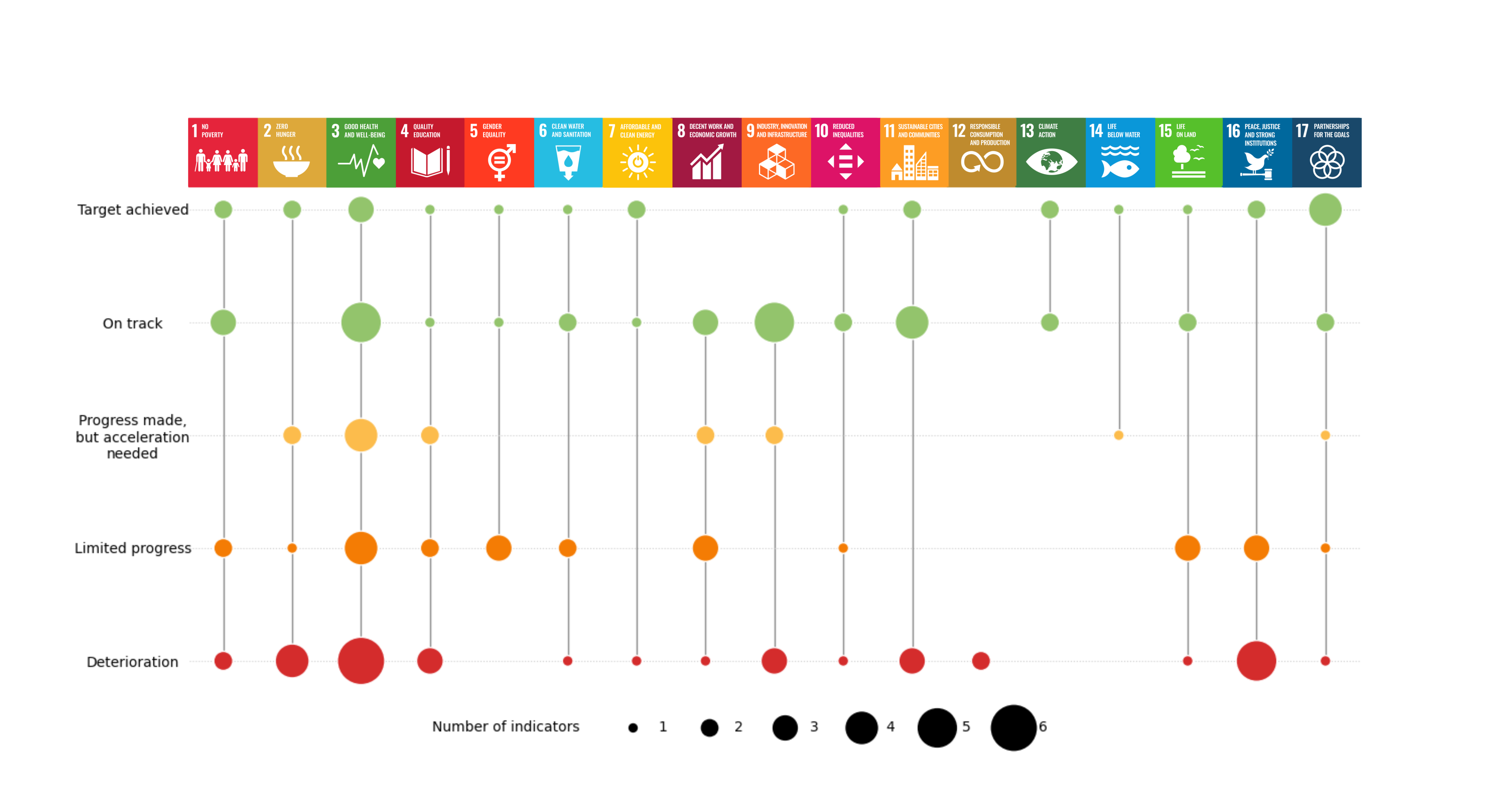
Text version of Figure 1
| Sustainable development goal (by number of indicators) | Target achieved | On track | Progress made, but acceleration needed | Limited progress | Deterioration |
|---|---|---|---|---|---|
| SDG 1 | 2 | 3 | 0 | 2 | 2 |
| SDG 2 | 2 | 0 | 2 | 1 | 4 |
| SDG 3 | 3 | 5 | 4 | 4 | 6 |
| SDG 4 | 1 | 1 | 2 | 2 | 3 |
| SDG 5 | 1 | 1 | 0 | 3 | 0 |
| SDG 6 | 1 | 2 | 0 | 2 | 1 |
| SDG 7 | 2 | 1 | 0 | 0 | 1 |
| SDG 8 | 0 | 3 | 2 | 3 | 1 |
| SDG 9 | 0 | 5 | 2 | 0 | 3 |
| SDG 10 | 1 | 2 | 0 | 1 | 1 |
| SDG 11 | 2 | 4 | 0 | 0 | 3 |
| SDG 12 | 0 | 0 | 0 | 0 | 2 |
| SDG 13 | 2 | 2 | 0 | 0 | 0 |
| SDG 14 | 1 | 0 | 1 | 0 | 0 |
| SDG 15 | 1 | 2 | 0 | 3 | 1 |
| SDG 16 | 2 | 0 | 0 | 3 | 5 |
| SDG 17 | 4 | 2 | 1 | 1 | 1 |
With regard to the Canadian Indicators Framework, 4% of the indicators had met their targets, while 21% were on track to meet them by the deadlines. However, just over 75% of the indicators were not on track to meet their targets, with just over half of these even showing a deterioration relative to the targets.
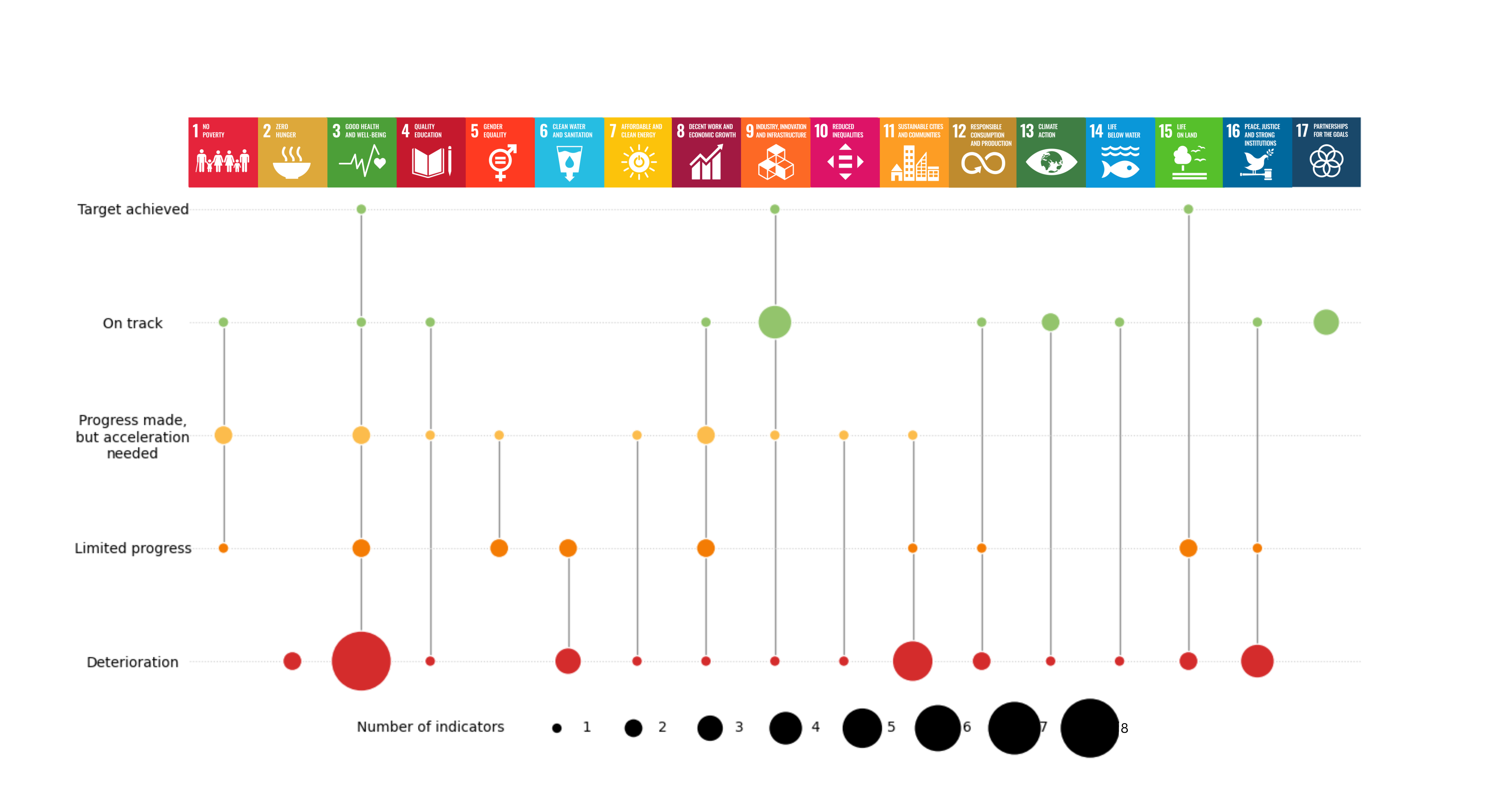
Text version of Figure 2
| Sustainable development goal (by number of indicators) | Target achieved | On track | Progress made, but acceleration needed | Limited progress | Deterioration |
|---|---|---|---|---|---|
| SDG 1 | 0 | 1 | 2 | 1 | 0 |
| SDG 2 | 0 | 0 | 0 | 0 | 2 |
| SDG 3 | 1 | 1 | 2 | 2 | 8 |
| SDG 4 | 0 | 1 | 1 | 0 | 1 |
| SDG 5 | 0 | 0 | 1 | 2 | 0 |
| SDG 6 | 0 | 0 | 0 | 2 | 3 |
| SDG 7 | 0 | 0 | 1 | 0 | 1 |
| SDG 8 | 0 | 1 | 2 | 2 | 1 |
| SDG 9 | 1 | 4 | 1 | 0 | 1 |
| SDG 10 | 0 | 0 | 1 | 0 | 1 |
| SDG 11 | 0 | 0 | 1 | 1 | 5 |
| SDG 12 | 0 | 1 | 0 | 1 | 2 |
| SDG 13 | 0 | 2 | 0 | 0 | 1 |
| SDG 14 | 0 | 1 | 0 | 0 | 1 |
| SDG 15 | 1 | 0 | 0 | 2 | 2 |
| SDG 16 | 0 | 1 | 0 | 1 | 4 |
| SDG 17 | 0 | 3 | 0 | 0 | 0 |
In summary, based on trends observed from 2015 through February 3, 2026, these two figures show that Canada's progress toward achieving the SDGs varies substantially from one SDG to another. For example, some indicate that a number of indicators are on track to meet the targets or have even already met them. However, other SDGs show much more mixed progress or are even deteriorating relative to the targets. These reflect challenges observed in Canada, but also globally, such as the rising cost of living. These trends highlight areas where greater efforts are needed to achieve the targets and ambitions set, ensuring that no one is left behind.
Policy coherence for sustainable development (PCSD) in Canada's implementation of the Sustainable Development Goals
Policy Coherence for Sustainable Development (PCSD) is about making sure that actions taken in one policy area support, rather than undermine, progress in others. It is a key part of implementing the 2030 Agenda as it helps ensure actions across economic, social, and environmental areas work together to advance sustainable development.
The SDGs are interconnected. This means a SDG cannot be achieved in isolation and progress in one goal affects progress in others. Because of these links, policy decisions can have cross-cutting impacts. A policy in one area has the potential to create a positive ripple effect across multiple sustainable development goals, or it could unintentionally create negative impacts for other SDGs or over time. PCSD helps to better understand and manage these relationships so actions across different sectors work together rather than conflict.
To learn more about PCSD, see the Organization for Economic Co-Operation and Development's (OECD) Recommendation on Policy Coherence for Sustainable Development.
In Canada, PCSD is an important part of Moving Forward Together: Canada's 2030 Agenda National Strategy and the Federal Implementation Plan. Canada continues to seek ways to ensure that federal actions across diverse policy areas support rather than undermine one another, so the SDGs can be advanced in a consistent, integrated manner.
Spotlight on PCSD: the interconnection between SDGs
Figure 3 belowFootnote 8 captures an example of how the SDGs are naturally interconnected. Evidence for these interlinkages comes from a large body of international academic and policy research showing how progress in one SDG can influence others. These documented relationships can be represented to illustrate the broader network of connections across the SDGs and their targets.
Some SDGs have more interlinkages than others, and the strength of these linkages can vary based on contextual factors within individual countries. The SDGs reviewed in this report (SDGs 6, 7, 9, 11, and 17) have a high number of theorized interlinkages with each other. The visual analysis demonstrates how SDG target 9.2, focused on inclusive and sustainable industrialization, has potential interconnections with almost every target under SDG 6, 7, and 11. These interlinkages create "nexus areas" where coordinated action can help advance progress on multiple SDGs at once.
By recognizing how progress in one area can influence others, decision-makers and partners across sectors can better identify synergies, anticipate pressures, and design strategies that overcome sectoral silos and reinforce sustainable development across the whole system.
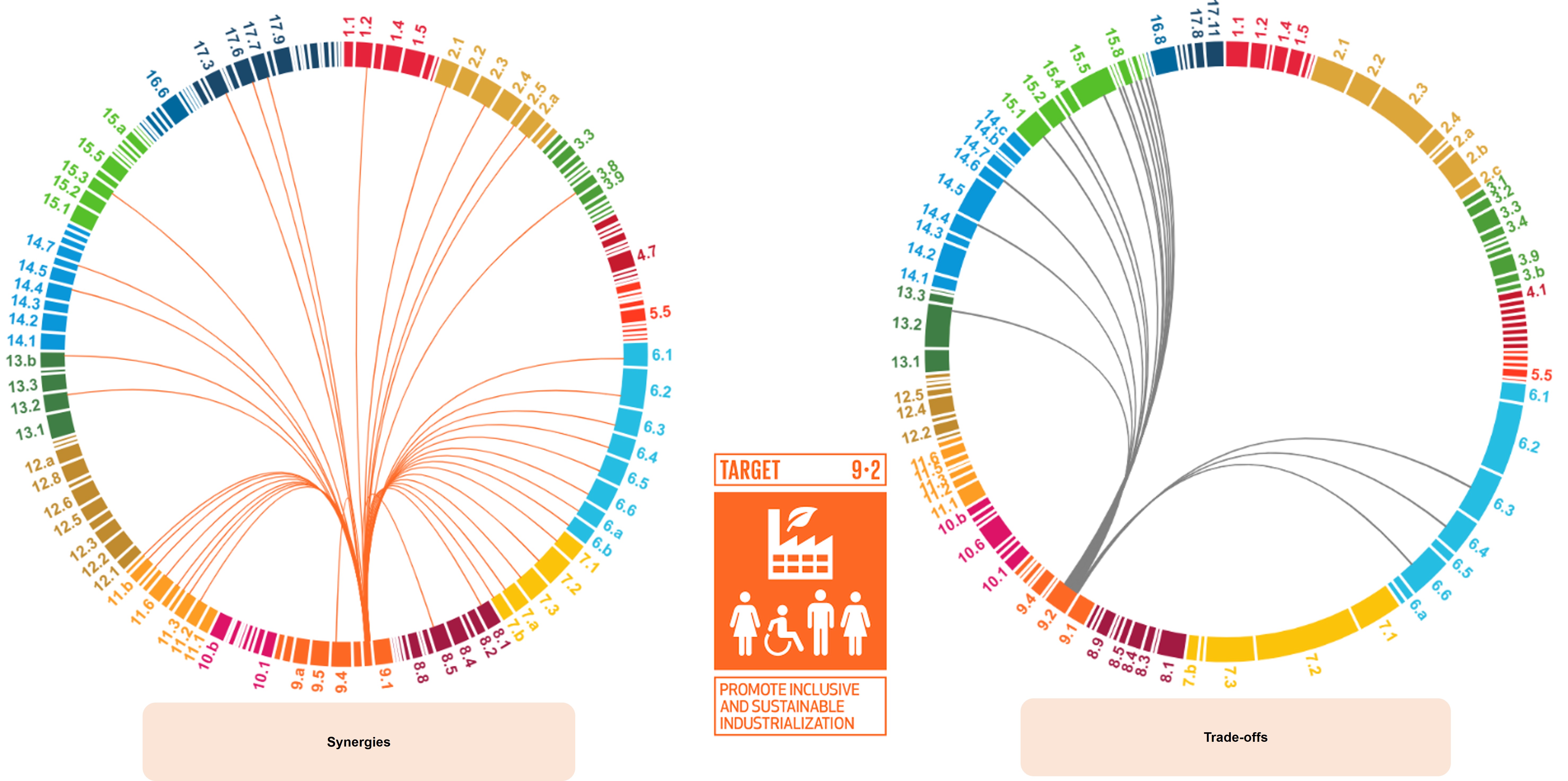
Text version of Figure 3
SDG Global Indicator Framework Target 9.2
Two circular network diagrams show how Sustainable Development Goal's Global Indicator Framework (GIF) target 9.2 (promoting inclusive and sustainable industrialization) interacts with other SDG targets.
The left diagram (“Synergies”) shows numerous positive connections from target 9.2 to targets across multiple goals, (SDG 1, 2, 3, 6, 7, 8, 9, 11, 13, 14, 15, 17). These links indicate that progress on industrialization can reinforce broader sustainable development outcomes.
The right diagram (“Trade-offs”) shows fewer connections, highlighting potential negative interactions primarily with environmental targets (SDGs 6, 13, 14, and 15), suggesting that industrialization may create pressures on natural systems if not managed properly.
A detailed list of linked Global Indicator Framework (GIF) targets is provided in the table below.
| Type | Sustainable Development Goal | Global Indicator Framework Targets Connected to 9.2 |
|---|---|---|
| Synergies | SDG 1 – No Poverty | 1.2 |
| SDG 2 - No Hunger | 2.1, 2.3. 2.5, 2.a | |
| SDG 3 - Good Health and Wellbeing | 3.8 | |
| SDG 6 – Clean Water and Sanitation | 6.1, 6.2, 6.3, 6.4, 6.5, 6.6, 6.a, 6.b | |
| SDG 7 – Affordable and Clean Energy | 7.1, 7.2, 7.3, 7.a, 7.b | |
| SDG 8 – Decent Work and Economic Growth | 8.1, 8.5 | |
| SDG 9 – Industry, Innovation and Infrastructure | 9.4 | |
| SDG 11 – Sustainable Cities and Communities | 11.2, 11.3, 11.4, 11.5, 11.a, 11.b, 11.c | |
| SDG 13 – Climate Action | 13.2, 13.b | |
| SDG 14 – Life Below Water | 14.4, 14.6 | |
| SDG 15 – Life on Land | 15.3 | |
| SDG 17 – Partnerships for the Goals | 17.3, 17.6, 17.7 | |
| Trade-offs | SDG 6 – Clean Water and Sanitation | 6.3, 6.4, 6.6 |
| SDG 13 – Climate Action | 13.2 | |
| SDG 14 – Life Below Water | 14.4, 14.6 | |
| SDG 15 – Life on Land | 15.1, 15.2, 15.3, 15.5, 15.6, 15.7, 15.8, 15.9, 15.a, 15.b, 15.c |
The figure shows the most direct positive (synergies) and negative (trade-offs) interlinkages between SDG target 9.2 (promoting inclusive and sustainable industrialization) and other SDG targets. Each circular diagram displays SDG targets around the outside ring. Lines connect SDG target 9.2 to other targets where evidence-informed linkages have been identified.
In the Synergies diagram, orange lines indicate areas where progress on target 9.2 can reinforce progress on other SDG targets. For example, investment in electrifying and upgrading industry could help reduce energy intensity while improving economic competitiveness. This co-beneficial relationship is illustrated by the line connecting targets 9.2 and 7.3.
In the Trade-offs diagram, grey lines indicate where progress on target 9.2 may create unintended pressures that could slow or undermine progress on other targets if not properly managed. For example, industrial growth may increase wastewater generation, which can harm the environment and pose risks to public health, if industrialization is not accompanied by strong environmental safeguards. This potential trade-off is shown by the line connecting targets 9.2 and 6.3.
Overall, the figure highlights the integrated nature of the SDGs. It shows how considering interlinkages between targets can help maximize co-benefits across policy actions and reduce potential trade-offs, leading to more coordinated and coherent action on sustainable development.
Making Canada's industrial plans work together within the water-energy-innovation nexus
Canada's push to scale an innovation economy advances numerous targets under SDG 9, particularly SDG target 9.2, target 9.4, and target 9.5 which focus on inclusive and sustainable industrialization, upgrading industrial infrastructure and technology, and enhancing scientific research. The Government of Canada is spearheading a new industrial strategy. Generational investments aim to expand high-value domestic production, grow strategic sectors, and enable Canadians to capitalize on its natural advantages while transforming to a clean economy. Investments in skills and technology will build new capabilities and bolster Canada's productive capacity, with significant potential from emerging technologies.
Applying a policy coherence lens helps strengthen the delivery of this renewed industrial agenda by aligning industrial growth with the SDGs and reducing potential trade-offs. Federal innovation initiatives like the Global Innovation Clusters are expanding artificial intelligence (AI), quantum computing, advanced manufacturing, and the digital infrastructure that supports them, but these gains can significantly increase energy and water demand, particularly from data centres.
Rising demand creates potential tensions across the SDGs. For example, industrial expansion may stress water ecosystems (SDG target 6.3) and climate objectives unless accompanied by stronger water-use efficiency (SDG target 6.4) and clean energy deployment (SDG target 7.2). The Clean Electricity Strategy, Clean Electricity Regulations, and investments through the Smart Renewables and Electrification Pathways Program are positioning Canada to develop an increasingly renewable, non-emitting grid by powering innovation to better respond to energy demands.
At the same time, industrial growth places new pressures on freshwater systems. Through the Freshwater Action Plan, the Canada Water Agency works to address ecosystem stresses by supporting watershed restoration, pollution reduction, and promoting integrated water management, while Housing, Infrastructure, and Communities Canada support upgrades to wastewater and monitoring systems, helping to ensure that industrial growth does not compromise ecosystems or community water security.
Because primary jurisdiction over fresh water rests with provinces and territories, the federal government advances transboundary watershed management through collaborative governance that brings together provincial, territorial, and Indigenous governments, as well as municipalities, conservation authorities, industry, and civil society to strengthen alignment across jurisdictions and ensures that actions taken in one jurisdiction do not undermine water security in another. This approach exemplifies vertical policy coherence, linking federal leadership with subnational implementation so that freshwater sustainability and economic co-benefits are pursued in a mutually reinforcing manner across levels of government.
Together, these coordinated water, energy, and innovation policies demonstrate how Canada is working to advance economic modernization and sustainability through coherent policy design. While innovation-driven growth can increase demand for water and clean electricity, federal policies aim to anticipate and manage these pressures so that they support, rather than hinder long-term progress. Canada's renewed approach to industrialization is being pursued in tandem with the building of a foundation of protected freshwater systems and a rapidly decarbonizing grid, illustrating a model in which technological competitiveness and environmental stewardship can be advanced together.
SDG 6: Clean water and sanitation
SDG 6 Policy context
Clean and safe water is essential for life, health, and the environment. Canada holds some of the world's largest freshwater reserves, but climate change, pollution, and aging infrastructure continue to put water quality and availability at risk. SDG 6 focuses on helping everyone in Canada to have access to clean drinking water and safe wastewater systems, while protecting lakes, rivers, and aquifers for future generations.
Improving drinking water safety
The Government of Canada develops the Guidelines for Canadian drinking water quality in partnership with the provinces and territories. The Guidelines set national limits on contaminants in drinking water. Every jurisdiction in Canada uses the Guidelines to establish drinking water quality requirements, helping improve drinking water quality for Canadians.
Protecting freshwater
The Government of Canada is taking action to restore and protect waterbodies of national significance through the Freshwater Action Plan, which, through Budget 2023, is investing $650 million over ten years. The Canada Water Agency leads these efforts by providing leadership, effective federal collaboration, and improved coordination and collaboration with provinces, territories and Indigenous Peoples.
Eight Freshwater Ecosystem Initiatives are currently under way to protect ecosystems in waterbodies across Canada. These initiatives focus on the Great Lakes, St. Lawrence River, Lake Winnipeg, Lake of the Woods, Mackenzie River, Wolastoq/Saint John River, Fraser River and Lake Simcoe. Led by the Canada Water Agency, in collaboration with provinces, territories, Indigenous partners, and other stakeholders, the initiatives also support Indigenous-led freshwater stewardship.
The Canada Water Agency also conducts periodic reviews of federal freshwater policies and strategies. For example, it has begun pre-engagement with provincial, territorial, and Indigenous partners to modernize the Canada Water Act.Footnote 9
Ensuring drinking water and wastewater effluent meet standards in First Nations communities
Improving access to safe drinking water and ensuring adequate wastewater effluent standards in First Nations communities is a Government of Canada priority. Over 97% of Indigenous Services Canada-funded First Nations water systems meet national quality standardsFootnote 10, and 71.1% of wastewater systems in Indigenous communities met effluent quality standards in 2024. As of February 2026, 151 long-term drinking water advisories on public systems in First Nations communities have been lifted, although there remain 39 long-term drinking water advisories in 37 communities.Footnote 11 Indigenous Services Canada continues to work with First Nations to develop innovative approaches, ensuring on-reserve water and wastewater systems are both safe and tailored to meet each community's unique needs.
First Nation infrastructure investment plans, developed by First Nations with the support of the Government of Canada, help Indigenous Services Canada assess community infrastructure needs and plan infrastructure investments in First Nation communities across Canada.
The Government of Canada also supports First Nations to assume full control of their water and wastewater services, such as in the case of the Atlantic First Nations Water Authority, a First Nations-led organization that oversees the operation, maintenance, and upgrades of all water and wastewater assets in participating communities in the Atlantic region.
Improving wastewater treatment in Canada
To reduce pollution and protect ecosystems, the federal government is helping communities to upgrade wastewater systems. The Wastewater Systems Effluent Regulations set realistic and predictable timelines over a 25-year period to build and upgrade wastewater treatment in communities lacking adequate treatment. The Regulations were amended in 2024 to allow small, rural and remote communities, including First Nations communities, an opportunity to focus on wastewater upgrades.
With support from the Investing in Canada Plan (IICP)- Green investment stream and the Canada Housing Infrastructure Fund (CHIF), along with provincial and territorial investments, upgrades to wastewater treatment plants have continued across the country. As a result, 78 percent of systems met national standards in 2024Footnote 12. Communities across Canada continue to build or upgrade their wastewater systems to meet regulatory requirements.
Strengthening monitoring, data, and resilience
Canada monitors and publishes water quality through the National Hydrological Service and the Canadian Environmental Sustainability Indicators program. Canada's river quality is classified into five categories, from poor to excellent. During the 2022 to 2024 period, 77% of monitored sites were rated fair to excellentFootnote 13.
The National Hydrometric Program, a long-standing partnership between the federal government and provinces and territories, operates nearly 3000 hydrometric monitoring stations across Canada to provide real-time and historical data on water levels and river flows. This authoritative water quantity information is foundational for public safety, supporting flood and drought forecasting, emergency response, and activities under domestic and international water management agreements. In 2024, Canada expanded ongoing investment in early-warning systems to help communities mitigate the effects of flooding, both through the Predicting and Alerting for Coastal Flooding Initiative, and in developing best practices in floodplain mapping.
The Government of Canada has developed a National Freshwater Science Agenda to support and guide the planning, coordination, and collaboration of freshwater science and knowledge in Canada. With input from experts, provincial and territorial partners, Indigenous organizations and governments, and stakeholders nationwide, this Agenda identifies national freshwater science priorities and provides regional perspectives to support the protection, management, and stewardship of freshwater in Canada. The Canada Water Agency is also leading the development of a National Freshwater Data Strategy, which will set guidelines and principles for organizing, storing and sharing freshwater data in Canada.
Canada monitors ambient water quality in transboundary waters (such as the Great Lakes and the Saint-Lawrence River), waters on federal lands (such as national parks), and waterbodies of national interest (such as Lake Winnipeg). The federal government monitors water quality jointly with several provinces and territories under long-standing formal agreements, to ensure scientific collaboration and efficient use of monitoring resources towards a more comprehensive understanding of aquatic ecosystem health in watersheds where multiple agencies have jurisdictional responsibilities.
Canada has made progress toward the goal of everyone in Canada having access to clean water and effective sanitation. However, challenges remain, as building water and wastewater infrastructure takes significant time and investment from all levels of government. Continued collaboration among federal, provincial, territorial, municipal, and Indigenous partners remains essential to protect freshwater ecosystems, enable safe drinking water, and improve wastewater management for future generations.
Strengthening water security through global partnerships
Canada is actively participating in multilateral water initiatives that support SDG 6. Alongside implementing the federal government's voluntary commitments made at the 2023 UN Water Conference, Canada is collaborating with civil society organizations, National Indigenous representatives, and other member states to advance the Water Action Agenda both domestically and internationally.
The Canada Water Agency is leading Canada's preparations for the 2026 UN Water Conference. Canada is also strengthening cooperation with like‑minded countries through forums such as the G7 Water Coalition, using these platforms to coordinate and advance shared water priorities.
The Government of Canada is an active participant in developing the World Health Organization's Guidelines for Drinking Water Quality, and in RegNet, an international forum to promote best practice in drinking-water regulation and protection of public health.
The federal government supports developing countries in addressing water management and the increasing threats to water security because of climate change and biodiversity loss. For example, in 2024, Canada provided a US$18 million loan through the Canada-African Development Bank Climate Fund (CACF) to support a Moroccan company, the OCP Group, in constructing two modular seawater desalination plants and contributing to an increase in the share of renewable energy used by OCP. These facilities aim to supply an autonomous source of water for the OCP Group's industrial sites and will also provide up to 75 million m³ of drinking water to the towns of Safi and El Jadida, benefiting more than 1.5 million people.
Access to water, sanitation and hygiene (WASH) is particularly important to advancing sexual and reproductive health and rights for women and children in rural communities. For example, WaterAid Canada, with support from Global Affairs Canada, is working to improve WASH services for reproductive and child health, provide hygiene training for community members, and helping to incorporate WASH to strengthen and build inclusive health systems in Liberia, Pakistan and Zambia. The expected results will benefit over 2 million women, men, adolescents and children.
SDG 6 Statistical analysis
SDG 6 Clean water and sanitation
Domestic indicator 6.4.1: Water quality in Canadian rivers
Monitoring water quality is essential to ensure access to safe drinking water and sanitation in a sustainable manner. The water quality in Canadian rivers indicator provides information on the state of surface water quality at the national and regional levels to support water resource management. It measures the ability of Canada's surface water to support plants and animals.Footnote 14
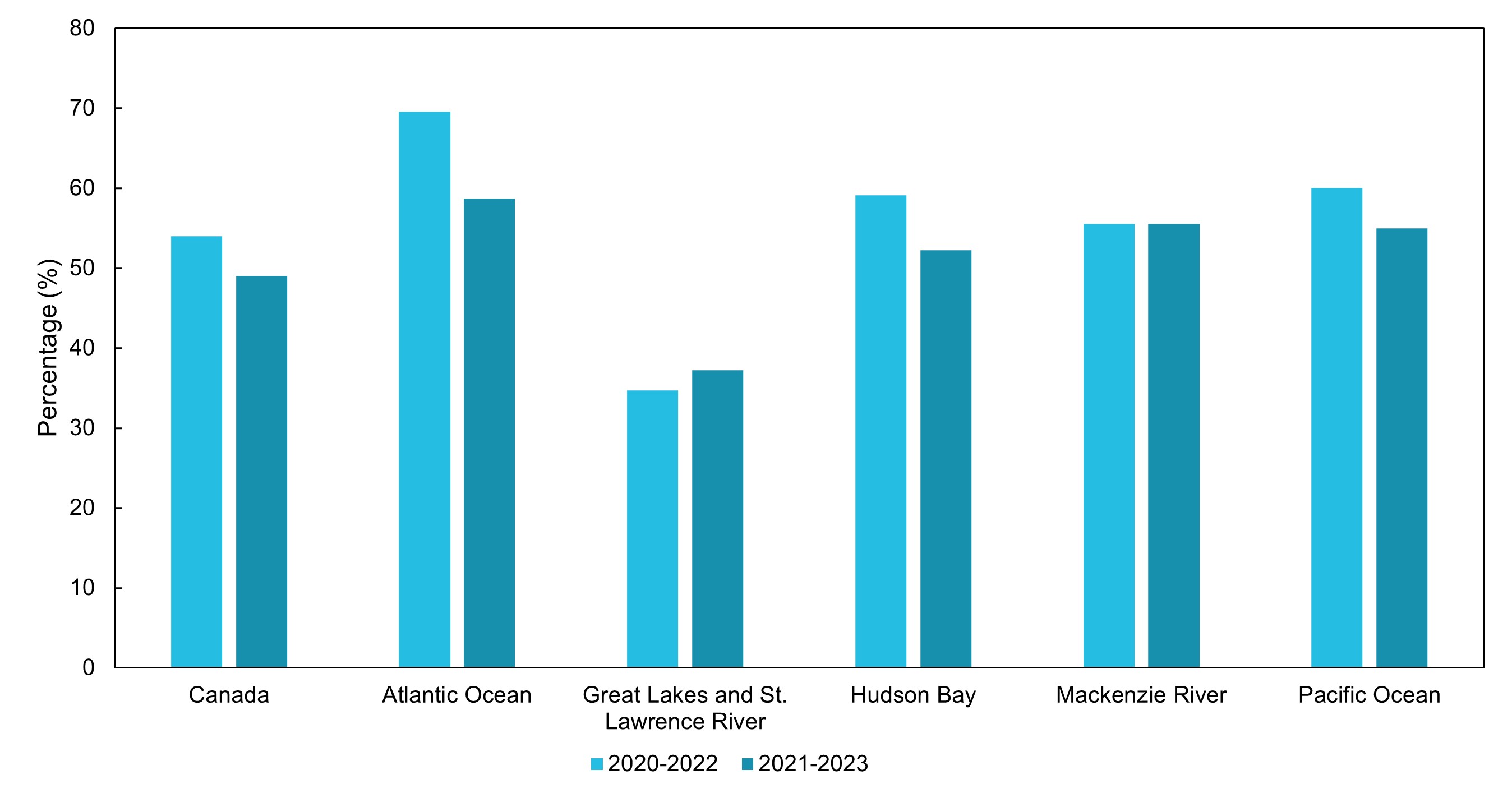
Text version of Figure 4
| Period | Canada | Atlantic Ocean | Great Lakes and St. Lawrence River | Hudson Bay | Mackenzie River | Pacific Ocean |
|---|---|---|---|---|---|---|
| 2020-2022 | 54 | 70 | 35 | 59 | 56 | 60 |
| 2021-2023 | 49 | 59 | 37 | 52 | 56 | 55 |
- Source : Canadian Environmental Sustainability Indicators Program, Water quality in Canadian rivers
For all rivers monitored in the country during the most recent monitoring period (2021-2023), the proportion of Canadian rivers rated as having good or excellent water quality was 49% (Figure 4). This represented a decrease of 9.3% from the previous period, but an increase of 19.5% since the start of the 2030 Agenda for Sustainable Development.
At the regional level, four of the five regions had more than half of their monitoring sites with good or excellent water quality. Three of these four regions have shown a downward trend since 2020-2022, with the largest decline observed for the Atlantic Ocean region. In contrast, water quality in the Mackenzie River region remained largely unchanged.
The Great Lakes and St. Lawrence River region was an exception with the proportion increasing from 35% in 2020-2022 to 37% in the following period. However, it is the region with the lowest proportion of monitoring sites where water quality is rated good or excellent. This could be related to the fact that across the country, the lowest proportions of sites with good or excellent quality are in the most populated sectors, particularly where there is greater human, industrial, agricultural, and mining activity.Footnote 15 Conversely, as is the case for the Atlantic Ocean region, the highest proportions of sites with good or excellent quality are in areas with little or no human activity or with low population density.
Percentage of wastewater systems where effluent quality standards are achieved
Canada is home to 20% of the world's freshwater reserves,Footnote 16 underscoring the importance of protecting this resource through wastewater treatment. Compliance with effluent quality standards by wastewater treatment systems is critical to the sustainable development of this resource and is a priority for the Government of Canada. This goal is tracked using the percentage of wastewater systems in Canada where effluent quality standards are achieved as well as the equivalent indicator which measures progress on reserves.
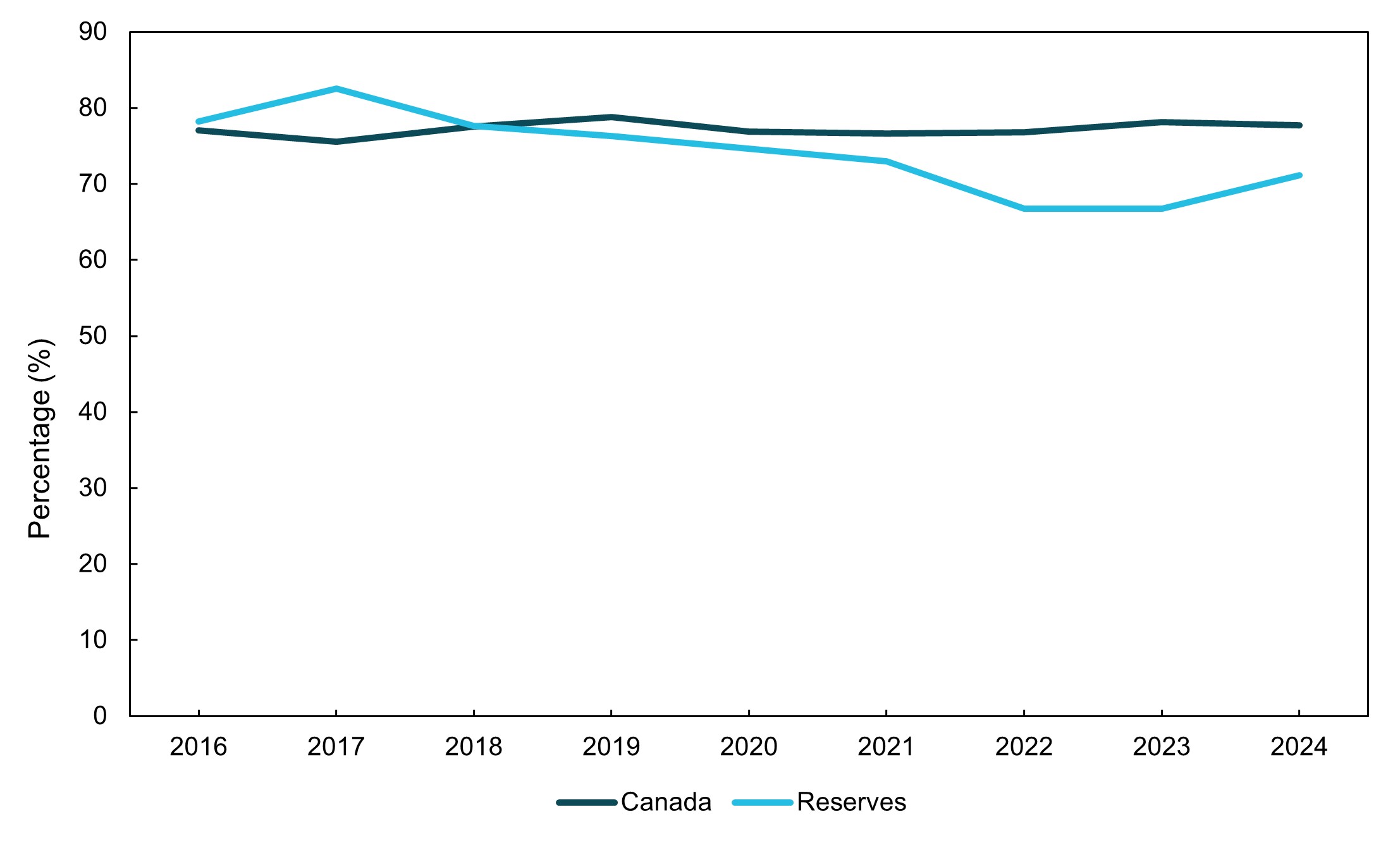
Text version of Figure 5
| Year | Canada | Reserves |
|---|---|---|
| 2016 | 77.0 | 78.2 |
| 2017 | 75.5 | 82.5 |
| 2018 | 77.5 | 77.6 |
| 2019 | 78.8 | 76.3 |
| 2020 | 76.9 | 74.6 |
| 2021 | 76.6 | 73.0 |
| 2022 | 76.8 | 66.7 |
| 2023 | 78.1 | 66.7 |
| 2024 | 77.7 | 71.1 |
- Source: Environment and Climate Change Canada
Domestic indicator 6.6.1: Percentage of wastewater systems in Canada where effluent quality standards are achieved

The percentage of wastewater systems meeting effluent quality standards in Canada was 77.7% in 2024, down slightly from 78.1% in 2023 (Figure 5). There has been limited progress from the 2016 level (77.0%) toward the target of ensuring 100% of wastewater systems in Canada meet effluent quality standards by December 2040.
Timelines established over a 25-year period by federal regulations to ensure compliance with effluent quality standards in communities partly explain the stable trend observed. In addition, growth from 2015 to 2020 in the number of existing systems that will need to be upgraded may also have contributed to low compliance. Furthermore, although investment in wastewater infrastructure increased between 2018 and 2024, it has not resulted in any significant improvement in the compliance rate, which remained generally stable.Footnote 17
Domestic indicator 6.5.1: Percentage of wastewater systems on reserves where effluent quality standards are achieved

On reserves, 71.1% of wastewater treatment systems met effluent quality standards in 2024, a decline of approximately 7 percentage points compared with 2016.Footnote 18 This trend shows a deterioration with respect to the target of ensuring 85% of wastewater treatment systems on reserves meet effluent quality standards by December 2030. Despite the decrease observed since 2016, this rate still represents an increase from the 2023 level (66.7%). The Government of Canada's support to First Nations to assume full control over their wastewater management, particularly with the Atlantic First Nations Water Authority, may have contributed to recent progress observed. However, the lack of comprehensive data for First Nation wastewater facilities limits the interpretation of this indicator.
SDG 6 Feature stories
Water, ice, snow: advancing Métis leadership in a changing climate
For Métis communities, water has always been the first road and the first teacher. Yet, across the Homeland many citizens describe how that relationship is under strain. Climate change has altered ice cover, spring runoff, and created extreme weather events, such as flooding. These have directly affected the health of waterbodies and ecosystems that Métis families have relied on to fish, gather medicine, and travel safely between communities.
Métis governments continue to face challenges in access to the policy tables where standards are set. Administrative changes within Canada, including the creation of the Canada Water Agency in 2023 and new federal approaches to watershed governance, opened opportunity but also highlighted barriers. These challenges have inspired renewed actions to ensure that everyday reliance on rivers and lakes is reflected in national planning.
The Métis National Council (MNC) Nature Strategy, developed by the MNC and the Governing Members in 2025, serves as a national advocacy tool that reinforces the central role of Métis governance, culture and rights in caring for all our relations. One of the priority areas of the Nature Strategy is "Water, Ice and Snow" which elevates distinctions-based water priorities and a pathway forward. Key actions to advance this priority include:
- Create space for water protectors to lead in water governance;
- Advance Métis inclusion at all levels of water governance;
- Include Indigenous culture, language and ceremony in water governance; and
- Community-led water quality monitoring under the Métis Guardians Program.
The creation of the Nature Strategy and priority areas identified within are rooted in Keeoukaywin - the visiting way - and relied upon broad cooperation from Elders, youth, technical staff and elected leaders from the Métis Nation of Ontario and the Otipemisiwak Métis Government in Alberta, who walked and paddled this journey together. The MNC continues to collaborate with a multitude of partners who are learning to braid Indigenous Knowledge with western science and continues to build partnerships with other Indigenous kin both nationally and internationally to help illustrate how watersheds connect us beyond borders.
In 2025, their work produced tangible progress, such as:
- New community monitoring activities through the Guardians Program.
- Greater transparency of Métis water research available to Canadians.
- Métis input incorporated into Canada's National Biodiversity Strategy and Emergency Management planning.
Water stewardship is inseparable from Métis identity. Administrative burdens ease when partnerships trust communities directly. True conservation must be about relationship and reciprocity, not exclusion. As long as the waters flow clean, the Métis Nation shall have water to sustain itself; and when Métis are present at the table, the menu for the future changes in favour of the next seven generations.
Shared stewardship for shared waters
Watersheds in Canada are increasingly threatened by climate change, biodiversity loss, and pollution. Environments are changing faster than institutions can adapt. There is widespread recognition across the country of these challenges, but efforts to protect and restore watershed health remain fragmented across multiple jurisdictions, sectors, and rights holders. That's why Our Living Waters (OLW) is working to build capacity and connections for collective action.
With relationships at the heart of their work, OLW serves 300+ watershed organizations across Canada by connecting and amplifying collective impact.
OLW works to increase collective resilience by observing national trends and sharing solutions across regional hubs. It facilitates dialogue about opportunities and challenges related to funding, emerging technologies, and practices for translating data into policy. It supports coordination across academia, government, nonprofits and grassroots groups to advance watershed health using community-informed impact measures.
For example, OLW launched a Shared Measurement System (SMS) - the only national, open-source data framework that builds coherence across a fragmented watershed governance system. It is in alignment with the SDGs and enables the national water community to track progress towards the common agenda of all waters in good health by 2030.
From November 2024 to early 2025, OLW fostered dialogue to explore potential pathways for modernizing how we measure collective action and investment in watershed health to facilitate timely, accessible, and user-friendly information, as well as First Nations, Métis and Inuit priorities for action.
OLWs says, "The only way forward is to maintain strong connections between organizations, share our learnings, and recognize that every region and territory holds part of the solution. That's what allows us, together, to protect the health and flow of freshwater bodies across Canada."
Turning cigarette butts into action: youth-led water protection
In LaSalle, Quebec, one kind of litter kept showing up everywhere. Cigarette butts. They sat along sidewalks, near bus stops, and in parks. Most people walked past them without noticing. Michael Lecchino, founding member and President of the Conseil jeunesse de LaSalle, used to do the same.
But cigarette butts are not harmless. Each one contains more than 2,000 toxic chemicals. When they break down, those chemicals can leak into waterways and harm wildlife. A single butt can contaminate up to 500 litres of water.
That is why Michael co-founded the 5000x500 initiative. He wanted to take on a problem that was common, overlooked, and directly linked to water pollution. The initiative set a clear goal that people could picture: collect at least 5,000 cigarette butts. Show the scale of the issue and spark action.
To make it happen, they worked with Chantiers Jeunesse through the Canada Service Corps to secure funding. It covered gloves, containers, and simple collection equipment so volunteers could take part safely. They then spread the word through social media and local community Facebook groups.
Over the course of the initiative, more than 25 volunteers joined in from across LaSalle. They gave out collection kits and focused on areas where cigarette waste was concentrated, like parks, sidewalks, and transit stops. People started to see their neighborhood differently. Several said they had never realized how many cigarette butts lined their streets until they began looking closely.
By the end, they had collected 5,844 cigarette butts, surpassing their original target. Based on the estimated contamination impact per butt, that helped prevent the contamination of about 2,922,000 litres of water.
The impact went beyond the number. The project opened up a public conversation about cigarette waste and pushed residents to think twice about disposal. It also sparked discussions at the borough level about practical solutions, like adding outdoor ashtrays in key locations.
One lesson was simple. People care when the problem is made visible. When youth lead with a clear goal, the community follows. And small actions, done together, can protect the water we all share.
When science bridges continents
Africa's Great Lakes, Victoria, Tanganyika, Malawi/Niassa/Nyasa, Albert, Edward, Kivu, and Turkana, have long been the beating heart of East and Central Africa. They feed millions, shape cultures, and hold some of the richest freshwater biodiversity on Earth.
But the lakes are changing. Fish populations are in decline. Climate pressures are mounting. And while scientists across the region work tirelessly, their efforts are often isolated, separated by borders, limited resources, and a lack of shared data.
In Canada, freshwater lakes also face growing pressures from climate change, nutrient pollution, invasive species, and increasing human development.
Out of these challenges a partnership began to form, one that stretched across the Atlantic Ocean. The African Center for Aquatic Research and Education (ACARE) joined forces with the IISD Experimental Lakes Area (IISD-ELA).
Located in northwestern Ontario, IISD-ELA is the world's only whole ecosystem experimental research station. At IISD-ELA, scientists turn entire lakes into living laboratories to uncover how ecosystems react. To learn more, listen to IISD-ELA's TEDx Winnipeg talk, "We should pollute the environment more."
Together, ACARE and IISD-ELA worked to build a scientific community working across seven countries and two continents to protect the lakes that millions depend on.
The first step is people. Through the African Women in Science program, 10-15 early to mid‑career female researchers from African Great Lake countries take part in a 10-month leadership program, focused on networking, mentorship and cross-continental exchange.
Dimple Roy, the Director of Water Management at IISD, explains, "Women scientists from across Africa bring expertise, innovation, and leadership to our collaboration at IISD-ELA. When they visit, they exchange knowledge with Canadian researchers in hands-on field and lab settings. These partnerships have strengthened confidence, visibility, and leadership opportunities for women across the network, with more women now taking on influential roles in advisory groups and scientific decision-making."
Next comes knowledge. The partners are developing a shared, open access information system. Standardized monitoring protocols are being created so that water quality, fish stocks, and ecological changes can be tracked consistently across all seven lakes. For the first time, researchers in Uganda, Tanzania, Malawi, Kenya, Rwanda, Burundi, and the DRC can speak the same scientific language.
But collaboration doesn't stop at the lab. The partnership works to align lake management priorities across borders, helping governments and communities build strategies for climate resilience, biodiversity protection, and pollution reduction. As IISD-ACARE grows, there are aspirations for citizen science programs involving local residents to take part in monitoring their own waters, turning stewardship into a shared responsibility.
Slowly, a network has taken shape between African and Canadian scientists, policymakers, and communities. Advisory groups have formed. Joint research projects have launched. Scientists come together in person every year to build relationships and share knowledge.
This is the story of people coming together across continents to protect some of the world's most vital freshwater ecosystems. It's a story of partnership, empowerment, and the belief that when people unite across borders, they can change the future of entire regions.
SDG 7: Affordable and clean energy
SDG 7 Policy context
Affordable, reliable and clean energy is central to Canada’s fight against climate change and its low‑carbon economy. In 2025, the government, through close collaboration with provinces and territories, contributed to the expansion of access to reliable, non‑emitting sources such as wind, solar, hydro, nuclear, and bioenergy. Canada is a global leader with the proportion of electricity generated from renewable and other non-greenhouse gas emitting sources being approximately 80% in 2024.
Building a clean electricity future
Launched in 2024, Powering Canada's Future: A Clean Electricity Strategy provides a national roadmap to grow and modernize Canada's electricity grid while ensuring it remains clean and resilient. The strategy focuses on regional collaboration, managing demand, and providing policies to support investment in clean energy infrastructure. It also supports Indigenous leadership in clean electricity transition.
The Clean Electricity Regulations, finalized in December 2024, phase-in emissions limits for large grid-connected fossil fuel-based electricity generation beginning in 2035 with a requirement to reach net-zero by 2050, and include flexibility measures to support reliability and affordability. The Regulations send a clear signal to the electricity sector to invest in low and non-emitting electricity infrastructure.
Enabling legislation for the Clean Electricity Investment Tax Credit has now received Royal Assent. This investment tax credit is meant to encourage investment in certain low-emitting electricity generation systems, certain stationary electricity storage systems, and equipment for the transmission of electricity between provinces and territories.
The Output-Based Pricing System (OBPS) Proceeds Fund supports projects to reduce emissions and promote clean energy, such as clean electricity generation, energy efficiency, energy storage, electricity transmission upgrades, and building heating retrofits. In 2025, 13 funding agreements were executed and 4 projects completed under the program, representing approximately $65M in Government of Canada contributions.
Advancing technology innovation and energy efficiency
Canada drives innovation and economic transformation through strategic investments in energy research, development, and demonstration (RD&D), the deployment of clean technologies, and the enhancement of digital tools and data infrastructure. For example, the Government of Canada invested approximately $1.7BFootnote 19 in energy RD&D projects in 2024 to 2025 across 25 departments and agencies through initiatives such as the Energy Innovation Program, the National Research Council of Canada Industrial Research Assistance Program,.
Innovative Solutions Canada (ISC) is a government-wide innovation program that leverages procurement to accelerate the development of Canadian technologies and the scale-up and growth of small and medium-sized enterprises (SMEs). It partners with departments to fund the development, testing and procurement of Canadian innovations. Since its launch in 2017, Innovative Solutions Canada has supported the development of 251 early-stage development and testing projects in clean and environmental technologies.
Separately, in 2025 Natural Resources Canada's suite of energy innovation programs, funded over 350 research, development, and first-of-a-kind demonstration projects and related scientific activities by Canadian innovators who are working to develop and scale up new made-in-Canada clean energy technologies and solutions. Projects are also working to lower barriers to adoption, build Canadian expertise and supply chains, and support modernization of regulations, market arrangements and business models, so that clean energy solutions can be broadly accessible and economically feasible.
The Canada Greener Homes Initiative helps homeowners make energy‑efficient upgrades, reducing energy poverty and improving affordability for lower income households. The recently concluded $2.6-billion investment in the Canada Greener Homes Grant has reduced energy use in more than 400,000 homes, and the $2.6 billion Canada Greener Homes Loan committed over 119,000 loans to help Canadians make their homes more energy efficient.
The new Canada Greener Homes Affordability Program will increase energy affordability through no-cost home retrofits for low- to median-income Canadians, including improvements to insulation and heating and cooling systems. In addition, the Oil to Heat Pump Affordability program helps low- to median-income households that heat their homes with oil to switch to electric heat pumps.
The Green Municipal Fund (GMF), funded by the Government of Canada through the Federation of Canadian Municipalities (FCM), supports innovative and scalable municipal environmental projects. From 2024 to 2025, the GMF's Community Efficiency Financing program supported 16 municipalities across Canada in establishing local, property assessed clean energy, home retrofit programs. In addition, from 2024 to 2025, FCM's Sustainable Affordable Housing program approved funding for the construction of 944 new, affordable, energy efficient housing units, and supported plans and studies for a further 9,247 units.
Canada is improving energy efficiency in buildings through updated codes for new construction while incentivizing deep retrofits for existing buildings. Since 2023, the Codes Acceleration Fund has supported the adoption of the highest feasible energy performance tiers of the national model energy codes. In parallel, the Deep Retrofit Accelerator Initiative is supporting building owners in driving deep retrofit project implementation in commercial, institutional, and mid-or high-rise multi-unit residential buildings.
Industrial energy use represents a significant opportunity for efficiency improvements. Programs such as the Green Industrial Facilities and Manufacturing Program help industrial facilities in Canada implement energy efficiency and energy management solutions to improve industrial sector energy performance.
Supporting major renewable energy and grid modernization projects
By October 2025, the Smart Renewables and Electrification Pathways Program had approved 124 projects, adding over 3,100 megawatts (MW) of renewable capacity and almost 600 MW of energy storage. These investments support grid modernization and battery storage deployment needed to strengthen electricity reliability, integrate renewable energy, and support Canada’s clean electricity transition. Approximately half of these projects are Indigenous owned, underscoring Canada’s commitment to inclusive, community led clean energy development.
Through the Strategic Response Fund, Canada also invested $40 million in transformer production and high-voltage direct current research in Quebec to secure critical grid components and create more than 500 high skilled jobs, strengthening energy sovereignty.
The government has introduced a suite of tax measures called the Clean Economy Investment Tax Credits (ITCs) that support the transition to a clean economy, including the deployment of clean technologies, clean hydrogen production, CCUS and clean technology manufacturing. Budget 2025 confirmed the government’s intention to proceed with the implementation of the Clean Electricity investment tax credit and introduce legislation to deliver the enhancements to other existing Clean Economy investment tax credits. In addition, Budget 2025 also announced the extension of full credit rates under the Carbon, Capture, Utilization and Storage Investment Tax Credit (CCUS ITC) through 2035 (previously 2030) to support investment certainty and industrial decarbonization.
The Canada Growth Fund also supports Canada’s clean economy transition by using public investment tools to attract private capital to low-carbon projects and technologies, including CCUS, clean fuels and carbon removal solutions.
Through the First Nation Infrastructure Fund, Canada is supporting the transition of First Nations communities from diesel to clean energy through targeted projects that reduce reliance on fossil fuels for heat and power. One of the recent projects is the Wataynikaneyap Transmission Project, which will decrease the number of Ontario First Nations communities reliant on diesel-generated electricity by 64% when completed.
Canada is also investing $40 million in transformer production and high-voltage direct current research in Quebec to secure critical grid components and create more than 500 high skilled jobs, strengthening energy sovereignty. Other major programs such as the Energy Innovation Program, the Strategic Response Fund's Net-Zero Accelerator, and Industrial Decarbonization Program help companies lower emissions, develop new low-carbon processes, and bring green solutions to market.
The Canada Infrastructure Bank (CIB) invests in infrastructure projects across five priority sectors: public transit, broadband, green infrastructure, trade and transportation, and clean power and invests in Indigenous infrastructure across all these categoriesFootnote 20. Through investing in its Clean Power priority sector, the CIB has committed more than $4.9 billion to improve electricity interties and advance clean power generation, distribution and use.
Advancing clean fuels
Canada is accelerating its clean energy transition through strategic investments and regulations. Initially announced in September 2025 and formally introduced in Budget 2025, the Government of Canada committed to a $372 million Biofuels Production Incentive to support domestic biodiesel and renewable diesel producers. The program launched and became operational on January 1, 2026. This complements broader efforts under the Emissions Reduction Plan, such as Canada's Hydrogen Strategy, industrial carbon pricing and the recent government announcements to consider targeted amendments to the Clean Fuel Regulations to support Canada's domestic biofuels industry.
To ensure safe and scalable deployment, Canada is prioritizing codes, standards, and technical guidance for clean fuel production, delivery, and use-critical to meeting national emissions targets.
Budget 2025 also confirmed the government's intention to expand the Clean Hydrogen Investment Tax Credit to include projects that produce hydrogen through methane pyrolysis, allowing for another eligible production pathway to produce clean hydrogen for market.
Federal leadership
Through the Greening Government Strategy, federal departments continue to reduce emissions from buildings and fleets compared to 2005 to 2006 baseline levels. In 2025, the government surpassed its 40% emissions reduction target one year ahead of schedule en route to its 2030 goal to cut emissions by 50% from the baseline.
Along with these results, the Government of Canada launched a $10 million initiative to explore and invest in carbon removal technologies, capitalizing on Canada’s global expertise. Canada is also supporting the development and commercialization of carbon dioxide removal technologies through broader clean growth and innovation initiatives that aim to strengthen Canada’s competitiveness in emerging low-carbon markets. These efforts support the goal of federal government net-zero operations by 2050.
Canada's international role in accelerating the clean energy transition
The Government of Canada engages with key bilateral partners and multilateral organizations to advance clean energy technologies and equitable access to clean energy around the world. Canada is a founding member of the International Energy Agency (IEA) and actively supports its mandate to promote sustainable, reliable, and affordable energy globally. Canada and the IEA will co-host a major global conference on energy efficiency in Montreal in 2026.
Canada is also a founding member of the International Partnership for Hydrogen and Fuel Cells in the Economy (IPHE), which is an inter-governmental partnership whose objective is to facilitate and accelerate the transition to clean and efficient energy using hydrogen, fuel cells and hydrogen technologies. Canada will serve a 2-year term, as Vice-Chair of the IPHE starting in 2025.
Canada supports developing countries shift to low-carbon, more climate-resilient and inclusive economies. As of March 2025, Canada's climate finance commitments are expected to reduce, avoid or remove 759.1 megatonnes of greenhouse gas emissions.
For example, the Canadian Climate Fund for the Private Sector in the Americas initiative, or C2F, Phase 1 (2012 to 2037) and Phase 2 (2019 to 2044), as well as the Canadian Net Zero and Climate Resilience Accelerator (2024-2049) initiative, provide loans at below-market rates combined with financing from the private sector arm of the Inter-American Development Bank-IDB Invest-to stimulate private sector climate investments in Latin America and the Caribbean. This helps to start large projects in key sectors such as renewable energy, energy efficiency, biofuels, or sustainable agriculture and forestry that would not otherwise take off on purely commercial terms. Canada's support is expected to abate 90 megatonnes of CO2 emissions over the life of these three funds. In fact, the C2F (Phase 1) has already reduced 7,804,159 tons of CO2 as of March 2026 - the equivalent of removing 2.6 million passenger vehicles from the road for a year.
In the Indo-Pacific region, Canada established, at the Asian Development Bank, the Canadian Climate Fund for the Private Sector in Asia (CFPS), Phase 1 (2013-2040) and Phase 2 (2017 to 2046), and more recently, the Canadian Climate and Nature Fund for the Private Sector in Asia (2024 - 2051). Canada's financing helps to reduce project risk, making clean energy investments more attractive to private and commercial investors. Projects supported by these initiatives have so far generated over 19 billion kilowatt hours of power, enough to supply electricity to an estimated 2.5 million households across major developing countries in the Indo-Pacific for one year. They are also driving real climate impact-cutting over 10 million tons of greenhouse gas emissions as of March 2026, equivalent to removing nearly 3 million cars from the road.
From 2023 to 2024, Canadian funding enabled developing countries to reduce, avoid or remove an expected 282 megatonnes of carbon dioxide emissions from the atmosphereFootnote 21.
SDG 7 Statistical analysis
SDG 7 Affordable and clean energy
Domestic indicator 7.3.1 Total energy consumption per capita

The total energy consumption per capita indicator measures the consumption of different types of energy per capita. Total energy consumption per capita was 0.21 terajoule in Canada in 2024, unchanged from 2023. This is the lowest level since the start of the 2030 Agenda for Sustainable Development and a decrease of 0.02 terajoule per capita compared with 2015 (Figure 6). Despite an increase in total energy consumption from 2015 to 2024 (4%), growth in Canada's populationFootnote 22 (16%) has been sufficient to lead to a decrease in per capita energy consumption observed since 2015.
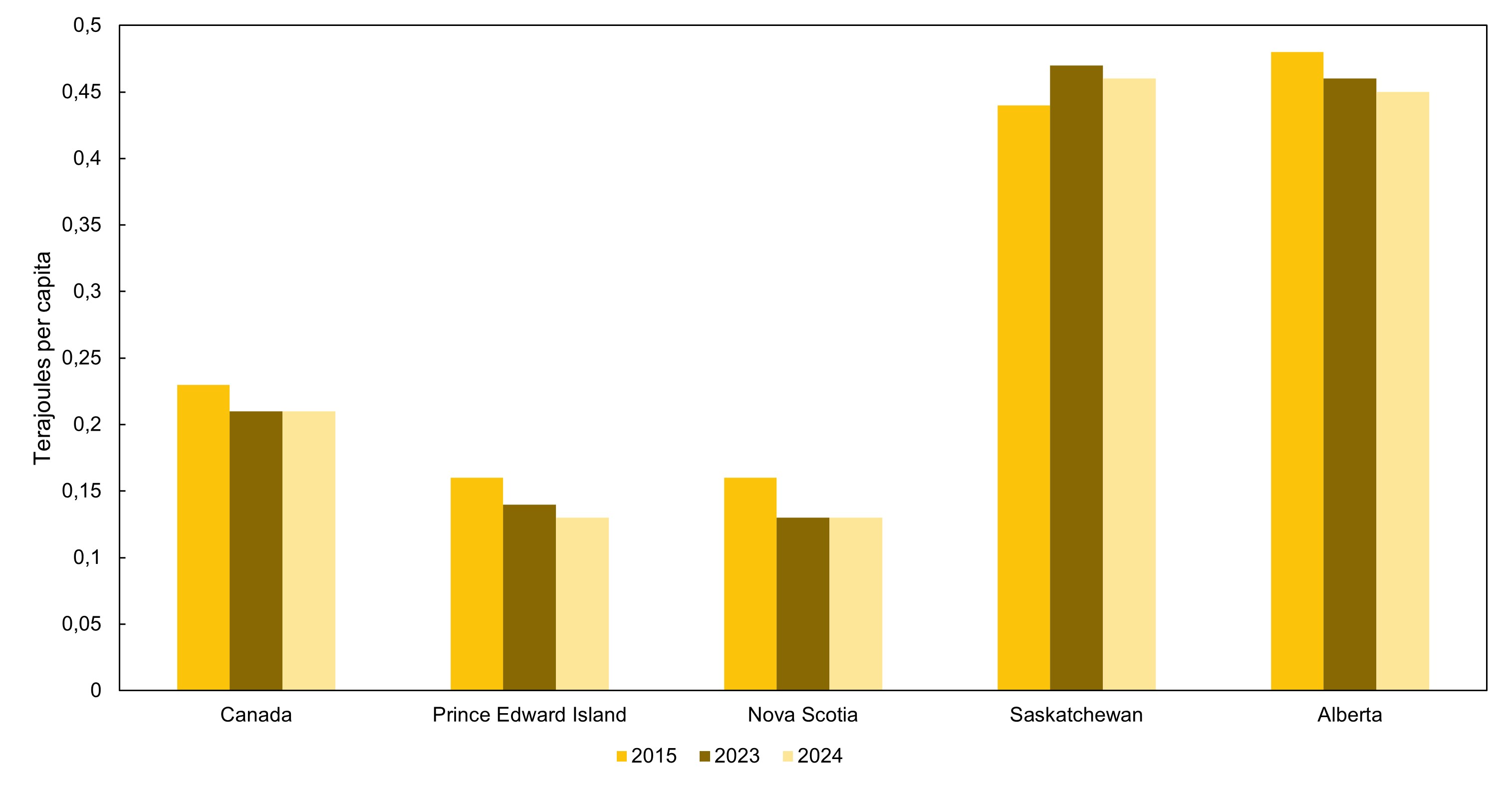
Text version of Figure 6
| Year | Canada | Prince Edward Island | Nova Scotia | Saskatchewan | Alberta |
|---|---|---|---|---|---|
| 2015 | 0.23 | 0.16 | 0.16 | 0.44 | 0.48 |
| 2023 | 0.21 | 0.14 | 0.13 | 0.47 | 0.46 |
| 2024 | 0.21 | 0.13 | 0.13 | 0.46 | 0.45 |
- Source: Statistics Canada, Supply and demand of primary and secondary energy in terajoules, and Statistics Canada, annual population estimates
Provincially, Alberta and Saskatchewan were the two Canadian provinces with the highest per capita energy consumption in 2024. Alberta's energy consumption was 0.45 terajoule per capita in 2024, its lowest level for the period and down from 2015 (0.48) and 2023 (0.46). In Saskatchewan, consumption was 0.46 terajoule per capita in 2024, the highest level in the country. Despite the recent decline from 2022 to 2024 (-0.02 terajoule), Saskatchewan is the only Canadian province to have seen an increase in per capita energy consumption since 2015.
In both Alberta and Saskatchewan, the proportion of energy intensive industries is above the Canadian average and energy consumption by these industries has also increased since 2015. These are also the two provinces with the lowest proportion of electricity generated from renewable and other non-greenhouse gas emitting sources in Canada in 2024.
The two provinces with the lowest per capita energy consumption in 2024 were located in the Maritimes: Nova Scotia (0.13) and Prince Edward Island (0.13). Both provinces have seen a downward trend since 2015.
Global indicator 7.3.1 (Proxy): Energy intensity
Progress on SDG 7: Affordable and clean energy is measured in part by indicator 7.3.1, which estimates energy intensity, a measure of a country's energy consumption as a function of economic activity.
Energy intensity was 3.463 terajoules per million dollars of real GDP in 2024, representing a 12.9% decline since 2015 (Figure 7). Canada has therefore increased its energy efficiency by reducing the energy required to produce each unit of GDP. However, this trend represents limited progress in achieving the established target of halving 2015 energy intensity levels by 2030. An increase in GDP (+19.5%)Footnote 23 greater than the growth in final energy consumption (+4.0%) observed between 2015 and 2024 apparently contributed to Canada's progress.
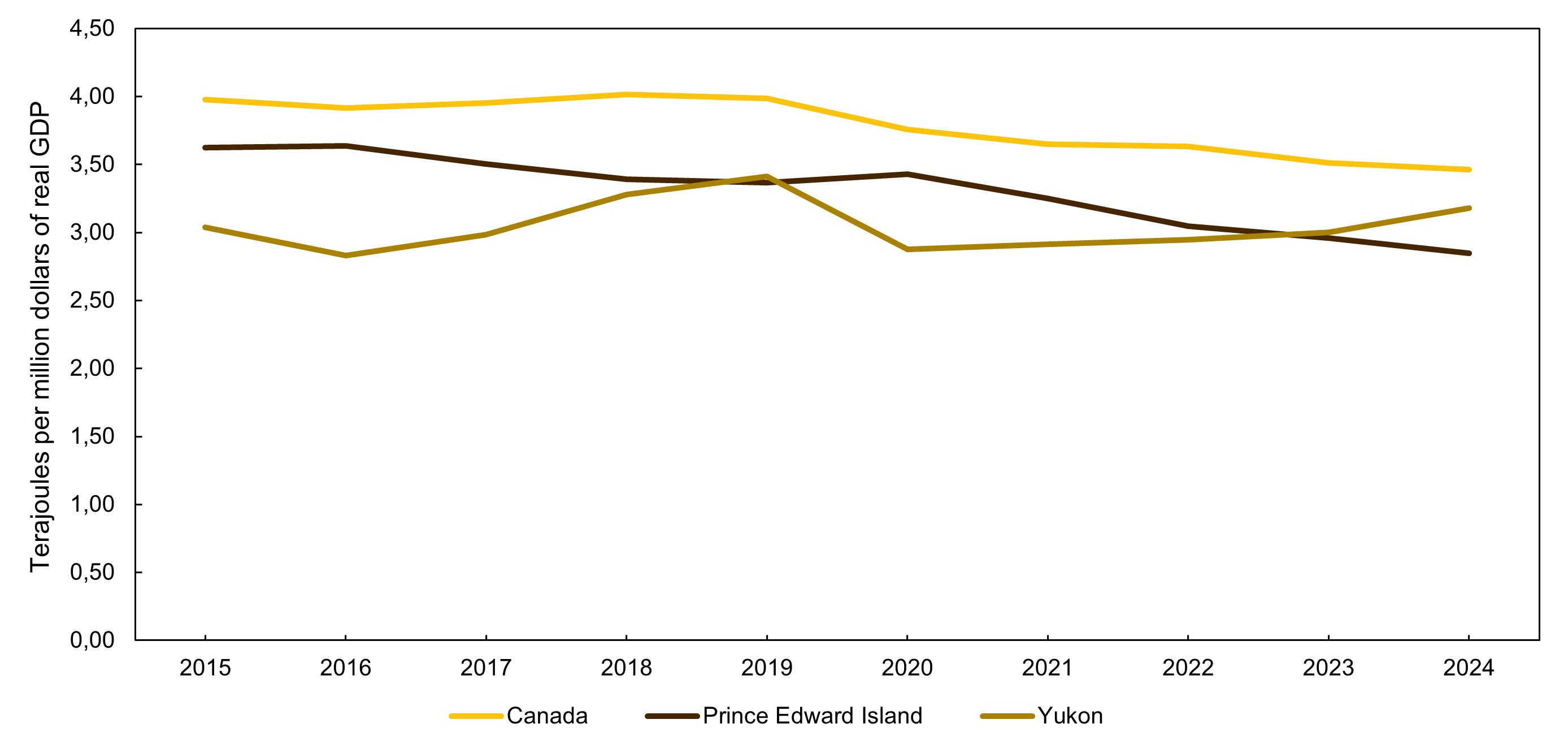
Text version of Figure 7
| Geography | 2015 | 2016 | 2017 | 2018 | 2019 | 2020 | 2021 | 2022 | 2023 | 2024 |
|---|---|---|---|---|---|---|---|---|---|---|
| Canada | 3.977 | 3.917 | 3.952 | 4.015 | 3.985 | 3.755 | 3.648 | 3.632 | 3.513 | 3.463 |
| Prince Edward Island | 3.626 | 3.636 | 3.503 | 3.391 | 3.365 | 3.430 | 3.251 | 3.048 | 2.959 | 2.847 |
| Yukon | 3.038 | 2.830 | 2.983 | 3.278 | 3.413 | 2.877 | 2.915 | 2.945 | 3.002 | 3.179 |
- Source: Statistics Canada, Supply and demand of primary and secondary energy in terajoules, and Statistics Canada, Gross domestic product, expenditure-based, provincial and territorial
Energy intensity improved in all provinces and territories between 2015 and 2024, with the exception of Yukon and Saskatchewan. More recently, Yukon and Nunavut were the only places in the country where energy intensity deteriorated from 2023 to 2024. However, energy intensity in these territories remains lower than the Canadian average. A decline in energy consumption (0.9%) from 2023 to 2024 in Yukon was not sufficient to counter a 2.5% decline in GDP due in part to a slowdown in mining activity following the suspension of operations at the Eagle gold mine in the territory.Footnote 24,Footnote 25
On the other hand, the greatest improvement in energy intensity from 2023 to 2024 was in Prince Edward Island (-3.8%). A slight decrease in energy consumption between 2023 and 2024 combined with the largest increase in GDP among the provinces as a result of a sharp increase in service industries led to an improvement in energy intensity.Footnote 26
SDG 7 Feature stories
The line that brings light: the largest Indigenous-led electricity project in Canadian history
Across northern Ontario in the late 1990s, the homes, schools, and businesses of more than 18,000 people were at the mercy of rolling power outages from costly, unreliable diesel generators. This led to school closures, food spoilage, constraints on the construction of new homes and facilities, and limited access to medical care.
In response, 24 First Nations communities partnered together for the betterment of their communities, resulting in the Wataynikaneyap Power Transmission Project: 1,800 kilometres of transmission lines powering some of Canada's most remote areas with clean, reliable energy.
Wataynikaneyap means "line that brings light" in Anishininiimowin.
This line of light has sent ripples through the Ontario's energy industry, forever altering how energy infrastructure is built in the province. Wataynikaneyap is the largest Indigenous-led electricity project in Canadian history. It connects 16 remote First Nations communities to Ontario's power grid and eliminates the need for emissions-intensive diesel generators. Ultimately, 17 communities will be connected by 2026.
The 24 First Nations communities negotiated a 51% ownership stake in the project, with the remaining 49% held by private investors. In a landmark agreement that sets a new precedent for Indigenous participation in energy infrastructure, the 24 First Nations communities have established a pathway for full ownership of the transmission line within 25 years-ensuring long-term control, equity, and economic empowerment.
First Nations leadership established Guiding Principles that set out expectations to ensure Indigenous protocols, rights, and ways of life were part of every aspect of the project's requirements. Hatch Ltd provided this story and said, "we were honored to be chosen as Owner's Engineer and trusted to uphold these Principles with all parties working on the project."
The new transmission system eliminates an estimated 6.6 million tons of greenhouse gas emissions, the equivalent to taking 35,000 cars off the road.
But more than that, the line brings new opportunities to the First Nations communities and has resulted in a new era of energy infrastructure development in Ontario. Hydro One, and other energy utilities, have made an official policy to offer First Nations a 50% equity stake in all new transmission lines valued over $100 million.
Lighting the way for seven generations and beyond, this is more than a power transmission project. It's a lifeline. A symbol of what's possible when technical excellence meets cultural respect.
The Digital2030 Challenge: Youth Driving Sustainable AI
Digital Moment's Digital2030 program invites youth to step into the future by using digital skills to take action for a more sustainable world. Rooted in the SDGs, the Digital2030 Challenge began in 2021 as a decade‑long promise: ten online Challenges that help young people use Artificial Intelligence (AI), data, and coding to tackle some of the world's most pressing problems.
The Challenge that was in-focus in 2025 was built around a big question: "How Sustainable Is AI?"
AI can drive incredible progress, but it also comes with a significant environmental footprint. Through Digital Moment's work with educators, they learned that many classrooms lack accessible, age-appropriate resources that connect digital literacy with climate action. The 2025 Challenge was designed to fill that gap. It focused on SDG 7 (Affordable and Clean Energy) and SDG 9 (Industry, Innovation, and Infrastructure), inviting youth to explore AI's energy footprint and imagine a more resilient, eco‑friendly digital infrastructure.
The Challenge begins with learning how AI systems are trained and how much energy they consume. Then youth step into the role of AI engineers through an interactive game. They make choices across four variables-hardware, dataset size, cooling method, and energy source. Each decision affects both AI performance and environmental impact. With instant visual feedback, participants start thinking like systems designers, asking themselves questions such as "How did your choices balance performance and energy consumption?" and "Is a perfect solution possible?"
The 2025 Challenge helps youth shift from passive technology use to active digital stewardship. By December 2025, more than 10,000 participants had taken part. To reach even more young people, Digital Moment partnered with Exploring By the Seat of Your Pants. Their national broadcast platform made it possible to run live, interactive sessions with multiple classrooms at once. Through this collaboration, over 1,150 students across Canada connected directly with Digital Moment facilitators, no matter where they lived or what resources their schools had. More sessions are planned for 2026.
To support educators, Digital Moment created comprehensive Educator Discussion Guides with extension activities linking AI, clean energy, and climate action. These tools help teachers confidently lead conversations at the intersection of technology and sustainability. As one educator shared, "The Sustainable AI Challenge working document is very timely. It will enrich our discussions on the responsible use of AI in our Science & Technology modules. Many organizations encourage young people to train in AI but fail to address the societal and environmental impact in depth."
One key lesson has become clear: meaningful SDG‑aligned education needs both strong content and inclusive, scalable delivery. While structured learning materials provide a solid foundation, long‑term partnerships with broadcasting and community organizations are essential to ensure equitable access and lasting impact. Addressing complex goals like SDG 7 and SDG 9 requires evolving collaborations that keep pace with rapid technological change-an approach Digital Moment is committed to advancing.
Powering the transition: easing pressure on Canada's electricity grid
The humble electricity grid, often taken for granted, is facing increasing pressure from electrification and renewable energy. A partnership between the University of Alberta and FortisAlberta is helping to ensure Canada's power supply remains stable.
University of Alberta engineering professor Ryan Li and his team are tackling the critical issue of "de-bottlenecking" distribution systems, a challenge made urgent by electric vehicles (EVs) and other new electrical loads.
"If everybody's charging at the same time, there is a huge stress on the distribution system, which is not designed to deal with these types of new loads," explains Li.
While the current power system predominantly uses AC (alternating current), many new technologies are based on direct current, or DC. Li says the advantage of DC becomes clear when considering the surge in electric vehicle adoption.
"What's going to happen when all these residential electric vehicles get plugged in, in a future where so much more power is needed?"
The problem is compounded when EVs roll into a home that is not wired to charge the vehicle, which is the case for most homes built before 2010. The current bill to dig up the old cable and put in new cable capable of carrying the needed electrical load can start at $50,000.
To solve this problem, Li and his team are testing electricity converters that switch current between AC and DC, which can be installed to provide higher-powered DC voltage to homeowners without replacing the AC cable.
This approach also provides relief to the grid by reducing the need for constant transformer replacements that have been ongoing for the last decade.
Monique Schluff Soboren, senior engineer with FortisAlberta, says the uniqueness of this project - believed to be the first of its kind in the world - is not lost on her company.
"We phoned around everywhere; no one was doing this. We even phoned California; we thought, 'California has got to be doing something like this.' They're not, but they want to know all about it when it's finished," says Soboren. "From the utility point of view, all the utilities care about this, but FortisAlberta put our hand up to say, 'We want to work with you on this.'"
For the study, FortisAlberta has created a "fake house" at its employee training centre outside Red Deer that mimics the loads of a normal home to test the converters.
Li emphasizes the practical application of his research. "From the beginning, I've worked closely with industry partners."
This collaborative approach ensures that their theoretical contributions quickly translate into tangible benefits for society. His group has not only published numerous papers and a book on hybrid AC/DC technologies but has also directly contributed to the creation of startup companies driving innovation.
"Technology is evolving very fast," says Li. "We have to keep up, and part of that is producing a skilled workforce. That's a big contribution for the University of Alberta."
SDG 9: Industry innovation and infrastructure
SDG 9 Policy context
Canada's ambitions for SDG 9 are to foster sustainable research and innovation across the country, and to ensure people in Canada have access to modern and sustainable infrastructure. In 2025, the federal government continued to invest in clean technology, green infrastructure, and research to help communities and businesses adapt to climate change, cut greenhouse gas emissions, and stay strong in the global economy.
Investing in climate resilient infrastructure is crucial for Canada to mitigate increasing severity, frequency and impacts of climate change and natural hazards. These hazards can shorten the lifespan of infrastructure, disrupt service due to damage, or overwhelm systems during extreme weather events or gradual climate changes.
Supporting clean technology and research
The federal government is backing innovators who are creating cleaner ways of doing business in areas like transportation, energy, natural resources, infrastructure, and manufacturing. One key program, the National Research Council Canada Industrial Research Assistance Program, is offering support for Canadian small and medium enterprises to develop and advance clean technologies into products and services. It offers funding, expert advice, and industry connections to bridge the gap between research and commercialization.
Other major programs such as the Energy Innovation Program, the Strategic Response Fund's Net-Zero Accelerator, and Industrial Decarbonization Program help companies lower emissions, develop new low-carbon processes, and bring green solutions to market. For example, the Methane Centre of Excellence, launched in 2024, is advancing projects to better measure and cut methane emissions.
Canada is investing in research, development, demonstrations and front-end engineering studies to advance the commercial viability of carbon capture, utilization, and storage, and through the development of tools, such as the National Carbon Capture, Utilization and Storage (CCUS) Assessment Framework, to support Canadian governments and industry with strategic planning of CO2 capture/removal, transport and storage infrastructure.
Canada is also supporting the scale-up and commercialization of CCUS and carbon dioxide removal technologies through measures including the CCUS Investment Tax Credit, and support from the Canada Growth Fund to help accelerate industrial decarbonization and private sector investment in clean growth projects.
Since 2018, the Clean Energy for Rural and Remote Communities (CERRC) program has provided funding for renewable energy and capacity building projects to reduce the reliance on fossil fuels for heating and electricity in Indigenous, rural and remote communities across Canada.
Building greener infrastructure
Modern, climate-resilient infrastructure is key to Canada's future. By 2025, the federal government had approved $21.1 billion in green infrastructure projects, nearly reaching its $22.6 billion target for fiscal year 2027-2028.Footnote 27 These projects include energy-efficient public buildings, created or restored natural infrastructure, renewable energy systems, modernized waste, water and wastewater facilities, and stronger flood protections.
The federal government funds projects to foster innovation and green infrastructure through various programs. For instance, the Green and Inclusive Community Buildings program aims to improve energy efficiency in existing community buildings and support the construction of new net-zero carbon (or net-zero carbon ready) buildings by encouraging best practices in building design for climate change resilience.
Canada sees all infrastructure funding programs as opportunities to build climate resilience, an approach that aligns with the objectives of the National Adaptation Strategy. Some funding programs build climate resilience directly by supporting protective infrastructure, such as the Disaster Mitigation and Adaptation Fund or the Natural Infrastructure Fund. Together, from 2018 to 2025, these programs committed over $3.8 billion to 217 resilience-related projects across communities in Canada.
Other programs, like the Canada Public Transit Fund and the Canada Housing Infrastructure Fund, strengthen climate resilience by expanding essential infrastructure, with additional federal requirements to prevent disruption of these key infrastructure services due to climate hazards. An example includes considerations for natural infrastructure, while also supporting emissions reductions and use of lower-carbon ready-mixed concrete.
The Climate Toolkit for Housing and Infrastructure (CTHI) equips communities with tools, expert support and place-based data to consider and implement greener, low-carbon infrastructure and housing. In its first year, CTHI has supported more than 400 small, rural, and Indigenous communities across all provinces and territories to integrate climate resilience and emissions reduction into housing, water, transit, asset management planning and waste projects.
Through the Research and Knowledge Initiative, the federal government has been fostering research and knowledge-based collaborations, supporting innovative projects for climate mitigation and adaptation, and strengthening the evidence base on infrastructure and climate resilience challenges.
The Canada Infrastructure Bank's (CIB) Green Infrastructure priority sector invests in a range of projects that support Canada's transition to a low-carbon economy. Examples of these investments include the development of zero-emission vehicle infrastructure through its Charging and Hydrogen Refueling Infrastructure Initiative, and increased energy efficiency through the Building Retrofits Initiative.
Expanding zero-emission transportation
Transportation is one of Canada's largest sources of emissions, accounting for nearly a quarter of national greenhouse gas (GHG) emissions, with most originating from the on-road sector. A key strategy to lower these emissions is replacing fossil fuel powered vehicles with electric vehicles (EVs).
As affordability remains a key barrier to greater EV adoption in Canada, the federal government has offered incentives to help narrow the purchase price gap with comparable gas vehicles through the Incentives for Zero-Emission Vehicles program (iZEV). As of early 2025, the program had supported over 4,100 zero-emission vehicle purchases. Combined with other federal, provincial, and territorial measures, federal incentives have helped to increase new EV market share from 3.1% in 2019 to 15.4% in 2024.
As of 2025, the Government of Canada has invested over $1.7 billion to support public and private electric vehicle chargers, hydrogen fueling stations and enabling electricity infrastructure through Natural Resources Canada's Zero-Emission Vehicle Infrastructure Program (ZEVIP), Electric Vehicle and Alternative Fuel Infrastructure Deployment Initiative (EVAFIDI), and the Canadian Infrastructure Bank.
As of December 2025, the Government of Canada has selected for funding approximately 59,000 EV chargers, with approximately 34,900 in operation, meeting the 2026 target of 34,500, and working towards the 2029 target of 84,500 EV chargers. As of December 2025, the Government of Canada has supported 33 hydrogen refuelling stations, surpassing the 2026 goal of 25. These projects are making it easier to charge or refuel clean vehicles where Canadians live, work, travel, and play.
Through its transit initiatives, the federal government has approved support over 21,800 transit and school buses, including more than 8,800 zero-emission models.Footnote 28 The Zero-Emission Transit Fund offers support to public transit and school bus operators across Canada who are electrifying their fleets. Federal funding also supports associated infrastructure, such as charging facilities. Supporting these purchases is greatly accelerating the use of battery-electric transit buses by Canadian transit systems, from only 21 in service in 2019 to 333 in 2024.Footnote 29
As of 2025, the CIB's investments will enable the deployment of about 5,400 new electric vehicle fast charging ports and hydrogen refueling stations, along with investing about $1.4 billion through concessionary loans to modernize and improve energy efficiency in Canada's existing building stock.
Natural Resources Canada's Zero-Emission Vehicle Infrastructure Program (ZEVIP) is investing $630 million to support public and private electric vehicle chargers, making it easier for Canadians to charge where they live, work, travel and play. As of December 2025, ZEVIP has committed to funding over 52,000 EV chargers, over 33,000 of which are in operation.
Creating economic opportunities
Green investments also mean new jobs and stronger industries. Programs like the Global Innovation Clusters co-invest with businesses to speed up new technologies in areas such as advanced manufacturing, artificial intelligence, digital technologies, plant protein, and the ocean economy. Projects range from innovative low-carbon concrete to low-emission mining and energy-efficient ship coatings, helping Canadian businesses lead in fast-growing clean technology markets.
Both urban and rural Canadians rely on access to reliable, affordable, high-speed Internet and mobile connectivity to grow their businesses, apply for jobs, access services, and communicate with loved ones. The federal government is committed to helping bridge the connectivity gap and is on track to meet its goal of ensuring that, by end of 2026, 98% of Canadian households have access to high-speed Internet, and 100% of Canadian households by 2030.Footnote 30 In 2025, the federal government continued to help increase the number of households with high-speed Internet access by continuing major investments through the Universal Broadband Fund and by advancing High-Speed Access for All: Canada's Connectivity Strategy. As such, new high-speed Internet projects were announced for Internet Service Providers to extend their high-speed broadband infrastructure to more rural and remote communities
Canada's global engagement on infrastructure and economic growth
Canada is engaged in infrastructure and critical mineral initiatives that strengthen supply chains and foster sustainable development. For example, Canada is a committed member of the G7's Partnership for Global Infrastructure and Investment, which includes strategic projects such as the Lobito Corridor, an essential trade route for copper and cobalt, leveraging blended finance and public-private partnerships. Additionally, Canada is a major contributor to the G7 Resilient and Inclusive Supply Chain Enhancement (RISE) Partnership, which focuses on diversifying and securing global critical mineral supply chains while promoting investment and inclusive economic growth, as well as the Intergovernmental Forum on Mining, Minerals, Metals, and Sustainable Development, which convenes and leads sectoral capacity building efforts for its 86 member countries.
Under Canada’s 2025 G7 presidency, Canada has reinforced its global leadership on critical minerals through initiatives including the Critical Minerals Action Plan, the Critical Minerals Action Plan, the Critical Minerals Production Alliance, and the Roadmap to Promote Standards-Based Markets for Critical Minerals. These efforts advance sustainable, transparent, and responsible supply chains by developing minimum threshold standards on environmental protection, labour and human rights, anti-bribery, and rule of law, while promoting market-oriented investment and traceability. Collectively, these initiatives support the SDGs by encouraging socially and environmentally responsible mining, enhancing resource efficiency, and fostering resilient, high-standard global markets for critical minerals.
Looking ahead
Canada is moving steadily toward a low-carbon, innovation-driven economy. By investing in clean technology, modern infrastructure, zero-emission transportation, CCUS, carbon removal, battery storage, and industrial decarbonization technologies, the federal government is supporting communities, creating good jobs, and keeping Canada on track to reach net-zero emissions by 2050.
SDG 9 Statistical analysis
SDG 9 Industry, Innovation and Infrastructure
Domestic indicator 9.3.1: Proportion of households that have access to broadband Internet service at speeds of 50/10 Mbps

One of Canada's ambitions for Goal 9 is for Canadians to have access to modern and sustainable infrastructure. In 2024, 96.4% of Canadian households had access to high-speed Internet services,Footnote 31 up from 84.3% in 2016 (Figure 8). Canada is therefore on track to meet the domestic target of connecting all Canadians to high-speed Internet by 2030.
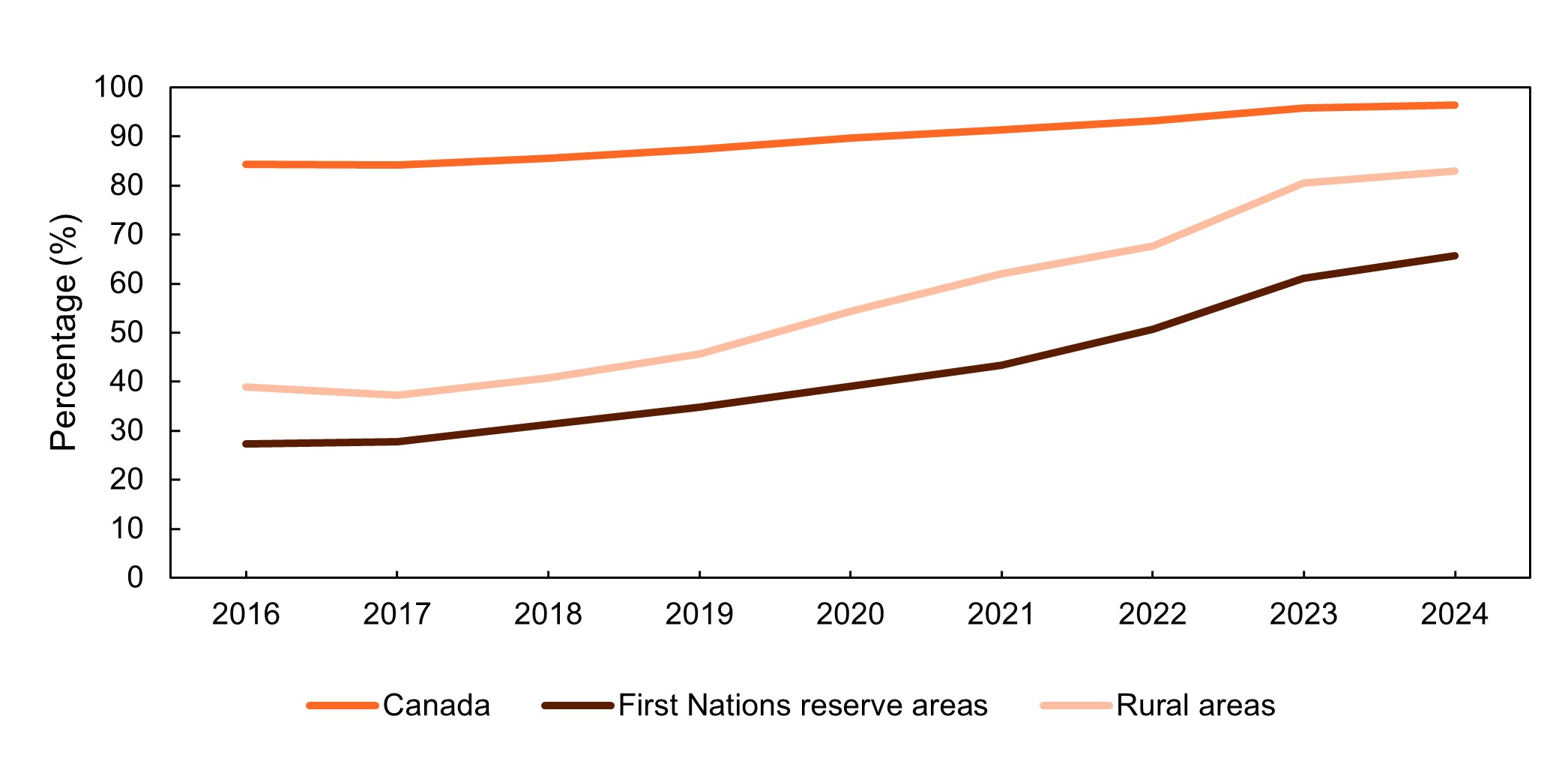
Text version of Figure 8
| Year | Canada | First Nations reserve areas | Rural areas |
|---|---|---|---|
| 2016 | 84.3 | 27.3 | 38.9 |
| 2017 | 84.1 | 27.7 | 37.2 |
| 2018 | 85.5 | 31.3 | 40.7 |
| 2019 | 87.4 | 34.8 | 45.6 |
| 2020 | 89.7 | 39.1 | 54.4 |
| 2021 | 91.4 | 43.3 | 62 |
| 2022 | 93.1 | 50.7 | 67.6 |
| 2023 | 95.8 | 61 | 80.5 |
| 2024 | 96.4 | 65.7 | 83 |
- Source: Canadian radio-television and telecommunications commission (CRTC)
High-speed Internet access rates varied across provinces in 2024 from a low of 87.3% of households in Saskatchewan to 98.8% in Quebec. In addition, all provinces have seen an increase in the proportion of households that have access to high-speed Internet services since 2018.
Households in rural and remote areas had lower rates of high-speed Internet access than the Canadian average between 2016 and 2024. However, increased investment in communications networks since 2016Footnote 32 has contributed to substantially narrow this gap.
Furthermore, access rates to high-speed Internet services in rural or remote areas increased in all provinces between 2018 and 2024. This was particularly evident for households in Prince Edward Island (from 31.4% to 94.8%), Manitoba (from 13.0% to 75.0%), Alberta (from 21.1% to 79.5%) and Ontario (from 29.5% to 77.5%). These advances coincided with investments from the Canada Infrastructure Bank (CIB) and the Universal Broadband Fund (UBF)Footnote 33 to improve access to high-speed Internet networks in rural and remote areas.
For households in First Nations reserve areas, access to high-speed Internet services rose from 27.3% in 2016 to 65.7% in 2024. This improvement coincides with funding from the First Nation Infrastructure Fund (FNIF) to help First Nations communities upgrade and increase public infrastructure to improve their quality of life and environment, including connectivity.Footnote 34
Domestic indicator 9.7.1: Remaining useful service life ratio of infrastructure assets

In a Canadian context where demographic changes, climate risks and housing pressures are increasing, Canadian residents and residences need appropriate infrastructure. Domestic indicator 9.7.1 is intended to measure the remaining useful service life ratio of infrastructure assets.Footnote 35
Since 2015, Canada has continued to meet its target of maintaining a remaining useful service life ratio of infrastructure assets of greater than 50%. This target has also been achieved by all provinces and territories across the country. Nationally, the ratio has improved from 2015 (58.2%) to 2024 (59.4%) (Figure 9). The province with the highest ratio in 2024 was Newfoundland and Labrador (64.6%), while New Brunswick had the lowest ratio (53.0%).
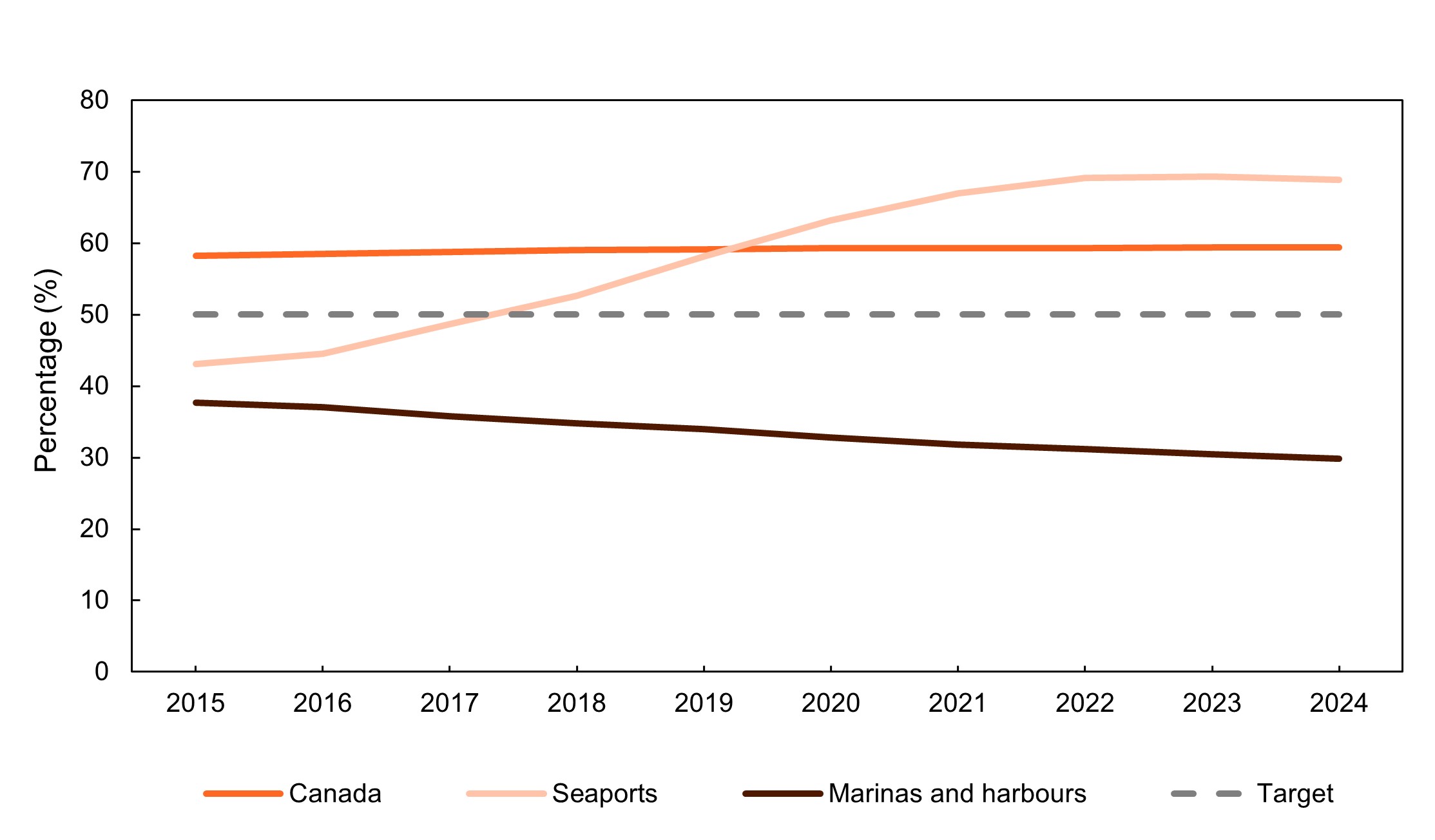
Text version of Figure 9
| Year | Canada | Seaports | Marinas and harbours | Target |
|---|---|---|---|---|
| 2015 | 58.2 | 43.1 | 37.7 | 50 |
| 2016 | 58.5 | 44.5 | 37 | 50 |
| 2017 | 58.8 | 48.7 | 35.8 | 50 |
| 2018 | 59 | 52.6 | 34.8 | 50 |
| 2019 | 59.1 | 58.1 | 34 | 50 |
| 2020 | 59.3 | 63.2 | 32.8 | 50 |
| 2021 | 59.3 | 67 | 31.8 | 50 |
| 2022 | 59.3 | 69.1 | 31.2 | 50 |
| 2023 | 59.4 | 69.3 | 30.5 | 50 |
| 2024 | 59.4 | 68.9 | 29.8 | 50 |
- Source: Statistics Canada, Infrastructure Economic Accounts, average age and remaining useful service life ratio by asset and asset function
Achieving the 50% target throughout the observed period was generally accomplished for all asset types across the country, with a few exceptions such as marinas and harbours. The latter was the asset with the lowest ratio in 2024 (29.8%) and is the only asset that remained below the 50% target between 2015 and 2024. Conversely, a few asset types achieved the target over the 2015-2024 period. This was the case for seaports, which rose from 43.1% in 2015 to 68.9% in 2024, an improvement partly explained by an increase in investment in this type of infrastructure between 2015 and 2021.Footnote 36
To enable Canadians to live in accessible and sustainable cities and communities, investments in transportation machinery and equipment assets such as buses, locomotives, railway rolling stock, and rapid transit equipment are needed. The ratio for this asset group fell from 60.0% in 2015 to 57.2% in 2024 despite increased investment during this period.Footnote 37 Among these assets, the ratio for buses fell by 25.4% between 2015 and 2024, while the ratio for locomotives, railway rolling stock and rapid transit equipment rose by 4.2%.
SDG 9 Feature stories
Working together to build climate resilience in Northern Canada
In the Northwest Territories (NWT), the impacts of climate change are not abstract or distant; they are felt every day in communities where warming temperatures are reshaping land, infrastructure, and ways of life. Permafrost thaw, increased wildfire risk, flooding, coastal erosion, and changing winter road conditions create complex and interconnected risks that no single community or organization can address alone.
Recognizing this reality, partners across the NWT have come together to pilot a new, collaborative approach to climate change adaptation: Risk-Based Partnership Tables. Led by the NWT Association of Communities (NWTAC), this model brings together community governments, Indigenous governments, territorial and federal departments, researchers, and non-governmental organizations to focus collective effort on shared climate risks.
Rather than responding to climate impacts through isolated projects or placing the burden on small and often under-resourced community governments, the Partnership Tables organize partners around specific risks-such as wildfire, permafrost degradation, flooding, or coastal erosion. Each table identifies shared priorities, clarifies roles and responsibilities, pools expertise, and coordinates funding and data collection. This risk-based approach helps ensure that resources are applied where they can have the greatest impact, while reducing duplication and fragmentation.
The model also supports communities to better prepare for major infrastructure decisions. In the North, infrastructure investments often need to last 50 years or more, meaning that climate risks must be considered throughout an asset's entire lifecycle. By working collaboratively across jurisdictions and sectors, partners are better positioned to integrate climate resilience into planning, engineering, and construction from the outset.
Early applications of the Partnership Tables approach have already demonstrated tangible results. For example, partners successfully coordinated efforts to assess permafrost impacts on community buildings and to secure nearly $20 million in disaster mitigation funding to construct wildfire breaks in high-risk communities across the territory. These initiatives would not have been possible without strong partnerships that combined local knowledge, technical expertise, and shared leadership.
By shifting from ad-hoc responses to structured, risk-based collaboration, the NWT's Partnership Tables are helping communities move from reacting to climate impacts toward proactively building resilience. This approach reflects the core principle of the 2030 Agenda: that sustainable development challenges are interconnected and require coordinated, inclusive solutions. In the North, working together is not just progress- it is essential to ensuring communities remain safe, resilient, and sustainable for generations to come.
One standard, many benefits: collaborating to accelerate mass timber
British Columbia, Ontario and Quebec are contributing to helping communities construct safe, taller, low-carbon mass timber buildings, strengthening Canada's reputation as a leader in production of sustainably-sourced wood products and in wood construction, including through building code updates to permit Encapsulated Mass Timber Construction up to 18 storeys.
Mass timber is reshaping how wood can be used in modern construction. Composed of multiple layers of smaller wood products bonded or nailed into large structural panels, posts, and beams, mass timber provides an alternative to steel and concrete in parts of a building's structural frame, while remaining durable, cost-effective and reducing the carbon intensity of construction. When these elements are protected by materials that help reduce the spread of flames (for example, fire-rated drywall), it is known as Encapsulated Mass Timber Construction (EMTC).
Important progress has taken place to support EMTC as different provincial governments have worked together and changed their building code requirements. This collaboration reflects the ambition of Sustainable Development Goal (SDG) 9, Industries, innovation and infrastructure, by helping scale innovative, lower carbon building technologies and strengthening the conditions for resilient new development.
The Joint Task Group for Harmonized Variations for Mass Timber, an interprovincial working group which included Quebec, British Columbia and Ontario, provided the mechanism to work together and change their building code requirements, to expand EMTC to more uses, enable taller buildings, and adjust encapsulation requirements. Those proposals were evaluated through a structured joint review and public consultation period, so jurisdictions could work from a common technical basis. This provincial solution is currently under review for potential inclusion in future National Model Codes.
The three provinces have demonstrated how this partnership translated into tangible outcomes. In 2024, British Columbia and Ontario updated their building codes to enable taller EMTC buildings up to 18 storeys for residential and office buildings and expand EMTC into additional building types, including schools and care facilities. Since July 2025, the Régie du Bâtiment du Québec has also permitted the use of EMTC for the construction of buildings up to 18 storeys high.
Over the last year, more consistent building code pathways have also contributed to lowering approval risk and helped builders and manufacturers invest with confidence. As an example, the Government of British Columbia worked directly with the City of North Vancouver to design the North Shore Neighbourhood House, to ensure code compliance and facilitate faster permitting; this 18-storey tower is currently under construction and will help to increase rental housing and community-based services in North Vancouver.
Ontario released a five-year Advanced Wood Construction Action Plan to encourage wood use in construction and grow Ontario's wood-products market. British Columbia's Mass Timber Action Plan outlines plans to develop mass timber as an innovative economic sector, maximize mass timber's benefits for people, and support a more sustainable, low carbon future. Quebec has also released the following updated guidelines for encapsulated mass timber buildings of up to 18 storeys. Canada and Quebec also jointly invested in sustainable wood construction, including support to develop the design for a 21-storey mass timber multi-unit residential building to generate data and insights for future approvalsFootnote 38.
Together, these efforts demonstrate SDG 9 in practice: supporting innovation in construction materials, enabling resilient and lower carbon infrastructure, and strengthening Canada's capacity to deliver modern, sustainable buildings at scale.
Inuit Nunangat University: innovation rooted in Inuit Knowledge
For thousands of years, Inuit have innovated to survive and thrive in the Arctic. The igloo is an Inuit engineering achievement perfectly adapted to its environment: a self‑supporting dome built from generation to generation with snow blocks. It insulates, resists wind, and warms from within, a structure refined over centuries through observation, experimentation, and mastery of Arctic conditions. Today, Inuit continue to blend traditional ingenuity with new tools, reflecting a long history of creativity, problem‑solving, and resilience.
Yet despite this rich knowledge system, colonization meant that Inuit ways of knowing were overshadowed by Western worldviews in education and research. For generations, many Inuit had to leave their homeland to pursue post-secondary studies, often facing culture shock, separation from family, and a curriculum that does not reflect Inuit values, perspectives, or lived experience. The result has been a long‑standing imbalance: Western science and academic structures have been treated as the default, while Inuit knowledge was pushed aside.
Inuit Nunangat University aims to change that.
Led by Inuit Tapiriit Kanatami (ITK), the university will be the first Inuit‑governed institution in the Arctic, with plans to welcome its first students by 2030. Its foundation is rooted in Inuit culture, language, and worldviews and is a deliberate effort to re‑centre Inuit knowledge and leadership in research and higher education. The university's model envisions academic programs and research that reflect Inuit priorities, including land stewardship, sustainability, health, governance, engineering, and innovation informed by Inuit values.
Private partnerships are playing a critical role in turning this vision into reality. In 2024, the Mastercard Foundation made a historic $50‑million investment, the largest private donation ever made to Inuit, to support key start‑up elements of the university, including academic planning, course development, community engagement, and digital connectivity. This contribution shows the importance of private‑sector collaboration in fostering innovation.
The creation of Inuit Nunangat University supports Canada's ambitions for SDG 9: to foster sustainable research and innovation in Canada, and to ensure Canadians have access to modern and sustainable infrastructure. The federal government will invest $50 million through Budget 2025's Build Communities Strong Fund to support the development of the university. Inuit‑led research and innovation, grounded in local knowledge and lived Arctic experience, can transform the way Canada approaches sustainability, climate adaptation, and infrastructure in the North.
Inuit Nunangat University will offer undergraduate and graduate degrees in areas of community development, Inuktut and the arts, environmental stewardship, health and traditional medicine. The vision is to be open to all and create space for Inuit scientists, engineers, teachers, community leaders, and researchers to shape solutions that are culturally appropriate, environmentally responsible, and community‑driven. In doing so, it will strengthen sovereignty, advance reconciliation, and promote innovation that benefits both Inuit and Canada as a whole.
SDG 11: Sustainable cities and communities
SDG 11 Policy context
People in Canada live, work, and connect in cities and communities that shape daily life and influence our environmental, economic, and social well-being. SDG 11 aims to make communities inclusive, safe, resilient, and sustainable, with access to affordable housing, reliable transportation, clean air, and green spaces that support health and quality of life.
Building more affordable housing
Access to affordable housing continues to be a challenge across Canada, as demonstrated by 11.6% of households in the country in core housing need in 2022Footnote 39.
In September 2025, the federal government launched Build Canada Homes, a new federal agency focused on building affordable housing at scale using public land, flexible financing, and modern methods of construction to promote, support and develop the supply of affordable housing in Canada and to promote innovative and efficient building techniques in Canada's housing construction sector.
With an initial $13 billion budget, Build Canada Homes is expected to directly support the creation of affordable housing units and accelerate supply growth across the housing system. Further, Build Canada Homes intends to prioritize projects that demonstrate energy efficiency and climate performance, and the use of low-carbon climate resilient, and innovative building materials and construction methods. This includes climate-informed site selection and design features that address local hazards, such as flooding, wildfire, hail, and extreme heat - as directed in the Investment Policy Framework.
The federal government continues to work with provinces, territories, municipalities, and Indigenous partners to address needs across the housing continuum, prioritizing Canada's most vulnerable populations through the National Housing Strategy. Together, these initiatives represent over $115 billion in investments to increase housing supply, repair existing homes, and make it easier to rent or buy. By December 2025, the National Housing Strategy had reduced or eliminated the housing need for 742,000 households, supported the creation of 196,000 new housing units, and repaired 329,000 housing units.Footnote 40
Since 2016 and as of September 2025, approximately $3.94 billion of targeted funding has been invested to support housing infrastructure for First Nations on reserve by Indigenous Services Canada. Cumulatively, since 2016 and as of September 30, 2025, these efforts have helped thousands of individuals, couples, and families move into new homes, or benefit from living in a home that has been repaired to be safer and healthier. Funding has resulted in the construction of 4,197 new homes, renovation of 10,875 units, and development of 2,268 lots. Over 13,000 additional ongoing projects supporting new unit construction, renovations, and lot servicing are already underway with the potential to help thousands more.
Support also includes Canada Greener Homes Affordability Program funding for First Nations on-reserve which is being distributed to First Nations as a climate-resilient enhancement to ongoing renovations and new construction projects. Targeted funding has supported over 1,210 completed housing capacity building and innovation projects, with another 1,541 projects ongoing. Effective planning and management support communities as they meet their housing needs and increase the likelihood that existing housing stock will last for its full intended life cycle.
Additionally, Budget 2025 announced that the Minister of Indigenous Services will coordinate a cross-government Indigenous Housing Strategy following engagement with First Nations on reserve, Inuit Treaty Organizations, Métis governments, and Modern Treaty holders and Self-Governing Indigenous Governments.
Through Reaching Home: Canada's Homelessness Strategy, $5 billion over nine years has been allocated to help communities prevent and reduce homelessness. The flexibility of Reaching Home allows communities to target sub-populations (e.g., women, girls and gender-diverse people, including among the Indigenous population) according to locally identified needs and priorities. As of January 2026, more than 112,000 people were placed into more stable housing and over 200,000 people had received core homelessness prevention services (such as rental assistance and landlord mediation).
The Toronto Waterfront Enabling Infrastructure project, a $975 million federal, provincial, and city partnership, supports the creation of over 10,000 homes in Toronto, including affordable rentals, while promoting low-carbon building materials, net-zero energy systems, active transportation, and natural infrastructure (e.g. expanded green spaces, restored natural areas, etc.). Engagement with Indigenous rights holders and communities, including the Mississaugas of the Credit First Nation, will help ensure future revitalization reflects, and celebrates, Indigenous culture and leadership.
The Canadian Infrastructure Council, an independent advisory body, produced the first National Infrastructure Assessment Report on housing-enabling infrastructure, including drinking water and wastewater, public transit, and waste management. This evidence base strengthens planning, maintenance, and delivery of housing and infrastructure nationwide. In addition, by generating new data, fostering research partnerships, and evaluating emerging technologies, the Research and Knowledge Initiative has been contributing to the foundation for effective housing solutions across Canada.
Through the Infrastructure for Housing Initiative (IHI), the Canada Infrastructure Bank (CIB) invests in enabling infrastructure to support growth plans for water, wastewater, local civil works, local transit and connectivity. The CIB's participation enables municipalities and private developers to build infrastructure in advance of growth, while taking on risk if growth fails to materialize as or when expected. The CIB has two projects under the IHI in Manitoba that have reached financial close.
Building strong communities
The government's next step towards building communities is the Build Communities Strong Fund, announced in Budget 2025, which will invest $51 billion over 10 years, followed by $3 billion per year ongoing, to revitalize local infrastructure - the hospitals, universities, and colleges that serve our people, the roads and bridges that move our goods, and the water and transit systems that sustain Canadian towns. The fund includes requirements for low embodied carbon materials, high energy efficiency, as well as finding solutions to identify and mitigate climate risks using best available climate data and report on adaptation measures.
Investing in public and active transportation
Federal funding supports thousands of projects to expand and rehabilitate public transit and active transportation systems. Since 2015, the federal government has provided more than $30 billion in federal funding to support over 2,000 public transit projects in communities across Canada. The Canada Public Transit Fund provides dedicated funding for public transit and active transportation projects and the Canada Community-Building Fund (renamed the Community Stream of the Build Communities Strong Fund announced in Budget 2025) provides ongoing support for transit agencies and municipalities. Almost 75% of Canadians lived within 500 metres of a public transit stop in 2024Footnote 41.
The Canada Public Transit Fund is a major federal investment aimed at strengthening Canada's transit and active transportation infrastructure. It supports long-term planning and delivery of resilient, inclusive, and sustainable transit systems. It seeks to reduce reliance on car travel, promote transit-oriented housing development, enhance climate resilience, and improve mobility options for Indigenous Peoples and equity-deserving groups, advancing modern infrastructure priorities across communities of all sizes.
The development of the Alto High-Speed Rail Initiative, launched in February 2025, will connect Toronto, Peterborough, Ottawa, Montréal, Laval, Trois-Rivières and Quebec City through a primarily dedicated and electrified rail network with trains traveling up to 300 km/h, cutting travel times and lowering carbon emissions.
Improving air quality and community resilience
Clean air is essential to human health and environmental well-being. The federal government works with provinces and territories to improve air quality under the Air Quality Management System, which includes Canadian Ambient Air Quality Standards (CAAQS). For the 2021-2023 period, 74% of the Canadian population lived in areas meeting the CAAQS, up from 63% for the 2005-2007 reporting periodFootnote 42. In 2025, the federal government published updated CAAQS for fine particulate matter to be met in 2030, and more stringent CAAQS for ground-level ozone, nitrogen dioxide and sulphur dioxide came into effect. The federal government administers several measures that reduce air pollution and, in 2025, published new regulations to further reduce air pollution from petroleum sector facilities.
Climate change is impacting communities across Canada. In 2024, insured damages from extreme events like wildfires, floods, and hailstorms reached over $9.2 billion. The government is investing in knowledge, data, and practical solutions. The Climate Toolkit for Housing and Infrastructure helps communities access tools, expert guidance, and local data for climate-resilient projects.
From 2015 to 2025, over $4.19 billion has been committed to 319 resilience-building projects through the Disaster Mitigation and Adaptation Fund, Natural Infrastructure Fund, and the Adaptation, Resilience and Disaster Mitigation Sub-Stream of the Investing in Canada Infrastructure Program - Green Infrastructure stream. In partnership with provinces, territories, municipalities, and Indigenous communities, these investments help communities across Canada adapt to climate change and natural hazards and to reduce their impacts.
The Government of Canada is also leading the development of new national standards and guidance, and contributing to the evolution of national codes, to ensure the next generation of infrastructure is more resilient to the impacts of climate change. As of February 2026, more than 65 new National Standards, 35 new National Guidance / Specifications documents, 200 scientific journal articles, and 120 foundational research reports have been developed to inform the development of more resilient buildings and infrastructure. Future projected climatic data for temperature, wind, snow and rain have also been integrated into the 2025 edition of Canada's National Building Code.
The Climate Resilient Built Environment initiative is developing climate resilience guidance in 8 areas including: nature-based solutions, flooding, resilience of dams, urban transit, wildland-urban interface design (related to wildfire risk), targeted guidance for northern, remote and Indigenous communities, tools and technical solutions for public infrastructure management.
The Standards to Support the Resilience of Infrastructure Program is developing national standards and other standardization strategies related to community climate resilience in the areas of extreme weather, resilience, frameworks for risk assessment and management, resilient transportation systems, nature-based solutions and low-carbon resilience.
Expanding access to parks and green spaces
Green spaces and public buildings are vital for recreation, biodiversity, and community well-being. The Natural Infrastructure Fund supports the use, creation, and enhancement of natural infrastructure and hybrid infrastructure, including parks and green spaces, delivering community services and co-benefits, such as climate change resilience, protection of biodiversity and habitats and increased access to nature for Canadians.
The Green and Inclusive Community Buildings program is helping to improve the availability and condition of community buildings by supporting retrofits, repairs or upgrades of existing publicly accessible community buildings, as well as the construction of new publicly accessible community buildings in Canadian communities experiencing higher needs and that are currently underserved. These community buildings serve high needs and underserved communities across Canada, provide improved places in which Canadians live and gather by making life more affordable, support thousands of good jobs, and cut pollution.
By investing in affordable housing, sustainable transportation, resilient infrastructure, and vibrant green spaces, Canada is building inclusive, safe, and sustainable communities where people in Canada can live, work, and thrive now and into the future.
Contributing to sustainable cities and communities abroad
In September 2025, UN-Habitat launched its first Canadian office in Montréal, supported by the Government of Canada and Québec. The new office will act as a catalyst for new partnerships and financing, with a strong emphasis in supporting global housing and urban initiatives and supporting Canada and North America in addressing housing challenges, homelessness, and climate resilience in multilateral processes.
One of Canada's ambitions under SDG 11 is that Canadians live in areas where air pollutant concentrations are less or equal to the 2020 Canadian Ambient Air Quality Standards. Air pollution can travel long distances and pollution originating elsewhere impacts Canadian air quality. Canada works internationally to reduce transboundary air pollution under a number of fora, including the Canada-United States Air Quality Agreement and the Convention on Long-range Transboundary Air Pollution and its Gothenburg Protocol.
Under the Canada-United States Air Quality Agreement, both countries work to control transboundary air pollution by reducing emissions of key pollutants that contribute to acid rain and ground-level ozone that affects tens of millions of people. Under the Gothenburg Protocol, Canada also has commitments to reduce its national emissions of key air pollutants. This Protocol is important to Canada because it covers transboundary air pollution from Europe and parts of Asia, some of which is transported to North America.
Canada has also played a leadership role in UN Environment Assembly resolutions, which facilitate cooperation in reducing transboundary air pollution globally.
SDG 11 Statistical analysis
SDG 11 Sustainable cities and communities
Domestic indicator 11.2.1: Proportion of households in core housing need
In Canada's provinces, the proportion of households in core housing need increased from 2021 (9.8%) to 2022 (11.6%) (Figure 10).Footnote 43 This increase was due in part to the end of government programs related to the COVID-19 pandemic and a return to pre-pandemic market conditions. This meant that in 2022, the proportion of households that spent 30% or more of their income on shelter costs was about the same as pre-pandemic levels.Footnote 44 As a result, the rise in the proportion of households in core housing need from 2018 to 2022 illustrates a deterioration in progress towards the ambition that Canadians have access to quality housing.
The proportion of households in core housing need was higher for certain housing-vulnerable populations. These included households with one reference person who has experienced homelessness (30.0%), one-person households (21.0%), and one-parent one-family households (21.0%). For the latter two types of households, the proportion was even higher if the reference person was a woman+,Footnote 45 a single parent (23.0%) or living alone (23.0%).
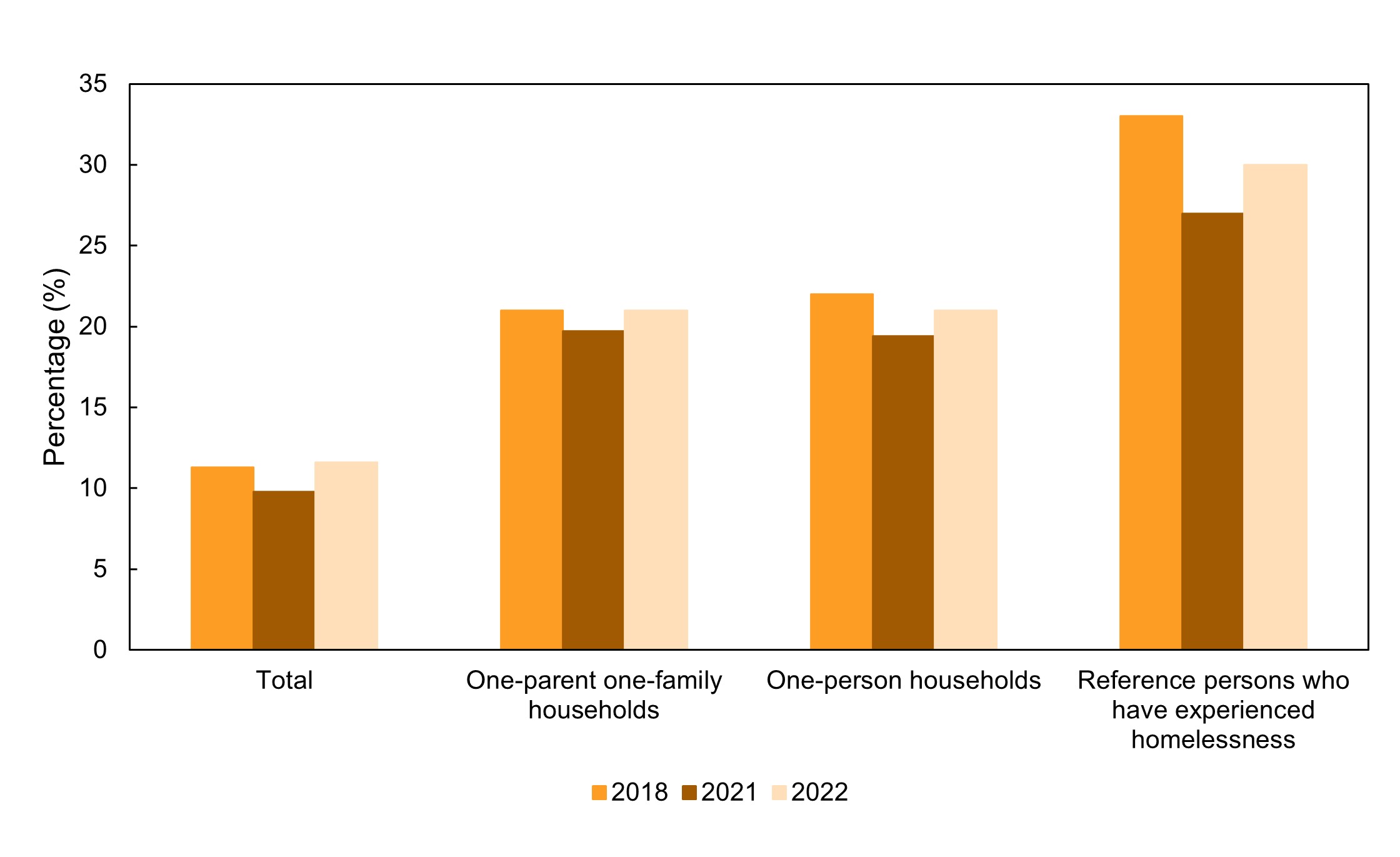
Text version of Figure 10
| Year | Total | One-parent one-family households | One-person households | Reference persons who have experienced homelessness |
|---|---|---|---|---|
| 2018 | 11.3 | 21 | 22 | 33 |
| 2021 | 9.8 | 19.7 | 19.4 | 27 |
| 2022 | 11.6 | 21 | 21 | 30 |
- Source: Statistics Canada, Canadian Housing Survey
Provincially, only Quebec, Saskatchewan and Prince Edward Island had a smaller proportion of households in core housing need in 2022 than in 2018. Quebec had the smallest proportion in the country in 2022 (5.5%). It also ranked second among provinces where households devoted the smallest proportion of their household expenditures to shelter in 2023 (18.2%).Footnote 46 In contrast, British Columbia (16.0%) and Ontario (14.5%) were the two provinces with the highest proportion of households in core housing need in 2022. They were also the two provinces where households allocated the largest proportion of their household expenditures to shelter in 2023 (26.6% and 24.9% respectively).Footnote 47
Domestic indicator 11.5.1: Proportion of commuters using sustainable transportation for commuting
The proportion of commuters who used sustainable transportationFootnote 48 to commute to work increased from May 2024 to 18.2% in May 2025 (Figure 11). However, this rate remains lower than the 19.4% recorded in May 2016. Despite an upward trend over the past five years, Canada's progress in ensuring that 22% of commuters have adopted sustainable transportation by 2030 has deteriorated since 2016.
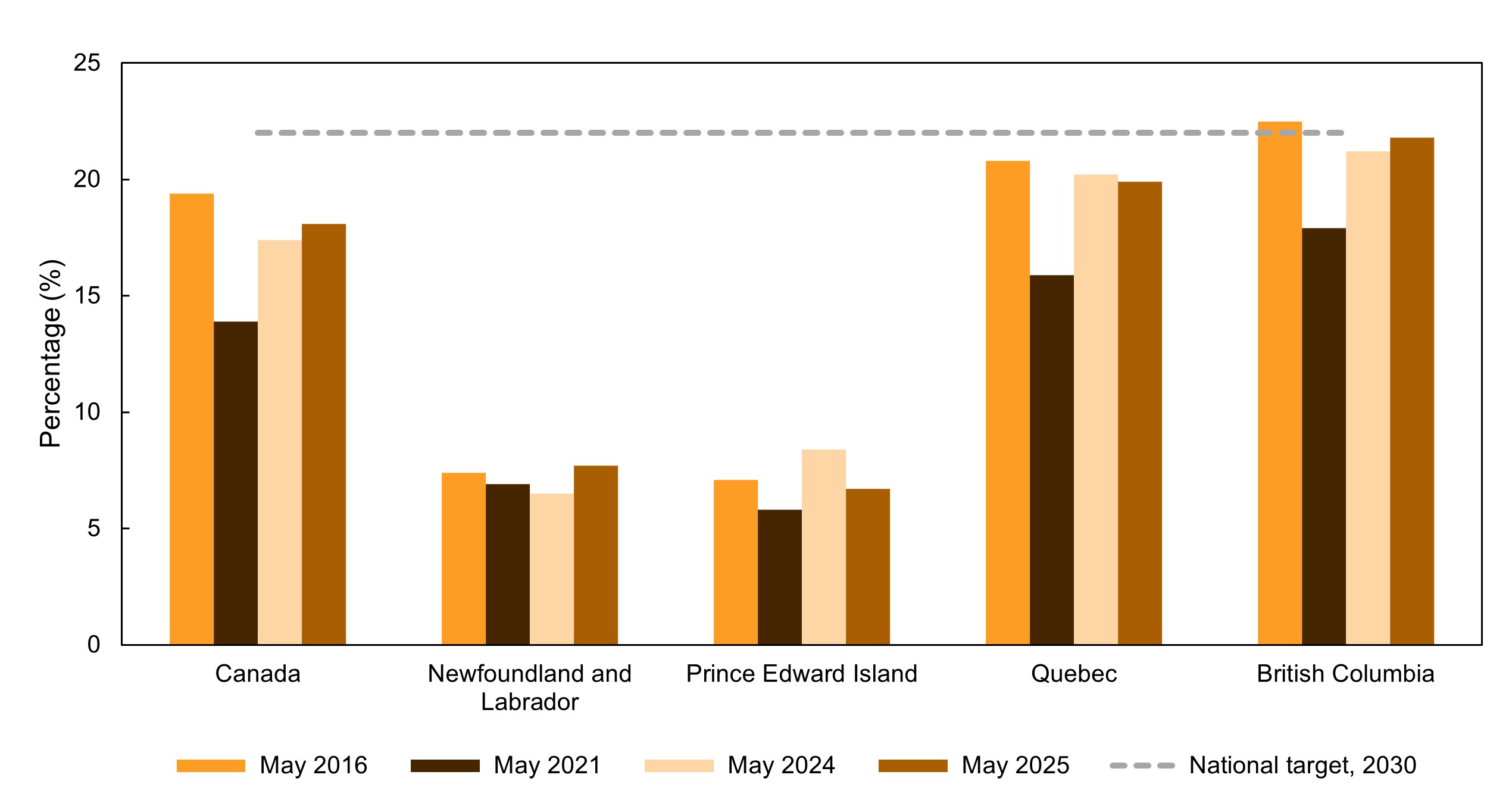
Text version of Figure 11
| Location | May 2016 | May 2021 | May 2024 | May 2025 | National target, 2030 |
|---|---|---|---|---|---|
| Canada | 19.4 | 13.9 | 17.4 | 18.1 | 22 |
| Newfoundland and Labrador | 7.4 | 6.9 | 6.5 | 7.7 | 22 |
| Prince Edward Island | 7.1 | 5.8 | 8.4 | 6.7 | 22 |
| Quebec | 20.8 | 15.9 | 20.2 | 19.9 | 22 |
| British Columbia | 22.5 | 17.9 | 21.2 | 21.8 | 22 |
- Source: Statistics Canada, Labour Force Survey
Provincially, British Columbia (21.8%) was the province with the highest proportion of commuters using sustainable transportation in May 2025. Following British Columbia, the provinces closest to the national target in May 2025 were Quebec (19.9%) and Ontario (19.3%). In contrast, commuters in Prince Edward Island (6.7%) and Newfoundland and Labrador (7.7%) had the lowest rates of sustainable transportation use.
The use of sustainable modes of transportation for commuting in May 2025 was more prevalent in Canada's three largest census metropolitan areas (CMAs): Toronto (29.9%), Montréal (29.1%) and Vancouver (29.0%). It should be noted that these three CMAs were also among those with the largest percentage of the population living within 500 metres of a public transit stop in 2024.
SDG 11 Feature stories
Building a future where no one is left behind
A few years ago, the SaltWater Community Association in Newfoundland began noticing a pattern that they could no longer ignore. Across rural communities on Newfoundland's Bonavista Peninsula, youth and young adults with exceptionalities were aging out of school systems but not into independence. Many relied heavily on government supports and lived with aging parents who provided daily care, guidance, and stability. Their potential was undeniable, yet their opportunities were not. Employment barriers were particularly stark. In a region already strained by limited job availability, meaningful employment for individuals with exceptionalities was almost nonexistent. Many were underemployed, some were never employed, and others had never been given the chance to discover what they were capable of.
So, they took action.
The Association began hiring these individuals through provincially funded programs and federal summer student jobs initiatives. What they witnessed was transformative-confidence built through meaningful participation, a sense of belonging through purposeful contribution, and a growing belief in what their futures could hold. But another reality remained. Many of these individuals lived with parents now entering their senior years. Quietly, but urgently, families were asking the question no one wanted to say out loud: "What happens to my child when I'm no longer here?" The answer, far too often, was institutionalization. We knew we could do better. That realization became the foundation for a new vision-one rooted in dignity, independence, inclusion, and community strength. That vision became Blended Living.
Blended Living is an innovative housing model that supports two populations who are often overlooked in rural regions: individuals living with exceptionalities who are ready for independence but need support to get there, and families-primarily women and children-fleeing domestic violence with nowhere safe to go. On the Bonavista Peninsula, there is no women's shelter or transitional housing and no supportive independent living model for persons with exceptionalities. When someone needs help, their only options are leaving their home community-or staying in unsafe or dependent environments.
So, the Association purchased a home and redesigned it with purpose. Upstairs: a safe, fully contained apartment for a family fleeing domestic violence-secure, private, and supported by community resources so healing can begin. Downstairs: an affordable apartment for an individual with exceptionalities-close to services, employment opportunities, and mentors who can help them live independently. Two different realities, one shared goal: A stable place to live. A chance to rebuild. A pathway to independence.
The Association sees Blended Living as an opportunity not just for their community, but as a blueprint rural communities across Canada can adapt and replicate.
Blended Living isn't just housing. It is infrastructure built around people, not programs. A gateway to dignity, safety, and belonging. A step toward ending generational cycles of dependence and violence. A pathway to meaningful employment, purpose, and opportunity. Every person-regardless of circumstance, ability, or background-deserves the chance to build a future full of possibility.
Pamishkatau Biosphere Class: learning to see differently
Through direct contact with the land young people develop a lasting understanding of the world around them. This simple conviction is behind the genesis of the Pamishkatau Biosphere Class project, an initiative supported by the exceptional richness that is Nitassinan, the traditional territory of the Pessamit Innu and an immense hinterland with unique stories, knowledge and ecosystems. By fostering encounters between scientific knowledge and Indigenous knowledge, the project enables students to develop a more nuanced view of the territory, to better understand the complexity of the living world, and to enhance their sense of belonging.
In keeping with the spirit of SDG 11, the project contributes to building more inclusive, resilient and sustainable communities through a better understanding of the land and its natural and cultural heritage.
Anchored in the Manicouagan-Uapishka Biosphere Region, a UNESCO-designated area, the project relies on close collaboration with local partners, including the Centre de Service Scolaire de l'Estuaire and secondary school instructors, a team of knowledgeable guides with Tourisme Pessamit and Station Uapishka, a logistics and accommodation hub. These collaborations have generated educational content that is relevant and grounded in local realities, while ensuring a safe and rewarding experience for students.
During a three-day outing, the group of young people, accompanied by a biologist guide and a guide from Tourisme Pessamit, enters the territory along legendary Route 389 amid a sea of black spruce to become immersed in the boreal region. This is a territory transformed by economic development, and students learn the stories of a region that has been navigated for thousands of years by the Pessamit Innu along the Manicouagan River.
The group stays at Station Uapishka, located at the foot of the Uapishka Mountains and near what is known as the Eye of Quebec (l'œil de Québec), a formation created by a meteorite and the flooding of the area during the construction of major dams. With a schedule balancing various activities with free time to connect at one's own pace to this unique and isolated place, the central element of the stay unfolds around a mountain outing. On a hike through changing ecosystems that make it feel like walking from the lowlands of the St. Lawrence to Nunavik, students proudly reach the summit of Mont Harfang in the midst of the plateaus of the alpine Arctic tundra.
During the hike, the guides share stories and knowledge about the territory, while leading an activity that inventories the plants at different points along the trail, enabling the young people to be attentive to the subtle changes taking place beneath their feet. This trip is an undeniable opportunity for young people to develop better understanding and sensitivity by reconnecting to the territory.
Among the main lessons learned, the Pamishkatau Biosphere Class demonstrates the power of experiential learning and the juxtaposition of different knowledge sources to engage young people. It also highlights the importance of creating authentic spaces for dialogue, where different visions of the territory can meet and complement each other. Learning to see things differently means equipping the next generation to act in an informed, respectful and sustainable manner towards the land and the communities that inhabit it.
A university-community partnership transforming dementia care spaces
People experiencing dementia have a more meaningful place to call home, thanks to human-centered design work done by University of Alberta researchers in partnership with Canterbury Lane, an Edmonton seniors' residence.
By creating safer, more inclusive, and human centred living environments for older adults, this partnership directly supports SDG 11.
The partnership involves renovating a 51-year-old building to expand the space for clients experiencing dementia. It is designed to "change social engagements massively for the residents, their families and friends," says professor Megan Strickfaden, a design anthropologist. She led a team of students from the Faculty of Agricultural, Life and Environmental Sciences who partnered with the Canterbury Foundation on the five-year project.
"The wing gives residents the chance to engage in spaces that encourage discovery, play and finding places where each person belongs," Strickfaden explains.
The state-of-the-art space is airy and colourful, with warm lighting, fixtures and finishes that reflect a homelike rather than an institutional setting for residents, family and friends to enjoy. The team helped project architects choose the best spatial designs, lighting, materials and details like fixtures and finishes to help residents feel at home.
The researchers also teamed up with Canterbury Lane staff to get an understanding of their space needs for activities, worker training and connection with residents. Interviews with the residents - using arts-based workshops - and their families and friends were also part of the process.
"We took 'destination' and 'home-like' approaches to the overall design of the dementia lane," which is divided into public, semi-public and private areas, Strickfaden says. The public areas support wandering and exploration by residents, with distinct 'destinations,' including an art gallery, an Edmonton historic streetscape, a roadside diner area, an indoor green space, a common kitchen area and an outdoor garden.
Canterbury Foundation CEO, Heidi Hadubiak, explains, "We wanted to ensure that the programming and design we undertook were coming from a point of understanding and research, so that our renovations meet the needs of our increasing population of residents requiring memory care.
"The partnership with the University of Alberta has given us insight into the need to understand who our residents are, including their background and life prior to their dementia diagnosis," she notes.
The research for the project was funded by a Mitacs Accelerate grant awarded to Strickfaden.
Cultivating community through volunteering
The Botanical Gardens of Silver Springs Society in Calgary, Alberta, has a simple but powerful mission: to contribute to a welcoming outdoor space with unique gardens and forests that inspire, educate, and provide enjoyment for all within a multi‑use environment.
Through partnerships with the community, the City of Calgary, and other garden‑oriented organizations, volunteers at the Botanical Gardens of Silver Spring Society have created 30 distinct gardens. Entirely volunteer‑run, the Society now contributes more than 10,000 hours of labor each year to build, maintain, and nurture the space. It is an inspiring example during the International Year of Volunteers for Sustainable Development, and a testament to how volunteer energy can strengthen vibrant, welcoming places for all.
Each of the 30 gardens has its own personality and theme. Some respond to specific growing conditions, such as the Shade Garden, Low H2O Garden, and Crevice Garden, while the Shakespeare Garden brings literature to life, and a labyrinth offers space for reflection and exploration.
But the heart of the Gardens is the volunteer community that has grown alongside them. While supporting the purpose and beauty of space, volunteers have also created a warm, welcoming, and supportive environment for one another. Many join during moments of transition-new retirees, newcomers to Canada, and individuals coping with loss. Today, over 130 members contribute not just gardening expertise, but encouragement, friendship, and belonging. Stories of volunteers being welcomed and finding renewed meaning here are countless.
Together, they have become a sustainable community of people working collectively to preserve botanical history, create beauty and peace for all, and make a positive difference locally. Their example is now being replicated across Calgary and beyond, as others recognize the many benefits that dedicated volunteers and community‑rooted green spaces can bring.
The Botanical Gardens of Silver Springs Society continues to thrive-rooted in community, inspired by nature, and strengthened by volunteers whose contributions help shape more welcoming and resilient places for everyone.
SDG 17: Partnerships for the goals
SDG 17 Policy context
Working together is at the heart of the 2030 Agenda. SDG 17 is about strengthening partnerships across governments, sectors, and communities, to share knowledge, resources, and innovation so that progress benefits everyone. Canada continues to build strong domestic and international partnerships that advance sustainable development and ensure no one is left behind.
Accelerating progress through collaboration across governments
In 2025, Canada took important steps to strengthen cooperation among federal, provincial, and territorial governments to align policies and actions that advance the SDGs.
The Free Trade and Labour Mobility in Canada Act, passed in 2025, supports economic resilience and inclusion by making it easier for people and businesses to work and trade across provinces and territories. This Act aligns with recent ambitious efforts from provinces and territories to accelerate the recognition of regulatory differences, and helps lay the groundwork for coordinated, pan-Canadian efforts to remove internal trade and labour mobility barriers.
Partnerships on major infrastructure projects also deepened. The newly launched Major Projects Office acts as a single point of contact and leadership for federal, provincial, territorial, and Indigenous partners to work together to advance large, complex infrastructure projects that connect Canada's economy, diversify our industries and trade opportunities and create high-paying jobs in Canada. The Office brings together people and processes to move these major projects forward faster, responsibly and sustainably, while respecting the rights of Indigenous Peoples and protecting the environment. The Office is supported by an Indigenous Advisory Council, which provides expert advice on policy, operational practices, and process improvements related to the inclusion of Indigenous perspectives on, and interests in, major projects.
At the community level, the SDG Funding Program continued to mobilize local actors, supporting organizations, municipalities, and youth networks across Canada to raise awareness and advance practical, local solutions. In 2025, the program supported 31 projects to advance new partnerships focused on climate action, inclusive education, sustainable cities, youth engagement, and Indigenous reconciliation through distinction-based National Indigenous organizations. This resulted in an investment of $4.6 million of the annual budget.
Partnering with Indigenous governments and organizations
Partnerships with Indigenous Peoples are central to achieving the 2030 Agenda.
Through the Federal Interlocutor Contribution Program funding supports Métis and off-reserve Indigenous organizations to build governance capacity and develop partnerships with governments and the private sector. These partnerships help address community priorities, such as affordable and sustainable housing, and advance initiatives like the Canada-Métis Nation Housing Sub-Accord and the Urban, Rural and Northern Indigenous Housing Strategy.
Specifically, partnership with Indigenous Peoples on the Urban, Rural, and Northern Indigenous Housing Strategy advances SDG 17 by fostering inclusive, co-developed workplans, self-determined and Indigenous-led decision making; strengthening Indigenous institutions and housing off-reserve sector capacity; and supporting shared monitoring and Indigenous data sovereignty. Together, these actions build durable, trust ‑based governance and enable regionally coordinated, sustainable housing outcomes that align with reconciliation and the United Nations Declaration on the Rights of Indigenous Peoples Act (UN Declaration Act) Action Plan.
Canada continues to implement the UN Declaration Act Action Plan which further guides federal departments in working collaboratively with Indigenous partners to align laws and policies with the principles of reconciliation, self-determination, and the rights affirmed in the UN Declaration. The fourth progress report was published in 2025 as part of the UN Declaration Act's requirement for the federal government to report annually to Parliament on progress in aligning federal laws with the UN Declaration, as well as on the development and implementation of the Action Plan.
Partnering internationally
In 2025, Canada actively promoted the SDGs at international fora, emphasizing partnerships and collaboration. Canada’s seventh G7 Presidency occurred in 2025 and centered on protecting communities, strengthening energy security and digital innovation, and forging future‑oriented global partnerships, showcasing Canadian leadership in promoting international peace, economic stability, and collaborative action with partners at home and abroad.
The federal government hosted a virtual G7 Labour and Employment Ministers' meeting and participated in the G20 Labour and Employment Ministerial in South Africa, highlighting initiatives such as the Youth Employment and Skills Strategy, Canada Service Corps, expansion of student grants and interest-free loans, and Equi'Vision, Canada's first-of-its-kind pay transparency website designed to address pay gaps not only related to gender, but across all designated groups under the Employment Equity Act.
Canada also advanced SDG 4 through active engagement in the G20 Education Working Group and the G20 Education Ministers' meeting. It shared the Government of Canada's approach to building an accessible, high quality, affordable, flexible, and inclusive Canada-wide early learning and child care system and promoting lifelong learning and inclusive education. The G20 Leader's Declaration welcomed and adopted G20 targets to further reduce youth not in employment, education or training (NEET) rates by 5% by 2030 and to reduce the gender gap in labour force participation by 25% by 2030.
Canada actively participated in the Asia-Pacific Economic Cooperation Human Resources Development Ministerial Meeting and Education Ministerial Meeting in May 2025, which delivered two Joint Statements that support forward-looking labour market policies to promote access to high-quality and full employment opportunities for everyone and recognized that ensuring quality education and promoting lifelong learning opportunities for all are essential for economic prosperity.
At the Second World Summit for Social Development in Doha, Qatar, Canada hosted a solutions session on youth employment, digital equity, and preparing young people for an AI-enabled labour market. The Doha Political Declaration adopted at the Summit renews leaders' commitments in several areas, including poverty reduction, decent work and economic transformation, gender equality, social integration, food security and health.
In addition to Canada's engagement in international fora, 2025 saw strong partnership‑driven results through its international assistance. As a lead government donor-alongside the Government of Qatar-to UNICEF's Generation Unlimited (GenU), Canada helped expand access to digital, technical, and vocational learning, as well as employment opportunities for youth. In collaboration with GenU's multi‑stakeholder network of public and private sector donors, foundations, and youth-led organizations, Canada contributed to reaching 19.6 million young people with market‑relevant skills that support participation in the green economy-such as renewable energy and climate‑resilient agriculture-as well as the digital economy. For example, GenU's flagship initiative, "Passport 2 Earning," supported the delivery of free, world‑class digital and AI skills training to youth in up to 15 countries.
Strengthening global partnerships to finance sustainable development
Canada is also working with partners around the world to unlock financing and accelerate innovation.
At the G7 Leaders’ Summit in Kananaskis, Alberta in June 2025, Canada announced new measures to deepen global cooperation on financing for development and shared prosperity. These include:
- Up to $544 million in portfolio guarantees to multilateral development banks. This initiative will enable the Inter-American Development Bank and the Caribbean Development Bank to provide up to US$1.6 billion in new financing to support development in emerging markets and developing countries in Latin America and the Caribbean.
- $290 million over five years for the International Assistance Innovation Program, which helps mobilize private sector investment in developing countries to achieve the SDGs.
- $101.3 million over five years to support private capital mobilization and tackle major barriers to private sector investment in developing countries, including accelerating infrastructure projects and fostering an enabling environment for investors.
Canada joined the international community at the Fourth International Conference on Financing for Development in Spain where countries reaffirmed a shared commitment to mobilizing all resources for sustainable development. As a clear signal of Canada's commitment to building a more inclusive international financing system, Canada contributed the Common Principles for Private Capital Mobilization to the Sevilla Platform for Action to serve as a roadmap for harmonized approaches, increased transparency, and stronger alignment between public and private actors. Canada is also co-leading the development of a new global blended finance platform Scaling Capital for Sustainable Development (SCALED) in partnership with Germany, France, South Africa, and the UK and private sector partners. This initiative will mobilize large-scale private investment to help address the SDG financing gap in emerging markets and developing economies.
On the margins of the conference, Canada announced $2 million in support for the Integrated National Financing Framework (INFF) Facility. Implemented by the UN Development Programme, the Facility offers a structured approach to aligning diverse financial flows with sustainable development priorities.
The federal government also announced a $5-million project in partnership with the Organisation for Economic Co-operation and Development's Centre for Tax Policy and Administration on "Funding the Future: Domestic Resource Mobilization in a Digital Economy". The project will help developing countries enhance domestic resource mobilization through a comprehensive technical assistance program.
Canada championed financing for development as a priority of its 2024-2025 presidency of the UN Economic and Social Council (ECOSOC), with a particular focus on fostering greater collaboration between the UN and international financial institutions, including multilateral development banks. Bringing together governments, experts, innovators, and civil society, Canada also convened a Special Meeting on Artificial Intelligence for the SDGs at UN Headquarters in New York. The dialogue highlighted AI's potential to accelerate progress on 134 SDG targets, underscoring its power to transform outcomes for people, planet, and prosperity.
SDG 17 Statistical analysis
SDG 17 Partnerships for the goals
Domestic indicator 17.2.1: Total official support for sustainable development
Total official support for sustainable development (TOSSD) encompasses all officially-supported flows of resources to promote sustainable development in developing countries and to support and address global challenges.
It includes funding from official sources as well as private resources mobilized through official mechanisms. Based on preliminary data, Canada's TOSSD totalled $14.8 billion in 2024 (Figure 12). While this support has increased by about 125% since 2018, it still represents a decline of about 7% when compared with 2023. As a result, this indicator shows progress as on track towards Canada's ambition to foster collaboration and partnerships to advance the SDGs, when measured since 2018.
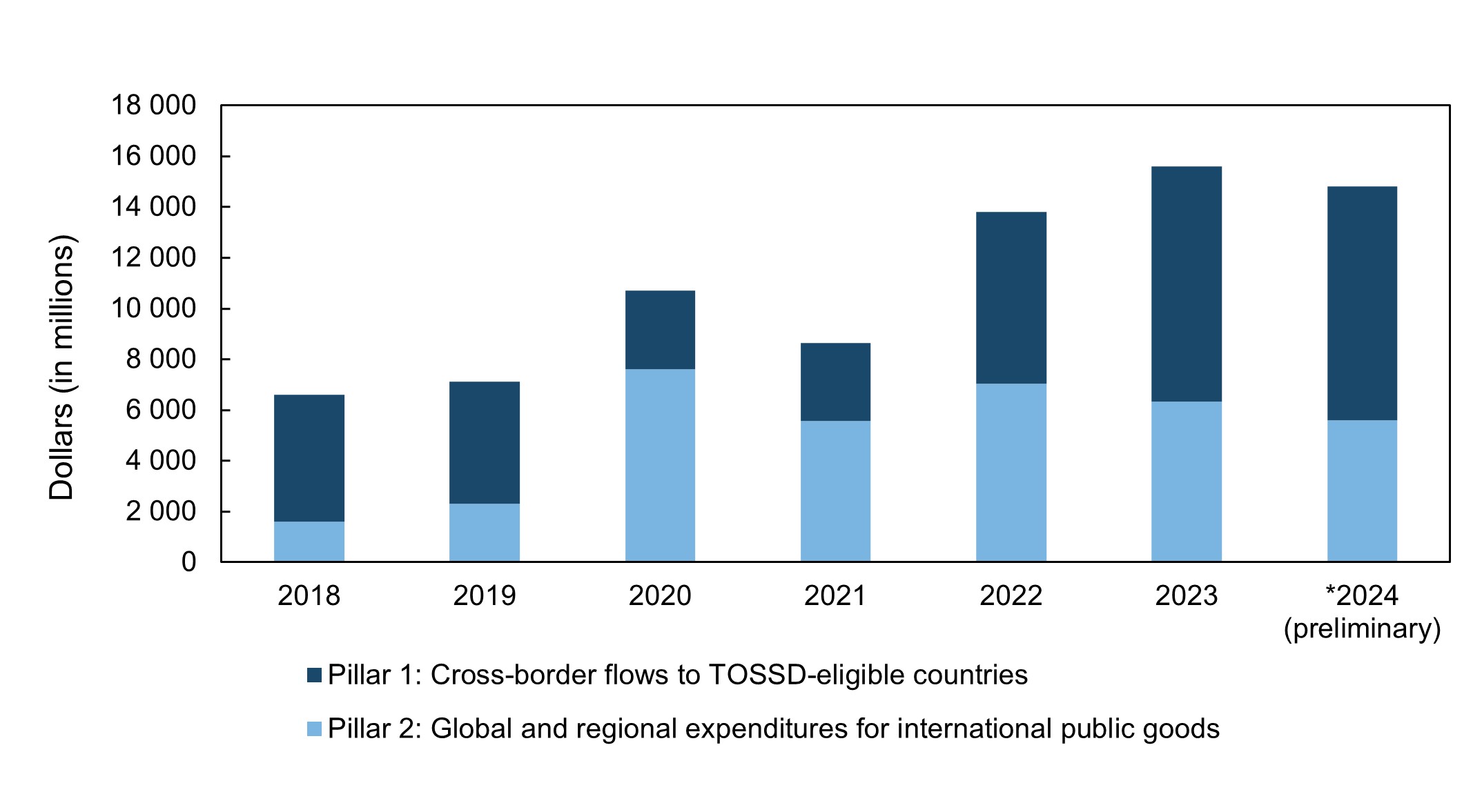
Text version of Figure 12
| Year | Total | Pillar 1: Cross-border flows to TOSSD-eligible countries | Pillar 2: Global and regional expenditures for international public goods |
|---|---|---|---|
| 2018 | 6600 | 5,000 | 1,600 |
| 2019 | 7100 | 4,809 | 2,320 |
| 2020 | 10800 | 3,100 | 7,600 |
| 2021 | 8650 | 3,080 | 5,570 |
| 2022 | 14000 | 6,750 | 7,050 |
| 2023 | 16000 | 9,250 | 6,340 |
| *2024 (preliminary) | 14822 | 9,200 | 5,600 |
- Source: Global Affairs Canada
The TOSSD has two types of resource flows separated into two pillars. Pillar I includes bilateral cross-border flows to TOSSD-eligible countries. It totalled $9.2 billion in 2024, accounting for the majority of Canada's TOSSD. Pillar II measures global and regional spending (multilateral) on international public goods. The latter totalled $5.6 billion in 2024. Both bilateral TOSSD (-0.5%) and multilateral spending (-11.7%) declined from 2023 to 2024.
The region of the world that received the most total public support for sustainable development from Canada in 2024 was Africa, receiving $4.9 billion, and accounting for about one-third of Canada's total support. This was a 5.4% increase in flows to Africa compared with 2023, including diverse loans and repayable climate contributions. The second largest beneficiary was Europe with flows totaling $2.9 billion in 2024. Bilateral disbursements to Ukraine to help meet its urgent needs and support its economic stability accounted for the majority of this amount and were down 2% from 2023.
Domestic indicator 17.3.1: Exports of environmental and clean technology goods and services to developing countries
Assessing exports of environmental and clean technology (ECT) products (goods and services) to developing countriesFootnote 49 helps measure Canada's contribution to sustainable development in developing countries. This indicator is part of a shared responsibility to achieving the sustainable development goals (SDGs). ECT products exported by Canada to developing countries totalled $1.4 billion in 2023, an increase of 5.2% from 2022 (Figure 13). These exports were up 40.5% from $1.0 billion in 2015. This increase illustrates a trend that is on track towards Canada's ambition to foster collaboration and partnerships to advance the SDGs.
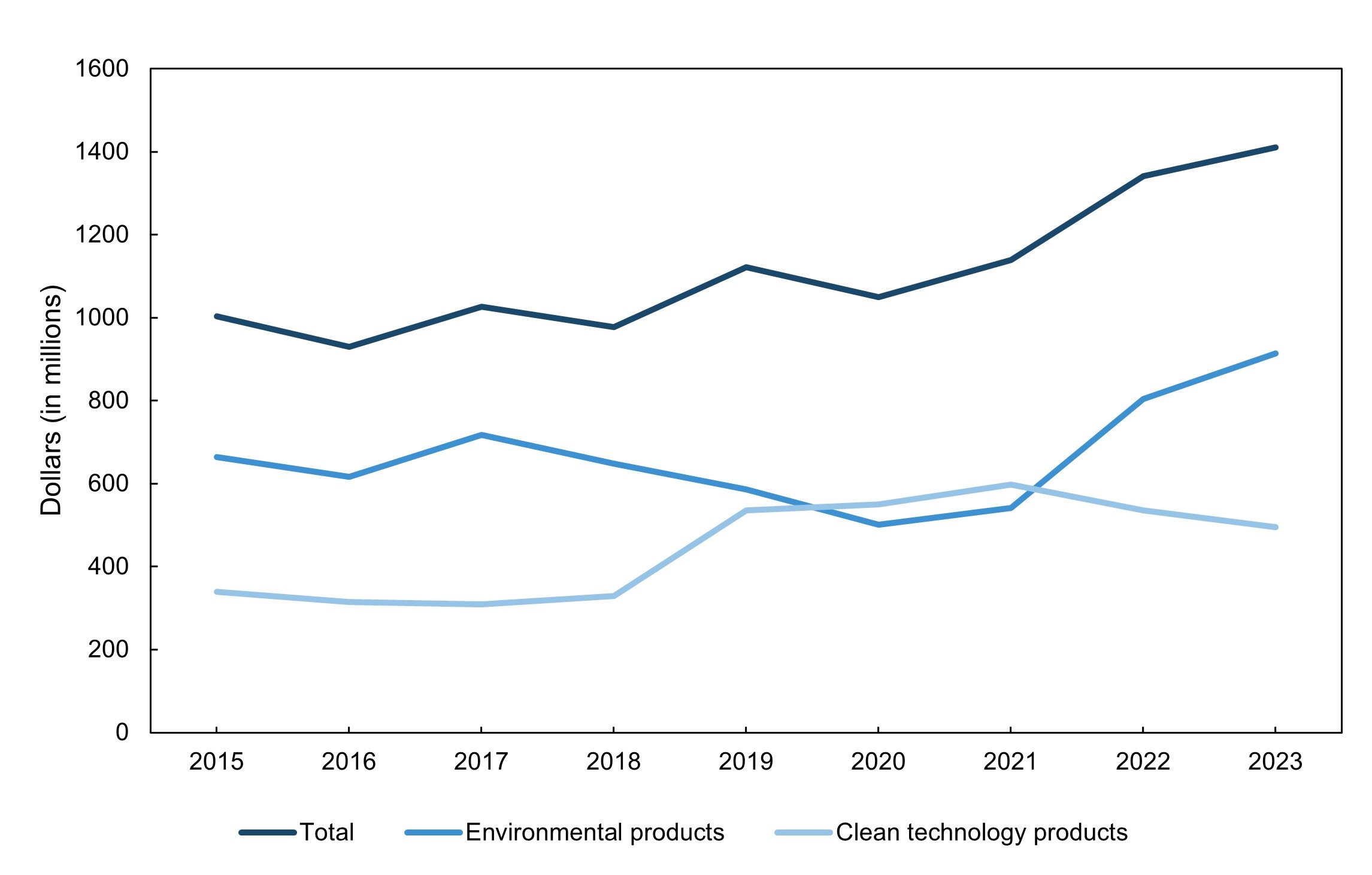
Text version of Figure 13
| Year | Total | Environmental products | Clean technology products |
|---|---|---|---|
| 2015 | 1003.855 | 663.88 | 339.977 |
| 2016 | 930.2 | 616.125 | 314.07 |
| 2017 | 1026.533 | 718.013 | 308.525 |
| 2018 | 977.25 | 647.58 | 329.674 |
| 2019 | 1121.822 | 586.709 | 535.114 |
| 2020 | 1050.244 | 500.825 | 549.42 |
| 2021 | 1139.218 | 540.781 | 598.436 |
| 2022 | 1340.725 | 804.454 | 536.267 |
| 2023 | 1410.165 | 914.588 | 495.578 |
- Source: Statistics Canada, Environmental and Clean Technology Products Economic Account, international imports and exports and UNDP, Human Development Index (HDI)
Exports of environmental products to developing countries have risen steadily since 2020 to $914.6 million in 2023. On the other hand, exports of clean technology products have declined steadily since 2021 to $495.6 million in 2023.
The overall trend is heavily influenced by exports to Asia. These exports accounted for 70.6% of Canada's total exports to developing countries in 2023. By comparison, the region in the world where developing countries received the second largest export of ECT products from Canada in 2023 was North America (9.1%), followed by Africa (8.9%).
SDG 17 Feature stories
Many hands, one platform: volunteers and partnerships
Across Canada, thousands of people, organizations, and businesses work every day to strengthen their communities. Do Some Good emerged to support and amplify that shared work by removing barriers, sparking connections, and helping good grow.
What began in 2015 as a simple tool to help students find volunteer opportunities has grown into a national platform empowering Canadians to collaborate on the issues that matter most. And in the spirit of the International Year of Volunteers for Sustainable Development, it is powered by everyday people whose generosity fuels community resilience.
The impact comes directly from the people who use the platform. Individuals, nonprofits, and businesses have collectively contributed more than 1.45 million volunteer hours, the equivalent of 700 full‑time volunteers working for an entire year. These hours reflect meals served, trails cleaned, seniors supported, events hosted, and countless small acts of kindness that strengthen communities across the country.
Used in over 2,400 communities nationwide, the platform has helped create more than 147,500 connections between individuals, nonprofits, and businesses. Its 18,250+ shared stories shine a light on efforts that often go unseen: volunteers stepping up, donors helping organizations reach more people, and grassroots groups solving problems with creativity and determination.
Community organizations of all sizes use Do Some Good's free tools to build capacity, reach new audiences, and form lasting relationships. More than 15,000 nonprofits have been supported, gaining access to a national space where they can thank supporters, publish impact updates, and extend their reach through world‑class tools. This accessibility ensures that even the smallest grassroots groups can gain visibility and resources typically available only to larger organizations.
For individuals, the platform opens doors to meaningful ways to contribute. More than 60,000 volunteer matches have been made, each one a spark that can ignite long‑term community involvement. Students have discovered causes that inspire them, families have volunteered together for the first time, and newcomers have found belonging through service. These experiences help shape future leaders and cultivate more connected, inclusive communities.
Businesses play an essential role in this ecosystem. Through Do Some Good, companies of all sizes have moved from one‑time donations to long‑term, values‑driven partnerships with community groups. By requesting and sharing impact stories, they amplify nonprofit work, inspire others to get involved, and strengthen local economies through trust and collaboration. During the pandemic, these partnerships supported buy‑local efforts and helped keep small businesses and community organizations resilient.
The network now includes national charities, small nonprofits, chambers of commerce, associations, media outlets, community foundations, co‑operatives, credit unions, colleges and universities, small and medium entreprises, and large companies-each contributing strengths that multiply collective impact. Whether a community has 500 residents or 500,000, the platform helps people share success, mobilize volunteers, and uplift one another through partnership.
Canada's progress toward the SDGs is driven by the collective efforts of everyday Canadians. Do Some Good provides the tools that help them connect, collaborate, and celebrate their impact.
Together, they demonstrate that when communities work in partnership, their capacity for good is truly limitless.
Indigenous climate leadership: strengthening global partnerships for a resilient future
First Nations are climate leaders, advancing innovative and culturally grounded approaches to mitigating, responding and adapting to climate change. Despite Indigenous Peoples receiving only a small share of global climate finance, recognizing Indigenous land tenure and territorial rights and uplifting self-determined, Indigenous-led climate action are foundational for safeguarding nature.
The British Columbia (BC) Assembly of First Nations (BCAFN) is a Provincial Territorial Organization led by Regional Chief Terry Teegee. BCAFN advocates for the rights, title and interests of First Nations in BC, guided by resolutions passed at BCAFN Chiefs Assemblies. BCAFN received a mandate from Chiefs in Assembly to pursue international advocacy opportunities on climate change, Indigenous rights, and sovereignty and build relationships for joint action and advocacy with Indigenous Peoples abroad.
BCAFN advocates for stable, long-term investment in First Nation-led climate action and calls on governments to provide equitable access to climate finance and funding to support Indigenous Peoples in mitigating and adapting to climate change.
Part of adaptation includes joint advocacy, knowledge sharing and North-South Indigenous partnerships, which are essential to upholding Indigenous Peoples' inherent rights and responsibilities to Mother Earth.
Although disproportionately affected by climate change, Indigenous Peoples around the globe play a unique and essential role in combating it through their intrinsic relationship and interconnectedness with Mother Nature and ancestral knowledge systems, science, and technologies. Building strong international partnerships and solidarity between Indigenous Peoples is essential for holding governments accountable on climate action, asserting sovereignty and upholding Indigenous rights through international human rights instruments, such as the adoption of the United Nations Declaration on the Rights of Indigenous Peoples in 2007 by the U N General Assembly.
Building Climate Resilience from Indigenous Perspectives (BCRIP) is a four-year (2024 - 2028), Indigenous-led, first of its kind project, funded by Global Affairs Canada's Indigenous Peoples Partnering for Climate funding stream, and developed in partnership with the Assembly of First Nations, the Inuit Circumpolar Council Canada and the Métis National Council.
The BCRIP project aims to uplift Indigenous knowledge systems and science and contribute to Indigenous Peoples' rights, self-determination, and climate leadership, while providing funding to build strong partnerships between Indigenous Peoples in Canada, in particular First Nations in BC and Indigenous Peoples in Peru, Bolivia, Colombia and Guatemala.
The project is guided and steered by an Indigenous Wisdom and Knowledge Circle and an Indigenous Steering group and led by a diverse technical team, including the BCAFN, the Continental Network of Indigenous Women of the Americas (ECMIA SUR), with the support of Save the Children Canada (National Reconciliation Program) and Save the Children Latin America and Caribbean.
The BCRIP project aims to fund 11 Indigenous-led partnership projects between 11 Indigenous Organizations and Nations in Bolivia, Colombia, Guatemala, Peru, and a total of 10 Indigenous Organizations and Nations in Canada (8 First Nations in BC, one Inuit organization and one Métis Organization).
Each of the distinct North/South partnership projects are co-designed climate resilience initiatives, weaving self-determined Nature-based Solutions with ancestral knowledge and science, knowledge sharing, cultural revitalization, Indigenous rights and Indigenous-led climate leadership. Project implementation is scheduled to begin in early 2026.
The projects will promote ecosystem restoration through practices such as reforestation with native species, water harvesting, seed conservation, and ancestral agriculture. The North and South collaboration strengthens this work through a continuous process of mutual and reciprocal learning, knowledge exchange, and relationship building. The projects also place gender equity, self-determination, Indigenous rights, and intergenerational knowledge transfer at the core, with mechanisms to ensure meaningful participation and uplift women, 2SLGBTQQIA+ individuals, and youth climate leadership.
Rising together: how international partnerships drive change
In 2025, Rising Out of the Ashes (ROOTA) continued its mission to empower marginalized communities in Cairo, Egypt, and Toronto, Canada. Although the needs in these two cities differ, the challenges are real: in Cairo, the Zabaleen community faces poverty, limited access to education, and ongoing health concerns; in Toronto, youth and vulnerable populations often lack awareness of sustainable practices and access to essential services. ROOTA's approach combines education, sustainability, and direct support to bring these communities together through learning, solidarity, and shared purpose.
To deepen understanding and spark action, ROOTA partnered with universities including the University of Toronto and the University of Windsor. Through interactive workshops and Earth Day events, students learned about the Zabaleen, Cairo's garbage collectors, and their crucial role in environmental sustainability. Experiencing firsthand the sustainable methods the Zabaleen use to recycle and manage waste helped students build environmental awareness and inspired them to take action within their own communities.
ROOTA also strengthened support for local residents in Toronto. By providing weekly meals in collaboration with the Toronto Family Residence, the organization ensured that vulnerable individuals had access to nutritious food, making a tangible difference in community well‑being.
Meanwhile in Cairo, ROOTA's work focused on economic empowerment, education, and health. Vocational training in glass recycling, weaving, and sewing enabled community members to develop skills for sustainable livelihoods. Educational programs, such as literacy classes, scholarships for children, and life‑skills workshops, supported the next generation. To promote hygiene and improve health, ROOTA constructed water stations that provide clean water and encourage proper sanitation practices. Each initiative helped build economic independence, strengthen health outcomes, and foster long‑term community resilience.
At the heart of this impact is collaboration. Partnerships with Canadian universities expanded awareness and engagement among students, while coordination with local organizations in Cairo ensured that programs met community needs. These cross‑community and international relationships connected students, volunteers, and residents across borders, showing how shared learning and cooperation can amplify impact.
The results have been meaningful. Students in Canada reported increased understanding of environmental and social responsibility. Local residents in Toronto gained reliable access to nutritious meals. And members of the Zabaleen community in Cairo benefited from improved education, vocational skills, and healthier living conditions.
From these experiences, ROOTA has learned that sustainable change requires a holistic, community‑centered approach. Integrating education, economic development, and health interventions, while fostering strong partnerships, creates lasting impact. By connecting Canadian youth with the resilience and ingenuity of the Zabaleen, ROOTA nurtures empathy, responsibility, and a shared commitment to a healthier, more equitable world. Through these partnerships, the organization continues to demonstrate the power of working together to strengthen communities across borders.
Way forward
Canada made meaningful progress toward the SDGs in 2025, but the path ahead is just as important as the steps already taken. As people and communities continue to face rising costs, climate impacts, and global uncertainty, advancing the SDGs remains essential to building a stronger, more resilient future for everyone.
In the years ahead, Canada will focus on closing the gaps highlighted throughout this report, such as improving access to clean water and wastewater services in First Nations communities, strengthening energy efficiency, accelerating the transition to clean power and zero‑emission transportation, and building more affordable homes. These efforts will help communities adapt to a changing climate, reduce emissions, and ensure that economic growth is sustainable and inclusive.
Canada's efforts to improve SDG progress will be informed by core national priorities, such building one Canadian economy, increasing the rate of homebuilding and making housing more affordable, strengthening climate and economic security, boosting productivity and innovation, and deepening intergovernmental cooperation.
Canada will prepare to present is next Voluntary National Review to the UN in July 2027. The development of this comprehensive assessment of Canada's progress on the SDGs will be an opportunity to build partnerships across governments, civil society, private sector, and Indigenous or local communities, and stimulate national dialogue about acceleration priorities, policy coherence and citizen engagement. Stay tuned for ways to get involved.
Partnerships will continue to be at the heart of Canada's approach. Progress in 2025 was driven by collaboration among federal, provincial, territorial, municipal, and Indigenous governments, as well as communities, youth, seniors, civil society, and the private sector. This whole‑of‑society effort is essential to meeting the targets set out in Moving Forward Together: Canada's 2030 Agenda National Strategy and to tackling shared challenges at home and globally.
Canada will continue to strengthen policy coherence, ensuring that actions in one area support progress in others.
Our current challenges are significant, both domestically and globally, but so is the collective momentum. By continuing to work together, Canada can build a future where everyone enjoys clean water and sanitation, affordable and clean energy, resilient infrastructure, and inclusive, sustainable communities.