
Super visa for parents and grandparents
Applying on paper for specific situations
Follow the instructions below to apply on paper.
On this page
Get your documents ready
If you need a super visa to travel to Canada, you must apply online for one. We’ll only accept paper applications if
- you can’t apply online because of a disability, or
- you’re travelling with an identity or travel document that was issued to you as a refugee, a stateless person or a non-citizen
Before you apply, make sure you need a super visa. We won’t refund your application fee if you apply for the wrong type of visa.
Local visa office instructions
Get your local visa office instructions by selecting the country or territory from which you’ll be applying.
Answer a few questions to get the next steps for your situation.
Where are you applying from?
- Afghanistan
- Albania
- Algeria
- Andorra
- Angola
- Anguilla
- Antigua and Barbuda
- Argentina
- Armenia
- Aruba
- Australia
- Austria
- Azerbaijan
- Bahamas
- Bahrain
- Bangladesh
- Barbados
- Belarus
- Belgium
- Belize
- Benin
- Bermuda
- Bhutan
- Bolivia
- Bonaire
- Bosnia and Herzegovina
- Botswana
- Brazil
- British Virgin Islands
- Brunei
- Bulgaria
- Burkina Faso
- Burma (Myanmar)
- Burundi
- Cabo Verde
- Cambodia
- Cameroon
- Canada
- Cayman Islands
- Central African Republic
- Chad
- Chile
- China (People’s Republic of)
- Colombia
- Comoros Island
- Congo
- Costa Rica
- Côte d’Ivoire
- Croatia
- Cuba
- Cyprus
- Curacao
- Czech Republic
- Democratic Republic of the Congo
- Denmark
- Djibouti
- Dominica
- Dominican Republic
- Ecuador
- Egypt
- El Salvador
- Equatorial Guinea
- Eritrea
- Estonia
- Ethiopia
- Fiji
- Finland
- France
- Gabon
- Gambia
- Georgia
- Germany
- Ghana
- Greece
- Grenada
- Guatemala
- Guinea
- Guinea-Bissau
- Guyana
- Haiti
- Holy See
- Honduras
- Hong Kong (SAR)
- Hungary
- Iceland
- India
- Indonesia
- Iran
- Iraq
- Ireland
- Israel
- Italy
- Jamaica
- Japan
- Jordan
- Kazakhstan
- Kenya
- Kiribati
- Kosovo
- Kuwait
- Kyrgyzstan
- Laos
- Latvia
- Lebanon
- Lesotho
- Liberia
- Libya
- Liechtenstein
- Lithuania
- Luxembourg
- Macao
- Madagascar
- Malawi
- Malaysia
- Maldives
- Mali
- Malta
- Marshall Islands
- Martinique
- Mauritania
- Mauritius
- Mexico
- Micronesia (Federated States of)
- Moldova
- Monaco
- Mongolia
- Montenegro
- Morocco
- Mozambique
- Namibia
- Nauru
- Nepal
- Netherlands
- New Caledonia
- New Zealand
- Nicaragua
- Niger
- Nigeria
- North Korea
- North Macedonia (Republic of)
- Norway
- Oman
- Pakistan
- Palestinian Authority (Gaza)
- Palestinian Authority (West Bank)
- Panama
- Papua New Guinea
- Paraguay
- Peru
- Philippines
- Poland
- Portugal
- Puerto Rico
- Qatar
- Romania
- Russia
- Rwanda
- Samoa
- San Marino
- Sao Tome and Principe
- Saudi Arabia
- Senegal
- Serbia
- Seychelles
- Sierra Leone
- Singapore
- Slovakia
- Slovenia
- Solomon Islands
- Somalia
- South Africa
- South Korea
- South Sudan
- Spain
- Sri Lanka
- St. Kitts and Nevis
- St. Lucia
- St. Vincent and the Grenadines
- Sudan
- Suriname
- Swaziland
- Sweden
- Switzerland
- Syria
- Tahiti
- Taiwan (Republic of China)
- Tajikistan
- Tanzania
- Thailand
- Timor-Leste (Timor oriental)
- Togo
- Tonga
- Trinidad and Tobago
- Tunisia
- Turkey
- Turkmenistan
- Turks and Caicos Islands
- Tuvalu
- Uganda
- Ukraine
- United Arab Emirates
- United Kingdom
- United States of America
- Uruguay
- US Virgin Islands
- Uzbekistan
- Vanuatu
- Venezuela
- Vietnam
- Yemen
- Zambia
- Zimbabwe
Get your photograph taken
You must include 2 photos that meet the visa photo specifications with your application.
Photograph and head size specifications
Please review the brochure (PDF, 506 KB) for further photo examples.
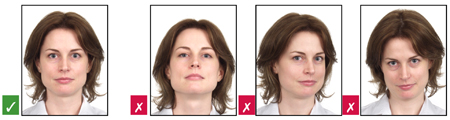
Requirements
- Provide two photos of yourself with your application.
- Your photos must comply with the specifications below. If the photos do not meet the specifications, you will have to provide new photos before your application can be processed.
- Photos must be printed on quality photographic paper.
Specifications
- The photos must be identical and taken within the last six months. They may be either black and white or colour.
- The photos must be clear, well defined and taken against a plain white or light-coloured background.
- If the photos are digital, they must not be altered in any way.
- Your face must be square to the camera with a neutral expression, neither frowning nor smiling, and with your mouth closed.
- You may wear non-tinted prescription glasses as long as your eyes are clearly visible. Make sure that the frame does not cover any part of your eyes. Sunglasses are not acceptable.
- A hairpiece or other cosmetic accessory is acceptable if it does not disguise your normal appearance.
- If you must wear a head covering for religious reasons, make sure your full facial features are not obscured.
Photograph and head size specifications

- The frame size must be at least 35 mm x 45 mm (1 3/8″ x 1 3/4″).
- The photos must show the full front view of the head, with the face in the middle of the photograph, and include the top of the shoulders.
- The size of the head, from chin to crown, must be between 31 mm (1 1/4″) and 36 mm (1 7/16″).
- Crown means the top of the head or (if obscured by hair or a head covering) where the top of the head or skull would be if it could be seen.
- If the photos do not meet the specifications, you will have to provide new photos before your application can be processed.
Photograph Specifications (PDF, 506 KB)
You may print this and bring it with you to the photographer.
Filling out the form
If you’re having trouble filling out the application, the information below may help.
Personal details
If you don’t have a family name on your passport or travel document, enter all your given names in the family name field and leave the given name field blank.
If you don’t have a given name on your passport or travel document, leave this field blank.
Check “Yes” to Have you used another name in the past, if you’ve ever used any other name, including your
- birth name
- maiden name
- married name
- nickname
If you don’t know your date of birth, use * (star sign or asterisk) to fill in the spaces for the year, month or day.
If you’re not a citizen of the country or territory where you’re applying, you must send proof of your legal status in the country or territory you live in with your application.
If you’re in a common-law union, you must also request and fill out the Statutory Declaration of Common-Law Union (IMM 5409) form and include it with your application.
If you’re married, you must send a photocopy of your marriage licence or certificate with your application.
Travel document details
There must be at least one blank page other than the last page available on your passport so we can stamp it.
Contact information
All correspondence will go to the mailing address you provide unless you provide an email address.
If you give us an email address, make sure you check your email regularly. Any emails we send you will end in
- “@cic.gc.ca”,
- “@canada.ca”, or
- “@international.gc.ca”
Add these to your safe senders list in your email and check the junk mail folder in case important emails get filtered.
If your email address does not work or no longer exists, we’ll communicate with you by mail only.
Using a representative
If you want to use a representative to apply for you, you must
- give us their mailing addresses in this section
- fill out the Use of a Representative (IMM 5476) form
Details of visit to Canada
Select “Super visa – Parents and grandparents” as the purpose of your visit to Canada.
Enter the approximate dates you’ll enter or leave Canada if you don’t know the exact dates.
Pay your application fees
In most cases, your fees will include processing fees. You must include these fees with your application.
If you’re applying for the first time, you must pay the biometrics fee when you submit your application, unless you’re exempt. If you don’t pay the fee when you apply, you may experience delays.
Use the table below to calculate your fees.
| Application | Amount in Can$ |
|---|---|
| Super visa processing fee (per person) | $100 |
| Biometrics (per person) | $85 |
| Biometrics (per family – 2 or more people) | $170 |
Other fees
Depending on your situation, you may need to pay other fees for documents you’ll need to submit when you apply. Make sure you have these documents ready before you apply.
- your medical exam
- a police certificate
How to pay the fees
To pay the fees for your application, you’ll need
- a valid email address
- access to a printer (you’ll need to print the receipt) and
- a credit card, Debit MasterCard® or Visa® Debit card
Follow the instructions online to pay your fees. The only acceptable form of payment is online payment. If you send any other form of payment, we’ll return your application.
Common issues with fee payment
The following incorrect fee payments may delay processing of your application.
No fee included
We’ll return your application. We’ll only begin processing your application after you resubmit it with the fees.
Not enough fees included
We’ll return your application and tell you how much you need to pay. We’ll only begin processing your application once you resubmit it with the correct fees.
Overpayment
We will
- start processing your application
- send you a refund
You do not have to ask for a refund, it will be done automatically.
Required biometrics fee not included
We’ll tell you the fee amount and how to pay it. We’ll continue processing your application after you send the missing fees.
Certify your photocopied documents
If you need to photocopy documents for your application, you must get a certified true copy.
To have a photocopy of a document certified, an authorized person must compare the original document to the photocopy and must print all of the following on the photocopy:
- “I certify that this is a true copy of the original document”
- the name of the original document
- the date of the certification
- the name of the authorized person
- their official position or title and
- their signature
Who can certify copies
Only authorized people can certify copies.
In Canada:
Authority to certify varies by province and territory. Check with your local provincial or territorial authorities to learn who has the authority to certify.
Outside Canada:
- a notary public
Authority to certify international documents varies by country. Check with your local authorities to learn who has the authority to certify in your country.
Who can’t certify copies
You or your family member can’t certify copies of documents for your application. This means that your documents can’t be certified by any of the following people:
- yourself
- parent
- guardian
- sibling
- spouse
- common-law partner or conjugal partner
- grandparent
- child
- aunt
- uncle
- niece
- nephew
- first cousin
Submit your application
You must submit a complete application to avoid delays.
If you need to give biometrics
If you’re applying on paper and you need to give biometrics (fingerprints and a photo), submit your application in person. The visa application centre staff will check that your application is complete and confirm that you’ve paid the correct fees before you can give your biometrics.