
New President Briefing Binder
Table of Contents
A: The Public Service Commission of Canada
The Public Service Commission of Canada (PSC) is responsible for promoting and safeguarding a merit-based, representative and non-partisan public service that serves all Canadians, in collaboration with stakeholders. We also manage the tools for public service recruitment, providing applicants and managers with a single portal to access all public service job opportunities.
The PSC consists of a President and 2 or more other Commissioners. While the President serves on a full-time basis, the other Commissioners serve on a part-time basis. The President and other Commissioners are appointed by the Governor in Council and hold office for a term of 7 years. The appointment of the President is made by commission under the Great Seal, after approval by resolution of the Senate and House of Commons.
Mandate and role
On behalf of Parliament, the PSC safeguards the integrity of staffing and the non-partisan nature of the public service. In this respect, the PSC works closely with government but is independent from ministerial direction and is accountable to Parliament. The PSC’s mandate is threefold:
- To appoint, or provide for the appointment of, persons to or from within the public service under the delegated staffing system set out in the Public Service Employment Act. The PSC provides staffing and assessment functions and services to support staffing in the public service.
- To oversee the integrity of the staffing system and ensure non-partisanship. This oversight role includes maintaining and interpreting data on the public service, carrying out audits that provide assurance and make recommendations for improvements and conducting investigations that can lead to corrective action in the case of errors or problems.
- To administer provisions of the Public Service Employment Act related to the political activities of employees and deputy heads.
Raison d’être
The President of the King’s Privy Council for Canada is responsible for the PSC in accordance with the Financial Administration Act and for tabling the agency’s annual report under the Public Service Employment Act. We report independently on our mandate to Parliament.
Through collaboration with departments and agencies, the PSC is dedicated to building tomorrow’s public service, one that is based on excellence and is representative of Canada’s diversity. We safeguard non-partisanship and promote and protect merit, as well as the use of both official languages in a staffing and recruitment context. We support departments and agencies in recruiting talented people from across the country using innovative and modern services, tools, and practices.
Minister’s role
Designated Minister for the PSC
Minister Sajjan, President of the King’s Privoy Council for Canada and Minister of Emergency Preparedness and Minister responsible for the Pacific Economic Development Agency of Canada
Documents that may require ministerial signature
Departmental results framework
While the framework is intended to be enduring, departments and agencies may request changes once a year. To date, our changes have not required the Minister’s signature. If major changes were to require the Minister’s signature, they would be requested in October of the year covered by the framework.
Departmental plan
The departmental plan is signed by the Minister and submitted to the Treasury Board Secretariat of Canada, and the Treasury Board President tables it in Parliament.
Departmental results report
The departmental results report is signed by the Minister and submitted to the Treasury Board Secretariat of Canada, and the Treasury Board President tables it in Parliament.
Memoranda to Cabinet and Treasury Board submissions
The PSC rarely provides memoranda to Cabinet and submissions to the Treasury Board. Currently, we have no submissions in development.
Documents to be tabled in Parliament
Annual report to Parliament
Context
The Public Service Employment Act states:
23 (1) “The Commission shall, as soon as possible after the end of each fiscal year, prepare and transmit to the minister designated by the Governor in Council for the purposes of this section a report for that fiscal year in respect of matters under its jurisdiction.”
The act further requires the minister designated by the Governor in Council to table the report before the House of Commons and the Senate within 15 sitting days of receipt.
The report draws on a range of data on hiring trends, as well as findings from oversight activities and engagement with stakeholders. It highlights positive practices across departments and agencies and signals any system risks related to merit-based staffing and non-partisanship. For reference, the 2021-2022 PSC annual report can be found here.
Upon tabling, we communicate the findings widely across the public service and share the report with all Canadians on our website. The report is complemented by an open data portal, which contains more detailed data related to public service hiring activities.
Annual reports on the administration of the Access to Information Act and the Privacy Act
The Access to Information Act (section 94) and the Privacy Act (section 72) require that annual reports on the administration of these acts be prepared by every institution. These reports are to be tabled in each house of Parliament during the first 15 sitting days after September 1 of the year in which the reports are prepared.
The Treasury Board of Canada Secretariat establishes the content requirements for these annual reports.
The authority to approve these reports lies with the head of the government institution, which, for the purpose of these acts, is the President of the Public Service Commission of Canada (PSC). However, transmittal letters to the Clerk of the House of Commons and to the Clerk of the Senate must be signed by the Minister.
The annual reports on the administration of the 2 actsmust be tabled in Parliament within 15 days of the start of the fall session.
Main Estimates and Supplementary Estimates
The allocated 2023–24 Main Estimates are approximately $94.3 million in total funding ($82.0 million in voted appropriations and $12.3 million in statutory).
Our total voted and statutory authorities for 2023–24 have a net increase of $1.5 million over the previous year’s total Main Estimates.
This increase in funding is primarily due to an increase in funding received from the signing of new collective agreements and temporary funding received for the implementation of the Public Service Employment Act.
The PSC expects to receive an additional $3.4 million as part of an allotment adjustment for the 2022–23 year-end carry-forward that was rolled over into the 2023–24 Budget.
Departmental planning and performance
B: Governance Framework
Commissioners’ biographies

Hélène Laurendeau
Hélène Laurendeau was appointed to the position of part-time Commissioner of the Public Service Commission of Canada effective July 13, 2023, for a term of 7 years.
Hélène served as Deputy Minister of Canadian Heritage from 2018, until her retirement from the public service in April of 2021.
From 2016 to 2018, Hélène was Deputy Minister of Crown-Indigenous Relations and Northern Affairs Canada, formerly Indigenous and Northern Affairs Canada. Prior to her appointment as Deputy Minister, Hélène served as Associate Deputy Minister for the department, starting in December 2013.
Hélène first joined the public service in 1991 with the Department of Justice. She then held several senior executive positions at the Treasury Board Secretariat, Privy Council Office and the Public Service Commission of Canada.
Hélène graduated from the University of Ottawa in 1982 with a B.A. in Arts (Communication) and a Law degree in 1985. She was called to the Québec Bar in 1986 and practiced administrative, labour relations and human rights law in the private sector from 1986 to 1991.
Raised in the region of Lanaudière, Québec, but with deep roots in the Bas-Saint-Laurent region, Hélène completed her high school studies at Collège de l’Assomption.

Fiona Spencer
Fiona Spencer was appointed Commissioner of the Public Service Commission of Canada in September 2019.
Previous to this, she was Merit Commissioner for the province of British Columbia since 2010. Her leadership and dedication to ensuring a merit-based non-partisan provincial public service was widely appreciated, and her integrity, excellence and continued commitment to accountability were extensively acknowledged.
Fiona has also had a successful 30-year career in the federal public service in Ottawa. She served as Director General, Management Priorities and Senior Personnel Secretariat, Privy Council Office, providing professional, non-partisan advice to the Prime Minister and the Head of the Public Service on HR issues of national significance, as well as on matters related to the appointment and compensation of the federal government’s most senior officials. She has also held several positions of significant responsibility, namely Vice-President, Human Resources, Canadian Food Inspection Agency; Director General, Human Resources, Department of Justice; Director, Compensation and Safety Programs, National Research Council; Director, Civilian Human Resource Planning, Department of National Defence.
Fiona is a graduate of the University of Western Ontario’s Richard Ivey School of Business. She has received the Queen’s Golden Jubilee Medal for exemplary service and, more recently, the Queen’s Diamond Jubilee Medal. She also received the Head of the Public Service Award for Valuing and Supporting People.
She has also worked as a Management Consultant providing professional strategic advice and guidance to public and private sector senior managers and senior human resource professionals to help them resolve complex human resource issues.
Internal governance structure
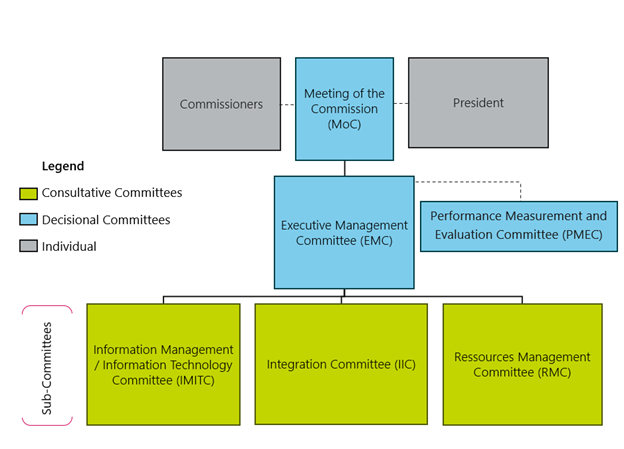
Text version
The organization flowchart showing the PSC’s governance structure has a legend that divides the structure into three categories: consultative committees, decisional committees, and individual.
In the individual category there is:
- Commissioners
- President
In the decisional committees category, there is:
- Meeting of the Commission (MoC)
- Executive Management Committee (EMC)
- Performance Measurement and Evaluation Committee (PMEC)
In the consultative committees category (also listed as sub-committees) there is:
- Information Management / Information Technology Committee (IMITC)
- Integration Committee (IIC)
- Resources Management Committee (RMC)
At the top of the flowchart there is:
- Commissioners
- Meeting of the Commission (MoC)
- President
Under MoC there is:
- Executive Management Committee (EMC)
Attached to EMC there is:
- Performance Measurement and Evaluation Committee (PMEC)
Below EMC, listed as sub-committees, there is:
- Information Management/Information Technology Committee
- Integration Committee (IIC)
- Resources Management Committee (RMC)
Committees
Meetings of the Commission (MOC)
The Meeting of the Commission is the decision-making forum that allows the Commission to fulfill its obligations under the Public Service Employment Act and the Employment Equity Act vis-à-vis the federal public service, and its governance role vis-à-vis the PSC as an organization.
Mandate
The Commission is composed of the Commissioners, including the PSC President, and has the following responsibilities:
- to provide strategic direction to the PSC in establishing its vision, mission and core values, and ensuring their implementation
- subject to the limits of the Public Service Employment Act, to delegate, at its discretion and under its conditions, certain of its authorities to the President, the Commissioners and PSC employees
- to provide advice on external communications, including relationships with parliamentarians and deputy heads
The mandate of the Commission is described in the Public Service Employment Act, under section 11:
- to appoint, or provide for the appointment of, persons to or from within the public service in accordance with this act
- to conduct investigations and audits in accordance with this act
- to administer the provisions of this act relating to political activities of employees and deputy heads
Authorities
The Commission may delegate any power or function, other than under section 20 or 22 of the Public Service Employment Act, to any Commissioner or employee of the PSC. The Commission may also create committees, as it sees fit, in order to meet its obligations.
The Commission also has the authority to delegate and organize its internal activities to service organizations under section 13.
Commission membership
The Commission is composed of the President and the Commissioners, who are supported by the Vice-Presidents, the General Counsel, and the Chief of Staff to the President.
Roles and responsibilities
Chair and Commissioners
- Presiding over meetings, on a rotating basis
- Opening and facilitating discussions and decisions in alignment with the Commission’s mandate, and in keeping with the planned timeframe
- Participating in the Commission’s discussions and decision-making
- Summarizing key points and identifying next steps for each agenda item, including:
- highlighting issues for discussion and resolution
- confirming decisions
- Approving the Meetings of the Commission’s forward agenda
- Recusing themselves when a subject may put them in real, potential or apparent conflict of interest
- Participating in any activities as requested by the Commission
Meetings
- The Commission uses meetings as the prime forum to conduct its business, and work towards a consensus on all decisions
- Commission meetings are held monthly; additional meetings could be held if requested by the Chair
- The quorum for a meeting of the Commission is the majority of the Commissioners
Operating Principles of the Public Service Commission
Executive Management Committee (EMC)
This committee serves as a horizontal and inclusive decision-making forum to establish strategic priorities, provide operational direction in the management of the organization, and monitor progress against set objectives and targets, in an integrated approach for achieving PSC priorities and expected results in the delivery of its mandate, as a “department” and a central agency.
Mandate and level of authority
The Executive Management Committee is the primary review and decision-making forum on PSC operations.
The committee will focus, at the strategic level, on PSC-specific matters such as:
- departmental planning and priority setting
- direction on policies, programs and services
- oversight of significant impact files and initiatives
- corporate-level management, such as:
- financial planning
- human resources management
- communications
- program evaluation
- information technology
- performance against expected results
Committee membership
The Executive Management Committee is chaired by the President or, in the President’s absence, by a vice-president. It is composed of the vice-presidents, the general counsel, chief executive of the Audit and Evaluation Directorate and the Chief of Staff to the President.
Meetings
- Meets once a week; additional meetings may be scheduled if requested by the Chair
- Information can also be shared secretarially with members by the Corporate Secretariat (through email) when required, on an ad hoc basis
Sub-committees of the Executive Management Committee
Integration and Inclusion Committee
- Serves as a horizontal and inclusive consultative forum to provide strategic advice, recommendations and constructive feedback on an integrated approach for achieving PSC priorities and objectives in delivery of its mandate, as a “department” and a central agency
- Helps ensure activities remain highly aligned with expected results and the level of organizational capacity and diversity in a rapidly changing environment
- Chaired by a vice-president and composed of 4 directors general, 3 directors from various PSC sectors, an Emerging Leaders Network representative and a PSC Diversity & Inclusion Committee representative
- Meets once a month
Resource Management Committee
- Serves as a horizontal and inclusive consultative forum to discuss cross-cutting resource management matters for the PSC as a department
- Helps ensure that priorities, activities and resources remain highly aligned with expected results and the level of organizational capacity and diversity in a rapidly changing environment
- Chaired by a vice-president and composed of 3 directors general and 4 directors from various PSC sectors, an Emerging Leaders Network representative, and a PSC Diversity & Inclusion Committee representative
- Meets once a month
Information Management/Information Technology Committee
- Serves as a horizontal and inclusive consultative forum to provide strategic advice and recommendations, as well as constructive feedback, on strategies, plans and priorities relating to Information Management (IM) and Information Technology (IT) initiatives
- Includes providing a challenge and advisory oversight function for IT-enabled business projects to ensure they are delivering intended business value and client satisfaction through shared accountability while respecting planned resource allocation
- Chaired by a vice-president and composed of 4 directors general, an assistant director and 3 directors from various sectors of the PSC, an Emerging Leaders Network representative and a PSC Diversity & Inclusion Committee representative
- Meets once a month
Public Service Commission Joint Advisory Council (PSCJAC)
Purpose
The Public Service Commission Joint Advisory Council (PSCJAC) provides a forum for discussion and consultation on Public Service Employment Act (PSEA) matters of common concern and interest and for collaboratively exchanging information and views. The Council consists of representatives from the PSC, the public service bargaining agents, federal departments and agencies as well as senior officials from the Office of the Chief Human Resources Officer, the Human Resources Council and the National Joint Council. The Council is co-chaired by a representative from the bargaining agents and a representative from the departments/agencies.
Public Service Commission Internal Audit Committee (IAC)
Purpose
The objective of the Treasury Board Policy on Internal Audit is to ensure that the oversight of public resources throughout the federal public administration is informed by a professional and objective internal audit function that is independent of departmental management. This function provides assurance as to whether government activities are managed in a way that demonstrates responsible stewardship to Canadians.
The purpose of the PSC’s Internal Audit Committee is to support this objective by:
- providing objective advice and recommendations to the PSC President on the sufficiency, quality and results of internal audit engagements related to the adequacy and functioning of the department’s frameworks and processes for risk management, control and governance
- using a risk-based approach, reviewing all areas of responsibility for departmental audit committees related to departmental management, control and accountability processes as determined by the Comptroller General of Canada
- providing advice and recommendations on matters for which the President, as accounting officer, is responsible, and on other related matters as needed or requested by the President
The committee will achieve the expected results of the Policy on Internal Audit such that the President is:
- supported in their role as accounting officer by an internal audit function that contributes directly and proactively to improving risk management, control and governance
- provided with assurance and advice from the committee and from the internal audit function to inform decision making at the PSC
Members of the committee:
- Nada Semaan (chair)
- Andrée Lafortune
- Ali Rahnema until April, 2024
- Satya Sarangi (Starting February, 2024 to replace Ali Rahanema)
Terms of reference: https://gcdocs.gc.ca/psc-cfp/llisapi.dll/link/6714268 (accessible only on the PSC network)
Performance Measurement and Evaluation Committee (PMEC)
Purpose
Created as per Treasury Board Policy on Results,the Performance Measurement and Evaluation Committee supports the President in instilling a strong departmental culture where evidence from performance measurement and evaluation informs program and policy design and delivery, decision-making and public reporting. This culture supports the department in achieving its planned results for Canadians by continuously improving the relevance, effectiveness and efficiency of its programs, services and policies.
The committee also takes into consideration priorities, expertise and information stemming from other departmental governance bodies to facilitate integrated departmental governance.
The President chairs this committee, and PSC vice-presidents are permanent members.
Terms of reference: https://gcdocs.gc.ca/psc-cfp/llisapi.dll/link/13476576 (accessible only on the PSC network)
C: About us
Departmental profile
Workforce Demographics
https://gcdocs.gc.ca/psc-cfp/llisapi.dll/Overview/21267185 (accessible only on the PSC network)
Overview of finances
https://gcdocs.gc.ca/psc-cfp/llisapi.dll/Overview/21238896 (accessible only on the PSC network)
https://gcdocs.gc.ca/psc-cfp/llisapi.dll/Overview/21396861 (accessible only on the PSC network)
IT Landscape
https://gcdocs.gc.ca/psc-cfp/llisapi.dll/Overview/21267580 (accessible only on the PSC network)
General organizational chart
https://gcdocs.gc.ca/psc-cfp/llisapi.dll/Overview/21267186 (accessible only on the PSC network)
President’s Office and direct reports to the President (23.4 FTEs)
Corporate Secretariat
The Corporate Secretariat provides support, advice and services to the Commission, the President and senior management, and acts as the custodian of the Commission’s governance framework.
Its duties include:
- providing operational and administrative support to the following PSC executive committees: Meetings of the Commission; Executive Management Committee and sub-committees
- providing administrative support to the President, managing the President’s calendar and coordinating the development of briefing documents
- providing Chief-of-Staff services, such as advice and guidance to the President
Internal Audit and Evaluation Directorate
Chief Audit and Evaluation Executive: Ghislaine Tremblay
The Internal Audit and Evaluation Directorate regularly performs audits and evaluations of PSC programs and activities either as part of internal audit and evaluation plans or on special request from senior management. It is led by the Chief Audit and Evaluation Executive and covers both the internal audit and the evaluation functions. The Chief Audit and Evaluation Executive also acts as the PSC’s Senior Officer for Disclosure of Wrongdoing in the Workplace.
The Office of the Ombuds
Ombuds: Maria Tsourounakis
The Office of the Ombuds provides a safe space for all persons working at the PSC to help resolve work-related issues. It reinforces a workplace culture that focuses on values, respect, teamwork, fairness, civility and accountability. Acting as an agent of change, the office provides upward feedback on areas of concern for the organization, while preserving confidentiality. The office is responsible for:
- Ombuds Services
- Workplace and wellness coaching services
- Values and ethics (including conflict of interest and political activities)
- Employee Assistance Services
- Informal Conflict Management Services
- Employee wellness surveys
- Exit Interview Program
- Workplace restoration
Office of the Ombuds Annual Review
The 2022 to 2023 annual review (accessible only on the PSC network) covers the services provided by the Office of the Ombuds over the last fiscal year.
This report preserves confidentiality for the people who have used these services. It presents the various Ombuds programs and services accessed by employees, as well as an overview of the main issues affecting PSC staff. This overview enables the PSC to act, and to adapt to the changing needs of employees.
Policy and Communications Sector (130.7 FTEs)
Acting Vice-President: Michael Morin

Prior to his current position, Michael served as Director General, Policy and Strategic Directions where he was responsible for delivery and support of the PSC’s appointment framework and strategic alignment and coordination of the PSC’s key activities, partnerships and external relations. Michael has also served in various roles within the PSC including as Senior Director, Business Transformation, and Director of Program Delivery.
In his over 20-year public service career, Michael occupied various roles in the area of HR management at Agriculture and Agri-Food Canada and the Department of National Defence.
Michael holds a Bachelor of Arts in English Language and Literature with a legal studies option from the University of Waterloo.
About the Policy and Communications Sector
The Policy and Communications Sector provides federal departments and agencies with policies and guidance related to merit-based appointments, delegation and accountability. The sector is responsible for strategic policy, political activities and non-partisanship, alignment of key PSC activities and outreach to the broader Government of Canada agenda, and special projects that support strategic recruitment across the public service.
The sector also provides corporate internal and external communications and parliamentary affairs services to support all PSC program activities.
Policy and Strategic Directions Directorate
This directorate provides the PSC and departments and agencies with expertise in policy development, application and interpretation. It is also responsible for the horizontal integration of all the PSC’s sectors. It includes the following program functions:
Policy Division
This division is the centre of expertise for interpretation and guidance on the PSC appointment framework (Appointment Policy and the Appointment Delegation and Accountability Instrument). The division:
- ensures that the Appointment Framework balances the needs of departments and agencies while respecting requirements and staffing values
- guides and promotes diversity and inclusion in appointments within the federal public service
- provides advice and guidance on official languages in the appointment process
The division also develops and updates statutory instruments (regulations and exclusion approval orders) related to the PSC’s mandate, and provides advice and guidance on their application. In addition, the division represents the PSC before the Federal Public Sector Labour Relations and Employment Board.
Strategic Directions and Partnerships Division
This division is responsible for the strategic alignment and horizontal coordination of the PSC’s key activities, partnerships and external relations. Its core activities include environmental scanning to increase organizational awareness of current and future trends and drivers, as well as analyzing initiatives and publications from various sources.
The division also produces the PSC annual report on the state of the public service staffing system. To ensure an integrated approach and visibility of key initiatives, the division is responsible for developing strategic and tactical external relations plans. The division is also responsible for coordinating international, federal, provincial and territorial commitments and engagements.
Staffing Support, Priorities and Political Activities Directorate
This directorate provides departments and agencies with advice, guidance and outreach activities aimed at promoting and safeguarding an effective staffing system and a non-partisan public service. It also administers and monitors priority entitlement provisions, mobility provisions and the political activities of employees and deputy heads to promote a non-partisan public service. It includes the following program areas:
Staffing Support Division
This division provides departments and agencies with customized advice, guidance and outreach activities aimed at achieving an agile, inclusive and effective staffing system. In support of this function, the division provides stakeholder information sessions, discusses staffing related scenarios with corporate HR staffing clients, provides insight into departmental client staffing environment to PSC partners, and collaborates with internal partners to adapt informal program communication approaches to reach out to clients and assist in effective program delivery.
The division also monitors emerging organizational trends related to policy, oversight, inclusive hiring practices and general staffing needs. A principal objective of this work is to support departments and agencies in experimenting and innovating with their staffing approaches to meet ongoing and emerging business needs and achieve diversity, equity and inclusion objectives. One of the current key priorities is to support HR and organizations in the implementation of the amendments to the Public Service Employment Act.
Priority Entitlements Program
This program provides front-line service, guidance and outreach to persons with a priority entitlement, home and hiring organizations, and other stakeholders. It also develops directives, guides and tools, including the Priority Information Management System, to support stakeholders in managing priority entitlements.
Political Activities and Non-Partisanship Division
The division is responsible for providing front-line advice, guidance and outreach to public servants on their rights and responsibilities related to political activities and to departments and agencies on safeguarding a non-partisan public service (includes organizations from the core public administration and certain separate agencies). The division reviews and analyzes employee requests to seek nomination as, and to be, a candidate in an election at the municipal, provincial, territorial or federal level.
The division also administers the mobility provision for former ministers’ exempt staff and for persons formerly employed in an excluded position at the Office of the Governor General’s Secretary to participate in advertised internal appointment processes open to the employees of the public service. The division administers these requests, assessing them for eligibility and providing access to those internal job opportunities.
Communications and Parliamentary Affairs Directorate
The directorate is responsible for guiding the PSC’s relationship with Parliament and managing communications with parliamentarians.
It also provides leadership in communications with managers and job seekers as well as in corporate and internal communications. Services include:
- parliamentary affairs
- strategic, corporate and internal communications, including planning and implementing communication strategies and approaches, and writing and editing
- social media accounts: Facebook (GC Jobs/Emplois GC), Twitter (@Jobs_GC/@Emplois_GC and @PSCofCanada/@CFPduCanada), Instagram (@jobs_gc/@emplois_gc), LinkedIn and YouTube (English/French)
- media relations, advertisement and public opinion research
- events (includes speaking role for Commissioners at all-staff events)
- graphic and web design and developing the PSC’s external web presence on Canada.ca, the internal employee website Intracom and the PSC’s interdepartmental extranet
- video production
- the Centre of Expertise on Accessible Documents
It also creates and implements marketing campaigns, using a suite of tools and products, to generate greater awareness and uptake of specific initiatives.
Services and Business Development Sector (335.2 FTEs)
Vice-President: Ravinder Rakhra

Ravinder Rakhra is the Vice-President of the Services and Business Development Sector.
Prior to joining the PSC, Ravinder spent 30 years with Public Services and Procurement Canada, Pacific Region. In her last role there, she was the Regional Director, General Pacific Region, responsible for providing the department’s full range of integrated and client-focused services.
Ravinder holds a Bachelor of Commerce, with a Major in Finance, and an MBA from the University of British Columbia.
About the Services and Business Development Sector
This sector offers integrated recruitment and assessment services, adapted to the needs of clients and the public service across Canada. It provides job seekers, public servants and hiring managers with:
- access to focused inventories and specialized recruitment programs (student, graduate and general recruitment)
- assessment tools (second language testing, occupational tests, test administration services, advice and guidance)
- access to the Public Service Resourcing System
The sector’s programs and services are offered through 3 directorates:
- Business Development and Systems Directorate
- National Recruitment Directorate
- Personnel Psychology Centre
The sector consists of 335 employees located across 5 regional offices (Halifax, Montréal, Gatineau, Toronto and Vancouver), with the majority located in the Gatineau office.
Business Development and Systems Directorate
This directorate is responsible for the reliable and secure operation of the Public Service Resourcing System, also known as GC Jobs. This includes managing day-to-day operations, providing tiered client support to job seekers and HR professionals, as well as managing bugs, errors and downtimes. The directorate is responsible for managing change requests for system enhancements and conducting user surveys and operational data analytics to support system improvements.
On an average business day, GC Jobs sends out over 81 000 email alerts. Around 10 000 job advertisements are posted annually, producing over half a million job applications. Over 3 500 HR professionals use the system. The GC Jobs website receives around 10 million views a year. It has over 3.2 million active applicant accounts, with over 910 000 applicants logging in each year.
Public Service Resourcing System operations, maintenance and enhancements are funded through a permanent ARLU transfer from medium and large departments that are subject to the Public Service Employment Act.
As many innovative initiatives across the PSC rely on the system, the directorate works closely with other programs and services across the Services and Business Development Sector and the PSC. It is also responsible for recruitment systems renewal: modernizing the recruitment platform by replacing the aging Public Service Resourcing System with an adaptable, modern, inclusive, user-centric and digital recruiting solution.
This directorate’s expertise includes project management, business analysis, user experience research and design, all of which support various initiatives across the sector.
National Recruitment Directorate
This directorate plays a key role in supporting the PSC’s mandate by providing staffing, recruitment and assessment advice, services and products to clients. Composed primarily of HR advisors across 5 regions, the directorate:
- develops, administers, and implements talent products, such as:
- Federal Student Work Experience Program
- Employment Opportunity for Students with Disabilities
- Indigenous Student Employment Opportunity
- Post-secondary Co-operative Education/Internship Program
- Research Affiliate Program
- Post-Secondary Recruitment Program
- Federal Internship Program for Canadians with Disabilities
- Indigenous Career Pathways
- Inuksugait Resume Inventory
- Virtual Door to Talent with Disabilities
- Recruitment of Policy Leaders
- other inventories and pools
- administers the second language evaluation tests
- leads recruitment outreach activities in collaboration with departments, as well as Deputy Minister University Champions, to promote employment opportunities with the federal public service, to academic institutions, official languages minority and employment equity communities
- builds and maintains partnerships through engagement activities with departments, and represents the PSC at regional federal councils, functional communities and communities of practice
- develops actions to modernize recruitment programs to ensure they remain inclusive and relevant to users
The directorate is informed through the strategic support of its centres of expertise (Talent Product Development, Talent Product Operations, Assessment, Outreach and Engagement, Candidate Matching, Diversity and Inclusion, Indigenous recruitment, Business Enablement and Continuous Improvement), which conduct research on best practices and monitor trends to develop internal competencies, strategies, direction, processes and required tools.
Personnel Psychology Centre
The Personnel Psychology Centre provides expert assessment advice, guidance, products and services to HR professionals and hiring managers in federal departments and agencies. It is composed mostly of assessment specialists, licensed psychologists and language assessors. It is funded partly through cost recovery.
The centre develops a variety of assessments, including:
- the Second Language Evaluation – Oral Language Assessment, as well as the tests of reading comprehension and written expression
- it is responsible for administering the oral language assessment in the National Capital Region, as well as managing the testing program for tests of reading comprehension and written expression
- it also offers services that include leadership competencies assessment, psychological assessments for high-profile and high-risk positions, coaching, counselling and career management services for executives
With the recent amendments to the Public Service Employment Act, the Personnel Psychology Centre has developed a guide, tool, workshop and facilitator guide to help departments identify and mitigate biases and barriers disadvantaging people belonging to equity-seeking groups in departmental assessment methods. The centre also provides departments and agencies with advice and guidance on inclusive assessment.
The centre strives to innovate by increasing their online testing, exploring alternative approaches to testing, applying universal design concepts to their tests, and making them more accessible through unsupervised internet testing, which allows applicants to choose where and when they will take their exams.
The centre provides advice, support and guidance on assessment accommodation measures for PSC tests, and it supports departments in defending the use of PSC tools in the event of a complaint.
Oversight and Investigations Sector (117.8 FTEs)
Vice-President: Stan Lee

Stan Lee is originally from Edmundston, New Brunswick. He moved to Ottawa in 1994 to pursue graduate studies at Carleton University, where he earned a PhD in Experimental Psychology.
Stan began his public service career as a psychologist at the Personnel Psychology Centre in 1998 and has since occupied a number of positions in policy, research, operations, internal services and oversight. In 2006, he was appointed Director General of the Personnel Psychology Centre. He was appointed Vice-President of the PSC’s Oversight and Investigations Sector in July 2016.
More recently, he also completed graduate studies in Public Policy and Governance at the University of Ottawa.
About the Oversight and Investigations Sector
This sector plays an important role in the PSC’s accountability to Parliament by helping safeguard the integrity of appointments and by overseeing the political impartiality of the federal public service. The sector performs audits and investigations and conducts surveys to monitor organizational compliance with staffing legislation, regulations and policies, and provides a systemwide view of the public service staffing environment. This sector also monitors and analyzes appointment data, and conducts research to provide departments and Canadians with an informed view of the dynamics of public service staffing.
Audit Directorate
The PSC’s audit mandate, as defined in the Public Service Employment Act, provides the authority to conduct audits on any matter within its jurisdiction. It also provides systemwide assurance and an assessment of the effectiveness of staffing processes to achieve a merit-based, non-partisan public service that is drawn from across the country, representative of Canada’s diversity and able to serve members of the public with integrity and in their official language of choice. The audit mandate also includes undertaking audits to determine whether there are biases or barriers that disadvantage people belonging to any equity-seeking group. These audits provide objective information, advice and assurance to Parliament, and ultimately to Canadians, on the integrity and fairness of appointments in the public service.
Investigations Directorate
Overview : https://gcdocs.gc.ca/psc-cfp/llisapi.dll/link/21274520 (accessible only on the PSC network)
This directorate plays a key role in the PSC’s mandate to oversee the integrity of the staffing system and the political impartiality of the federal public service. The directorate investigates concerns relating to specific appointment processes and allegations of improper political activities for departments and agencies that are subject to the Public Service Employment Act.
Appointments
Under Part 5 of the Public Service Employment Act, the PSC has the authority to investigate allegations of merit not being met, as well as errors, omissions and improper conduct in external appointment processes. It can also investigate allegations of fraud and political influence in both internal and external appointment processes. The Investigations Directorate can also investigate errors, omissions or improper conduct in internal appointment processes at the request of a deputy head, or in instances where the appointment authority is not delegated to the deputy head.
With the coming into force of Public Service Employment Act amendments on July 1, 2023, the PSC can now also investigate errors, omissions or improper conduct resulting from biases or barriers in staffing that disadvantage people in equity-seeking groups.
Improper political activities
Under part 7 of the Public Service Employment Act, the PSC has exclusive authority to investigate allegations of improper political activities by federal public service employees. The PSC can conduct investigations related to:
- candidacy in a federal, provincial, territorial or municipal election
- political activities in support of, within, or in opposition to a political party
- political activities in support of, or in opposition to, a candidate before or during an election period
- a deputy head who engaged in any political activity other than voting in an election
Data Services and Analysis Directorate
This directorate supports the PSC’s mandate by producing analytical research, data tools and statistical information on hiring and staffing in the public service. It is comprised of the 3 following divisions.
Research, Data Reporting and Surveys Division
The division manages data requests from internal and external clients, leads the research agenda for the PSC and produces quantitative analyses on various topics related to staffing activities, including employment equity, merit, fairness, transparency, political activities, efficiency and time to staff. It also provides methodological support for PSC audit activities and conducts surveys, including the biennial Staffing and Non-Partisanship Survey.
Open Government and Data Support Division
The division is responsible for providing support to sectors in the development and implementation of data management practices and the PSC’s biennial Open Government implementation plans. The division supports sectors in their data collection, processing, quality assurance and overall management to ensure that the PSC has the right data, the right way, in the right hands at the right time. The PSC’s fourth Biennial Open Government Implementation Plan outlines our vision and commitments from 2022 to 2024 and represents a comprehensive overview of what we aim to accomplish in implementing an Open PSC.
Data Systems and Tools Division
The division:
- processes, deploys and maintains public service recruitment, HR and pay data used in developing data products across the PSC
- builds macrosimulations of the staffing system to support evidence-based decision making
- develops innovative, interactive and accessible web-based data visualization tools offering a user-friendly interface to explore HR trends
Chief Financial Officer and Corporate Affairs Sector (249.1 FTEs)
Chief Financial Officer and Vice-President: Farhat Khan
Farhat Khan is the Chief Financial Officer and Vice-President, Corporate Affairs. She leads a sector team of 250 professionals and is accountable for the provision of departmental HR, information technology and financial management functions as well as other corporate services. Farhat is also accountable for departmental planning including risk management and performance measurement for the PSC. She is the Chief Security Officer for the PSC and oversees the administration of the Access to Information Act and the Privacy Act at the PSC.
Farhat has held the positions of Deputy Chief Financial Officer and Director General from 2015 to 2022 in several large, decentralized organizations, with areas of responsibility spanning financial management, grants and contributions program management and recipient audits. In addition, she has held various executive positions in information management and information technology. Farhat is a chartered professional accountant (CPA, CMA) and holds a bachelor’s degree in accounting and management information systems.
Farhat is energized by the diversity of her team and their passion for excellence in service delivery. She has a hands-on management style and is non-hierarchical in her interactions with teams.
About the Corporate Affairs Sector
The Corporate Affairs Sector is the internal services provider for the PSC, supporting the needs of programs and other corporate obligations. Key areas of internal services offered by the sector include financial management, acquisitions, material management, real property, HR management, information management and information technology, travel and other administrative services, as well as Access to Information and Privacy services. Additionally, the sector leads the Corporate Planning function for the PSC and includes performance and risk management.
Finance and Corporate Planning Directorate
This directorate supports the Chief Financial Officer, who is the financial steward accountable for financial management of the department and supports the implementation of the Policy on Financial Management. The directorate protects the integrity of the PSC’s business activities by managing all financial and procurement services, including financial management and maintaining internal controls according to acts, regulations and central agency requirements. This directorate is also responsible for strategic business planning, reporting and organizational performance measurement.
Information Technology Services Directorate
The directorate plays a leading role in the PSC environment, which requires an IT infrastructure that is responsive, modern, adaptable, flexible and secure. It is responsible for developing and maintaining assessment tool platforms, the Government of Canada recruitment system, as well as most back-office applications supporting core PSC business and internal services. The directorate also provides the full range of information management services to the organization.
Human Resources, Workplace and Security Directorate
The directorate provides HR services to PSC employees relating to the workforce and workplace. It enables effective people management with timely hiring and onboarding, learning, development and talent management, HR planning focused on diversity and inclusion, and ensures a healthy, safe, and secure workplace. The directorate is also leading the implementation of a hybrid culture in a modern workplace.
Sector Management and ATIP Coordination/VP Office
The office provides strategic advice and administrative support to the sector Vice-President, as well as business support services across the sector. Through powers delegated by the PSC President, the directorate also ensures proper administration of the Access to Information Act and the Privacy Act, develops and implements efficient procedures to process requests under both acts, provides privacy advice, promotes awareness, and monitors the PSC’s compliance with legislation, procedures and policies.
Legal Services Unit (2 FTEs)
Introduction
Executive Director and General Counsel: Martine Benoit
The Department of Justice Act sets out the powers, duties and functions of the Minister of Justice and the Attorney General of Canada. The Minister and Attorney General exercises and performs them with the support of the Department of Justice. The latter provides legal advice to the government and departments and agencies, including the PSC, represents the Crown in civil litigation and before administrative tribunals, drafts legislation and responds to the legal needs of federal departments and agencies.
The PSC accesses Department of Justice services mainly through its Legal Services Unit. The PSC works directly with this unit, which in turn collaborates and liaises with other Department of Justice teams, including centres of expertise, legislative services and the National Litigation Sector. An exception to this principle exists for labour relations’ issues and complaints filed in this regard. The Department of Justice’s Center for Labour and Employment Law advises the PSC directly in those cases, with or without the Legal Services Unit’s involvement.
The unit is comprised of legal counsel employed by the Department of Justice and administrative staff employed by the PSC. The unit is co-located with the PSC, and headed by a General Counsel and Executive Director.
Our work
The Legal Services Unit provides legal services and advice to the PSC on a wide range of legal issues related to the PSC’s mandate, responsibilities and operations. It provides legal advisory, litigation support and legislative support services to the PSC, in collaboration with other sections of the Department of Justice, as necessary.
Advisory Services
The Public Service Employment Act establishes the mandate of the PSC for appointments in the public service, for the conduct of investigations and audits and for administration of political activities in relation to employees and deputy heads. The interpretation and application of the act and associated regulations are central to the work of the Legal Services Unit. The unit also advises on other legislation relevant for the PSC to carry out its responsibilities. This includes the Canadian Charter of Rights and Freedoms, the Employment Equity Act, the Canadian Human Rights Act, the Financial Administration Act, the Official Languages Act, the Access to Information Act and the Privacy Act.
Advice is given on appointment-related issues, ranging from the interpretation of legislative requirements for developing policy direction to assist deputy heads across the public service, to opinions on specific staffing incidents. This covers a wide range of topics implicating all PSC sectors, on matters including the application of merit, non-partisanship, political activities, priority administration, appointment programs and services, and audits, investigations and oversight. The Legal Services unit also advises on legal matters relating to Access to information law, including the authority to share various types of information with other organizations. We also work with the PSC’s Access to Information and Privacy Office on legal questions arising from access to information and privacy-related matters and provide legal services for other corporate matters, such as contractual issues and financial administration.
The unit reviews and provides advice to the PSC about its investigation reports and the scope of its authority to impose corrective actions. The unit also reviews all requests from employees seeking permission to be candidates in municipal, provincial, territorial or federal elections.
Legislative Services
The Legal Services Unit works closely with the policy team as it develops regulatory proposals to support the operation of the Public Service Employment Act. It provides legal services and legislative drafting support to make and amend statutory instruments, which includes advising on the power to exclude individuals or groups from the application of provisions of the act.
Litigation Services
The Legal Services Unit provides litigation support for public service staffing as well as political activities related matters before the courts. Most often, these are applications for judicial review of the Commission’s investigation decisions. The unit also provides advice to and represents the PSC in staffing complaints before the Federal Public Sector Labour Relations and Employment Board, for which the PSC is, by law, considered another party, and in complaints before the Canadian Human Rights Commission.
Additional information
The unit reports to the Commission on its activities and on the litigation activities of the PSC, on a regular basis at the regular Meeting of the Commission.
D: Key files
Amendments to the Public Service Employment Act
Context
In June 2021, the Budget Implementation Act, 2021, No. 1 introduced changes to the Public Service Employment Act to strengthen diversity and inclusion and remove or mitigate potential biases and barriers faced by equity-seeking groups. The changes came into effect in stages, with the following changes taking effect upon royal assent:
- new definition of “equity-seeking groups”
- expansion of PSC audit authorities to include biases and barriers
- requirement for an evaluation of biases or barriers when establishing or reviewing qualification standards
- providing permanent residents with the same level of appointment preference as Canadian citizens for advertised job processes open to the public
Current status
Further amendments to the act came into force on July 1, 2023, following an order in council. These include:
- expanding the authority of the PSC and deputy heads to investigate errors, omissions and improper conduct resulting from biases or barriers that disadvantage people belonging to equity-seeking groups
- introducing a new requirement to evaluate assessment methods for biases and barriers that disadvantage people belonging to equity-seeking groups, and to make reasonable efforts to remove them or mitigate their impact
To support these changes, we have:
- updated the PSC Appointment Framework and provided associated guidance
- developed a preparation handbook for departments, as well as a guide and tool to mitigating biases and barriers in assessment
- delivered national and individual workshops and information sessions to managers and the HR community
- supported knowledge and expertise via an Ambassador Network for Inclusive Assessments and investigation liaison information sessions, discussions and workshops
- launched bias mitigation and evaluation consultation services
- revised and established new investigation processes and templates, and established internal protocols when expert analysis is required
- started work to expand data collection to include equity-seeking groups
Going forward
We will continue to provide support to the HR community by delivering sessions to increase the staffing community’s understanding of how and when to apply the act’s new requirements. We will also continue work on raising managers’ awareness of the changes to meet these requirements.
Regulatory initiatives underway
Locally Engaged Staff Exclusion Approval Order and related employment regulations
Background / Context
Locally engaged staff are people hired outside Canada to perform diverse functions in support of government operations abroad. The knowledge, contacts and language skills of locally engaged staff are essential to the delivery of the government operations abroad.
The employment regime for locally engaged staff is established through the Locally-Engaged Staff Exclusion Approval Order and the Locally-Engaged Staff Employment Regulations.
These instruments needed to be modernized, as they no longer met the operational needs of the 2 departments they serve (Global Affairs Canada and the Department of National Defence), and they were not aligned with the current flexible, merit-based staffing system of the Public Service Employment Act.
Considerations
Global Affairs Canada manages locally engaged staff at Canada’s diplomatic and consular missions, while the Department of National Defence manages locally engaged staff in foreign military support units abroad.
Both departments have been engaged in the regulatory development process and support the proposed regulatory regime.
The new Locally Engaged Staff Exclusion Approval Order and the new Locally Engaged Staff Employment Regulations, 2024 were approved by the Commission on November 21, 2023.
Going forward
The submission package has been sent to our designated minister for approval. It will then be submitted to the Assistant Clerk of the Privy Council for consideration and Governor-in-Council approval at a next available Treasury Board Cabinet Committee meeting.
Once approved, the statutory instruments will be registered and published in the Canada Gazette, Part II.
Public Service Diversity and Inclusion Exclusion Approval Order and related employment regulations
Background / Context
As departments explore measures and initiatives to increase diversity within their organizations, they have raised questions on the use of staffing measures under the Public Service Employment Act, including how to launch appointment processes that go beyond employment equity objectives and target equity-seeking groups (for example, Black people, persons with intellectual disabilities).
The goal of this regulatory proposal is to facilitate hiring people from equity-seeking groups, for reasons related to a special program to address disadvantage. The proposal would remove current hiring limitations and facilitate the appointment of individuals of equity-seeking groups, which would help build a more diverse and inclusive public service.
We are also looking at applying this regulatory proposal to the student employment appointment regime.
Considerations
Several stakeholders were consulted, including diversity employee networks, Treasury Board of Canada Secretariat, the Canadian Human Rights Commission, bargaining agents and departments. All supported the proposal.
The proposal is consistent with recent amendments to the Public Service Employment Act that aim to reduce barriers in staffing processes and improve representation of the diversity of the Canadian population throughout the public service. The amendments included a new definition of equity-seeking groups: a group of persons who are disadvantaged on the basis of one or more grounds of discrimination under the Canadian Human Rights Act.
The Commission approved the regulatory proposal, and the drafting process was initiated.
Going forward
In June 2022, the Commission approved the recommendation to put this regulatory proposal on hold, pending the release of the Employment Equity Act Review Task Force report.
Following the release and analysis of the report, a recommendation will be brought forward to the Commission to either pursue the regulatory proposal or cease the work and close the file.
Public Service Employment Regulations
Background / Context
The Public Service Employment Regulations govern appointments to positions in the public service. They prescribe a comprehensive appointment and lay-off regime that support the Public Service Employment Act.
The regulations have remained mostly unchanged since they came into force in 2005. Since their introduction, the staffing system has evolved, and a review was necessary to ensure they remain relevant. This work is critical as the public service competes to acquire and retain the talent it needs to maintain service excellence to Canadians.
The PSC is continuously working to meet the evolving needs of hiring organizations and candidates. It is in this context that the review was undertaken, to ensure the regulations continue to support the act, while enabling efficient and effective staffing within the public service.
Considerations
A key component of the review process was the early and sustained engagement and consultation of stakeholders, which included departments and agencies, the Treasury Board of Canada Secretariat, bargaining agents and subject-matter experts. Views on the application of the regulations and on opportunities to enhance them were solicited, and feedback on proposed amendments and additions was supportive.
Consultations were recently reopened following a joint letter of agreement between the Public Service Alliance of Canada and Treasury Board Secretariat with respect to seniority in the context of workforce adjustment situations, and given recent amendments to the Public Service Employment Act to identify and address biases and barriers in assessment methods.
The amendments, ranging from substantial to technical, are expected to address the current and emerging needs of hiring organizations, and eliminate any unnecessary requirements.
Going forward
The Commission approved the regulatory proposal, and the drafting process is underway and may be adjusted based on the result on consultations that close on December 22, 2023.
When approved, the proposed regulations will be pre-published for a period of 30 days for public consultation in Part I of the Canada Gazette.
2023 Staffing and Non-Partisanship Survey
Background / Context
The Staffing and Non-Partisanship Survey was first introduced in 2018 as a biennial survey addressed to all employees in the federal public service subject to the Public Service Employment Act. It provides a snapshot of the state of the federal public service staffing system. The survey targets employees, hiring managers and staffing advisors to gather their views on a wide range of staffing-related topics, including perceptions of merit, fairness and transparency, organizational staffing policies and practices, and awareness of rights and responsibilities related to political activities and non-partisanship.
The third cycle of this survey was administered by Advanis, a private opinion research firm, from September 20 to November 17, 2023.
Collection closed with 86 736 surveys completed with a ~32% response rate.
Considerations
Results from the survey will allow us to inform departments and agencies about staffing-related topics by key demographic characteristics, such as employment equity groups, equity-seeking groups and subgroups.
The 2023 iteration of the survey will also provide useful insights on potential biases and barriers encountered in the staffing process as well as perceptions of diversity and inclusion initiatives related to staffing.
Going forward
Results will be published in spring 2024.
Reference documents
Publications from the 2021 Staffing and Non-Partisanship Survey:
- 2021 Staffing and Non-Partisanship Survey: Highlights Report
- 2021 Staffing and Non-Partisanship Survey - Perceptions of Federal Public Servants with Disabilities
- 2021 Staffing and Non-Partisanship Survey - Perceptions of Federal Public Servants Who Are Members of an Employment Equity Group
Audits in progress
The PSC’s audit mandate, as defined in the Public Service Employment Act, provides the authority to conduct audits on any matter within its jurisdiction. Our audits provide system-wide assurance and an assessment of the effectiveness of staffing processes to achieve a merit-based, non-partisan public service that is:
- drawn from across the country
- representative of Canada’s diversity
- able to serve the public with integrity and in the official language of choice
The audit mandate also includes conducting audits to determine whether there are biases or barriers that disadvantage members of equity-seeking groups. These audits provide objective information, advice and assurance to Parliament, and ultimately to Canadians, on the integrity and fairness of appointments in the public service.
The following PSC audits are currently underway:
System-Wide Staffing Audit
- Will determine whether appointments and appointment processes comply with legislative, policy and regulatory requirements
- Will also examine whether hiring managers adhere to the direction established by the deputy head on the choice of appointment process (advertised or non-advertised)
- The sample covers 292 internal and external advertised and non-advertised appointment processes from 19 medium and large organizations
- The audit report will be available in fiscal year 2023 to 2024
Audit of Employment Equity Representation in Acting Appointments
- Will determine whether the 4 designated employment equity groups are proportionately represented in acting appointments
- Will also examine systems and practices departments and agencies have in place to promote access to appointments for employment equity groups, and the extent to which hiring managers consider employment equity when making acting appointments
- Sample covers 350 advertised and non-advertised acting appointments from 14 medium and large organizations
- Report will be available in fiscal year 2023 to 2024
Audit of Biases and Barriers in the Pre-Assessment Process
- Will determine the representation of equity-seeking groups for which data is available in the pre-assessment process (job application and Public Service Resourcing System screening stages)
- Will also determine the extent to which potential barriers exist in the pre-assessment process, including their frequency and potential relation to the application rates of the equity-seeking groups included in the audit
- Will identify systems and practices in place to reduce potential biases and barriers disadvantaging persons belonging to equity-seeking groups in the job application and Public Service Resourcing System screening stages
- Will not require participation from departments and agencies
- Report will be available in fiscal year 2023 to 2024
Priority and Risk-Based Audit Plan
Each year, the Audit Directorate prepares a Priority and Risk-Based Audit Plan, which is developed based on risk assessments, environmental scanning and through consultations with internal and external stakeholders. The plan is approved by the Meeting of the Commission (MOC), and progress on its implementation is monitored by the Audit Directorate and reported to MOC on a regular basis.
The 2023-2026 Priority and Risk-Based Audit Plan was approved on June 15, 2023. In addition to the 3 audits currently underway, the plan includes the following reviews for 2023 to 2024:
- review of RCMP authority to appoint casuals for more than 90 days
- review of reasons for use of non-advertised appointments
For 2024 to 2025, the plan has identified these audits:
- audit of assessment accommodation measures
- System-Wide Staffing Audit
- audit of effectiveness of collective staffing processes
Recruitment Systems Renewal
Background / Context
The current recruitment system, known as the Public Service Resourcing System or GC Jobs, is aging and does not support the user experience that today’s job seekers expect. Its outdated architecture and legacy technology make it increasingly complex and costly to add new functionalities, and maintaining it is highly challenging.
GC Jobs Transformation was launched to provide an adaptable, modern, inclusive, user-centric and digital recruiting solution that attracts talent and provides everyone with an equal opportunity to apply to federal government jobs.
GC Jobs Transformation completed the discovery phase of the project in fiscal year 2022 to 2023. We held consultations, gathered requirements and conducted discovery through proof-of-concept testing. The proof-of-concept completed in 2021 demonstrated that a cloud-based, software-as-a-service solution could meet most of our recruiting needs, integrate with various government HR applications and allow for greater agility and value in keeping up with recruitment trends.
In the fall of 2022, the GC Jobs Transformation team completed a review of the recruitment solution offered by the NextGen HR and Pay solution vendor, Ceridian. This included prototype design and testing with 10 participating departments; results showed that Ceridian’s Dayforce recruitment module was a viable solution. Based on these findings, the PSC recommended live pilots if a positive recommendation is made on NextGen HR and Pay.
Considerations
The recruitment system is part of an HR continuum, where existing and future systems need to work together. For this reason, we are working with key partners, such as Shared Services Canada, Public Services and Procurement Canada and the Office of the Chief Human Resources Officer, to align efforts on related projects, including NextGen HR and Pay. This includes helping to develop an enterprise HR Target Operating Model and Data Strategy.
Modernizing recruitment directly supports key priorities such as reducing time to staff and promoting a more diverse and inclusive public service through disaggregated reporting capabilities that will inform our efforts to reduce bias. It will also provide a more intuitive user interface to the nearly one million users that access the system each year.
The NextGen HR and Pay Final Findings Report was presented to the ADM HR and Pay Steering Committee in Fall 2023 and concluded that Dayforce is a “viable option for an integrated GC HR and Pay system” but that “viability does not constitute readiness.”
Going forward
A “go/no-go” decision on NextGen HR and Pay is expected in the spring of 2024. In the meantime, the team is finalizing an interim plan, which includes a short-term plan and a long-term strategy. The plan proposes to address some of the key end user challenges in the current recruitment system and prepare for future potential enhancements. We have considered a range of potential value-added enhancements in the short term, which will be presented to the Executive Management Committee in the new year, along with the overall vision and long-term strategy.
Modernizing second language evaluation
Context
The PSC develops, administers, scores and monitors second language evaluation tests for reading, writing and oral proficiency in English and in French. Use of tests approved by the PSC to assess second language proficiency is mandatory for staffing bilingual positions in departments and agencies governed by the Public Service Employment Act. Also, many departments who have their own appointment authority and are part of our extended jurisdiction clientele use our second language tests.
At the onset of the COVID-19 pandemic, we responded rapidly and flexibly by innovating in second language testing to support departments and agencies with their bilingual staffing. We quickly implemented temporary measures and tests. We transformed a business line that relied on in-person testing to enable remote, virtual assessments.
Effective March 24, 2020, we introduced policy flexibilities permitting departments and agencies to conduct their own second language testing.
Current status
Policy flexibilities
Temporary measure 1 (exemption from using PSC tests for reading and writing) and measure 2 (extension of validity period of second language evaluation results) have expired. Measure 3 allowed for using alternative assessment methods for all 3 tests, where deputy heads received PSC approval of their framework. As of September 1, 2023, measure 3 no longer applies to assessing reading comprehension and written expression, but it remains in effect for assessing oral competency, by departments and agencies authorized by the PSC . They may continue to use this flexibility until further notice.
Oral proficiency
The decrease in demand as a result of policy flexibility, along with the increase in capacity and streamlining of business processes, enabled us to eliminate the testing backlog for English tests. However, the backlog for French tests remains relatively stable.
Reading comprehension and written expression
On October 3, 2022, we launched new second language tests for reading comprehension and written expression on an online platform called the Candidate Assessment Tool. This tool enables departments and agencies to administer these tests remotely and in an unsupervised manner. Through this platform, we can deliver the most requested accommodation measures directly to candidates. As of October 31, 2023, more than 104 000 tests have been administered on this platform.
Going forward
We will continue to assess the need for measure 3 for oral proficiency, and we will ensure that departments and agencies have advance notice before the measure is rescinded, to allow for transition.
We are developing an approach to support a more sustainable service delivery model of second language evaluation in the public service.
Reference documents
- Authorization for departments and agencies to use an alternative method to assess second language proficiency (22-05)
- Change to temporary measure on use of alternative methods for assessing second language proficiency (23-01)
- Questions and answers for HR specialists in the context of COVID-19
Diversity and Inclusion
Affirmation of Indigenous Identity Form
Background / Context
As per the Appointment Policy, all departments and agencies under the Public Service Employment Act are required to use the Affirmation of Indigenous Identity Form when appointing a candidate who has self-declared as an Indigenous person, and where one of the following conditions applies:
- the area of selection is limited to Indigenous Peoples
- an organizational need is used to increase the representation of Indigenous Peoples
- an inventory of Indigenous candidates or a student employment program approved by the Treasury Board of Canada Secretariat is used to increase the representation of Indigenous Peoples
The original Affirmation of Aboriginal Affiliation Form was developed following concerns raised by Indigenous groups and in consultation with them. It was introduced as a pilot project on January 1, 2010, and reviewed in 2011, 2014 and fiscal year 2020 to 2021.
Current status
On November 1, 2022, the PSC launched the revised form following the results of the consultations conducted the previous fiscal year. The consultations showed support for the continued use of the form, which serves to recognize the uniqueness of Indigenous identity, and deters people who are not Indigenous from falsely self-declaring to benefit from employment opportunities intended for Indigenous candidates.
There is no policy requirement for additional proof of Indigenous identity, unless it is required as part of an investigation into an allegation of false claim of Indigenous identity. The PSC does not have the authority to determine whether an individual who has claimed Indigenous status and signed the affirmation form is Indigenous or not; but we can investigate whether false or misleading information related to the Indigenous identity was provided.
Going forward
We will continue to conduct cyclical reviews on the use of the form in consultation with Indigenous groups to ensure that the approach keeps up with the evolving environment and that the principles of reconciliation are respected.
Reference documents
- Review of the Affirmation of Indigenous Identity in Appointment Processes (22-07)
- Government-wide approach to the Affirmation of Indigenous Identity Form
Call to Action: Supporting departments and agencies
Background / Context
On May 9, 2023, the Clerk issued a message to deputies that included immediate actions for departments to implement, as well as longer-term instructions to support effective and consistent implementation of the Call to Action on Anti-Racism, Equity, and Inclusion in the Federal Public Service objectives.
In August 2023, the PSC provided heads of HR with a comprehensive list of our guidance, programs and services, along with details on the implementation of changes to the Public Service Employment Act, to support departments in meeting the objectives of the Call to Action and forward direction.
Current status
The PSC continues to support departments and agencies in meeting the Call to Action through:
- the Guide to Mitigating Biases and Barriers in Assessment and a Tool for Mitigating Biases and Barriers in Assessment
- leadership development support and tools (adapted simulation, coaching services and 360° feedback), including support for the Office of the Chief Human Resources Officer’s Mosaic and the Executive Leadership Development Program
- guidance and awareness, such as the Inclusive Recruitment Toolkit for hiring managers and human resources specialists
- an expanded Assessment Accessibility Ambassadors Network to help the HR community in improving the accessibility and inclusiveness of appointment processes
- interactive tools for exploring public service staffing data, including the PSC Data visualization hub
- Focused student recruitment initiatives such as:
- Focused graduate and candidate recruitment initiatives such as:
Going forward
We will continue to support departments and agencies in recruiting diverse talent through our focused recruitment initiatives, and by collecting and analyzing detailed hiring data to ensure goals focus on areas where the most work is needed.
We will also continue to make hiring data, and the results of our studies, audits and investigations, openly available to all departments and agencies, as well as to all Canadians, to measure progress and support our collective accountability.
Data collection for equity-seeking groups
Background / Context
The amendments to the Public Service Employment Act established a new definition of equity-seeking groups, which is linked to the 13 grounds of discrimination within the meaning of the Canadian Human Rights Act.
The federal public service has 2 main methods to collect employment equity data related to appointments: self-declaration and self-identification. The PSC collects self-declaration information (employment equity information voluntarily provided by applicants to appointment processes). Self-identification data (employment equity information voluntarily provided by employees upon hiring and during workforce survey campaigns) is collected by the Treasury Board Secretariat (TBS).
Current status
The PSC is looking to expand its data collection process beyond the 4 designated employment equity groups. A central part of this work is to ensure alignment with the modernized self-identification data collected by TBS and facilitate data sharing between central agencies.
We currently use the government’s Public Service Resourcing System to gather identity data. To collect more data on diversity and equity-seeking groups, we intend to create a new voluntary diversity questionnaire that is separate from the self-declaration process. This questionnaire will cover more groups than the 4 designated ones, and it will be consistent with the data collected by the modernized self-identification form.
To support the Public Service Employment Act amendments, the data collected via the diversity questionnaire would be for statistical purposes, such as reports, analyses and special studies. Information could also be used in the context of investigations into possible biases or barriers that disadvantage people who belong to an equity-seeking group in an appointment process. The self-declaration form for designated groups mentioned in the Employment Equity Act will be maintained for statistical and appointment purposes.
Going forward
We are working toward the implementation of the new diversity questionnaire. Further consultations with internal stakeholders and TBS are needed to refine the proposed approach to data collection, including privacy considerations.
Accessibility Strategy: Recruitment Pillar
Background
The Accessibility Strategy for the Public Service of Canada was launched in May 2019 to make the Canadian public service the most accessible and inclusive in the world. This strategy supports the Accessible Canada Act, which enforces the identification, removal and prevention of accessibility barriers for departments and agencies under federal jurisdiction, and contains 4 guiding principles:
- Nothing About Us Without Us
- collaboration
- sustainability
- transparency
The first goal of this strategy is to improve the recruitment, retention and promotion of persons with disabilities within the public service. The PSC is actively involved in achieving this goal and supporting the hiring of 5 000 new persons with disabilities by 2025.
As part of the accessibility strategy, the PSC introduced the Federal Internship Program for Canadians with Disabilities, which has its own section in this document.
Current status
Update on the hiring of 5 000 persons with disabilities
To improve the recruitment and retention of persons with disabilities, we are working in close collaboration with the Office of the Chief Human Resources Officer and the Office of Public Service Accessibility, who send annual progress updates to deputy heads, most recently in February 2023.
These letters provided 2021-22 organizational representation data and hiring targets (available only on PSC network) to support departments’ concrete and measurable actions to close the representation gap. The hiring targets were established based on data and analysis provided by the PSC. The letters also reported on public service progress in achieving the goal of 5 000 hires by 2025, as well as individual departmental results.
Some progress has been made in closing the representation gap for persons with disabilities, with an increase in representation for 2021 to 2022 (6.8%) from 6.1% in 2020 to 2021, but it is still below workforce availability in Canada (9.2%)
In addition, promotion rates for persons with disabilities continue to be an issue. In departments and agencies covered by the Public Service Employment Act, a recent update of promotion rates for persons with disabilities indicates a widening gap compared to their counterparts. Between 2008 and 2021, the gap in their promotion rate compared to their counterparts has steadily widened (from -7.9% to -12.6%).
Inventories for persons with disabilities (joint HRC / PSC initiative)
A joint Human Resources Council / PSC working group was also established following the enactment of the Accessible Canada Act to develop inventories of persons with disabilities available to all departments and agencies. These inventories are in the EC, IT, FI and BI groups.
Going forward
We will continue to support departments in hiring persons with disabilities through our outreach, recruitment programs and services, and we will keep working with organizations that represent persons with disabilities to promote employment opportunities and the importance of self-declaration.
Federal Internship Program for Canadians with Disabilities
The Federal Internship Program for Canadians with Disabilities is a 5-year national pilot program (2019 to 2024) which supports the accessibility strategy goal of improving recruitment, retention, and promotion of persons with disabilities.
The program was launched on April 1, 2019, to provide 125 2-year internship opportunities in the federal public service to Canadians with disabilities. Internships provide Canadians with disabilities with meaningful work experience and allow them develop their professional skills.
All hires for the program are now completed. In total, 126 interns will have participated in the program.
Evaluation
The PSC’s Internal Audit and Evaluation Directorate conducted an evaluation of the Federal Internship Program for Canadians with Disabilities in fiscal year 2022 to 2023. The evaluation focused on the relevance, effectiveness and efficiency of the program’s development, administration and achievement of outcomes since its inception in 2019. The evaluation of the program and the Management Response Action Plan were presented and approved by PSC governance committees. The overall feedback was positive.
The program shared their key lessons learned during an HR Council Smartshop event on September 20, 2023, addressing the HR community as outlined in one of our proposed actions within the Management Response Action Plan.
While the future of the program has yet to be determined, funding to extend the program for an additional 5 years has been requested through our partners at the Office of Public Service Accessibility. We are anticipating a decision in winter 2024.
Advice, guidance, and support on inclusive assessment
The Personal Psychology Centre supports HR advisors and hiring managers throughout the federal public service in the use of valid, reliable and inclusive assessments. We provide personalized consultations, hosting forums and workshops, and we offer guidance on how to identify and mitigate biases and barriers in assessment. Through the Ambassadors Network of Inclusive Assessments, we share best practices, and we advise and guide HR professionals in their work on inclusive, accessible and fair assessment. We also offer tailored advice and recommendations for assessment accommodation measures to support the fair evaluation of candidates with specific testing needs. We launched the Candidate Assessment Tool, a self-serve and accessible testing platform that improves candidate experience and facilitates the administration of PSC tests requiring common accommodation measures such as extra time and breaks.
We have also streamlined our information-gathering approach for the most requested assessment accommodation measures for second language evaluation reading and writing tests. These improvements have greatly improved assessment accommodation request processing time.
Resources
- Guide to Mitigating Biases and Barriers in Assessment
- Tool for Mitigating Biases and Barriers in Assessment
- Enhance fairness and reduce bias in your assessment tools
- Spotlight on diverse assessment boards
- Flexibility in Assessment
- Guide for Assessing Persons with Disabilities
- Guidelines for Fair Assessment in a Diverse Workplace
Recruitment Programs Modernization
Context
In winter 2022, a decision at Executive Management Committee was made to invest in modernizing recruitment programs. This followed the identification of recurring and long-standing challenges through evaluations, survey results and audits (including the 2021 Horizontal Audit of Student Hiring under the Federal Student Work Experience Program).
Working closely with the Office of the Chief Human Resources Officer, the holder of the student employment policy and directive, the initial focus of the PSC’s Recruitment Programs Modernization team is on modernizing student recruitment.
Taking a user-centric approach, the team consulted with stakeholders (students, academic representatives, hiring managers, HR, senior leaders, other jurisdictions) and, in June 2023, they brought forward a suite of recommendations (available only on the PSC network) that were endorsed by Executive Management Committee.
Ultimately, the future vision for student recruitment is: An inviting and intuitive recruitment experience for students and hiring managers that is inclusive, fair and user-centric. To achieve this, the team proposed 4 courses of action that are now starting to be implemented:
- Enhance user experience
- One-stop online portal for students and hiring managers, with self-serve access for hiring managers
- Revamp program design
- Increase flexibility by enabling specific name referrals from the Federal Student Work Experience Program (FSWEP) inventory
- Student jobs organized by career streams
- Diversified work-integrated learning
- Improve diverse talent attraction
- Rebrand FSWEP to more intuitive and user-friendly brand
- PSC-led efforts
- Expand eligibility criteria
- Career streams for equity-seeking groups, and in-demand skills
- Strategic and future-focused approaches
- The PSC’s Recruitment Research and Innovation Hub to conduct and share research on innovative recruitment practices, identify recruitment process inefficiencies, and create streamlined, automated solutions
- Increase collaboration with academic institutions and community, including potentially influencing academic curricula to align with public service hiring needs
The workplan to achieve these goals is centred on an experiential and iterative approach that will scale as we learn and grow from working with users, with the aim of completing all recommendations by the end of fiscal year 2026 to 2027 (dependant on IT and GC Jobs Transformation to support digital-related transformation).
Current status
Student programs modernization
Work is underway to launch a Specific Name Referral experiment that would allow departments/agencies the flexibility to request a specific student from the FSWEP inventory under 3 conditions: for students from employment equity groups, those in remote locations, and those in specialized fields of study. This experiment aims to provide more flexibility for hiring managers, improve candidate matching, support prioritization of diversity and inclusion, facilitate hiring students in hard-to-staff locations, and address unique needs, all while adhering to staffing values.
There will be 8 organizations participating in the first phase of this experiment. Its success will determine the gradual inclusion of 8 to 10 more organizations in following phases, with the goal of extending this flexibility to all departments and agencies within 12 to 16 months.
The Recruitment Programs Modernization team is also considering experimenting with the Office of the Chief Information Officer on a career stream for students in the digital sphere. This initiative underscores the importance of incorporating specialized streams into recruitment programs to attract talent with specific skill sets and meet evolving organization needs. The goal is to finalize a project proposal before the end of the current fiscal year.
Going forward
Modernization will require sustained transformation over the following 2 fiscal years to advance the Recruitment Programs Modernization team’s recommendations. It will continue to engage and seek to collaborate with public service departments and with diversity and inclusion and horizontal communities. In addition, engagement with public-service-wide governance bodies is planned, including the HR Council.
Research and Development Plan 2023-2025
The PSC’s research and development plan outlines the research and related activities to be undertaken over a 2-year period by the Data Service and Analysis Directorate within the Oversight and Investigations Sector on behalf of the whole of the PSC. The plan also includes developing tools that provide our stakeholders with unique insights into staffing and employment equity demographic trends. Each item listed in the plan is aligned with PSC and government priorities to support policy development and program decisions.
Consultation with internal and external stakeholders took place over the summer of 2023, and the 2023-2025 Research and Development Plan was approved in October 2023 (see also summarized presentation; links available only on the PSC network). The following projects are part of the plan:
- 2023 Staffing and Non-Partisanship Survey analysis
- measuring the impact of the recent amendments to the Public Service Employment Act on the hiring of permanent residents
- updates to existing studies on diversity and inclusion
- developing indicators to measure employee mobility in the public service workforce
- exploring the association between organizations’ staffing strategies and employees’ perceptions of the staffing process
- exploring the predictive validity of public service entrance exams (reasoning and judgment tests) on future career progression
- enhancements to the PSC Staffing Dashboard and organizational profiles
- 2023 Staffing and Non-Partisanship Survey results dashboard
- exploring more systemic staffing behaviours through macrosimulation modelling
- supporting research and development plan items with further upstream improvements to data pipeline and deployment
Recent media and parliamentary coverage
Media coverage
- Annual Press Coverage 2023 to 2024: https://gcdocs.gc.ca/psc-cfp/llisapi.dll/Overview/20816428 (accessible only on the Public Service Commission network)
Parliamentary coverage
Parliamentary committees in the 44th Parliament
Overview
There are currently 22 standing committees (including 2 standing joint committees) in the House, and 20 in the Senate.
During this parliamentary session, up until now, no official from the PSC has appeared in front of a parliamentary committee. In the past, the PSC was somewhat routinely invited to discuss the annual report before the Standing Committee on Government Operations and Estimates and the Standing Senate Committee on National Finance.
See also section below: “References to the PSC in 44th parliament”
Standing Committee on Government Operations and Estimates
Since the pandemic struck in March of 2020, the committee has spent significant time on these topics:
- Government’s Response to the COVID-19 Pandemic
- Federal Government Consulting Contracts Awarded to McKinsey & Company.
- Bill C-290, An Act to amend the Public Servants Disclosure Protection Act
- Main Estimates
- Supplementary Estimates (A)
- Supplementary Estimates (B)
- Supplementary Estimates (C)
- ArriveCan Application
- Diversity in Procurement
- Outsourcing of Contracts
- Military expenditures
Although time was set aside for Main Estimates, and Supplementary Estimates, the PSC did not receive an invitation to appear in front of the committee. The PSC appeared regularly prior to the pandemic.
The last time the PSC appeared in front of the committee was in April 2019, on the topic of “Hiring Process in the Public Service.”
Senate Committee on National Finance
This committee is mandated to examine matters relating to federal estimates, including the public accounts, reports of the Auditor General and government finance.
The committee has devoted significant time to these topics:
- Main Estimates
- Supplementary Estimates (A)
- Supplementary Estimates (B)
- Supplementary Estimates (C)
- numerous financial studies such as federal-provincial fiscal arrangements, fall economic statement and relief measures
Official Languages Committees
Bill C-13, An Act to amend the Official Languages Act, to enact the Use of French in Federally Regulated Private Businesses Act and to make related amendments to other Acts, stipulates:
- managers and supervisors can communicate in both official languages with employees of their institution in carrying out their managerial or supervisory responsibilities
- employees are supervised by their managers and supervisors in the official language of their choice, regardless of the linguistic identification of their position
Senate Standing Committee on Human Rights
On Monday, December 11, 2023, the committee presented a Report on Anti-Black Racism, Sexism and Systemic Discrimination in the Canadian Human Rights Commission. The report includes 10 recommendations, some of which are of interest to the PSC:
- that all federal departments and agencies increase mandatory anti-racism training for their employees, with the content of such training tailored to employees’ specific roles and responsibilities
- that a parliamentary committee undertake a study about anti-Black racism in the public service as soon as possible
- that the Government of Canada appoint a Black Equity Commissioner as an independent officer of Parliament
- that the Government of Canada introduce legislation to modernize the Employment Equity Act, including by amending the designated groups under the act to better reflect intersectionality and to specifically include Black and other equity-deserving groups
House of Commons Standing Committee on Veterans Affairs
In October, the committee released a report on a National Strategy for Veterans Employment, which includes a recommendation of interest to the PSC:
- Recommendation 15: that the Government of Canada explore ways to give preference in federal public service hiring to the spouses of veterans and serving military members
Senate Standing Committee on Social Affairs, Science and Technology
In May 2021, the PSC appeared before this committee on the study of amendments to the Public Service Employment Act.
References to the Public Service Commission in Parliament
- References to the PSC in 44th Parliament: https://gcdocs.gc.ca/psc-cfp/llisapi.dll/link/16270149 (accessible only on the Public Service Commission network)
F: Reference materials
Acts and regulations
- Public Service Employment Act
- Public Service Modernization Act
- Public Service Employment Regulations
- Political Activities Regulations
- Public Service Official Languages Exclusion Approval Order
- Public Service Official Languages Appointment Regulations
- Employment Equity Act
Organizational Framework
Delegation of Spending and Financial Authorities: https://gcdocs.gc.ca/psc-cfp/llisapi.dll/Overview/7754816 (accessible only on the PSC network)
G: Reports
H: Acronym list
https://gcdocs.gc.ca/psc-cfp/llisapi.dll/link/14495850 (accessible only on the PSC network)