
Mumps: For health professionals
On this page
- Key information
- Epidemiology
- Clinical manifestations
- Risk factors
- Diagnosis and laboratory testing
- Treatment
- Prevention
- Post-exposure and outbreak management
- Surveillance and monitoring
Key information
Mumps is caused by the mumps virus, a member of the Paramyxoviridae family. Mumps is a nationally notifiable disease.
The disease is characterized by acute parotitis that is either unilateral or bilateral. It is typically preceded by:
- fever
- headache
- malaise
- myalgia
- anorexia
Complications are relatively frequent, but permanent sequelae are rare. Complications can occur in the absence of parotitis.
The virus spreads through infectious respiratory particles or secretions and, rarely, contaminated fomites.
With the introduction of routine mumps vaccination programs in Canada beginning in 1969, mumps has transitioned from being a common childhood infection to a relatively rare disease. Nonetheless, outbreaks of mumps continue to occur in Canada with an increasing proportion of cases occurring in teenagers and young adults.
The National Advisory Committee on Immunization (NACI) recommends routine immunization against mumps with a mumps-containing vaccine.
Learn more:
Epidemiology
The mumps virus is an enveloped, negative-sense, single stranded RNA virus which belongs to the Rubulavirus genus in the Paramyxoviridae family.
Reservoir
Humans are the only reservoir.
Incubation period
Mumps is characterized by a relatively long incubation period of 12 to 25 days (average of 16 to 18 days).
Transmission
Mumps virus is transmitted through:
- inhalation of infectious respiratory particles
- direct contact of mucosal surfaces (for example, ocular, nasal or oral) with infectious respiratory particles or secretions
- contaminated fomites (rare)
The mumps virus has been isolated from the saliva of persons who are infected with mumps from 7 days before the onset of parotitis to 9 days after. Those infected with mumps are most infectious from 2 days before to 5 days after parotitis onset.
Persons who are infected with the mumps virus and who are asymptomatic or have prodromal symptoms can still transmit the disease to others.
Learn more:
Clinical manifestations
Mumps is characterized by inflammation of 1 or more salivary glands, usually the parotid. Parotitis may be unilateral or bilateral and typically lasts about 5 days.
Prodromal symptoms are usually nonspecific. They may include:
- myalgia
- malaise
- anorexia
- headache or earache
- fever (usually low grade)
Mumps infections have been associated with cough and rhinorrhea, particularly in children younger than 5 years.
Emergence of contralateral parotitis within weeks to months after apparent recovery has been described.
Complications
Complications are relatively frequent in up to about 30% of those infected, but permanent sequelae are rare.
Complications from mumps can include:
- orchitis
- oophoritis
- mastitis
- meningitis
- temporary hearing loss
- myocarditis
- pancreatitis
- encephalitis
- nephritis
- fetal loss during the first 3 months of pregnancy
Long-term sequelae from mumps can include:
- permanent deafness
- cranial nerve palsies
- neurologic disabilities, such as:
- paralysis
- difficulties with speech, language, memory and communication
- seizure disorders
- hydrocephalus
- testicular atrophy and hypofertility
Mumps is rarely fatal.
Complications are more common among those who are unvaccinated and in adults more so than children.
Images of clinical manifestations of mumps
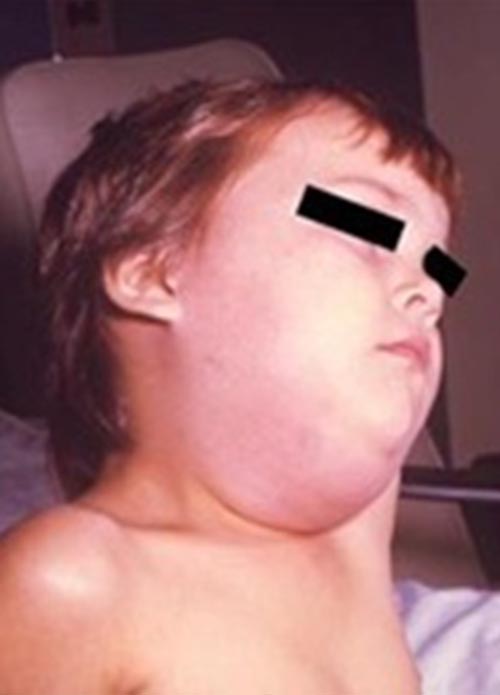
Source: U.S. Centers for Disease Control and Prevention.

Courtesy of Dr. C.W. Leung, Department of Paediatrics and Adolescent Medicine, Princess Margaret Hospital, Hong Kong.
Image 1 on the left shows a child with unilateral parotitis due to the mumps virus.
Image 2 on the right shows a child with bilateral parotitis due to the mumps virus.
Risk factors
Anyone is at risk of mumps if they have not had mumps or have not been fully immunized according to the recommended immunization schedule.
In Canada, adults born before 1970 are presumed to have acquired natural immunity to mumps. This is due to the high levels of mumps circulating before 1970. Vaccination for mumps may still be recommended for some population groups, even if born before 1970.
Adolescents and adults born in or after 1970 who are at the greatest risk of exposure to mumps include:
- health care workers
- travellers to destinations outside Canada
- students in post-secondary educational settings
Learn more:
Diagnosis and laboratory testing
When health care providers suspect mumps (including in those known to have had an epidemiologic link to a mumps case or outbreak), confirmation of the diagnosis should be done with a laboratory sample. This can include:
- a parotid gland, or buccal swab or throat swab for viral detection by RT-PCR (reverse transcription polymerase chain reaction)
- saliva for viral detection by RT-PCR
- urine for viral detection by RT-PCR
- blood for serology
Viral detection specimens should be collected and, if positive, are also used to determine the mumps genotype. Only genotyping can distinguish illness due to a vaccine reaction rather than wild-type infection.
Health care providers are required to report suspected cases of mumps to their local public health unit or office as mumps is a nationally notifiable disease.
Only cases meeting the national case definition are reported to the Canadian Notifiable Disease Surveillance System.
Learn more:
- Notifiable Diseases Online
- Mumps: National case definition
- National Microbiology Laboratory: Measles, Mumps and Rubella Unit
Treatment
There is no specific treatment for mumps.
Medical management is supportive and aimed at symptom relief and management of complications. This can include rehydration and management of secondary complications of mumps.
Prevention
Routine vaccination
Mumps-containing vaccines are effective at reducing the risk of mumps infection and complications. Receiving 2 doses of a mumps-containing vaccine is about 90% effective at preventing mumps. It is still possible to be infected with mumps when fully vaccinated but vaccinated people are much less likely to develop complications.
The measles-mumps-rubella (MMR) vaccine or the measles-mumps-rubella-varicella (MMRV) vaccine are routinely given in childhood.
The first dose should be given at 12 to 15 months of age and the second dose at 18 months of age or any time thereafter, but no later than school entry. The second dose must be given a minimum of 4 weeks after the first dose. Vaccination schedules may vary by province or territory.
The MMR vaccine can be given throughout the lifespan to people who have not received all their scheduled vaccinations. The MMRV vaccine is only authorized for children 12 months to less than 13 years of age.
Learn more:
- Mumps vaccines: Canadian Immunization Guide
- NACI statements and publications: Mumps vaccines
- Provincial and territorial routine and catch-up vaccination schedule for infants and children in Canada
Catch-up and additional considerations
The following are current recommendations for those who do not meet the definition of mumps immunity.
Two doses of MMR vaccine are recommended for:
- all susceptible children and adolescents up to 17 years of age
- health care workers
- travellers to destinations outside Canada if born in or after 1970
- students in post-secondary educational settings if born in or after 1970
A single dose of MMR vaccine is recommended for:
- susceptible adults 18 years of age or older born in or after 1970
- travellers to destinations outside Canada if born before 1970
- students in secondary or post-secondary educational settings if born before 1970
Learn more:
Adverse events and contraindications
Expected reactions to mumps-containing vaccines are usually mild and resolve on their own. They can include local injection site reactions that occur soon after vaccination and others that may develop 1 to 3 weeks after vaccination, including fever and a mild rash.
Serious adverse events after vaccination are rare.
To ensure the ongoing safety of vaccines in Canada, reporting of adverse events following immunization (AEFI) by vaccine providers and other clinicians is critical. In most jurisdictions, reporting may also be mandatory under the public health legislation. Vaccine providers are asked to report AEFIs through their local public health unit or office and to check for specific AEFI reporting requirements in their province or territory.
There are circumstances where mumps vaccination may be contraindicated, such as in individuals:
- with a history of anaphylaxis after previously receiving the vaccine
- who are immunocompromised
- with active, untreated tuberculosis
Learn more:
- Vaccine safety: Canadian Immunization Guide
- Adverse events following immunization reporting form
- Mumps vaccines: Safety and adverse events (Canadian Immunization Guide)
Post-exposure and outbreak management
Health care providers should contact their local public health unit or office for more direction when a mumps case is suspected. Confirmed cases are nationally notifiable.
Persons infected with mumps should be isolated for 5 days after the appearance of parotitis to prevent transmission to others. In health care settings, droplet precautions should be followed.
There are no data on the use of MMRV vaccine in post-exposure scenarios and therefore NACI recommends the use of MMR vaccine.
Post-exposure vaccination with MMR vaccine should be given to susceptible individuals because exposure may not result in infection, and MMR vaccine will induce protection against subsequent exposures.
There is no evidence of increased risk of expected side effects from immunization with MMR vaccine if an individual is:
- infected by mumps virus or
- already immune to 1 or more components of the vaccine
In the event of a mumps outbreak, the size, scope and duration can be variable and difficult to predict. This can be explained by:
- delays in reporting
- adoption of prevention measures
- the relatively long incubation period of the mumps virus
In a highly immunized population, circulation of the mumps virus may be under-detected.
In an outbreak scenario, implementation of an outbreak dose of MMR vaccine (up to a third dose) may be considered as a part of the broader outbreak management strategy. Early vaccination is likely to be the most effective intervention to control the outbreak.
Learn more:
- Mumps: National case definition
- Outbreak control: Canadian Immunization Guide
- Immunization of travellers: Canadian Immunization Guide
- Post-exposure immunization: Canadian Immunization Guide
- Use of Measles-Mumps-Rubella Vaccine for the Management of Mumps Outbreaks in Canada
- Airborne precautions: Routine practices and additional precautions for preventing the transmission of infection in healthcare settings
Surveillance and monitoring
Surveillance systems to monitor mumps in Canada
Mumps has been a nationally notifiable disease in Canada since 1924.
Cases that meet the national case definition of mumps are reportable and health care providers and laboratories report cases to their local public health unit or office. These reports are then forwarded to provincial and territorial public health officials and provide annual data to the Public Health Agency of Canada through the Canadian Notifiable Disease Surveillance System or a disease-specific surveillance system.
Genotype surveillance is conducted by the National Microbiology Laboratory. Genotyping is an important tool in mumps surveillance because it:
- is the only way to distinguish clinical illness due to mumps vaccine, as opposed to a wild-type mumps virus infection
- can be used to distinguish distinct clusters of mumps cases and identify imported cases
Learn more:
Mumps epidemiology and immunization in Canada
Routine 1-dose vaccination against mumps was implemented across provinces and territories between 1969 and 1983. A second dose of MMR vaccine was implemented following large outbreaks of measles in several provinces in 1996. Since the introduction of vaccines, the number of reported mumps cases has decreased by more than 99%.
The average annual incidence rate has dropped significantly since the pre-vaccine era (Figure 1). For example, the incidence was about:
- 251.6 cases per 100,000 population from 1950 to 1954
- 0.2 cases per 100,000 population from 2019 to 2023
Note that between 1959 and 1985, mumps was removed from the list of nationally notifiable diseases and national surveillance data are not available.
Mumps nevertheless remains endemic in Canada, with peaks in activity occurring sporadically.
Since introducing a routine second dose of MMR vaccine in 1996 and 1997, a change in the age distribution of mumps cases has been observed. From 1991 to 1995, the highest rates of disease were among children between the ages of 1 and 14 years of age. This has shifted to older age groups, with rates being the highest in people between 20 to 24 years of age in current years.
Mumps outbreaks occurred in several provinces between 2016 and 2018, resulting in a significant increase in the number of reported cases. However, case numbers have stabilized in recent years. Between 2019 and 2023 (Figure 1), the:
- 5-year average of reported cases was 67 cases per year (range: 13 to 174)
- average incidence was 0.2 cases per 100,000 population (range: <0.1 to 0.5)
- highest incidence rates were among those:
- 20 to 24 years of age (0.5 cases per 100,000 population)
- 25 to 29 years of age (0.4 cases per 100,000 population)
Figure 1. Number and incidence rate (per 100,000 population) of reported mumps cases in Canada by year, 1924 to 1959 and 1985 to 2023

Figure 1: Text description
| Year | Cases | Incidence rate |
|---|---|---|
| 1924 | 7,997 | 122.1 |
| 1925 | 7,669 | 115.4 |
| 1926 | 7,607 | 112.7 |
| 1927 | 8,418 | 122.4 |
| 1928 | 23,925 | 245.8 |
| 1929 | 12,053 | 121.4 |
| 1930 | 9,464 | 92.8 |
| 1931 | 11,158 | 107.7 |
| 1932 | 12,421 | 118.3 |
| 1933 | 11,562 | 108.9 |
| 1934 | 8,460 | 78.9 |
| 1935 | 22,644 | 209.1 |
| 1936 | 29,753 | 272.1 |
| 1937 | 14,441 | 130.9 |
| 1938 | 8,401 | 75.4 |
| 1939 | 5,844 | 52.0 |
| 1940 | 13,498 | 118.8 |
| 1941 | 22,936 | 199.6 |
| 1942 | 52,344 | 449.8 |
| 1943 | 48,304 | 410.1 |
| 1944 | 19,819 | 166.1 |
| 1945 | 20,400 | 169.2 |
| 1946 | 26,056 | 212.4 |
| 1947 | 32,252 | 257.5 |
| 1948 | 24,601 | 192.2 |
| 1949 | 24,557 | 183.0 |
| 1950 | 43,671 | 319.1 |
| 1951 | 35,189 | 251.6 |
| 1952 | 38,439 | 266.3 |
| 1953 | 36,297 | 244.9 |
| 1954 | 26,908 | 176.3 |
| 1955 | 27,193 | 173.6 |
| 1956 | 28,112 | 195.4 |
| 1957 | 22,386 | 166.3 |
| 1958 | 13,360 | 96.5 |
| 1959 | No data | No data |
| 1960 | No data | No data |
| 1961 | No data | No data |
| 1962 | No data | No data |
| 1963 | No data | No data |
| 1964 | No data | No data |
| 1965 | No data | No data |
| 1966 | No data | No data |
| 1967 | No data | No data |
| 1968 | No data | No data |
| 1969 | No data | No data |
| 1970 | No data | No data |
| 1971 | No data | No data |
| 1972 | No data | No data |
| 1973 | No data | No data |
| 1974 | No data | No data |
| 1975 | No data | No data |
| 1976 | No data | No data |
| 1977 | No data | No data |
| 1978 | No data | No data |
| 1979 | No data | No data |
| 1980 | No data | No data |
| 1981 | No data | No data |
| 1982 | No data | No data |
| 1983 | No data | No data |
| 1984 | No data | No data |
| 1985 | No data | No data |
| 1986 | 836 | 3.2 |
| 1987 | 949 | 3.6 |
| 1988 | 792 | 3.0 |
| 1989 | 1,550 | 5.7 |
| 1990 | 535 | 1.9 |
| 1991 | 390 | 1.4 |
| 1992 | 330 | 1.2 |
| 1993 | 325 | 1.1 |
| 1994 | 356 | 1.2 |
| 1995 | 397 | 1.4 |
| 1996 | 290 | 1.0 |
| 1997 | 254 | 0.9 |
| 1998 | 114 | 0.4 |
| 1999 | 92 | 0.3 |
| 2000 | 81 | 0.3 |
| 2001 | 102 | 0.3 |
| 2002 | 200 | 0.6 |
| 2003 | 28 | 0.1 |
| 2004 | 33 | 0.1 |
| 2005 | 79 | 0.3 |
| 2006 | 42 | 0.1 |
| 2007 | 1,109 | 3.4 |
| 2008 | 748 | 2.3 |
| 2009 | 187 | 0.6 |
| 2010 | 768 | 2.3 |
| 2011 | 272 | 0.8 |
| 2012 | 48 | 0.1 |
| 2013 | 96 | 0.3 |
| 2014 | 40 | 0.1 |
| 2015 | 59 | 0.2 |
| 2016 | 365 | 1.0 |
| 2017 | 2,266 | 6.2 |
| 2018 | 808 | 2.2 |
| 2019 | 174 | 0.5 |
| 2020 | 77 | 0.2 |
| 2021 | 13 | 0.0 |
| 2022 | 27 | 0.1 |
| 2023 | 47 | 0.1 |
Figure 2. Total number and average annual incidence rate (per 100,000 population) of reported mumps cases in Canada by age group, 2019 to 2023 (n=333)

Figure 2: Text description
| Age group | Total number of cases | Average incidence rate (per 100,000 population) |
|---|---|---|
| Under 1 year | 2 | 0.1 |
| 1 to 4 years | 27 | 0.4 |
| 5 to 9 years | 30 | 0.3 |
| 10 to 14 years | 7 | 0.1 |
| 15 to 19 years | 28 | 0.3 |
| 20 to 24 years | 56 | 0.5 |
| 25 to 29 years | 50 | 0.4 |
| 30 to 39 years | 68 | 0.3 |
| 40 to 49 years | 51 | 0.1 |
| 60 years and older | 14 | <0.1 |
Learn more:
- Mumps outbreaks across Canada, 2016 to 2018
- Vaccine Preventable Disease: Surveillance Report to December 31, 2019
- Vaccination coverage goals and vaccine preventable disease reduction targets by 2025
- Mumps resurgence in a highly vaccinated population: Insights gained from surveillance in Canada 2002-2022