
Students and the CRA
The Canada Revenue Agency (CRA) offers financial support through benefits, credits, and programs.
Don’t miss out! Do your taxes every year to get the benefit and credit payments you’re eligible for. Filing your taxes may feel overwhelming, but the CRA has resources to help.
Do your taxes to get payments
In most cases, the CRA automatically considers you for benefit and credit payments when you do your taxes. However, you may need to apply and be approved for some payments.
Even if you do not owe tax, are tax-exempt, or have no income to report, you should do your taxes every year. You could be eligible for a refund and filing an annual tax return is a requirement to continue to get the benefit and credit payments you are entitled to. The CRA uses the information from your tax return to calculate your payment amounts and without that information, your payments could be stopped.
You and your spouse or common-law partner, if applicable, have until April 30 each year to do your taxes. If you or your spouse are self-employed, the deadline to do your taxes is June 15.
If you live in Quebec, you also need to file a provincial tax return each year with Revenu Québec.
Find out when you must file a tax return and how to get ready to do your taxes.
If you are new to Canada, find out what you need to know about applying to get benefit and credit payments, including certain provincial and territorial program payments, even before doing your taxes for the first time.
Free solutions
- Free tax software
- You can do your taxes online with NETFILE-certified tax software. A variety of tax software packages and web apps are available, some of which are free.
- Free tax clinics
- If you have a modest income and a simple tax situation, you may be eligible to get your taxes done for free by a volunteer.
- Support from the CRA
- Organizations can request free outreach services.
Taxes for international students studying in Canada
If you are an international student studying in Canada, you may need to do your taxes in Canada. Your residency status will determine how you are taxed in Canada. Learn more about taxes for international students studying in Canada.
Payments you may be eligible for
You may be eligible to receive some of these payments. You can use the benefits calculator to determine how much you could get.
Canada Groceries and Essentials Benefit
This is a tax-free quarterly payment that helps low- and modest-income individuals and families with the cost of groceries and other day-to-day essentials.
Eligible single individuals can get up to $679 per year. A couple with two children under 19 could get up to $1,358 per year.
If you are eligible for the Canada Groceries and Essentials Benefit, you may automatically be entitled to certain benefits and credits that the CRA administers on behalf of the provinces and territories.
Payments from the provinces and territories related (or similar) to the Canada Groceries and Essentials Benefit
Based on where you live, you may also get the:
 New Brunswick harmonized sales tax credit
  Newfoundland and Labrador income supplement
 - Newfoundland and Labrador disability amount
- Newfoundland and Labrador disability benefit
- Newfoundland and Labrador seniors' benefit
 Nova Scotia affordable living tax credit
 Ontario trillium benefit which includes:
- Ontario senior homeowners’ property tax grant
-
 Prince Edward Island sales tax credit
  Saskatchewan low-income tax credit
This is a monthly tax-free payment that helps with the cost of raising children under 18.
Eligible families can get up to $7,997 per year for each child under 6 and up to $6,748 per year, for each child aged 6 to 17.
If you are eligible for the Canada child benefit (CCB), you may automatically be entitled to certain benefits that the CRA administers on behalf of the provinces and territories.
 Alberta child and family benefit
 BC family benefit
 Northwest Territories child benefit
 Nunavut child benefit
 Yukon child benefit
This is a refund payment based on the amount the CRA determines after assessing the individual’s income tax and benefit return.
Provincial and territorial programs
In addition to federal benefits, individuals may be eligible for more programs depending on where they live.
Claim deductions on your tax return
Claim credits and other allowances
You may be able to claim credits and allowances on your taxes.
You may be able to claim or transfer eligible tuition fees paid to a post-secondary institution.
Interest paid on your student loans
You may be able to claim the interest you paid on your student loan.
You may be able to claim an amount for work-related expenses.
This is a non-refundable tax credit that helps people with disabilities, or their supporting family member, reduce the amount of income tax they may have to pay. Being eligible for the DTC can help you in a number of ways. If you think you may be eligible, you should apply even if you do not have taxable income. Being approved for the DTC can help you access other federal programs, such as the registered disability savings plan, the Canada workers benefit disability supplement, and the child disability benefit.
This is a refundable tax credit that helps Canadians with the cost of eligible training fees. You can claim the CTC for tuition and other fees paid for courses that you took in the year.
Claim your expenses
Claiming expenses on your income tax return lets you lower your taxable income and potentially reduce the amount of income tax you owe.
Common expenses claimed by students are:
For all deduction types you can claim on your tax return, refer to: All deductions, credits and expenses.
Savings plans you may be eligible for
Registered retirement savings plan (RRSP)
An RRSP is a savings and investment plan that you can open and contribute to in order to save for your or your spouse’s future.
First home savings account (FHSA)
An FHSA is a registered savings account that allows first-time home buyers to save money to buy or build their first home. It is a registered plan that combines features of the RRSP and TFSA.
The LLP allows you to withdraw funds from your registered retirement savings plans (RRSPs) to finance training or education for yourself or your spouse or common-law partner.
Registered disability savings plan (RDSP)
This savings plan is intended to help an individual who is approved to receive the disability tax credit save for their long-term financial security.
Tax-free Savings Account (TFSA)
A TFSA lets Canadian residents save money that is tax-free throughout their lifetime.
Manage your information with the CRA
You can access your CRA account information in multiple ways, making it easier and faster to make changes, view your benefit details, arrange payments and more.
Making or receiving a payment
Stay connected and stay informed
For all digital services offered by the CRA, go to Digital services for individuals.
Learn about your taxes
Take our free online course to help you understand Canadian taxes, how to do them, and what’s in it for you. We’ve got 5-minute lessons, fun quizzes, and quick videos to break down everything you need to know.
Protect yourself from scams
Beware of scammers pretending to be the CRA. When in doubt, check your information in My Account or call the CRA. To learn what to expect if the CRA contacts you, go to Scam prevention and the CRA.
Know your rights
You have 16 rights when dealing with the CRA, outlined in the Taxpayer Bill of Rights. These rights build upon the CRA’s corporate values of professionalism, respect, integrity, and collaboration.
Forms and guides
- Income Tax Package – Guide, return and schedules
- Guide P105, Students and Income Tax
- Information for Students – Educational Institutions outside Canada
For all forms and guides, go to Forms and publications.
Multimedia

Webinar: Students, it pays to do your taxes!
Learn about the benefits and credits you could be eligible to receive as a student.
Webinar: International Students
Learn about the benefits and credits you could be eligible to receive as an international student.
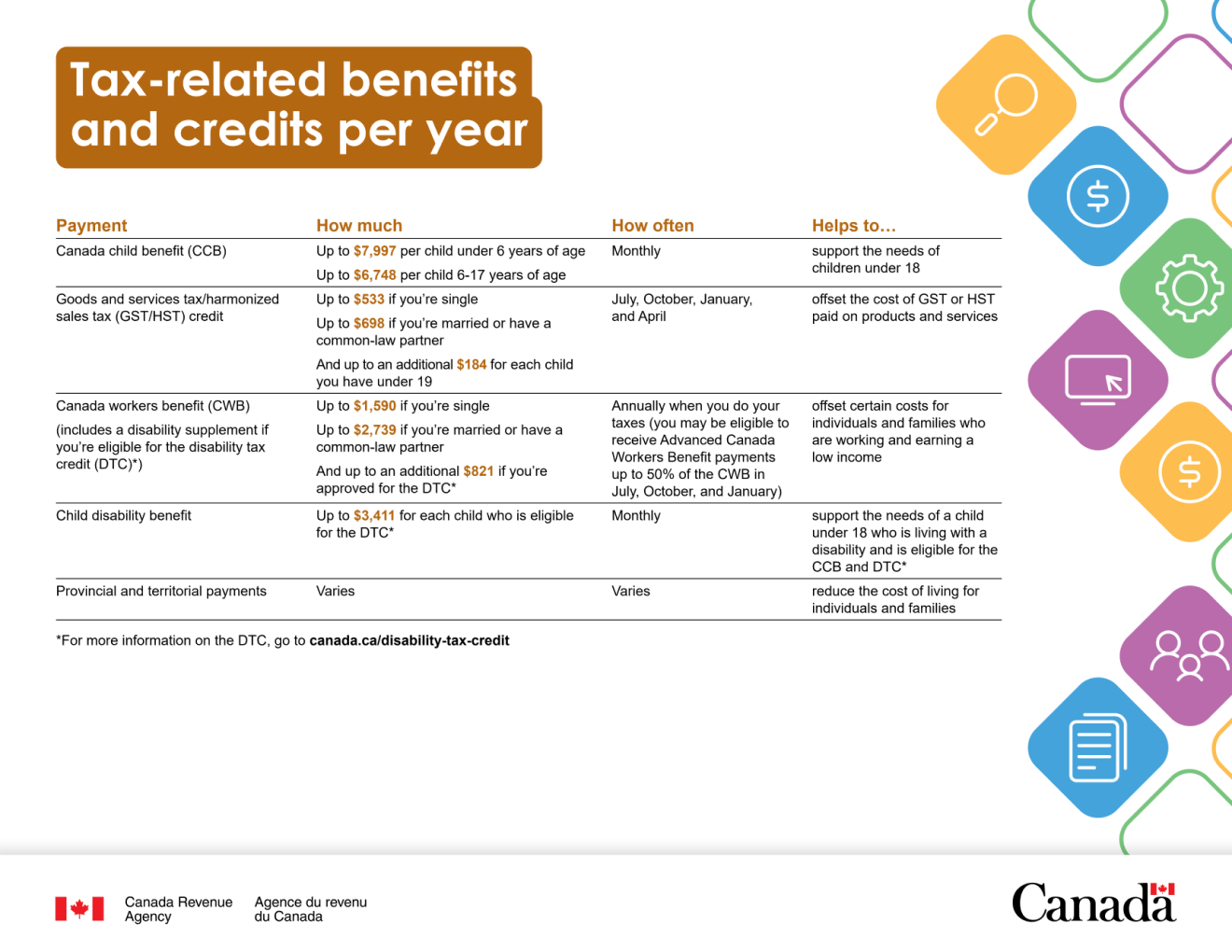
Infographic: Benefit and credit payments
Learn about the benefit and credit payments you may be eligible for.

Taxology – Episode 9: It pays to grow up: Tax tips when starting to work or starting post-secondary studies
Tune in to find out about your tax obligations as a student, and what benefit and credit payments you may be eligible for.
All multimedia outreach materials to print and share
Learning events
View recordings and register for upcoming national webinars
What’s new and upcoming at the CRA
We are continually improving our services to better support persons with disabilities.
SimpleFile tax filing services
The CRA offers simplified tax filing options to eligible individuals with a lower income and a simple tax situation. With SimpleFile services, you only need to answer a series of quick questions. The services use your answers and the information the CRA has on file to complete and process an income tax and benefit return on your behalf.
Invitation packages will go out in early March to CRA accounts and by mail. Note that you may receive your package in your CRA account, even if you have received your package by mail in the past.
If you don’t receive a letter, you may still be eligible to use SimpleFile Digital. Use our eligibility questionnaire, which will be available starting February 23, 2026, and see if you may be eligible to use SimpleFile Digital to complete your 2025 tax return.
Employment opportunities
A career at the CRA is an opportunity to join one of Canada’s top 100 employers. Make sure you self-declare if you are a member of an employment equity group when applying to federal public service jobs.
Students with disabilities can apply for employment with the public service through the Federal Student Work Experience Program.